The Unholy Union of Success and Failure

The Unicorn by Batik Artist Bill Laux
The new external disk drive arrived. Hooray, it worked! I was able to retrieve one floppy after another. The feeling of success after such a long wait almost created a sense of euphoria. After checking some fifty disks with all those enticing file names, I came across only one disk that the floppy disk drive could not read. Some contained images, but most had text files all carefully numbered by chapters indicating that massive amounts of research were hidden on these archaic storage devices. That was exactly what I was hoping to find. I randomly picked one disk and transferred its content onto my harddrive. In our era abounding in giga- and terabytes, we easily forget the times when we had to struggle to make do with 3.5 kilobytes, with which the Vic-20, the dinosaur of ancient computer world, came so equipped. Still if the content was merely text and NOT the byte gobbling images and videos, then an entire novel of 800 pages would easily fit on a floppy disk.
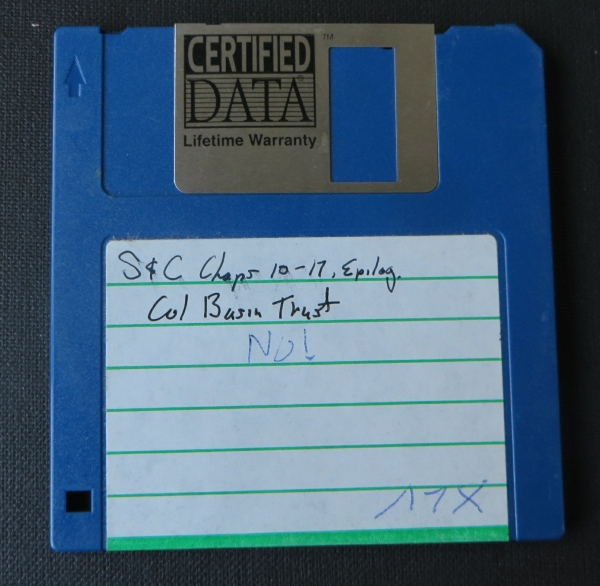
One of the Dozens of Floppy Disks with Bill Laux’s Writing
Now came that long expected moment to get a first look at Bill’s writing. From the first list of titles I could tell that their content dealt mostly with the political wrangling over the building of the great Canadian transcontinental railway, whose purpose was to unite the second largest country in the world.

Bill Laux Working on his Castle at the Arrow Lake in 1977
Full of anticipation, I double-clicked on chapter1.cwk. Like a lightning bolt out of the blue sky, I was struck by the ominous computer message on the screen, “Windows cannot open this file”. Upon further investigation, I discovered that the file extension cwk comes from the extinct word processor Clarisworks, which the Apple company had acquired in 1998, renamed it AppleWorks, but later on abandoned it after its final upgrade in 2004. Owning 4 different word processors, I was almost certain that at least one of them would be capable of decoding those archaic files. Having thus recovered from my disappointment, I loaded one text file into the queen of all word processors (of course, I am referring to Word by Microsoft). But its performance was a total disaster. All it could produce was a whole pile of gobbledygook on the screen. Similar results surfaced, when I tried the other three word processors. Great was my disappointment, but I was not yet ready to give up. How the story ends will be revealed in next week’s post on Bill Laux and his mysterious collection. So stay tuned.
 The Peter and Gertrud Klopp Family