STEEP AND CROOKED … by Late Writer, Artist & Castle Builder Bill Laux

CHAPTER SIXTEEN

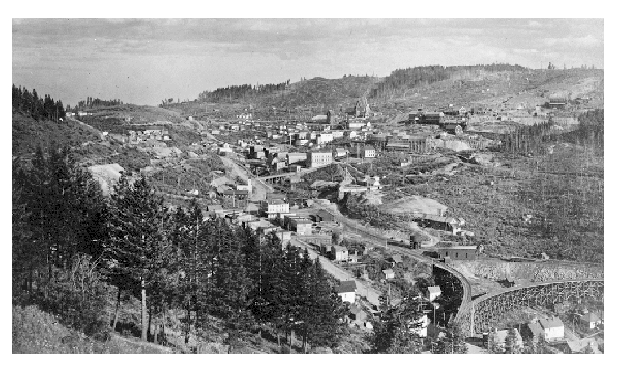
SLOW DEATH:THE DEMISE OF THE HOT AIR LINE 1902 – 1921
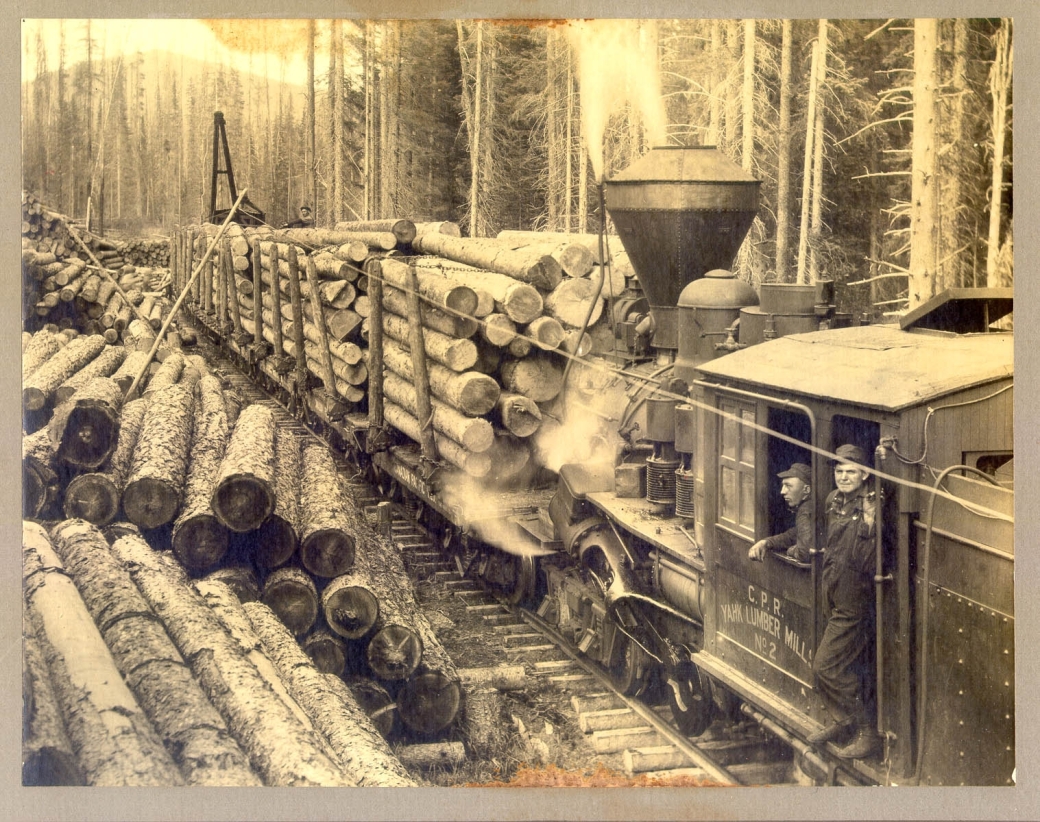
CPR Logging Train

        After the arrival of the W&GN rails in Republic in 1903, the production of the mines was split between the two railroads.   Approximately 1000 tons per week was going out, with the GN taking the largest share.   Most of this ore had been stockpiled at the mines awaiting the rails.   Almost all of the 30 carloads a week being shipped, went to the Granby smelter.   Very high grade ores went to Everett and Tacoma, Washington where the smelters were willing to pay premium prices for Republic ores with their high silica and lime content, to blend with their “wet” (high in sulfur) ores to make a desirable slag in the furnaces.

        Once the stockpiles of ore had been shipped, traffic began to dwindle from 35,000 tons with a value of $350,000 in 1903 to a mere 195 tons with a value of $9,000 in the panic year of 1907.   It was not an indication that the mines were exhausted.   Recovery of the gold values was the problem, not exhaustion of the deposits.   When better concentrating methods were installed in the larger mines, production increased.

            With better concentrating machinery installed in 1908, shipments began to pick up with 584 tons shipped for a value of $20,000.     Shipments steadily climbed to 44,000 tons in 1911 with a value of $900,000. Meanwhile, the Hot Air line limped along, with Republic Agent O.E. Fisher, picking up what business he could.   He contracted log hauls to sawmills along the line, and organized rail excursions on Sundays to the popular picnic grounds on Curlew Lake  The Great Northern’s W&GN, however, with its direct connection to Spokane, took the majority of the the passenger business.

            Train No. 256 from Spokane dropped its buffet car at Curlew, and continued on west to Oroville where it terminated.   Return train, No. 255, originated there at 6:30 AM, and stopped in Curlew to board passengers bound for Grand Forks or Spokane, and to pick up the buffet car.   The 2-1/2 percent grades on the Midway – Oroville portion of the line made it prudent to leave the heavy buffet car at Curlew, since the locomotives assigned to this service were older machines from Dan Corbin’s SF&N with limited pulling capacity.   At Karamin, not listed in this timetable, but at Mile 163, passengers and freight were set out for the narrow gauge Belcher Mine Railway which pulled its single passenger car 8 miles up Lambert Creek whenever Conductor Ike Mc Clung had paying traffic.

            In the Teens and Twenties of this century, Marcus, Washington was the center of action for all these mining lines.   Daily, at noon, the town came to life with sudden energy.   No. 259, the morning train from Nelson would arrive at 12:40 with the passengers and express that had come down the Red Mountain Railway to board at Northport.   The passengers would hurry into the restaurant, a neatly panted two story building just west of the station, congratulating themselves on being the first to arrive with a choice of tables.   No. 259 would be quickly wyed by its crew and set out beside the station on the north leg of the wye to return to Northport and Nelson as No. 260 after lunch.   Once parked on the house track, its hungry crew would make their way to the table in the restaurant reserved for GN employees.

               At 12:50, No. 255 from Oroville, Curlew and Grand Forks would come rumbling across the great Columbia River bridge to halt on the west leg of wye opposite the restaurant and its passengers would pour off and crowd into the building.   At he same time, 12:50, No. 256 was arriving from Spokane and its passengers were on the vestibule steps ready to make a run for the restaurant, shouting their orders as they crowded through the door.

              No. 255 was due to depart for Spokane in ten minutes, so its passengers had time only to pick up their box lunches ordered by telegraph from Laurier.   At 1:l0, both No 260 for Northport and Nelson, and No. 256 for Grand Forks, Curlew and Oroville were whistling for departure.   The diners cursed, shoving last mouthfuls of food into their faces, put down their napkins and hurried out to their trains, suffering the first pangs of heartburn and damning Jim Hill for his belief that twenty minutes was ample time to order and consume a noon meal.   The trains, probably a few minutes late, chuffed off, leaving the restaurant employees time to sit down, put their feet up and enjoy a smoke.   The whistle blasts from the three trains, resounding from the mountains, died away, the long rumble from the Columbia Bridge was silenced, and the sleepy, riverfront town of Marcus relaxed into a quiet afternoon snooze.   It would all happen again at noon the next day.

           In Grand Forks, the Hot Air management, defeated by Jim Hill’s competition at Republic, had turned to their North Fork line.   They had built 18 miles up the river and then stalled for want of funds at Lynch Creek.   An arrangement with the CPR allowed the Canadian Pacific’s trains to use the Hot Air track through town, and its station on 4th Avenue in exchange for Hot Air trackage rights from Westend to Smelter Junction on the CPR line.   The North Fork line then ran alongside Smelter Lake, serving a sawmill there, and on up the valley through the settlements at Niagara, Troutdale and Humming Bird where ore from nearby mines was loaded.   At two places north of Humming Bird, the wagon road was side by side with the tracks, and to keep the locomotives from frightening horses on the road, a high board fence was erected to separate the track from the road.   The road was frequently impassable in bad weather and couples would then resort to pumping a hand car down the Hot Air rails to attend dances at Volcanic Brown’s Camp.   The Hot Air was a home town railroad and when locals needed transportation, borrowing a railroad hand car and pumping down the line was customary practice.

             The Franklin Camp gold mines, 40 miles to the north were the line’s immediate goal.   An ambitious extension was planned to cross Monashee Pass and reach the Okanagan at Vernon, and beyond to the coal mines of the Nicola Valley. However, no one wanted to risk investing in a line Jim Hill had publicly announced he would destroy.   A hotel was built at Lynch Creek, the jumping off place for prospectors and miners, and a wagon road to Franklin Camp brought out its ore to be loaded on the Hot Air cars for the Granby smelter.

               In 1919, the Trail smelter was interested in getting fluorite from the Rock Candy mine to use as flux.   The CPR built the Lynch Creek bridge and extended the Hot Air rails two miles to Archibald where an aerial cable way brought the fluorite to a loading bunker.   This, together with log shipments to the sawmill and cedar utility pole shipments, allowed the Hot Air to maintain a weekly service, since the copper mines along the line had shut down with the closing of the Granby smelter.

               In the 1930s, the Hecla Mining Company, of Wallace, Idaho, bought the Union mine at Franklin Camp.   They built a concentrator and mill, and shipped their concentrates by truck to the Hot Air at Archibald, staving off the line’s abandonment for a few more years.  In 1921 the Hot Air’s wooden bridge over the Kettle River between Cuprum and City Station was damaged and there was no money to repair it.   That part of the line was abandoned and the CPR trains backed and out of City Station.   That accounts for the mileage on the timetable above being figured from Westend, which was the CPR interchange.   By 1935 mine traffic on the North Fork line had ceased and the sawmill at Lynch Creek had closed.   With no remaining traffic, the CPR pulled the rails.   The present steel highway bridge across the North Fork at Bumblebee is the only remaining artifact of the North Fork branch.   In September, 1952, the CPR ceased backing its passenger trains into the downtown station and those tracks were pulled. The Great Northern pulled out of Grand Forks on June 15, 1943, closing its station, and pulling its tracks back across the Kettle River to the “Big Y”, three miles south of town where a tiny station was maintained for passengers.             Ever since the Hot Air lost most of the contracts for hauling ore from the Eureka Creek mines to the Great Northern, the managers of the Trusts and Guarantee Company back in Ontario had wanted desperately to unload this ailing railroad.   In 1906 they sent out James Warren, the former manager of the White Bear mine at Rossland, to either make the Hot Air profitable, or abandon it.

            Warren saw at once that the Republic line, in direct competition with Hill’s Great Northern branch, was a loser.   It’s only salvation could be as a Canadian Gateway Line for one of the four American transcontinentals in Spokane.   Accordingly, the Hot Air had been reorganized in 1905 as the Spokane and British Columbia Railway with lawyer, W.T. Beck, of Republic as president.   The line claimed three locomotives, two passenger cars, and sixteen freight cars.   These, lettered for the Spokane and B.C.., ran on all Hot Air branches, from Eureka Creek to Lynch Creek.               Beck and Warren sent out surveyors to stake out a grade from Republic to Spokane.   The location survey ran down the San Poil river to the Hedlund Lumber Company Mill at West Fork which was expected to provide substantial traffic.   To encourage investors, a short length of isolated track was laid here, just as had been done on Clark Avenue in Republic in 1902.   The survey followed the San Poil south to the Columbia at Keller where the Indiana corporation was planning to build a smelter to process ore from the Keller mines.   The Granby company, as well, had issued bonds in 1902 to finance the extension of the Hot Air to the Keller mines so that it could bid for their ores.   From Keller, the S&BC was to run along the north bank of the Columbia to the mouth of the Spokane River.   A bridge was to cross the Columbia here and the line was to ascend the Spokane River and enter Spokane across the flat prairie north of town.   The line was announced with great fanfare in Spokane, and purchases of land were made, not so much for right of way, but as speculations on the development of north Spokane should the S&BC ever build track.   A further scheme was announced by which the S&BC would skirt the north edge of town and connect with Dan Corbin’s Spokane International which he had built to bring the Canadian Pacific into Spokane from Yahk, B.C.   The idea was to provide a water level coal route from the Crowsnest mines to the Granby and Greenwood smelters, bypassing the CPR’s costly barge route across Kootenay Lake with its “double dockage” charges on every carload of coal, and that costly haul, with double-headed freights, over Mc Rae Pass.   Such route, if built, would break Jim Hill’s monopoly on coal to the Granby smelter, something that the CPR dearly wished for.   Jim Hill, for his part, sent his surveyors to stake out a parallel line.   It was graded, Bluestem to Hawk Creek, and that was a sufficient message to potential investors.   The message was received, and the S&BC languished.

            Warren and the Hot Air were not alone in these schemes to bring cheaper coal to the Kootenay and Boundary industries.   Frederick Blackwell, who had completed his Idaho and Washington Northern Railroad from a Spokane connection to Metalline Falls, a few miles from the Canadian border, maintained a cutoff line from Blanchard to Athol on Corbin’s SIR, so that coal could come over over his line to Trail, B.C. if only the CPR would build a 35 mile connecting line from Trail, up the Pend Orielle River to tie into his rails at Metalline Falls.   CPR officials looked at the proposal.   It would give them an easy grade to Trail and bypass the awkward Kootenay Lake barge link. But in the end, they rejected the scheme.   For the same amount of money required to build up the Pend Orielle, they could put CPR rails around the south end of Kootenay Lake to Nelson, eliminating the barge line and having an All-Canadian line.   Having made this decision, they then characteristically omitted to build the Kootenay Lake Line, and barging went on until the 1930s.

            Meanwhile, the Milwaukee bought Blackwell’s Idaho and Washington Northern in 1912. Warren and the Hot Air approached the Union Pacific with their Spokane and B. C. Gateway proposal.   The UP considered, but in 1917, opted for 50% of Corbin’s SIR and an interchange with the CPR at Yahk. This American timetable gives times and mileage only from the border at Danville.   The Belcher mine had closed the previous year, though there are reports that the Mine Railroad still hauled logs for the sawmill at Karamin.

           As with the Canadians up the North Fork, the American residents of Danville used the railroad’s hand cars to attend dances in Curlew. Since trains did not run on Sunday, the baseball teams would use the handcars as well to get to games in Republic. With the destruction of the Hot Air’s Grand Forks depot and offices by fire in August, 1908, the early records of the line perished.   However, U.S. sources record that from the period March 1, 1909 until June 30, 1915, total revenues of the American segment of the line were $122,956, and expenses $292,461.   Possibly, revenues from the North Fork line may have offset this loss to some extent, but it is doubtful that the Hot Air ever operated in the black.   Certainly, the Republic line was always a loser.   One trip, related by Harry Lembke, illustrates the parlous state of the Hot Air line in its last years.   The Lembkes were buying logs from the Trout Creek area and having them brought to Curlew by the Hot Air train.   On one trip to pick up logs, the Hot Air locomotive began to lose water through cracked boiler tubes.   With the tank empty, they stopped on the Trout Creek Trestle and tried to dip water from the creek with a rope and bucket. But they found the engine was losing water from her boiler as fast as they could pour it in the tank.   The crew took the train to the siding just south of the trestle where all piled onto a flat car and coasted all the way back to Danville.   (More likely to Curlew, and pumped a hand car from there to Grand Forks.)   Another locomotive was fired up at Grand Forks and run down the line to bring back the leaking locomotive and its train.

            With the failure to peddle the Spokane and B.C. to an American railroad, J.J. Warren turned to the last remaining asset the Hot Air Line possessed, that charter authorization to build west to the Coast.   It was fanciful to believe that the Hot Air, a bankrupt railroad, barely able to run its trains, could be the corporation to accomplish that “Coast to Kootenay” railroad that British Columbians had wanted for so long.   But, astonishingly, Warren thought it could.   He somehow convinced the CPR that the way to beat Jim Hill’s “Third Main Line” to the Coast, was to lease the Hot Air for its charter, and then finance it to build the long hoped for line.   In 1913, the CPR agreed, and leased the Hot Air.   Warren and his directors renamed the corporation again (the Canadian part).   This time it became “The Kettle Valley Railway,” and with CPR backing, began building west from the Columbia and Western’s dead end at Midway.   Under Warren’s direction, and with CPR money, the Hot Air finally succeeded with a hair-raising mountain line through to Hope B.C. and a connection with the Canadian Pacific’s main line to Vancouver.

            The Republic line, under its U.S. charter as the Spokane and B.C.., was allowed to declare itself bankrupt in 1920, and ceased operations.   It was not worth saving; the CPR in 1921, allowed its assets to be auctioned off and its rails pulled up for salvage.   Washington State Highway 21 was built on its grade from Danville to just north of Curlew, and from the present Curlew High School south to Karamin.   The Karamin turnoff follows the grade to Trout Creek and the upper part of the Barrett Creek road is on its grade to Swamp Creek.

            The Great Northern trackage up Eureka Creek was seeing slight use in the 1930s as the mines were now using a cyanide process to recover the gold and smelting was no longer required.   When a sudden flood washed out the north approach to the great looping trestle over Granite Creek trapping a train up Eureka Creek, the railroad decided to pull its tracks back to the Republic station. A temporary fill was put in to rescue the stranded train, and in 1940, the tracks were lifted and an ore loading platform was built near the station to accommodate carload shipments to the Tacoma smelter.

           The Day Brothers of San Francisco, bought and consolidated a number of Eureka Creek properties in the 1930s, and kept them in production with modern concentrating machinery and methods. Hecla Mining Company acquired the Day Company’s Eureka Creek properties in 1981 in an unrelated transaction. Hecla engineers, in inspecting the Day properties in Eureka Creek, found them worth working.   Hecla worked the mines until 1995 when the Knob Hill mine was finally closed.   It had been an extremely long run; 99 years of nearly continuous production from a single mine, extracting 2 million ounces of gold, surpassing Phoenix and Rossland.

               Today, (1997) Echo Bay Mining operates several low grade properties on Cooke Mountain, not far from the old Belcher Mine.     Santa Fe Pacific Gold Corporation has leased the Golden Eagle claim from Hecla and is drilling on it to assess its value as a possible open pit mine.   Republic, the longest lived of the three Boundary Bonanzas, still thrives as a mining town.

                 Paradoxically, a fragment of the Hot Air Line has outlasted the Canadian Pacific in the Boundary District.   When, in 1995, just after completing a tie replacement program on the C&W Midway-Castlegar line, the Canadian Pacific, apparently suffering another panic attack, pulled its tracks back to Castlegar, the industries of Grand Forks were left without a rail connection.   The Burlington Northern was still running down its line to Republic, south of town and a surviving piece of Hot Air track still ran from Cuprum to Coopers’ Wye (“Big Y” locally), the BN interchange.   To serve the Grand Forks industries, the CPR stationed a diesel switcher at Cuprum and taxied a crew over from Nelson once or twice a week to perform industry switching and interchange cars with the BN.   This was wasteful and ridiculous.   The crew taxied over from Nelson had to be paid railroad mileage for the trip as union rules required, and the switcher, unprotected from the weather, had to be idled all winter long to keep the coolant from freezing.

            Pope and Talbot, operators of the sawmill undertook to form the Grand Forks Railway Company to take over the switching job.   Each morning the personnel of the Railroad, Dennis John, Manager, Mario Savaia, Conductor, and Miss Shelley Dahl, Engineer, switch the Grand Forks industries and run the loads down the 1-1/4 miles of Hot Air Track to the BN interchange at Cooper’s Wye.   Pope and Talbot provide a shed for winter storage of the switcher.   Headquarters is at Cuprum.
 

Chapter 27 of the Peter and Gertrud Klopp Story – Part IV

Gale Force 7 in the North Atlantic

130

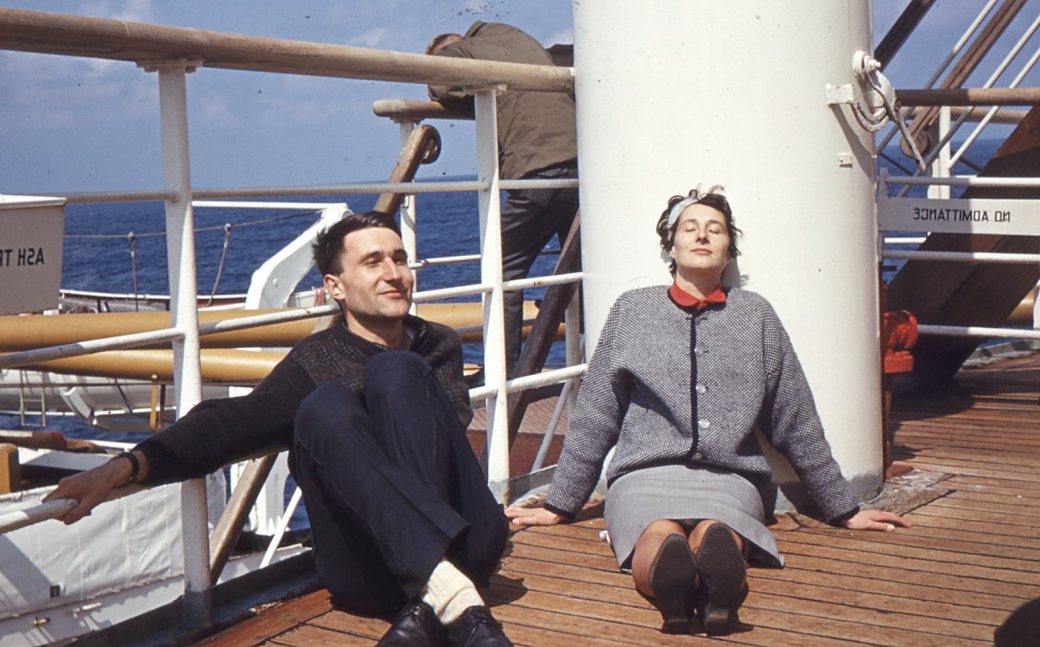
The calm sea and the sunshine are deceiving (my sister and I relaxing on deck of the Ryndam)

After a few days of calm and sunny weather a violent storm broke out, which put an end to the leisurely lounging on deck and made most passengers withdraw into their cabins. I entered into my travelogue:

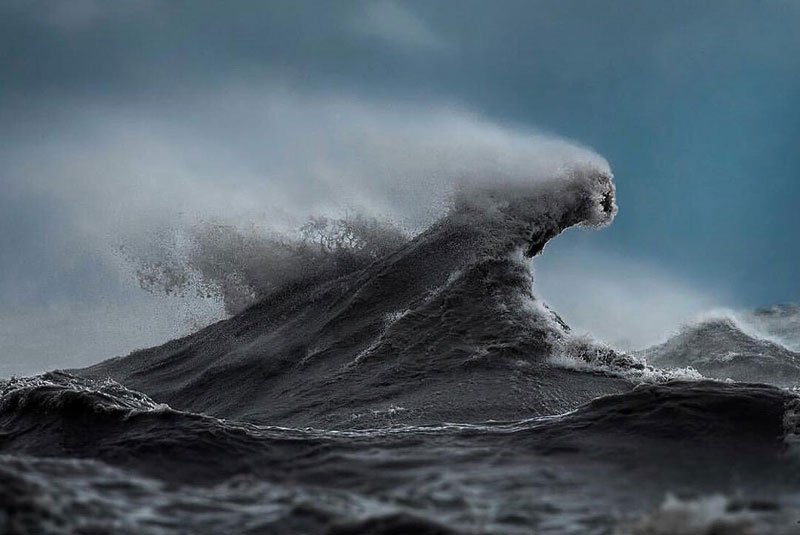
“ Today is an especially stormy day. Most passengers don’t dare to come on deck. They play cards instead or while away the long hours in some other way. But outside awaits the intrepid traveler an indescribable experience. I believe, if you fellow travelers were not afraid of becoming seasick, you would, like my brother and I, be eager to see what a storm Poseidon can whip up for you. At the stern of the ship we view how one of the most awesome spectacles are playing out in front of our eyes. Presently we have wind force 7 on the Beaufort scale, and the waves are piling up high threatening to engulf the Ryndam. In the dark all this takes on an all the more eerie appearance. The waves are bedecked with white foam. And it seethes and hisses like in a witch’s cauldron. When the crests reach a certain height, they seem to lose by the sheer wind force their support and dissolve into sheets of spray, which drift like blowing snow up against us. Feeling the mighty wind and tasting salt in our mouth, we are invigorated in body and soul. A great sea voyage turns into an inner experience.”

Storm zaujimavysvet.sk

Giant Wave – Photo Credit: zaujimavysvet.sk

World literature is replete with fascinating stories dealing with violent storms at sea. Confronted with the raw unbridled forces of Mother Nature man seems so small, so weak and insignificant. In the early days of exploration sailing ships were being tossed about like little nutshells by mountainous waves and hurricane-force strong winds. In ballads, short stories and novels the authors extol the indomitable human spirit that pushed man beyond what was thought to be possible. Standing with Adolf at the stern, hanging onto the safety ropes, and leaning against the wind that threatened to knock us down, we caught a glimpse of what it must have been like to be a sailor on a small sailing ship. On the other hand the Ryndam passengers hardly noticed the storm that was howling on the outside of the steel hull. The 200 m long vessel pitched and rolled just a little. None of the entertainment programs were cancelled. Most passengers continued to play cards, watch movies, danced, or sipped whiskey in the bar. They all missed out on the adventure of a lifetime.

          It was Sunday. I attended the church service provided by a Dutch minister in a large stateroom that served as church on this particular day. It was only a few months ago that I had bought a New Testament book in Latin with the twofold purpose of reading its message and keeping my ancient language skills alive. For similar reasons I felt attracted to the religious service. I wanted to hear God’s word and at the same time reinforce my English that had been getting rusty from lack of practice, since I graduated form high school. Was I ever into a treat on both counts! The minister spoke with a strong Dutch accent but very clearly. He explained how the Jews were devastated, after the Romans had utterly destroyed their temple in 70 AD. They believed that God had lost his dwelling place on earth and therefore could no longer live among them. The pastor emphasized that God had never lived in a temple. No man-made structure would be adequate to contain the glory of God. Instead he lives in the hearts of those who are seeking His presence and accept His Son Jesus as their personal savior. Hearing these words it felt like water was being poured on the parched soil of my impoverished soul and the seed that was once planted had just received the spiritual nourishment to grow and develop in the New World that I was about to enter.


Chapter 27 of the Peter and Gertrud Klopp Story – Part III

Two Letters and a Poem

129

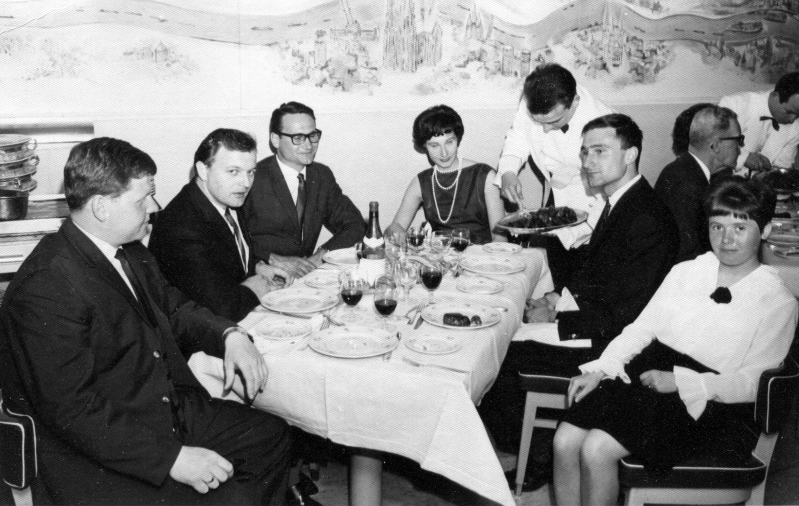
Meal Time on the Ryndam – Adolf, Eka and Peter at the Back

April 28th, 1965 Le Havre

           My dear Biene,

           We just left Le Havre and are heading towards England. Thousands of impressions hit me all at once. I feel as if I had already been on board  for a very long time. It is wonderful. Yet, I am restless, because you cannot experience all this with me. I would like describe to you how a typical day is panning out for us travelers. The tinkling of bells wakes us up in the morning. It also reminds us in this gentle way to show up for breakfast soon. Then I climb down the ladder. For I sleep in the upper bunk, while Adolf sleeps below. We can shower or take a bath for as long as we like.  Then we march off to the dining room. Never before have I seen a greater variety of food. When we return to our cabin, the steward has already made our beds. The cabin is very small, and if one had to share it with a stranger, it definitely would  not be a pleasant experience. We all have our own peculiar habits, which someone else would have to get used to.

124

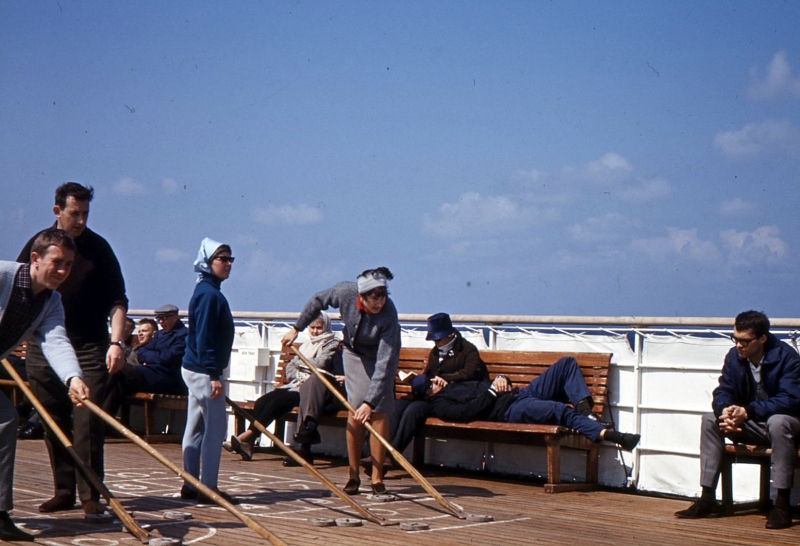
Shuffle Board on the Sun Bathed Deck

          The entertainment program is so rich and varied that one does not know which item to choose first. You can watch English movies, go to the library, play all kinds of games. The big hit here is shuffleboard. After lunch you can attend a concert, go dancing in the evening or have a beer in the bar. And now I experience all this without you! That makes me a little sad and pensive. When I turn melancholic, I gladly withdraw from all these fun activities and write in my travelogue.

          Oh this heavenly weather! People are presently sun bathing and the sea is not rough, not even a trace of a swell. I want to experience a real storm. But my brother says that it will come soon enough, if I am really that keen on getting seasick.

134

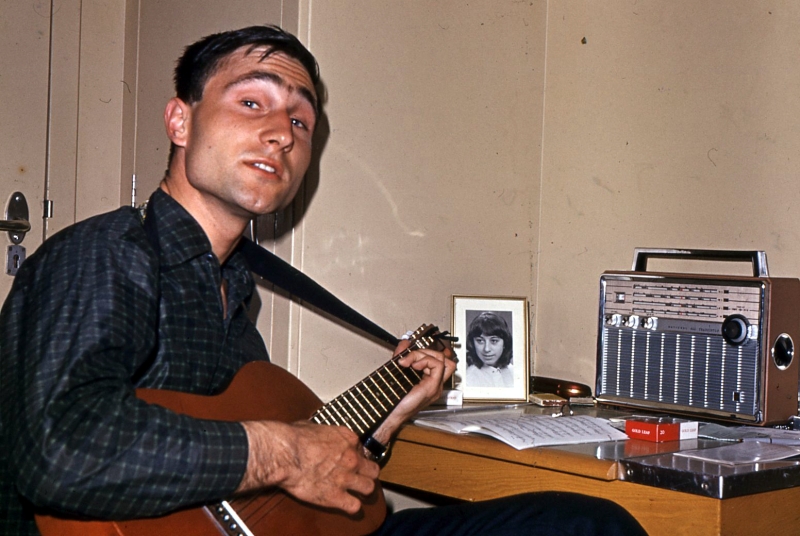
Peter Strumming on his Guitar

          Your picture stands on my little desk. When at night I look down to you from my bed, I feel infinitely happy. I wished I could do the voyage all over again with you one day, when I have enough money to pick you up in Germany.

In a few days you will begin your studies, whereas I while away the time here onboard doing nothing. Tackle your academic work as if you had never applied for the stewardess program and as if you pursued a life’s career. You should know that you can help me also as a trained teacher, perhaps later assist me for a little while, in case my own studies should be dragging on.

          What would I give to be able to kiss you now! Until next time greetings to you and your parents!

          Your Peter

           On the same day Biene also wrote me a letter, which of course I was unable to read, until I arrived at my brother’s place in Calgary. I only included excerpts here to avoid breaking the chronological order of the family history.

April 28th, 1965 Velbert

           My dear Peter,

           Again you have made me cry. But don’t you worry, Peter. I did not have to cry out of sorrow (it was only lingering at the back of my mind), but from an overwhelming feeling of joy, happiness and unfathomable love. I listened to your guitar music  and to your voice on the record you had sent me. I could not grasp it! I just sat there, and tears were streaming down my cheeks. I once read that only a few people really understand how to say good-bye, and you knew how, Peter. Never will I forget this!

Dear Peter, now you have been on board for one day and with every minute you are getting closer to your destination. And when you read this letter, the long sea voyage and the road trip across Canada will already be behind you. Tell me Peter, isn’t it an incomprehensible feeling to be on the high seas and to experience the vastness and beauty of the ocean? When I experienced the sea for the first time, I was deeply moved. It was in the year we had met. My family and I were spending our vacation on the island of Corsica. Toward evening we had landed on the island. It was already night, when we reached our vacation village at the sea after an adventurous trip through the mountains. Completely exhausted we immediately fell into a deep sleep, from which I awoke unusually early in the morning. In eager anticipation to finally cast my eyes onto the sea, I quietly sneaked out, because my brother Walter was still fast asleep. Outside the air was cool and still. The sun had just risen above the horizon. The beach spread before me still completely untouched. I went a few steps down the slope and then I took in the full view of the sea! Somehow I was like in trance and could not move another step forward. Although the view was overwhelmingly beautiful, the infinite vastness also instilled in me a little bit of fear. I sat down very quietly in the sand and remained there, until the first beach guests, who frolicked in the water, broke the charm that had kept me spellbound. You alone, dear Peter, would not have dispelled the magic atmosphere.

          Inspired by her memories Biene wrote the following poem and entered it into the Book of Dreams.

The Sea

 I will forever love the sea,

Even when the gulls scream

Above thousands of storm-tossed waves.

I love the play of colors in the surf,

The billowing clouds, the sun, the warm sand, …

Oh Peter!

How much would I like to sit with you

On a lonely beach, at the sea

With its music

Rather than being

Separated from you

So infinitely far away

On the other side of the ocean.

On board of the Ryndam I also romanticized the sea as if in response to her letter that I had not even read yet.

STEEP AND CROOKED … by Late Writer, Artist & Castle Builder Bill Laux

THE MINING RAILROADS OF THE CANADIAN BORDER

 By Bill Laux

CHAPTER FOURTEEN

TWO RAILROADS; FIVE SMELTERS 1905 – 1921

Phoenix,_British_Columbia

Phoenix BC 1905 – Once the Highest Town in Canada (4610 ft)

Having bought Granby for $4.00 a share, William Nichols and his associates in the copper refining and marketing business, got up a special train and traveled west to see for themselves what they had acquired.   At Grand Forks, Jay Graves, Stephen Miner, and Aubrey White toured them through the smelter.   Then the CPR put on two locomotives and pulled their train up the steep grades to Phoenix where they stepped out in the highest town in Canada at 4610 feet.   There they were shown the claims and the producing mines of the company.   These were knowledgeable men, and they were enthusiastic at what they saw.   Analyst Stanton admitted, “Nowhere have I seen superior methods.”   J.B. Hereshoff, perhaps a rendered a bit light-headed by the elevation, rhapsodized, “…a magnificent, monotonous mass of homogeneous ore…”

These men, now his bosses, instructed Jay Graves to do two things.   First, pay a dividend.   Second, do more development work to determine precisely how much ore they had.   He did both.   A modest dividend was forthcoming, and he had his men begin a tunnel from the 4400 foot elevation at the foot of Church Street in Phoenix, to burrow under the town and tap the ore body 400 feet beneath its discovery point.   He ordered that the shaft from the Victoria be deepened as well, to meet the tunnel on the 400 foot level.   Then crosscuts were to be made to explore the ore body from end to end and side to side to discover its extent at the deep levels.

Eholt had become a busy railroad town with a five stall roundhouse, five tracks, four hotels, 25 houses, and half a dozen commercial establishments.   Switchers bustled around the small yard day and night, making up cuts of cars for the five smelters the mines were serving, the Granby in Grand Forks, the B.C. Copper in Greenwood, the Dominion Copper in Boundary Falls, the Trail smelter and the Northport smelter.

For passenger service to Phoenix , the CPR ran a mixed train from Eholt.   The ten mile trip uphill took 50 minutes, but downhill, with a heavy train of ore cars and the passenger car trailing, the time was an hour and twenty minutes, though the timetable suggests otherwise.   Mixed trains were obliged to stop and cool brakes on the way down, and limited to ten miles per hour.   Pure passenger consists could keep the published schedule.

The 1:55 PM train leaving Eholt boarded passengers from westbound CPR train No. 41 from Grand Forks, Robson West, Castlegar and Nelson which had arrived at Eholt at 1:55 PM.   Obstreperous miners returning from alcoholic and other endeavors in Grand Forks could be a problem on the trains.   Conductors learned to turn the train heat control wide open.   In ten minutes, they reported, the cars would be hot and the miners snoring peacefully.   Awakened in Phoenix, they would be bundled out into the cutting mountaintop winds to find their way to the “Rampasture,” their name for the Granby Company’s large employee boarding house at the top of Second Street.

With the steep, 3.4 percent grade and 600 tons of ore behind the locomotive, a brake failure on this line could be disastrous.   On the 23rd of August, 1904, Shay 1901 (formerly No. 111 from the Rossland branch) lost train brakes half a mile above B.C. Junction.   Engineer Alf Kenward and Fireman Charlie Haggart jumped and escaped injury, but the Shay left the tracks at the curve just above the Oro Denoro mine and the following ore cars piled up on top of it.   Fortunately, this was not the afternoon mixed; no passenger coach was attached.   So imperative was it to restore service at once, that a short trestle was built around the wreck and traffic went on while the mess was cleaned up.   It was crucial not to interrupt the flow of ore to the smelters, as shutting down the furnaces and restarting them was both costly and shortened the life of the furnace linings.     Shay 1901 was repaired and put back into service.

On February 2, 1907, CPR Consolidation No. 1384 with a heavy train of ore wrecked a short distance below the Rawhide mine when it spilled a switch.

The VV&E had its share of wrecks as well.   On Sept. 20, 1909, both the engineer and fireman were killed at Phoenix when their locomotive overran the tail of switchback and rolled down the mountainside.   Just one month later, Engineer McAstocker was killed and Fireman Beatty injured when their locomotive derailed and rolled coming down the 2.2 percent from Phoenix.   Snow on the rails was believed to be the cause.   1909 was an unlucky year for trainmen; a week after the VV&E wreck just mentioned, CPR engine No. 1385 running light, Phoenix to Eholt, left the rails just below B.C. Junction and rolled.

The VV&E service did not require a change of trains.   Still, it was one hour, 25 minutes, Grand Forks to Phoenix, and one hour, 20 minutes, Phoenix to Grand Forks.   These were mixed trains, trailing a coach behind the ore cars, with a stop for water at Hale, and on the downhill run, one or more stops to cool brakes.   Weston station served West Grand Forks, the former Columbia.   The Spencer flag stop served the Athelstan and Jackpot mines, as the CPR spur line to them did not have passenger service.   The Hale flag stop served the Summit Camp including the B.C. Copper mine.   Glenside served the Tiger mine.

By 1905, Granby and the Phoenix mines were in full bonanza.   Jim Hill himself came out by special train on those VV&E tracks that had cost him so much ire and invective to build.   His seven car train came snorting up its spiral grade to Phoenix.   Down from its platform stepped the short, broad, and scowling Cyclops of St Paul.   Behind him came a hunched Jay Graves and a young and athletic George Baker Jr. who danced about in a series of hopping and arm swinging Swedish exercises popular at the time, all the while praising the invigorating qualities of mountain air.

While Director Baker danced and inhaled his mountain air, a driving rain commenced, and J.J. Hill, watching these antics without comment, allowed a company slicker to be draped around him and be led off for a tour of the property.   The party inspected the mines, watched one of the Thew steam shovels loading Granby ore into Granby patent cars, and then retired to one of the Granby offices for confidential talks.   Graves was in an ambiguous position with Granby.   He was vice President and General Manager, but a second to Abel Hodges.   The New Yorkers preferred to keep control in the hands of their own men.   Graves owed his position to the influence of J.J. Hill who as now a major shareholder in Granby.   Graves must have had something he wanted to discuss with J.J. Hill as well.   He had incorporated The Spokane and Inland Railway the previous December and had been trying to convince New York investors that Mr Hill was behind him in this enterprise.   Hill was not; his son Louis was trying to persuade him to break with Graves whom he did not trust.   Graves certainly, on his own ground in Phoenix, must have tried to persuade Mr Hill to grant his new railway some sort of public approval.   There is no evidence that he was successful.

When, by 1905, electricity reached Phoenix from Granby’s Cascade Power development, it replaced steam for haulage and underground work.   The three Davenport saddle tank 0-4-0s then moved ore and waste on the surface while a fleet of 4 wheel Baldwin electric ‘mules’, taking 600 volt power from trolley poles, moved the ore underground.   The locomotive fleet, divided among the five big Granby mines, comprised 3, 36” gauge Davenports, 3, 36” gauge electrics, nine 20” gauge electrics, one 20” gauge Baldwin steam locomotive, one 18” Baldwin steam loco, and two Thew 36” gauge steam shovels converted to electricity in 1905 to work underground.

The multiplicity of gauges reflects the five different mines, each with its own choice of track gauge, that now comprised Granby.

At the smelter the service tracks were 3 foot gauge with a Davenport 0-4-0 saddle tanker and five Baldwin electric mules handling the coal, ore, and flux to the furnaces. A standard gauge Davenport, piloted by Bill Euerby, moved cars on the elevated ramp over the receiving pockets and hauled the huge 6 ton slag pots loaded with red hot molten slag to the slag dumps along the riverbank east of the smelter.

The furnaces roared day and night and Grand Forks old timers remember how the dumping of the pots of molten slag at night would light up the skies with a red glow over the river.

Ore trains coming from Phoenix and Republic would leave their cars on the yard tracks, and depart with strings of empties.   Bill Euerby would sort the loads out and move them with his Davenport to one of the five elevated tracks on the north side of the smelter, and spot each car over the appropriate bin below.   Ore from each mine had to be kept separate, as each carload had to be assayed for metal content so proper payment could be made to the shipper.   Custom ores were blended by the smelter men with the Granby ores, depending on which of their individual contents was desired in the furnaces.   Republic ores, with their high lime and silica content, were used to flux the more sulfurous of the Phoenix ores.

Up at Phoenix, at the urging of the new American directors, production was pushed.   300,000 tons of ore were produced in 1903, 500,000 in 1904, and 550,000 tons in 1905.   Beginning about 1904, the price of copper was manipulated to 25 cents a pound by the Amalgamated Copper Trust ( Standard Oil) which had captured all but Fritz Heinze’s mines in Butte.   Amalgamated was withholding 7,500 tons of copper from the market to drive the price up Granby was engineered to produce copper profitably at 12 cents; at 25 cents, it was paying liberal dividends and ores previously thought too lean to mine were now commercial.   The smelter’s eight furnaces were smelting 80 carloads of ore every day.   Three GN ore trains brought down most of the Granby ore and two CPR trains hauled the non Granby ore destined for the Trail and Greenwood smelters.

In spite of the boom in the copper market, Granby’s exploratory tunnel and shafts probing the 400 foot level of the great Knob Hill ore body were returning troubling news in 1905   On the 200 foot level the ore deposit was 300 x 300 feet.

But down at 400 feet the ore body had shrunk to 150 x 150 feet.   Worse news was to come.   At 430 feet down, the ore bottomed out.   This was kept a close secret between Yolen Williams, Graves and Abel Hodges, all of whom had substantial stock holdings in Granby.   Graves quickly bought the Gold Drop, Curlew and Monarch claims, on the east side of Knob Hill for Granby and opened them.   The extent of their ore bodies were unknown, but Graves hoped they would keep Granby going when the Knob Hill was exhausted.   As a further precaution, Graves sent Yolen Williams out to find other copper claims that Granby might buy into.   Williams found three promising deposits, and Graves presented them to the New York Directors, who were being kept in ignorance of how near the big Phoenix ore body was to exhaustion.   The Directors chose the Hidden Creek deposit, on the Alice arm of Observatory Inlet, just north of Prince Rupert, B.C.   It was purchased for $400,000, and just in time, for in 1910, the storm broke.

In 1909 Abel Hodges had stated in the Granby annual report to its stockholders, that, “Our ore reserves are largely increased and we have ore in sight for many years to come.”   Still, in Grand Forks, the local rumors could not be silenced.   Miners working at Phoenix knew what the exploratory tunnels had found.

In 1910, Abel Hodges, Granby’s Superintendent and the most important person in Grand Forks, unexpectedly announced that he was leaving to take a position in Peru. A great farewell banquet was mounted. Hodges was toasted in champagne and presented with a gold watch, his wife with a diamond ring.   But as the celebrants made their way home through the windy March streets, certain suspicions crystallized.

The next morning, those who held Granby stock, quietly instructed their brokers to sell.

The rumors from Phoenix, the stock sales, reached the market in New York and Granby prices began to sink.   The directors sent a geologist, Otto Sussman, to Phoenix to take over from Hodges and investigate. His report exploded on the boardroom table like a bomb. Hodges had high-graded the mine, he reported; Granby ores would be mined out in five years.   The mining industry raged.   Granby, capitalized at $15 million in 1905, was a bust, five years later.   Hodges was blamed, but he was unreachable, safe in Peru.   Jay Graves was summoned from his comfortable wintering spot, the Hotel Maryland in Pasadena where he spent his days playing poker with Otto Mears, the Colorado mining and railroad entrepreneur, also a winter resident.   Busy with his Inland Empire Railroad, Graves had not been to Phoenix for 18 months; he disclaimed any knowledge of Hodge’s deception.   After all, he had been cut off from the board, by the 1905 reorganization.

The mining world was deeply shocked by the disclosures.   The Engineering and Mining Journal editorialized, “No event has done so much to destroy public confidence in mining investments.” The company was obliged to bare the facts to the public.   Its 1910 report advised stockholders that but 4-1/2 years of ore were left.

Howls of outrage went up from the stockholders and the Granby share price plunged.

Jay Graves, again, was phenomenally lucky.   He was able to calm the storm with the Hidden Creek property, an ore body richer than Phoenix, which had been bought on his urgent recommendation.   Granby was saved by Graves’ perhaps not so innocent foresight.   Plans were made to develop Hidden Creek as the Phoenix ores were exhausted.   The crisis passed; Graves and Aubrey White buying all the Granby stock they could manage at its low level.

The massive tonnages being mined, feeding five smelters, would have indeed exhausted the ore bodies along the crest of the Boundary Range if it were not for the outbreak of World War I.   The copper price in 1914, which was between 11 and 13 cents per pound, rose precipitately, climbing steadily to an unprecedented 26 cents in 1918.   This meant that lower grade ores, below the 1 percent copper, that Granby had been mining, were now commercial.   The 4-1/2 year deadline could be extended. Old workings were reopened and new mines were brought on line.   The depressed Granby stock, which Graves had bought on credit in 1910, rose to $120.   Jay Graves, grasping once more for control of Granby, approached Jim Hill.   Many of Nichols’ associates had either died or disposed of their Granby stock in the debacle of 1910.   If Mr. Hill would supply him with money Graves, argued, he would now be able to acquire a majority control of Granby for himself and Mr. Hill.   Graves suggested that he then “…might be elected president and be a dominating influence in the company.”   Hill refused the bait.   As previously, Jim Hill would use Jay Graves where he could, but he would not permit himself to be used by Jay Graves.

The 0-4-0 Davenports working at the smelter were now needed at the Curlew and Gold Drop mines as they went into full production.   An Alco 0-6-0T, No. 20, was bought for smelter switching duties.   Two more 0-6-0 switchers appear on the roster, but they were evidently sent to work the new Hidden Creek mine and its smelter at Anyox.

The end for Phoenix came in 1919.   Copper prices plunged with the end of the war, and the low grade ore Granby was mining was now uneconomic.   Worse, a persistent series of strikes in the ill-managed Crowsnest mines shut off the supply of coal and coke.   Coal could be obtained from other mines, but Crowsnest had the only coking ovens in the Northwest.   As well, Jim Hill was dead.   His son, Louis, taking over, could see no reason for continuing the feud with the CPR , and began closing down the uneconomic British Columbia lines.

There were vast reserves of low grade copper still under Phoenix, the rail network was in place, the miners and the machinery were at hand.   With careful management and an ore concentrating plant, the low grade might still be smelted at a profit.   The strike in the coal fields, however, continued unresolved, and in Grand Forks the smelter furnaces went cold for lack of fuel.   The directors decided to move everything to Anyox and close the Phoenix mines.

The town of Phoenix, 1750 inhabitants, emptied at once.   People simply took what they could carry, walked out of their houses, and boarded the train, thankful that the tracks were still in place.   Many expected to return when the strike in the East Kootenays was settled and the coke began to arrive again.   But the strikes continued, and in Phoenix neither houses, stores or businesses could be sold.   Most of the miners who remained moved to Greenwood where electricity and other amenities were to be found.

At this time, the Canadian Pacific, remembering the old Columbia & Western location along the Kettle River in the U.S., queried the Great Northern about using their water level grade from Grand Forks to Midway.   This would eliminate the helper grades over the Eholt summit.   But the Great Northern, even with the great Empire Builder gone, was still infected with his dark suspicions of the CPR.   If the CPR transferred their Boundary service to the GN tracks, they reasoned, then they might be permitted to abandon their Phoenix line at once and leave the GN with a legal obligation to continue a Phoenix service.   The Great Northern refused, and hastily pulled its Phoenix rails.   By the end of 1919, they were gone, removed back to Copper Junction.

The spur to the smelter was kept for another year in case it should open again and receive Republic ores.   In 1920 it was pulled and the tracks cut back to the Weston yards and the Grand Forks station.   The CPR, as the last rail link, was obliged to continue service to Phoenix until the government convened hearings on abandonment.

In the thirties, with traffic diminishing on its Curlew – Oroville line, the Great Northern reversed itself and opened discussions with the CPR about leasing them the Kettle River Line.   But the CPR remembered the 1919 snub, rejected the idea.   It would be better, they believed, to let the GN abandon its Curlew – Oroville line, and leave the CPR as the sole railroad serving the Midway – Rock Creek district.   In 1935, the GN pulled its rails back to Curlew and the subject was closed.   The old antagonism between Van Horne and Hill still hung ghostly over railway policy in the Boundary district.

The smelters at Greenwood and Boundary Falls were closed at the end of the war and their machinery moved out.   Up in Phoenix the CPR hung on for a few years, moving small lots of ore from local miners leasing the old diggings.   All those pillars of ore that had been left underground to support the roof of the workings were mined out, one by one, with wood cribbing put in place to hold up the roof.   The cribbing was intended only as a temporary measure while the miners removed the last bits of commercial ore.   After that, the wood slowly rotted and collapsed, with the abandoned town of Phoenix above sinking slowly into the old pits.   The buildings first sagged, then leaned, and finally, year by year, sank into the flooded workings below.

By 1921, the CPR had won permission to pull its tracks.   The last train left Phoenix forever with engineer, Thomas Needham pulling the throttle.     Needham, who had brought the first train into Grand Forks twenty years before, sounded a continuous note of farewell on his whistle as he brought his cleanup train of miscellaneous cars down the steep grade past a score of abandoned mines and through a young forest growing up on the mountainside so laboriously cleared by the woodcutters of 1900 – 1905.   Like mining camps all over the West in the post war years, it was finally all over.

Well, not quite. William Bambury, Robert Denzler and some 30 miners moved into the best houses in town and stayed, leasing old pits and working outlying pockets of high grade ore too small to have been of interest to the large mining companies.   Adolph Sercu, known as “Four Paw,” or “Forepaw,” for the iron hook he had in place of an arm, closed his livery stable and moved into the old City Hall.   There he appointed himself constable, and with a large billy club and a tin star cut from the bottom of a tomato can pinned to his shirt, he patrolled the sagging, sinking buildings until his death in 1942.

Phoenix was now mined for boards, windows, doors and plumbing fixtures.   Over 200 buildings had been salvaged for their lumber or moved away by 1927.   As one hotel was being stripped for its fine interior paneling, a hidden room was discovered with full gambling equipment in including a roulette wheel.   The gamblers had been in too great a hurry to leave to bother taking it with them.   The indoor skating rink was sold to a Vancouver buyer.   With the proceeds, a cenotaph was commissioned to commemorate the Phoenix war dead of 1914 – 1918.   It still stands on the road overlooking the site.

William Bambury, a genuine eccentric, “a man of polished education and widely read,” remained in Phoenix, its last inhabitant.   He had come from England as a carpenter and located in Phoenix in 1902.   He had seen the entire rise and fall of the town, and now, as a pensioner, was determined to stay.   With he departure of the population, he had the pick of the houses in Phoenix, and chose to live in Dr. Boucher’s fine home rent free, his presence a guarantee to Mrs. Boucher that the building would remain unvandalized.   An omnivorous reader, he made minute corrections in the margins of everything he read, and carried on a voluminous correspondence, sticking stamps with the likeness of King George VI on his envelopes upside down as a mark of loyalty to Edward VIII, “the true King of England.”    Daily, he observed the slow caving of the abandoned town into the underground workings.   His diary for May 28, 1950 reads,

“Little traffic besides a Grand Forks boy named Cochrane, who came up with his girlfriend on a motorcycle. “In strolling around this morning I observed the wreckage of the King’s Hotel with that of the Bolivia Hotel seems to have sunk considerably, giving the impression that a mine cave-in has caused the subsidence. Water not far below apparently.   No sign of a break in the ground outside the wreckage.   Cut some wood.”

Local miners bought the Granby claims and continued to pick at the remaining pockets of ore.   In the 1950s, with copper prices over $1.00, the Granby Company bought back its claims from W. E. Mc Arthur and dug out a huge open pit under what had been Phoenix. The ore went out through a tunnel to a concentrator on the east slope just below the old C&W grade.   The Phoenix ore was supplemented by ore trucked from the Lone Star mine across the border on what was to have been the C&W spur surveyed to that mine in 1905.   The open pit operation closed in 1978.   There still remain a million tons of low grade in the Monarch and Rawhide claims awaiting exploitation.   Nothing whatever remains of Phoenix but the cenotaph.   Where the town existed, is now a huge, raw hole in the ground half a mile across and 400 feet deep.


Chapter 27 of the Peter and Gertrud Klopp Story – Part II

Farewell to Germany


54

Papa Panknin with Daughter Biene and Son Walter 1965

Career planning for his daughter was on Papa Panknin’s mind, when he asked Biene to have a serious talk with him. He was not fond of seeing her becoming a teacher. He felt that it would be too stressful for her.  Sitting endless hours in lecture rooms, bending over and studying textbooks would lead to even getting more stressed out, when after her university training Biene would enter again the educational treadmill. In his opinion the best thing for her to do would be to get a job and earn money as quickly as possible. Being a little tightfisted and in control of the family purse strings, he may also have been thinking of the expenses, which a prolonged period of university training for his daughter would incur. In contrast to North American practice German law required that parents were at least in part financially responsible for their children’s post-secondary education. In addition, there was probably on his mind his son Walter, Biene’s twin brother, who was embarking on a six-year program at the Institute of Engineering at the University of Hanover. Biene, with her eyes firmly set on getting married, agreed to a compromise that her father had proposed. She would start immediately her teacher’s training at the university of Wuppertal, but at the same time apply at the German airline Lufthansa to enter a training program to become a stewardess at the age of twenty-one. In my eyes this was a good plan. I really wanted her to become a teacher. So I took comfort in the fact that thousands of young girls were dreaming about becoming a stewardess and only a few had their applications accepted every year. Therefore, I had no difficulty of sending my wholehearted approval and let Biene romanticize about working for Lufthansa and flying to Calgary, where she could visit me on her stopover flights to Western Canada.

107

Adolf and Eka in the Waiting Room at the Rotterdam Terminal Station

          At last, the day arrived when Adolf, Eka and I were on our way to Rotterdam, where we would board the passenger ship Ryndam that was to carry us to Canada. Mother woke us at 3 a.m. to make sure we would have ample time to enjoy a solid breakfast before we parted. One hour later we sat at the breakfast table. Aunt Mieze read from her devotional booklet and included us in her morning prayers, with which she had been greeting the day for as long as I can remember. The outside world was still shrouded in darkness, which put us all into a somber mood. The thought that we would not be seeing Mother and all the other dear relatives for a very long time was weighing heavily on our mind. Later on, we were occupied loading Jürgen’s car with our possessions, five suitcases, my tape recorder, guitar and a gigantic duffel bag with personal belongings too valuable to be trusted to the wooden crates. The heavy work made us forget a little the pain of leaving home. We even managed to put on a cheerful face, when we said our good-byes adding comforting words like ‘We’ll meet again in beautiful Canada!’

108

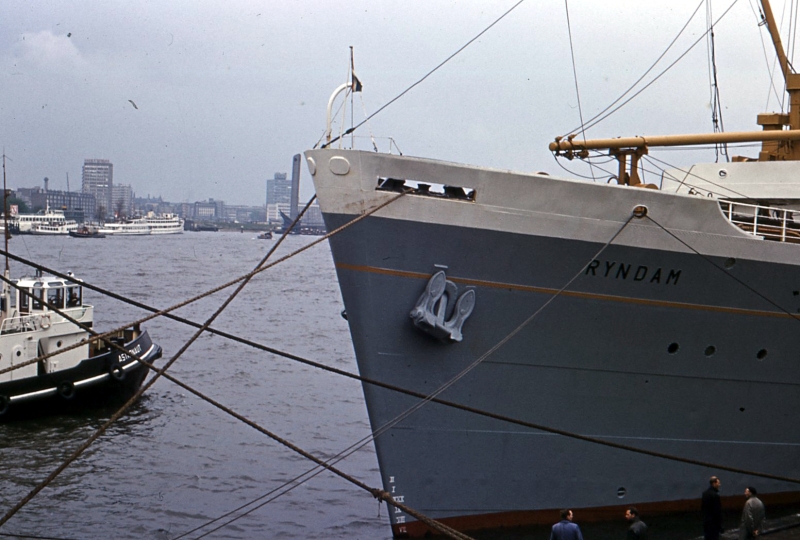
The Ryndam that brought us to Canada – Anchored at Rotterdam Harbour

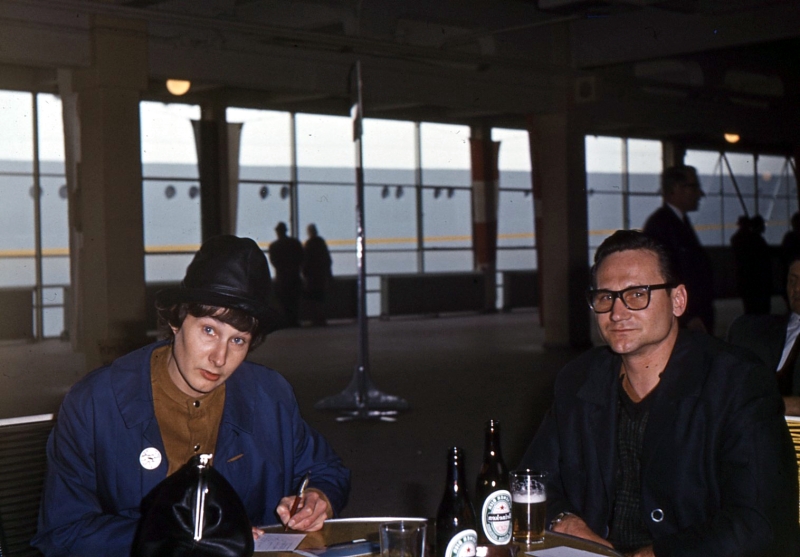
          The Trans European Express train (TEE) was racing at an incredible speed towards the Dutch border stopping only at major urban centres. At Wesel, my previous hometown, which had grown into a city of almost 50,000, the train did not stop either. Shortly after noon we arrived in Rotterdam, where a taxi took us to the harbour, which was and still is one of the biggest and busiest ports in the world. There our ship was waiting for her passengers to come on board. In the harbour inn Adolf and I sat and drank beer, while Eka had a coffee to perk up with after such a long train ride. We were quite annoyed at the delay of our departure caused by the much larger sister vessel of the Holland-America line bound for New York, which happened to leave port on the same day. Finally we were allowed to embark. Before heading out into the Atlantic Ocean, the Ryndam, for the next ten days our home, hotel, restaurant, and entertainment centre, had to make two ports of call, Le Havre and Southampton. From England I mailed Biene my first letter written at sea.


STEEP AND CROOKED … by Late Writer, Artist & Castle Builder Bill Laux

THE MINING RAILROADS OF THE CANADIAN BORDER

 By Bill Laux

CHAPTER THIRTEEN

THE BELCHER MINE RAILWAY 1906 – 1914

Lambert Creek WA seahorsecorral.org

Lambert Creek WA – Photo Credit: .seahorsecorral.org


            The Belcher mine was located on Cooke Mountain, in Ferry County, Washington.   The ore deposit was pyrrhotite, a sulfide of iron, which on Cooke Mountain contained appreciable quantities of gold.   When smelters opened at Grand Forks, Greenwood and Boundary Falls, there was a market for this ore, since the iron was in demand as a slag forming mineral, and the smelting process recovered the gold.

            H.C. Lycett opened the mine and built a three foot gauge railroad in 1906 from Karamin up Lambert Creek to the Belcher Camp, below the mine.   The transfer point to the standard gauge was just a quarter mile north of Karamin where a pile of rusty looking dirt (pyrrhotite) beside the BN track indicates the former ore bunker.   The two lines were just a few feet apart, the highway being on the old Hot Air grade.

            There was a reversing loop on the flat above this transfer point, and the line ran south along the hillside with a double switchback to gain elevation to enter Lambert Creek. In early morning light, the switchback grade can be easily seen today, looking east from the Karamin intersection.   The track ran up the north side of Lambert Creek for 8 miles to the Belcher Camp which was on the flat by the creek.   The camp comprised some 40 to 50 persons, a school, a store and post office and bunkhouses for the miners and railroad crew.   The railroad looped around the camp and had a loading bunker on the south side of the creek where a three-rail gravity tram came down from the mine 1500 feet up on the mountain.   The tram had two, 5 ton cars connected by a steel cable that ran over a sheave at the top.   The loaded car, coming down, pulled the empty car up. A passing tracks with spring switches in the center, allowed the cars to pass each other.   Kenneth Fairweather, the tram operator, had to climb the steep trail to the mine on foot each morning and hoist the crew in the empty car. At the end of the day he had to let them down again and then descend on foot. He got an extra half hour pay for this.

            A daily ore train ran down the line to the Karamin transfer bunker.   When someone needed to go to town, or when there were company officials on the property, the single passenger car was attached to the ore train by Conductor, Ike McClung.   Ed Williams was engineer, Dan Mc Dougal was fireman, and only the brakeman’s first name, Ralph, is remembered.   In addition to the ore shipments which went to the B.C. Copper smelter in Greenwood, the settlers along Lambert Creek hewed railroad ties for a cash income and sent them out via the Mine Railway.  At the Karamin transfer point the ore was loaded into W&GN ore gondolas to be taken up to Grand Forks.   There was no interchange between the GN and CPR in Grand Forks, so the single car of Belcher ore would be coupled to a GN train of empty ore cars bound for Phoenix.   The car would be dropped at the Coltern interchange with the CPR, and a CPR train would take it down the hill to Eholt.   A westbound freight would then pick it up and take it to Greenwood.   The CPR Shay would move it up to the B. C. Copper Company’s smelter on its Motherlode turn.

            The Belcher Mine Railway owned two locomotives.   No. 1 was a Baldwin 2-8-0, c/n 11005, of June, 1890, built new for the Alberta Railway and Coal Company.   It had 16 x 20 cylinders and 37” drivers.   No. 2 was another one of the Alberta Railway and Coal Company’s Hinkleys, a 2-6-0, and may very well have been former Trail Creek Tramway No. 1, as that machine was noted at Midway in 1905.   As well, the line owned a baggage car, little more than a boxcar with a side door and windows, also probably from the AR&C.   The single passenger coach, carefully lettered, “No. 1,” may well have come from the “Turkey Trail,” as it was of the same pattern as those cars.   The ore cars appear to have been identical to the old link and pin coal cars of the Trail Creek Tramway.   They may have been those cars or others from the Alberta line.

            As flags from both Canada and the U.S. were equally displayed on the passenger train for its inaugural run, some Canadian ownership may be inferred.   The mine and Belcher Camp lasted until 1914; Ike Mc Clung’s wife, Madge, taught school and the Belcher Camp store supplied the stump ranchers along Lambert Creek.   The railroad may have lasted a little longer.   A photo of the old Karamin lumber mill shows a narrow gauge track alongside.   The Belcher Camp was reported to have carried logs out of Lambert Creek to this mill, possibly prolonging its life for a year or two.

            Today Echo Bay Minerals works several gold mines on Cooke Mountain, not far from the old Belcher, and trucks the ore to their concentrator above Curlew Lake.