Walter Panknin (1898 – 1977) and His Family – Part 18

Papa’s First Experiences as a POW

As a US sergeant was marching a miserable lot of captured German soldiers to the railway station, a drunk Red Army man attempted to strike them with the butt of his rifle but refrained when ordered by the GI to back off. However, great was their horror, when shortly afterwards they saw an American soldier from under a bridge aim his gun at them apparently for the fun of target practice. Papa heard distinctly the click of the trigger followed by the soldier’s derisive laughter, clearly displaying his pleasure of having struck terror into the hearts of the hapless bunch of captives. After a tiring march, they finally arrived at a provisional POW gathering station, where they spent a cold night in the open-air facility. Their treatment was good. Papa felt great relief knowing that, at least for him and fellow prisoners, the war was finally over. He was also becoming optimistic about the near future after hearing the officer in charge of the camp say that they would be treated fairly in keeping with international law and the Geneva Convention.
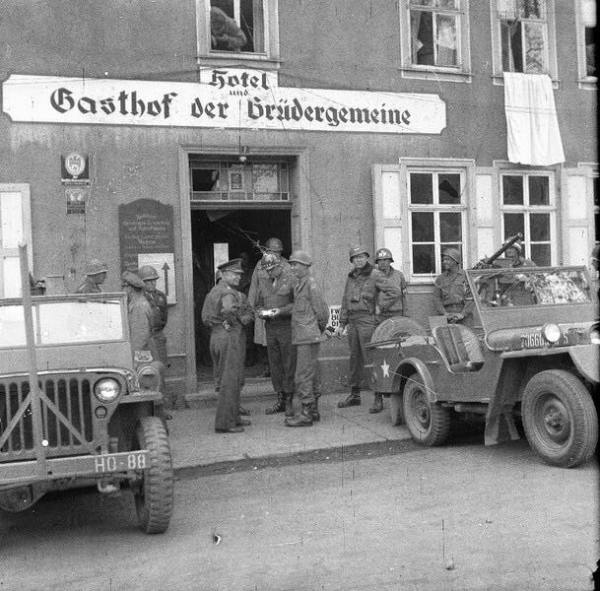
American HQ near Erfurt April 12 1945

After another cold night without shelter, they received, considering they were POWs, a royal breakfast. It consisted of seized German army provisions such as pumpernickel, canned meat and even chocolate once intended as rations for the Air Force. Thus, strengthened by the high-calorie intake, they went on a four-hour march, bringing them to a stadium. They had permission to salvage wood from the dilapidated buildings to make a fire for cooking and to build primitive shelters for protection against the cold and the rain. During the next couple of days, they were being moved frequently from one place to another until they arrived by army truck at a camp at Kirchheim near the city of Bad Hersfeld.
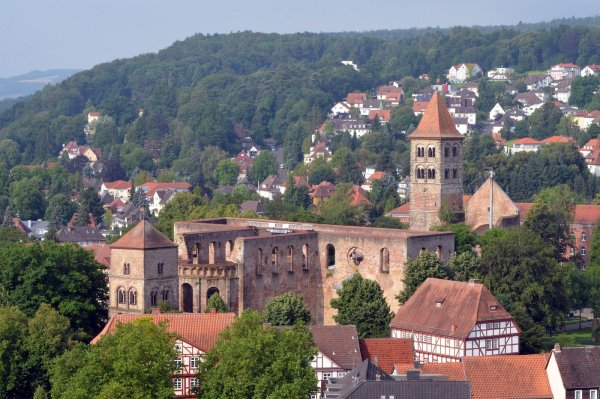
Modern Bad Hersfeld – Photo Credit: Tripadvisor

When Papa had identified himself based on the official documents that he had always carried with him and thus convinced his captors that he was indeed a high-ranking officer, he was immediately given at least for now preferential treatment. He found some relatively comfortable sleeping quarters in the attic of a house confiscated and occupied by the American forces. When Papa arrived, eight other German officers had to share the room. By evening eight more POWs were added to their lot, making things so tight that Papa had to lie down under the table for a good night’s sleep. There was plenty of food. In his notes, Papa marvelled how quickly one could forget past ordeals if one only has some decent food in one’s stomach. The following day, he enjoyed taking in a sumptuous breakfast with delicious items he had not consumed for the last couple of weeks. He felt refreshed, and a new sense of optimism filled his entire being. Some of the items on the breakfast menu were cake and coffee, tea and lemon. Feeling liberated from the ideological shackles, most officers present, even those, who had once strong leanings to the Nazi regime before, displayed a very noticeable shift in their outward behaviour. Less than twenty-four hours after their arrival, they no longer saluted each other with ‘Heil Hitler’ but were quite content to greet one another with a simple ‘Good morning.’
Walter Panknin (1898 – 1977) and His Family – Part 17

Life is More Important than a Clean Shirt

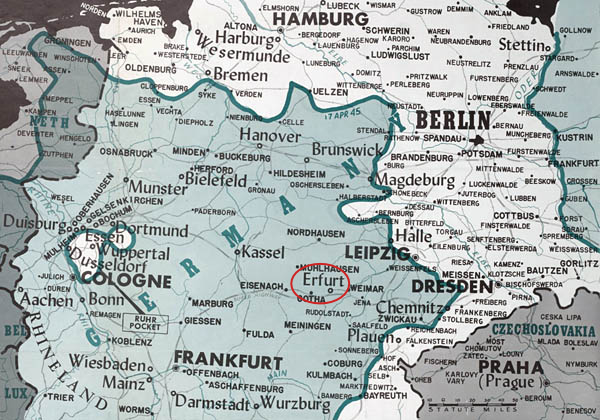
On Monday, April 9, Captain Panknin received yet another marching order. German troops were retreating to Weimar, where he was supposed to report for duty. After hearing that the trains were no longer running in the area, he debated whether he should walk there or try to get somehow to Erfurt. He decided to go to the latter, where he received a decent meal and accommodation at the local police station. He complained in his diary that he had not taken a bath for several weeks. Also, the dirty clothes on his body began to bother him. But when he heard that Schmira was under attack by enemy shellfire and was burning, he realized that he had been lucky again and that life was more important than the temporary inconveniences caused by lack of hygiene and cleanliness.

Front Lines April 1945

The following night Opa wrote another letter to Mutti in the relative security of the HQ. At 23 hours, he had just stretched out on his bed when enemy shells exploded in closest proximity to the building, where Opa was trying to find some rest. He quickly rushed down the stairs to the basement that served as a bomb shelter. Many people from the neighbourhood were packing the already overcrowded facilities. Opa had to sleep in the hallway. But it was not a night of good sleep, as stragglers were stumbling over his cot. During these fitful moments of sleeplessness, he was debating in his mind whether he should attempt to walk to Weimar the very next morning. For all train services into and out of Erfurt had been discontinued. An inner voice advised him to stay put and wait with the other police force members until the end of these crazy chaotic conditions. I heard the desperate silent cry of despair while reading the question in his notes, “When will finally somebody come and take us prisoners?”

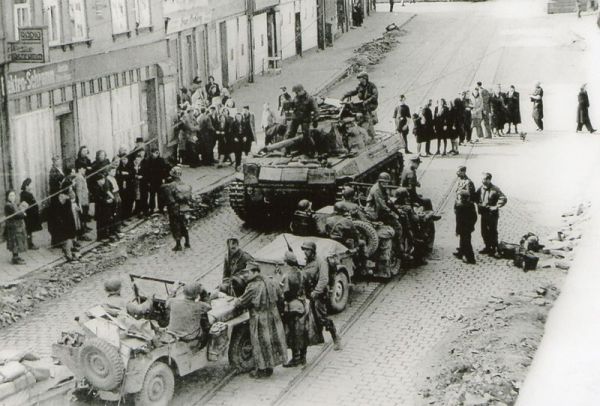
American Army at Erfurt April 12, 1945 – Photo: erfurt.de


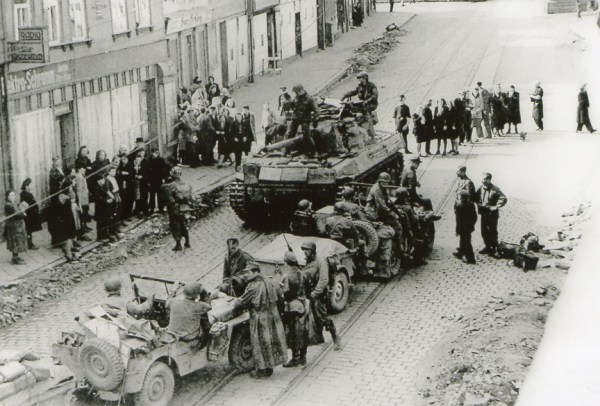
At last American soldiers appeared at the basement door. An army captain was calling him and his bedraggled troop to come out of the basement. Earlier other German soldiers had put on civilian clothes. There was one among them who had some command of the English language. When the Gi’s stormed the building, he cried out with a pleading voice, “Don’t shoot. I am not a German Hitler soldier!” These were the final moments when around eight o’clock in the morning of April 12, 1945, Opa became a POW of the US forces in Thuringia.

Walter Panknin (1898 – 1977) and His Family – Part 15

The Horrors of War

Small army units had found temporary shelter and accommodation in private homes. Opa and his war-weary comrades slept in a basement from 22 hours till three in the morning when enemy shellfire woke them up. The barrage lasted for three hours. Some shells exploded in close vicinity of the house, where he was staying. At 7:30, a series of fierce skirmishes erupted while Allied dive-bombers were pounding their position at Steigerwald, a district of Erfurt. One bomb hit their temporary home. It smashed through the roof and exploded inside, causing the building to collapse like a house of cards. Fortunately, the civilians had all been evacuated, thus preventing unnecessary injury and loss of life.

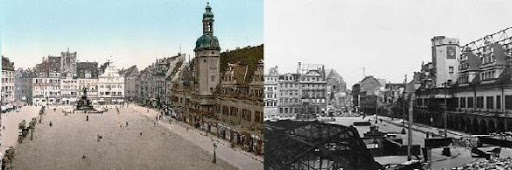
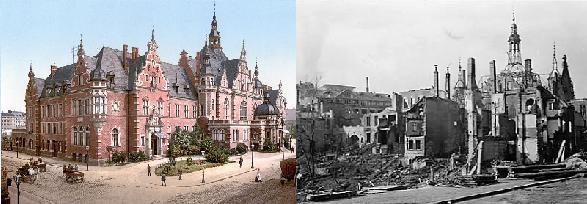
Incendiary Bombing of Leipzig – Before and After Photo Credit: Leipzigbuch


On Wednesday, April 5th, following the first marching order, Opa arrived by train in Leipzig at 22 hours. He quickly hid the wooden box filled with food supplies intended for his family while sirens were announcing another bombing raid. He managed to find shelter in a private basement room, from where he made a phone call to his superior and old acquaintance by the name of Jepsen. The German signal corps was still able to keep the lines of communication open, whereas the public telephone system had been out of order for some time. Opa received a heart-warming reception from his former colleague and friend. While he was being brought up to speed on the current frontline situation, he also received instructions about his role in the constantly shrinking space being held by German troops. Another bombing raid rained terror, fire and death from the unprotected sky. At three in the morning, Opa finally went to bed and found some much-needed rest. But he could not fall asleep.

Incendiary Bombing of Leipzig – Before and After Photo Credit Leipzigbuch


Worries about his family kept him awake. Hundreds of questions occupied his mind, to which he had no answers. Had the Americans already reached Weimar? Was the rumour true that their tanks have pushed their way to Gotha? How was his wife faring under these chaotic conditions? Was she still alive? And what about his stepdaughter Elsbeth? Then his thoughts turned to his twins Gertrud and Walter, whom he had held on his arms only two months ago? How were they doing? Was Mutti able to take care of them? When seen through the eyes of a caring and loving father, who must serve as a soldier fighting for his country, war takes on a new horrific dimension that goes beyond killing the enemy, worrying about getting killed, about death and destruction all around you. For every soldier killed in action, a mother will mourn the loss of her son. A sweetheart will never meet her lover again. A wife will have lost her husband and the father of her children. But when a soldier survives the horrors of the killing fields and returns home from a POW camp, and discovers that his entire family had perished in one of the horrendous aerial attacks, then what more is there to say about the utter and total senselessness of war? Having been a conscientious police officer and army captain faithful to country and convictions, Opa meditated deeply about things of concern to him. He often liked to share his views with friends and relatives in his massive correspondence later in the early sixties, from which I derived a lot of valuable information.

Walter Panknin (1898 – 1977) and His Family – Part 14

Utter Chaos and Contradictory Orders

Near the end of March 1945, SS-Colonel Josef Dietrich had taken over the defence of Vienna. A few days later, artillery fire was thundering and warning that the Soviet frontlines were moving closer. Opa fortuitously recalled his marching orders commanding him to report for duty at his hometown Gotha. So with these documents on hand, it was in the eyes of the military authorities quite proper and legitimate for him to leave the endangered Austrian capital and not be considered a deserter. Yet, with his keen survival instinct, he saw a golden opportunity to be near his family in his leaving the city. Papa also saw a chance to get through the final stages of the war alive. To fall into the hands of the Americans as a POW was, in his mind, the lesser evil. He managed to reach Erfurt by train a short distance east of Gotha, which was already under attack by US troops and tanks. This event prevented him from taking on his new assignment there. So on the highway to Gotha, where he was walking, he joined the German forces in full retreat from the enemy. Papa did not indicate in his notes the army units under his command in the final stages of the war.

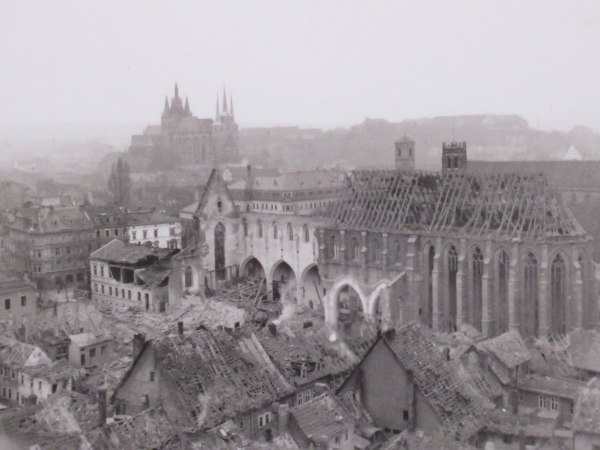
Erfurt 1945 – Photo: Wikimedia


Later, on a beautiful sunny April morning, when he would have preferred to take a relaxing hike with his family through the Thuringia Forest, he walked instead in the direction of the Central Station in search of provisions. When he passed by the railway station, the ordinarily busy and often overcrowded place was utterly deserted. Enemy tanks had bypassed the town during the afternoon on the previous day and threatened to cut off the local defence lines set up for the region around the city. Rumour had it that an order would come that very same night regarding a desperate attempt to hold the town with troops drawn from the so-called ‘Volkssturm’ brigades long enough for the bulk of the battalion to reconnect with the German defence lines farther east. Despite the town mayor’s opposition to the inevitable house-to-house combat and the danger of more destruction to his beloved city, the order was carried out to the effect that the regime-loyal Nazi officials had also taken flight together with a remnant of the retreating army. Expecting the arrival of the American vanguard of tanks and troops at any time and being no longer afraid of their oppressive regime, audacious town folks tore down the pictures of Adolf Hitler from public buildings and the walls inside the railroad station.

American Troops in Erfurt April 12, 1945 – Photo: erfurt-web.de

For Papa, these were turbulent times. With a small company of soldiers, he stayed behind, having received an order to fight as long as possible to delay the advance of enemy units converging on the city of Erfurt. On April 2nd, 1945, he recorded on his notes that the lines of command and communication were in a complete state of disarray. In the chaos and the rapid disintegration of the command lines, coordination of troop movements became increasingly more challenging to maintain. Often conflicting orders were sent out by the high command resulting in total confusion for the officers in charge down the military hierarchy. For instance, since his return from Vienna, Opa had received two marching orders, one for Leipzig and another for Dresden, while at the same time, he was supposed to provide leadership in the defence of Erfurt.

Walter Panknin (1898 – 1977) and His Family – Part 9

The Good Life in Zavidovici

Papa, who had recently advanced to the rank of a captain, enjoyed an excellent rapport with his staff. He carried out his business in a strict but fair manner, which earned him the respect of his officers and the people of the Bosnian district around Zavidovici. They were grateful for the security that his troops provided. Tito’s bands and the German army alike were terrorizing towns and villages elsewhere in their attempts to gain control over the enemy. For Captain Panknin, there was just one fly in the ointment. He also had to deal with troublesome disciplinary matters arising from a company of volunteer soldiers under his command soon after Germany attacked the Soviet Union in June 1941. The company mainly consisted of exiled Russians, former Belorussians or their children. As Papa described them in a letter to a friend after the war, they were drunkards, thieves, and good-for-nothings. In his opinion, the military police should have arrested them and put them in an army jail for all kinds of significant infractions. Breaking military rules and criminal activity within and outside the barracks were examples that Papa mentioned in his report. But documenting all the individual cases and summoning witnesses to support the evidence would have taken too much valuable time. The little episode corroborated what I learned from my brothers’ reports in Book I.  It may come as a surprise to most readers that many young men from European countries were willing to fight for Germany against the Bolshevik threat to take over all of Europe.

This image has an empty alt attribute; its file name is c08d752f9f621d92cf384efb5278b638.jpg
Picturesque Landscape near Zavidovici, Croatia

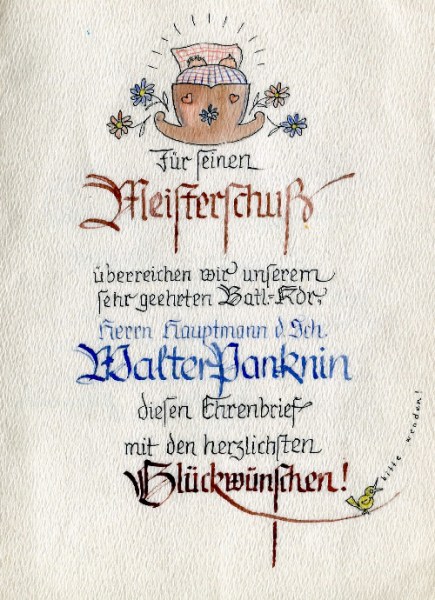
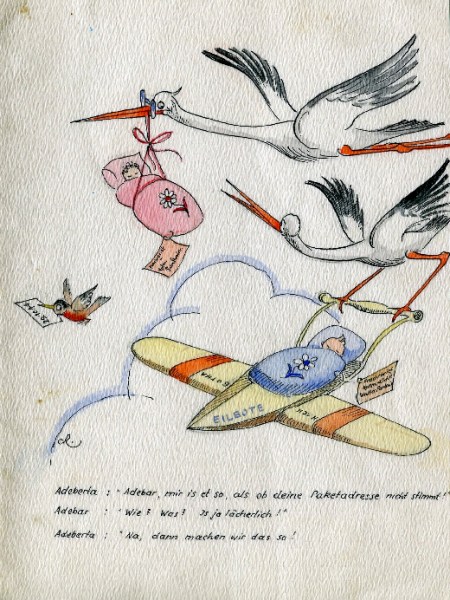
On October 30th, 1944, a telegram arrived from the Gotha police headquarters informing Captain Panknin of a very joyful event back home. The message read as follows: TWINS ARRIVED ON 29/10 44 BOY AND GIRL MOTHER AND CHILDREN ARE WELL. Great was Papa’s joy. What a blessing to have twins when it had appeared that he would not have any children of his own after fourteen years of marriage! His staff was equally delighted and created for their boss the most beautiful congratulatory card I have ever seen.

This image has an empty alt attribute; its file name is birth-congrat-44-cropped.jpg

There must have been an artist among the officers. No commercial card could have matched the quality of the picture depicting two storks delivering the babies, the touching message for their dear commandant, and a lovely poem to boot signed by the entire staff. Of course, this extraordinary event called for celebration. But the best part for Papa was that he was granted a rare leave in the New Year from war-torn Yugoslavia to travel home to see his wife and children.

This image has an empty alt attribute; its file name is birth-congrat-44_2.jpg

Walter Panknin (1898 – 1977) and His Family – Part 8

Joyful Times in Croatia

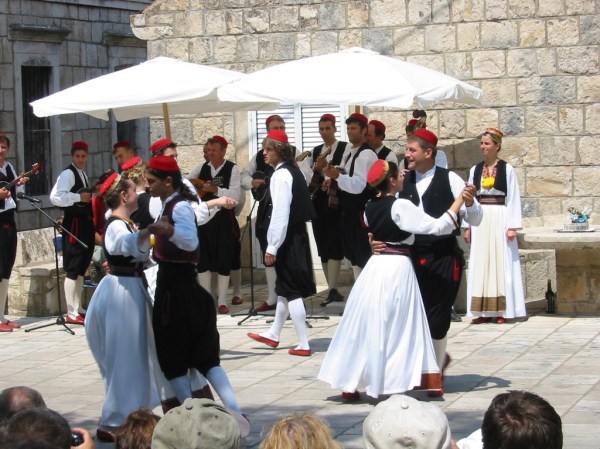
Papa loved the people and their culture. Although they were poor and had to work hard to make a living, they knew how to celebrate. After they brought in their harvest in the fall, or when they gathered at a wedding banquet or welcomed a newborn child into their community, they made good use of these festive occasions. Many of the songs Papa was so fond of listening to come from the Balkan Roma, the people once called Gypsies.

Folk Dance Group of Dalmatia, Croatia – Photo Credit: Wikipedia

If one grew up on a steady diet of Western pop music, Balkan melodies take a little bit of getting used to. While many of the tunes use familiar rhythms, including the driving rhumba beat, some Balkan tunes add spice using asymmetrical meters. The music tells only half the story. The dancers, prompted by the intoxicating rhythm and the ever-increasing tempo, suddenly emerge from the cheerful crowd. The steps in the Balkan dances can be delightfully simple or maddeningly complex. Most are line dances; they rarely occur in couples. What does the music sound like that Papa loved so much? It depends on where you go. In Croatia and Serbia, there is the tamburica tradition of plucked-string instruments. But the musicians are also using accordion, violin and woodwinds. Add to this the wailing melodies delivered by wedding bands that play songs popular across the entire region. Now we will understand Papa’s fascination with the Balkan people, their music, dances, and customs.

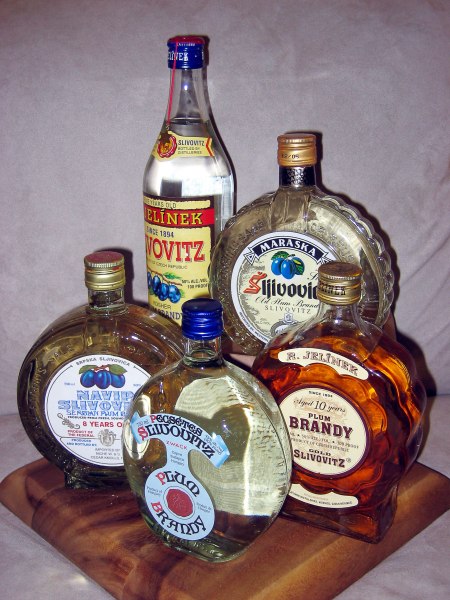
Collection of Slivovitz Bottles – Photo Credit: Wikipedia

When it came to alcoholic beverages, nothing would appeal to Papa’s taste buds more than the famous Slivovitz. Orchardists have been producing the sweet, velvety plum brandy for hundreds of years, primarily in Croatia, Serbia, Poland, Hungary and Bulgaria. Late-summer plums are the most commonly used: deep purple, ovoid and freestone, such as damson and Italian prune types. The fruit is pierced, covered with sugar and alcohol and stored in a cool, dark place for months. The most exquisite and complex slivovitzes age in casks, like wine or bourbon.