Gustav Robert Hermann Klopp – Friedrich and Emma’s Eleventh Child – Part 1

Fighter Pilot and Hereditary Estate Farmer

Friedrich and Emma’s eleventh child, Hermann was the first one to be born in the recently acquired house on 30 August 1892. In 1903 the eleven-year-old boy moved with his mother Emma and his six younger siblings to the farmstead at the village of Elsenau near Schönsee (now Polish: Kowalewo Pomorski) in West Prussia. Hermann completed an agricultural apprenticeship in that area and found before 1916 an administrative post of the Prussian state property Wtelno near Gogolinke, county of Bromberg (now Polish: Witelno near Gogolinek, about 20 km northwest of Bydgoszcz). The agricultural area of the domain was 385 ha.

In 1916 Hermann became a soldier and participated in World War I. He enlisted at the newly established air force unit just as his brother Ferdinand, who had served from 1915 on at the airstrip Großenhain. In August 1917, according to an army postcard, he became a fighter pilot trained at the “Flieger-Ersatz-Abteilung I”.

From March 21 to November 10, 1918, the day of the unit’s closure, Hermann Klopp belonged as a lieutenant and fighter pilot to the Airforce Unit I, which was headed by Manfred von Richthofen (1892 – 1918). Hermann was on active duty when his leader was fatally shot down on 21 April 1918 between Bray and Corbie (France).

Since the end of March 1918 the headquarters of the famous unit JG I was moved forward to the airport Léchelle as part of the German March offensive. After Richthofen’s death, First Lieutenant Reinhard became Herman’s new leader. On 6 July 1918 Captain Hermann Göring (1893 – 1946) was installed as the last commanding officer of the Imperial Airforce.

Under Göring’s leadership, the distinguished and audacious unit suffered heavy losses in the summer and fall of 1918. During the course of these air battles, during which Lieutenant Hermann Klopp flew the fighter plane Fokker D VII, his flying machine was shot down in the vicinity of Léchelle/Cappy. Seriously wounded he was transported to the nearest field hospital. It was found that he received a non-operable lung shot, from which he suffered for the rest of his life.

To be continued …
Friedrich Wilhelm Otto Klopp (1886 – 1937)

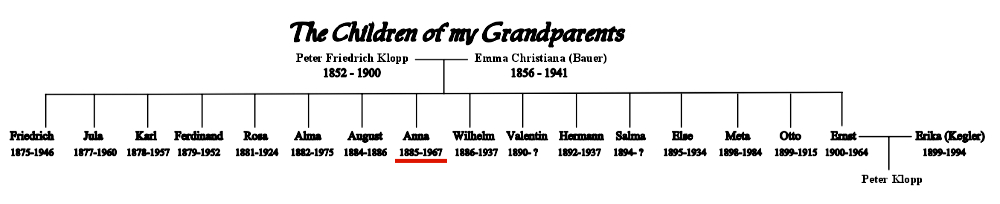
Chart I Peter and Emma Klopp Tree simple

The stories of the first eight children of my paternal grandparents have been told in earlier posts last year. Here are the links to the first half of Friedrich and Emma Klopp’s sons and daughters: Friedrich, Juliane, Karl, Ferdinand, Rosa, Alma, August, and Anna.

Friedrich Wilhelm Otto Klopp (1886 – 1937)

The Innkeeper of the “Brown Elk”

As the ninth child Wilhelm was born on 8 December 1886 in Jersleben. Due to the sparse memory retention of the descendants, Eberhard Klopp, the author of the Klopp Family Chronicles, had not been able to dig up any information on Wilhelm all the way up to 1919, when after the lost WW1 the latter returned from the eastern German provinces (given to Poland by the provisions of the Treaty of Versailles) to Elbeu. At the Magdeburg Street of Elbeu, Wilhelm bought a house, presumably with agricultural land attached to it. With his brother Ferdinand he seemed to have come to some sort of financial arrangement involving a considerable sum of money paid out by the state to compensate for lost property in the eastern provinces.

From Wilhelm’s first marriage with Maria Söchting come two sons: Wilhelm and Gerhard. Their mother died in 1912. In 1912 Wilhelm married his second wife Louise (née Grünwald). From this marriage originate four children: Viktoria (1914), Fritz (1916), Heinz (1919) and Günther (1924). It is safe to assume that 28-year old Wilhelm became a soldier in 1914. When he returned from the war with his brothers, he procured for his brother Ferdinand Klopp (1879 – 1952) the lease of the Elbeu Inn “Brown Elk”. Over financial disagreements in August 1922, the two had in the barroom a fight, during which Ferdinand shot his brother. Wilhelm was wounded at his left shoulder. Louise, who was standing behind him, was grazed by the bullet. Mother-in-law Emma Klopp must have heard about this incidence either at her daughter Rosa Diesing’s (1881 -1924) place at Schöneberg or experienced it first hand right on location in Elbeu. At any rate, it had been passed down through the grapevine that Emma had used the highly defamatory term “Satan’s wife” in describing her daughter-in-law. Mother Emma condemned Wilhelm’s excessive alcohol consumption, which she blamed on his wife’s bad influence. Louise died in 1924, presumably on account of the injury she suffered from the grazing bullet. Wilhelm was reconciled with his brother Ferdinand – at least on the surface, took over the “Brown Elk”, and remained innkeeper for the rest of his days.

Around 1925 he married for the third time: Ruth (née Grünwald), the sister of his second wife. Six underage children needed to be cared for. From this marriage descended two more sons: Hans-Georg and Hans-Joachim, both were born in Elbeu. On 7 August 1937, Wilhelm passed away at the age of only 51 years. At the end of his short life, he had apparently become his own best customer of the local watering hole.

Baroness Anna von Waldenfels (née Klopp) – Part XX (Final Episode)

Aunt Anna’s Neglected Gravesite

At the end of the 1950s, after giving up the house in Söcking, Bavaria, Anna von Waldenfels moved to Freiburg/Breisgau close to her sister Meta Mülbert, who lived at Maria-Theresiastraße 4. Her husband Vincenz had passed away in 1958. Anna at first rented an apartment at number 7 across the street.

In the summer of 1959, while on a bike tour through Germany with my friend Rainer Schüler, I visited both aunts, who add moved together at No. 4. I remember Aunt Anna quite well, a feisty old lady filled with an unbroken spirit and a fervour, which revealed strong nationalistic overtones. She spoke to us young men of sacrifices to be rendered in blood and honour to put Germany back on her feet again. Obviously, her heart and mind were still dreaming of an era that no longer existed. These bizarre ideas of a past imperialistic Nazi-Germany, having brought nothing but extreme suffering and total destruction to many nations under its control, were completely foreign to us growing up in democratic West Germany.

At about the same year she met for the last time her granddaughter, the then 23-year old Carola von Waldenfels (born in 1932 at Lagowitz). She had most likely made a farewell visit and proceeded from there to travel as a photographer to California, USA. The two widows maintained contact with Ernst Klopp (my father), who had remarried and lived with his new wife Erna Klopp (née Krämer) in Michelbach near Schotten.

Once a resolute, energetic lady, always leaving the impression of a governess, now suffered from bladder incontinence, which considerably restricted her mobility and physical activities. At 82, she died of cancer on 3 November 1969 in Freiburg/Breisgau. The two families Georg von Waldenfels from Haren/Ems and Meta Mülbert provided on 7 November 1967 a final resting place for Anna on her beloved husband’s side in the Starnberg forest cemetery. Her son had arranged the transfer of his mother’s remains to Söcking, but he did not deem it necessary to take care of the completion by adding a cross for his mother. Fate’s irony is that her gravesite remained nameless just as the one of her eldest brother Friedrich Klopp (1875 – 1946)  in Gardelegen in the former German Democratic Republic. “Sic transit gloria mundi.”

Baroness Anna von Waldenfels (née Klopp) – Part XVII

Narrow Escape and Loss of Property

In the early part of 1945 Georg’s wife, Ilse  von Waldenfels escaped just in time from the rapidly advancing  Red Army. After briefly visiting acquaintances at Lake Scharmützel near Berlin she reached Berghorst in the Münster region in Northwest Germany, where her mother Helene née Wattendorf (1881 – 1973) resided. Georg after joining her as reported earlier became shortly afterwards a British POW and was interned in Recklinghausen until 1947. His entire property had been confiscated on account of his SS membership. There are some vague indications about Georg having been summoned as a witness against Genraloberst of the SS, Sepp Dietrich, in court proceedings at the Nuremberg war crime tribunal or at the Malmedy  Court, in which his former boss received a life sentence for being responsible for the shooting of POW’s during the Ardennes Offensive. The author Eberhard Klopp of these family chronicles did not further explore the connections of these claims. At any rate, Ilse von Waldenfels was able to send family care parcels to her interned husband in Recklinghausen.

By the end of January 1945, the Red Army was approaching the town of Tirschtiegel, which the Wehrmacht (regular German army) and SS units were defending on 30 January. Soviet units were breaking through the so-called ‘Obra Position’ and advanced on 28 January south and north of Tirschtiegel in a pincer attack all the way to the road connecting Meseritz and Bentschen. After the conquest of Bauchwitz only 5km north of Panwitz the Soviets not only blocked to the defenders the retreat from Tirschtiegel, but also to the rural inhabitants the escape route to the railway station in Meseritz.

Anna von Waldenfels describes the loss of her beloved Panwitz. “We were totally unaware the Russians with their tanks were ready to strike at any moment being only 5 km away from us. A general of the SS came by and told us that he would take us to Berlin if we would make up our mind immediately. He warned, ‘Tomorrow you all will be hanging from a tree’. Indeed that’s what happened to all our neighbours who stayed behind. For us to escape was truly a miracle”. On the very next morning (29 January 1945) the Russians had occupied the entire county. All men were shot and all women were raped by the Asian hordes.

To be continued next Friday …

Baroness Anna von Waldenfels (née Klopp) – Part XVI

‘Castle’ Lagowitz in Ruins

In a chaotic flight with lightning speed from Posen (Poznan), passing through his beloved Lagowitz, Georg von Waldenfels reached his wife’s home turf, the Münster province in the northwest of Germany and became a POW of the British Army. Ilse von Waldenfels, when approached for an interview by my cousin Eberhard Klopp, the author of the Klopp Family Chronicles, was very reluctant to share any information on her husband’s past. In her eyes, more than 40 years later in 1996, Georg was ‘an insignificant subaltern officer, who did not play any special role in the SS. After the war, he paid his tribute. We never talked about those bad years anymore.” She like many other Germans of her generation had buried and suppressed deep within her guilt-ridden psyche a considerable number of events of the Nazi era.

In the night from 28 to 29 January 1945, a certain SS general was passing through Panwitz and demanded the immediate evacuation. His urgent warning revealed that the Red Army would be at their doorsteps within just a few hours. Perhaps it was only the SS-Obersturmbannführer by the name of Georg von Waldenfels, who in his flight from Posen in the direction of Berlin had quickly warned his parents. As early as 1980 the author of this book in translation had received the following information in Trier from a reliable source: “Our all-rounded super-provisioner in France, a man from the nobility, Sepp Dietrich’s staff officer, succeeded before the arrival of the Russians in burning down Castle Lagowitz.”

Should von Waldenfels have really destroyed his very own NS-Headquarters and Castle Lagowitz with all its incriminating documents and evidence turning them into a heap of rubble and ashes? Eyewitnesses can no longer be found. But the action in a time of perilous urgency fits perfectly within the overall frame of his mentality. Treacherous documents and correspondence of all sorts in the hands of the Russian or Polish authorities would have heralded a dangerous new beginning for Georg. If all these collected facts agree, the parents Anna and Ludwig von Waldenfels on the morning of their own flight from Panwitz may have seen Castle Lagowitz for the last time as a smoking and smouldering pile of ruins. Georg von Waldenfels has taken this particular piece of history with him into his grave.

Baroness Anna von Waldenfels (née Klopp) – Part IX

Georg von Waldenfels and his Great Ambition

The Nazi and his Shattered Dreams

Considering the massive amount of available information, I had right from the outset limited the scope of our family history to my wife’s and my grandparents and their children, our uncles and aunts, to our own stories and those of our children. As reported earlier my grandparents on the paternal side had 16 children, of whom my father Ernst Klopp was the youngest. My aunt Anna von Waldenfels (née Klopp) was the eighth child, who is the focus of the present series. So in view of this massive undertaking there is no time to deal with all the other children.

However, with Anna’s son Georg von Waldenfels I would like to make an exception, the reason being to avoid being accused of leaving out embarrassing details about one black sheep in the family, whose greed and ambition for fame and gain made him a follower of the Nazi regime. On the basis of documented files, which my cousin Eberhard Klopp had gathered from various government and archival sources, I tried to put together and to highlight Georg’s ‘achievements and failures’, which will clearly identify him as the black sheep of the family.

  • Early member of the Nazi party.
  • Known to disrupt meetings of other parties, especially speakers of the socialist and communist parties in pubs and other public places through rude and bullying tactics.
  • It was during this period that his marriage with Emilia (née von Zychlinsky fell apart and ended in divorce.
  • Emilie could not stand that the Lagowitz castle had become the centre and breeding ground for National Socialism (Nazi), all the more when she realized that her husband wholeheartedly embraced the new movement and supported it with vim and vigour.
  • Even Georg’s mother Anna von Waldenfels regretted the end of their relationship, although she was fully aware of her son’s conduct, which destroyed the earlier solid foundations of her son’s marriage.
  • One day after Hitler’s rise to power on February 1, 1933 Georg became member of the infamous SS with the number 147,781.
  • It is still difficult to see through the maze-like complexity of the SS organizational structure. Heinrich Himmler, the Reich’s leader of the SS, created one sub-organization after an another with various fanciful names to camouflage his intent to turn the SS into his own personal empire by enlisting as many members as possible with no regard to any military background and experience.
  • This may explain why Georg found easy access to the SS in view of his non-military background as estate manager.
  • But a career as a military high ranking officer seemed impossible under the given personal circumstances.
  • A fateful chance encounter in Berlin with the like-minded commander of Hitler’s body guard unit “Leibstandarte SS Adolf Hitler” and friendship with this notoriously rambunctious leader removed the obstacles to Georg’s military career in a jiffy.

To be continued next Friday …