Walter Panknin (1898 – 1977) and His Family Ch6 Part 29

Foreshadowing the Turbulent Adolescence Years

Biene wrote this post.

Gisela’s grandparents always received us warmly when Gudrun and I came for a visit, and they treated us with delicious homemade refreshments. They took a genuine interest in our lives and liked to tell us stories of their exciting past,
Unlike Gisela, Gudrun was very outgoing and radiated warmth. She always had a sweet smile on her round face. Blond, blue-eyed and well-developed, she liked to take life easy and have fun. While I still wore hand-me-down clothes from my second cousins, Gudrun had the most beautiful skirts, blouses and dresses, which her mom sewed for her.
Like Gisela’s mom, her mother was a war widow and a seamstress. She also had a tailoring business at her home. Gudrun’s grandma lived with them. But her grandfather was dead. Gudrun’s Oma did the household chores while her mom sewed on a big long table in the corner of the spacious kitchen close to the window.
Gudrun’s well-dressed mom looked glamorous with her fashionably styled blonde hair, heavy makeup and bright red, enormously long fingernails. They were curved like claws. I secretly wondered how she could handle delicate materials with them. She would take frequent smoke breaks showing off her long fingers by gracefully holding the cigarette. She half closed her eyes leisurely and slowly exhaled the smoke through her rounded red lips. Smoking looked so pleasurable and alluring to us girls.
Periodically. a male friend of the family who was a truck driver for a brewery would visit Gudrun’s mom. At those times, much laughter and joking occurred, and thick clouds of smoke were coming from the sewing corner, distracting us from studying for school. I think her mom’s friend was a father substitute for Gudrun.
Gudrun had a record player, a luxury our family could not yet afford. She owned records of the top hits, most of them gifts from her mother’s friend. We would listen with excitement to the catching songs and rhythms of Little Richard, Elvis Presley. Connie Francis and Brenda Lee. We would even dance around as soon as Gudrun’s mom and Oma ran errands. When our top idol Elvis sang, “Love me Tender,” we were mesmerized and started dreaming of first love.
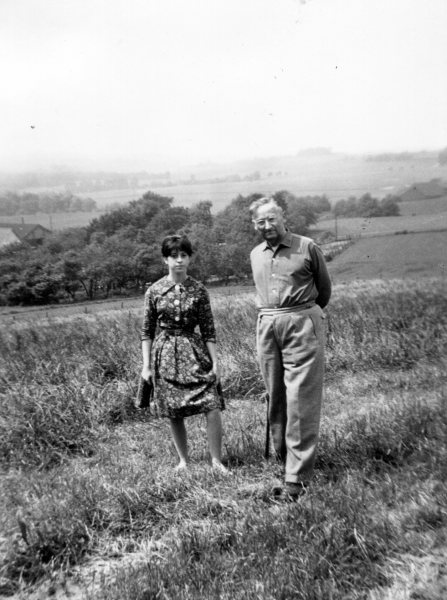
Biene Hiking with her Father Walter Panknin

With this final post of chapter 6, Biene concludes her contribution to the Walter Panknin story. I will carry on with this family history in Chapter 7.
Walter Panknin (1898 -1977) and His Family Ch6 Part 27

Papa’s Shocking Letter from Home

Biene wrote this post.

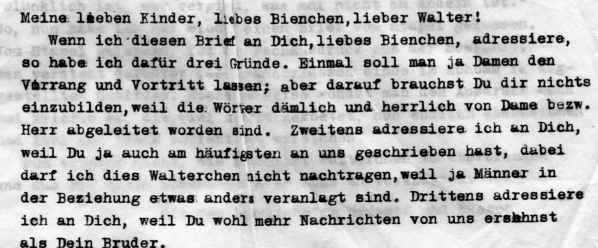
One day, we were all supposed to write a postcard home. I wrote a desperate plea to my parents to come and get me as soon as possible. A few days later, I received a letter from my father.  I eagerly opened this welcome message from home with joyful anticipation. But what my father wrote to me seemed to top off all the bullying I had endured. Instead of comforting words, my father wrote what he may have thought to be a witty  “dissertation.” He explained the linguistic origin of the German words ‘dämlich’ and ‘herrlich,’  roughly translated as ‘dumb’ and ‘masterful.’   Unfortunately, the allusions and fine points of his linguistic examinations are lost in translation.  There are no equivalents in the English language. He told me that the word “dumb” derives from the word “dame.”  On the other hand, “masterful” or “manly” originates from master or man,  and ‘Herrlich’  also has the connotation of wonderful or glorious.

Extract of Papa’s Letter in German (1956)

I could not finish reading my father’s letter because tears of shame and disappointment blinded my vision.  But miraculously, my pain was short-lived.  A supervisor approached me and told me I had a visitor waiting for me in the main office.  When we entered, there was my beloved mother!  It seemed like a miracle. She had made the long and costly trip by bus and train to see me against my father’s advice. I was overjoyed.  We spent the beautiful afternoon together walking in the forest and talking.  I unburdened my heart, and she listened with empathy.   When evening approached, she gave me the choice of going back home with her or staying for the remainder of the vacation.

One thing my father’s letter had accomplished. It stirred up my pride and courage. I was going to show him that I was not that ‘dumb’  weak ‘dame’  intimidated by the ‘wonderful masters.’ I would not give him the satisfaction of proving his point. I decided to stay.I enjoyed the remainder of my time at the youth camp. I learned to ignore verbal assaults and not take them personally. I avoided playing unsupervised games with rough boys and sought out the company of friendly girls.  I also noticed that the supervisors intervened more readily when they saw inappropriate behaviours. Maybe due to my mother’s visit, they were more vigilant.

Summer camp, in many respects, was a great learning experience for me and made me stronger. Thanks to my mother’s love, I felt happy and relieved that I did not quit or give in to fears and feelings of insecurity.  In retrospect, I also appreciate my father’s words.  Although it was not so obvious,  he acted out of concern for me.  He knew that by taunting me, I would rise to the challenge.   In his words, I learned to  ‘master’ my fears.

Walter Panknin (1898 – 1977) and His Family Ch6 Part 24

Angelika’s Traumatic Childhood

Biene wrote this post.

 One day I talked to my mom about this, and she told me Angelika’s story, which offered a possible explanation.

Angelika’s parents married very young, towards the end of the war.  Her mom was still in medical school studying medicine when she became pregnant.  Angelika’s dad was fighting at the front.

Angelika’s mom decided to put her newborn daughter in a foster home to get her back when her husband returned, and she had completed her studies.

For four years, Angelika lived in foster care until she was finally reunited with her parents.   Trying to make up for a lost time, they showered her with love and attention, but Angelika did not seem to return their affection.   She was reticent,  almost withdrawn and easily upset.  She avoided social interactions and did not like to play with other children.   Her parents were overjoyed when Angelika finally developed a close friendship with me.  Angelika was capable of closeness and affection with other human beings.

Angelika never talked about the time she spent in foster care. But she often told me that she always wanted a sister or a brother; she envied me for having a twin brother. She thought I was never lonely and had always had a close friend.  I did not want to shatter her illusion, but at that time, my brother and I didn’t love and appreciate each other.

Walter Panknin (1898 – 1977) and His Family Ch6 Part 20

Frau Panknin’s Success and Biene’s New Friend Angelika

Biene wrote this post.

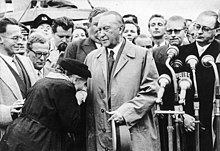
Often my mother was at the point of exhaustion and desperation to give up. The bureaucracy was so overwhelming that all her efforts seemed futile. But my mother’s tenacity and indefatigable spirit finally paid off after seven years. She went to the highest government department to plead for justice as a last desperate effort. Miraculously, she was received by a representative of the German Chancellor, Konrad Adenauer, who had a sympathetic ear and got the “ball” rolling in no time. My father was finally entitled to a sizeable pension and a big back pay for the lost years. My mother had won the struggle for financial security at the expense of her health and vitality. The years of worries and deprivations had taken their toll. But my brother and I were too young and self-absorbed to notice. For us, she remained a pillar of strength and comfort. Her love for us was inexhaustible.

Adenauer with the mother of a German POW brought home in 1955 together with thousands of other POWs from the Soviet Union due to Adenauer’s visit to Moscow– Photo Credit: Bundesarchiv


After this memory fragment of my mother, let’s return to my life. Shortly after our second year of high school had started, “Mecki,” our homeroom teacher, introduced a new student. He assigned her to sit beside me since I had lost my desk partner the previous year. She had failed the grade.
I glanced furtively at my new companion, who looked straight ahead at Mecki. Angelika had a cute snub-nose and big blue eyes with long dark eyelashes. Her short hair curled softly around her round red cheeks. She had a nicely curved mouth and dimples. When she eventually dared to smile at me, she looked beautiful.

Walter Panknin (1898 – 1977) and His Family Ch6 Part 19

Mutti Panknin Fighting for her Husband’s Pension

Biene wrote this post.

The first year of high school was a big adjustment for us. We had to get used to a variety of teachers and teaching styles. Learning a new language was fun but also very difficult. We had to memorize many English words, their difficult pronunciations and their idiosyncratic spellings. To this day, the infamous “th” is still a challenge for me sometimes. Spelling rules are relatively consistent in German, but exceptions to the rule are common in English. Memorization of words and phrases seemed to be the best solution.

In this humorous video, a German coast guard employee is having serious trouble with the ‘th’.

Although school ended at 1:15 p.m., we had little free time because of heavy homework for each subject. In the afternoon, my brother and I would sit at our only table in the small room of the “House of Rocky Docky” and study. His homework was utterly different from mine. We hardly talked to each other, immersed in a different world. My father worked in the Krupp dental laboratory and would not return until supper. My mother had her battles to fight. She was constantly on the go trying to fight for my father’s right to receive a government pension from the police force he had worked for until Germany was divided.

Most people in Germany did not have phone service when I grew up. It was difficult for my mother to talk to government officials and other essential contact persons involved in her struggle to get justice for my father. It was a difficult and stressful undertaking for my mother and very exhausting. She had to travel by bus or train to government offices in other cities to get an appointment. She had to write letters and fill out lengthy forms, which often landed in the wrong departments or were filed away unread. There was an overload of administrative work for the government officials to accommodate all the refugee claims from the east.

Walter Panknin (1898 – 1977) and His Family Ch6 Part 17

Biene’s High School in Velbert

Biene wrote this post.

 Life was school, and school was life for me in those days.  Everything revolved around school. Every morning, except on Sundays, school started strictly at 8:00 a:m. and the big portal with the stained glass motto “Not for School but for Life”  was locked by the caretaker.   If you were late, you had to ring a bell.  The custodian would open for you and ceremoniously accompany you to the principal’s office on the school’s top floor.  Frau Lindemann reigned like a queen at her huge shiny mahogany desk.  She was a short, round lady with snow-white hair, bright blue eyes, and red cheeks.  She looked kind, but that was deceiving.  She was a strict disciplinarian.  She would give you a severe reprimand the first time you were late. If you were late three times, you would be suspended.  If you had three suspensions, you would be dismissed from school. We feared Frau Lindemann and would only enter her office with great trepidations.

Our classrooms looked austerely functional. There were giant blackboards on the front and side wall opposite the big windows.  We would sit in neat rows of two side-by-side desks facing the central blackboard in front and the teacher’s workstation. The room was bare of pictures, displays, plants, or decorative items.  There was nothing to distract us. However, we had the most exciting experiences in this dull physical environment.  We would vicariously relive humanity’s quest for scientific knowledge and spiritual truths.  Most of our teachers were passionate about expanding our minds.  They tried to teach us skills to foster critical thinking, problem-solving, and effective oral and written communication.