Walter Panknin (1898 – 1977) and His Family – Part 23

Crammed, Deloused and Harrassed

Then suddenly and just as unexpectedly as a balmy spring breeze and sunshine had brought relief, good food and drink cheered up the POWs. Bread, corned beef, cheese and calorie-rich soup, although not too plentiful, have now become part of their daily diet, supplemented by a few chunks of chocolate for dessert. Although the adage says that hunger is the best cook, they all agreed that the cooks were doing an excellent job. To round things off, they had as a beverage a choice of tea or coffee. The coffee tasted so good that many imbibed too much of the excellent brew, which kept them awake half through the night. On June 16, all men, whose hometown had become part of the Soviet-occupied zone of Germany, were put on a special list. Rumours about early release from their prison camp instantly circulated among Papa’s comrades. How soon would the Americans let them go home? Would army trucks drive them to the border? How would the Red Army men receive and treat them? Would Papa be free after his release from the camp? These were some of the questions and worries the POWs had. The troublesome thoughts burdened Papa’s heart at the time when he should have been rejoicing to be finally free from hunger and cold.
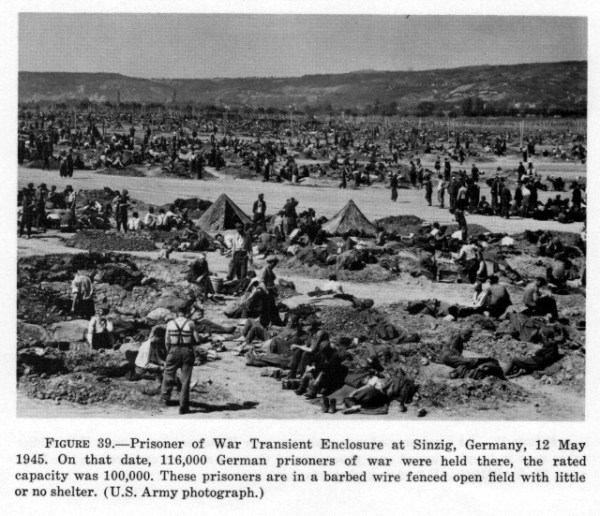
Photo Credit: Wikipedia


Near the end of the month, it rained again. But the air was mild, and the POWs now found shelter in the hastily erected wooden barracks. But they had to put up with cramped conditions. Space was so limited that there was not enough room on the primitive floor for everyone to sleep on his back. Packed tight like in a can of sardines, many had to sleep on their side. Thus, it was very likely that lice would have a heyday and spread like wildfire among the hapless bunch of humanity. The camp authorities had them march to the delousing stations to prevent the infestation from gaining the upper hand. There they had to undress and wait in the pouring rain for their turn to be deloused. Papa did not fail to see the irony, at least for this embarrassing moment. Like slaves powerless and naked, they stood before their black masters, who searched in a bout of chicanery for anything they deemed dangerous. Nail clippers and files, even pencils, were considered dangerous weapons and promptly confiscated. Papa must have hidden his precious writing tools in the sleeping quarters, knowing full well that he would be punished for having them in his possession. After being thoroughly deloused, they returned to their barracks and felt a lot better after receiving a bowl of sweet soup. Papa bitterly remarked that the worst form of chicanery did not come from their American guards but rather from their own ranks. Those lucky enough to be chosen as helpers and supervisors in the camp kitchen now turned against their comrades to be sure in part to impress their American guards. At 4:30 in the morning, when everyone was still fast asleep, they would holler with a commanding voice, ‘Get up, you sleepy heads! Pick up your grub!’ Everybody understood this message too well. For if you did not comply or you were too slow to respond, you would miss out on your breakfast and have nothing to eat till noon. From all the shelters, you could see the prisoners rushing to the source of food. To have something in your belly was more important than an extra hour of sleep. But when they arrived in joyful expectation of a nutritious breakfast, the German kitchen helpers were laughing their heads off at their successful prank and shouted, ‘Get back to sleep. You should know that we don’t serve breakfast until six!’
Walter Panknin (1898 – 1977) and His Family – Part 22

Reflections on Life as a POW

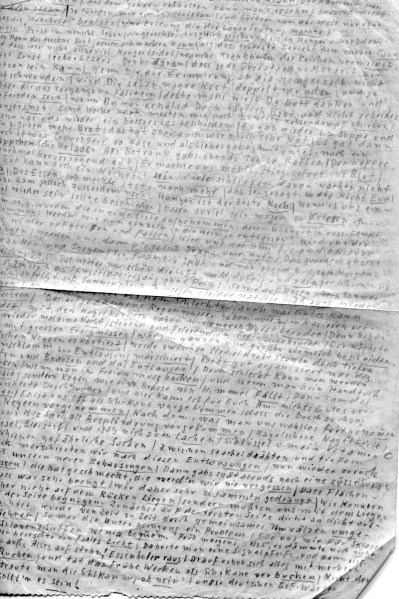
With more time for thought and reflection, Papa, making full use of his poetic talent, began to describe his life as a POW more vividly and in much greater detail. To make it easier for the reader to decipher this unusual piece of literature, he underlined the rhyming words and indicated with a slash the end of each line. Papa often went beyond a mere description of the good and bad times at camp.


He began by reflecting upon what makes a man truly free and what makes him a prisoner, not just in the literal sense of being surrounded by miles of barbed wire fences and guards ready to shoot at anyone attempting to escape. Freedom for Papa was more than having food, drink and shelter; slavery more than being deprived of these things. If the human spirit prevails despite severe deprivations, it is free. If, on the other hand, it drowns in a flood of material goods, it becomes a slave, not of some exterior force, such as a dictatorial political system, it puts on shackles of its own making.
Papa stated in his notes that something very positive came out of these horrible times at camp. He appreciated food, even the simplest meals, so much more. (Indeed, he would get furious when his children refused to eat what was so lovingly prepared and often left on the plate what he would have gladly eaten while being a POW. ) He addressed the reader directly by saying, ‘There is a sense of fair balance in human life. The hungry and deprived individual relishes a slice of dried bread and finds that it tastes much better than a rich man would ever experience eating a sumptuous gourmet dinner. Indeed simple, modest food will spare the less fortunate in life many diseases afflicting the wealthy gluttons in society. Dear reader, remember that times of adversity can be helpful. So if you don’t forget them, you will savour even the most basic food with great enjoyment when you are doing better. The more you are mindful of your past ordeals, the more you will thank God and be content when you receive your daily bread and no longer suffer from your hunger pangs.’

Walter Panknin (1898 – 1977) and His Family – Part 20

Coping with Rain, Mud, and Hunger

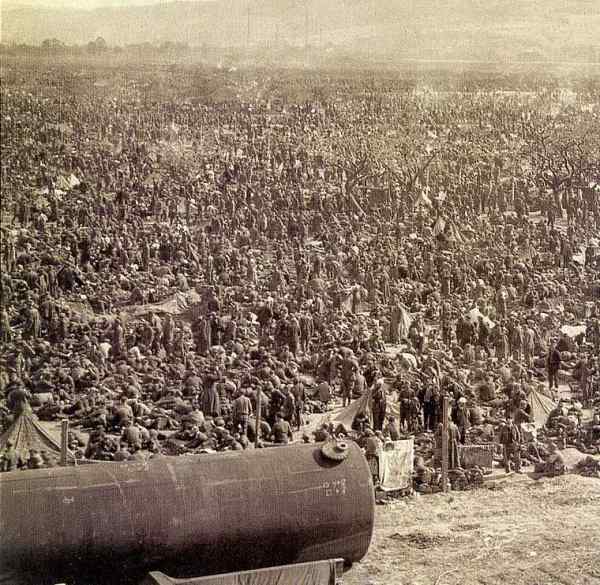
Suddenly, the weather changed from one day to the next and brought rain and more for the next seven days. Temperatures plunged to near freezing at night, while water soon filled their clay huts and made it impossible to sleep on the ground. Poor Papa Panknin tried to sleep while standing on one leg for a couple of minutes, then switching to the other. Once, he succeeded in catching a few winks, only to wake up in horror discovering to his utter dismay that he had plunged face down into the mud. He summarized his dismal experiences as triple torture of standing, starving and freezing. From the highest-ranking officer down to the common soldier, every POW had to endure the cold nights and the rainy days. The weather made no distinction. It fooled the prisoners by raising their hopes when short periods of clear skies promised a sunny, dry day, only to revert to more rain during the day.

One of the many overcrowded POW camps: The Rhinewiesen Camps, where Papa landed in April 1945

In the first week of May, the sun did not show its face for five long days. Papa was constantly scanning the sky for a sign of change in the weather. His long gaze created the hope that if he looked hard enough, he would perhaps discover a patch of blue on the murky horizon. Indeed, Papa thought he had found a definite shift from gray to blue. When he proudly announced his comrades the changes he had observed in the clouds, they all laughed at him. Like a desert traveller fancying an oasis, where there is none, so Papa had fallen victim to the mirage that had formed in his desperate mind. Perhaps hot, nutritious meals would have helped a little to provide some strength and warmth. Alas, the thin soups were getting lighter and often arrived cold at their swampy mud hole.

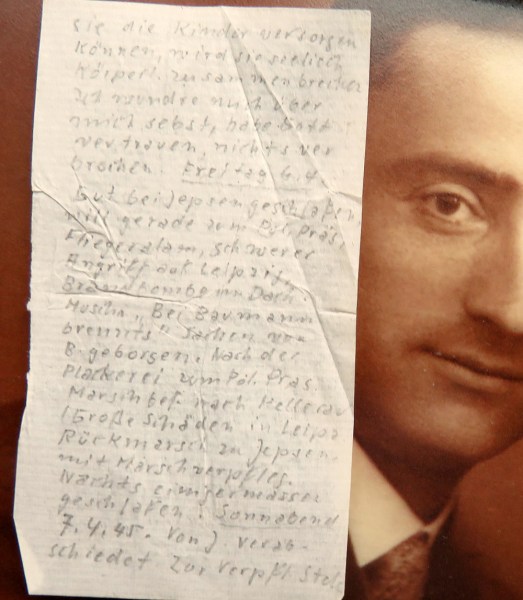
The posts on Walter Panknin are based on the notes he had written on tiny cigarette paper before and during his POW time. How he could write his experiences on such miniscule paper will be perhaps be forever a mystery.

During one night, Papa tried to find some rest for his tired feet by sitting on a water container, but completely exhausted fell two times asleep and into the muck. Unkempt and unshaven, covered in filth, he felt more like an animal than a human being. There was strife and petty spats over tiny morsels of food. There was no wood to make a fire, not even for roasting the few potatoes that had been made available for the hungry men. Papa built a primitive grating tool out of a tin can, into which he had punched some twenty holes. Now he could shred a potato into a porridge-like pulp, which he ate raw to get some badly needed nutrients, minerals and vitamins into his belly.

Ernst Klopp (1900 – 1964) and his Family – Part 34

The Writing on the Wall

Who can read the signs, when the fabric of family unity begins to unravel, when the glue that once held the clan together breaks loose under the load of stressful times? It is easy to answer such questions as we are looking back more than sixty years into past events. But at the time when the eldest son left the house, it appeared perfectly normal. After all, grown-up children with a few exceptions have always abandoned their nests to assert their independence and eventually have a family of their own. Yet, with hindsight we can probe a little deeper below the appearance of normalcy. Why would Adolf, the second oldest son, choose to immigrate to Canada, which turned out like the promised land, which however he did not know at the time he made the decision to emigrate? Or was it not rather the desire to escape his financial obligation to support the little farm in Rohrdorf with his meagre income? And why would Gerhard, the second youngest son, follow in Adolf’s footsteps if not for the same reasons. But most importantly, we children had no clue about the strain that the failed farming venture exerted on our parents. Ernst Klopp, once responsible as manager and director for a 3000 ha farming operation, utterly failed in turning the puny farmstead into a profitable venture. The psychological blow to my father must have been devastating.

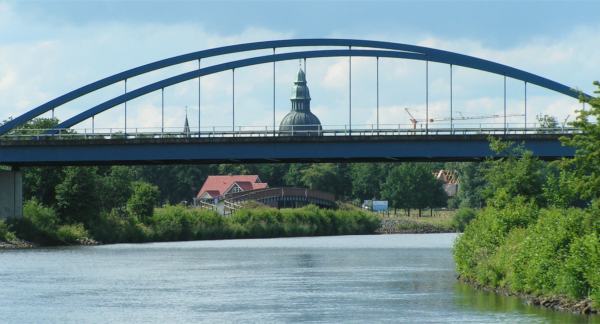
Haren, Ems Bridge – Photo Credit: wikipedia.org

In 1954, Father in search for meaningful employment moved to Haren at the Ems River in Northwest Germany. He worked in the office of the weaving factory of his nephew Georg von Waldenfels. The manufacturing plant was primarily producing cloth which was in high demand at the time. The newly created West German army (Bundeswehr) turned out to be a lucrative market for the son of Anna von Waldenfels. Unfortunately, Ernst Klopp and his meddlesome employer’s mother-in-law did not get along very well. The friction often resulted in unpleasant scenes, which wore him out and caused him to leave in 1957.

Rudersberg

In the meantime, my mother Erika Klopp had taken on a supervisory position in the kitchen facility of a senior citizen home in the town of Rudersberg northeast of Stuttgart. Her sister Maria Kegler, an elementary school teacher at the small village of Brünen near the city of Wesel took the 12-year old Peter under her wings. From there, he took the bus to attended the all-boys high school in Wesel, a city that ten years after the war had still many parts lying in ruins.

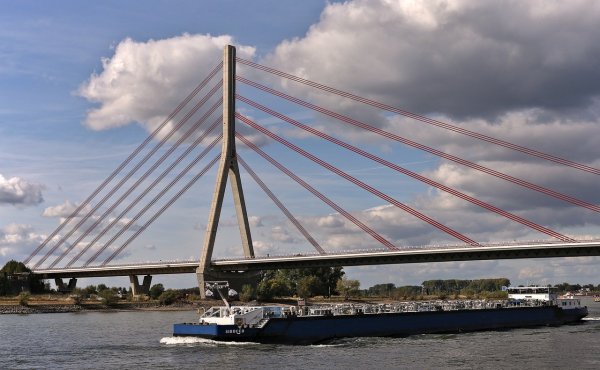
Lower Rhine Bridge at Wesel – Photo Credit: Thomas Biermann Pixabay

Rebuilding the city in the mid 1950s was in full in swing and the pressure of the extreme housing shortage was beginning to ease. Through some fortuitous connections, aunt Maria, also endearingly called Mieze, was able to find an apartment. An invitation went out to her sister Erika in Rudersberg to run her household in exchange for free roam and board. So it happened that in 1955, while Father was still doing office work at the cloth factory in the Ems Country, Peter’s mother finally found a place she could call her home again.

Ernst Klopp (1900 – 1964) and his Family – Part 32

The Ös Farm

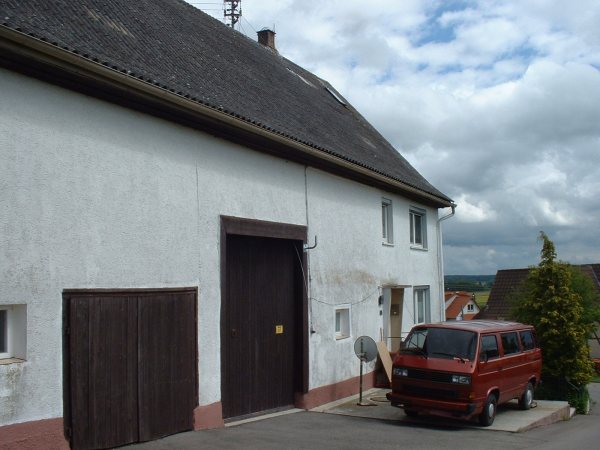
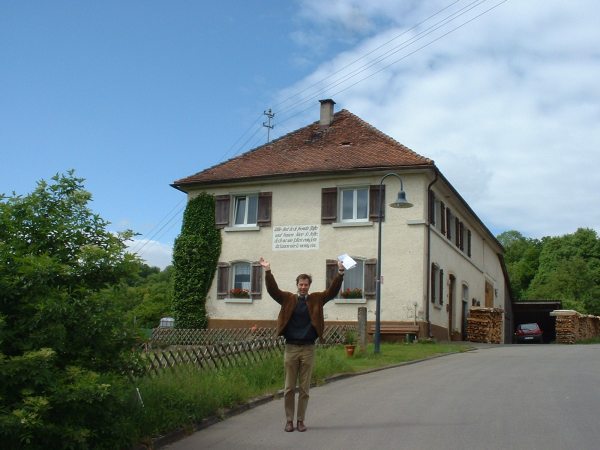
Then suddenly in the summer of 1950 an opportunity presented itself to Ernst Klopp. An elderly farmer by the short name of Ös decided to retire and leased his farm house and a few parcels of land not more than 6 ha in size to my father on credit. By comparison to the 3,000 ha Ernst had administered in Gutfelde, the total of arable land available for farming was minuscule. The house was adequate and a vast improvement over the upstairs dwelling of the ‘poor house’.  It came with a large barn with a hay loft, a sufficient quantity of farm implements, a fair-sized kitchen, the ubiquitous manure pile in front of the kitchen window and an outhouse. The only luxury item that I recall was the large tile stove (Kachelofen in German) providing warmth and a cozy ambience for the entire dwelling. Many of my sweet childhood memories are going back to the Ös farm, as we often irreverently called it.

The Ös Farm – 2003

So here my father Ernst Klopp tried with little prospect of success to pick up his life-long dream again to running a farm under his very own management. Having no capital to spend on much needed supplies, he heavily depended on loans, which created a heavy financial burden. He must have counted on the help from my older siblings for turning the farming operation into a successful venture. 

  The Farm House opposite to the The Ös Farm – Visit by our sons Robert and Stefan in 2003

Soon after his high school graduation Karl left home to study economics at the university of Braunschweig. Adolf, my second eldest brother, barely 18 years old found work at the Bizerba Factory in Meßkirch. Since that time in the early 1950s the Bizerba Company GMBH has developed into a world leader in weighing technologies for industry and trade. Adolf had to contribute most of the money he earned in order to keep this fledgling farming operation financially afloat. Three years later, Adolf was getting tired to support what in his opinion was a hopeless enterprise. Together with another refugee son by the name of Waldemar Klein he immigrated to Canada. Soon thereafter, my sister Erika also left home to take up nurses’ training in the City of Hamburg. In 1954, Gerhard managed to get an apprenticeship placement in a prestigious institute of technology in Switzerland.

Ernst Klopp (1900 – 1964) and his Family – Part 31

A New Beginning in Southern Germany

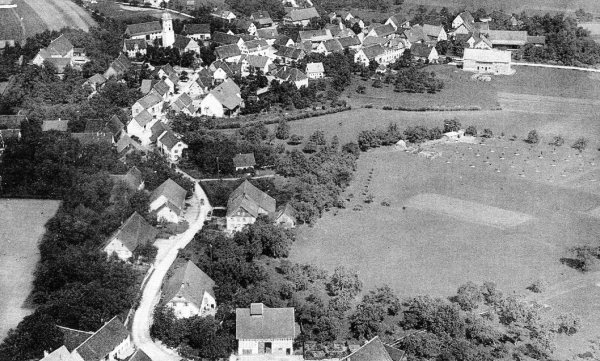
Rohrdorf as seen on an old postcard – about 1950

In June 1947, Ernst Klopp established himself anew in Rohrdorf , a small village near Meßkirch in Southern Germany. After finding employment as a forestry worker of the Fürstlich-von-Fürstenbergischen Forestry Administration located at Donaueschingen with a branch office in Meßkirch, he was able to reunite with his wife Erika and children. Adolf and Erika (see my sister’s report in an earlier chapter) joined them after a two- years interim with Uncle Günther in Erfurt.

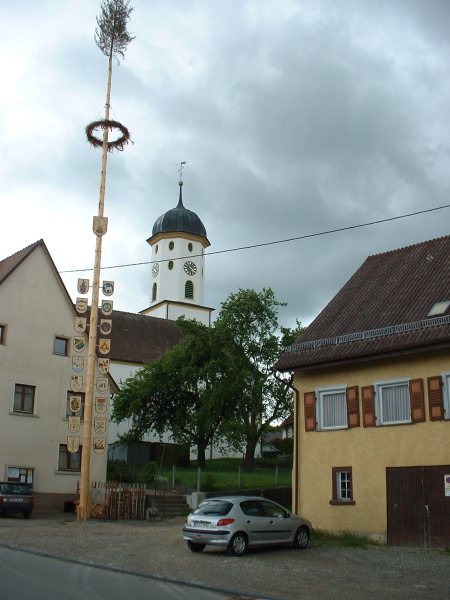
May Tree with St. Peter and Paul Church in the background – 2003

Karl, the eldest son, was the last one to join the Ernst Klopp family. The von Waldenfels couple, having to flee from their Panwitz property, had settled at their newly acquired estate Pentenried near Munich. In February 1948, they took the 19 year-old Karl into their care and provided food and shelter  for about a year. After an agricultural apprenticeship in Nellenburg near Stockach, Karl was finally able to join his family.

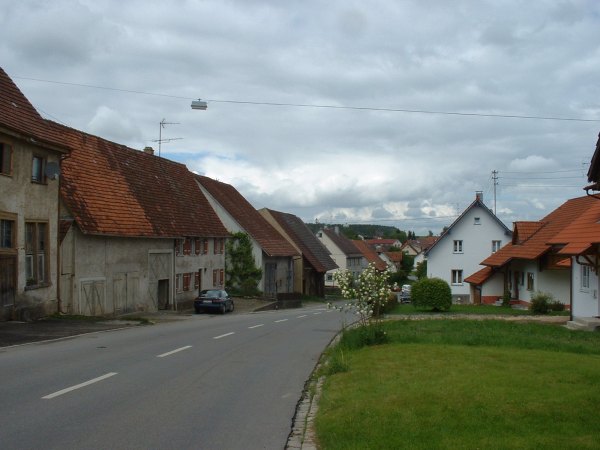
Street connecting the Upper and Lower Village of Rohrdorf – 2003

Rohrdorf consists of a long drawn-out assembly of farms and houses divided into a lower and an upper village. In the upper village we find the places where most of the social activities took place in the late 40s. There were at least two inns, a grocery store, a branch of the Credit Union, a dairy operation on the road to Meßkirch, an elementary school and the catholic St. Peter and Paul church. Our family lived in the lower village in the upstairs portion of a house, which my siblings called the ‘poor house’. Its primitive tight living quarters were a far cry from the spacious and luxurious estate in Gutfelde. Being the youngest child, I felt nothing of the stress that the other family members experienced during these difficult times of the postwar era.