Ernst Klopp (1900 – 1964) and his Family – Part 29

Karl and Adolf’s Perilous Journey March 1945

Karl’s Report – Part 4

We soon found out that the Russians were pushing hard directly to the coastline. Shots were coming out of the dunes aimed at the passers-by. German soldiers went into position and repulsed the attack, which would possibly have cut us off. Here is one impressive detail: A soldier was getting ready on the dune in the direction of the pine forest. An overly daring Russian fighter was hit and fell down and remained hanging in the lower branches. He wanted to get an overview of the scenario from the treetop.

I do not know why someone would throw bicycles into the sea. Anyway we got two of them out of the water, loaded our light luggage and moved ahead this way a lot faster. Near the water’s edge the sand was firm; only over the tidal inlets we had to lift our vehicles. The bikes were available to us for many more kilometres, until we caught in Neubrandenburg a train to Erfurt.

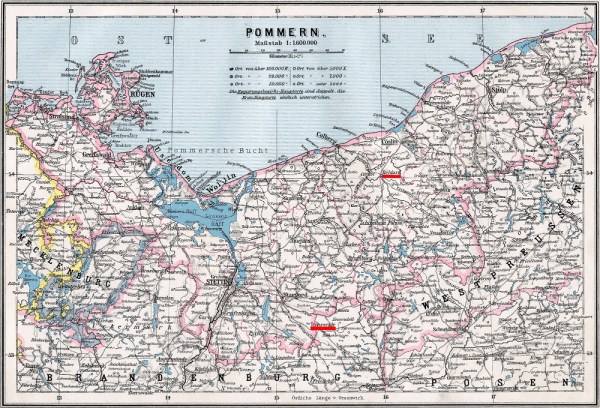
From the place, where we found the bikes, we soon reached the village of Dievenow located on either side of the arm of the Oder River, from which it got its name. On the east bank we had a major delay, because there was no bridge, but a ferry instead, which connected the ends of the old highway of the Reich I65 and which was no longer operational. The army had set up a pontoon service, which, when we arrived, was exclusively available for the troops. They consoled us civilians with the evening hours. We looked at the village. There were beautiful villas located near the beach like in so many resorts at the coast. We went into abandoned houses in search for food. The provisions we had with us had been exhausted. Where we had stayed overnight we had begged for food or often filled our stomachs at the military field kitchens. It was awkward that we had neither a tin bowl nor a spoon with us. Once we ate out of a steel helmet, the inner lining of which we had removed. In the houses of Dievenow we found very little, at most canned fruit.

In this beautiful place I should have received my paramilitary training. They were sending the male Hitler-Youth to so-called training camps, from which they were directly transferred to the troops. During our journey I always had the draft notice readily available in my pocket, but had no intention to look around and locate the camp to report for military duty.

Finally they let us two bicyclists onto a pontoon, some of which were ferrying constantly back and forth.. Now one could already hear heavy artillery fire close by. Shells hitting the water indicated that the Soviets intentionally were going to disrupt the withdrawal movements.

Much relieved we pedalled onward in a westerly direction, needed no longer to divert our march into forests and fields, but rode on decent roads. There were also organized centres of provisions through field kitchens. Also the military operations were less noticeable in the rural areas. The city of Wollin, a day’s march from Swinemünde, was only captured on May 4, 1945. We reached Swinemünde, the next city from Dievenow, already on March 12th, a date of horror in my memory.

Modern Swinemünde - Photo Credit: Wikipedia
Modern Swinemünde – Photo Credit: Wikipedia

We soon arrived at the small beach resort town of Misdroy, twelve km before Swinemünde on the main road to Stettin. We had more often heard the thunder of big guns from the direction of the Baltic Sea. The German navy, which not only carried the masses of refugees primarily from the East Prussia to safety, but was also actively engaged with its long range guns in support of the battle on land, and was shooting no-go areas against the enemy to safeguard endangered front lines. What we heard on March 12th, let the ground at a wide range shake and doors bang open and shut. The Americans and British had fooled the antiaircraft authorities by not flying in a straight line to the town of Swinemünde, but then for one hour intensively bombarded the relatively small town area. The bombing raid resulted in 23,000 dead. They rest on the German side on the Golm, a cemetery of an area of one square km. Swinemünde is Polish today.
Ernst Klopp (1900 – 1964) and his Family – Part 28

Karl and Adolf’s Perilous Journey March 1945

Karl’s Report – Part 3

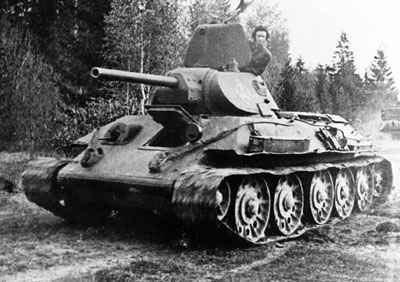
Only once did we get to know the Soviet air force. A ‘Rata’, an awkward looking, slow airplane, was shooting at the trek on the road leading to the West. Near us a woman lost her infant, whom she carried on her arm. We quickly looked for cover to evade further attacks. Once we had a chance to hitch a ride on a hauling truck, which pulled a huge artillery gun. At close range we could observe how the battery moved into position at dusk. We stayed nearby in order not miss a possible ride later on. Then it became clear what was going to happen: a tank attack in the immediate vicinity. I still remember the howling of the tank engines and the noise of the chains. In the flashes of the gun barrels I could watch the gunner load, how he slid the big, heavy shell into the barrel, stopped his ears, waited for the recoil, then picked up the next shell, about three or five times. To the right in the background I saw exploding tanks. The gun towers all-aflame flew up and to the side. The remaining tanks turned and withdrew into the night. Later on I found out that night aiming devices were in existence. I also have been contemplating, as to why I can still visualize so vividly this scene. It was the unshakable calm of the gunner and steadiness of his movements: industrial work at the machine, prepared by ‘Refa’. We were not fast enough; the battery with its three or four artillery guns had disappeared during the night.

t34_76c
Russian T-34 Tank

In one of the next days and nights we stayed in a more westerly located village. I observed a group of our soldiers, who were giving someone a lecture. One asked, “Where do you have your gun, Frenchman?” One needs to know that very many western Europeans under German occupation volunteered to be enlisted in their own units to fight against Bolshevism. The fear of being overrun from the East since the revolution in Russia was great. Almost all countries east of Germany developed into authoritarian and dictatorial regimes, Germany of course also and even more so. Thus, French people entered the German army. The scenario makes me ask: Was it German arrogance or realistic assessment of the French fighting spirit?

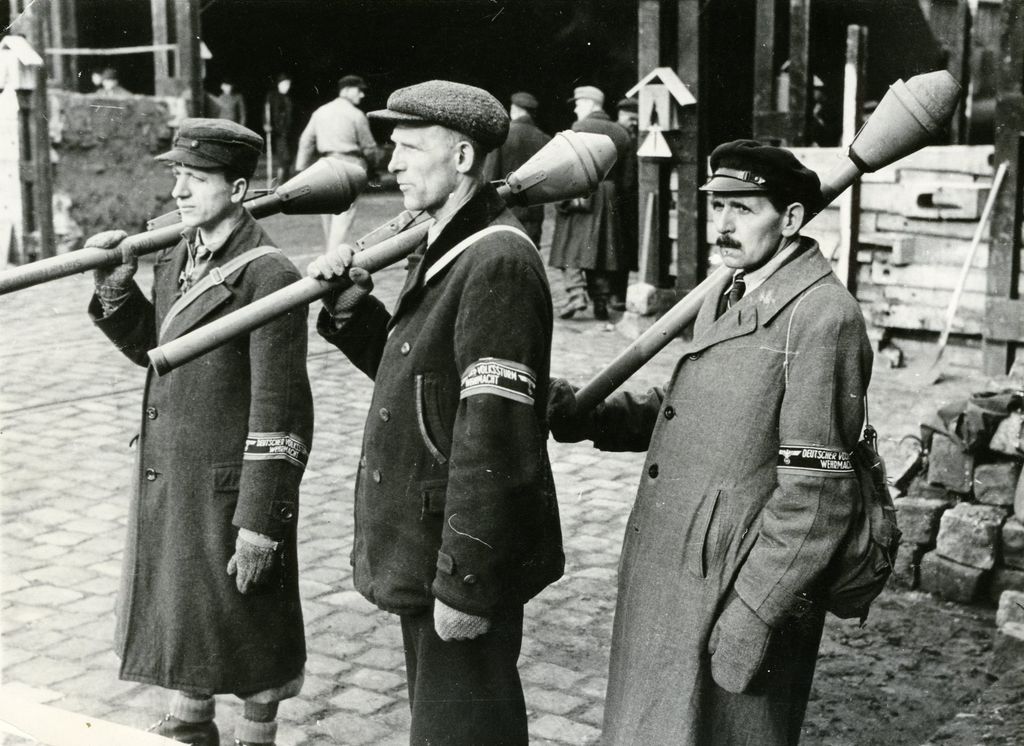
Volkssturm
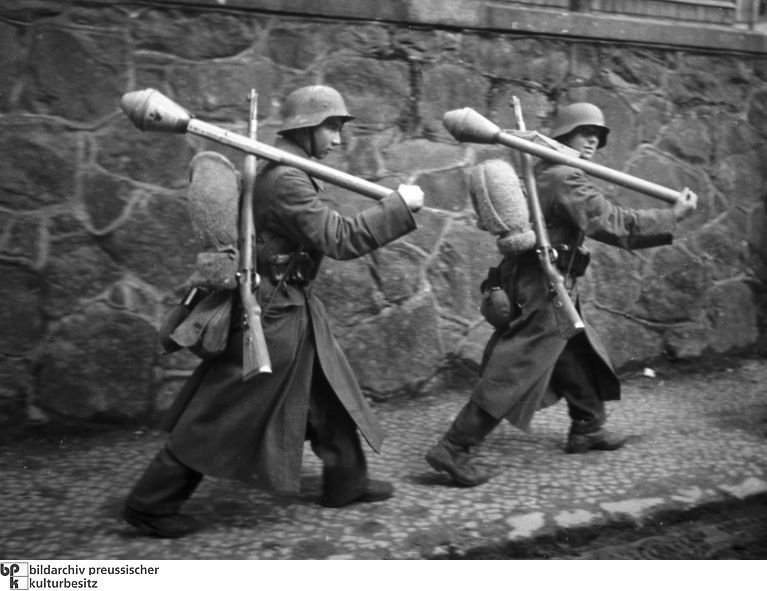
Old People Recruited to Fight – Photo Credit: Wikipedia.org

A short time later at the same spot we listened, as a battle at close range developed with the Soviet infantry. When tracer bullets were shot over our heads, we threw ourselves behind a manure pile, and we could see now close to our left and right the trails of light flashing by. The Russians were shouting “Hurrä”; in the counter offensive it was responded to with Hurrah. A German soldier lost his nerves. For several minutes he was dancing with his gun in his arm from one leg onto the other. Much later, sitting in relative safety in the train, I retold my observation to another refugee. Thereupon a sergeant severely reprimanded me, “One does not talk about these things in such detail.” The aforementioned attack therefore was repulsed. My brother and I were looking for better cover in a trench. An officer brandishing his pistol startled us and asked us to identify ourselves. He was a so-called hero-nabber (Heldenklau), whose job was to get after cowards and deserters or simply to bring the scattered bunch of his soldiers together again.

... and also Children
… but also Children

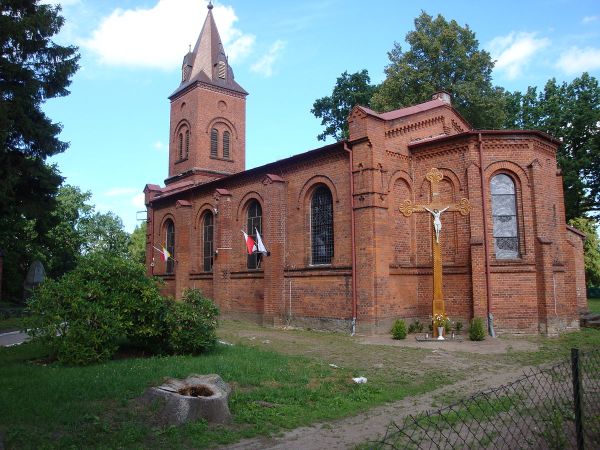
The military operations were pushing us again to the coast. Coming out of the dunes we saw an endless tapeworm of people moving west, military personnel as well as civilians, whom we joined. Soon we saw on the left the ruins of a church in the dunes. The village of Hoff lay ahead, a distance of 15 km to the eastern branch of the Oder river, the Dievenow. My grandmother had a picture of these ruins hanging in the hallway, which I had always looked at with great respect. I had spent the first two grades of my schooling in Stolpmünde. Now I saw the remainder of the church that had been destroyed by storm tides in previous centuries under such circumstances before my eyes.

To be continued …

Ernst Klopp (1900 – 1964) and his Family – Part 25

My Sister’s Ordeal

Part 3

[Here I must insert a paragraph gleaned from the City of Erfurt website which throws some additional light on the miracle of survival of my brother and sister who lived for a while in that city in Thuringia: “How close Erfurt escaped such an inferno as the city of Dresden had suffered in February, however, no one suspected, right to the top of the Nazi officials. In view of the relocation of armaments factories, Reich authorities and the military to Thuringia, the British in particular pressed for a massive bombing of the Erfurt traffic junction. The attack was initially scheduled for April 2nd and was then postponed twice. On April 4, the Royal Air Force was to launch a double attack on Erfurt and Nordhausen. 376 bombers were standing on the tarmac that morning alone for Erfurt. While the city in the southern Harz had to lament thousands of victims and the total destruction of its old town a few hours later, Erfurt remained unscathed. What happened? The US ground forces under General George S. Patton were at this time already moving towards Erfurt from Gotha, so that the Americans were afraid of bombs being dropped on their own soldiers and literally stopped the British  at the last minute.” I searched for the location of the street where my uncle lived and found that is was located very close to the city centre and the railway station. It would have meant certain death for my uncle, aunt and Erika and Adolf]. 

Cathedral of Erfurt Germany

And it was decided that Adolf and I were to join Mother in southwest Germany. The necessary papers arrived and we were on our way. The train took us close to the border and we walked the rest of the way. Two Russian border guards saw us coming and questioned us. After studying our valid papers allowing us to pass, they just tore them up. We were stunned at such injustice, after all we were 15 (Adolf) and 13 years old myself. The soldiers shooed us off, one of them pointing at his gun, in case we had any ideas of returning. We left seeking shelter behind a haystack and began to weigh our options on what to do next. Adolf wanted to return to Erfurt, but I would have none of it. I picked up my stuff carefully avoiding the guardhouse. Now a steady rain had begun. Soon I heard my brother’s footsteps behind me and I was much relieved. I don’t remember how long we walked. It seemed like a long time. By the time we got to a small railway station, we were exhausted, yet very much relieved that we were in the West. Two French border guards approached us demanding to see our papers, – no wonder, we looked like runaways. Adolf handled the situation quite well and we were allowed to board the train.

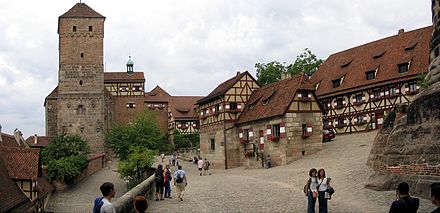
Nuremberg Germany

In Nuremberg we found the Red Cross Refugee Camp, where we received food and shelter. As we were out of money, discussing our next move, a woman interrupted us handing Adolf a bill that would cover our train fare to Meßkirch. Several kilometres more on foot and we arrived in Rohrdorf. What a relief for all of us to join our mother and the two youngest brothers again after such a long separation!

Ernst Klopp (1900 – 1964) and his Family – Part 24

My Sister’s Horrific Experiences

In January of 1945 everything came to an abrupt halt. Refugees started pouring in from neighbouring provinces, fleeing from the encroaching Russian front. They were mostly old people, women and children. There was lots of speculation about how this all would develop, some people moved westward on their own, others stayed in the city, hoping that they may return some day. The evacuation order came in early February and trains were ready to take us to safety and by now we could hear the guns in the distance. My family hesitated, there were discussions, but finally common sense prevailed. And our little group left on the last train out; later on we learned that all Russian soldiers entered the city the following day. Our train compartment was very crowded, one toilet, a small hand basin with only cold water for all of us meant long line-ups throughout the day. Food and drink were provided for our journey. The winters in East Germany are very cold, the land covered in snow, not much for us kids to see. Twice the whistle blew, the train stopped and we were ordered to step outside and move away from the train and stand still. When the whistle blew again, we were to get back on the train immediately. These were brief episodes when Allied planes came and went quickly not interested in us at all as they had bigger fish in mind. However our last stop along the way was different, as we were now ordered not to leave the train. We were all wondering what this was all about. Soon it became apparent that Dresden, the beautiful city, had been bombed, the sky was aflame to tell the story. Later we learned that thousands of people had perished, many of them at the main train station. This was the reason for us to be rerouted a day later. Our Tante Margot survived, as they were in another part of Dresden.

Dresden after the Devastating Bombing Raids

Our little group eventually made it to Mark Brandenburg, a place so far untouched by the war. Our major problem was that we were always hungry. Us older kids left daily on food-begging trips. Thus we managed to survive. Often I went on my own. Once while crossing a forested area, I came across the body of a German officer, eyes and mouth open providing a feast for tiny creatures. Another episode was more frightening. Three German teens in uniform, not knowing that the war had ended, shot dead a Russian soldier on patrol. These kids were caught and executed in the courtyard of the farmhouse where we stayed. It was horrifying to hear those shots. Another experience stands out for me. As I was approaching a large farmhouse, the hausfrau saw me coming, yelling at me to leave or she would sic the dog on me. Scared I turned to run off, when a Russian soldier took me by the arm and motioned me to follow him into the root cellar. Here the farmers kept their food. From the shelves the soldier took bread, cheese, a piece of bacon and handed me the goodies, which I put into my bag. I was out of there in no time never to come back to that place again.

Erfurt Cathedral – Wikipedia

Eventually my host family was able to contact an uncle of mine in Erfurt. He and his wife took me in and my life began to normalize again. I loved the family, the school and the beautiful city. However, I often wondered where my parents and siblings might be. My mother and the two youngest brothers were finally located. In the meantime the two older brothers also arrived in Erfurt.

Ernst Klopp (1900 – 1964) and His Family – Part 23

Report by Peter’s Sister Lavana (Erika}

The war came to an end with Germany’s unconditional surrender on May 8th, 1945. But nothing changed in Mother’s life for more than a year until early in the summer of 1946 when she was expelled along with millions of other Germans from her homeland. In a well-calculated program of ethnic cleansing all German nationals were forced to leave in order to make room for the Polish people who had been displaced in turn by the Russians in their eastern provinces. Thus, the Pomeranian lands that had once been settled and cultivated for a period of over 500 years by industrious German pioneers and farmers were put under permanent Polish administration and are now part of Poland. 

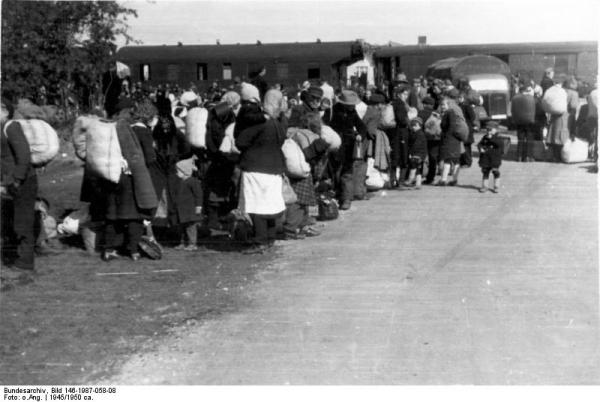
Arrival of Refugees in West Germany

By now I was a little over four years old. What I have been writing about myself, I had gleaned from Mother’s diary, from my second-generation cousin Eberhard Klopp, who did extensive research on the Klopp family going back some four hundred years, from Uncle Günther’s Kegler Chronicles and other sources. I am especially thankful and greatly indebted to my brothers Karl (died in 2019) and Gerhard  and my sister for their personal accounts of their incredible ordeals. I decided to insert them here as documents of a tumultuous period and as a testimony to their inner strength and courage without which they would not have survived.

Report by my sister Erika who adopted a new name Lavana Kilborn in the early 1980s

My Journey from 1943 to 1947

In the summer of 1943, my mother and I left by train for Hirschberg, where relatives of mine resided. As we lived in the country, it was necessary for me to move in order to obtain proper schooling. My host-family consisted of my widowed aunt Johanna, her parents and three cousins of mine, one of them being a girl, named Elisabeth and two boys. After a few days my mother returned home. 

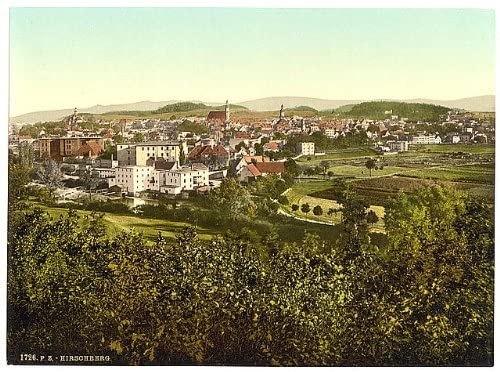
Hirschberg near Breslau,  Lower Silesia

I got along very well with my new family, in particular with Elisabeth, who was of the same age as myself. We sat side by side in school and became good friends. The beautiful city had a large swimming pool, surrounded by grass to sunbathe, play ball etc. On weekends the family would go hiking in the nearby mountains, where the source of the mighty Elbe River is located. The song “Oh du schönes Riesengebirge, wo die Elbe heimlich rinnt …” still makes me melancholic, when I sing it. We also skied on wooden skis. There were no lifts then, but how much fun it was. All these activities were new and exciting experiences for me. 

To be continued …

Ernst Klopp (1900 – 1964) Part 22

My Mother’s Ordeal in Pomerania 1945 – 1947

 While Father slaved away in a Soviet coal mine, Mother had to endure indescribable hardships. Escape across the River Oder, where the area was still in German hands, was no longer an option. The Russian troops were heading in that direction and there was heavy fighting. She was left behind at the forestry with my brother Gerhard and me and the four orphans, whom she had taken along during the arduous trek from Gutfelde. That she and thousands of other women from West Prussia and Pomerania did not despair, did not give up and did not fatalistically slip into a state of utter hopelessness gives me cause for great admiration. After the forestry building burned to the ground, Mother wandered around in search of food, shelter, and relative safety. Eventually she obtained permission from a commanding Russian officer to travel with us children to Belgard in the hope of finding my brothers Karl and Adolf. To her great disappointment she discovered that they had decided to leave school and town, when they had heard that the Red Army would be in Belgard within days.

Belgard, Pomerania (now Polish: Bialogard) – Photo Credit Wikipedia

While the town of Belgard remained relatively unscathed from the ravages of war, Mother had to suffer under the harassment and abuses of the new masters in town. In the secret treaty in 1940 between Nazi Germany and the Soviet Union Stalin had acquired control over the eastern parts of Poland and wanted to keep them in compensation for the stupendous losses in life and material during the German invasion of Russia. So he ordered the Poles to leave their homes and their farms and settle in the German provinces east of the Rivers Oder and Neisse.

Pomerania, now part of Poland

Now in an ironic reversal of roles, the Poles were now the masters of former German farms and exercising control over the towns and cities. For the Germans, who wanted to stay or could not escape in time, it was now their turn to experience harassment and abuse. Mother refused to be forced into a role in which she would lose her dignity, especially, as it often occurred, if she felt that she was confronted with injustice. She knew about the century old animosity between the Russian and the Polish people. So whenever she felt that the Polish authorities had unfairly treated her, she would go straight to the Russian officer in charge of the district and complain about the incident. To her great satisfaction she received justice ironically from the hands of an enemy officer.

Apart from her inner strength that allowed her to show courage where others would have meekly knuckled under, one must also consider the fact that Russian officers had a heart for the plight of little children. One could dismiss this thought as stereotypical and sentimental bias, if what Mother had experienced in Belgard with the six children in her care had been an isolated case of kindness. But such tender feelings on the part of Russian soldier had been documented so frequently as to attest to their truth.