Walter Panknin (1898 – 1977) and His Family Ch07 Part 11

More Steps to Climb

Three stories from the apartment of the Panknin family was the communal laundry room located another staircase down in the basement. The management set up a schedule to regulate its usage to avoid congestion and quarrels among the renters. Each apartment unit could only use the laundry room at a given time and day of the month.
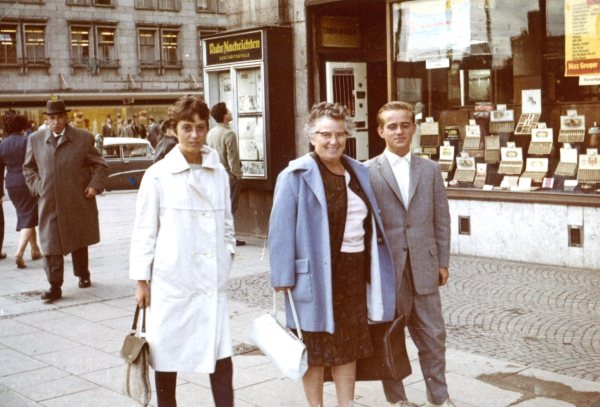
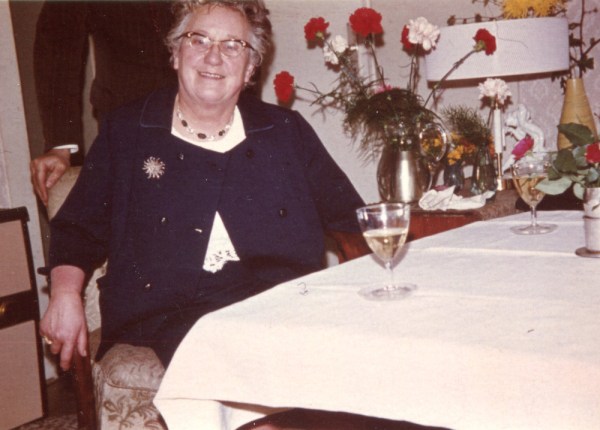
Mutti Panknin and her Twins Gertrud (Biene) and Walter Jn. 1962

So in addition to the shopping routine, Frau Panknin climbed down the three flights of stairs with a heavy load of clothes. In the early 1960s, many women still washed their clothes by hand. Coin-operated washers and dryers were unknown during the post-war years in Germany. For Frau Panknin, the task was laborious and time-consuming. But the worst part of the laundry was yet to come. She packed the wet wash into the basket. Climbing up the stairs with a load now twice as heavy as before, she frequently stopped on the way up to catch her breath. When she finally reached the top floor, there were more stairs to struggle with to get to the attic, where she hung up the clothes to dry. The reader may be inclined to say. Doing this exhausting chore a few times per month was not all that bad for the sixty-year-old housewife. After all, she would have the rest of the time to relax and recover from all that hard work. But wait before we jump to a conclusion.

The apartment had no central heating. The cost of electricity was and still is very expensive in Germany. To heat your home with coal as a source of heat, however, was relatively cheap. Like all the apartment dwellers, the Panknin’s had a small lockable storage facility, where all the things for which there was not enough room in the apartment would be stored. That was also the place where the coal for heating and cooking was located. When I look back some sixty years and ponder about a fair division of labour for this family of four, I must say that it was shocking to learn how Frau Panknin took on this burden without the help from the twins or her husband.
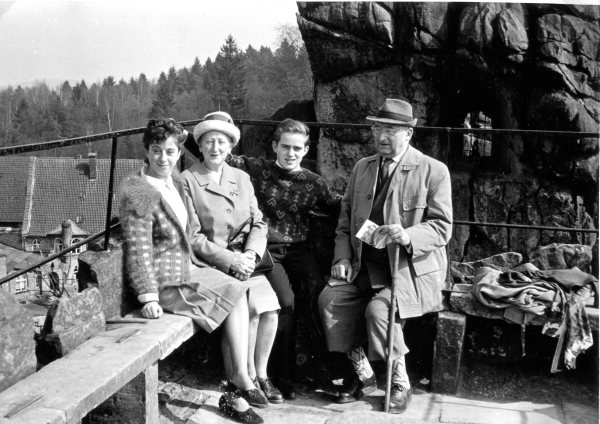
Walter Panknin (1898 – 1977) and His Family Ch7 Part 10

Papa the History Buff

During his time as a POW in 1945, Papa attended many scholarly lectures that some learned fellow prisoners gave in open-air forums on various topics. As writing was strictly forbidden, he secretly wrote down on the tiny sheets of cigarette paper the authors of books recommended by the lecturers. He was especially interested in history books, which he intended to read later. Fifteen years have passed. Now the time has come to fulfil one of the dreams he had for his retirement. Among the history authors, he admired the famous 19th-century historian Leopold von Ranke the most.  He especially liked the quote that underlines the importance of objectively presenting historical events: “Let the author be quiet, but let the events and documents tell the story.” Proudly Papa wrote in a letter to his friend Herr Kampmann that he had already devoured eight of Ranke’s twenty-five volumes.

The correspondence with his pen pal mainly dealt with political issues of the German postwar era. He drew the most relevant information and its polemic spirit from the German news magazine “Der Spiegel.” Its claim to fame was the publisher’s uncanny ability to uncover and publish government secrets, cases of corruption and scandals. Major Panknin, in retirement, wrote his multi-paged letters on his old typewriter, using carbon paper to have copies for his record. They fill binders carefully ordered by year, month and day. The letters reveal his critical view of the West German political landscape. They describe his disgust over how deep his beloved Germany has sunk into the quagmire of dishonesty and scandalous behaviour. His diatribes take on a familiar ring when we fast forward into the 21st century.

Did I digress from telling the Walter Panknin family story? Having Ranke’s quote in mind, I declare, “Let Papa’s immense correspondence and insatiable appetite for reading history books and historical novels tell the story.”

Walter Panknin (1898 – 1977) and His Family Ch7 Part 09

The Sunset Years

Before the ‘golden years’ arrived, the division of labour was fair for both husband and wife. In the following posts, I will talk about the injustice of the heavy burden for Frau Panknin as a mother, housekeeper, cook, and wife. I will also show how much, on the other hand, Papa enjoyed his sunset years as a father, hiker, traveller, hobbyist, and history enthusiast.

Grocery shopping has drastically changed since the early 1960s. Nowadays, well-to-do families living in their homes or modern high-rise apartment buildings take the elevator down to the ground floor, step into their car and drive to a nearby shopping centre. After they are done shopping, they may have time to dine in a family restaurant and take the kids to a bowling alley or the movies for some weekend entertainment.

Elisabeth Panknin on her 60th Birthday – 1960

Sixty years ago, in the little town of Velbert, Elisabeth Panknin went shopping at least twice a week. She takes two large cloth bags and descends the 120 steps down to the ground floor of the three-story building. The tiny neighbourhood corner store only carries bare essentials, like bread, milk and butter. Frau Panknin takes the bus to a larger city. She only buys as much as she can carry. Public transportation poses a problem when the bags are filled to the hilt, and there is no seat for a sixty-year-old woman in an overcrowded bus reeking from the nauseating fumes of cigarette smoke. It is also time-consuming. If you miss the bus, you may have to wait up to an hour to catch the next one. Mutter Panknin finally stands at the entrance of the apartment building. Huffing and puffing, she climbs up the staircase with the two heavy bags of groceries. Then, you will not believe this. She immediately starts cooking the evening meal for her husband and the twins Gertrud and Walter.

Walter Panknin (1898 – 1977) and His Family Ch7 Part 8

The Turning Point

In late 1960, shortly before Christmas, a letter from the highest state court arrived at the Panknin residence with the long-awaited good news. Their request for Papa’s pension and the refugee status associated with all the rights and privileges had been granted. However, having battled for seven years with the various government agencies, they had paid a high price. Frau Panknin had been travelling by bus and train to talk to the officials in person. At the same time, Papa Panknin did the massive paperwork to make requests and provide written proof to the authorities. One day, Elisabeth Panknin collapsed from juggling the nerve-wracking travels and her housekeeping chores at home. Papa had to write the Christmas letters to all their relatives and friends, as his wife was too weak to do so. Fortunately, Mutti recovered just in time to prepare the Christmas dinner for the family. After over ten years, they could finally sit down on Christmas Eve and enjoy feasting on a sumptuous goose dinner with all the trimmings.

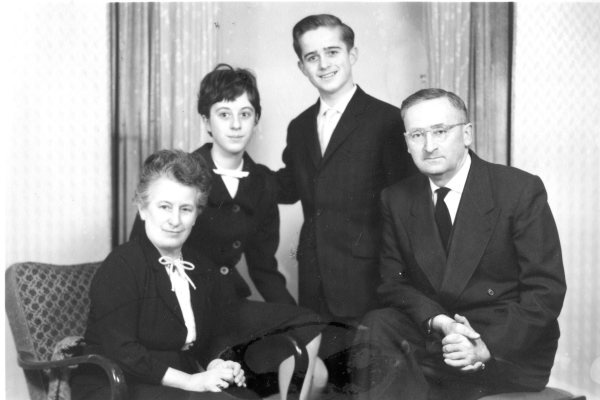
From left to right: Elisabeth, Gertrud (Biene), Walter Junior, and Walter Panknin 1960


The celebration of their victorious battle with the West German bureaucracy marked the end of their financial woes. It also turned out to be the end of their workload’s fair and equitable sharing. Up to this point, the couple had performed their domestic and professional duties along traditional lines. Papa, as a police officer, worked under highly stressful conditions under the Nazi regime, while his wife, in charge of their beautiful home, lovingly took care of the children. In those days, it was rare in most societies to have the predefined roles of husband and wife reversed. Today, it is very common, especially in Western societies, for a wife with higher qualifications to go out to work and leave the nurturing of the children to the father. Unfortunately, the basic things of life, such as shelter, food, and transportation, have become so expensive that both need to provide an income to make ends meet. They have to entrust their children to others all too often at an exorbitant price.
Coming back to my father-in-law, I believe that he was so deeply rooted in the culture of a bygone era that he, without any qualms, left the entire burden of the household to his wife while he was experiencing to the fullest extent the joys of early retirement.

More details in the next post …

Walter Panknin (1898 -1977) and His Family Ch7 Part 5

The Judiciary That Sentenced 50,000 People to Death

Walter Panknin’s Fight for Justice – Part 2

I chose the title from the West German News Magazine as the heading for this post. It confirms what my father-in-law had described in a letter to a friend. The title reveals a dark chapter in the judicial system of postwar West Germany. The article, as quoted in the previous post and continued here, is an eye-opener for the legal battles Herr and Frau Panknin had to fight in their struggle for justice.

“Now the halls of justice were even staffed with judges who had once served on the Nazis’ People’s Court (Volksgerichtshof), which was set up in 1934 to handle “political offenses” and became notorious for the frequency, arbitrariness and severity of its punishments. Nevertheless, the civilian courts handling the de-Nazification process merely classified them as “hangers-on.” In 1953, at least 72 percent of judges on the Federal Supreme Court, Germany’s highest court for criminal and civil law, had former Nazi connections. The number increased to 79 percent by 1956 and, in the criminal division, it was at 80 percent by 1962.”


Now we understand the anger and frustration my in-laws experienced for more than five years. Poor Papa Panknin, having demonstrated and documented through his actions before and during WW2 his anti-fascist position, encountered, in an ironic twist of fate, one humiliating rejection of his applications after another. The former Nazi judges were back, making ideologically motivated decisions. In Papa’s correspondence, I found names such as Franz Schlegelberger – Minister of Justice (1941 and 1942), Hans Globke (he participated in drafting the Nuremberg race laws), and Theodor Oberländer – as an academic laying the foundation of the Final Solution. Many were found guilty in the Nuremberg trials, and some were sentenced to life imprisonment, then released after a few years, going into judiciary service or early retirement with a pension six times higher than the average worker in the Federal republic.

https://www.spiegel.de/international/germany/from-dictatorship-to-democracy-the-role-ex-nazis-played-in-early-west-germany-a-810207.html

https://en.wikipedia.org/wiki/Franz_Schlegelberger

https://en.wikipedia.org/wiki/Hans_Globke

https://en.wikipedia.org/wiki/Theodor_Oberl%C3%A4nder

Walter Panknin (1898 – 1977) and His Family Ch7 Part 4

Walter Panknin’s Fight for Justice Part 1

Bit by bit, in an all-out power grab, the Nazis were taking control of the various institutions, such as the justice system, local and regional police forces, the banks, as well as the army, navy and air force. In a letter to the Minister of Interior Affairs in 1959, Walter Panknin wrote that membership in the NSDAP was mandatory for every police department in Germany. At a time when even foreign ministries initially recognized the legitimacy of the Nazi government, Papa Panknin was forced to join the party in 1934. However, he resisted joining the SS that all the higher-ranked officers were expected to become part of. Despite a barrage of threats and chicaneries, he steadfastly refused to become part of the infamous SS or to quit the Lutheran Church of Germany. Most officers in the armed and police forces had incredible advancements waiting for them, climbing up the rank ladder at a great speed, especially after the start of WW2. My father-in-law never moved any higher than his actual rank of captain during the entire war years. He had to take a punitive transfer to a battalion stationed in Croatia, which turned out as a blessing in disguise. (see chapter 3).

Herr Panknin described, while dealing with the federal and provincial government departments, his battles in army-like terms, his quest for justice. He fought a paper war on many fronts:  

  1. His right to fair and equal treatment as a former officer of the regular armed forces compared with officers of the former members of the SS of the same rank,
  2. Recognition of his refugee status C, which was denied because, as an anti-fascist, he had no reason to leave the Soviet-controlled Zone of East Germany as he was told,
  3. Entitlement to a Pension as a former officer or at least granting a meagre old age pension, 
  4. Compensation for the well-documented bicycle accident in the early 1930s (somewhat like the BC Workmen’s Compensation Board), which he was eligible to receive and did not get.
Papa Panknin

The reason why Papa Panknin and his family had so much trouble  finding justice in West Germany as a refugee from the former German Democratic Republic can be found in an article published by the German News Magazine ‘Der Spiegel.’

“Roughly 80 percent of the judges and prosecutors who had served Hitler’s regime of terror until May 8 were soon dispensing justice once again — but this time in the young Federal Republic. “Perhaps there is truly evidence,” wrote Nazi expert Jörg Friedrich, “that a constitutional state can stand on a judicial mass grave.”

In the misery of the postwar era, lawyers were urgently needed. Although the crime rate skyrocketed in the era of black markets and refugees, there was a shortage of judges to hear cases. To make up for the deficiencies, the occupiers of the western zones appointed judges who had retired before 1933, or they hired lawyers untainted with Nazi connections. Starting in October 1945, the British practiced the so-called “piggyback procedure” in the recently established judicial administration: For each judge without a Nazi past, one judge with former Nazi connections could be appointed. But, by the summer of 1946, even this restriction had been dropped.

To be continued …