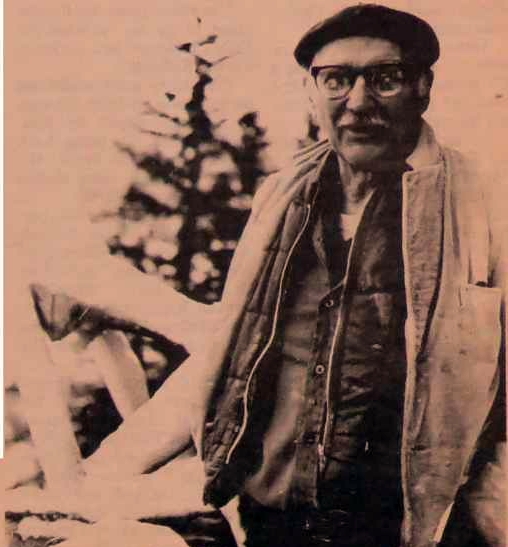
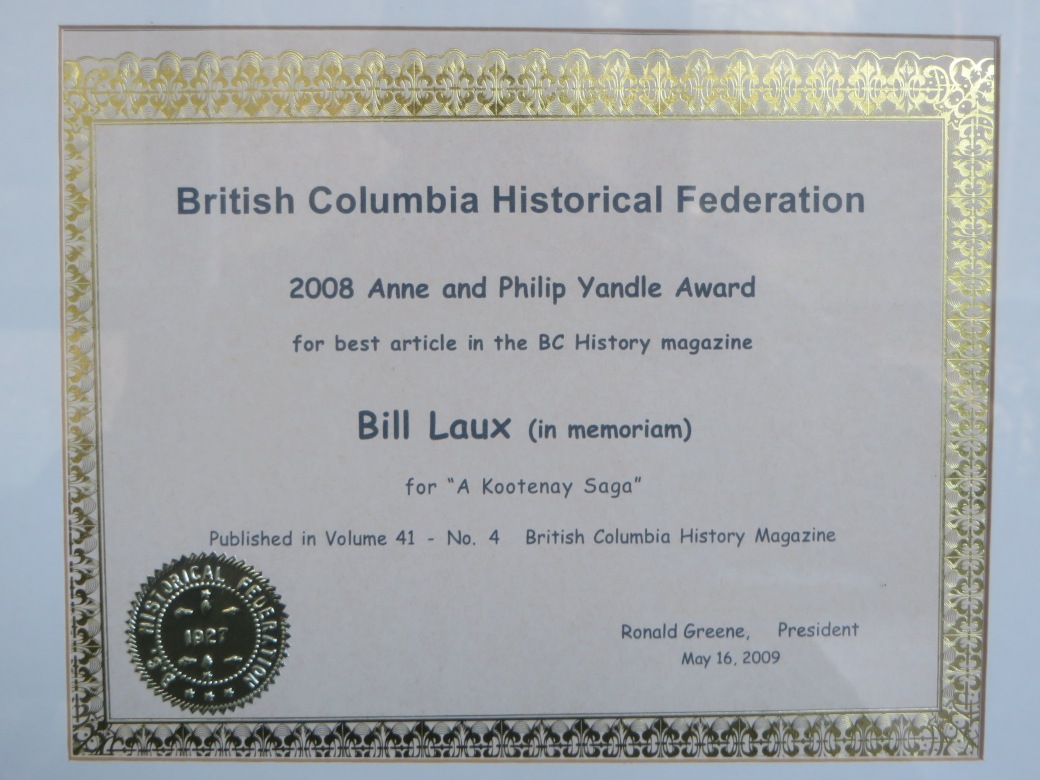
For information on the author search for Bill Laux on this blog.
STEEP AND CROOKED:
THE MINING RAILROADS
OF
THE CANADIAN BORDER
By
Bill Laux
INTRODUCTION
In the last decade of the Nineteenth Century, the discovery of three successive copper-gold bonanzas along the international border between Washington and British Columbia, brought the railroad builders of the Northwest into a fierce rivalry to get their tracks to the new camps and control the traffic in ores, coal and merchandise.
The mining potential of the Kootenay country in southeast British Columbia had been known since the 1840s. The voyageurs of the Hudson’s Bay Company had been shown the lead deposits on the shores of Kootenay Lake by the local Indians, and for years had melted down those silver-rich ores on wood fires to cast bullets for their muskets.[i]
The Big Bend gold strike of 1864 on the Upper Columbia in British Columbia attracted the attention of Captain John C. Ainsworth of Portland, Oregon and the Oregon Steam Navigation Company. The Oregon Steam Navigation Company had a near monopoly on steamer transportation on the Columbia and Snake Rivers and Captain Ainsworth was determined that any development in Interior British Columbia should be made tributary to Portland merchants through his steamers. He therefore financed the building of the small sternwheel steamer, Forty Nine, (named for the Forty Ninth Parallel, the international boundary), at Marcus, Washington Territory. By the next year, 4000 miners, mostly Americans, were at work, washing the gravel bars of the Big Bend. All were supplied by Captain Leonard White and the steamer, Forty Nine.[ii] The Big Bend boom fizzled out in a few years, and with no one to hire her, the Forty Nine was beached.
The next effort to exploit Kootenay minerals came in the 1870s when Henry Doan, a Colville prospector, claimed to have a deposit of very rich ore on the shore of Kootenay Lake. It was actually that same deposit the Hudson’s Bay fur traders had been exploiting for their musket bullets. Doan sent what he claimed was a sample from his deposit to George Hearst (later Senator) of San Francisco. In fact it was not.; it was high grade silver-lead ore, probably from Colorado. Hearst came north by train, steamer, and stagecoach to Colville, and engaged Albert Pingston,[iii] mate of the Forty Nine, to take him, Doan, and an assay outfit to Kootenay Lake by rowboat. Pingston rowed the party up the Columbia from Marcus to the mouth of the Kootenay River. During the long portage around the falls and rapids of the Kootenay, Doan secretly proposed to Pingston that he should “lose” the assay outfit so that Hearst would not be able to make any tests on the deposit Doan was going to show him. Pingston indignantly refused, and brought the two men and the assay kit successfully to Kootenay Lake. Hearst, on testing the ore, saw that he had been duped; it did not resemble the sample sent to him. Furious at having come all the way from San Francisco, Hearst refused to let Doan into the boat for the return. He proposed to abandon the man there on that wilderness lake. Pingston told Hearst, “You can go and thrash him if you like but you cannot leave him here to starve and you must let him come back in the boat to where he can get something to eat.”[iv]
Pingston was concerned more for his reputation than for Doan. There was a tradition on the Upper Columbia that one never left a penniless prospector on the beach in that wild and empty country. Hearst went back to San Francisco, damning the Kootenay and its scoundrelly prospectors.
Captain Ainsworth, however, was still interested. The Northern Pacific Railway would be been completed in 1883 putting Kootenay minerals within reach of a transcontinental railroad. Small quantities of rich silver-lead ores were beginning to come out of that country by boat to Bonner’s Ferry and from there by pack-horse to the Northern Pacific at Kootenay Station (a few miles east of Sand Point). A party of his people, including his son, George, made their way into the Kootenay and visited the small mining camps that were springing up on Kootenay lake in 1882. They staked some claims, laid out a townsite called “Ainsworth,” (still in existence), and proposed a portage railway around those falls and rapids in the lower Kootenay River so that a rail and steamer service could link the area via the Columbia River to Portland.[v] To that end, Captain Ainsworth had, the year before, commissioned Albert Pingston to make a survey of the Columbia River from Wallulla to its confluence with the Kootenay, to see if a through steamer service would be feasible. Pingston reported that with three portage sections, boats could navigate the Columbia as far as Rickey’s Rapids (below Kettle Falls) “for 2/3 of the year.” However, a portage railway would definitely be needed around the twenty foot drop of Kettle Falls.[vi]
Ainsworth lobbied the U.S. Congress for the navigation improvements Pingston had recommended. Congress sent out Lt. Symons in the fall of 1881 to repeat Pingstone’s survey, and report on what engineering works might be necessary.[vii]
To get a charter from the B.C. Government to build the portage railroad, it would be necessary for Captain Ainsworth to present the project as a thoroughly Canadian plan to keep the Kootenay trade for B.C. merchants. Accordingly, Ainsworth went to Victoria posing as a friend of Canada.
Captain Ainsworth’s plan was to construct a wagon road from the head of navigation on the South Thompson River over Eagle pass to the Columbia River at Big Eddy (Revelstoke). He promised the legislators that he would then put his steamers on a route down the Columbia and through the Arrow Lakes to the mouth of the Kootenay River. Here he would build a forty mile portage railway to Queen’s Bay on Kootenay Lake. This “All Canadian route” would secure the Kootenay trade for the B.C. merchants.
The B.C. legislature, alarmed by the rumor that the just completed Northern Pacific was planning to tap the Kootenay Lake trade with a branch from Sandpoint to Bonner’s Ferry on the Kootenai River, gave Captain Ainsworth his charter and a wildly generous land grant of 750,000 acres of Kootenay land. Only when the charter was submitted to the Dominion Parliament for approval, did someone actually look at a map.[viii] What the Federal Railway Commissioner saw, was that Kootenay traffic, moving down the portage railroad to the Columbia, could just as easily move south, down the river into Washington and on to Portland via the canals and portage railways Congress was expected to authorize. The Dominion Government therefore disallowed the B.C. legislature’s charter, creating outrage in the Province. In an attempt to resolve the bitter conflict following, the whole affair was thrown into the courts to wind slowly through their procedures for seven years. Eventually the Ainsworth syndicate, getting nowhere in courts, sold their charter to the Canadian Pacific Railway, which satisfied both the Dominion Government and most British Columbians.
The completion of the Northern Pacific in 1883 was bringing the era of steamboat transportation on the Middle Columbia to a close.[ix] Captain Ainsworth sold his Oregon Steam Navigation Company to the new Oregon Railway and Navigation Company. The American Congress took note of this and failed to vote any new river improvement projects for the Columbia. Railroads, not dredged waterways, were to be the new mode of access in the Northwest.
As the new railway era opened in the Northwest, it was Daniel Chase Corbin, a Spokane mining and railroad investor, who was the first to lay tracks toward the Kootenays. The Northern Pacific was receiving ores from the Kootenay Lake mines via a laborious wagon haul from Bonner’s Ferry to Kootenai Station. Corbin’s plan was to run his rails all the way to Kootenay Lake via Colville, the Columbia and Salmo rivers. His survey included, as a branch, Captain Ainsworth’s portage railway for steamer traffic around Kettle Falls, just in case Congress changed its mind. Corbin began building his Spokane Falls and Northern Railway in 1890, and reached Colville that year. The following year he had his rails to Little Dalles, a steamer landing, on the Columbia, seven miles north of Marcus.[x] From Little Dalles he had navigable water all the way to the Canadian Pacific main line at Revelstoke.
Corbin joined forces with a syndicate of Kamloops, B.C. businessmen who had organized the Columbia and Kootenay Steam Navigation Company to link the two transcontinentals with a sternwheel steamer service from Revelstoke to Little Dalles.[xi]
Corbin kept his track layers moving north. In 1893 his rails crossed the border at Waneta and climbed Beaver Creek to a low pass leading to the Salmo River. From the headwaters of the Salmo his graders laid the line steeply down Cottonwood Creek to reach Kootenay lake 5 miles east of Nelson. But her he found himself blocked by William Van Horne ofthe mighty Canadian Pacific.
The CPR was in no position to build a new rail line into the Kootenays from Alberta. It was still paying off its construction debt and was financially cripples by having to rebuild hundreds of miles of line washed out by the great flood of 1894 in B.C. However, it had Captain Ainsworth’s charter for that portage railway around the falls in the Kootenay River. Van Horne believed that by building that portage railway and buying the CKSN steamship company he could control Kootenay traffic by rail and boat service to the main line at Revelstoke. He had also committed to the CPR building at some future time, that rail line in from Alberta over Crowsnest Pass. To secure that right of way and to block Corbin’s line from entering Nelson, Van Horne had the B.C Government declare a “Canadian Pacific Railway Reserve” along the south shore of Kootenay Lake.
Corbin, blocked out of Nelson, simply ran his tracks down to the water where freight and passengers would transfer to a steamer for the five miles to Nelson.
The lure of a substantial mining and coal traffic now brought James J. Hill and his unfinished Great Northern Railway into the contest. His Great Northern was to run through Bonner’s Ferry, from which a boat service down the river to Kootenay Lake would give him access to the new mining districts there at Ainsworth, Nelson and Bluebell.
The entry of J.J. Hill alarmed his bitter adversary, William Van Horne, President of the Canadian Pacific. As Hill had patiently built his Great Northern across the Dakota and Montana prairies, he had run feeder lines up to the border to siphon off Canadian traffic. Van Horne knew he had to preempt the Kootenays for the CPR or lose them to the aggressive J.J. Hill. He sent his surveyors out to locate a line from Lethbridge, Alberta to Hope, B.C. through the mineral-rich Kootenay and Boundary country. They reported back that such a line was possible, but would be difficult and very expensive to build. Jim Hill countered this by incorporating the Bedlington and Nelson Ry. to connect at the border with his American branch, the Kootenay Valley Ry running up from from his main line at Bonner’s Ferry.[1] When built,that line would put Great Northern steel on Kootenay Lake. Van Horne had no choice. His rail steamer service was summer only. When the Arrow Lakes froze each winter, service had to be suspended until spring. Van Horne began laying track through Crowsnest Pass to enter the Kootenays in 1898.
With the three great Captains eying the increasing rich Kootenay mines, and each intent on seizing the traffic for his railroad, a serious clash was imminent. It came in the 1890s when three great gold-copper bonanzas of international importance were uncovered along the border, at Red Mountain and Phoenix in British Columbia, and at Eureka Creek in Washington. Now the railroad wars were on. Daniel Chase Corbin, William Van Horne, James Jerome Hill, and a newcomer, Frederick Augustus Heinze, a 26 year old American mining millionaire, were all determined to put their own rails to the new mining camps. In the ensuing struggle to control the mineral traffic, seven steep and crooked mining railroads were built from the main lines. Each of the now four great captains was determined to put his tracks to the mouth of every substantial mine to freeze out the other three. Engineers were called in and tracks were laid, competing sets of them, switchbacking up dangerously steep grades, over towering wooden trestles, and around cranky curves to mouths of the mines themselves. Mine owners, finding two competing sets of tracks at their loading bunkers, bargained for lower and still lower rates. The railroads, fighting for the ore hauls, dropped their rates to cost. And then to below. At 75 cents a ton, even low grade ores, discarded as uncommercial, could be shipped to the smelters, and the great boom was on
.
This is the chronicle of those seven small railroads through their short and contentious lives from 1896 until 1921.
NOTES TO INTRODUCTION [i] Letter of Archibald Mc Donald, HBC factor at Fort Colvile (not “Colville”), to James Douglas, Governor of the Colony of British Columbia, September 29, 1844. It is quoted in Edward L. Affleck, Kootenay Lake Chronicles, (Vancouver, 1978), p. 33.
[ii] Affleck, Columbia River Chronicles, (Vancouver, 1976), p. 49 & 58, note 4. Letter from Magistrate Haynes at Osooyoos to Colonial Secretary, August 11, 1865, “A steamer is now being built near Fort Colville by a company represented by one Captain White, which will, I am told, be ready to start in about six weeks. I would beg for instructions as regards U.S. steamers running up here.” Quoted in Affleck, op. cit., p. 54, note e.
[iii] The name is spelled “Pingstone” in the US and “Pingston” in Canada.
[iv] Related by William Fernie in a letter to S.S. Fowler, manager of the Bluebell mine, in 1909. Quoted in Affleck, Sternwheelers, Sandbars and Switchbacks, (Vancouver, 1973), p. 8. Fernie was an early Kootenay settler and trail builder.
[v] Affleck, Kootenay Lake Chronicles, pp. 25 – 26.
[vi] Albert Pingstone, A Memorial to Captain John C. Ainsworth, n.d. in WSU library, Pullman.
[vii] Symons’ Report, Sen. Ex. Doc. No. 186, 1st Session, 47th Congress.
[viii] Affleck, Columbia River Chronicles, p. 125.
[ix] In British Columbia, “Lower Columbia” meant that part of the river in the U.S.; the “Upper Columbia “ designated that part of the river inth Rocky Mountain trench, above Boat Encampment. In Washington State “Lower Columbia” meant the part of the river from Portland to the Pacific, “Middle Columbia” referred to the river from Portland to the confluence with the Snake, and the “Upper Columbia” meant the remainder of the river in both countries.
[x] Fahey, Inland Empire, p. 10 Affleck, Sternwheelers, Sandbars and Switchbacks, p. 18.

 The Peter and Gertrud Klopp Family