STEEP AND CROOKED … by Late Writer, Artist & Castle Builder Bill Laux

THE MINING RAILROADS OF THE CANADIAN BORDER

 By Bill Laux

CHAPTER FOURTEEN

TWO RAILROADS; FIVE SMELTERS 1905 – 1921
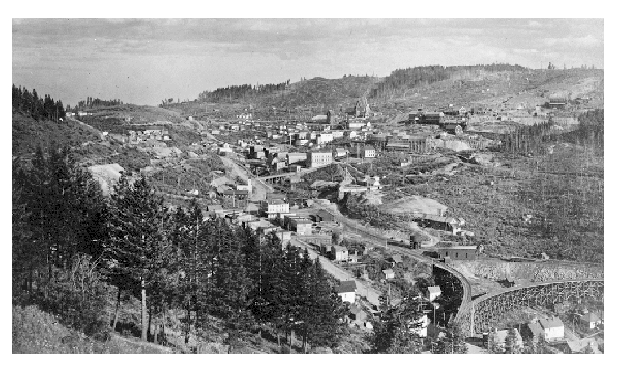
Phoenix,_British_Columbia

Phoenix BC 1905 – Once the Highest Town in Canada (4610 ft)

Having bought Granby for $4.00 a share, William Nichols and his associates in the copper refining and marketing business, got up a special train and traveled west to see for themselves what they had acquired.   At Grand Forks, Jay Graves, Stephen Miner, and Aubrey White toured them through the smelter.   Then the CPR put on two locomotives and pulled their train up the steep grades to Phoenix where they stepped out in the highest town in Canada at 4610 feet.   There they were shown the claims and the producing mines of the company.   These were knowledgeable men, and they were enthusiastic at what they saw.   Analyst Stanton admitted, “Nowhere have I seen superior methods.”   J.B. Hereshoff, perhaps a rendered a bit light-headed by the elevation, rhapsodized, “…a magnificent, monotonous mass of homogeneous ore…”

These men, now his bosses, instructed Jay Graves to do two things.   First, pay a dividend.   Second, do more development work to determine precisely how much ore they had.   He did both.   A modest dividend was forthcoming, and he had his men begin a tunnel from the 4400 foot elevation at the foot of Church Street in Phoenix, to burrow under the town and tap the ore body 400 feet beneath its discovery point.   He ordered that the shaft from the Victoria be deepened as well, to meet the tunnel on the 400 foot level.   Then crosscuts were to be made to explore the ore body from end to end and side to side to discover its extent at the deep levels.

Eholt had become a busy railroad town with a five stall roundhouse, five tracks, four hotels, 25 houses, and half a dozen commercial establishments.   Switchers bustled around the small yard day and night, making up cuts of cars for the five smelters the mines were serving, the Granby in Grand Forks, the B.C. Copper in Greenwood, the Dominion Copper in Boundary Falls, the Trail smelter and the Northport smelter.

For passenger service to Phoenix , the CPR ran a mixed train from Eholt.   The ten mile trip uphill took 50 minutes, but downhill, with a heavy train of ore cars and the passenger car trailing, the time was an hour and twenty minutes, though the timetable suggests otherwise.   Mixed trains were obliged to stop and cool brakes on the way down, and limited to ten miles per hour.   Pure passenger consists could keep the published schedule.

The 1:55 PM train leaving Eholt boarded passengers from westbound CPR train No. 41 from Grand Forks, Robson West, Castlegar and Nelson which had arrived at Eholt at 1:55 PM.   Obstreperous miners returning from alcoholic and other endeavors in Grand Forks could be a problem on the trains.   Conductors learned to turn the train heat control wide open.   In ten minutes, they reported, the cars would be hot and the miners snoring peacefully.   Awakened in Phoenix, they would be bundled out into the cutting mountaintop winds to find their way to the “Rampasture,” their name for the Granby Company’s large employee boarding house at the top of Second Street.

With the steep, 3.4 percent grade and 600 tons of ore behind the locomotive, a brake failure on this line could be disastrous.   On the 23rd of August, 1904, Shay 1901 (formerly No. 111 from the Rossland branch) lost train brakes half a mile above B.C. Junction.   Engineer Alf Kenward and Fireman Charlie Haggart jumped and escaped injury, but the Shay left the tracks at the curve just above the Oro Denoro mine and the following ore cars piled up on top of it.   Fortunately, this was not the afternoon mixed; no passenger coach was attached.   So imperative was it to restore service at once, that a short trestle was built around the wreck and traffic went on while the mess was cleaned up.   It was crucial not to interrupt the flow of ore to the smelters, as shutting down the furnaces and restarting them was both costly and shortened the life of the furnace linings.     Shay 1901 was repaired and put back into service.

On February 2, 1907, CPR Consolidation No. 1384 with a heavy train of ore wrecked a short distance below the Rawhide mine when it spilled a switch.

The VV&E had its share of wrecks as well.   On Sept. 20, 1909, both the engineer and fireman were killed at Phoenix when their locomotive overran the tail of switchback and rolled down the mountainside.   Just one month later, Engineer McAstocker was killed and Fireman Beatty injured when their locomotive derailed and rolled coming down the 2.2 percent from Phoenix.   Snow on the rails was believed to be the cause.   1909 was an unlucky year for trainmen; a week after the VV&E wreck just mentioned, CPR engine No. 1385 running light, Phoenix to Eholt, left the rails just below B.C. Junction and rolled.

The VV&E service did not require a change of trains.   Still, it was one hour, 25 minutes, Grand Forks to Phoenix, and one hour, 20 minutes, Phoenix to Grand Forks.   These were mixed trains, trailing a coach behind the ore cars, with a stop for water at Hale, and on the downhill run, one or more stops to cool brakes.   Weston station served West Grand Forks, the former Columbia.   The Spencer flag stop served the Athelstan and Jackpot mines, as the CPR spur line to them did not have passenger service.   The Hale flag stop served the Summit Camp including the B.C. Copper mine.   Glenside served the Tiger mine.

By 1905, Granby and the Phoenix mines were in full bonanza.   Jim Hill himself came out by special train on those VV&E tracks that had cost him so much ire and invective to build.   His seven car train came snorting up its spiral grade to Phoenix.   Down from its platform stepped the short, broad, and scowling Cyclops of St Paul.   Behind him came a hunched Jay Graves and a young and athletic George Baker Jr. who danced about in a series of hopping and arm swinging Swedish exercises popular at the time, all the while praising the invigorating qualities of mountain air.

While Director Baker danced and inhaled his mountain air, a driving rain commenced, and J.J. Hill, watching these antics without comment, allowed a company slicker to be draped around him and be led off for a tour of the property.   The party inspected the mines, watched one of the Thew steam shovels loading Granby ore into Granby patent cars, and then retired to one of the Granby offices for confidential talks.   Graves was in an ambiguous position with Granby.   He was vice President and General Manager, but a second to Abel Hodges.   The New Yorkers preferred to keep control in the hands of their own men.   Graves owed his position to the influence of J.J. Hill who as now a major shareholder in Granby.   Graves must have had something he wanted to discuss with J.J. Hill as well.   He had incorporated The Spokane and Inland Railway the previous December and had been trying to convince New York investors that Mr Hill was behind him in this enterprise.   Hill was not; his son Louis was trying to persuade him to break with Graves whom he did not trust.   Graves certainly, on his own ground in Phoenix, must have tried to persuade Mr Hill to grant his new railway some sort of public approval.   There is no evidence that he was successful.

When, by 1905, electricity reached Phoenix from Granby’s Cascade Power development, it replaced steam for haulage and underground work.   The three Davenport saddle tank 0-4-0s then moved ore and waste on the surface while a fleet of 4 wheel Baldwin electric ‘mules’, taking 600 volt power from trolley poles, moved the ore underground.   The locomotive fleet, divided among the five big Granby mines, comprised 3, 36” gauge Davenports, 3, 36” gauge electrics, nine 20” gauge electrics, one 20” gauge Baldwin steam locomotive, one 18” Baldwin steam loco, and two Thew 36” gauge steam shovels converted to electricity in 1905 to work underground.

The multiplicity of gauges reflects the five different mines, each with its own choice of track gauge, that now comprised Granby.

At the smelter the service tracks were 3 foot gauge with a Davenport 0-4-0 saddle tanker and five Baldwin electric mules handling the coal, ore, and flux to the furnaces. A standard gauge Davenport, piloted by Bill Euerby, moved cars on the elevated ramp over the receiving pockets and hauled the huge 6 ton slag pots loaded with red hot molten slag to the slag dumps along the riverbank east of the smelter.

The furnaces roared day and night and Grand Forks old timers remember how the dumping of the pots of molten slag at night would light up the skies with a red glow over the river.

Ore trains coming from Phoenix and Republic would leave their cars on the yard tracks, and depart with strings of empties.   Bill Euerby would sort the loads out and move them with his Davenport to one of the five elevated tracks on the north side of the smelter, and spot each car over the appropriate bin below.   Ore from each mine had to be kept separate, as each carload had to be assayed for metal content so proper payment could be made to the shipper.   Custom ores were blended by the smelter men with the Granby ores, depending on which of their individual contents was desired in the furnaces.   Republic ores, with their high lime and silica content, were used to flux the more sulfurous of the Phoenix ores.

Up at Phoenix, at the urging of the new American directors, production was pushed.   300,000 tons of ore were produced in 1903, 500,000 in 1904, and 550,000 tons in 1905.   Beginning about 1904, the price of copper was manipulated to 25 cents a pound by the Amalgamated Copper Trust ( Standard Oil) which had captured all but Fritz Heinze’s mines in Butte.   Amalgamated was withholding 7,500 tons of copper from the market to drive the price up Granby was engineered to produce copper profitably at 12 cents; at 25 cents, it was paying liberal dividends and ores previously thought too lean to mine were now commercial.   The smelter’s eight furnaces were smelting 80 carloads of ore every day.   Three GN ore trains brought down most of the Granby ore and two CPR trains hauled the non Granby ore destined for the Trail and Greenwood smelters.

In spite of the boom in the copper market, Granby’s exploratory tunnel and shafts probing the 400 foot level of the great Knob Hill ore body were returning troubling news in 1905   On the 200 foot level the ore deposit was 300 x 300 feet.

But down at 400 feet the ore body had shrunk to 150 x 150 feet.   Worse news was to come.   At 430 feet down, the ore bottomed out.   This was kept a close secret between Yolen Williams, Graves and Abel Hodges, all of whom had substantial stock holdings in Granby.   Graves quickly bought the Gold Drop, Curlew and Monarch claims, on the east side of Knob Hill for Granby and opened them.   The extent of their ore bodies were unknown, but Graves hoped they would keep Granby going when the Knob Hill was exhausted.   As a further precaution, Graves sent Yolen Williams out to find other copper claims that Granby might buy into.   Williams found three promising deposits, and Graves presented them to the New York Directors, who were being kept in ignorance of how near the big Phoenix ore body was to exhaustion.   The Directors chose the Hidden Creek deposit, on the Alice arm of Observatory Inlet, just north of Prince Rupert, B.C.   It was purchased for $400,000, and just in time, for in 1910, the storm broke.

In 1909 Abel Hodges had stated in the Granby annual report to its stockholders, that, “Our ore reserves are largely increased and we have ore in sight for many years to come.”   Still, in Grand Forks, the local rumors could not be silenced.   Miners working at Phoenix knew what the exploratory tunnels had found.

In 1910, Abel Hodges, Granby’s Superintendent and the most important person in Grand Forks, unexpectedly announced that he was leaving to take a position in Peru. A great farewell banquet was mounted. Hodges was toasted in champagne and presented with a gold watch, his wife with a diamond ring.   But as the celebrants made their way home through the windy March streets, certain suspicions crystallized.

The next morning, those who held Granby stock, quietly instructed their brokers to sell.

The rumors from Phoenix, the stock sales, reached the market in New York and Granby prices began to sink.   The directors sent a geologist, Otto Sussman, to Phoenix to take over from Hodges and investigate. His report exploded on the boardroom table like a bomb. Hodges had high-graded the mine, he reported; Granby ores would be mined out in five years.   The mining industry raged.   Granby, capitalized at $15 million in 1905, was a bust, five years later.   Hodges was blamed, but he was unreachable, safe in Peru.   Jay Graves was summoned from his comfortable wintering spot, the Hotel Maryland in Pasadena where he spent his days playing poker with Otto Mears, the Colorado mining and railroad entrepreneur, also a winter resident.   Busy with his Inland Empire Railroad, Graves had not been to Phoenix for 18 months; he disclaimed any knowledge of Hodge’s deception.   After all, he had been cut off from the board, by the 1905 reorganization.

The mining world was deeply shocked by the disclosures.   The Engineering and Mining Journal editorialized, “No event has done so much to destroy public confidence in mining investments.” The company was obliged to bare the facts to the public.   Its 1910 report advised stockholders that but 4-1/2 years of ore were left.

Howls of outrage went up from the stockholders and the Granby share price plunged.

Jay Graves, again, was phenomenally lucky.   He was able to calm the storm with the Hidden Creek property, an ore body richer than Phoenix, which had been bought on his urgent recommendation.   Granby was saved by Graves’ perhaps not so innocent foresight.   Plans were made to develop Hidden Creek as the Phoenix ores were exhausted.   The crisis passed; Graves and Aubrey White buying all the Granby stock they could manage at its low level.

The massive tonnages being mined, feeding five smelters, would have indeed exhausted the ore bodies along the crest of the Boundary Range if it were not for the outbreak of World War I.   The copper price in 1914, which was between 11 and 13 cents per pound, rose precipitately, climbing steadily to an unprecedented 26 cents in 1918.   This meant that lower grade ores, below the 1 percent copper, that Granby had been mining, were now commercial.   The 4-1/2 year deadline could be extended. Old workings were reopened and new mines were brought on line.   The depressed Granby stock, which Graves had bought on credit in 1910, rose to $120.   Jay Graves, grasping once more for control of Granby, approached Jim Hill.   Many of Nichols’ associates had either died or disposed of their Granby stock in the debacle of 1910.   If Mr. Hill would supply him with money Graves, argued, he would now be able to acquire a majority control of Granby for himself and Mr. Hill.   Graves suggested that he then “…might be elected president and be a dominating influence in the company.”   Hill refused the bait.   As previously, Jim Hill would use Jay Graves where he could, but he would not permit himself to be used by Jay Graves.

The 0-4-0 Davenports working at the smelter were now needed at the Curlew and Gold Drop mines as they went into full production.   An Alco 0-6-0T, No. 20, was bought for smelter switching duties.   Two more 0-6-0 switchers appear on the roster, but they were evidently sent to work the new Hidden Creek mine and its smelter at Anyox.

The end for Phoenix came in 1919.   Copper prices plunged with the end of the war, and the low grade ore Granby was mining was now uneconomic.   Worse, a persistent series of strikes in the ill-managed Crowsnest mines shut off the supply of coal and coke.   Coal could be obtained from other mines, but Crowsnest had the only coking ovens in the Northwest.   As well, Jim Hill was dead.   His son, Louis, taking over, could see no reason for continuing the feud with the CPR , and began closing down the uneconomic British Columbia lines.

There were vast reserves of low grade copper still under Phoenix, the rail network was in place, the miners and the machinery were at hand.   With careful management and an ore concentrating plant, the low grade might still be smelted at a profit.   The strike in the coal fields, however, continued unresolved, and in Grand Forks the smelter furnaces went cold for lack of fuel.   The directors decided to move everything to Anyox and close the Phoenix mines.

The town of Phoenix, 1750 inhabitants, emptied at once.   People simply took what they could carry, walked out of their houses, and boarded the train, thankful that the tracks were still in place.   Many expected to return when the strike in the East Kootenays was settled and the coke began to arrive again.   But the strikes continued, and in Phoenix neither houses, stores or businesses could be sold.   Most of the miners who remained moved to Greenwood where electricity and other amenities were to be found.

At this time, the Canadian Pacific, remembering the old Columbia & Western location along the Kettle River in the U.S., queried the Great Northern about using their water level grade from Grand Forks to Midway.   This would eliminate the helper grades over the Eholt summit.   But the Great Northern, even with the great Empire Builder gone, was still infected with his dark suspicions of the CPR.   If the CPR transferred their Boundary service to the GN tracks, they reasoned, then they might be permitted to abandon their Phoenix line at once and leave the GN with a legal obligation to continue a Phoenix service.   The Great Northern refused, and hastily pulled its Phoenix rails.   By the end of 1919, they were gone, removed back to Copper Junction.

The spur to the smelter was kept for another year in case it should open again and receive Republic ores.   In 1920 it was pulled and the tracks cut back to the Weston yards and the Grand Forks station.   The CPR, as the last rail link, was obliged to continue service to Phoenix until the government convened hearings on abandonment.

In the thirties, with traffic diminishing on its Curlew – Oroville line, the Great Northern reversed itself and opened discussions with the CPR about leasing them the Kettle River Line.   But the CPR remembered the 1919 snub, rejected the idea.   It would be better, they believed, to let the GN abandon its Curlew – Oroville line, and leave the CPR as the sole railroad serving the Midway – Rock Creek district.   In 1935, the GN pulled its rails back to Curlew and the subject was closed.   The old antagonism between Van Horne and Hill still hung ghostly over railway policy in the Boundary district.

The smelters at Greenwood and Boundary Falls were closed at the end of the war and their machinery moved out.   Up in Phoenix the CPR hung on for a few years, moving small lots of ore from local miners leasing the old diggings.   All those pillars of ore that had been left underground to support the roof of the workings were mined out, one by one, with wood cribbing put in place to hold up the roof.   The cribbing was intended only as a temporary measure while the miners removed the last bits of commercial ore.   After that, the wood slowly rotted and collapsed, with the abandoned town of Phoenix above sinking slowly into the old pits.   The buildings first sagged, then leaned, and finally, year by year, sank into the flooded workings below.

By 1921, the CPR had won permission to pull its tracks.   The last train left Phoenix forever with engineer, Thomas Needham pulling the throttle.     Needham, who had brought the first train into Grand Forks twenty years before, sounded a continuous note of farewell on his whistle as he brought his cleanup train of miscellaneous cars down the steep grade past a score of abandoned mines and through a young forest growing up on the mountainside so laboriously cleared by the woodcutters of 1900 – 1905.   Like mining camps all over the West in the post war years, it was finally all over.

Well, not quite. William Bambury, Robert Denzler and some 30 miners moved into the best houses in town and stayed, leasing old pits and working outlying pockets of high grade ore too small to have been of interest to the large mining companies.   Adolph Sercu, known as “Four Paw,” or “Forepaw,” for the iron hook he had in place of an arm, closed his livery stable and moved into the old City Hall.   There he appointed himself constable, and with a large billy club and a tin star cut from the bottom of a tomato can pinned to his shirt, he patrolled the sagging, sinking buildings until his death in 1942.

Phoenix was now mined for boards, windows, doors and plumbing fixtures.   Over 200 buildings had been salvaged for their lumber or moved away by 1927.   As one hotel was being stripped for its fine interior paneling, a hidden room was discovered with full gambling equipment in including a roulette wheel.   The gamblers had been in too great a hurry to leave to bother taking it with them.   The indoor skating rink was sold to a Vancouver buyer.   With the proceeds, a cenotaph was commissioned to commemorate the Phoenix war dead of 1914 – 1918.   It still stands on the road overlooking the site.

William Bambury, a genuine eccentric, “a man of polished education and widely read,” remained in Phoenix, its last inhabitant.   He had come from England as a carpenter and located in Phoenix in 1902.   He had seen the entire rise and fall of the town, and now, as a pensioner, was determined to stay.   With he departure of the population, he had the pick of the houses in Phoenix, and chose to live in Dr. Boucher’s fine home rent free, his presence a guarantee to Mrs. Boucher that the building would remain unvandalized.   An omnivorous reader, he made minute corrections in the margins of everything he read, and carried on a voluminous correspondence, sticking stamps with the likeness of King George VI on his envelopes upside down as a mark of loyalty to Edward VIII, “the true King of England.”    Daily, he observed the slow caving of the abandoned town into the underground workings.   His diary for May 28, 1950 reads,

“Little traffic besides a Grand Forks boy named Cochrane, who came up with his girlfriend on a motorcycle. “In strolling around this morning I observed the wreckage of the King’s Hotel with that of the Bolivia Hotel seems to have sunk considerably, giving the impression that a mine cave-in has caused the subsidence. Water not far below apparently.   No sign of a break in the ground outside the wreckage.   Cut some wood.”

Local miners bought the Granby claims and continued to pick at the remaining pockets of ore.   In the 1950s, with copper prices over $1.00, the Granby Company bought back its claims from W. E. Mc Arthur and dug out a huge open pit under what had been Phoenix. The ore went out through a tunnel to a concentrator on the east slope just below the old C&W grade.   The Phoenix ore was supplemented by ore trucked from the Lone Star mine across the border on what was to have been the C&W spur surveyed to that mine in 1905.   The open pit operation closed in 1978.   There still remain a million tons of low grade in the Monarch and Rawhide claims awaiting exploitation.   Nothing whatever remains of Phoenix but the cenotaph.   Where the town existed, is now a huge, raw hole in the ground half a mile across and 400 feet deep.
 

STEEP AND CROOKED … by Late Writer, Artist & Castle Builder Bill Laux

THE MINING RAILROADS OF THE CANADIAN BORDER

 By Bill Laux

CHAPTER THIRTEEN

THE BELCHER MINE RAILWAY 1906 – 1914

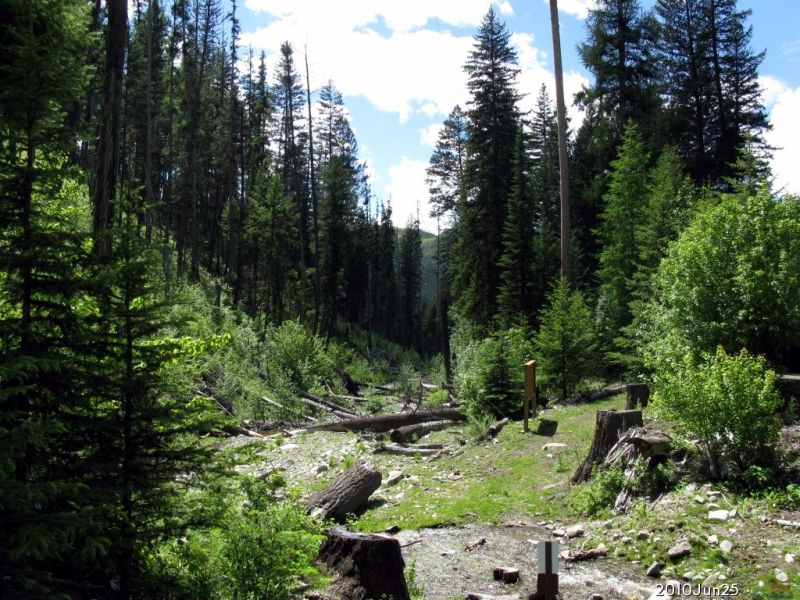
Lambert Creek WA seahorsecorral.org

Lambert Creek WA – Photo Credit: .seahorsecorral.org


            The Belcher mine was located on Cooke Mountain, in Ferry County, Washington.   The ore deposit was pyrrhotite, a sulfide of iron, which on Cooke Mountain contained appreciable quantities of gold.   When smelters opened at Grand Forks, Greenwood and Boundary Falls, there was a market for this ore, since the iron was in demand as a slag forming mineral, and the smelting process recovered the gold.

            H.C. Lycett opened the mine and built a three foot gauge railroad in 1906 from Karamin up Lambert Creek to the Belcher Camp, below the mine.   The transfer point to the standard gauge was just a quarter mile north of Karamin where a pile of rusty looking dirt (pyrrhotite) beside the BN track indicates the former ore bunker.   The two lines were just a few feet apart, the highway being on the old Hot Air grade.

            There was a reversing loop on the flat above this transfer point, and the line ran south along the hillside with a double switchback to gain elevation to enter Lambert Creek. In early morning light, the switchback grade can be easily seen today, looking east from the Karamin intersection.   The track ran up the north side of Lambert Creek for 8 miles to the Belcher Camp which was on the flat by the creek.   The camp comprised some 40 to 50 persons, a school, a store and post office and bunkhouses for the miners and railroad crew.   The railroad looped around the camp and had a loading bunker on the south side of the creek where a three-rail gravity tram came down from the mine 1500 feet up on the mountain.   The tram had two, 5 ton cars connected by a steel cable that ran over a sheave at the top.   The loaded car, coming down, pulled the empty car up. A passing tracks with spring switches in the center, allowed the cars to pass each other.   Kenneth Fairweather, the tram operator, had to climb the steep trail to the mine on foot each morning and hoist the crew in the empty car. At the end of the day he had to let them down again and then descend on foot. He got an extra half hour pay for this.

            A daily ore train ran down the line to the Karamin transfer bunker.   When someone needed to go to town, or when there were company officials on the property, the single passenger car was attached to the ore train by Conductor, Ike McClung.   Ed Williams was engineer, Dan Mc Dougal was fireman, and only the brakeman’s first name, Ralph, is remembered.   In addition to the ore shipments which went to the B.C. Copper smelter in Greenwood, the settlers along Lambert Creek hewed railroad ties for a cash income and sent them out via the Mine Railway.  At the Karamin transfer point the ore was loaded into W&GN ore gondolas to be taken up to Grand Forks.   There was no interchange between the GN and CPR in Grand Forks, so the single car of Belcher ore would be coupled to a GN train of empty ore cars bound for Phoenix.   The car would be dropped at the Coltern interchange with the CPR, and a CPR train would take it down the hill to Eholt.   A westbound freight would then pick it up and take it to Greenwood.   The CPR Shay would move it up to the B. C. Copper Company’s smelter on its Motherlode turn.

            The Belcher Mine Railway owned two locomotives.   No. 1 was a Baldwin 2-8-0, c/n 11005, of June, 1890, built new for the Alberta Railway and Coal Company.   It had 16 x 20 cylinders and 37” drivers.   No. 2 was another one of the Alberta Railway and Coal Company’s Hinkleys, a 2-6-0, and may very well have been former Trail Creek Tramway No. 1, as that machine was noted at Midway in 1905.   As well, the line owned a baggage car, little more than a boxcar with a side door and windows, also probably from the AR&C.   The single passenger coach, carefully lettered, “No. 1,” may well have come from the “Turkey Trail,” as it was of the same pattern as those cars.   The ore cars appear to have been identical to the old link and pin coal cars of the Trail Creek Tramway.   They may have been those cars or others from the Alberta line.

            As flags from both Canada and the U.S. were equally displayed on the passenger train for its inaugural run, some Canadian ownership may be inferred.   The mine and Belcher Camp lasted until 1914; Ike Mc Clung’s wife, Madge, taught school and the Belcher Camp store supplied the stump ranchers along Lambert Creek.   The railroad may have lasted a little longer.   A photo of the old Karamin lumber mill shows a narrow gauge track alongside.   The Belcher Camp was reported to have carried logs out of Lambert Creek to this mill, possibly prolonging its life for a year or two.

            Today Echo Bay Minerals works several gold mines on Cooke Mountain, not far from the old Belcher, and trucks the ore to their concentrator above Curlew Lake.


STEEP AND CROOKED … by Late Writer, Artist & Castle Builder Bill Laux

THE MINING RAILROADS OF THE CANADIAN BORDER

 By Bill Laux

CHAPTER TWELVE

JIM HILL BUILDS TO PHOENIX 1903 – 1905

eholt.jpg

It was certain that as soon as Jim Hill got his tracks into Grand Forks and around Observatory Mountain to the Granby smelter, he would begin building to Phoenix.   From the days back in the 1870s when he took over the ailing St Paul and Pacific, Hill had maintained that, “every mile of track must pay its way.”   So, with his “Third Main Line” plan, he intended to make every mile along the VV&E pay by competing for every carload of traffic offered.   As well, Hill had bought heavily into Granby, seeing its smelter as a market for coal.   He had bought an interest in the Crowsnest Coal Company in the East Kootenay, and built a railroad from his main line to its operations to supply his locomotives.   Hill could move Crowsnest coal over his water level routes to the Granby smelter, while the CPR route had a 30 mile barge trip plus climbs over two mountain ranges on 2.2 percent grades.

As soon as the Hot Air blockage was removed by Holland’s compromise, the VV&E men began bridging the Kettle River and laying track north toward the smelter. Just outside the Grand Forks municipal boundary, a wye was installed, called Columbia Junction.   From the east leg of this wye, track extended down what is now 68th Avenue, and a station built at Boundary Drive.   On the west leg of the wye, the station of Weston was established with a five track yard, a locomotive servicing facility, coal bunker, water tank, and engine house.   This line continued northwest, and

at mile 2 (Km. 3.2), from Cooper’s Wye (now called “Big Y,”) where the Grand Forks line diverged from the main line to Curlew and Republic, another wye was laid, called Copper Junction.   The east leg of this wye, at mile .6 (Km. 1), bridged the CPR line with a 1000 foot trestle and single span Howe truss bridge.   The grade then went around the east shore of Ward Lake and paralleled the CPR smelter spur on a slightly higher alignment just a few feet south.   At the North Fork (Granby) River, a trestle and two span Howe truss bridge, 660 feet in all, bridged both the CPR smelter spur and the river.   On the north bank the VV&E ran parallel and just uphill of the CPR line into the smelter yards at mile 3.3 (Km. 5.3), from Copper Jct.

Hill then set his men to grading a loop from the west leg of the Copper Jct. wye to climb around Eagle Mountain and enter Fourth of July Creek.   This was slow work since much of the grade had to be blasted out of granite bluffs.

While Hill’s men were methodically grading toward Phoenix, expecting to reach the camp in 1904, Nichols and the New Yorkers who had bought Granby, decided to Americanize the company.   With an American railroad shortly to be completed from the Phoenix mines to the smelter and to Spokane, they saw no more need to conciliate the Canadian Pacific or their Canadian directors.   In June, 1904, Nichols requested the resignations of Granby’s Canadian directors.   All but one, Robinson, resigned.   In their place, the American directors made Abel Hodges, whom Graves had hired in 1898, Granby’s General Superintendent, reporting directly to the board.   Jay Graves kept his vice-presidency, and became non-resident General Manager.   Yolen Williams, Graves’ trusted lieutenant, was retired and given the honorary position of consultant.   That Graves held his place at all was due to J.J. Hill, whose man, George Baker Jr., represented Hill on the board.   Hill’s interest, though studiously and repeatedly denied by the company, was quite evident. Graves, for his own purposes, floated the legend that he, through Granby, was the trusted associate of J.J. Hill.

With his line to the smelter, Hill had captured the Granby coal market with his lower rates.   Now his men were on their way to Phoenix where he intended to take the ore haul away from the CPR as well.   The VV&E grade, which is very visible today from Highway 3 just west of Grand Forks, climbed Fourth of July Creek toward Summit Camp, on the divide between the Brown’s Creek and Eholt Creek. Here, at mile 14.3 (Km. 23), a station called Hale was laid out with a 2000 foot passing track and water tank.   The loaded ore trains would take the siding here, while the up trains passed.   At mile 15.9 ( Km.25.6) the track passed right though the Oro Denoro mine, a large and irregular glory hole, with a 1000 foot siding for loading ore and a station named Denoro.   The CPR’s Phoenix line was just a few feet uphill, climbing in the opposite direction.

At mile 16 (Km. 25.7), and the Emma mine, the VV&E tracks passed under the CPR trestle bridging the gulch.   An interchange to the CPR was laid here, and the place was called Coltern (the CPR called this point B.C. Junction).   Now on the north slope of Montezuma Hill, and running west on a continuing 2 percent grade, the line crossed the canyon of Glenside Creek at mile 18.1 (Km. 29.1) on the huge, Deadman’s Creek trestle, 672 feet long, 195 feet high, and built on a 14 degree curve.

A loop into Providence Creek came next with another curving trestle at mile 21.4 (Km. 34.4).   Turning the corner into Twin Creek at mile 22 (Km. 35.7), the line came out of the dense fir forest and onto open, grassy slopes facing south.   The VV&E entered Phoenix on the 4300 foot contour, just above the road up from Greenwood.

Phoenix was built in a shallow gulch; the VV&E entered town with a wye on trestle work at the intersection of Dominion Avenue and Banner Street. The left leg led to the depot at mile 23.4 (Km. 38.8) and the foot of Phoenix Street.     The west leg of the wye crossed Twin Creek and climbed to a switchback at the 4400 foot level, and then ran back to the Idaho mine ore bunker at the 4500 foot level.   From this spur, a second switchback climbed the slope of Knob Hill, and reversed back to the Victoria ore bunkers at the 4600 foot level.   With the Americanization of Granby, the VV&E was invited to install loading tracks on the lower side of the Victoria mine ore bunkers, while the CPR loaded from the uphill side.   Here, an interchange track connected the two lines.

On February 15. 1905, the VV&E hauled its first train load of Granby ore.   By building a climbing spiral clear around the mountain on which Phoenix was located, VV&E engineer Kennedy had constructed a longer but easier grade than the short but steep CPR branch.   Both railroads now had their tracks at the mine mouths and ore bunkers of the Granby Company’s biggest producers, and it was clear that the lowest rates would determine who got the haulage.

With its 2.2 percent grades, the VV&E could bring down more loaded cars in a single train and haul more empties uphill.   That gave it a cost advantage over the C&W with its 3.4 percent grades.   The CPR typically ran ore trains of 15 cars down to Eholt; the VV&E ran 22 car trains down its grade to the smelter.   The CPR immediately reduced its rate for hauling Phoenix ore to the Granby smelter from $1.00 per ton to 25 cents, which President Shaugnessy agonized loudly, was “bare cost.”   If 25 cents was “bare cost” the previous $1.00 had represented a substantial profit.   But Hill was not to be outdone.   He reduced his rate below “bare cost,” and got the bulk of the traffic.      From 1905 on the VV&E was hauling 70% of Granby’s ore.[i]

Although running different routes, the two lines were almost exactly the same length.   The CPR line from Phoenix to Eholt was 9.7 miles (15.6 Km.) of 3.4 percent grade, plus Eholt to Smelter Junction, 12.5 miles (20 Km.) of 2.2 percent grade, plus 2.2 miles (3.5Km.) of nearly level grade into the smelter, 24.4 miles(39.1Km.), in all.   The VV&E had 22.3 miles (35.7 Km.) of 2.2 percent grade, Copper Junction to Phoenix, and 2.2 miles, (3.3 Km.) into the smelter, a total of 24.3 miles (39 Km.).   The CPR ran its short ore trains down to the Eholt yard, where they were broken up and separate cuts of cars made up made up for the four smelters to which they were consigned.   When a sufficient number of cars had accumulated for the Granby smelter, a train would be made up for that destination.   Cars destined for the Trail smelter would be attached to eastbound freights, those for the B.C. Copper or the Dominion Copper smelters, attached to westbound freights.

The CPR went after the traffic from those outlying mines not served by the VV&E.   From Hartford Junction, a spur was extended east .8 miles (1.3 Km.) to serve the Winnipeg and Golden Crown mines.     A short spur running south along the ridge top from Hartford Jct. reached the Buena Vista.   As previously described, other spurs served the B.C. Copper mine in Summit Camp and the Jackpot and Athelstan mines above Spencer.   In 1909 a short spur was built west from Hartford Junction to the terminal of an aerial cable way which brought ore down from the Boundary/War Eagle mine on the south slope of Knob Hill.

As the CPR line made the loop at Hartford and climbed the east slope of Knob Hill, short spurs ran in to the Rawhide, Gold Drop, Snowshoe and Curlew mines, all of which were big producers.   The west leg of the wye at the Phoenix station was extended down the north side of Twin Creek to reach the Brooklyn mine.   A few hundred feet west of the Brooklyn, it switch backed down to the Stem winder, below the Brooklyn.

Granby, however, was still the largest producer, with the VV&E loading at tunnels 2 and 3; the CPR at tunnel 2.   Hill’s line was tying Grand Forks and the Boundary District closer to Spokane and the U.S.   By 1905, the Hill lines had 60 percent of all classes of Boundary rail traffic.   The Rossland experience was being repeated.   There the steep Trail Creek Tramway had won the race to the mines, but the better engineered Red Mountain Railway took the bulk of the traffic and by far the most passengers who were bound for the American trading center of Spokane.   Now, at Phoenix, though the CPR had won the race and covered the mountains with its twisting spurs, the Hill line with its better grades and its direct connection to Spokane, was taking most of the business.


STEEP AND CROOKED … by Late Writer, Artist & Castle Builder Bill Laux – Chapter XI


STEEP AND CROOKED: THE MINING RAILROADS OF THE CANADIAN BORDER

 By Bill Laux

Typical Trestle Bridge around 1900

Chapter XI

JIM HILL VS THE HOT AIR LINE 1900 – 1908

When the Canadian Pacific brought its Columbia and Western rails into Grand Forks in 1900, a civic dream was born.   In the euphoria of getting a railroad, a copper smelter, and a hug influx of miners, merchants and promoters, the citizens began to see their town as a second Spokane, the hub of an empire of mining, agriculture and industry.   Their location, with broad, easy valleys leading to east, west, north and south, suggested that it was the destiny of Grand Forks to become the center of a network of railroads.   Not cramped on a steep hillside against a lake, as was Nelson, nor on top of a wintry mountain, as Rossland, it would be Grand Forks, they believed, that would dominate southeastern British Columbia.

“The immensity of the ore deposits in the Boundary and Kettle River districts is almost unparalleled in history,” the Grand Forks Miner exulted in 1896.   The year following, the Miner’s pride soared to even greater heights as the editor counted the local “firsts.”

“…the first town in the Boundary to have a man found dead in his room in a hotel; the first to have a man publicly horsewhipped by a woman; and the first to announce the arrival of a pair of twins.”

Local prospector, R.A. “Volcanic” Brown, spoke of “a new type of city arising; one without any schools, churches, or banks, and served by four railroads running in from the four cardinal directions..”  Having witnessed the rise of Rossland from a handful of tents and log cabin to the fifth city in B.C. in a single year, Grand Forks’ dream seemed eminently achievable.   All that was needed was leadership.   Leadership and money.

The leadership presented itself in the person of Tracy Holland, a native of Ontario, who had come west to manage the affairs of the Grand Forks branch of his brother’s Dominion Permanent Loan Company.   Holland proposed that Grand Forks itself build Volcanic Brown’s railroads to the four cardinal directions with himself as manager.   He enlisted the support of his brother, Frederick in Ontario, and his Loan Company.   Their enthusiasm converted James Stratton, the Provincial Secretary of Ontario, Thomas Coffee, manager of the Toronto Trust and Guarantee Company, and George Cowan, a Vancouver lawyer.

Holland then went to work to secure a charter for the four railroads.   He gave them a bewildering confusion of names: Grand Forks and Kettle River Railway, to run east; Grand Forks and Republic, to run south; Kettle River Lines, to run west.   The skeptics of Grand Forks, wearied of Holland’s endless speechmaking, and interminable lobbying in Victoria and Ottawa.   Just another paper railroad, they concluded, and all of Holland’s projected lines, whatever its corporate title, went by just one name: “The Hot Air Line.”   The name stuck, and all of the chartered lines, Canadian and American, were known in the Boundary Country only as “The Hot Air Line.”   To avoid confusion, we shall refer to them by that name.

When Jim Hill bought the Vancouver Victoria and Eastern charter in 1902, his way was clear to enter Canada with his line from Marcus and build to the Phoenix mines.     He had chartered the Washington and Great Northern Railway to build the American parts of his line, and began from Marcus with a reaction ferry carrying the cars across the Columbia while the long bridge was being built, just as Dan Corbin had done six years before in Northport.   His graders followed the Kettle River north to the Canadian line at Laurier, crossed it, and then. under the VV&E charter, began working west.

At the same time, in Grand Forks, it appeared that after years of lobbying, Tracy Holland had actually succeeded, and had real railway charters in his hands. The delighted residents swung in behind him.   Amazingly, they now had charters for all those four railroads running to the cardinal points.   Volcanic Brown’s dream was becoming reality. In their enthusiasm, the City Council passed by-law No. 68 in December, 1901, allowing for the issuance of debentures to grant the Kettle River Railway $3,500.

Holland’s charters authorized him to build a fifty mile line north up the North Fork of the Kettle River to the gold mines at Franklin Camp.   A second line was authorized to run west to Midway.   A third would parallel the CPR tracks east to Cascade where a smelter was proposed to take advantage of the electric power that could be generated at that point from the falls of the Kettle River.   In addition, Holland had obtained from the Americans a charter for a line south to the new gold camp of Republic (Eureka Creek).   None of the charters provided land grants.   And the $3,500 from the city of Grand Forks would not build much of a railroad.   But there were the Ontario Banks supporting the scheme. And there was the CPR.   Its position would be crucial.   When the newly formed Hot Air Line issued construction bonds to finance their first line, the Canadian Pacific bought the bonds and quietly became the line’s sponsor.   With Jim Hill about to begin a fourth incursion into southern B.C. and the territory the CPR considered its own, the Hot Air appeared to be the tool with which to fight him from behind the scenes.

In Grand Forks, railroad enthusiasm became conviction, when, on August 31, 1901, the first contract for construction was awarded, and grading began on the line south to Republic, Washington.   This first Hot Air line was to run south from a depot on Fourth Street where the Boundary Mall now stands.   It was to cross the Kettle and turn west to enter the U.S.A. at Danville, and then south down the valleys of the Kettle River and Curlew Creek to Republic.   On the 28th of October the Hot Air’s first locomotive arrived, an ancient 4-4-0 of ungainly proportions and uncertain ancestry.   However, it ran, and a celebration was in order.   The townsfolk followed the local band across the Kettle River Bridge to the CPR siding called Cuprum, and here, leading citizen, John Manly, pounded down the first spike, while his wife who had left her horsewhip at home on this occasion, broke a bottle of champagne across the first rail.   The scoffers showed up as well — they always do — with a wagon on which was mounted a huge blacksmith’s bellows with the legend, “Hot Air.”

However, locomotive No. 1 had real steam up, not air, and demonstrated her ability by creakily moving off the CPR rails, and onto the very first lengths of steel of the Grand Forks and Republic Railway.   From the ragged sound of her whistle, No. 1 was there and then dubbed “The Tin Whistle,” and was known by that name rather then by her number, as long as she ran, creaking and screeching, up and down the riverside prairies of the Kettle River Valley.

All this civic jollification, the whistle blowing, the champagne and the speeches, ignored the ominous fact, that just twelve miles to the east, Jim Hill’s men were crossing the border into Canada and beginning to grade westward toward Grand Forks.   Jim Hill had announced that, he too, was building to Republic. It was not likely that the mighty “Empire Builder” would have any patience with a home grown railroad, its one engine and few hundred feet of track.   Holland, of course, knew Jim Hill was coming, knew his enormous power and influence.   Still, he resolved to take him on, head to head.   His silent ally was the CPR.   It had bought his bonds, and he counted on its continued assistance.   However, CPR support had its price.   At Cuprum, it did not permit the Hot Air to lay a diamond crossing of its tracks.   Instead, it required that the Hot Air trains switch onto its rails, run for a few yards on them, and then switch off to the south.   This ensured that the CPR could charge each Hot Air train crossing its rails, a switching fee, and as well it would get all the Republic ore to haul on its own rails the last few miles to the Granby smelter.

Holland had worked out a scheme to counter this.   The B.C. Government Mineral Reference Map No. 4A shows a Hot Air track diverging from the Republic line just 1/4 mile south of Cuprum and running east to cross the CPR and the Kettle River on a bridge to the east bank about where Johnnie’s Motel is today.   This was to be the Hot Air’s north line to Franklin Camp.   It would run up the east bank of the North Fork of the Kettle to the Granby smelter, and past it up the river to Franklin Camp.   This line was never built.   Perhaps Holland came to an agreement with the CPR about more modest switching fees to the smelter.   Behind the scenes, the CPR was definitely pulling the strings. When the first interest payment came due on the Hot Air bonds, Holland was obliged to borrow the money from the CPR to pay the interest due it. The relationship was clandestine, but essential to Holland and his railroad.

A photograph of Tracy Holland at this time shows a young man, smooth shaven, regarding the camera with steely eyes, a slightly amused expression, and wearing a slouch hat pushed well back on his forehead.   It is reminiscent of early photographs of Fritz Heinze, the same humorous and confident mouth, the same unwavering eyes, hinting at a willingness to take on any of the financial carnivores of the day.

Holland’s crews graded west from Cuprum to Carson and crossed the border.

At Danville they crossed the Kettle River with a two span Howe truss bridge, and a station was built just south of the present Lone Ranch Creek road.   The grade from Danville south is now State Highway 21.   Just a half mile north of the Curlew iron bridge, a rock cut to the west of the highway shows where the Hot Air grade gained elevation to recross the Kettle on another two span Howe truss bridge and a trestle across the low lying fields on the east bank of the river.

Behind Holland’s graders with their one, rickety steam shovel, came Jim Hill’s men with the finest equipment, first class engineering, and horses and scrapers hired from the Montana prairies.   To try to delay them, Holland and his backers fanned out through he Kettle Valley in Canada to persuade the farmers to refuse Hill and his VV&E permission to cross their lands. The VV&E charter, of course, gave Hill’s lawyers the right to expropriate a right of way across the lands of the uncooperative, but that entailed protracted court proceedings and long delay for every separate parcel of land.   Holland hoped that by delaying Jim Hill this way, he would get his line to Republic first and contract for the cream of the trade.

The Hot Air men dug industriously, the Tin Whistle bustled up and down the lengthening track, leaking steam at every joint, but bringing up ties and rails and trestle timbers.   Over their shoulders was always the shadow of Hill’s lawyers, working as speedily as the courts would permit, to acquire, farm by farm, the rights of way for their line to Grand Forks.   These lawyers in special trains hurried up and down the lines between Spokane and Grand Forks.   Deputies carried writs from American courts to Canadian courtrooms.   Canadian judges dismissed them as unenforceable in Canada, and issued their own writs, which were of course void in the U.S.A.   Judges in both countries chose to be insensible to the fact that their pronouncements had no effect in the other country, and continued to fire paper salvos at each other.   It was a grand game; the newspapers and the public loved it.   Deputy Bunce, or “Burns,” as the papers spelled his name, hustled the papers back and forth from one country to the other.   He was becoming an old hand at this business.

In spite of all the Hot Air Line’s haste, the promised completion date of January 1, 1902, came and went with the graders only at Curlew, half way to Republic.

Hill’s men were catching up.   Holland conferred with his lawyers, and new injunctions were showered on the VV&E.   One enjoined the VV&E from crossing the Hot Air’s tracks, which it would have to do if it were to enter Grand Forks.   A second prohibited the VV&E from trespassing on land owned by Tracy Holland and his friends.   As Holland was a principal in the Grand Forks Townsite Company, which owned the unsold lots, this effectively barred Jim Hill from entering Grand Forks.   The third action was a notice of a court application denying the legality of the VV&E charter.   This charter had lain dormant for five years before Hill bought it, with no construction of any kind except from some desultory grading down Penticton’s Main Street for the election of 1898.   It contained the standard phrase that, “…construction was to begin immediately and be prosecuted continuously.”   But the precise meanings of “Immediately” and “continuously” could become surprisingly elastic when the courts cogitated on them.   The lawyers for both sides saw real meat in the arguments, and settled in for a long winter of litigation, hurrying back and forth from Spokane to Grand Forks in their special trains.

The question of the validity of the VV&E charter was taken all the way to the Canadian parliament where its Railway Committee held up approval of the VV&E line until the matter could be settled. No railway line in Canada could be opened to the public until the Parliamentary Railway Inspector examined and approved it.   Hill continued to grade and lay tracks, but he was forbidden to operate trains for profit until the Inspector should authorize it.

It seemed that this charter dispute had Hill stuck, but he countered with an injunction prohibiting the Hot Air Line from crossing his right of way at Curlew where Holland’s line came off the bridge on a trestle and crossed over the W&GN line with another bridge to reach Curlew and compete for traffic there.   E. J. Delbridge, of the California mine, near Torboy, was already shipping ore by wagon to the end of the Hot Air track at Curlew for furtherance to the Granby smelter.   Three carloads, amounting to 105 tons, were the first of the Republic ores to reach the smelter, and returned $10,000 to the owners.   Other shipments followed.[v]   It was crucial to Holland to haul these ores and show some revenue for the new line.

A deputy (“Burns,” in the newspaper report, but possibly, “Bunce”) served Holland in his office with Jim Hill’s injunction forbidding the Hot Air to cross his line at Curlew.   Holland politely observed to Burns (or Bunce) that Hill’s injunction had been properly issued by a Canadian court, but Curlew was in Washington State, and no Canadian injunction could be enforced on American soil.   The deputy nodded.   The argument was familiar to him.   It was all beginning again.

For his part, Holland had his men work all night to bridge the W&GN grade at Curlew without physically touching it, and thus avoid a trespass.   At daylight the bridge was discovered, and the news went out to an angry J.J. Hill in St Paul.   Blunt instructions came back to Chief Engineer Kennedy.

On Sunday morning, January 5, 1902, when railroaders were darning their socks, playing cards, or tuning up their fiddles, a group of W&GN men were rounded up by their foreman and promised Sunday wages if they would walk over to the Hot Air’s bridge and tear it down.   The men harnessed a team of horses, put a chain on the bridge and tried to pull it over.   The bridge stood fast.   They then began making preparations to blow it up with gunpowder.   The noise of these efforts alerted the Hot Air construction camp nearby.   Putting down their socks and cards, the Canadians hurried to the site to repel Hill’s men and save their bridge.   A fight ensued with fists and clubs.   The Hot Air men were tenacious in defense of their bridge and gained the victory.   The Hill men were driven to some distance where they shouted insults and hurled rocks and bottles.   Tommy Hogan, timekeeper at the Hot Air camp, hurried to Danville to summon Tracy Holland.   Commandeering the leaky Tin Whistle, and with deputy Bunce at his side, Holland hurried to the scene.   He arrived to find his men still in possession of their bridge, and reached into his pocket for money to enable deputy Bunce, that experienced international enforcer, to hire armed guards to patrol the Hot Air bridge.

Lawyers swarmed eagerly on this legal tangle.   Holland’s men argued no trespass.   Though Mr. Hill might own his rails and ties and the soil they rested on, he did not own the air above them.   Mr. Hill could not forbid a bird to fly over his rails, nor could he forbid the trains of the Hot Air Line to pass harmlessly overhead.   Hill’s lawyers revived an ancient definition of private ownership, which stated that a man had exclusive use of his land, “down to the center of the earth and up to the sky.”

But now, with these weighty matters being chewed over in the courts, with Hill blocked at Grand Forks by Holland’s injunction, and Holland blocked at Curlew by Hill’s suit, all construction came to a halt.   The workmen gathered their effects and went home.   Only deputy Bunce and his hired bravos remained, huddled over a smoky fire in the January winds at the Hot Air bridge.

The situation alarmed those in Grand Forks who knew of Jim Hill’s stubborn and vengeful nature when crossed.   It occurred to them that if Hill were blocked out of Grand Forks, he might finish his line to Republic, which no injunction forbade, and ship Republic ore to the Northport smelter, all on his own rails, and leave Grand Forks out of the Republic boom altogether.   The Granby managers, Hodges and Jay Graves, found that an intolerable prospect.   They were eager for the Republic ores with their high silica and lime content which would flux the sulfurous Phoenix ores and reduce the amount of coal needed.   In an effort at a solution, Grand Forks mayor, James Anderson offered (or was persuaded) to step out of the 1902 mayoralty election and let Tracy Holland, the only other candidate, win by acclamation. But only if Holland allowed Hill’s railroad to lay tracks to the Granby smelter.   After a conference between Holland, Mayor Anderson, and J.H. Kennedy, chief engineer for the VV&E Railway, Tracy Holland signed an agreement.

“Grand Forks, B.C., Jan. 15, 1902  On behalf of the Grand Forks Townsite Company, I agree to allow the Vancouver,               Victoria & Eastern Railway and Navigation Company, possession of a strip of land one hundred feet wide, fifty feet on either side of their line as located across the lands of the Grand Forks Townsite Company for its spur to the land of the Granby smelter.   Said land to be paid for by the railway company, the price to be mutually agreed upon or decided by friendly arbitration in the same way as if expropriation proceedings were being undertaken, and the work of grading to be commenced by the said railway at once.“Tracy W. Holland, Managing Director, Grand Forks Townsite Company.”

It is not hard to see the hand of Jay Graves behind this agreement.   Graves had financial involvement in the Republic mines.   He was anxious that Hill’s tracks should reach Phoenix as soon as possible, so that competition between the two lines should reduce ore hauling rates, and allow Granby to ship lower grades of ore.   As well, Graves knew that Hill was buying Granby stock ever since Graves’ takeover proposal to him.   Soon J.J. Hill would have a seat on the Granby board; it was crucial to Graves to solidify his position with him since the New Yorkers who now owned Granby were ready to discard Jay Graves.

With the signing of the agreement, engineer Kennedy of the VV&E had his men begin bridging the Kettle River and scraping a grade into Grand Forks.   But if Jim Hill thought that he had disposed of the pestiferous Tracy Holland by elevating him to the Mayor’s chair, he was very wrong.   Although Holland no longer opposed VV&E construction through the Township Company’s lands to the smelter, there was still this pesky injunction forbidding VV&E rails to cross the Hot Air tracks south of town.   And there were still those stubborn farmers who continued to refuse to sell rights of way to Hill’s agents.   Tracy Holland was very sorry about these matters, he said, but he had no authority to dismiss them.   They would have to be resolved in the usual way, by application to the courts.

Hill was furious.   In St Paul he glared at his lawyers and demanded who was this gadfly, this nobody, this insignificant Canadian, standing in his way?   His lawyers argued for a more conciliatory policy.   Reasonable compromise might prove effective where intimidation had not.   Mr. Hill should try to win the sympathy of Grand Forks, not its hostility.   His real adversary was, after all, the monopolistic CPR, not this preposterous Tracy Holland.

Hill listened.   He called off his forces at Curlew, and let the Hot Air complete their bridge and enter the town. He permitted a second crossing, this time at grade, four miles south of Curlew at Pelham Flats.   Hill knew that no matter who got to Republic first, he had resources to beat the Hot Air in the end.   The important goal was to get those Phoenix ores.

The matter of dissolving that injunction against crossing the Hot Air tracks south of Grand Forks went to the B.C. Supreme Court on January 24, 1902.   Astonishingly, Holland, not in the least mollified by Jim Hill’s gesture at Curlew, succeeded in having the injunction upheld.   In fury, Hill thundered publicly on February 8, that he would give up the Boundary trade altogether and haul Republic ores only to the Northport smelter.   Grand Forks would not profit a nickel from any Great Northern connection.

Holland greeted Hill’s pronouncement with bland ingenuousness.   If Mr. Hill was truly abandoning his intention to enter Grand Forks, he told the press, then Mr. Hill could have no objection to the Hot Air Line beginning their new line east to Cascade by using Mr. Hill’s apparently now abandoned grade. Hill, of course, exploded in apoplectic rage at this.   He damned his lawyers gentle counsels and forthwith ordered his men back to the disputed line to claim it as their own.

Holland was having the time of his life.   His repeated tweaking of Jim Hill’s nose strikingly resembles Fritz Heinze’s amused twitting of the CPR’s directors in Montreal four year before.   Holland and Heinze were both young men with their own ideas, and like brash young men everywhere, delighted in having a run at the rich and powerful of their time.   Even Dan Corbin, though older and more conservative, seemed to have a zest for the game.   “I have had one satisfaction, in knowing that I gave the Canadian Pacific the toughest fight it ever had, and I am not through with it yet,” he said in 1898.

In the following months, a frustrated Jim Hill announced to the press this plan and that in continuing war of words.   He would bypass Grand Forks altogether, and build to Greenwood instead, to access the Phoenix ores from the west.   Or he would shift his line to the north bank of the Kettle and build into Grand Forks behind Holland’s line.   The CPR, which had its own line on the north bank, came to life at that , and told Mr. Hill, that, No, he would not do that under any circumstances.

Nothing that J.J. Hill could come up with budged Holland’s intransigence. Intimidation, brute force, political payoff, conciliation, all had failed.   At last he gave in. On April 5, 1902, he dissolved his expropriation proceedings against the Grand Forks farmers who stood in his way.   He paid their extortionate prices for a right of way.   Hill could afford the money, but the legal delays from January until April had given Holland’s men the time to run their track down the Curlew valley toward Republic well ahead of Hill’s forces, which had been unable to complete the grade from Cascade to Grand Forks. The Washington and Great Northern crews had been able to grade a line on American soil, down past Curlew, but since he had no right of way through Canada, engineer Kennedy had been unable to bring up ties or rails or bridge timbers to complete it.

From Curlew south, the two lines ran side by side, barely a hundred feet apart, their respective crews trading insults as to the character of each other’s work.   The fight at the Curlew bridge was not forgotten, and at the least provocation it broke out anew, just for the love of brawling.   At Curlew Lake, the W&GN grade followed the west shore of the lake, while the Hot Air grade climbed along the west slope to gain elevation.   Above Pollard’s it turned up Trout Creek for a mile to climb higher.   It then crossed Trout Creek on a high, curving trestle to reverse direction and skirt the lower slopes of Bald Mountain, still climbing.   Two miles on, it entered Barrett Creek, and four more miles brought it to the summit where it entered the drainage of Swamp Creek and reached the Tom Thumb mine.   The Tom Thumb was up on a granite bench just a few hundred feet south of the grade.   While it was not yet shipping ore, Holland rejoiced, believing he had “captured” the first of the Eureka Creek mines.

Skirting the swampy ground along Swamp Creek (North Fork of Granite Creek), the grade passed close by the Mountain Lion’s big mill.   The Mountain Lion had lots of ore stockpiled, awaiting the railway.   Holland was delighted; he had added a second mine, this one with hundreds of tons of ore to move.   All he needed now was rails to lay on his grade.   They were slow in coming.

Another 2-1/2 miles down Swamp Creek brought the graders to Granite Creek.   There, holding their elevation, they contoured around the slope on a level grade to be able to enter Eureka Creek a mile further on.   As they passed under Flag Hill, the line picked up a whole series of mines just above their right of way.   The El Caliph and Morning Glory were ready to ship as soon as the rails arrived and were spiked down under their ore bunkers.   Holland, desperately needing the revenue, ordered the track laying to begin, although the grade was not complete, either into Eureka Creek or to his proposed station in Republic.

Meanwhile the W&GN graders passed Curlew Lake and reached San Poil Lake at Torboy.   Ahead, they faced several miles of rock work to keep the grade on the rock bluffs above the San Poil River.   This slowed their progress.   They were well behind Holland’s men who had a far easier location with very little blasting required.   Still, Holland’s injunction held and no ties or rails could be forwarded past Grand Forks.   The W&GN line had a number of trestles across arms and bays of Curlew Lake still to build, but nothing could be sent up to build them with; this left three unfilled gaps in their grade.

On April 12, Holland, convinced he had won the race, declared the Republic and Grand Forks line completed.   Republic was hung with bunting, and the Hot Air got out locomotives No.2, and No.3, second hand ten wheelers, to run a special train with 300 passengers down to Republic for a “Calithumpian Celebration and Last Spike Ceremony.”

It was something of a surprise to the celebrants when the train came to a stop at the end of track, some five miles from Republic.   Well, yes, Holland admitted, the track was not yet quite complete.   But no matter. Stages were on hand to take everyone the few miles into town for the festivities.   And there, in Republic, in the middle of Clark Avenue, opposite the Delaware Hotel, were a pair of orphan rails mounted on twenty ties, ready for a final spike to be driven.

The crowd was in an optimistic and forgiving mood.   Yes, the tracks were five miles away, but here was the Grand Forks brass band rendering sweet sounds, and Lawyer Morris and Mayor Holland had a real gold spike and were about to drive it.   Why spoil a party, a barrel of free whiskey and a fine banquet with niggling details. Some allowance, they supposed, ought to be made for a homemade Hot Air Line.

So, the hoarse-throated orators pronounced, the bands played lustily, some fireworks were let off, and the crowds cheered.   The golden spike was hammered down, and everyone agreed that it was a dandy celebration, and exactly what they had come to expect from their own railroad.   And Tracy Holland, that nobody, from Grand Forks, Canada, had beaten — well, sort of — the great James Jerome Hill and his Great Northern Railway to Republic and the Eureka Creek mines.

One could believe it, perhaps, and toast the hometown boys while the fireworks and oratory lasted, and the free whiskey flowed.   But anyone who thought that J.J. Hill would accept second place in Republic, or anywhere else, was not thinking with a clear mind.

Jim Hill, that same April, ran out of patience with his lawyers.   They were costing him a fortune, and spending most of their time racing up and down the rails in special trains between the American and Canadian courts.   He now gave orders for his men to ignore the law, the Canadian courts, the several Grand Forks injunctions, and proceed regardless and with main force. The lawyers could deal with the consequences, if any. The VV&E workmen began to lay illegal rails toward Grand Forks. The lawyers assembled.   The special trains rolled and the matter entered the courts to wind its way slowly through endless legal cunctation.

Outside the courts, however, a real railroad was being spiked down, and on June 9, 1902, the Canadian Government’s Railway Inspector approved the 11 miles of VV&E railway in Canada, from Laurier to Carson, and ties, timbers and rails could now come forward to be spiked down on the grade to Republic.

During the April to June delay, Tracy Holland had found the rails he was missing and spiked them down.   The track was now complete, not to Clark Avenue in Republic, but to a station over on the west side of Eureka Creek above the present County Highway shops.   His track ran up the right (west) wall of Eureka Gulch as far as The Cove, with spurs down to the creek bottom and the mines along its course. To his consternation, Holland now found the mine owners unexpectedly coy about signing long term contracts for their ore.   They would ship a car at a time by the Hot Air, but for the rest, Jim Hill’s men were coming; they could hear their blasts echoing from the other side of Klondike Mountain.   The owners chose to wait and see what rates the competition would offer them.

This was ominous for the Hot Air.   Jim Hill’s tactic had always been to be the lowest cost competitor in any transportation market.   With his vast network of lines, he could underbid any short line in his way, and make good the loss by raising rates in markets where his was the only railroad.

Holland had done his best. He had run his rails up Eureka Gulch on a 2% grade, and dropped a switchback to the creek below to serve the Quilp, Black Tail, Lone Pine, Surprise, Pearl and Little Cove mines.   His main line ended at the San Poil mill in the Cove, the head of Eureka Creek.   For ore cars he bought or leased those home-made ore boxes on flat cars that the CPR had built in Trail in 1898 for use on the Rossland run.   It is not possible from the early photographs to tell whether they are still lettered for the CPR, or whether the Hot Air had ownership.

Holland had the Eureka Creek traffic to himself for just a few months.   By September, the W&GN had arrived.   They built a Republic station at the confluence of Granite Creek and the San Poil River, no nearer Clark Avenue than the Hot Air station over on Eureka Creek.   From their station, with its wye and water tower, the W&GN ran their tracks up the east side of Granite Creek, crossed it on a curving trestle that looped the line back on the opposite bank to climb to the Jim Blaine mine.   Here, the tail of a switchback ran to the mine, while the line reversed to climb upstream again, passing above the big Republic Mill and following the creek to a point opposite the Flag Hill mine.   At this point a high trestle looped over Granite Creek and brought their grade just beside that of the Hot Air at the entrance to Eureka Gulch.   As the Hot Air was already in place on the west wall of the gulch, the W&GN crossed the creek on a high trestle at the Quilp mine and ran up the east bank.   Coal and mine timbers were shot down a wooden chute from this trestle to the mine below.   Eureka Gulch was narrow.   Log cribs had to be built along both sides of the creek and filled with mine waste to hold the two sets of spur track that Hot Air and W&GN ran to each of the ten mines along the creek’s golden mile.   The four sets of tracks, the two main lines dug out of the canyon walls fifty feet above the creek, and the two sets of mine spurs, one on either side of the creek, filled the gulch completely.   There was scarcely enough room for the dirt road from town.   At The Cove, where the Hot Air line ended, the W&GN men threw a great, climbing loop around the perimeter of the meadow with a spur to the Knob Hill mine on the north.   It then crossed above the San Poil mill, and a switchback was laid to to reverse the line up to the top of The Cove past the Ben Hur mine.   Climbing out of the gulch, the grade skirted the south shore of Mud Lake, the source of Eureka Creek.   Past the lake, it entered the wide flat behind Knob Hill.   Here a wye was laid to turn the engines, with one leg running a half mile west to the Mountain Lion, and the other leg a mile north to the Tom Thumb.   Excepting the El Caliph, Morning Glory, and Flag Hill mines, Jim Hill had now run his own spur to every mine served by the Hot Air, and he was ready to underbid Holland for every shovelful of ore to be moved out of Republic.

There was still one problem.   The VV&E while complete from Laurier to Carson, had not yet been able to enter Grand Forks and run up to the Granby smelter. It was still fenced out by that injunction forbidding it to cross the Hot Air’s track.   Faced with hauling Republic ore 103 miles to the Northport smelter, as against the Hot Air’s 48 mile haul to the Granby smelter, Hill applied to the Railway Committee of the Canadian Parliament for permission to cross both the Hot Air and CPR tracks to enter Grand Forks.   He got parliamentary permission, but still the local injunction held against him.   Hill opted for main force, and so, after dark, on Sunday, November 9, 1902, his crews quietly laid a diamond crossing over the Hot Air tracks south of town.   Monday morning found the VV&E crews laying track across the bridge into town.   The Hot Air men responded by getting steam up in one of the Ten Wheelers and parking her squarely on the diamond, blocking the VV&E line.   Now the crews of both lines gathered at the obstruction, hefting pick handles, showing their teeth, and ready for a dandy fight.   Where was deputy Bunce?   Still guarding that Curlew bridge, apparently, twenty miles away.

As a crowd from town gathered around them,the VV&E men saw that the Hot Air had a large part of the citizenry behind it, and this was, after all, Canadian territory.   They considered the odds, and settled for packing their ties and rails around the obstructing locomotive by hand under the hostile scrutiny of the Hot Air men.

Chief Engineer Kennedy of the VV&E wired Hill in St Paul.   Hill wired back to Tracy Holland telling him that if he did not remove his locomotive forthwith, the blockage at the Curlew bridge would be revived.   A stalemate was not to the advantage of Holland now; he needed the revenue from the Eureka Creek ores he was hauling.   Reluctantly, he conceded.   The locomotive was removed, the VV&E entered Grand Forks, and proceeded to lay its own rails to the Granby smelter.

Hill, or his engineer, Kennedy, seemed to have learned one thing from this long standoff.   When his men were running their line to the downtown Grand Forks, and came to the CPR tracks, Hill did not attempt to have them force a crossing.   Although he had Parliamentary permission, the CPR was somewhat more powerful than that body.   Engineer Kennedy ended his track at the CPR rails and built his station there, at Boundary Road.   And again, when at Ward Lake, his smelter spur had to cross the CPR line, he chose to bridge it rather than rouse the Canadian Pacific to retaliation.   He crossed CPR rails once more at the North Fork dam on the smelter spur, where he threw a bridge across both the CPR line and the river in one leap.   These structures were costly, but Hill and Kennedy had learned something about Canadian stubbornness when aroused.

Now, with Hill’s line running direct to the Granby smelter, and his agents able to underbid the Hot Air for ore haulage from Republic, Holland seems to have chosen to retire from the fight.   He had beaten Jim Hill to Republic, but now the financial power of the Great Northern came into play against him.   The W&GN undercut his rates on Republic ores by dropping its charge to 75 cents per ton.   The Hot Air matched that.   Then Hill dropped his rate to 37-1/2 cents per ton.   Again, the Hot Air matched the rate.   Finally, Hill dropped his rate to 25 cents per ton.   That was below cost and unmatchable.   Moreover, Hill could move his cars direct to the smelter, while the Hot Air had to turn over its cars to the CPR at Cuprum and absorb the switching charge for moving the ore the last three miles to the smelter.   Hill gradually took away most of the ore business.   The Hot Air tried to stay alive by moving logs, lumber, sheep and whatever other traffic agent O.E. Fisher could scrape up.

The Hot Air had cost Holland and his backers $718,747 to build, and $43,190 to equip.   The Washington and Great Northern line, built to higher standards, had cost Hill $4,555,392 to build, equip, and defend in court.   Hill could not possibly recoup this expenditure by moving ore at 25 cents a ton, a mere $7.50 a carload.   But Hill could raise his rates on other lines to make up the loss. The Hot Air could not.   But by staying in business, however shakily, and moving small lots of ore at 37-1/2 cents, the Hot Air prevented Jim Hill for the next 18 years, from raising his rates to a profit making level.   The mine owners reaped the benefit, but it is not recorded that they manifested their gratitude to Tracy Holland in any tangible way.

Crushed by the ingratitude of the mine owners he had done so much to enrich, Tracy Holland resigned from the Kettle Valley Lines at the end of 1902.   His mayoralty was in trouble as well, A civic protest meeting was held to urge him to resign. He finished his term, but then, a defeated Tracy Holland left Grand Forks for Vancouver, to be heard of no more.   He had beaten Jim Hill, railroad Mogul, only to lose to Jim Hill, the financier.   His place at the Hot Air was taken by Republic lawyer, W.T. Beck.

Although Tracy Holland had departed, the Hot Air management was not ready to give up their dream of railroads running to the four points of the compass.   Hill’s VV&E, and the CPR had preempted the route east to Cascade, and the W&GN was beggaring the line to Republic with lower rates, but there still remained that projected line up the North Fork (Granby) to Franklin Camp and its gold mines, and an extension beyond to cross the Monashees and reach the Nicola Valley coal mines.   With coal in demand at the three Boundary smelters, such a line would seem to have an assured future.   A line was surveyed to Franklin Camp and grading was begun running north up Fourth Avenue from the Hot Air station.   Jim Hill made his enmity known at once.   He was still angry at the delays Holland had previously put in his path, and he would punish the Hot Air if he could.   Using the press, he announced that he would build a parallel line up the North Fork if the Hot Air dared to lay rails in that direction.   This was undoubtedly St Paul hot air, but no one could be sure.   Potential investors were scared off by Hill’s proclaimed opposition, and work was halted.

When the Canadian Government came through with a subsidy of $3200 per mile in 1906, work began again, and track was built up the North Fork.   But 18 miles from town, at Lynch Creek, the money ran out, and no more could be found.   There, the Hot Air stalled, until, some years later, under CPR management, it was extended another two miles to Archibald where a cable tram brought down fluorite from the Rock Candy mine to be used as flux in the Trail smelter.

The Hot Air made one more floundering attempt at their railroad empire.   Under the leadership of lawyer, W. T. Beck, of Republic, they renamed their line the “Spokane and British Columbia Railway, and projected an extension south from Republic to Spokane.   Jay Graves offered a loan of $50,000 from Granby to get the work started.   This extension, if built, would short-haul the Great Northern’s roundabout line to Republic, arousing Hill’s anger once more.   He sent his Spokane lawyers baying after the Spokane and B.C. like a pack of savage hounds and submerged the scheme in reams of litigation.   The Hot Air lawyers fought back.   Astonishingly, ten years later, they had won, but by that time the Spokane and B.C. was bankrupt.

The S&BC was the Hot Air’s last gasp.   Traffic on the Republic line had dwindled.   When the depression of 1907 hit the country, the Eureka Creek mines were unable to finance a needed conversion to low-grade ore mining and concentration.   Ore shipments to both railroads, which in 1903 amounted to 35,000 tons, with a value of $350,000, had declined by 1907 to a mere 195 tons with a value of $9,000.   In desperation, the Hot Air, using its CPR connections advertised a rate to the Chicago stockyards to attract local sheep men.   By using the CPR’s Soo Line to Chicago, the Hot Air would accept live sheep at Republic for delivery in Chicago at the rate of $1.00 per pound.   It was not enough.   Regular service was suspended in 1907, and maintenance could no longer be afforded.   The Hot Air would still run a train for any traffic that was offered, but that was all.

The CPR leased the Hot Air in 1908 for the sake of its charter, which still offered the right to build to the fourth point of the compass, west, to the Okanagan Valley and the Coast.   Using this Hot Air charter, and renaming the Hot Air once again, to “Kettle Valley Railway,” the CPR built from Midway through Penticton to Hope on the CPR main line.   Thus, by 1916, Volcanic Brown’s great dream was fulfilled.   Rail lines, though now, Canadian Pacific lines, were running in all the cardinal directions out of Grand Forks.   There was an irony in the CPR takeover, for, beginning in 1908, the Republic mines began to recover as concentrators were installed. The turnaround was dramatic.

From the 1907 low of 195 tons, the ore shipped rose to 584 tons in 1908, to 11,000 in 1909, and, by 1911, all previous records were bettered, with shipments of 44,000 tons, with a value of $868,000.   Still, this was split between the two railroads with Jim Hill’s W&GN getting much the larger share.


STEEP AND CROOKED … by Late Writer, Artist & Castle Builder Bill Laux – Chapter X

STEEP AND CROOKED: THE MINING RAILROADS OF THE CANADIAN BORDER

 By Bill Laux

Rossland, BC 1910 – Photo Credit: wikimaedia.org

CHAPTER TEN

EUREKA CREEK 1896 – 1902

Responding to the urgings of Spokane mining men, the American Congress opened the north half of the Colville Indian Reservation to mineral entry on February 21, 1896.   Among the prospectors quietly leaving Rossland for the newly opened lands in the Colville Indian Reservation, were Phil Creaser and Tommy Ryan, both grubstaked by James Clark.   By grub staking the prospectors, Clark would receive a half interest in whatever the prospectors should find.

Creaser and Ryan bought horses and supplies at Bossburg, on the SF&N line, the jumping off place for the Boundary country.   They traveled up the Kettle River trail into Canada, and west to Carson, where the Kettle flowed out of the U.S.   Here, beside the river, they found the Welty Brothers, George and John, who had come north from their illegal camp in the Reservation to get news of the expected mineral opening.   Creaser and Ryan gave them the welcome news and were invited to join the Weltys who now could stake the mineralized outcrops they had found near the headwaiters of the San Poil River.

On February 28, 1896, Creaser and Ryan, following the Weltys, came into an area of rolling hills covered with ponderosa pine. Here they found long, dyke-like outcrops of a crumbly, white rock they identified as “porphyry,” a massy rock enclosing many small rocks of differing composition.   Veins of quartz ran through these crumbly outcrops, and in the quartz veins, tell-tale black streaks of some heavy mineral.   Creaser and Ryan knocked off some chunks, licked the samples shiny, and brought out their hand lenses.   Through the lenses they could see gold in minute specks in the black streaks.   All around them were more outcrops and all of them showed gold.   Creaser and Ryan, picking what looked to be the richest of the outcrops, staked the Iron Mask, the Copper Belle, and Lone Pine, and took samples from each. John Welty, naming the draw he was prospecting, Eureka Creek, staked the Black Tail.

The men continued to prospect the ground around Granite and Eureka Creeks. On March 5, Creaser and Ryan staked the Republic and Jim Blaine, and then headed back to show their samples to James Clark and have them assayed.

In Rossland the assays were disappointing.   Only a trace of gold in most of them, just $ 2.06 in their best specimen.   Clark sent Creaser and Ryan back to Eureka Creek to begin digging on their claims and bring back deeper samples.   The two men dug on the Republic, the Iron Mask, and the Lone Pine. This time the assays turned out much better: $4.00 to the ton from the Iron Mask, and $35.00 from the Lone Pine.   As they went deeper, the values continued to increase.   In August, James Clark came himself.   He looked, he approved, and went away convinced that a significant mining district had been discovered.   He went to Spokane and shared the news with his brother, Patrick, or “Patsy” as he was called.

Patsy Clark came to the Eureka Camp at once and began developing the Republic claim, the biggest of the visible ledges.   Soon it began to show values in hundreds of dollars per ton from a large vein fifteen feet wide.

With the Republic producing paying ore and shipping it out by wagon to the Northport smelter, Patsy Clark incorporated the Republic Gold Mining Company and bought out Creasers and Ryan’s interests for $55,000, while investing $70,000 of his own money.   Creaser and Ryan used the money to develop their Lone Pine and Iron Mask mines.   They were successful and a few years, as the town of Republic began to take shape on the low hog back ridge across Granite Creek from the Republic mine, Phil Creaser built the Hotel Creaser there.

When rich pockets of ore were discovered at 60 feet, James Clark came to take over the Republic mine while brother Patsy went to Toronto to negotiated the sale of their War Eagle mine in Rossland to the Gooderham-Blackstock syndicate for $700,000 cash.   With that money, he came back to the Republic Camp in 1897 to develop the Republic mine into a property equally valuable.

Patsy Clark was the monarch of the camp.   He was a popular man, running the biggest mine, a mill, and a boarding house where he played accordion for the miners’ dances.   At his urging, a townsite was platted on the low ridge opposite his mine, to be called Republic with its main street named Clark Avenue. Still, in 1898, most of the miners lived in the Eureka Creek camp at the mouth of that creek.   It was a wild place in those early years when the district was not organized. Legally, it was still the Colville Indian Reservation and the nearest sheriff was in Colville, two days away by horseback.   This allowed a certain amount of lawlessness.   An entry in the Boundary Creek Times of Greenwood, B.C.., dated January 8, 1898, reads:

“Bad whiskey, the absence of officers of the law and the general looseness which  prevails in the vicinity of Eureka, Wash., were responsible for a serious shooting affray in the mining camp on Friday last.   Three men were wounded, and one of them, Frank Gottfriedsen, is in the Greenwood hospital with his elbow splintered by a rifle bullet and a  flesh wound in the other arm.   Gottfriedsen was brought to the hospital in Sunday.  “It is a difficult matter to learn the particulars, but it appears that early Tuesday  morning Gottfriedsen, La Fleur and others were in Bennett’s saloon in Eureka.   Bennett and  Gottfriedsen got into a dispute about claim jumping and words led to blows.   Bennett got the better of the fight, and then Gottfriedsen pulled out a six shooter and opened fire. Before the gun could be taken from him he succeeded in wounding his antagonist in the cheek.  Bennett went off to get the wound dressed and Gottfriedsen left the house at the same time.   Later in the day Gottfriedsen returned for his coat and the quarrel was started  anew.   This time Bennett used a repeating Winchester, and opened fire.   Gottfriedsen grabbed the barrel of the the Winchester, but Bennett continued firing and almost shot the clothes off Gottfriedsen’s body.   He appeared to have a charmed life, however, for he escaped with the two wounds mentioned.   La Fleur tried to stop the shooting and was  rewarded with a bullet from the Winchester.   His wound is not dangerous.”

The ores from the Eureka Camp were not free milling.   The gold and silver they contained were encapsulated in lime and silica, and required treatment in a mill to break down that coating.   Costly processes were tried in Clark’s “Big Red Mill” and the Mountain Lion Mill, north of town.   None were entirely successful.   The coarse particles of gold and silver were recovered, but the fine ones were lost.   As well, the lack of cheap transportation was a serious drawback.   The wagon haul to the Spokane Falls and Northern was costing $25 per ton.   Rail freight to the Northport smelter was another $6.00, and the smelter charges were $10.00 per ton.

This meant that only $40.00 ore ore better could be sent to the smelter. The Republic had such ore, and their shipments ran as high as $12,000 per carload at Marcus, with an average of $4,000 per car. Railroads were projected.   One was to come up the Columbia and San Poil Rivers from Jim Hill’s Great Northern at Wenatchee.   Another was to come down the Spokane and Columbia Rivers from Spokane and turn up the San Poil to Republic. Everyone with a map and a pencil played at paper railroads, but investors could not be found.

Patsy Clark went to Montreal again in 1899 and negotiated the sale of the Republic mine and mill, plus the Surprise and Lone Pine mines, for an extraordinary $3,500,000 to a Canadian syndicate.   The Canadians moved in, bringing their own bank with them, the Halifax Trust and Guarantee (later the Royal Bank).   This was to last as long as the Republic mine operated, the only American branch of the Royal Bank outside of New York at that time.

Patsy Clark was extremely fortunate in selling the mines.   The Petalan-Clerici process he was using in his mill to release the fine gold from the ore was costly and only partly successful.   It involved a preliminary roasting of the ores to break down the silica coating on the gold and silver.   Wood was the only fuel and the Republic Mill was firing six boilers of 500 total horsepower.   The hills around the Eureka Camp were being rapidly depleted of firewood.   Patsy Clark had build a five mile flume up Granite Creek down which firewood was floated to the mill, and the water used to generate electricity.   Up at the headwaiters of Eureka Creek, the Mountain Lion Mill, firing three 100 horsepower boilers, had strung a half mile cable across the Swamp Creek valley and was bringing in wood on this overhead cable tram from the mountains beyond.   The camp could not last long with these pioneer methods.   If a railroad would build in, the costly milling procedures could be dispensed with, and the ore could go directly to the Granby smelter.     Jay Graves in Phoenix realized this, and bought into a number of Eureka Creek mines, developing his plan for a custom smelter in Grand Forks to treat non-Granby ores.

As the new Century began, the town of Republic took shape, Ferry County, Washington was organized, and a sheriff and deputies hired to keep the peace.   As well, a railroad was surely coming.   Jim Hill had promised one.   But so had an unknown, Tracy Holland, a bank manager in Grand Forks.   Two railroads building to the mines.   It began to sound like Red Mountain all over again.


STEEP AND CROOKED … by Late Writer, Artist & Castle Builder Bill Laux – Chapter VIII

STEEP AND CROOKED: THE MINING RAILROADS OF THE CANADIAN BORDER

 By Bill Laux

CHAPTER EIGHT

A CLASH OF CAPTAINS:

HILL, VAN HORNE, AND “THE ASSOCIATES”

James Jerome Hill, of St Paul, Minnesota and the Great Northern Railway, was at home on both sides of the border, and saw no reason why his railroads should not be as well.   In 1870, as a Canadian living in St Paul, he was asked by Canadian Parliamentary Secretary, Joseph Howe, to travel north to Fort Gary (near present Winnipeg) to report on the Riel Rebellion.   So isolated was the Manitoba territory from the rest of Canada by the trackless 800 miles of rocky wilderness north of Lake Superior, that St Paul was the nearest source of information, and the place through which travel to that remote region passed.

Hill traveled in March of that year by railroad, stagecoach and, dog sled over the snows.   On the trail  with his dogs, he encountered Donald Smith, of the Hudson’s Bay Company, returning from his own investigation of the rebellion.   Their campfire talk led them to agree that the Red River Valley, as both prime agricultural land, and as the surest route from St Paul to Fort Gary,. Manitoba, and the Canadian West, would some day support a very profitable railway.

In the following years Hill enlisted the support of Donald Smith and his equally wealthy cousin, George Stephen, of the Bank of Montreal, in getting control of the steamboat business on the Red River, the route to Winnipeg.   Their syndicate, “George Stephens and  Associates,” comprised Stephen and Smith, as the financiers, Norman Kittson, The Hudson’s Bay Company’s Minnesota agent,  operating the steamboat line, and Hill, their St Paul freight forwarder.    Once in control of steam navigation on the Red River, the Associates then went after the bankrupt  St Paul and Pacific Railroad which they intended to complete to the Red River and a connection with Kittson’s steamboats.

  It was the mephistophelean George Stephen who devised a way to buy the incomplete and bankrupt St Paul and Pacific Railroad from its Dutch bondholders with their own money.   The Dutchmen had invested $11 million in the railway to get its valuable land grant, and so far had received neither land nor a penny of interest.   George Stephen offered to take their bonds in exchange for bonds in a new railway company which the Associates would form.    The Associates were gambling that J.J., Hill could complete the railroad before the deadline, eight months away, and earn for them the huge land grant that went with it.    

  The new company’s worth, in five equal shares, was divided among Stephen, Smith, Hill and Kittson.     The concealed fifth share was kept by George Stephen who passed it clandestinely to New York banker J. S. Kennedy who had been the Dutchmen’s representative and who had, somewhat unethically,  persuaded them to accept  Stephen’s offer.   Stephen became president of the Associates’ new company, Smith became vice-president and Hill, the man on the ground, General Manager.  When the original bonds received from the Dutchmen could not pay their interest, the Associates foreclosed, and became instant owners of the bankrupt railway.    It was an extraordinary bargain; the Associates had put up but  $280,000 to acquire a railroad with assets of 11 million.    At once, Hill, with tremendous energy, pushed the railway to the Red River within the deadline, and the land grant was handed over.    Sale of those lands brought the Associates $13 million over the years, but more importantly, they now had a railway to the Red River and the exclusive steamboat transportation along its waters to Winnipeg.     The Associates, with this one coup, now controlled absolutely Canada’s only land transportation to its west.

The Associates renamed their railroad the St Paul, Minneapolis and Manitoba and capitalized it at $15 million.   The railroad and the steamboat company became  instantly profitable.   Stock was quickly bought up by the public and the proceeds were used  to pay off the construction debt. 

Through another of George Stephen’s manipulations, the Associates were able to buy back $11 million of the bonds they had given the Dutchmen for $1 million.    Hill, on Stephen’s instructions, refused to redeem the interest coupons on the bonds with the railway grant lands, alleging that the Dutchmen had violated the terms of the bond exchange agreement.   The bamboozled Dutchmen, who were primarily interested in land, sold out in disgust.  

The new Canadian government had been seeking a way to build the transcontinental railway which it had promised British Columbia and the rest of Canada from its inception.   The only syndicate sufficiently strong to undertake such a project was The Associates with George Stephen in charge.     

The Canadian government courted George Stephen.    But Stephen was wary.     Hill and Angus (of the bank of Montreal) pointed out to him that if some hostile syndicate, such as the NP or the Milwaukee built the Canadian transcontinental, their St P M &M would lose its international value and become but one more prairie granger line.   If George Stephen accepted the offer of substantial land grants and a cash subsidy the Canadian government was offering, Hill and Angus promised, they  would build the line.     Hill, Angus and Stephen at that time saw the Canadian transcontinental as a valuable feeder line to the St Paul and Manitoba and felt its only rational route would be to dip into the U.S. at Sault Ste Marie and run via their SPM&M to Canada at Emerson.    It would be madness, Hill thought to build a railroad across the Canadian Shield where no one lived and no agricultural land existed.  Thus, from its inception, The Canadian Pacific Railway was paradoxically conceived by its builders and owners as an international extension of their American railroad.     

George Stephen was more than naive in taking on the building of the Canadian Pacific.  As with the St Paul and Pacific, he would find the financing,  J.J. Hill would build the line, and they would all profit from the truly enormous land grant to be earned, in this case, 25 million acres.   But  the St Paul and Pacific had required but 87 miles of line to complete.   This time the distance  was 1900 miles, over unknown territory, and through two mountain ranges where no railroad passes had yet been  located.    George Stephen was able to wring concessions from the Canadian government: a monopoly on all rail transportation west from Winnipeg, and a further guarantee that the builders would own and run CPR forever.   With these, Stephen thought the thing could be done for $45 million, of which the Government would advance half.    It was an enormous and nearly disastrous underestimate.

Hill built the Associates’  SPM&M to the Canadian border at Emerson.   The Canadian Pacific built from there to Winnipeg.   George Stephen named J.J. Hill managing director of the CPR, and Hill moved to Winnipeg to direct the building of the line west to the Pacific.  He discovered at once that the CPR was a swamp of confusion, ineptitude, and graft.   In its first year,1881, it had spent $10 million and only built 130 miles of track.   The chief looters were former Confederate General, Thomas Lafayette Rossiter, and his superior, Alpheas B. Stickney, who later would become president of the Chicago Great Western.  The pair  were working an outrageous scam, selling privileged information as to the line’s location to land speculators.   The speculators could then buy up raw prairie land for $1.25 and acre and sell it as track-side locations a month later, for 50 times that amount.    Hill still had the Mantoba road to run; he desperately needed a supremely tough superintendent to clean out the deadwood and grafters in the CPR, and to drive its grading crews ahead at top speed.    

The man he hired was William Cornelius Van Horne, a hard-driving American whom he had met when Van Horne was resurrecting the Southern Minnesota line out of La Cross, Wisconsin.   Van Horne was exactly Jim Hill’s kind of man, one who eagerly sought every possible responsibility, and when given it, produced solid results.   Hill first offered Van Horne the presidency of his own St Paul, Minneapolis and Manitoba railroad.    When Van Horne laughed in his face at the proposal, Jim Hill knew that here was a man with enough self-confidence to take over the chaotic CPR whose current managers were more interested in organizing pheasant hunts and champagne parties than building track.   

Van Horne accepted, and brought along with him from the Milwaukee, Thomas Shaugnessy, to act as his purchasing agent.   The team of Van Horne and Shaugnessy, the blustering, belligerent “Terror of Flat Crib,” and the suave, meticulous Chief Clerk ingeniously stalling every creditor of the nearly insolvent line with exquisitely polite requests for more detailed invoices, completed the Canadian Pacific and successively held its presidency until 1918.

Van Horne at once took the CPR by its ears and shook it thoroughly, earning his title, “The Terror of Flat Crick.”    Van Horne’s arrival at any of the hundreds of end-of -track camps was described by R.K. Kernighan,

  “…when manager  Van Horne comes to town there is a shaking of bones… He is the Terror of Flat Crick… they are as frightened of him as they are of the old Nick himself.

“Yet Van Horne is calm and harmless looking.   So is a mule and so is a buzz saw.   You don’t know their inwardness till you go up and get the feel of them.   To see Van Horne get out of his car and go softly up the platform, you might think he was an evangelist on his way to preach temperance to the Mounted Police.   

“But you are soon undeceived.    If you are within hearing distance you will have more fun than you ever had in your life before.   He cuffs the first official he comes to just to get his hand in and leads the next one by the ear, and pointing eastward informs him that the walking is good as far as St  Paul.   To see the rest hunt their holes and commence scribbling for dear life is a terror.

“Van Horne wants to know.   He is that kind of man.   He wants to know why this was not done and why this was done. If the answers are not satisfactory there is a dark and bloody tragedy enacted right there.   During each act the all the characters are killed off and in the last scene the heavy villain is filled with dynamite, struck with a hammer, and by the time he has knocked a hole plumb through the sky, and the smoke has cleared away, Van Horne has discharged all the officials and hired them over at lower figures.”   

Hill was at first pleased with his choice; he had both found the man to terrorize  the CPR into order, and also very cleverly removed a dangerous rival from the competing Milwaukee Road which was by then invading what Hill considered  St Paul and Manitoba Road territory.

  Hill’s pleasure was not to last long.   As 1882 began, Van Horne had boasted that he would lay 500 miles of track that year, an unheard-of feat.  Moreover, he had ordered in advance, every tie, bridge timber, rail and keg of spikes for 500 miles of railroad.   His orders, filling 500 rail cars, choked Hill’s St Paul yards.  The Manitoba found itself unable to move its trains until Van Horne’s cars were removed.    Hill threatened to have his own men dump the cars where they stood.   Van Horne, choosing his own time, eventually sent his own men down to offload the cars and permit Mr. Hill to run his railroad.   But by the end of the year, Van Horne had laid an astonishing  548 miles of track, a record never bettered. 

Hill constantly complained to Van Horne that he was not sufficiently concerned

for the well-being of the Manitoba Road, for in Hill’s mind the Canadian Pacific was to make the Manitoba Road thrive.   But Van Horne had no intention of being the Associates’ pawn.    Almost from the beginning he became a thorough CPR man.   When the Canadian Pacific completed its line east from Winnipeg to Thunder Bay on Lake Superior, George Stephen promised a worried J.J. Hill that it would not be opened for another year so that their Manitoba Road would have all the haulage of CPR materials.   Van Horne, however, instructed his traffic officials to bring in materials via the Great Lakes and the Thunder Bay route, a considerable cost saving, but cutting the Manitoba line out of the traffic.     Hill protested Van Horne’s attitude, “…there is I know a feeling…of ill concealed hostility toward this company.” J.J. Hill had picked the one man thick-skinned enough to see the CPR through to the Pacific.   But he had failed to realize that  Van Horne was a man just like himself, stubborn, headstrong and supremely ambitious.   It was inevitable they would clash.    As well, Hill failed utterly to take into consideration that the Canadian Government, which was subsidizing the CPR construction by loans and grants,  would absolutely insist on an “All Canadian” route to the north of Lake Superior.    No matter that it made no economic sense, that it would not furnish a single carload of freight.  Canadian nationalism demanded it.    Canadian taxpayers would never permit their government to subsidize a railway through the United States. 

George Stephen and Associates were not going to be able to construct the Canadian Pacific as an extension of the St Paul, Minneapolis and Manitoba;  they were going to have to build an “All Canadian” route or forfeit government support.   Hill, his advice ignored, his protests unheeded, found his position on the Canadian Pacific board untenable.   He angrily resigned his position on May 3, 1883, and began selling his CAP stock.   In a note to Kennedy, the clandestine fifth Associate, on the following day,  Hill explained, “Mr. Van Horne… is inclined to take the view that the St Paul, Minneapolis and Manitoba are powerless to help themselves and must simply accept any situation that may be assigned to it by the Can Pac.”

Van Horne, seeing the CPR in a  wider perspective than J.J. Hill, realized that his line could never fulfill the destiny he saw for it as long as it operated as a feeder to the St Paul and Manitoba.   In an act that would render Hill an enemy forever, he declared the CPR’s independence by signing a preferential traffic agreement with the Northern Pacific, rather than with the Manitoba Road.  When  Hill discovered this, he sold his final 10,000 shares in the CPR in utter disgust, and became Van Horne’s implacable foe.    “I’ll get even with him if  I have to go to hell for it and shovel coal!”  Hill swore.

The position of George Stephen in all this is curious.   He was president of both the Canadian Pacific and of the St Paul, Minneapolis and Manitoba, now rival lines.   Van Horne’s disregard of Hill’s interests had to have the President’s sanction, yet Hill, mesmerized by the aristocratic presence of George Stephen, never blamed him for the rift.   

Stephen’s manipulations continued.   In 1886, with the Canadian Pacific completed, George Stephen and Donald Smith secretly bought control of the Minneapolis, St Paul and Salt Sate Marie (the So line), railroad, a line charted by Minneapolis millers to bring wheat from the Dakota prairies to the Minneapolis mills and carry their flour to the year round port of Salt Sate, Marie.   This line, a rival to both the CPR and the Manitoba Road, had been looked at by both Hill and Van Horne and rejected as  weak line, unfinished and no threat.   However, Stephen and Smith put $750,000 into it to complete it.   Once finished, they intended to sell it to either the CPR or to Hill, whichever would bid highest for it.   Hill discovered that the money had come from the bank of Montreal, and queried Stephen as to who was involved.   Stephen mendaciously denied that he or Smith had advanced the money.    With Hill still in the dark, Smith and Stephen went bargain hunting again, and bought the Duluth, South Shore and Atlantic, another line running from Duluth to Salt Sate Marie.   Their purpose was the same, to sell it to either the Manitoba or the CPR.    Hill began a savage rate war with both lines in an effort to drive them into bankruptcy.   But from some unknown source, money kept being poured into these competitors.   Eventually, Stephen had to confess to Hill that he and Donald Smith were behind the rival lines.   Hill then questioned Stephen’s anomalous position as President of both the CPR and the Manitoba.   In 1888 George Stephen sold the So line to the Canadian Pacific and resigned as CPR president.  His place was taken by Van Horne who began to pour money into the So, as a “defense” against the Manitoba line.

Hill responded with a campaign against the CPR, delaying his passenger trains so that travelers would not make their connections at Winnipeg, and on one pretext or another, blocking freight cars a the border, tying up the CPR line.

The anxiety Hill felt about the So line which paralleled the Manitoba on the south was doubled when in 1893, Van Horne bought the Duluth and Winnipeg for the CPR, a line, that would when completed,  parallel the Manitoba on the north.   This put Hill in vice, and Van Horne, it seemed to him, was twisting the handle.    For, if  Van Horne could complete the Duluth and Winnipeg north to the border, the CPR, using D&W and So tracks would have its own line into St Paul and connections to the Chicago roads.  Hill had to have the Duluth and Winnipeg, or he would be squeezed out of  the Canadian traffic.    Realizing at last that  the CPR was now never going to use his Manitoba road as an American connection, he changed the name of the St Paul, Minneapolis and Manitoba to the Great Northern, and encouraged by George Stephen, struck out for the Pacific Coast on his own. 

George Stephen had no intention of letting Van Horne destroy the Great Northern, which he could have done with the So and D&W.     Stephen now  began a treacherous campaign to get rid of Van Horne.   In 1897 he forced Van Horne out of the Presidency of the CPR, took over himself,and sold the D&W to Hill.   

George Stephen’s ambiguous position as President of the CPR from 1880 to 1888, and Chairman of the Board of the Manitoba Road from 1878 to 1886 gave him almost unlimited power to play with both lines for his own profit.   He played the deluded combatants,  Hill and Van Horne, shamelessly against each other, sliding adroitly from one camp to the other in his letters  to them.   Here he is to Van Horne on J.J. Hill,

“…he is the most ‘shame faced’ grown man I ever met, more like a very shy boy of 10 or 12 years than a full-grown man of 50.

“In dealing with him it is necessary to keep his odd ways in mind & to treat him rather as a spoilt child brimful of ridiculous suspicions of everybody he comes in contact with.”

Here he is to Thomas Shaugnessy on William Van Horne,

“It is quite evident that Sir William, either from failing health or from allowing other things to occupy his mind, is no longer able to give the affairs of the Company his undivided attention…  His actions gave me the impression that he felt like a man who knew he was in a mess and had not the usual courage to look his position in the face.”

Manipulated by the Machiavellian Stephen, the two former farm boys, Hill and Van Horne charged at one another like maddened bulls, creating a bitterly hostile relationship between the Great Northern and the CPR which was to last for their lifetimes.   Hill seems to have conceived the idea that by invading the CPR’s British Columbia territory with his profitless lines, he could trade them to the CPR for its So Lines in the U.S.   He made the offer in 1897 and was refused.   Rebuffed, he continued to build Canadian lines.   When, in 1906, the CPR acquired Dan Corbin’s Spokane International and trackage rights with the UP to Portland, Hill responded  with a threat to build a new Canadian transcontinental which would run from Winnipeg through Brandon, Regina, Calgary, Edmonton and the Peace River country.   

Near the end of his life, with his “Third Main Line” (the Vancouver, Victoria and Eastern route) in its final stages of construction, Hill made one more move to confound the CPR in British Columbia.   He conferred with the builders of the Grand Trunk Pacific who were building a  second Canadian transcontinental on the Edmonton to Prince Rupert route, about extending a link northward from his VV&E to link up with both the GTP and the Canadian Northern.  This link, if built, would have enmeshed the CPR in British Columbia, in a choking web of Hill lines. 

Hill died in 1916, but in his last years the GN board withdrew support for any further construction in Canada.    The defeat  of the Liberals killed the Free Trade policy which Hill has supported and counted on.    Without  Free Trade, the GN would always be at a disadvantage in Canada.   Hill’s son, Louis, taking over the Great Northern in his father’s last years, immediately stopped work on the VV&E and negotiated a joint trackage agreement with the CPR for that route.    It was never used.   Louis Hill and his successors began a slow withdrawal of the profitless GN lines from B.C.   Today only a hundred miles of ex-GN track remain in B.C., the steep and crooked line from the border to Nelson, the 12 mile arc into the Kettle Valley on the Republic line, and the route from the border at Blaine to the Vancouver terminal.