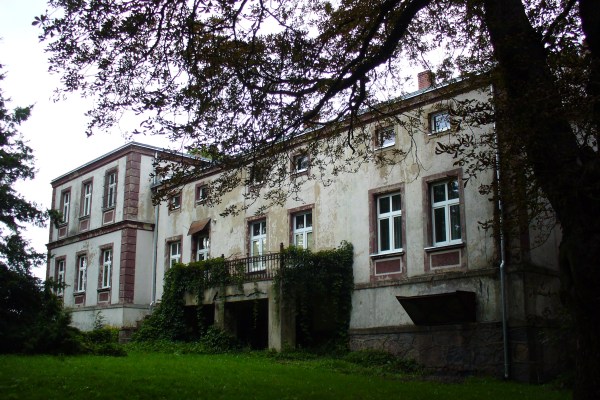
Ernst Klopp (1900 -1964) Part 17

Baby Peter Arrives at Gutfelde
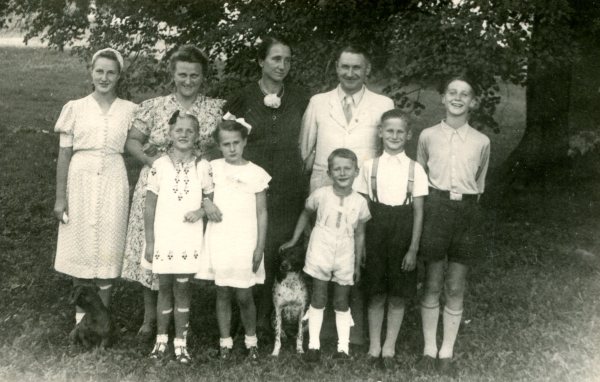
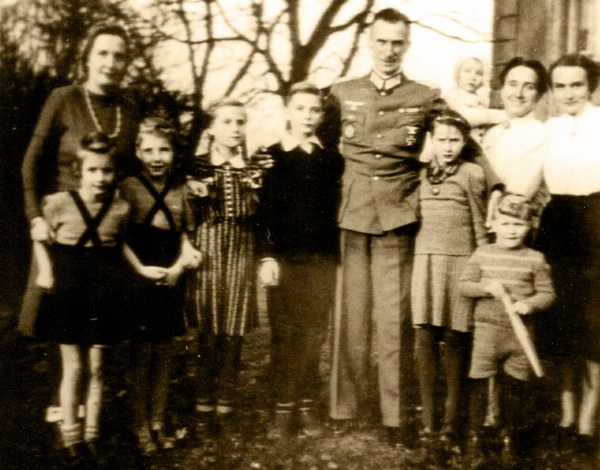
Family Photo Gutfelde 1941 – The six people on the right: My brothers and sister in the front, Ernst and Erika Klopp, my parents in the back

At the time of my birth, Father as manager and inspector was in charge of the estates Silberberg, Oberhof and Gutfelde totalling an area of approximately 3000 ha. Although he must have been thankful to the authorities for landing him such challenging and prestigious position and therefore may have harboured a favourable disposition towards the Nazi regime, he always strove to keep his humanity in dealing with his fellow human beings, Germans and Poles alike. In particular, through his actions he distanced himself from the policy that forbade German citizens to fraternize with the defeated enemy. It is a great testimony to his moral independence from the dark and sinister sides of Nazi Germany that he allowed Polish men and women to live and work closely and cordially with the Klopp family at the Gutfelde residence and the agricultural headquarter for the region.
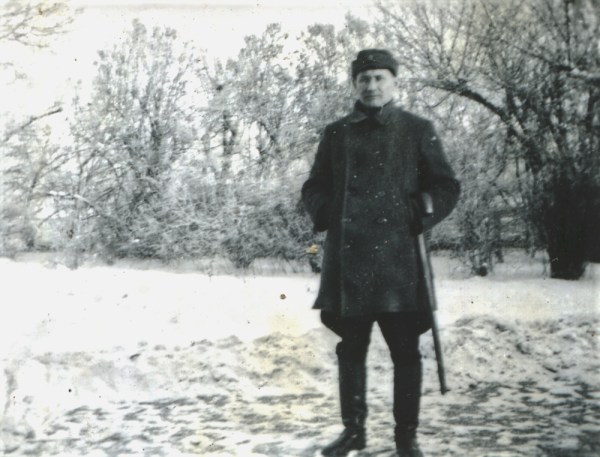
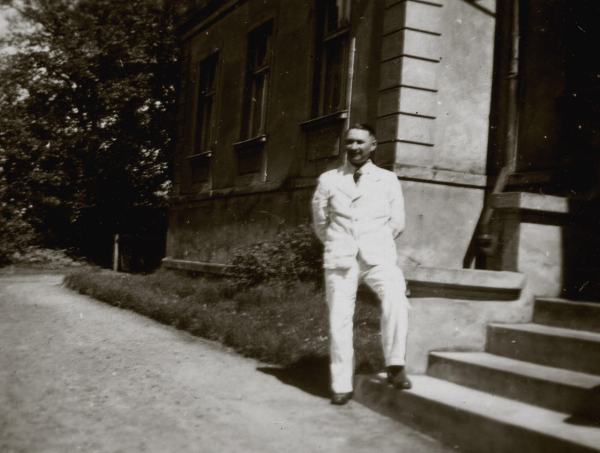
My Father Ernst Klopp 1941

From the stories I picked up from my mother I speculate that Father owed his survival to his reputation of treating fairly and equitably all the people who worked for the large estate under his directorship. Other administrators notorious for their arrogance, cruelty and injustice in dealing with the Polish population were rounded up, lynched, hanged or shot in the closing months of the war. On a  Polish website with a special focus on mansions, manors, and castles of Poland, I found an entire page devoted to Gutfelde – now an agricultural training center with orchards, wheat and corn under cultivation, 800 cows and 8000 pigs. The same page to my great surprise also mentioned my father’s name as an administrator during WW2!

The following are excerpts from my mother’s diary which she wrote from baby Peter’s perspective.
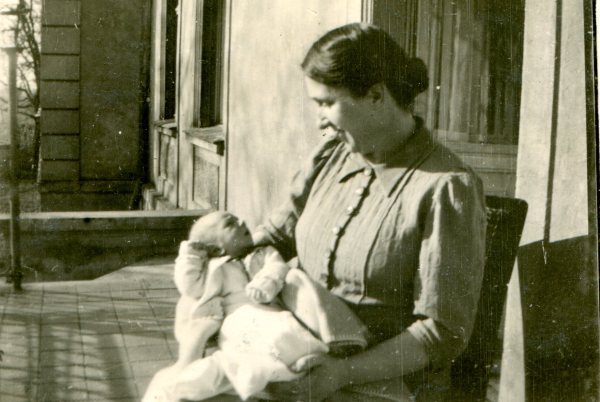
Mother and Baby Peter

When I arrived with Mother at Gutfelde, I received a truly royal reception. My brother Karl, who attends a boarding school in Belgard (Bialogard), would see me a few months later at the beginning of his summer holidays. But the others including my proud father did everything to welcome the fifth child in the family. Flags were waving. Fir branches and a big welcome sign decorated the door to my very own room. Inside the sunny and warm room several pots with beautiful flowers created a cheerful atmosphere for the latest arrival in Gutfelde.
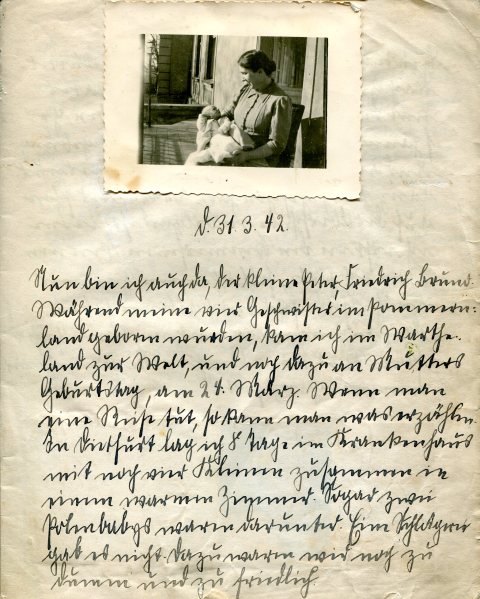
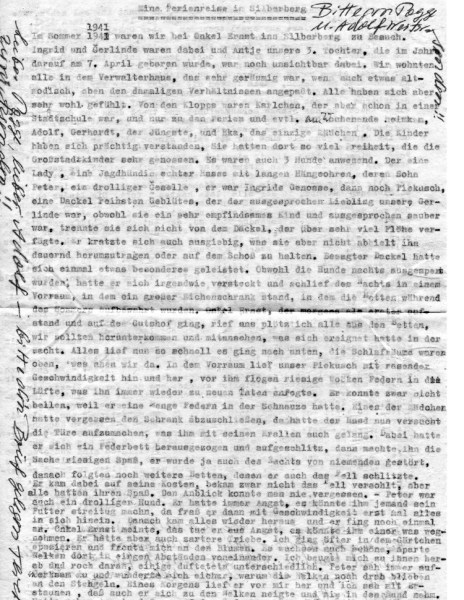
First Page of my Mother’s Diary

Father must have kindled my passion for music and my desire for writing. For he often spent time at my crib telling me long stories, singing with his deep beautiful voice or whistled many a lovely tune. His birthday was coming up. The entire family had prepared a wonderful celebration. For the first time the five children were together. Early in the morning of June 28th, Karl, Adolf, Eka and Gerhard entered the parental bedroom and presented to Father a bouquet of flowers and started off the day with cheerful ‘Happy Birthday’ wishes. Later when good friends of the family, the Döpelheuer couple, had arrived, Karl sat at the piano and played a few pieces to show what he had learned. For accompaniment, Father and Auntie Döpelheuer played on their violins with great enthusiasm. The trio created a really festive atmosphere. 

To be continued
Ernst Klopp (1900 – 1964) Part 16

Cousin Hartmut Kegler’s Vacation Report

This is the third part of the guest post written by my cousin Hartmut Kegler, who also wrote the children’s seminary on Albert Schweitzer I published a few months ago in the original German. I waited until now because it throws some additional light on my father Ernst Klopp and on the happy years in Gutfelde (Zlotniki).

The Hunting Firearm

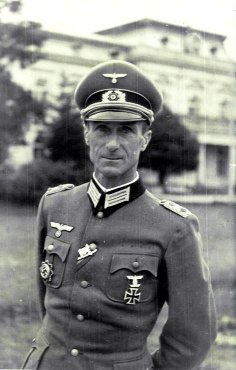
Finally, still vivid in my memory is another experience that was connected to a visit by my uncle Gerhard Kegler. [In January 1945, he was sentenced to death for disobeying Himmel’s insane order to defend the fortress and town of Landsberg, where thousands of innocent townspeople would have lost their lives. His story can be found here.] He was a colonel on the eastern front at that time and was on vacation in Gutfelde. One day, he asked me if I could shoot with a gun. Since I carried on my shirt the shooting badge of the German Youth Organization, I proudly answered yes. My problem, however, was that as a cub I had only been using a light pellet gun. But my uncle entrusted me with a heavy hunting firearm. At my uncle’s visit I was eleven or twelve years old but went full of pride out into the field. Then I spied a riot of crows which were sitting on a high poplar tree. I loaded the gun, raised it, aimed and pulled the trigger. The recoil of the firearm and the loud bang almost knocked me over. The crows flew away. I had not hit any. Since then I have never touched a gun, and never needed to nor was I forced to use one.

Generalleutnant Gerhard Kegler – Gutfelde 1944

The relationship of Uncle Ernst and Aunt Erika with the Polish personnel was, as I recall it, fair and respectful. I believe that they owe their successful escape from the Red Army to the proper treatment of the Polish personnel. The farm workers prevented through their cooperative actions that Uncle Ernst was captured by the Soviet soldiers. Through a series of adventurous moves he managed to safely make it to West Germany. [The actual tragic events that my cousin Hartmut Kegler did not know will be published on a later post.]

1943 Family Photo – My mother on the right with me on her arm

While at the fronts and the bombarded German cities, in concentration and POW camps innumerable people found a horrible death, we children enjoyed happy days during our vacation in Gutfelde. Much later I began to think about the darker sides of life. At any rate, I am thankful to Aunt Erika and Uncle Ernst for their hospitality and for giving us the freedom to romp around at our hearts’ content.

End of Hartmut Kegler’s childhood memories

Ernst Klopp (1900 – 1964) – Part 14

Cousin Hartmut Kegler’s Vacation Report

This is the second part of the guest post written by my cousin Hartmut Kegler, who also wrote the children’s seminary on Albert Schweitzer I published a few months ago in the original German. I waited until now because it throws some additional light on my father Ernst Klopp and on the happy years in Gutfelde (Zlotniki).

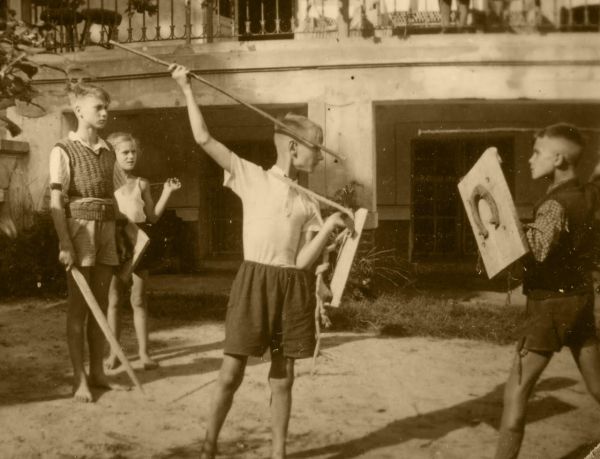
Playing War Games

 According to the prevailing circumstances our games often took a war-like character. I still have the following events vividly in my memory:

– Within the wide boundaries of the estate was a horse pasture. There, the yearlings were kept and could roam wild and free. We had fun chasing these horses around a bit so they would gallop over the entire pasture. It so happened that my four or five-year-old brother Jürgen had run away from us and somehow wound up among the galloping herd. We older children watched and gasped in horror. But Jürgen took the terrifying moment in stride without blinking an eye and miraculously stayed out of harm’s way. For his bravery, we awarded him the ‘Iron Cross first-class’.

– The big hay barn was the place where we played paratroopers. The barn had two floors allowing us to jump from the upper nearly 5 m high floor into the soft hay below. I do not know any more whether everyone had the courage to jump but some dared to take the plunge and even performed a midair somersault.

The ‘Warriors’ at Gutfelde

–  The war games also had a sinister side which we children did not recognize as such. It showed how children at a very young age were already shaped by the dominating culture of the Nazi era. We launched a ‘campaign’ into the settlement of the Polish farm workers, which was adjacent to the park of the Gutfelde estate. There we captured Polish children about our own age and made them ‘prisoners’. We ‘deported’ them to the estate mansion and handed them over to Uncle Ernst. However, he read us the riot act and sternly informed us that one does not do such cruel things and sent the Polish boys and girls back to their village.

To be continued …

Ernst Klopp (1900 – 1964) – Part 13

Cousin Hartmut Kegler’s Vacation Report

The following story is a guest post written by my cousin Hartmut Kegler, who also wrote the children’s seminary on Albert Schweitzer I published a few months ago in the original German. I waited until now because it throws some additional light on my father Ernst Klopp and on the happy years in Gutfelde (Zlotniki).

My Memories of Gutfelde after more than Seventy Years

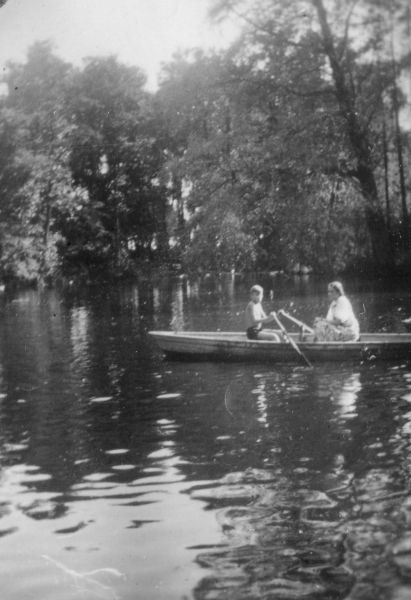
I gladly remember the wonderful vacations we were able to spend in the years of 1942 and 1943 during the murderous World War II at Gutfelde. Our aunt Erika Klopp, the sister of my father Bruno Kegler killed in action in 1940, and her husband Ernst Klopp were the caretakers and administrators of the Polish estate Gutfelde in the so-called Warthegau. They lived in a spacious mansion, behind which was a big beautiful park with a small pond. About the house, I still remember the large dining room and the estate office.

The Pond in the Park behind the Mansion

In the dining room, there was a long table. There we all, the four Klopp children and their parents and we three Kegler kids with our mother would sit to have lunch and dinner. Beforehand, the Polish domestic employee would diligently set the table. I remember her well because of what she said after one of us children had hidden a fork from the carefully laid-out cutlery. Quite shocked, she exclaimed in garbled German, “Where is forkie this?” We rascals were very much amused by her reaction. But the young Polish woman took our prank all in strides and was not even cross with us. When all had punctually taken their seats at the dinner table Uncle Ernst opened the mealtime with these somewhat irreverent words, “People eat, horses gorge. But today it will be the other way around. Enjoy your meal.” Not exactly a pious expression. According to the spirit of the times, the Klopps had left the church but described themselves as God-fearing.

Our holidays were filled with playing many games often bordering on extremely dangerous escapades.

To be continued …

Ernst Klopp (1900 – 1964) – Part 12

Freedom from Fear at Gutfelde

Please note that my thoughts on my father’s life appear in blue print. What is shown in regular print is translated from my cousin’s book on the Klopp family.

Another important aspect contributing to the sense of well-being and safety at Gutfelde was the lack of fear within this close-knit community. The Gestapo had almost unlimited control over Germany’s citizens in the more populated areas areas of the Reich. As reported in the posts on my aunt Tante Meta, a person could get into serious trouble simply by being denounced to the secret police for having made some derogatory remarks about any of the Nazi leaders, especially if the criticism was directed towards the Führer Adolf Hitler. Anyone having an axe to grind with a neighbour could pass on information. Even if, as it was the case regarding Aunt Meta’s husband, the charges were dropped for lack of evidence, the harrowing experience would stay with the accused for the rest of their life.

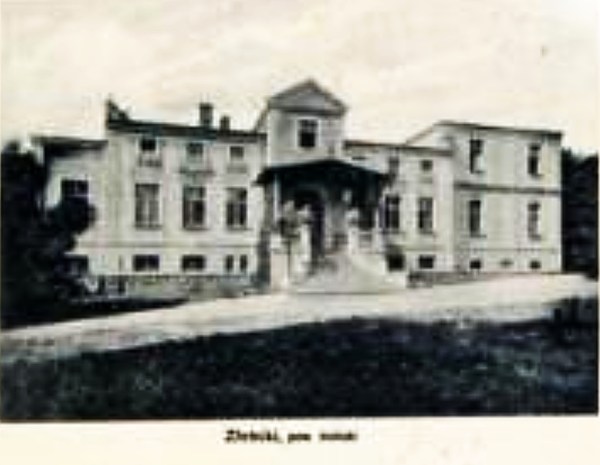
Gutfelde/Zlotniki 1912 Taken from a book on Manors in today’s Poland (very likely the oldest photo of Gutfelde in existence)

Out here in the far eastern corner of  Germany, the Ernst Klopp family and Polish staff lived and worked together in harmony, a situation actually frowned upon by the authorities. Sarcastic remarks and political jokes about the leaders of the Nazi regime, which elsewhere would have resulted in serious consequences, were quite common at Gutfelde. I recall three comments, which my mother had overheard at the large estate household and had passed onto me many years ago. I need to warn my readers the statements are somewhat crude.

Gutfelde – Zlotniki 1912

About Adolf Hitler at a time when it was clear to all that the war would be lost: “Our great Führer got us into this sh-t. No doubt, he will find ways to get us out of this mess.” About the Nazi Propaganda Minister, Joseph Goebbels, who suffered from a clubfoot handicap. He delivered many speeches aimed at keeping up the morale of the German people: “Now comes Little Clubfoot’s fairy tale hour.” About the commander of the Luftwaffe, Hermann Goering. It is presented here in German, because the joke’s effect depends very much on the implied rhyming word, which is missing: “Hermann Goering sprach vor kurzem, man kann auch ohne Zwiebeln auskommen.”

What I recently heard about the use of jokes in the Nazi era seems to fit the picture I painted of the Klopp family at Gutfelde. As long as the jokes excluded the political system and its leaders, they were tolerated, even encouraged. Obviously, the people at Gutfelde had crossed the line of acceptability. But the liberating influence of all that bantering must have been tremendous.

Ernst Klopp (1900 – 1964) – Part 11

Visitors from Berlin

Summer 1941

Please note that my thoughts on my father’s life appear in green print. What is shown in regular print is translated from my cousin’s book on the Klopp family.

Uncle Artur’s report about their summer vacation at Silberberg far away from the capital city in a  carefree rural setting was a joyful moment in time for the entire family. The Klopp children, Karl, Adolf, Erika, and Gerhard (I wasn’t born yet) and the visiting cousins Ingrid and Gerlinde had lots of fun exploring the fields and visiting the farm animals, the cows, horses and even a mule. They took an immediate liking to the three dogs, which added excitement and often real drama to their vacation in the country.

First Page of Artur’s Report on their Summer Vacation

Piekusch, the dachshund, Gerlinde’s favourite dog, managed to pry open the closet door in the middle of the night, pulled out a pillow stuffed with goose down, ripped it open and sent the feathers a-flying. Jumping high and chasing those elusive goose feathers were too much fun to enjoy all by himself. Yapping and howling he drove himself into a frenzy, waking up the entire family in the upstairs bedrooms who came rushing down to behold the spectacle. The event caused so much laughter and merriment that Piekusch got by with just a stern reprimand.

Watching the horses running wild and free on the nearby pasture was not without danger. One day a string of horses came galloping straight towards the children. It became frighteningly obvious the ferocious beasts would not bother to race around the children. In a split-second they leaped into the thicket of a bush, which saved them from being trampled to death.

Some other time the visitors from Berlin took a ride in a horse-drawn carriage to a village, where a wandering troop of performers offered some small town circus entertainment. Nobody was particularly worried as the carriage was gaining speed. As it turned out the coachman had fallen asleep and the horses had gone out of control. Luckily, the coachman woke up just in time to rein in the horses. Otherwise the horses would have dragged the carriage into the lake a mere hundred metres ahead of them.

Freshly caught carp from the pond frequently provided meat relished by all the guests and family members. Uncle Ernst always ready to crack a joke described a ten-pound carp as the venerable elder among the carp tribe.

My Father at the Main Entrance of the Gutfelde Manor 1941

In those days fridges were unheard of in the remote rural community in the land of the Warthe. But the cellar below the main floor was filled with ice. The children had free access to the barrel which contained an huge amount of pickles. Crunchy and tasty the pickles were a refreshing delight during the hot summer days. I could not leave “Uncle Artur’s” vacation report unpublished as insignificant as it may appear. For it gives the distinct impression of peace and happiness at a time of war and destruction in many parts of Germany and the world.