Ernst Klopp (1900 – 1964) – Part 10

The Golden Years (1941 – 1945)

A Few Words About The Title

Please note that my thoughts on my father’s life appear in green print. What is shown in regular print is translated from my cousin’s book on the Klopp family.

You may be puzzled about the title I have chosen for this episode of my father’s life. After all, in many parts of the world people were suffering under the horrific impact of World War II. After the Nazi aerial attacks on southern England came the Allied bombing raids of German towns and cities. Tens of thousands of people perished in the firestorms. Innocent people suffered, starved and got murdered in the Nazi concentration camps. Millions of soldiers gave their lives, on the Allied side in defence of freedom, on the Axis side for the illusion of the questionable honour of dying a hero’s death for the fatherland. So why would I chose such a seemingly inappropriate title for a period when the winds of war brought horror, death and destruction to many parts of the world?

Dresden after the Devastating Bombing Raids

Because at that particular time for the Ernst Klopp family, their workers, friends and relatives, Gutfelde and the entire county of Dietfurt (Znin) was an oasis of peace and tranquillity. Relatives from the big cities under the threat of constant bombardment came flocking to Gutfelde to spend weeks, often months far away and out of reach of the deadly bombing raids. Food was nutritious and plentiful. Even as late as December 1944 the family could celebrate a traditional Christmas with gifts for both adults and children, plates filled with Pfeffernüsse, nuts and all sorts of delicious baked goodies.
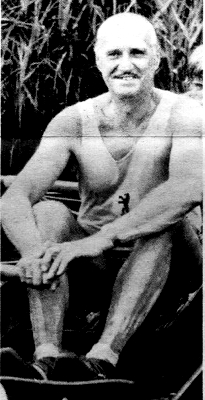
Artur Thiess at age 72. East Berlin Rowing Club

The first visitors came from Berlin in the summer of 1941. At that time my father Ernst Klopp had just started his first major assignment on the Silberberg estate in the Wartheland. Artur Thiess was the husband of Else, the daughter of aunt Alma. Later on because of the huge age difference (I was not yet born in 1941) I called him Uncle Artur, even though technically speaking he was my cousin. Artur spent his summer vacation with his wife Else and his two daughter Ingrid and Gerlinde at Silberberg. He wrote a one page type-written report, which my mother had passed on to me and which I will publish next week.
Ernst Klopp (1900 – 1964) – Part 9

County Court Duties in Dietfurt (Znin)

Please note that my thoughts on my father’s life appear in green print. What is shown in regular print is translated from my cousin’s book on the Klopp family.

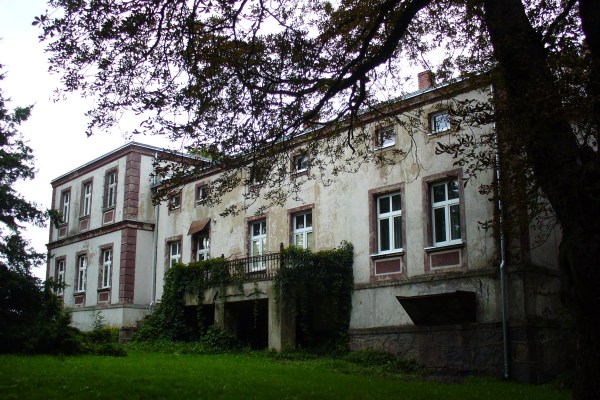
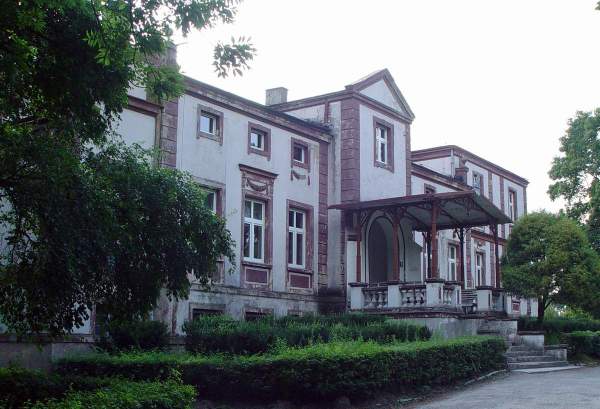
At the time of my birth, my father as manager and inspector was in charge of the estates Silberberg, Oberhof and Gutfelde totalling an area of approximately 3000 ha. Although he must have been thankful to the authorities for landing him such challenging and prestigious position and therefore may have harboured a favourable disposition towards the Nazi regime, he always strove to keep his humanity in dealing with his fellow human beings, Germans and Poles alike. In particular, through his actions he distanced himself from the policy that forbade German citizens to fraternize with the defeated enemy. It is a great testimony to his moral independence from the dark and sinister sides of Nazi Germany that he allowed Polish men and women to live and work closely and cordially with the Klopp family at the Gutfelde residence and the agricultural headquarter for the region. He maintained an excellent working relationship with the former Polish estate manager Haluda, who after WW2 took over as director of the communist run state farm. From the stories I picked up from my mother I speculate that Father owed his survival to his reputation of treating fairly and equitably all the people who worked for the large estates under his directorship. Other inspectors notorious for their arrogance, cruelty and injustice in dealing with the Polish population were rounded up, lynched, hanged or shot in the closing months of the war. On a  Polish website with special focus on mansions, manors, and castles of Poland, I found an entire page devoted to Gutfelde – now an agricultural training center with orchards, wheat and corn under cultivation, 800 cows and 8000 pigs. The same page to my great surprise mentioned my father’s name as an administrator during WW2! The mansion-like imposing building was built around 1880 in the late-classical style and consisted of a body with a higher wing and ground floor extensions. It has not changed much in the last seventy years.

Gutfelde/Zlotniki 2012

The estate secretary was Czeslawa Pruszewicz. Due to Nazi marriage restrictions regarding Poles, she could not call herself Gromowska until much later. My late brother Karl (1929 – 2019) added in a footnote the following comment, “She maintained through correspondence with Erika Klopp regular contact for more than 40 years and died in Rogowo in 1986. Her granddaughter still keeps up the connection with the Karl Klopp family in Detmold to this very day (1997). Ernst Klopp did not tell much about his experiences as an estate administrator. However, it is safe to assume that the descendants of his former Polish estate personnel have kept him in a favourable light.

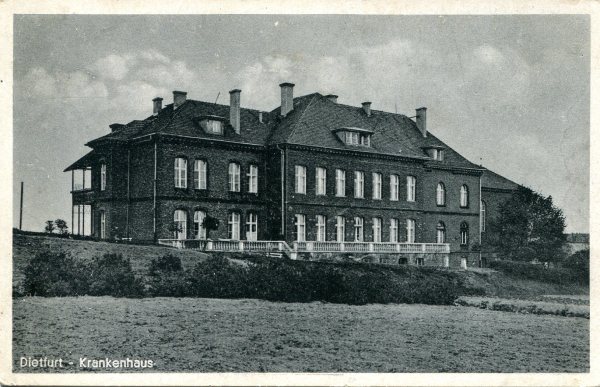
The Dietfurt Hospital, where Peter Klopp was born

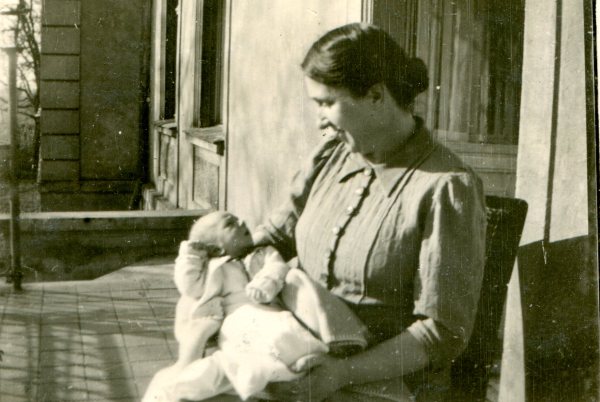
In the Dietfurt county hospital the last child, son Peter, was born on March 24, 1942. Contrary to family tradition and in comparison to his four older siblings, Peter for the time being remained unbaptized. It seems reasonable to assume that in view of Ernst’s positive attitude toward the system a certain alienation from the church institution may have played a major role in that decision.

Little Peter in Gutfelde

Even though Ernst Klopp was not a lawyer, he functioned never-the-less as a semi-independent within the county court system. In a sort of pseudo-independence acting in an honorary unsalaried function, he dealt with complaints among Nazi members against each other as well as with charges from outside the Nazi hierarchy against such individuals. In some individual instances, Ernst also dealt with cases of complaints coming from the Polish population. He was not a civil servant but was authorized to sign and authenticate documents such as marriage, birth and death certificates. He held his honorary position with the Dietfurt county system not on the basis of NS Party Membership, which he did not have, but rather on his reputation as a capable estate manager.

Ernst Klopp (1900 – 1964) – Part 8

New Beginning in the Wartheland

In September 1939 Ernst Klopp was drafted into the army and took part in the attack on Poland, which triggered the beginning of World War II. Within days Great Britain and France declared war on Nazi Germany. In the fall of 1940 Ernst Klopp was released from military service to take on new civilian assignments. In October 1940 he took charge as an administrator of the recently incorporated agricultural estate Oberhof northeast of Posen (Poznan). The Polish owner’s name was Stanislaus Brodnicki and his inspector was Nowak. The estate’s size was 279 ha. In 1939 the building of the manor had already been in ruins. Ernst managed the farming area of this property until May 1941.

Subsequently he was assigned to administer until November 1941 the manor and lands of the former Polish Magnate Moszczenski in the village of Srebrna Gora/Siberberg (German) with a total agricultural area of 510 ha. Both estates now belonged to the newly created county of Dietfurt/Znin (Polish).

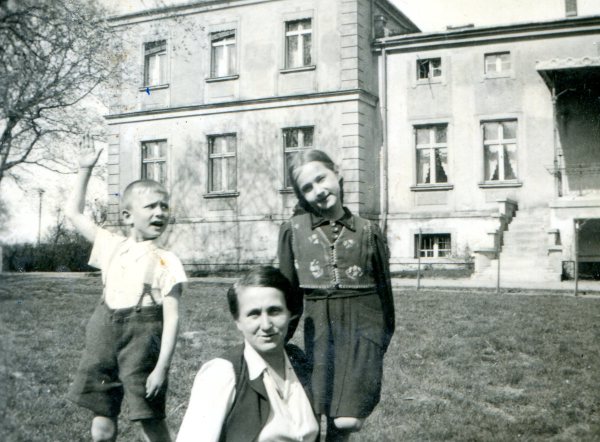
Gutfelde/Zlotniki 1942 – Mother Erika Klopp with her children Gerhard and Eka

In November 1941 the German Agricultural Society (renamed in 1942 ‘Reich’s Society for Agricultural Purposes) installed Ernst Klopp as an administrator of the farming and forestry domains, which belonged to the former Polish Estate Zlotniki/Gutfelde (German) in the county of Dietfurt. The estate belonged till 1939 to Zdenek Czarlinski and comprised 365 ha of arable land.

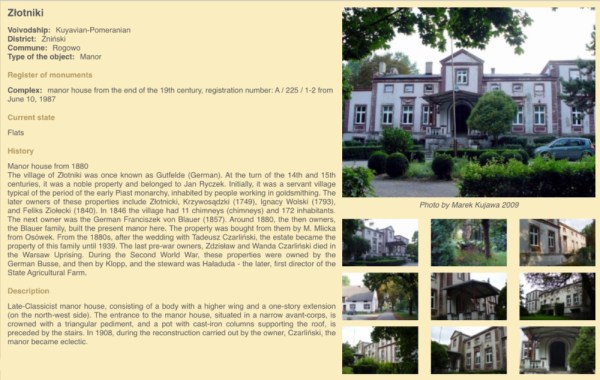
Peter’s commentary: To my greatest surprise I was able to find my father’s name and inspector Haladuda on a Polish website that deals with the history of Polish manors. Here is a brief excerpt from the article I found on the Internet and translated somewhat crudely by Google Translate: 

Zlotniki 2012 – Credit: Polish Manors Website – There has been little change to the outside of the building since the time our family had to leave this beautiful place in 1945.

The constant change of Polish and German ownership of Gutfelde is very noticeable in this short history of the manor.

Ernst Klopp (1900 – 1964) – Part 7

Brief Historical Background

Ernst Klopp in the Wartheland ( 1940 – 1945)

The partitions of Poland and Lithuania were three partitions of the Polish-Lithuanian Commonwealth that took place toward the end of the 18th century and ended the existence of the state, resulting in the elimination of sovereign Poland and Lithuania for 123 years. The partitions were conducted by the Habsburg Monarchy, the Kingdom of Prussia, and the Russian Empire, which divided up the Commonwealth lands among themselves progressively in the process of territorial seizures and annexations.

German Empire (1871 – 1919)

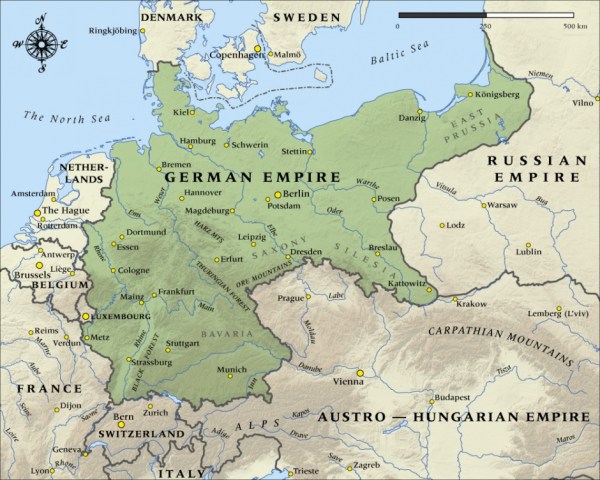
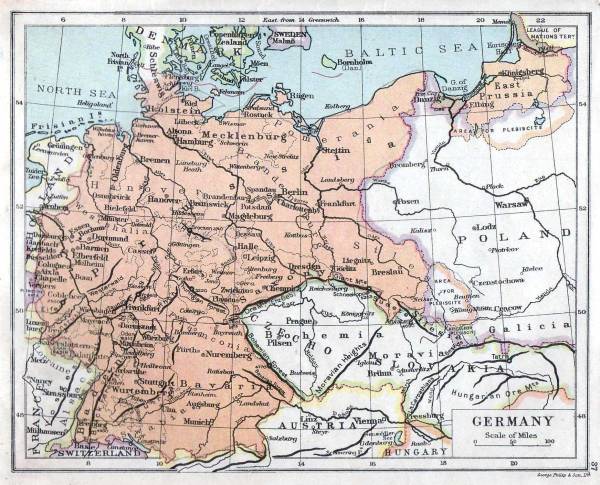
My readers may remember that my grandmother Emma Klopp had settled in Elsenau, West Prussia not many years after her husband Peter Friedrich Klopp has died in 1900. Due to the provisions of the Treaty of Versailles, in 1920 she had to move west together with thousands of other dispossessed Germans. Also the area further south around the city of Posen (today Poznan) had to be returned to the newly created Polish State. That particular region was known as the Warthegau during the Nazi era and was named after the River Warthe. It was here in the area near Dietfurt (Znin) that my father Ernst Klopp received his assignment as director of three abandoned farms.

Map of Germany after World War I

On 1 September 1939, without a formal declaration of war, Nazi Germany invaded Poland, using the pretext of the Gleiwitz incident, a provocation (one of many) staged by the Germans, who claimed that Polish troops attacked a post along the German-Polish border.  During the following days and weeks the technically, logistically and numerically superior German forces rapidly advanced into the Polish territory. Secured by the Molotov–Ribbentrop Pact, the Soviet troops also invaded Poland on 17 September 1939. Before the end of the month, most of Poland was divided between the Germans and the Soviets.

Source of the historical background and maps: wikipedia.org

Ernst Klopp (1900 – 1964) – Part 6

New Responsibilities and a Growing Family

Ernst Klopp followed Pascheke and took over the administration as director of the entire complex. His assistant director was Karl Paetsch. Ernst Klopp was heading the functions of the mission establishments self-responsibly until the fall of 1940. Since the ‘entire realm for the people’s food production was exclusively a national-socialist domain’, those in control over all aspects of administration converted the church-run training home into an establishment of the state, which was now under the jurisdiction of the provincial land association. During this decisive conversion to a state-controlled training centre, Ernst Klopp, as evidenced by keeping his director position, must have made a favourable impression.

In-between three more children were born: Adolf (1932 – 1989), Erika (1934), and Gerhard (1936). In these years, Ernst managed to have a painting of his parents Emma and P. F. W. Klopp done from an old no longer existing photo. The painting accompanied the family until 1945. In Belgrade also hung the framed message of brother Otto’s death, who was killed in Russia in 1915. On January 27, 1936, the entire family celebrated on Ernst-Flos-Estate the 80th birthday of mother and grandmother Emma Klopp (née Bauer). A photo of this eventful day still exists and is in the personal archives of Eberhard Klopp, the author of the Klopp Chronicles.

Three years before the family moved from Belgrade further east to West Prussia (re-occupied by the Nazi regime) Ernst Klopp had a house  built on the Ernst-Flos-Estate property, in which the family lived until the fall of 1940. Finally, the family had their own home separate from the institutional buildings.

Ernst Klopp (1900 – 1964) – Part 5

Gleichschaltung of the Belgard Institutions

The Belgard institutions of the Inner Mission were divided into three work areas: The Dr.-Klar-Foundation, the Johannis-House and the Ernst-Flos-Estate. In 1930, Ernst Klopp took over the agricultural part of the Ernst-Flos-Estate. For its operation, Ernst made use of orphans and young delinquents, agricultural apprentices of the town of Belgard, and asocial people, who were being drafted during harvest times. With this workforce at his disposal, Ernst was able to secure the food requirements for all the people under his care. In the home of the Dr.-Klar-Foundation these were mostly senior citizens and special needs persons and in the Johannis-House alcoholics and the incurable sick. For the delinquent youth and orphans there was mandatory school attendance.

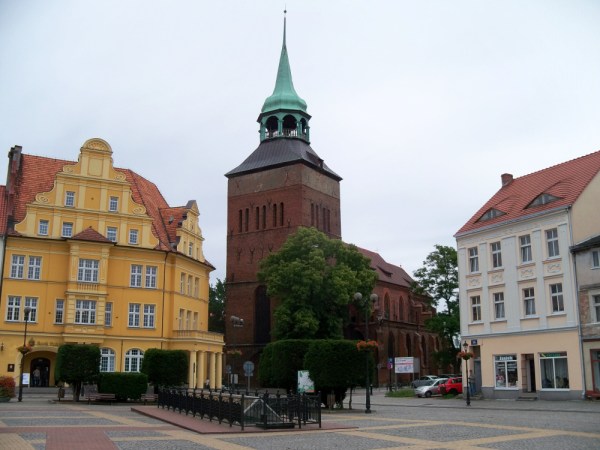
Belgard, Pomerania (now Polish Białogard) – Wikipedia

Erika Klopp (my mother) in the role of a domestic administrator was in charge of the personell from the ‘Alcoholic Rescue Home’, the Johannis-House, who had beed assigned to the Ernst-Flos-Estate. After 1933, female members of the NS Work Service (Reichsarbeitsdienst) and the operators of a pig farm for the NS Food Supply Service (Ernährungshilfswerk) were added to the growing enterprise.

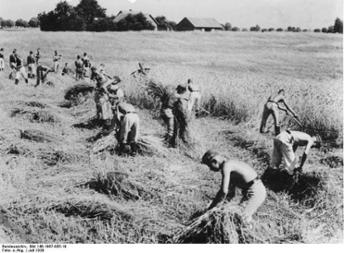
Reichsarbeitsdienst at Harvest Time – Bundesarchiv

Direktor Pascheke had been serving the Dr.-Klar-Foundation as House Father (Hausvater) since 1925. In 1933 or 1934, he was dismissed on account of alleged financial irregularities, an often used method by the Nazis to replace ‘undesirable’ individuals with more party-friendly people in their take-over of independently run institutions.