Falsely Accused and Smoking a Pipe

Conclusion of Chapter VII

One day as I was happily returning home from the Upper Village, a girl about my age crossed my path and placed herself in front of me.

“I want to show you something”, she said. To my surprise she quickly pulled down her panty and lifted up her skirt. Without waiting for my reaction, she demanded, “Now you pull down your pants!” Puzzled by this naughty request, I stared at her for a moment and then ran home as quickly as my legs could carry me.

Around supper time there was a knock at the door. When Mother opened it, I heard from inside the living room a soft, but ominous voice in a very accusing tone. Soon a woman, accompanied by the girl with whom I had just had this embarrassing encounter, entered and immediately continued to speak more menacingly than before.

“My sweet little girl was on her way home, when your naughty confronted her with the most indecent request. He asked her to expose herself. You can imagine, Mrs. Klopp, how shocked and disgusted she was with this display of improper behavior. When she turned around to run home, that brat grabbed her from behind and pulled her panty down.”

While the woman continued with the story about her ‘sweet little girl’ being harassed in broad daylight, I felt so stunned by the accusations that I was unable to utter a single word in my defense. We all know the old adage: silence is admission of guilt. And nobody got to hear my side of the story, not even my own mother. The shame I felt over something I did not do was so overpowering as if I had indeed done what I had been accused of. So I remained silent.

“Look, Mrs. Klopp, how guilty he looks! It was good I came by to tell you. Hopefully this will be teaching him a lesson.” And with that remark she took her ‘sweet, little girl’ by the hand and added, “We must go home now and fry our fish for supper. Good night!”

Father loved to smoke his pipe. I often watched him, as he was preparing to light it, a process that seemed to be like a relaxing ritual for him. With fascination I was watching him gather his pipe, tobacco bag and the matchbox. He opened the bag and held it under his nose to savor the aromatic delight in his nostrils. Then he grabbed a pinch of the brown fluffy stuff and loosely filled the pipe’s chamber. After he had carefully closed the tobacco bag, he struck a match to light the pipe. This was the moment I had been waiting for. With a few puffs the aromatic scent of smoked tobacco filled the entire room, and I vicariously participated in my father’s delight. Even though I never turned into a smoker in my later life, I do have fond memories of the cozy atmosphere surrounding Father and his pipe.

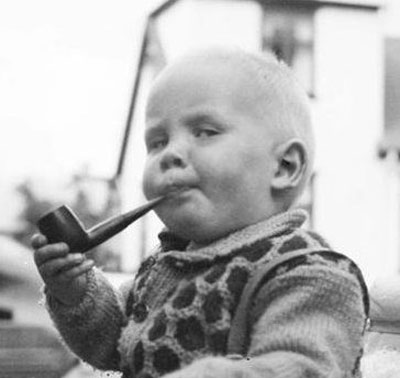
Kid Smoking Pipe - Photo Credit: smosh.com

Kid Smoking Pipe – Photo Credit: smosh.com

One day, when I came home from playing outside, I noticed to my great surprise Father’s pipe on the kitchen table. I was surprised indeed, because Father would always put it away in a secure place. Then there were also matches on the table, but what amazed me the most was that the pipe’s bowl was stuffed with bits of crumpled-up paper, leaves and old cigarette butts. The attraction to smoke Father’s pipe was irresistible like sweet honey to a bear. Within seconds I held Father’s pipe between my lips, lit a match and brought its flame near the bowl filled with that poisonous concoction of paper, leaves and cigarette butts. I sat on the chair like Father inhaling the disgustingly acrid smoke. A few puffs later, I suddenly felt sick to my stomach. Pale and green in my face I slid off the chair, on which I had just sat proud and strong like Father. Holding the glorious pipe in my hand, I landed on the floor with a thump, threw up and passed out all within less than a few minutes. It was then when my older brothers came rushing out from their hiding places, whence they had been watching the spectacle. They had set me up for their macabre entertainment. I was sick for a long time, so sick actually that this horrid experiment with tobacco served as a form of effective inoculation against nicotine addiction for my entire life. And for that I will be forever thankful to my brothers!

Rescue from Certain Death and Peter’s Perilous Bike Ride

Chapter VII – Part III

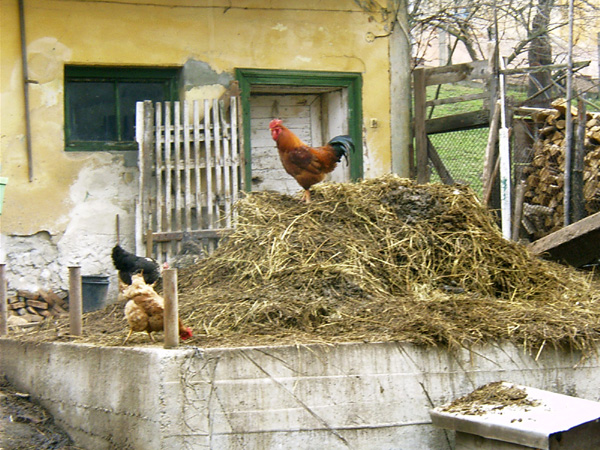
Misthaufen-large

Photo Credit: schnittpunkt2012.blogspot.com


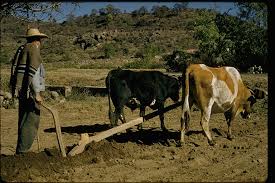
The farmers in Rohrdorf were relatively poor. But they were much ahead of their time by practicing what we now call organic farming methods. Their farmhouse was located in the village and their small fields often less than one ha in size were scattered in the outlying areas. With each plowing, rocks emerged from below the surface and needed to be picked up. Owning horses for pulling farm equipment was a luxury in this impoverished region between the River Danube and Lake Constance. Most farmers used cows for pulling their wagons and plows. Yet, they also expected them to give plenty of milk in the morning. Cow-barn and residence were located under the same roof. A giant manure pile decorated the front of the house right next to the stairway leading up to the main entrance. Conveniently the kitchen was right above the manure pile, so the farmer’s wife merely had to throw kitchen scraps and other organic refuse out of the window. Above the cow-barn the farmer stored hay for fodder and straw for the cows to rest on during the night. The architecture of the entire building was designed to save manual labor. During the winter months the farmer would simply take his pitchfork and throw down the hay into the long trough. From the rear end of the animals the cow pads mixed with straw would go directly onto the manure pile, while the urine would flow freely down the gutter into the holding tank outside the building. Nothing, absolutely nothing was wasted here. Well-rotted manure and aged slurry went back to the fields to revitalize the soil.

cows

Photo Credit: calphotos.berkeley.edu

At one of these farmhouses I was playing all by myself one day. I cannot remember what attracted me. To be sure, it was not the pungent smell or the questionable beauty of the manure pile. Spurred on by my childlike curiosity, I was simply exploring a place that was new to me. Boundaries have no meaning to little children. Trespassing is a foreign concept to them. As I was walking around, I stepped on the lid that did not completely close the opening of the holding tank. All of a sudden the lid tipped under the weight of my body. I lost my balance and slipped into the deep, smelly slurry underneath. Panic-driven I frantically thrashed around to keep at least my head above the smelly liquid. In vain I looked for a foothold or at least something to cling to with my hands. But there was nothing but the slippery, slimy wall surface. Soon I began to tire. I found it harder and harder to stay afloat.

The little light that had penetrated the darkness before suddenly grew dimmer. I could no longer see the walls. It seemed I was losing consciousness. Did the toxic fumes make me mercifully lose consciousness, before I would drown? Just as I was beginning to submerge in the infernal soup, I felt a strong grip at one arm, then on the other. I was no longer sinking, but going up instead. Centimeter by centimeter my body was dragged by an invisible force higher and higher towards fresh air, sunshine and life. With a thump I landed on firm ground and after I recovered a little, I looked at my rescuer’s smiling face. One of the older Pröbstel boys had heard the clang of the lid and saw me fall into the holding tank. It would have been my certain death, had he not acted immediately. The miracle of my rescue appears even greater to me now, when I consider that by chance the holding tank was filled almost to the top. For otherwise the boy would not been able to reach me.

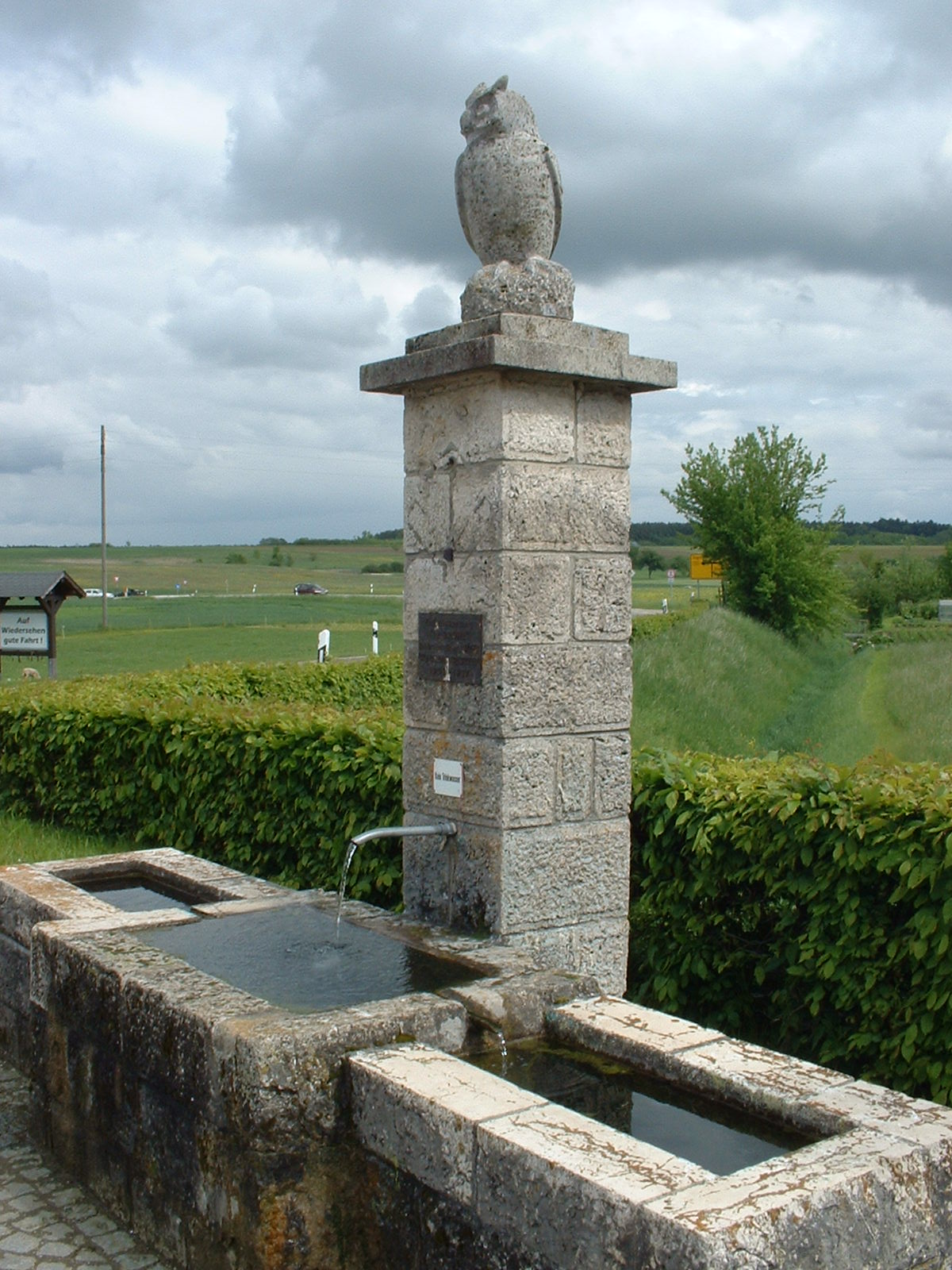
I learned to ride a bicycle under somewhat unpleasant circumstances. One day my brother Karl lifted me up onto the saddle of his rather tall bicycle. I was all excited. Indeed I was very eager to experience the freedom of moving about on two wheels. My legs were barely long enough for my feet to reach the pedals. While Karl was holding the luggage rack to keep the bike in an upright position, I began to pedal and managed to gradually build up speed. Every once in a while my brother let go of the rack just for a few seconds to give me the feeling of the relationship between speed and balance. Under his caring guidance I was able to ride the bike independently for longer and longer stretches, until I had developed enough confidence to break from Karl’s helping hands. I pedaled so fast that I soon left him far behind. I was on my own now experiencing the exhilaration of traveling on two wheels. I was on that straight level stretch between the ‘Poorhouse’ and the public fountain at the junction.

Fountain at Lower Village - Photo Credit: Stefan Klopp

Fountain at Lower Village – Photo Credit: Stefan Klopp

However, there was one problem. I had not yet learned to make a u-turn and what was worse I did not know how to stop the bike without falling and hurting myself. This meant that I was unable to turn around and get back to Karl who could assist me getting off the bike. The exhilarating sensation suddenly gave way first to mild anxiety, then to full-blown panic, as I realized that the only way to prevent a painful crash on the paved highway was to keep on pedaling. So I did, until after a few more minutes exhaustion set in and I could no longer move the bicycle fast enough to keep my balance. Fortunately, as the bike was just ready to fall on its side, I steered it into the ditch and thus avoided at least a major injury. If this had been a lady’s bike without that scary crossbar, I would have been all right. Roughed up a little in body and spirit I walked Karl’s bike back home crying all the way to express my hurt and misery.

OLYMPUS DIGITAL CAMERA

Photo Credit: lokschmiede.ch

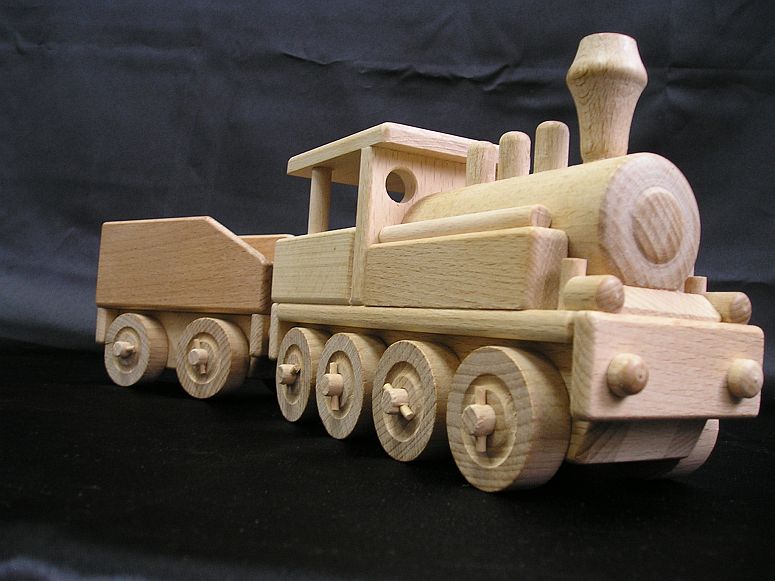
There are two kinds of gifts, the one you buy and the one you make yourself. Although the former may be much appreciated at times for its usefulness or inherent thoughtfulness, it is the latter that is of greater value, because the giver has devoted so much time, planning, workmanship, and love to the gift. In a sense he has given part of himself to the recipient. So I feel today when I contemplate about the first Christmas gift that I can remember from the early days in the ‘Poorhouse’. Apart from the customary plate of nuts, sweets and cookies – truly highly esteemed luxury items during the rest of the year – I found under the tree a colossal wooden locomotive about half a meter long and big enough for me to sit on. It was equipped with a set of six or eight wooden wheels, which revolved smoothly around its skillfully crafted axles. It was a joy to look at and an even greater joy to play with. A lot of thought had gone into designing and building it. If I consider how few tools had been available and how primitive they were, it was truly a masterpiece. I do not know who was involved in the plan of creating this wonderful homemade toy. But it seems to me that the entire family had made a contribution to a project, which I cherished as the only true gift worth remembering all the way up to my teenage years.

Chapter VII – Part 2

Young Shoots of Norway Spruce - Photo Credit: Dendroica on Flickr

Young Shoots of Norway Spruce – Photo Credit: Dendroica on Flickr

Mother’s guiding principle was the proverb: Necessity is the mother of invention. She was very resourceful and creative, when it came to providing a little more variety and nutritional value to our meals. It was in the wonderful month of May, when life began to stir. Among the budding trees the most amazing ones to show off vigor and zest are the conifers. First they display tiny brown buds. Slowly they swell, and then their papery brown covering falls away in wind and rain. Mother still remembered some old time-honored recipes she must have learned at Grandmother’s home in Grünewald. She asked us to get out into the woods and gather these limey-colored buds with their tantalizing scent. I had no idea what Mother would do with them. I had seen stranger things than spruce and fir needles on the dinner table. However her plan was to make a simple syrup that we could put on bread and pancakes. We had lots of fun gathering the needles according Mother’s strict instructions: to harvest only the young and tender tips. Little did I know how Mother would turn the fresh needles into syrup. But I remember the fragrance permeating the entire house, while she made the honey-like syrup in the kitchen. So for the reader interested in trying out the recipe here is what I discovered online:

1 cup of spring fir, hemlock or spruce tips

1 cup of water

1 cup of sugar (demerara, turbinado, white sugar)

Place the tree tips in an 8-ounce glass container.  Cover with water, close lid and place in a warm place (preferably in the sun).  Strain and place the liquid in a small sauce pan.  Add sugar, turn on medium heat and stir constantly until the sugar is dissolved.  Place in a glass jar and keep refrigerated.  This syrup will last several weeks.  Demerara is a natural brown sugar and turbinado is raw sugar.  These both have a richer and more complex flavor but white sugar will work fine too.

Since there was no Kindergarten in the Rohrdorf Elementary School, my parents sent me to the one set up by the Catholic Church. There I felt very much at home. Friendly nuns would provide a happy mix of schooling and religious instruction. Playing with the local children of my own age, I quickly learned to converse perfectly in the southern dialect and soon became indistinguishable from the other boys and girls. The teachers within the context of play and learning introduced us to the creative world of music, poetry and drama.

I really liked to recite the poems at home with great enthusiasm, which was only dampened by the constant teasing of my older siblings. I remember distinctly a particularly colorful poem that described the reddening of the evening sky and compared it with flickering flames in a fireplace. My brothers delighted in my heart-felt protests, when they deliberately changed the lines of the poem I was reciting.

At Christmas time the Church planned a concert for the community. Of course, a Christmas concert to be complete must include a Nativity play. Having shown quite early an interest and talent in acting, I was very proud that I was selected for the role of Joseph in the Christmas pageant. What I owe the most to my early childhood education, is that under the nurturing direction of the nuns I developed a liking for singing. Music for me became a liberating force for the soul.

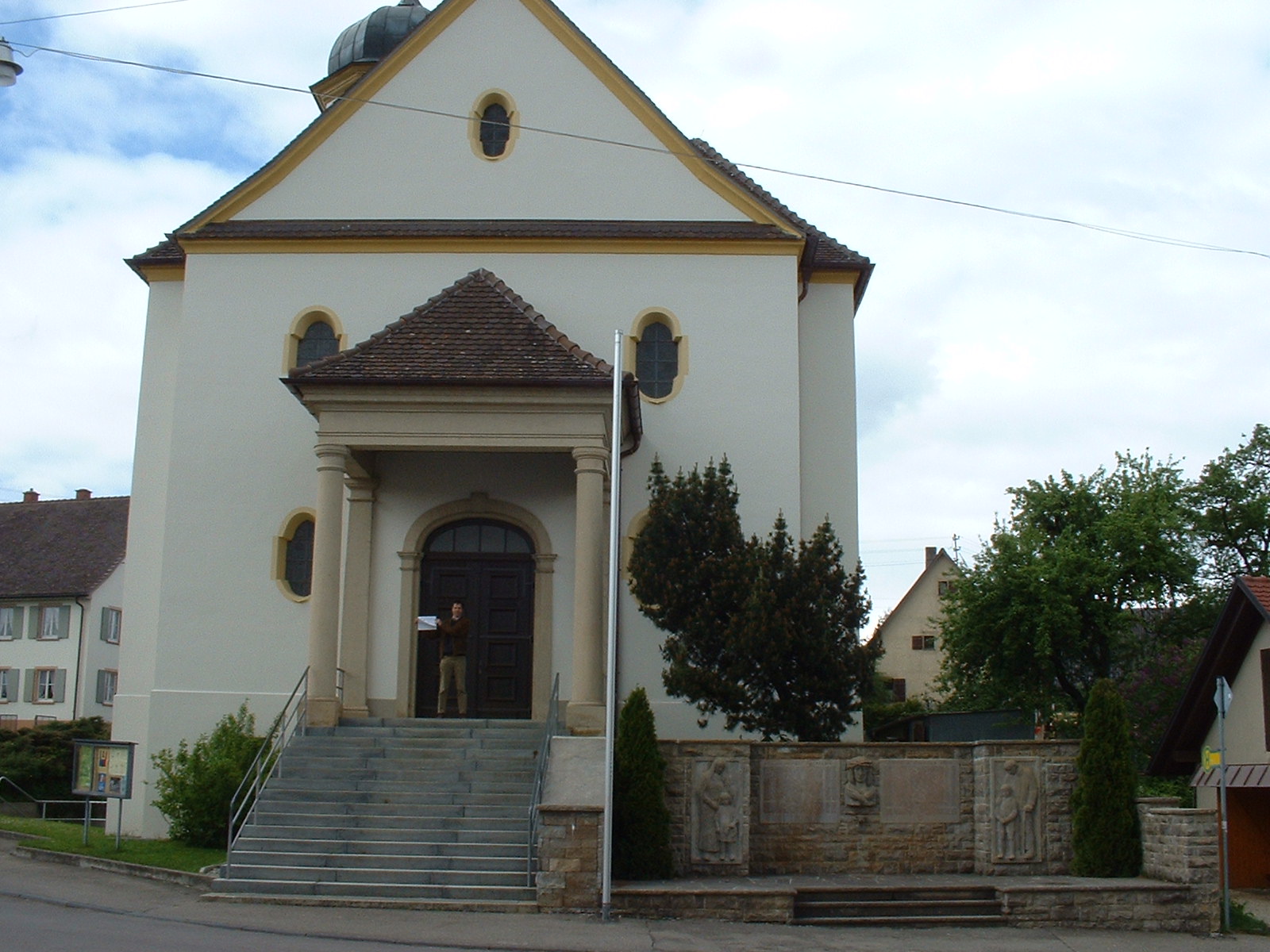
The Church in Rohrdorf in 2003 - Photo Credit: Stefan Klopp

The Church in Rohrdorf in 2003 – Photo Credit: Stefan Klopp

One dark and dreary evening I was all by myself. Nobody was at home. In those days there were no laws ensuring that children under the age of ten be attended at all times. The use of babysitters to protect such children from potential harm was virtually unknown. Mother had tucked me in and had said good night. Perhaps she waited a little longer at the door, until she thought that I had fallen asleep. But I hadn’t. When all was dead quiet in the house, the same feeling of abandonment overcame me just like the year before at the railway station. As twilight turned into complete darkness, I could only see what my fear-driven imagination would conjure up in my mind. A monster ready to devour me was lurking behind the closed door and a wolf with bared teeth sat somewhere in the shapeless room preparing to pounce on me at any moment. The fear of the unknown was growing more and more intense. I lay almost paralyzed in my bed hardly able to move. Suddenly a tiny light began to shine within my frightened inner being. It was very weak at first, then fed by happy memories at the Kindergarten class it became much brighter and started to dispel the terror of those awful beasts that my tormented imagination had engendered. Comforting words, lines, verses and finally entire songs emerged from deep inside me. They put my mind gradually at ease.  Picking up courage I sat up, opened my mouth and began to sing. I sang all the beautiful songs I had learned during the past couple of months. And the more I sang and the more I raised my voice, I knew that by doing so I chased away those scary creatures of my own making. Most of the songs were hymns steeped in the Roman Catholic faith intended to provide comfort and were composed especially for little children. The melody and the lyrics made me forget my anguish and created so much joy that I kept on singing, until my family returned from whatever social engagement they had attended to. They believed that I was a very happy boy that evening. Only I knew, how mistaken they were. I had fought a big battle that night and won in the end with the spiritual help of the comforting words and songs I had learned at Kindergarten.

To be continued …

The P. and G. Story – Chapter VII

Rohrdorf

The Poorhouse – Chart I – III


We are not rich by what we possess but by what we can do without.
Immanuel Kant


Map of Baden-Württemberg - Rohrdorf is located between the Danube and Lake Constance.

Baden-Württemberg – Rohrdorf is located between the Danube and Lake Constance.

          As the refugees began to move south from their camps to Baden-Württemberg, pressure was building on the local inhabitants to make room for their ‘brothers and sisters’ from the eastern provinces. Soon accommodation became very scarce. It consisted of space directly under the roof or some other primitive living quarters often without heat, electricity or water. Upon arrival in Rohrdorf, local officials assigned to our family one of these dingy places. I have no memory about my physical surroundings. But I had once a very vivid dream. In it I saw surrealistic images, in which space and its objects appeared grotesquely distorted. The assembly of the tableau consisted of bird-like creatures, men with birds’ heads strutting around with long beaks. There were strangely shaped sculptures, stone blocks with holes in them that looked like empty eye sockets. It seemed that the dream had broken all the laws of physics and all the rules of perspective in art in this contorted display of a chaotic world. When I woke up most likely from hunger pangs, I could not connect anything I saw in my dream to the real world around me. Could this have been an archetypical experience? Or did I sense as a child that the struggle for survival in a broken world was not over yet? It is impossible for me to tell. But the phantasmagoric imagery and the bewildering impact it exerted on me remained. Much later in life, when I was looking at abstract art, especially the sort that is known as surrealism, I encountered a few paintings that revealed an uncanny resemblance to my early childhood dream.

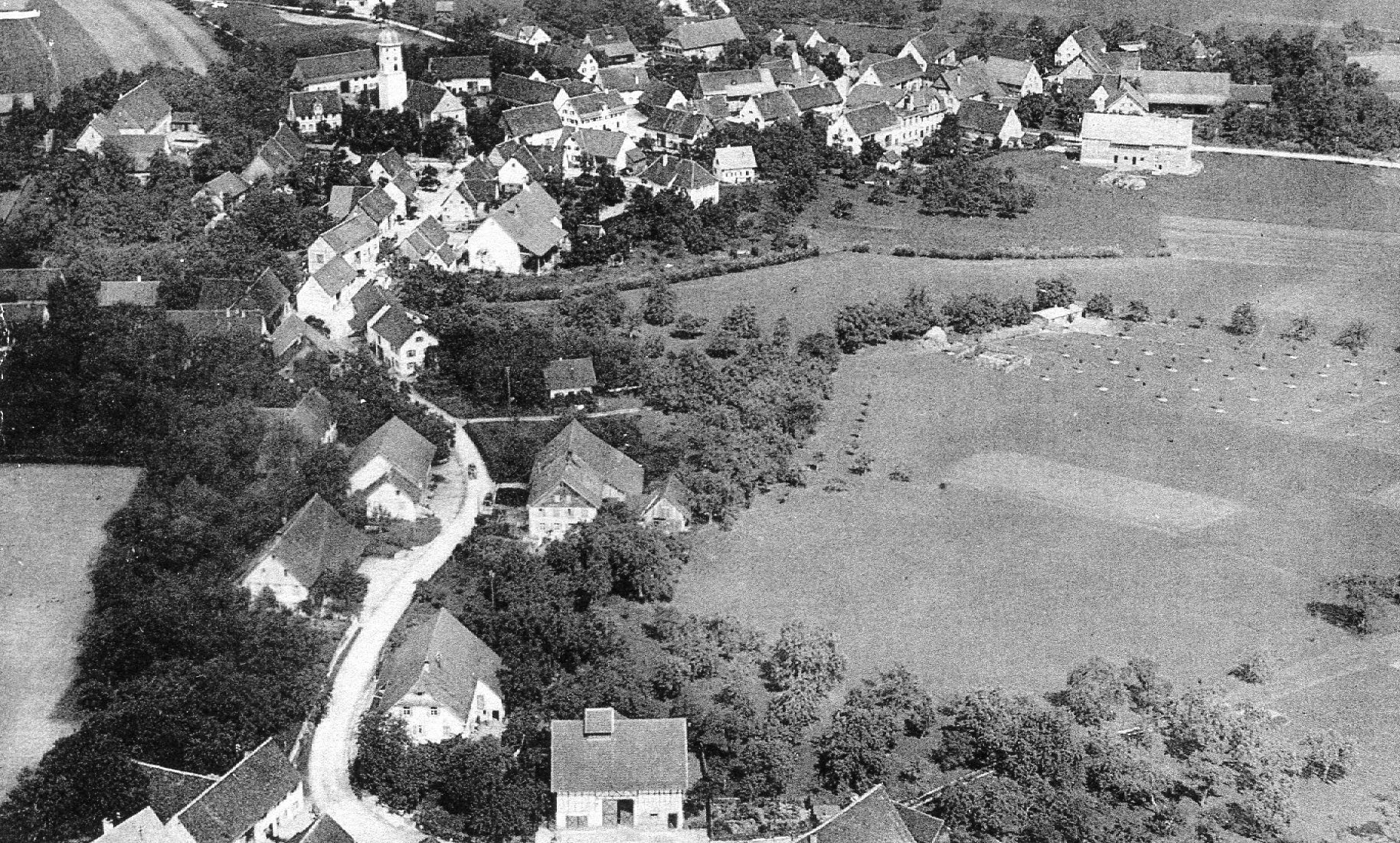
Rohrdorf near Messkirch

Rohrdorf near Messkirch

          Our next dwelling in Rohrdorf was located in the lower village not far from the intersection of two highways, one leading to Sigmaringen, the other one where our house was located to Castle Wildenstein. We lived on the second floor with access to the attic space. We called the place Armenhaus, ‘Poorhouse’, because in comparison with the stately mansion in Gutfelde it was a dark and uncomfortable place, too small for our seven family members. Downstairs on the ground floor lived the owner with his ailing mother and at least a dozen cats. He loved them dearly, but for the Klopp’s they were always slinking in and around the house and were occupying every nook and cranny as if they owned the place.

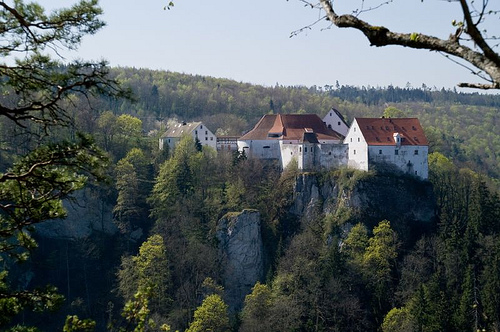
Castle Wildenstein - Photo Credit: Klaus Stückl on Flickr

Castle Wildenstein – Photo Credit: Klaus Stückl on Flickr

          The winter of 1947 was one of the severest in recent memory. All of Europe suffered under its icy grip. Even England, which usually enjoys a temperate climate, experienced extremely cold temperatures and massive snowfalls blanketing the entire country. Gigantic snowdrifts completely cut off Rohrdorf from the neighboring town of Meßkirch. Food had become so scarce at the Klopp family that we had to resort to begging. The local farmers, who had suffered the least during the war and had plenty of food on the table, were reluctant to help their fellow German citizens whom they considered with suspicion like intruders, almost like foreigners. True, we did not speak their southern dialect and belonged to the ‘wrong’ faith. Most of us were protestants, not Catholic. In short, we were outsiders, who did not belong. To avoid confrontations with the people in Rohrdorf and to protect the family from feelings of shame and disgrace, we often went begging in a neighboring village, where people would not recognize us. Being only five years old, always hungry and looking hungry, the family thought that I would be the best candidate to move hearts, especially those of kind-hearted women. One day I entered the yard of a farmhouse alone, while everyone else was hiding in the background. I walked up the steps. With some trepidation I knocked at the front door. Farmers had chased me away empty handed before. To add injury to insult, they had even hurled abusive language at me. After a long wait and repeated knocking, the door opened just a crack, and a gruff voice demanded to know, “Wa’ wit’?”, a hackneyed version of standard German, “Was willst du?”, meaning “What do you want?”

With all the strength at my disposal I replied, “ I’m sooooo hungry!” The man was just about to slam the door shut on me, when I heard the farmer’s wife ask, “Who is at the door?”

“Just a lousy refugee kid asking for grub!”

“Let him enter. I will take care of him.” Reluctantly he let me come in into the warm and cozy entrance hall and stepped aside, as his wife welcomed me with a motherly smile. She just took one glace at me and knew what my problem was. Before I could even say a second time, “I’m sooooo hungry!”, she rushed to the kitchen. I will never forget the moment when she placed a loaf of bread into my outstretched hands. But what is even more important than bread that is baked today and eaten tomorrow, is this kind of love, kindness and compassion that breaks down the walls of prejudice, bigotry and hatred, which people erect to protect their selfish comfort zone.

To be continued …

The P. and G. Klopp Story

Conclusion of Chapter 6

Chart I – III

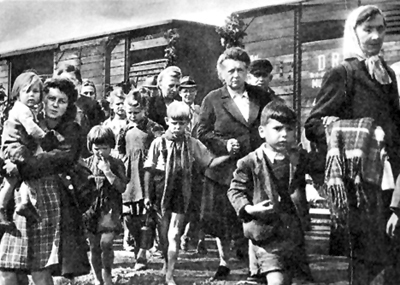
My very first memory goes back to the tumultuous time, when Mother, my brother Gerhard (Gerry) and I were on a train crammed with refugees. I do not remember any specific details, such as the name of the railroad station, where we must have stopped, the town, the time of the day, etc. What I do remember is that I was standing at the edge of the platform with hundreds of people frantically milling about. I do not know why I was standing there in a strange, noisy station surrounded by strange, noisy people. Then quite unexpectedly the train began to move ever so slowly at first. Panic-stricken I looked around and searched in vain for Mother. In agony I cried out for her. While the train on its way out of the station was gradually picking up speed, the fear of being left behind, the feeling of complete, utter abandonment struck me like a ton of bricks. Suddenly I felt being lifted up from behind and passed through the open compartment window into my mother’s arms. This traumatic event left such a vivid impression on me that even though it was devoid of concrete details the inner experience was so real that I have not forgotten it to this very day.

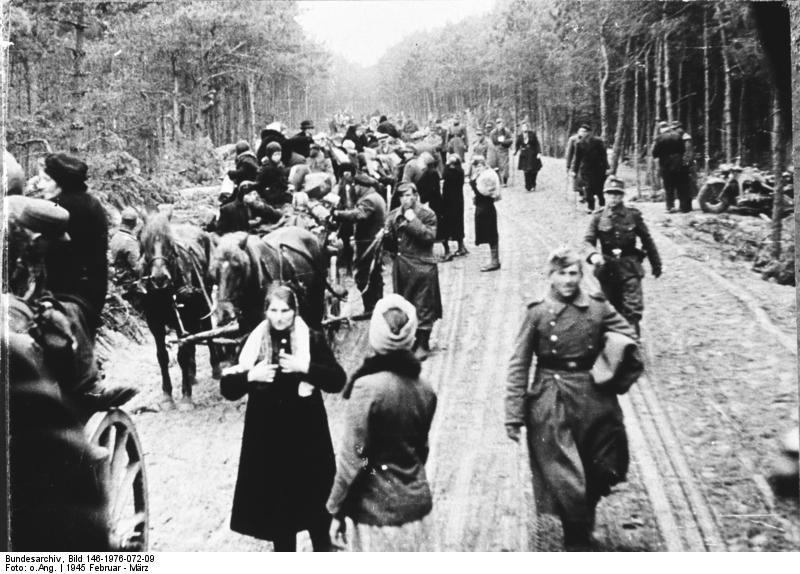
Expulsion from the Eastern Provinces - Photo Credit: Wikipedia.org

Expulsion from the Eastern Provinces – Photo Credit: Wikipedia.org

We arrived in Schleswig-Holstein at one of the many refugee camps set up for the thousands of displaced people from the eastern provinces. But it was only a temporary stay. The authorities urged the newcomers after they had recovered a little from the ordeals of their long journey, to move on to areas in Southern Germany, which had been less affected by the destruction and would more readily have accommodation available for us. So Mother, Gerhard and I travelled into the French-occupied zone to Freiburg, where my father’s sister, Aunt Meta, lived with her husband Professor Vincent Mülbert. On a stopover in Offenbach, Baden-Würthenberg, Mother made arrangements for me to be baptized. I often pondered later in my adult life on the reasons why it had taken more than four years to receive my baptism, one of the essential sacraments in a Christian’s life. I see an important lesson for all of us, who have grown up in the rapidly changing era of modern Western civilization with its great emphasis on materialism. The root of evil is not money itself, but, as the Bible states so clearly, it is the love of money. It is the desire to find happiness in the acquisition of material things. Looking back at Gutfelde with this critical perspective in mind, I cannot help but observe a drifting from the true faith, in which Mother had been nurtured in her father’s home, to a faith-like trust in the security offered by material possessions. We lived in a mansion that did not belong to us. Father was a good administrator of the lands and fields of dispossessed Polish farmers. Yes, he was kind and helpful to all the people working under his authority. But it does not detract from the rightful charge that the farmland was worked in a system that heavily relied on a master-servant relationship in order to make it work. With the collapse of the Third Reich that was supposed to last a thousand years and the loss of our beloved Gutfelde came the sober realization that their little ‘paradise’ in the east had been nothing but a pipe-dream, a house not built on rock, but on the shifting sands of man’s earthly aspirations.

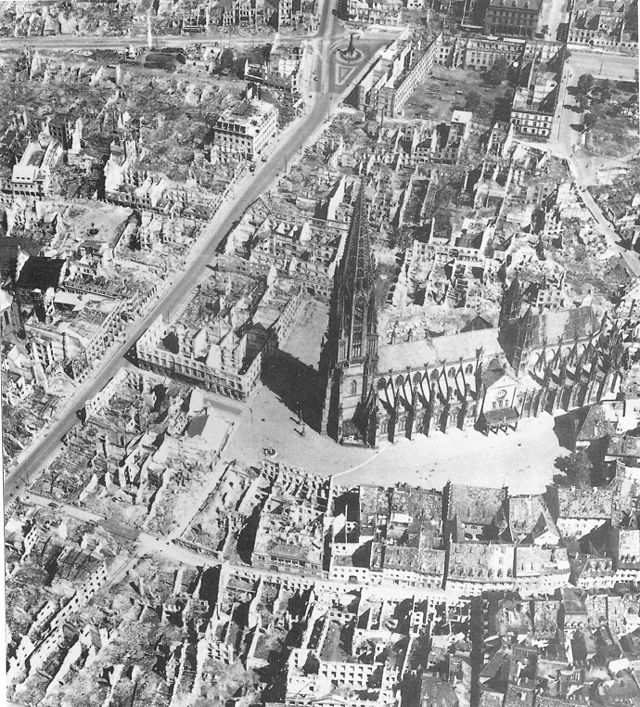
Freiburg City Center 1944 - Photo Credit: City Archive

Freiburg City Center 1944 – Photo Credit: City Archive

We received a warm reception at my aunt’s place in Freiburg, a city with a population of over 100,000 inhabitants before the war. By the end of the Second World War 80% of the city lay in ruins. An air raid as late as November 27th, 1944 made 9,000 out of 30,000 apartments uninhabitable, killed 2,000 people and all that was left of the city center was the cathedral. The Münster of Freiburg was built across a span of several centuries and exhibited a range of architecture from late Romanesque to Late Gothic and even a tad of Rococo. Its single tower with a lacy spire was the first of its kind. The building remained mostly unchanged since its completion in 1513. Miraculously, unlike so many great cathedrals and churches in Germany, it was not entirely destroyed during the severe Allied bombing of Freiburg and its ensuing firestorm, although the whole area around it was reduced to rubble. The city fathers had expected an aerial attack, even though strictly speaking Freiburg was a non-industrial town and practically useless as a military target. So they put their heads together to find a way to save the cathedral from destruction. My aunt told me when I came to visit her later as a ten-year-old, that they had fir trees attached to the pinnacles and other high points of the cathedral so that like Christmas trees they would with their bright green colours of hope alert the pilots to the city’s urgent plea to spare the 500-year-old precious piece of architecture. I could not verify the story, but I too found it amazing that everything else in a large diameter around the building was completely flattened by the Allied aerial attack, but the church itself had remained virtually unscathed.

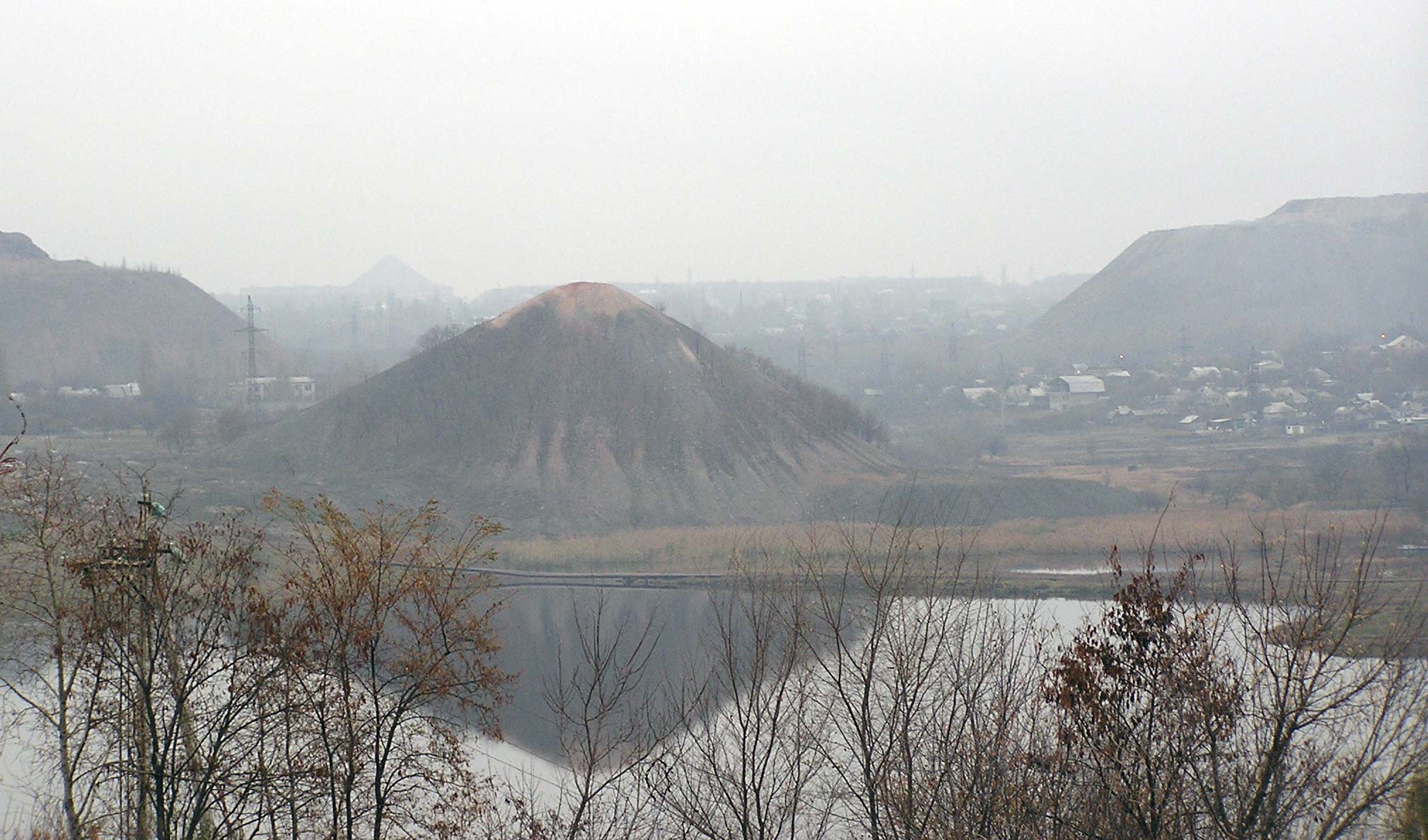
Coal-mining Spoil Tips along the Kalmius River

Coal-mining Spoil Tips along the Kalmius River – Photo Credit: Wikipedia.org

In the meantime, Father had a major accident, while he was working in the coalmines in the Donbas region of the USSR. He received treatment for his head injury and would have been sent back to work if he had not feigned continual headaches. Thus, he succeeded in getting an early release and was sent back to Germany. When he arrived at Uncle Günther’s place in Erfurt, he heard that the entire family had survived the war. He established contact with Mother and the children and in 1947 moved to Rohrdorf, a small village in Southern Germany between the River Danube and Lake Constance. There he found employment with the regional branch of the Fürstlich-von-Fürstenberg forest administration. Eventually, the entire Klopp family was reunited. Although now extremely poor, often hungry, and dispossessed, we were together and could attempt a new beginning.

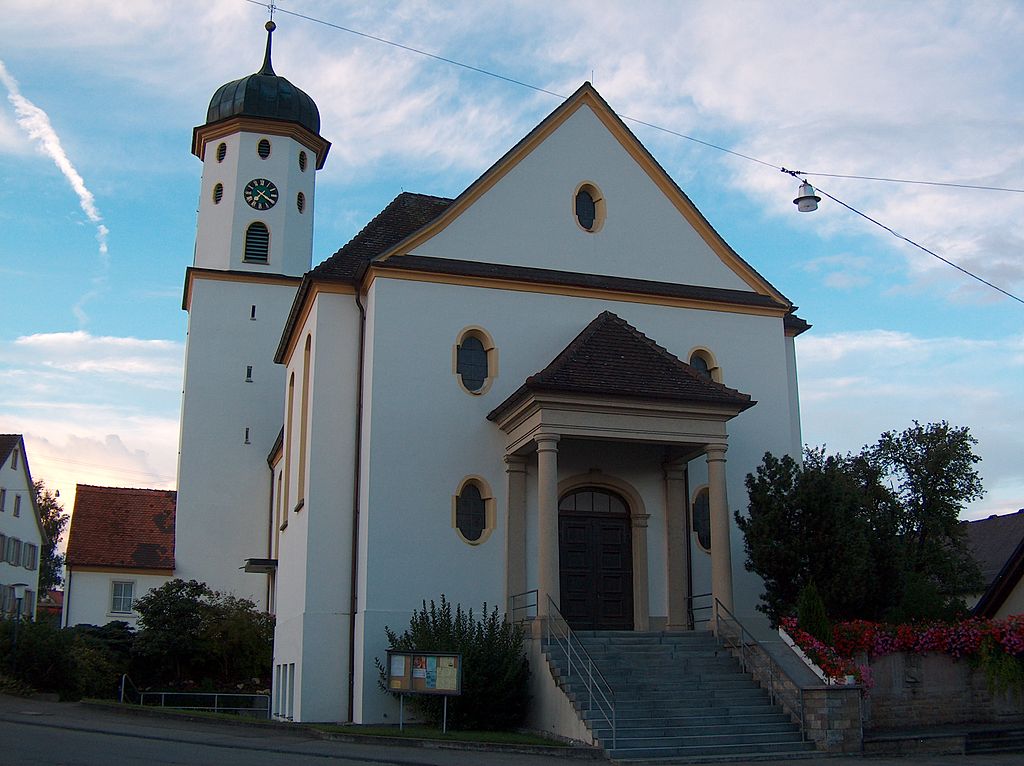
St. Peter and Paul Church Rohrdorf - Photo Credit: Wikipedia.org

St. Peter and Paul Church Rohrdorf – Photo Credit: Wikipedia.org

There were indeed very few refugee families who were fortunate enough not to have lost any family members during the horrible expulsion from their eastern home provinces. Volumes have been written on the topic of the greatest mass migration in modern Western history. I will relate only the bare facts as they pertain to my own family. Father belonged to that segment of the civilian population that was deported in large numbers to the Soviet Union to do as it was called ‘reparations labour’. The German Red Cross estimated that 233,000 German civilians were deported to the USSR, where 45% were reported either missing or dead. As to Mother’s expulsion from the eastern provinces, the numbers are truly mind-boggling. The movement of Germans involved a total of at least 12 million people. Official sources, like the German Federal Archives, estimate that at least three million people perished in their flight from the Red Army, in labour camps, through starvation and disease, through murder in retaliation and revenge for atrocities committed by the Nazis during the war years. I mention these gruesome statistics only to emphasize the great miracle of the survival of the Ernst Klopp family amid all the odds stacked against them.

The P. and G. Klopp Story – Chart I – III

Karl’s Report: Our Flight March 1945

Foreword

How was it possible that parents and children were going to flee from different places? Father Ernst Klopp had been ordered from our original residence in the Pomeranian county of Belgard into the Land of the Warthe to hand over expropriated Polish estates to Baltic Germans, who had been resettled primarily from Latvia. We were boarding with a family in Belgard to attend a secondary school. From there began on March 3rd, 1945 the flight into a westerly direction.

To what degree do memories committed to paper reflect the truth? This document limits itself to the presentation of direct impressions and experiences and sparsely delves into explanations. Therefore it avoids them unless absolutely necessary.

Due to the regrettable loss of a diary that I had kept since my early childhood days, most likely lost in a hay barn on the trek to the West, it is impossible for the sequence of events to be authentic.

Also subsequent inserts of military and historical value, or attempts of this nature were unproductive. The Wehrmacht reports, which one can read in the archives, and the historical works by authors based on the former – as far as they could be controlled by personal, absolutely authentic facts – lagged behind the events and even jumped ahead of them.

Images – March 1945

Memories of the Flight

On March 3rd at 6 o’clock in the evening ‘Tank Alert’ rang out in Belgard. Why did the defense and party headquarters choose the evening to evacuate the civilian population? The family Meißner-Kulmann, two women, five little girls and the Klopp brothers moved under the howling sounds of sirens and the wild perpetual ringing of our church to the designated area, where transportation facilities were supposed to be ready, which was not the case. Without any further discussions the group marched in the direction to the exit road leading to Kolberg in order to reach the coast. Halfway there we stopped in the middle of the night for shelter in the village of Leikow. Some luggage was in the handcart, on which also the children were sitting. Soon we realized that the family did not want to go farther. I was sent back the following evening to Belgard on a bicycle that I had been pushing to get a briefcase with documents belonging to one of their grown-up boys out of the house at the Schidlitz. In us grew the decision to separate from the family, who attempted to stop us by saying, “Fine Hitler boys you are!” I should mention that the march of the trek led us past familiar native places of our early childhood, which slid by in the dark night like shapeless outlines. We recognized how close the front line was by the fire in the village of Lülfitz, which was located north of the Kolberg road, which led in a westerly direction to the coast. In that direction stood also a train recognizable by the stream of sparks: Certainly the railroad line had already been cut.

I always liked to tell that early on my birthday I still got a cake – whether Frau Meißner had baked it in the simple quarters in Leikow or in her own oven in Belgard, I did not find out. March 6th was the day of separation from my room and board mother, who later had walked back to her house in Belgard with her daughters and grandchildren.
The Long Trek West

The Long Trek West

Halfway on the road to Kolberg we saw my classmate Ulrich Schulz (Uschu), with whom I had committed many a prank. He was wearing a bandage around his head. We exchanged a few words, but I have forgotten, what he had said about his injury. In the late afternoon of my birthday we arrived in Kolberg. We had entered the city without any problems. Earlier it had been declared a bastion and since then was considered (also according to army reports) surrounded. We hurried to the harbor, which we also knew very well and the seashore, because we had often traveled with the family or alone to this summer resort at the sea. There also existed relatives and a friendly family. The pictures of the German Baltic seaport of 1945 are well known through TV programs. We too saw the line-ups at the ships. We did not take long to think. We decided to march along the coastline. The great bridge at the Persante river was still intact and so we tried to get to the southern part (Maikuhle) of the city, where the friendly Pascheke family lived, who however had already fled. The city of Kolberg was already being fired at by artillery. The Soviets began the encirclement and assault of this also historically important place.
Kolberg March 1945

Kolberg March 1945

Once in a while we had a chance to travel a short distance on military vehicles. Since we had only our schoolbags filled with provisions on us, we were able to quickly climb on board. How nervous some people became, shall be demonstrated by the following example. A woman accused us of having stolen her suitcase filled with valuables. At a beach section we examined a boat that had been pulled up onto the shore as to its sea worthiness, but were quickly distracted by other things. Rides and marches changed according to the situation and opportunity. Finally we were forced to continue on land and a short time later even in an easterly direction. Thus, it happened that we saw a location twice: once on the march back and then again in the planned direction to the Oder estuary. The explanation for this is that the front lines were moving back and forth, often there were even wandering army pockets.
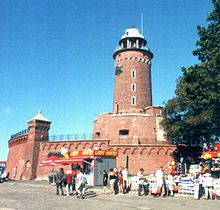
Lighthouse Kolberg Today

Lighthouse Kolberg Today – Photo Credit: Wikipedia.org

On such march in darkness and blowing snow we saw at the roadside an abandoned hearse. Since we were very tired, we simply lay down on the seats to catch a few winks. Whether it was instinct or battle noise, we left the protective shelter and went into the next village and asked the Pomeranian farmer to stay overnight. He did not want to let us into the barn saying, “You will set it on fire!” He offered us the pigsty and so we spent the remainder of the night right next to the box that housed a well-fed sow. We gave her our empty sardine cans, which she was licking and chewing all the time. When we came by the farm the next day on our way west to the Oder estuary, it was engulfed in flames. Now the farmer had lost everything! An hour later we saw the hearse. It had been totally torn to pieces by gunshot.

Only once did we get to know the Soviet air force. A ‘Rata’, an awkward looking, slow airplane, was shooting at the trek on the road leading to the West. Near us a woman lost her infant, whom she carried on her arm. We quickly looked for cover to evade further attacks. Once we had a chance to hitch a ride on a hauling truck, which pulled a huge artillery gun. At close range we could observe how the battery moved into position at dusk. We stayed nearby in order not miss a possible ride later on. Then it became clear what was going to happen: a tank attack in the immediate vicinity. I still remember the howling of the tank engines and the noise of the chains. In the flashes of the gun barrels I could watch the loading gunner, how he slid the big, heavy shell into the barrel, stopped his ears, waited for the recoil, then picked up the next shell, about three or five times. To the right in the background I saw exploding tanks, i.e. the gun towers all-aflame flew up and to the side. The remaining tanks turned and withdrew into the night. Later on I found out that night aiming devices were in existence. I also have been contemplating, as to why I can still visualize so vividly this scene. It was the unshakable calm of the gunner and steadiness of his movements: industrial work at the machine, prepared by ‘Refa’. We were not fast enough; the battery with its three or four artillery guns had disappeared during the night.
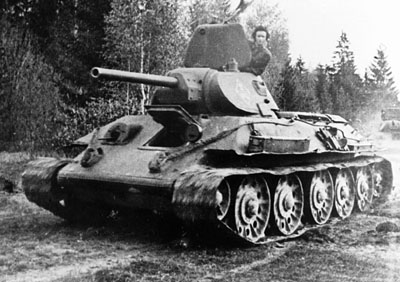
t34_76c

Russian T-34 Tank

In one of the next days and nights we stayed in a more westerly located village. I observed a group of our soldiers, who were giving to someone a lecture. One asked, “Where do you have your gun, Frenchman?” One needs to know that very many western Europeans under German occupation volunteered to be enlisted in their own units to fight against Bolshevism. The fear of being overrun from the East since the revolution in Russia was great. Almost all countries east of Germany developed into authoritarian and dictatorial regimes, Germany of course also and even more so. Also western peoples had similar ideas. Thus, French people entered the German army. The scenario makes me ask: Was it German arrogance or realistic assessment of the French fighting spirit?
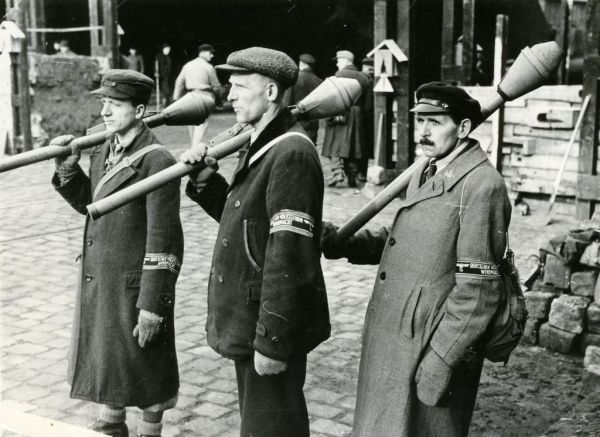
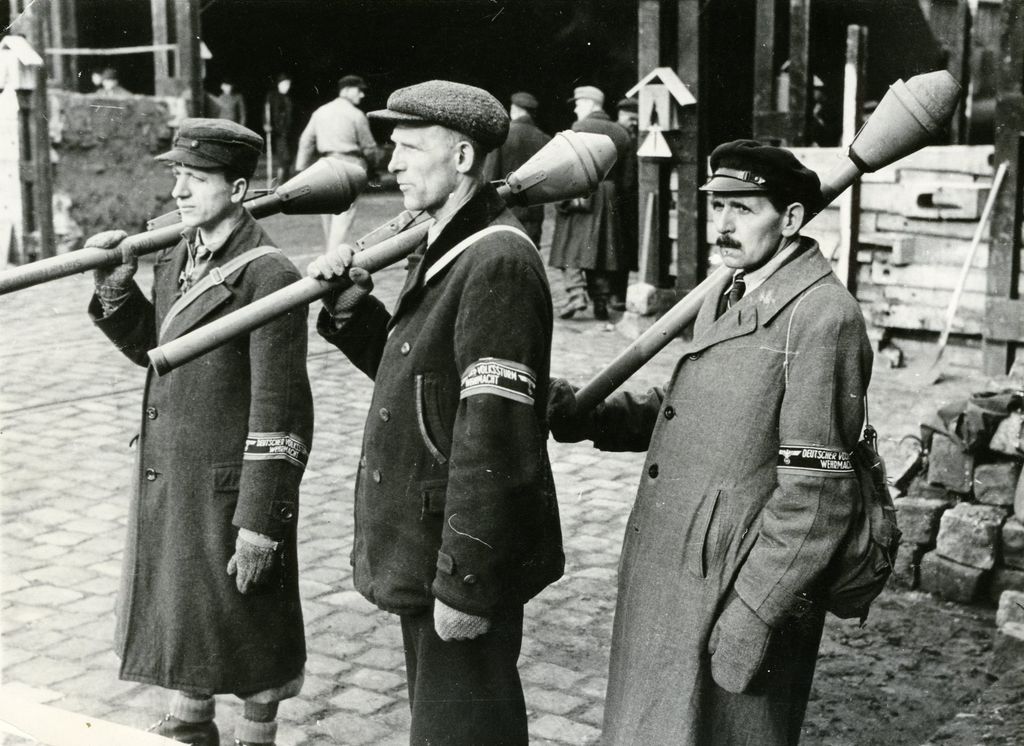
Volkssturm

Old People Recruited to Fight – Photo Credit: Wikipedia.org

A short time later at the same spot we listened, as a battle at close range developed with the Soviet infantry. When tracer bullets were shot over our heads, we threw ourselves behind a manure pile, and we could see now close to our left and right the trails of light flashing by. The Russians were shouting “Hurrä”; in the counter offensive it was responded to with Hurra. A German soldier lost his nerves. Minutes long he was dancing with his gun in his arm from one leg onto the other. Much later, sitting in relative safety in the train, I retold my observation to another refugee. Thereupon a sergeant severely reprimanded me; one does talk about these things in such detail. The aforementioned attack therefore was repulsed. My brother and I were looking for better cover in a trench. An officer brandishing his pistol startled us and asked us to identify ourselves. He was a so-called hero-nabber (Heldenklau), whose job was to get after cowards and deserters or simply to bring the scattered bunch of his soldiers together again.
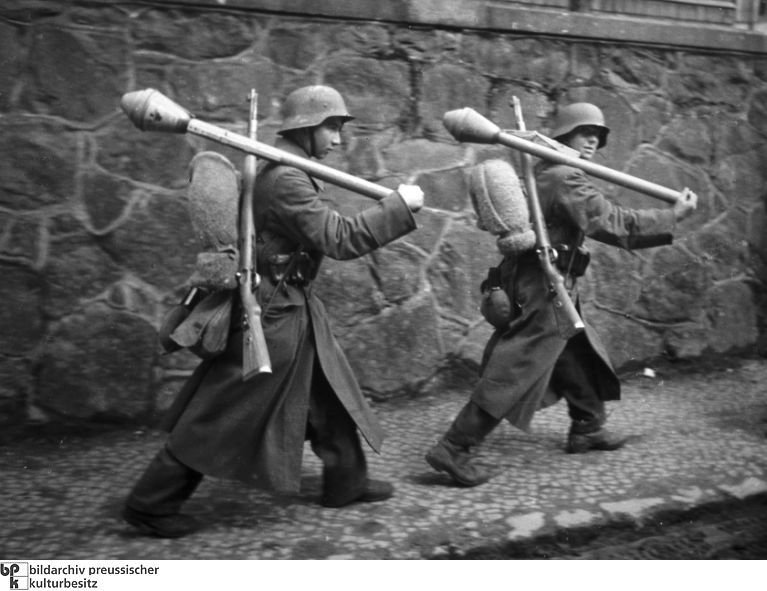
... and also Children

… but also Children

The military operations were pushing us again to the coast. Coming out of the dunes we saw an endless tapeworm of people moving west – military personnel as well as civilians, whom we joined, Soon we saw on the left the ruins of a church in the dunes. The village of Hoff lay ahead, a distance of 15 km to the eastern branch of the Oder river, the Dievenow. My grandmother had a picture of these ruins hanging in the hallway, which I had always looked at with great respect. I had spent the first two grades on my schooling in Stolpmünde. Now I saw the remainder of the church that had been destroyed by storm tides in previous centuries under such circumstances before my eyes.

We soon found out that the Russians were pushing hard directly to the coastline. Shots were coming out of the dunes aimed at the passers-by. German soldiers went into position and repulsed the attack, which would possibly have cut us off. Here is one impressive detail: A soldier was getting ready on the dune in the direction of the pine forest. An overly daring Russian fighter was hit and fell down and remained hanging in the lower branches. He wanted to get an overview of the scenario from the treetop.

I do not know why someone would throw bicycles into the sea. Anyway we got two of them out of the water, loaded our light luggage and moved ahead this way a lot faster. Near the water’s edge the sand was firm; only over the tidal inlets we had to lift our vehicles. The bikes were available to us for many more kilometers, until we caught in Neubrandenburg a train to Erfurt.

From the place, where we found the bikes, we soon reached the village of Dievenow located on either side of the arm of the Oder River, from which it got its name. At the east bank we had a major delay, because there was no bridge, but a ferry instead, which connected the ends of the old highway of the Reich I65 and which was no longer operational. The army had set up a pontoon service, which, when we arrived, was exclusively available for the troops. They consoled us civilians with the evening hours. We looked at the village – beautiful villas located near the beach like so many resorts at the coast. We went into abandoned houses in search for food. The provisions we had with us had been exhausted. Where we had stayed overnight we had begged for food or often filled our stomachs at the military field kitchens. It was awkward that we had neither a tin bowl nor a spoon with us. Once we ate out of a steel helmet, the inner lining of which we had removed. In the houses of Dievenow we found very little, at most canned fruit.

In this beautiful place I should have received my paramilitary training. They were sending the male Hitler-Youth to so-called training camps, from which they were directly transferred to the troops. During our journey I always had the draft notice readily available in my pocket, but had no intention to look around and locate the camp to report for military duty.

Finally they let us two bicyclists onto a pontoon, some of which were ferrying constantly back and forth.. Now one could already hear heavy artillery fire close by. Shells hitting the water indicated that the Soviets intentionally were going to disrupt the withdrawal movements.

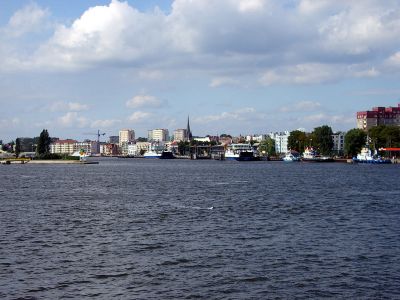
Much relieved we pedaled onward in a westerly direction, needed no longer to divert our march into forests and fields, but rode on decent roads. There were also organized centers of provisions through field kitchens. Also the military operations were less noticeable in the rural areas. The city of Wollin, a day’s march from Swinemünde, was only captured on May 4th, 1945. We reached Swinemünde, the next city from Dievenow, already on March 12th, a date of horror in my memory.
Modern Swinemünde - Photo Credit: Wikipedia

Modern Swinemünde – Photo Credit: Wikipedia

We soon arrived at the small beach resort town of Misdroy, twelve km before Swinemünde on the main road to Stettin. We had more often heard the thunder of big guns from the direction of the Baltic Sea. The German navy, which not only carried the masses of refugees primarily from the East Prussia to safety, but was also actively engaged with its long range guns in support of the battle on land, and was shooting no-go areas against the enemy to safeguard endangered front lines. What we heard on March 12th, let the ground at a wide range shake and doors bang open and shut. The Americans and British had fooled the antiaircraft authorities by not flying in a straight line to the town of Swinemünde, but then for one hour intensively bombarded the relatively small town area. The bombing raid resulted in 23,000 dead. They rest on the German side on the Golm, a cemetery of an area of one square km. Swinemünde is Polish today.

When we arrived at the town on the evening after the attack, where we had wanted to stay overnight, visibility was almost zero, the stench horrific, most certainly the smell of corpses. How we got over the relatively wide arm of the River Oder, by the name of Swine, I cannot recall. On a account of the smoke I was unable to see.

In the middle of the night we reached Ahlbeck and found some rest in a vacation guesthouse, where a compassionate woman with a little son took us in. For the first time in ten days we slept in a real bed.

Only now we began to discuss to which destination we should proceed. There were relatives, whose addresses we had in our heads as a result of a very active correspondence, in Freiburg and Erfurt. The latter was closer. Therefore, we decided to pedal on in a southeastern direction. Since we had neither maps nor compass, we did not choose the direct way, kept on pedaling six more days all the way to Neubrandenburg, where we became sick and tired of biking. We needed a rest, because the most recent journey went over the Pomeranian ridges, i.e. through hills and valleys and into the bones.

We used a savings account booklet filled with entries from our saved pocket money to buy train tickets to Erfurt and pay for the shipping of the bikes. The savings account organization had made life easier for the refugees with the set-up of a generous transaction policy.

It was a strange feeling to sit in a train, where to be sure there was incredible crowdedness, to be able to watch the landscape, to read the names of the cities of Mecklenburg-West Pomerania, of Brandenburg, and then of Saxony-Anhalt, places whose names until now had been unknown to me or about which I had a different perception.

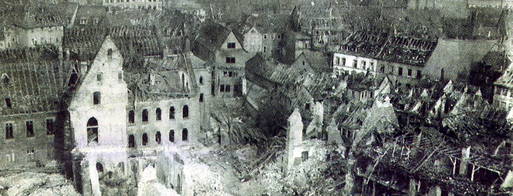
Once in a while the train stopped in a hollow to await a bomber formation. Often enough low flying aircraft attacked trains or blocked the route in order to target troop transports. A friendly place-name sign ‘Wolmirstedt’ indicated to us that we were passing through the birthplace of our father Ernst Klopp. Slowly we were approaching Thuringia, where Uncle Günther and Aunt Lucie lived. It was an unknown place to us. A long trip in our childhood, especially not during the war, was out of the question. Then came the giant railroad station that destroyed all small town Pomeranian perceptions, then the walk to the probable town section, the search in the long street with the name Nonnenrain and the confusion about the house number, 70 instead of 17. Aunt Lucie was speechless. Of course, she could not answer our first question about the whereabouts of our parents. That we looked like dirty pigs must have affected her rather badly as it would have anybody else. At mealtime there was information on the conditions in the city, above all on the almost daily aerial attacks and on the air raid shelters. Besides the American front was approaching from the west.
Erfurt after a Bombing Raid

Erfurt after a Bombing Raid – Photo Credit: TLZ.de

At first we did not heed the warnings of the aerial attacks, until the powerful explosion of a bomb taught us otherwise. Uncle Günther, who was at the time hospitalized due to health issues going back to WW1, was sent home, and we met again, himself looking quite worried. With the arrival in Erfurt the flight had come to an end, and the thread to our homeland and to the parents was totally cut off. What came next was completely different.

End of Karl’s report