The Wonderful Plant Called Hops

Growing Hops in our Garden
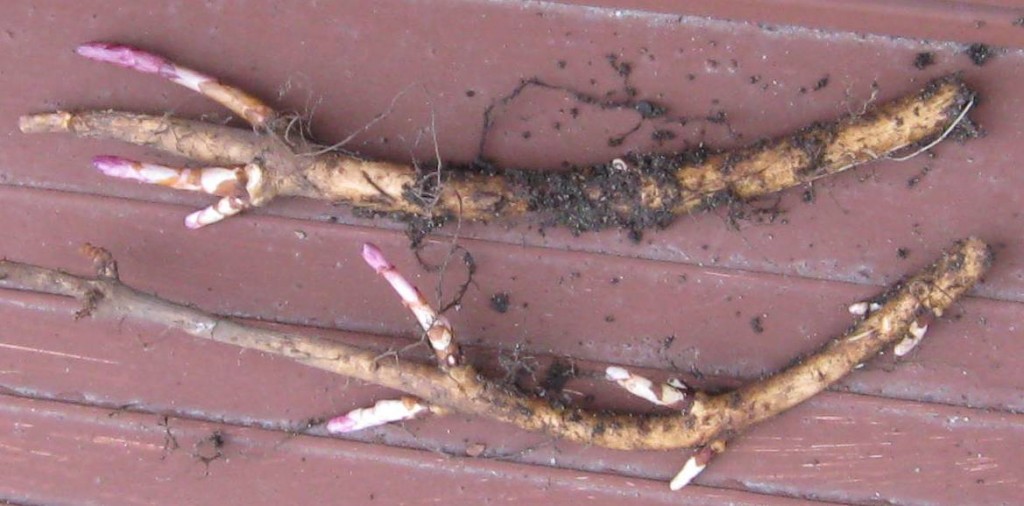
Hops Rhizomes Ready to be Planted

Hops Rhizomes Ready to be Planted

Stefan, our youngest son, has many great hobbies, traveling, photography, active hockey, playing board games, cooking and baking, designing websites, maintaining his own blog ‘This Timeless Moment’ at kloppmagic.ca, hanging out with friends, just to name a few. Three years ago he started making his own craft beer at his little home in Vancouver.
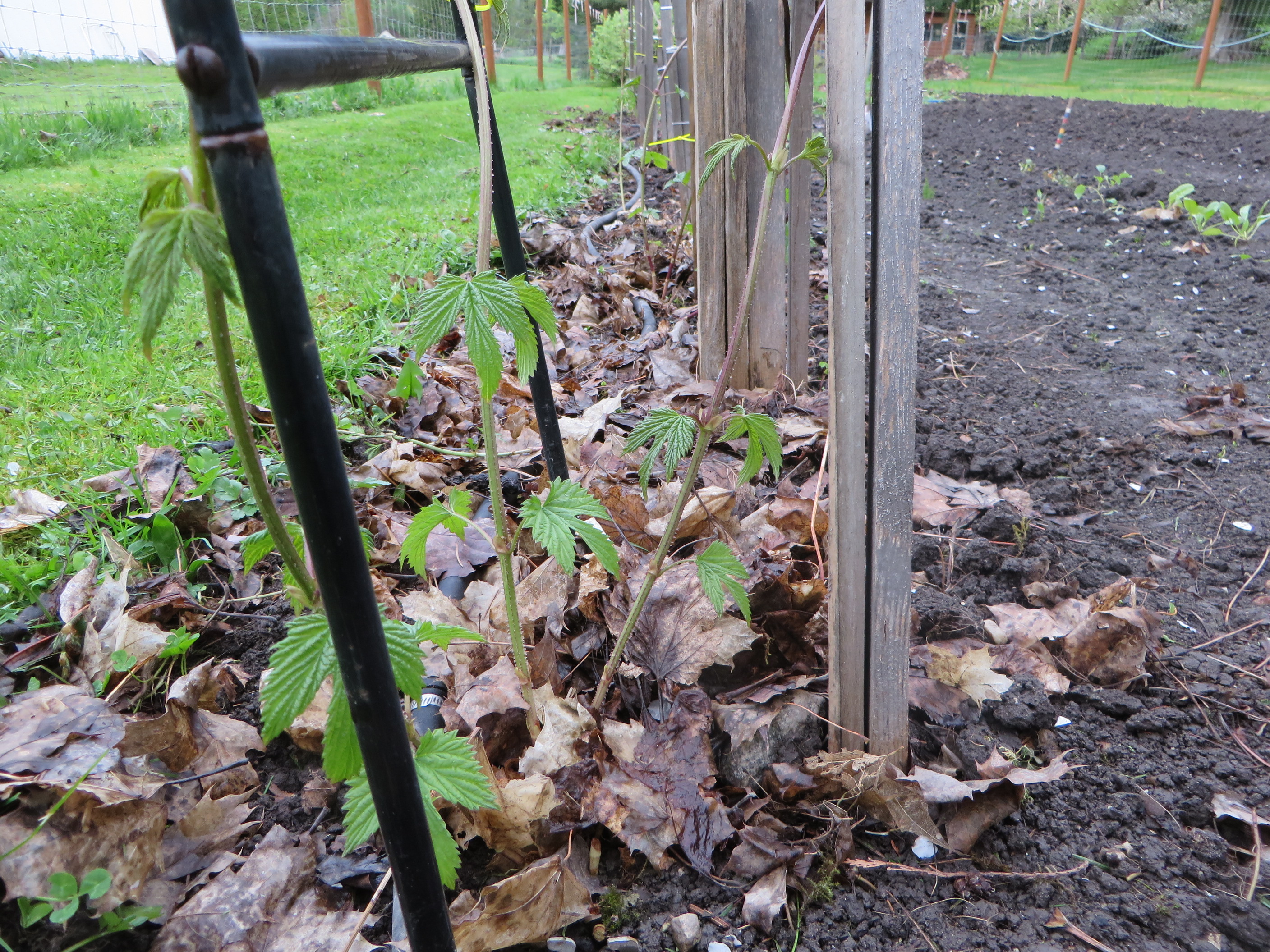
Tender Shoots Seeking a Foothold

Tender Shoots Seeking a Foothold at the Poles

When I heard about it for the first time, I had no idea that I would have any involvement in his latest passion. One day over the phone he announced that I would soon receive a parcel from a hops nursery in BC. It would contain hops rhizomes for me to plant in our garden. My attitude has always been this. When accepting a new task, do it right or don’t do it all. The idea of Stefan brewing beer with the hops I would be growing appealed to me, especially since I am a fan of good beer. In my mind I was already sampling his tasty, refreshing brew. So I accepted the challenge of growing a new plant in our garden. I won’t go into the details, as one can easily read up on the topic on-line.
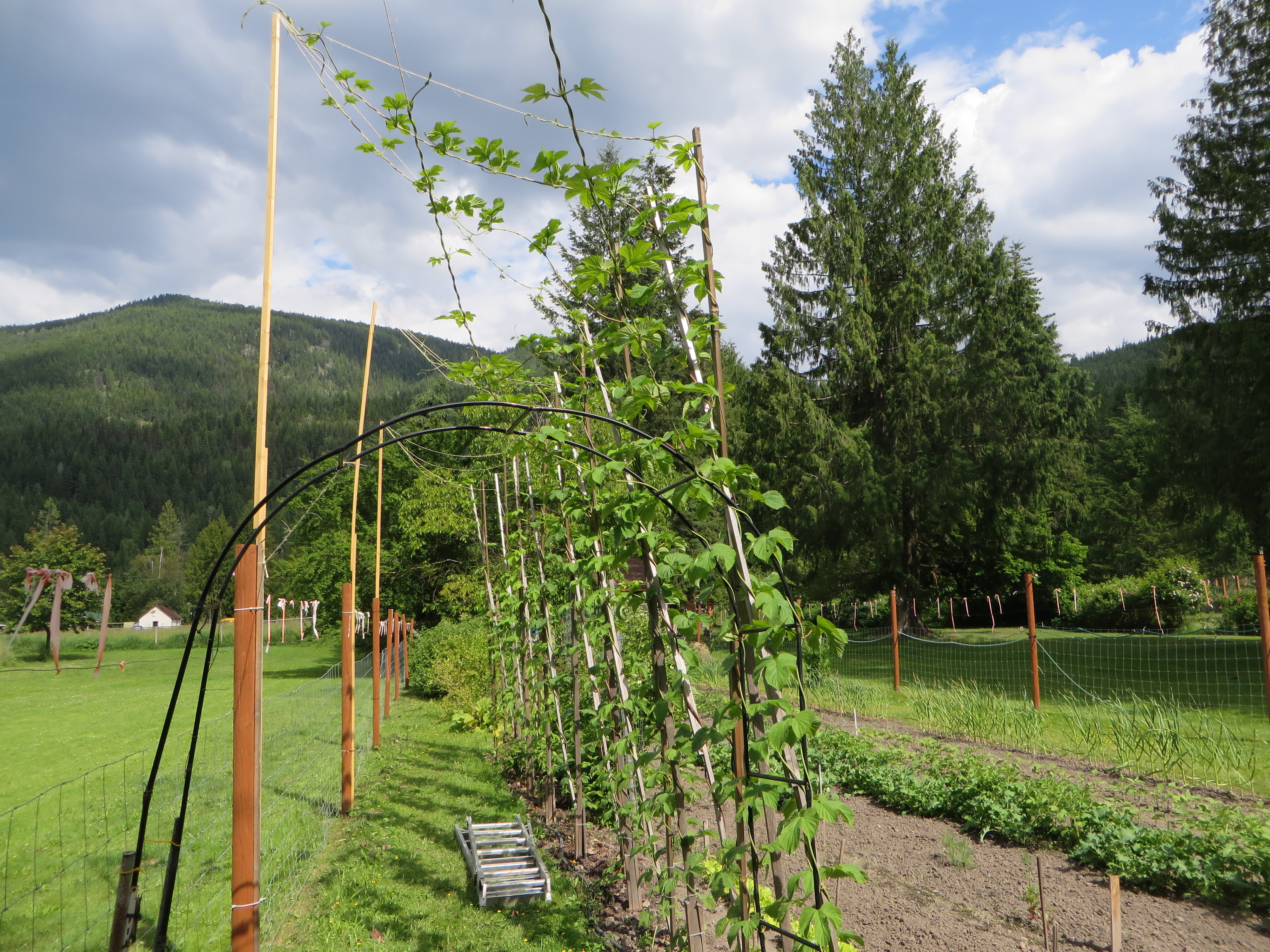
Within less than four Weeks they are at the Top

Within less than four weeks they are at the top of the poles.

To find out which variety of hops plants would do best in our climate and soil, Stefan had ordered eight different kinds: Mt. Hood, Willamet, Fuggle, Chinook, Golding, Centennial, Cascades, and Sterling. The reader, who has knowledge of the Pacific Northwest, may recognize some of the names as bearing resemblance to geographical places in Oregon. That is no coincidence, as Oregon State boasts of having the most and best breweries in the States.
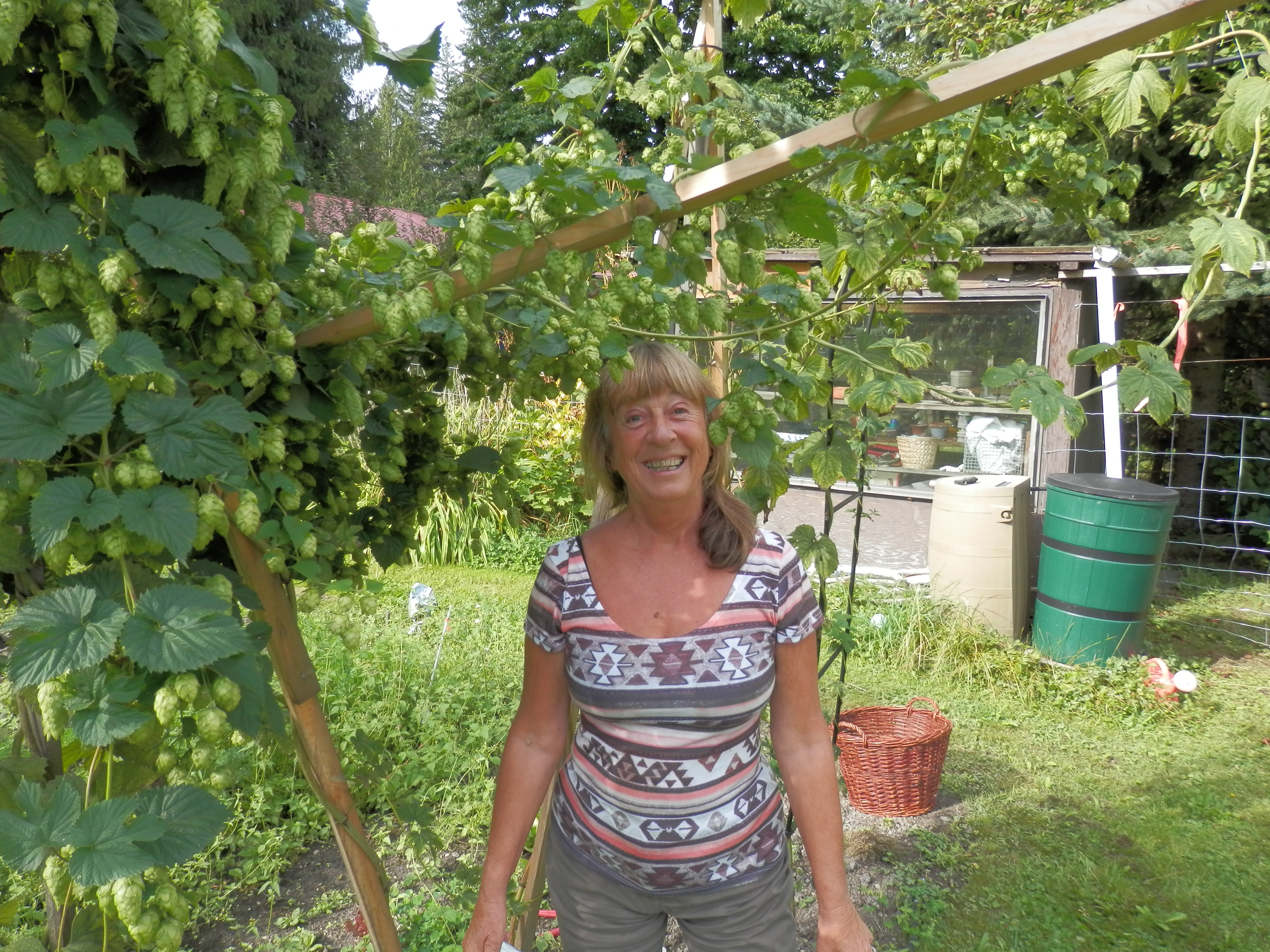
My Wife under the Roof of an Abundant Crop

My Wife under the Canopy of an Abundant Crop

The hops plant is quite modest in terms of maintenance and care. Also it grows in most types of soil, but needs a trellis system of poles and strings allowing it to grow 6 to 7 m high. It grows at an incredible speed. You can literally watch it grow some 30 cm in a single day. Later in the fall, you can marvel at the dense green canopy overhead with thousands of cones hanging from the side shoots of the hops plants.
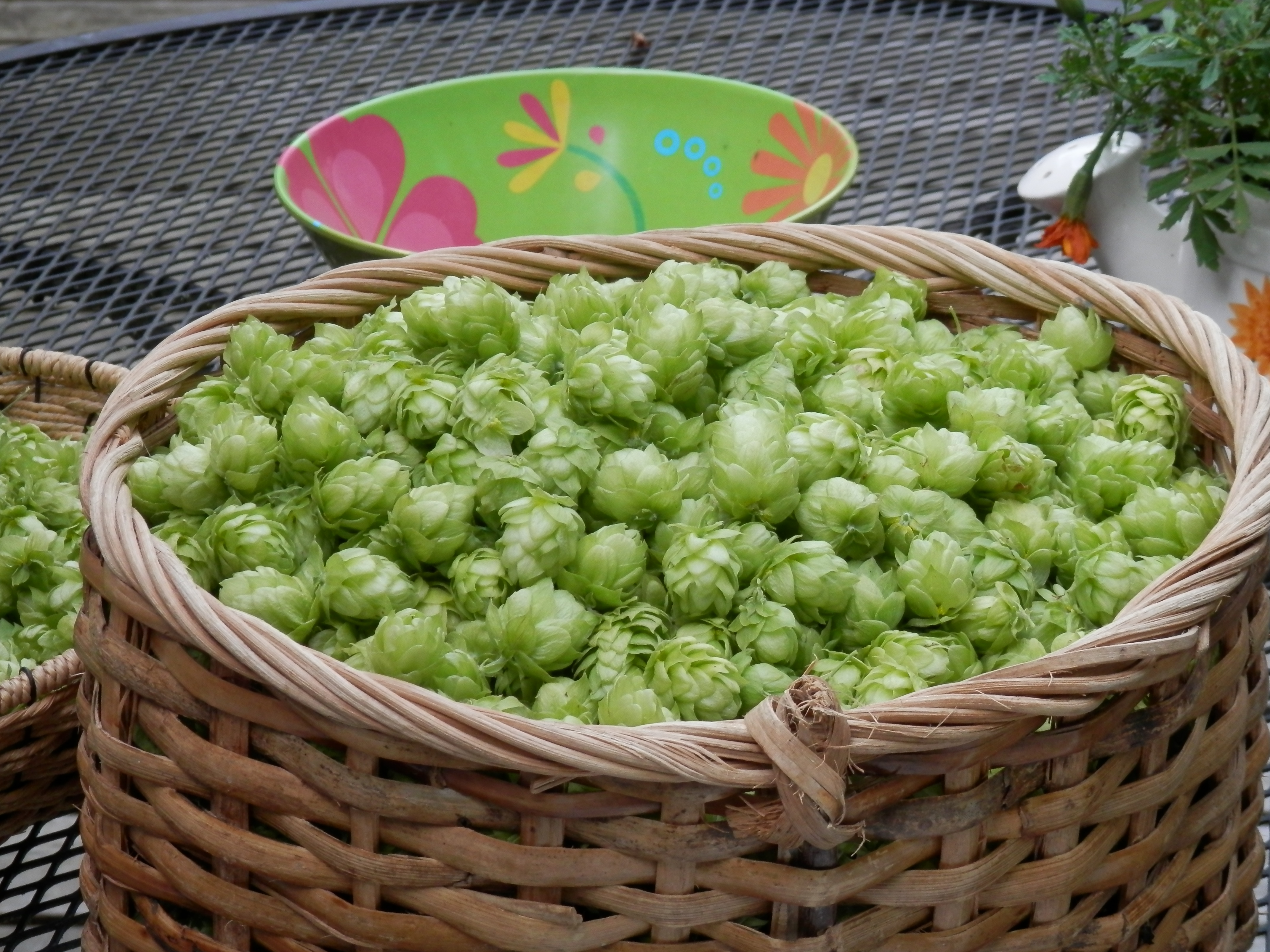
Baskets and Baskets of Hops Cones

Baskets and Baskets of Hops Cones

Picking and plucking off the cones is time-consuming and quite tedious. They also need to be dried and then put in plastic bags, where they will stay fresh in the freezer. But the pleasure of drinking the finest beer that Stefan brews is well worth the effort.
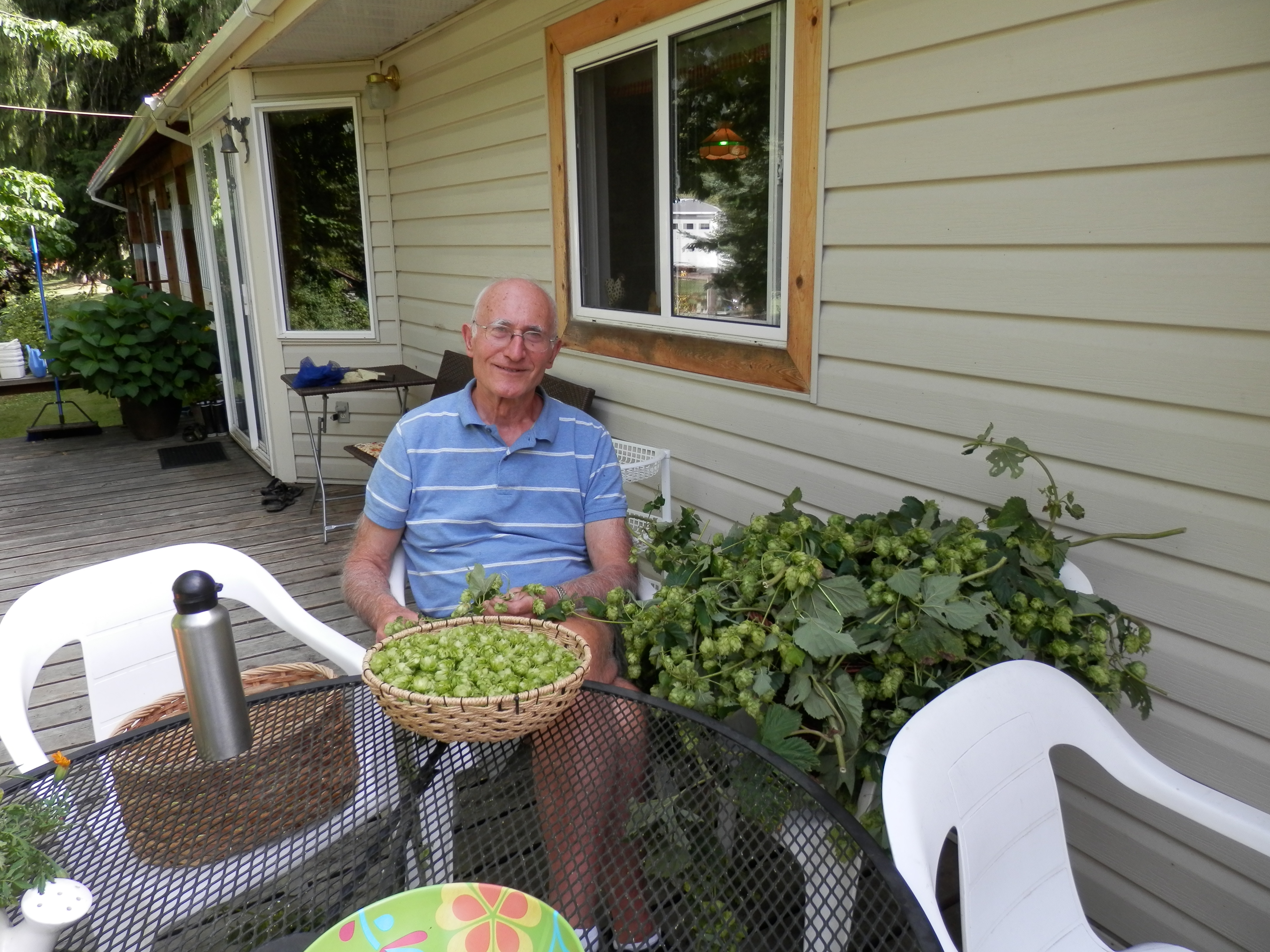
Dreaming about the best Pale Ale turns this kind of work into pleasure.

Dreaming about the best Pale Ale in the World
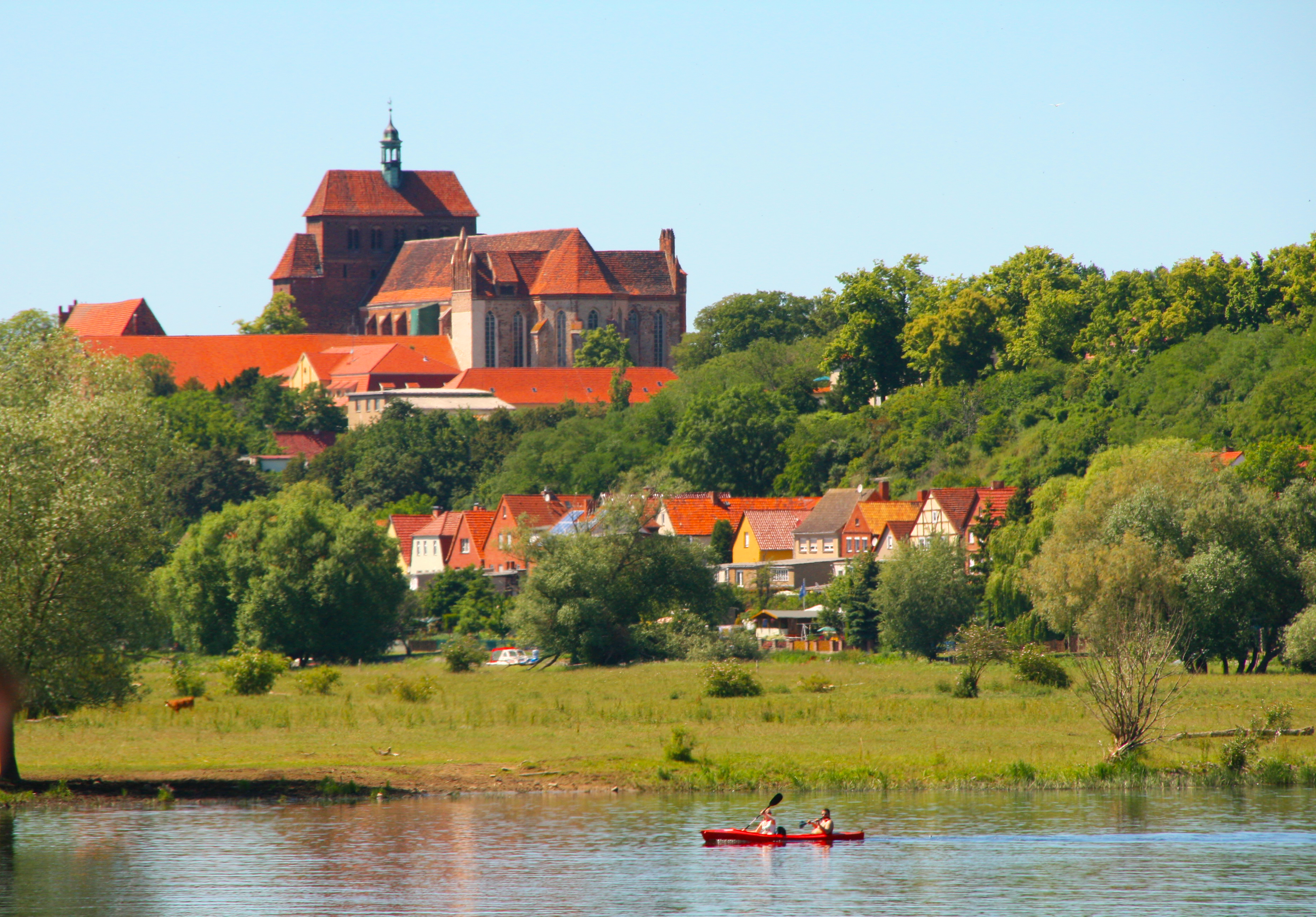
A Visit to Hartmut and Gisela Kegler’s New Home in Kochstedt

Our Visit with Uncle Hartmut and Aunt Gisela

by Dieter Barge

Chart II a – II and III

From April 28th to April 30th, 2015, we paid a visit to Edda’s Uncle Hartmut and his wife Gisela in Kochstedt near Dessau.

Hartmut, the first child of Bruno and Johanna Kegler, was born in 1931 in Stettin (Szczecin). He attended the elementary and high school in Hirschberg (town in Lower Silesia). In Thuringia he graduated from an agricultural institute and took his post-secondary education in Rostock and Halle.

From 1955 to 1991 he worked as a scientist at the Institute of Plant Pathology Aschersleben of the German Academy of Agricultural Sciences of Berlin. In 1959 he pursued his doctoral studies, which earned him in 1964 the postdoctoral qualifications as professor. Gisela was born in 1931 in Havelberg and had an active career in the teaching profession.

Havelberg Dom

Havelberg Dom

After the reunification of Germany, Hartmut was dismissed and became unemployed and a pensioner. This came as a result of the closure of the institure. Both Hartmut and Gisela are occupied with keeping the cultural heritage of Nobel Prize winner Albert Schweitzer alive, hold conferences and publish works related to this theme. The lived in Aschersleben am Bäckerstieg 11, where we had often visited them in past.

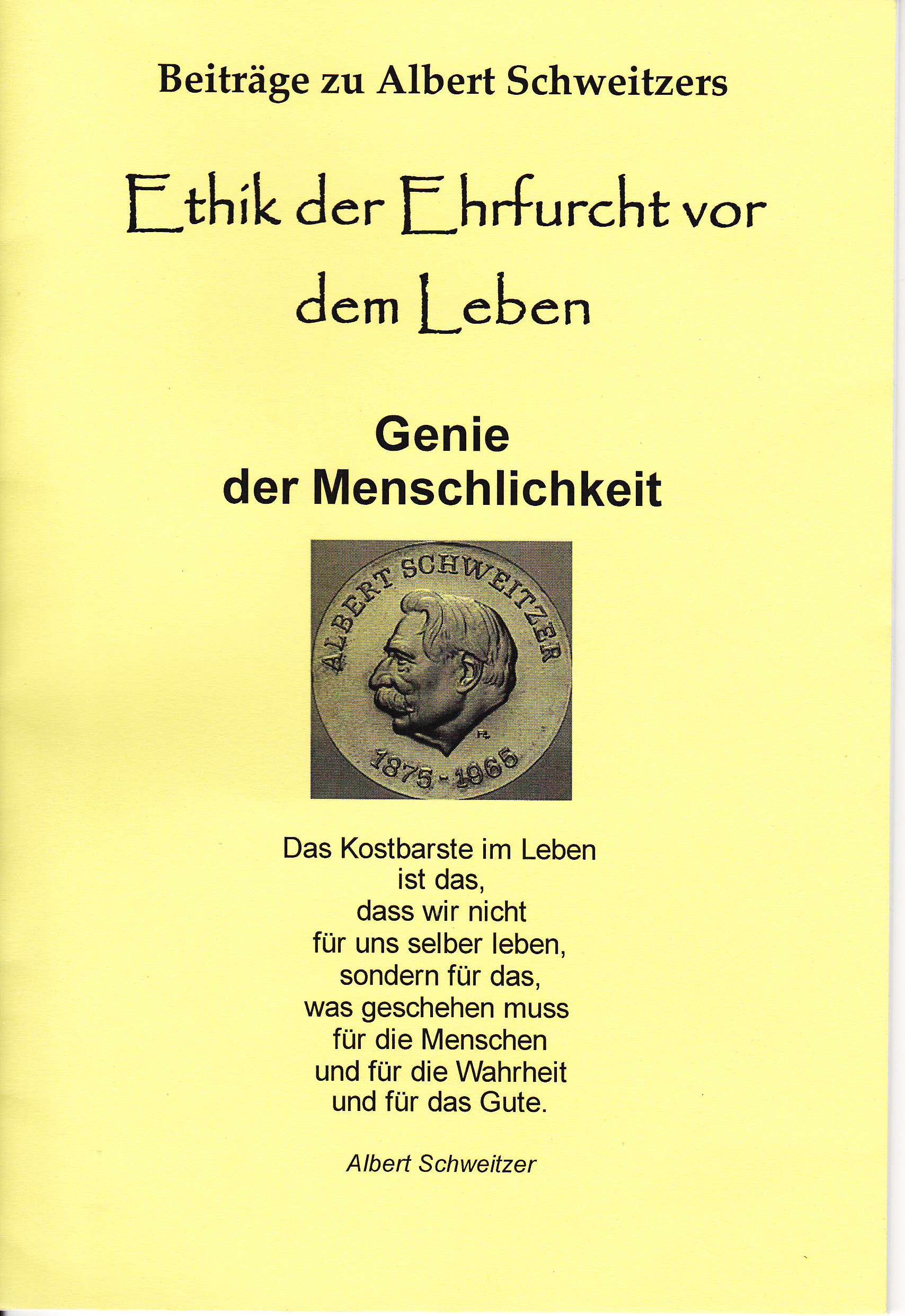
One of Numerous Publications about Albert Schweitzer's Legacy

One of Numerous Publications about the Albert Schweitzer’s Legacy

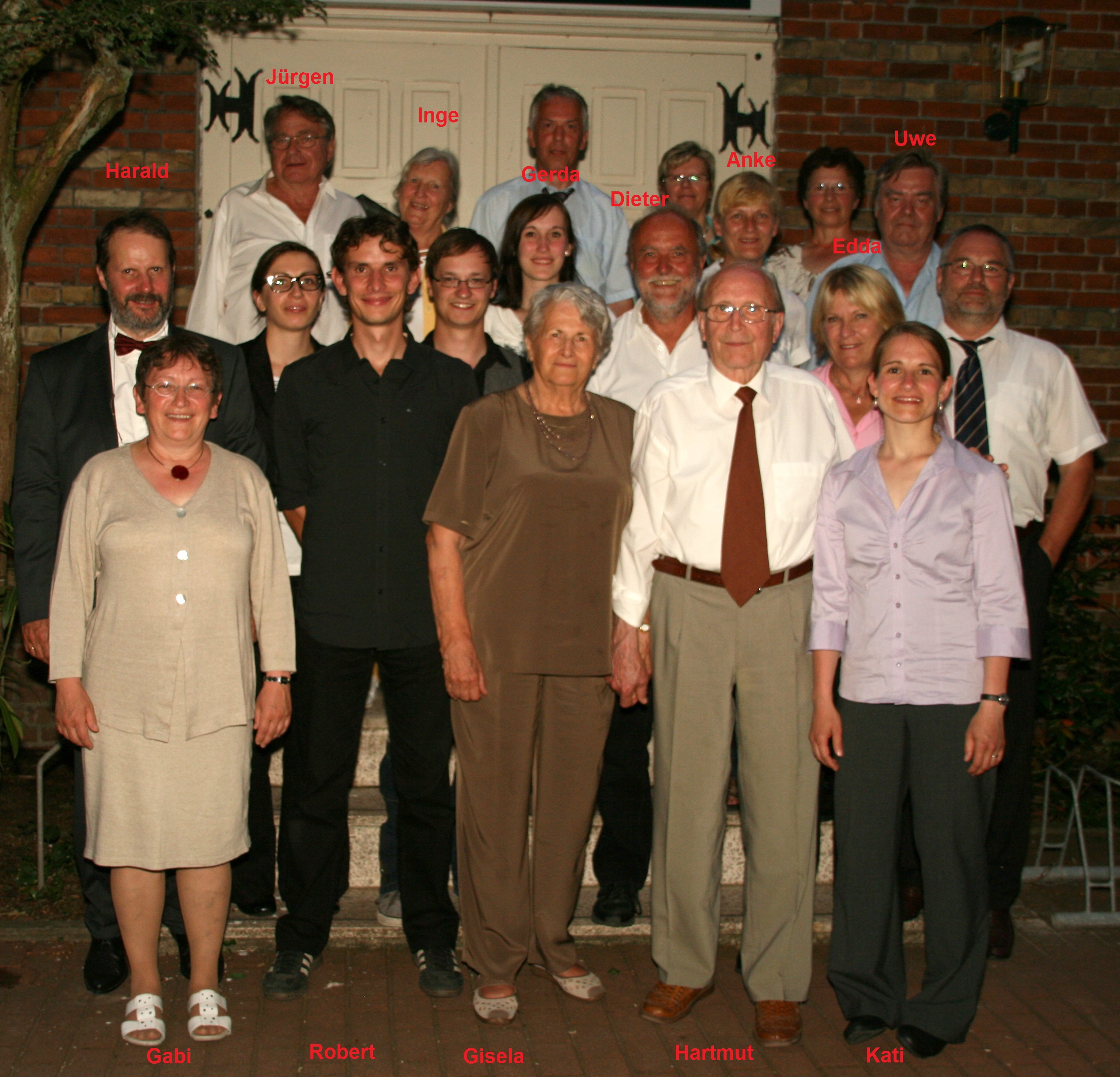
In 2011 we celebrated their combined 160th birthday in the wonderful town of Havelberg at the confluence of the Havel River (great for going paddling) with the Elbe River.

160th Combined Birthday of Hartmut and Gisela Kegler

160th Combined Birthday of Hartmut and Gisela Kegler

In 2014 their son Harald procured for them accommodation with in-house care facilities in the Dessau city district of Kochstedt.

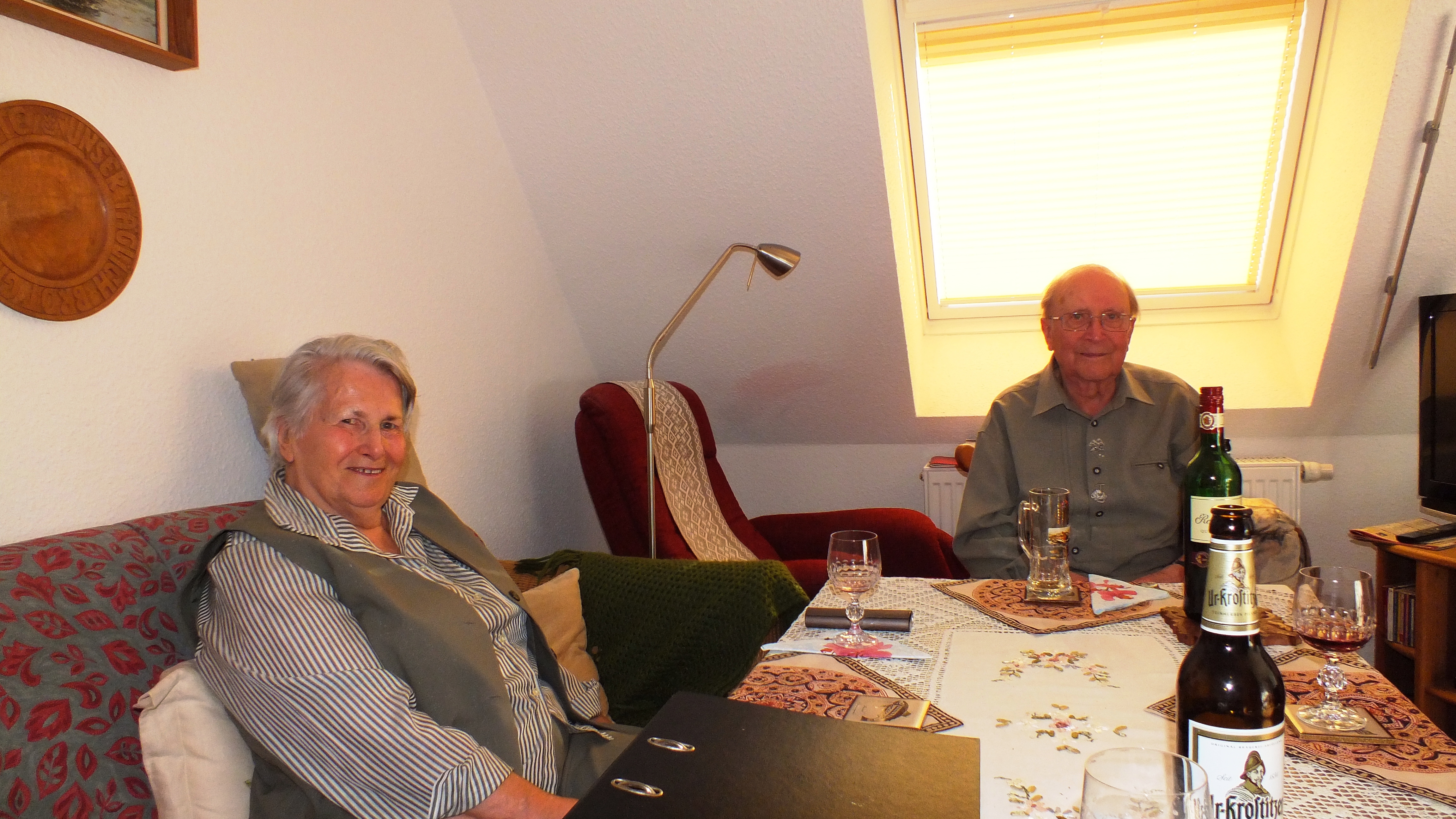
Hartmut and Gisela in their Cozy Livingroom

Hartmut and Gisela in their Cozy Livingroom

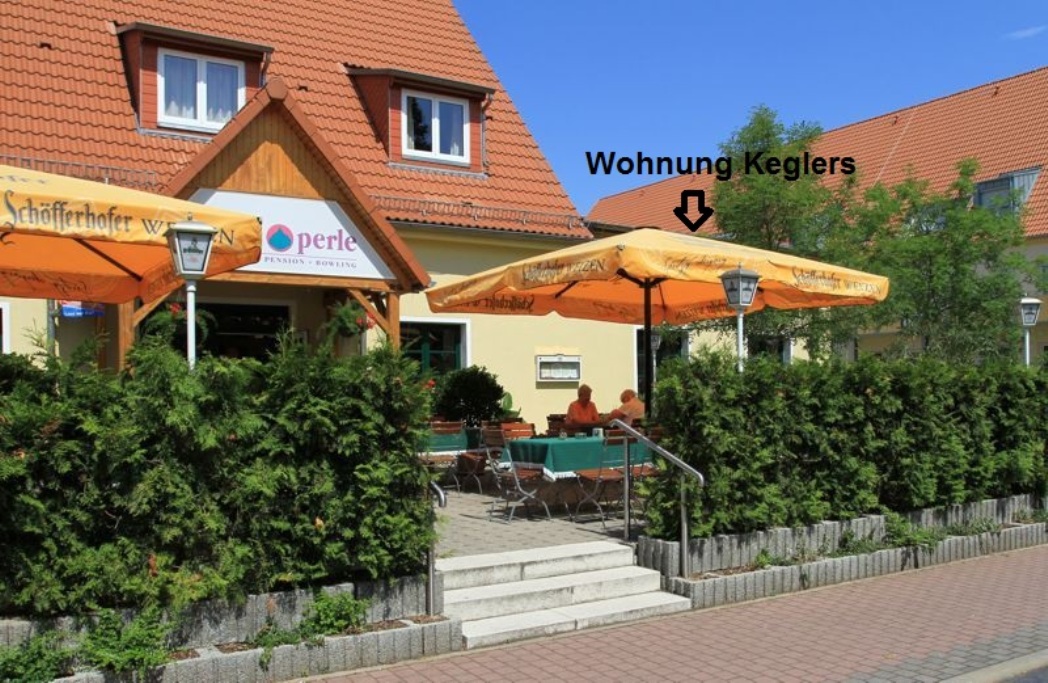
Here we visited them for the first time. Hartmut had reserved a room for us in the guesthouse ‘Heideperle’. We had lots of time for stimulating conversation.

Guesthouse Heideperle at Kochstedt

Guesthouse Heideperle at Kochstedt

A Young Boy’s Fatal Accident in 1949 and a Trophy in his Memory


The Story of the Danny Devlin Memorial Cup

Adapted from newspaper clippings at the Arrow Lakes Historical Society

Daniel Edward Devlin, five-year old son of Mr. and Mrs. W. Devlin of Fauquier met a tragic death Tuesday afternoon while playing on some saw logs decked on the beach. A log rolled and crushed him and he was rushed to the Arrow Lakes Hospital but he died en route. From a newspaper clipping of Thursday, April 14, 1949

Danny

Funeral services for Daniel Edward Devlin were held on Good Friday at 2:30 p.m. in the Community Hall, Rev. Hartley officiating. A large crowd of sorrowing friends and relatives were present to honor the memory of the sturdy, lively little fellow and the many floral tributes were token of their esteem.

Hymns sung were: “When He Cometh” and “Safe in the Arms of Jesus”. Mrs. Morrison acted as accompanist.

Burial was in the new Fauquier cemetery. Daniel Edward is the first to be laid to rest there. Pall bearers were Peter and Frank Bilinski, Raymond McTaque and Bill Maitland.

Daniel Edward Devlin, son of Mr. and Mrs. Wilfred Devlin, was born at New Westminster, April 27, 1943.

In a brief interview with his surviving brother Alan Devlin, I heard that Daniel liked the school (now the clubhouse at the Fauquier golf course)on the hillside, which was located not too far from the present Fauquier ferry landing. Even though he was not yet of school age, he often showed up at recess and lunch to play with the older kids. After his tragic death it was Mr. Wilkin, the principal and teacher of the Fauquier School, who came up with the idea of instituting a memorial cup for the school district.

Daniel was a very likable little chap and endeared himself to all those who came in contact with him. In donating the cup, Mr. Wilkin said in his letter, “We should like to have our little friend, still move in spirit among his friends and therefore we will promote a competition among the schools to foster the friendly play so characteristic of Daniel.”

The Danny Devlin Memorial Trophy

The Danny Devlin Memorial Trophy

From then on, at the end of each school year, a softball tournament was being held and the trophy named after the little boy, the Devlin Cup, was awarded to the winning school team of the district. For forty years Daniel’s memory was kept alive through this trophy. Then district school restructuring  and greater interest in soccer put an end to the softball tournament.

It is my hope that this post will make a small contribution in keeping Daniel’s memory alive.

Gertrud Kegler 1896 – 1957

Life-long Service to the Sick and Wounded

Chart II a – II

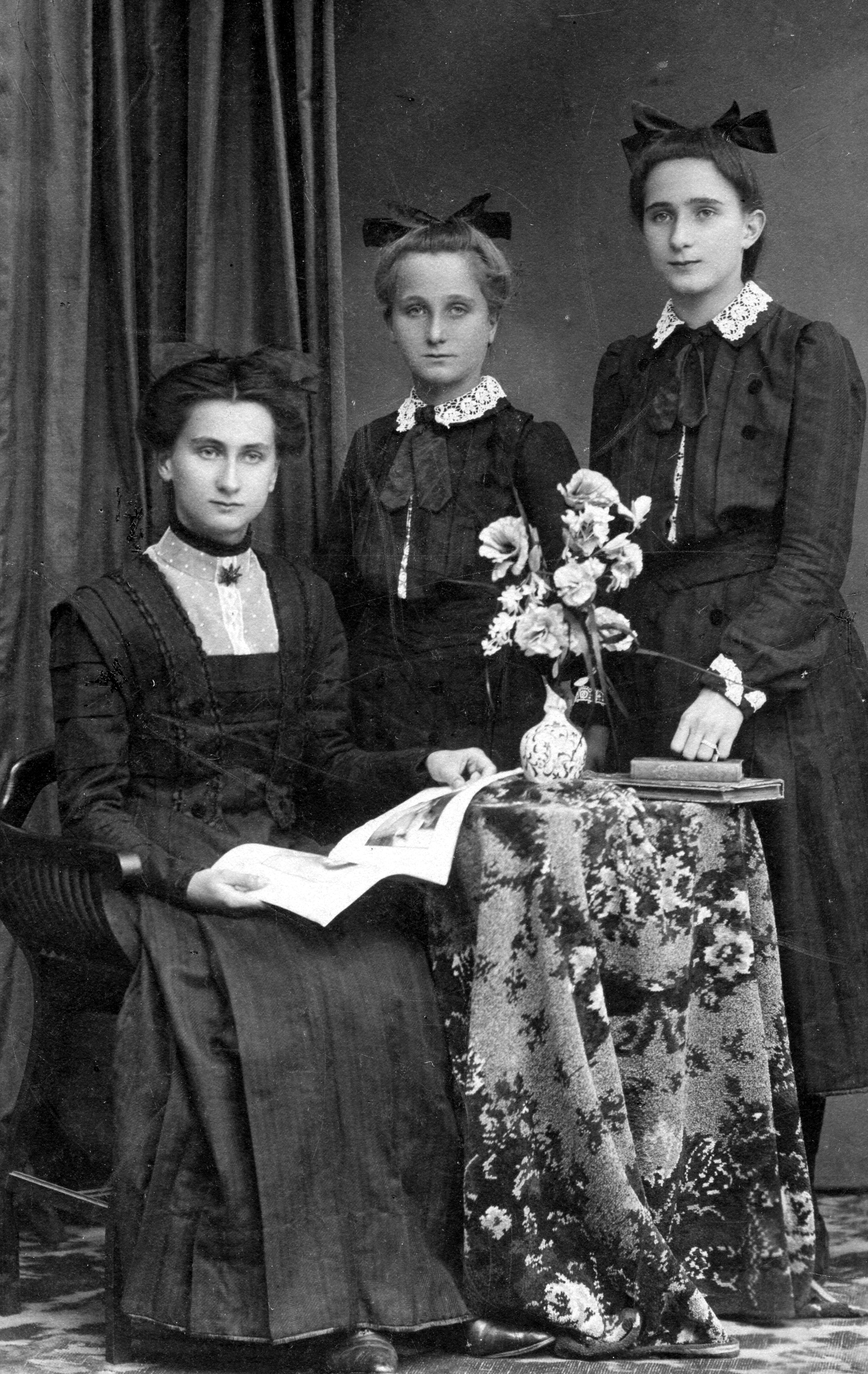
On March 27, 1896, Gertrud Kegler, second daughter of Pastor Carl Kegler, was born at home in the parsonage of Grünewald, Pomerania. She attended the local elementary school from 1902 to 1905. For the following three years she received private instructions in a neighboring village to prepare her for the all girls’ high school in Stettin (Szczecin). Like all the other Kegler children she was confirmed by her father in the village church of Grünewald. It must have been a great joy for Pastor Kegler to see his three lovely daughters sitting in the front pew, while he was delivering his Sunday sermon from the pulpit. He endearingly called Marie, Gertrud and Erika (my mother) his three lilies.

The Three 'Lilies'

The Three ‘Lilies’

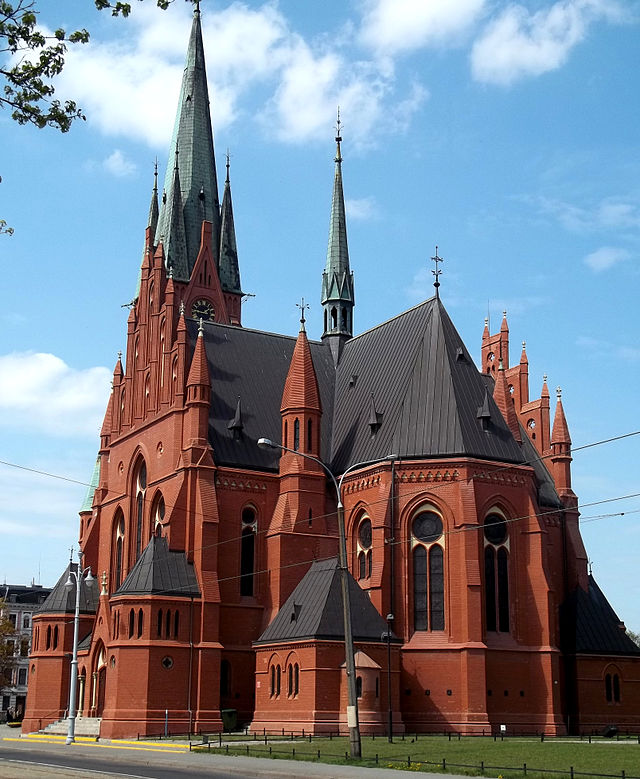
After graduation from high school she took nurses’ training in Neustettin (Szczecinek) and obtained certification as a registered nurse in 1919. For almost 20 years she worked as a member of the sisterhood of the Johanniter Order. The Order’s regulations have worded this command as, “The Johanniter answers the call, where the suffering of his neighbor awaits his act of love, and where the irreligion of the afflicted demands that he witness his faith.”

Saint Catherine of Alexandria church Photo Credit: wikipedia.org

Saint Catherine of Alexandria church in Thorn – Photo Credit: wikipedia.org

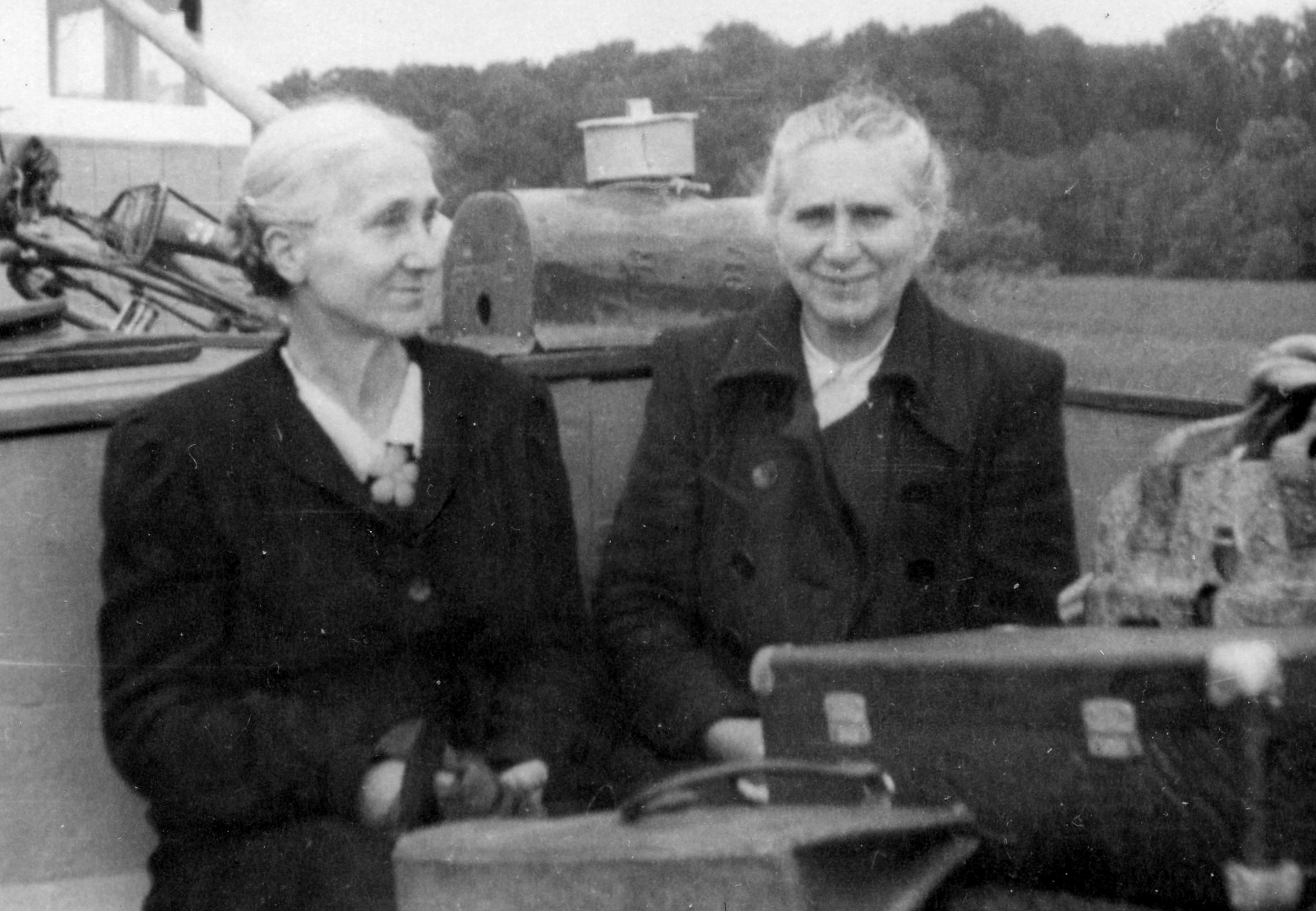
During the Second World War she worked from 1939 to 1945 in a military field hospital at Thorn (Torun) tending to the needs to the sick, disabled and injured. This came to a sudden end, when the advancing Red Army forced the medical administration to close down the hospital. Gertrud fled with her colleagues and managed to reach Stolpmünde (Ustka), where my grandmother Elisabeth and Aunt Marie were renting a small apartment. Shortly after,through a kind of ethnic cleansing all Germans in Pomerania and all the other eastern provinces were expelled from their homeland. So the three eventually arrived in Middle Germany, what later  came to be known as the German Democratic Republic.

A276

Mother and Aunt Gertrud on the Right

After the war from 1945 to 1947 Gertrud Kegler continued to work as a nurse in Belsen-Bergen, where nearby the infamous Nazi concentration camp was located. In 1948, the chief physician, who had worked with Gertrud in Thorn, West Prussia, remembered her as a highly qualified and competent nurse. He asked her to join his staff at the hospital in Malchin. There she was employed as head nurse. She helped under most difficult circumstances to build up the medical facilities of the hospital.

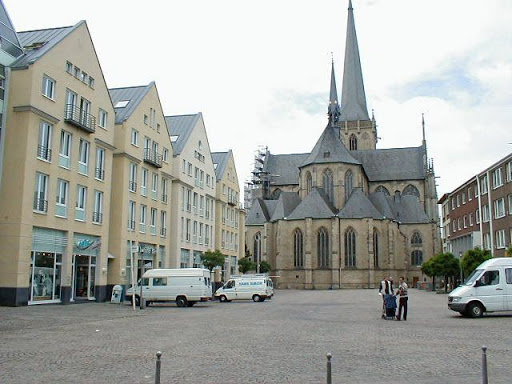
My wife Biene already described in her fascinating blog ‘This Miraculous Life’ at bieneklopp.com the lure of the ‘Golden West’. In addition to the attraction of greater freedom and prosperity in West Germany, there was a third factor that prompted my aunt to cross the Iron Curtain. Her sister Marie, who lived with my mother and me in Wesel from 1956 to 1962, had noticed an ad in the local newspaper for the position of a head nurse in a senior citizens’ home and alerted her Gertrud to the opportunity to start a new life in Wesel. When my aunt arrived in 1956, the three sisters were finally reunited.The Dom in 2001

However, what could have been a joyful period for the three, ended in tragedy. On her time off from work, Gertrud would often drop in at our small two-bedroom apartment on the street corner of ‘Auf dem Dudel 1’. Stress from the new and very challenging position as head nurse was written all over her face. It was not just the tremendous workload in a totally different environment that caused her a lot of grief. It was rather the envious and ill feelings her staff had toward the Ossie (slang for someone from East Germany) that gave her so much pain. Also they may not have liked the conscientious attitude of their supervising nurse, who put the care and well-being of the elderly front and center before comfort and ease at the work place. Gertrud did not mince words when it came to correct sloppiness and negligence in the treatment of the most vulnerable in her care. She may also have suffered under depression, which had struck on and off quite a few members of the Kegler family when they had been under great duress and mental strain. After one year of suffering she could not take it anymore. She committed suicide on February 21, 1957. I was not yet 15 years old at the time. Not having a concept of death as a final event for us here on earth, I was not overly shocked by her parting. I remember her as the kind aunt with enormous eye brows, who liked to listen to me, when I was reading aloud from my Latin reader.

Hiking in the Spring – Part II

Adventure into the Backcountry

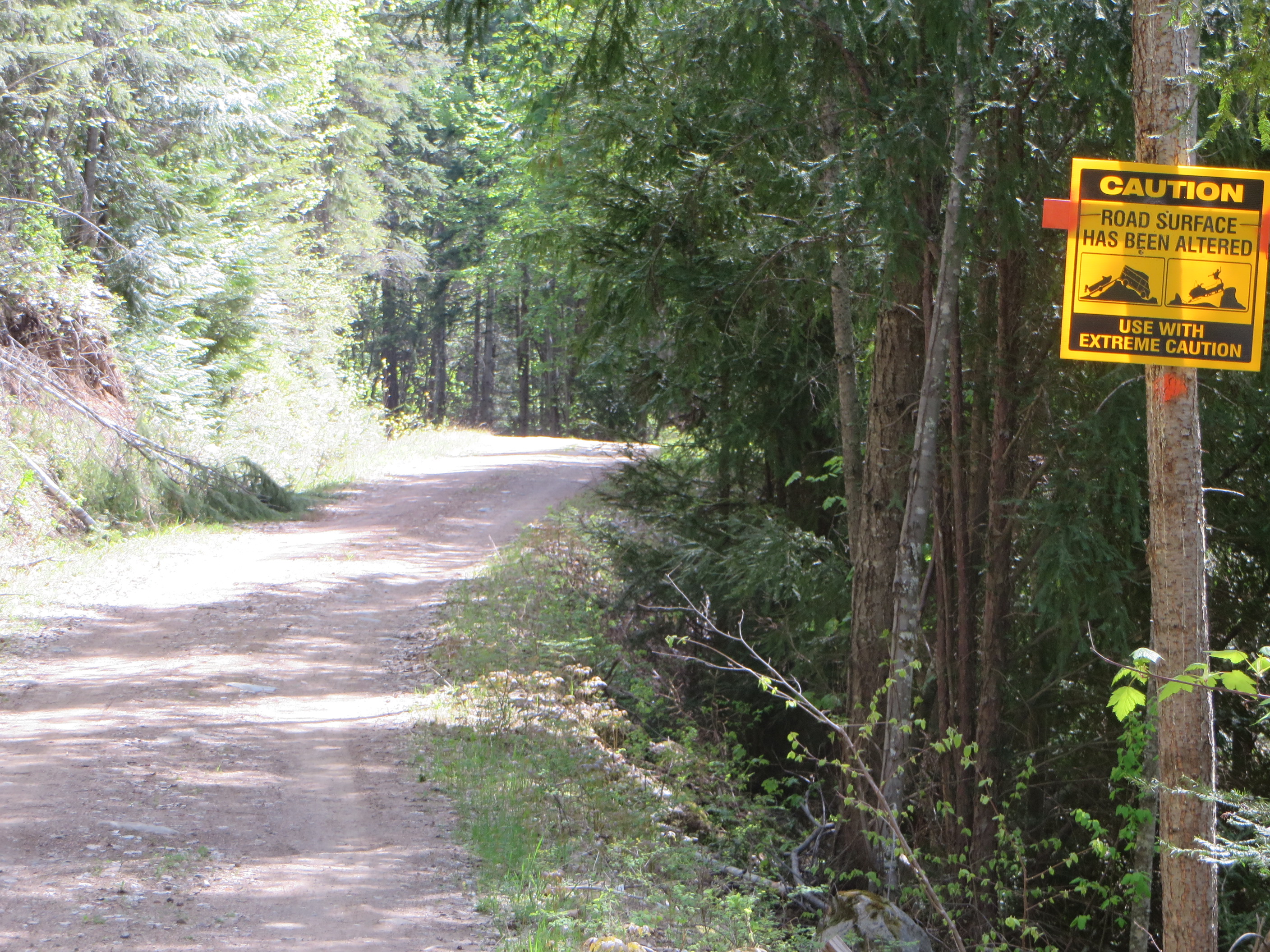
The ‘Pin Creek Trail’ is actually a logging road. But logging trucks rarely use it at the present time. It is is quite a pleasant way to explore the back country of Applegrove south of Fauquier. To get there, you start at the Arrow Motel in Fauquier and travel 7.6 km south on the Applegrove Road. I recommend you park your vehicle at the fork and start your hike from there. There is a sign warning you about road safety and it advises to use extreme caution. Any car with a low clearance will have trouble crossing the water bars.

Start of Pin Creek Road with Warning Sign

Start of Pin Creek Road with Warning Sign

The hike will take quite a bit longer than going on the Taite Creek loop as described in Part I. The destination is a 70-year-old cabin that used to house the loggers of long ago (see earlier post on Like-minded People of Applegrove Road). During my teaching years at the Fauquier Elementary School I would take my intermediate students up there for a history lesson in logging and mining in our area. To keep them occupied with a meaningful task on their way up, I asked them to collect leaves, cones and bark pieces for later identification of larch, western hemlock, cedar, pine, fir, spruce and birch trees. The distance is about 2.5 km one way and is quite steep in some places. The closer you get to the cabin, the more the road will level off. Then Pin Creek, a tributary of Taite Creek, will soon announce its presence through its waters tumbling down in the ravine to the right.

Deer Posing for a Portrait

Deer Posing for a Portrait

At approximately 2 km up the mountain side, a smaller road branches off to the right and leads you directly to the creek. But don’t get sidetracked, continue on the main road and enjoy the break from the strenuous climb in the lush green of the dense forest all around you. Once you are at the cabin, it is time to have a snack and something to drink, before you do some exploring around the cabin.

IMG_5659

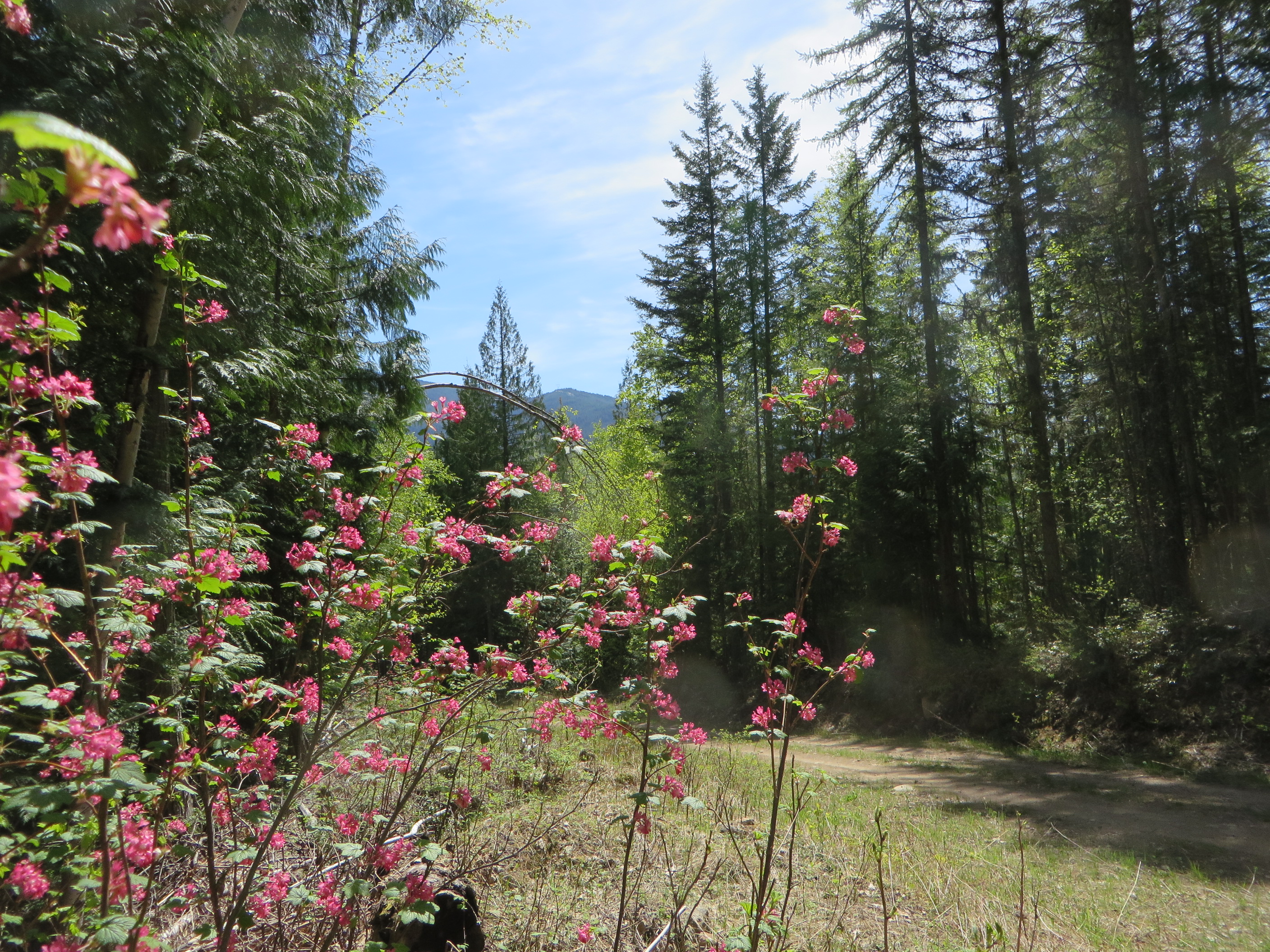
Beauty wherever you go on Pin Creek Road


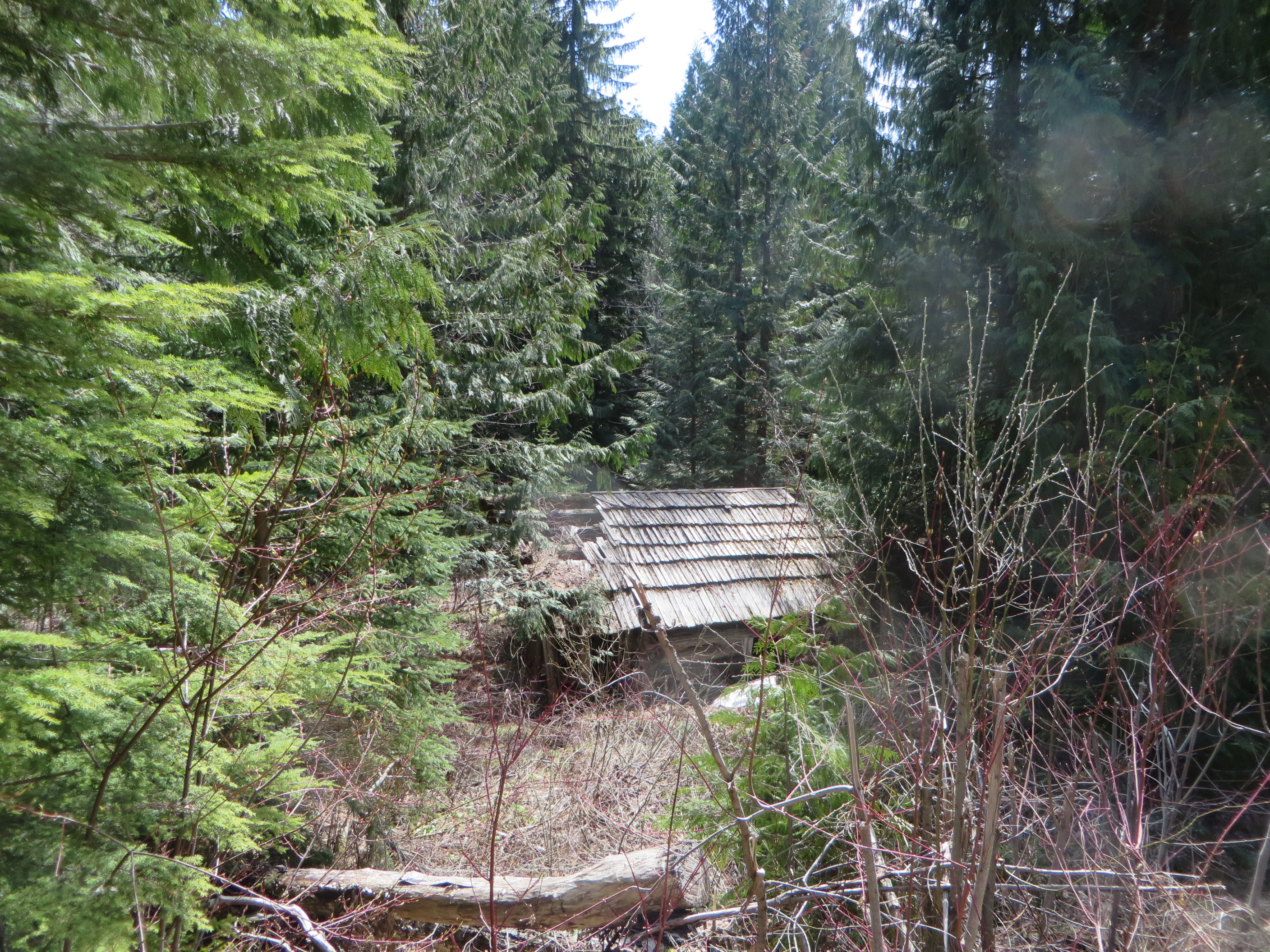
My students went inside to satisfy their curiosity. In its state of utter dilapidation, much of the roof has succumbed to decades of rot and decay. But the walls are still standing. If you are lucky to find any of the bits and pieces of newspaper wedged in between the walls for insulation, you might get to read the latest news from 1946.

Cabin where Loggers once Slept away from Home

Cabin where Loggers once Slept away from Home

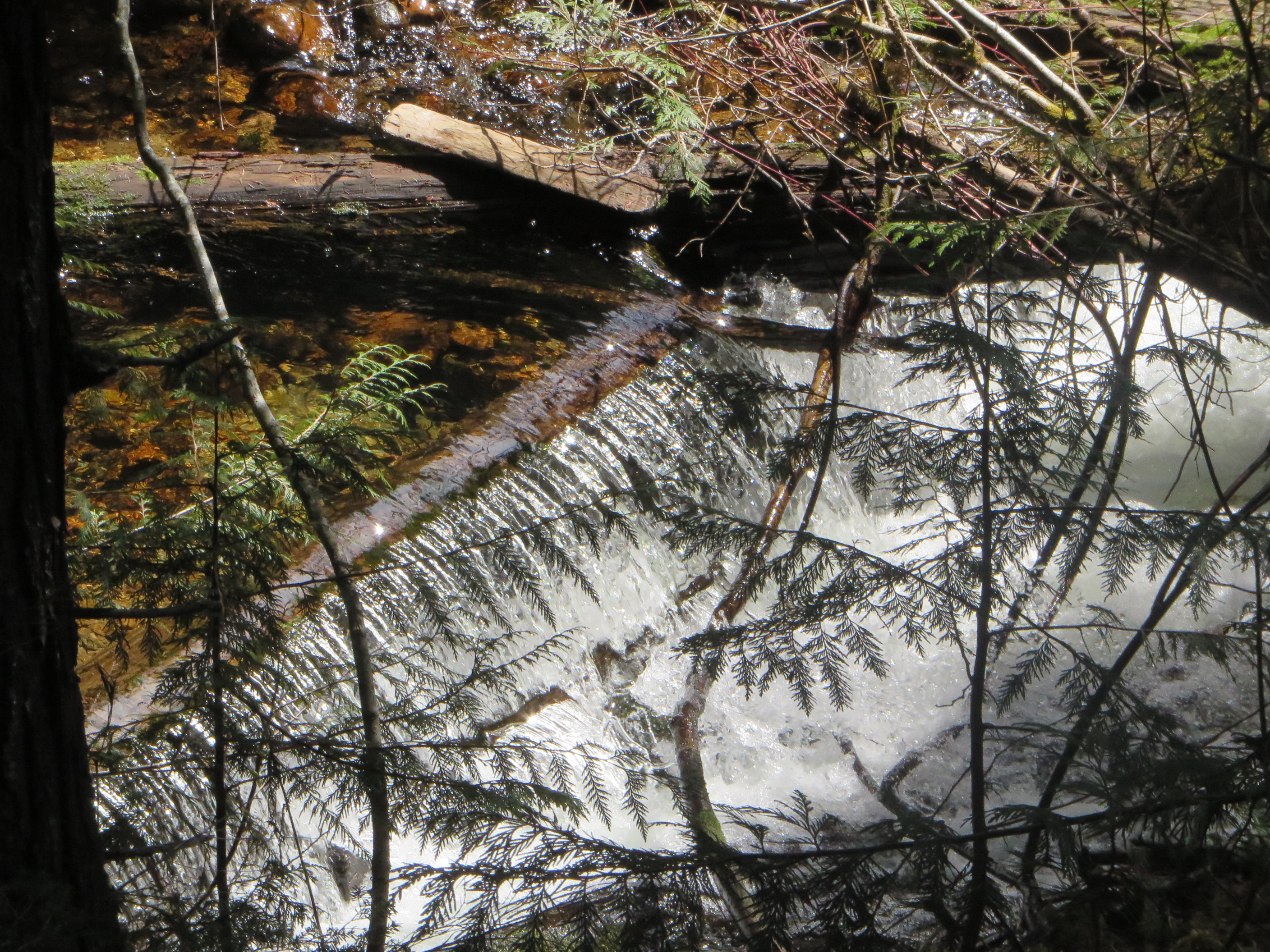
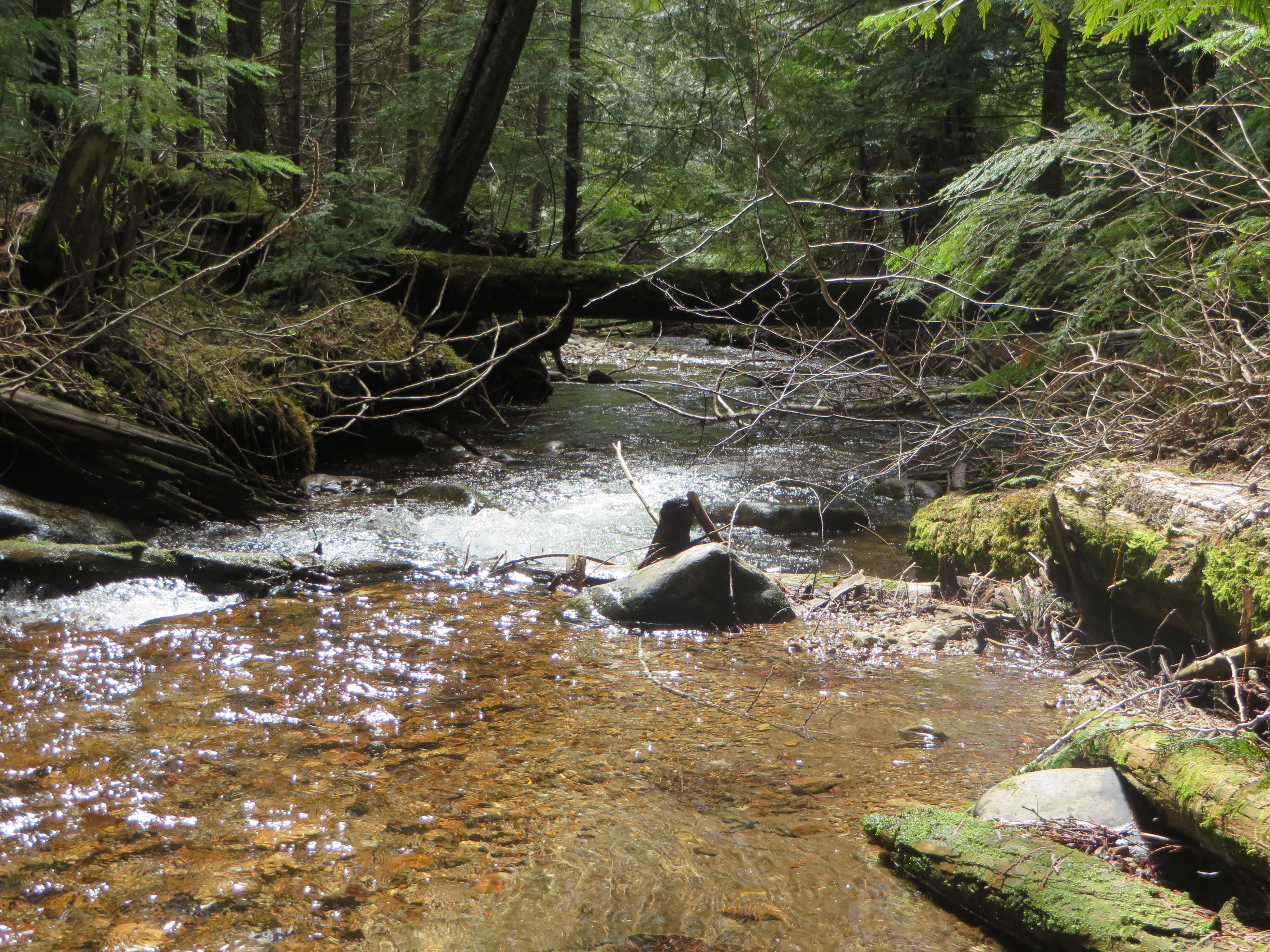
If you really want to enjoy your hike, plan on a minimum of altogether two hours of hiking to the cabin and back to your vehicle plus half an hour at the cabin. There are also a few places, where you can climb down to the creek and listen to the calming sound of rushing waters.

A Log across the Creek creating a tiny Water Fall

A Log across the Creek creating a tiny Water Fall

Some other time you may wish to add three expansions to the itinerary, for which you should plan at least half a day to fully enjoy it. Forestry people told me that the side road, which I mentioned earlier in this post, takes you over a bridge to a number of cut blocks at a much higher elevation. Once there you will enjoy fantastic views into the valley below and the mountains on the Edgewood side across the Arrow Lake. You could also continue on the Pin Creek road, which will take you to Heart Creek. It provides the drinking water for Fauquier below. There used to be a bridge. In the spring of 1985, the creek swollen by heavy rains and melt water completely destroyed the bridge.

Serene Atmosphere at Pin Creek

Serene Atmosphere at Pin Creek

But the most exciting experience requiring an adventurous spirit and quite a bit of courage on your part would be a visit to the nearby abandoned silver mine from about a hundred years ago. For this adventure you need to bring along a flashlight and a pair of gum boots. At the cabin across the road on the left you will find a partially overgrown trail that is quite steep. Make sure to stay on the trail until you come to a path to the left that leads you to the entrance of the mine shaft. You would be well advised to have someone come with you. How the early miners managed to dig a hole so deep into a mountain with only the simplest of tools is quite amazing.

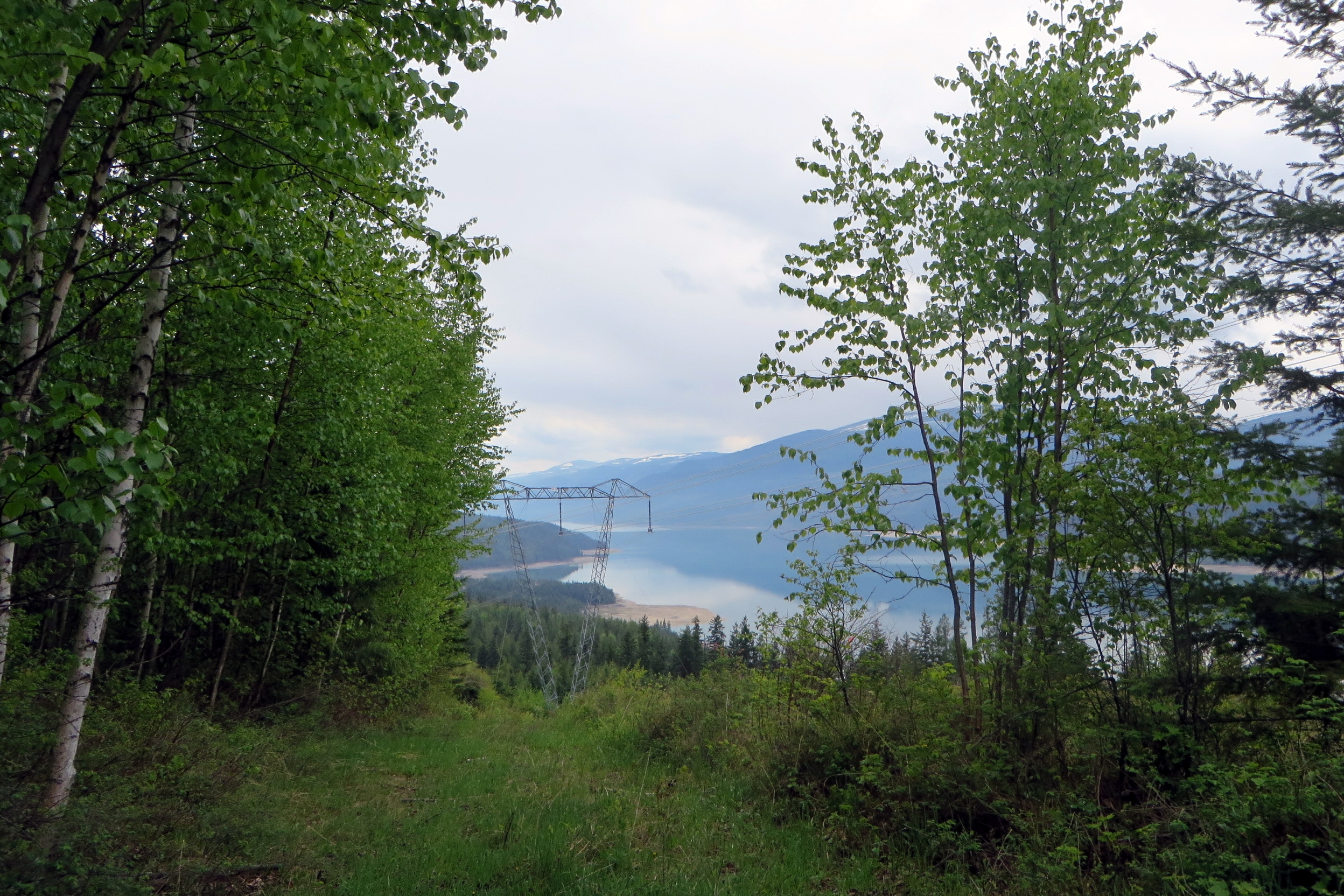
View from the Look-out onto the Arrow Lake

View from the Look-out onto the Arrow Lake

When you drive home, don’t forget to stop at one of the look-outs about half a km from where you parked your vehicle. There on the left you will get a fantastic view of the Arrow Lake. Ah, before I forget, take your camera with you to capture all these memorable moments.


Chapter IX of The P. and G. Klopp Story – Part VI

Of Crime and Punishment

During the second half the school year Frau Stoll gave birth to a baby boy. With his arrival came also a dramatic change in my relationship with the Stoll family. Had I experienced until then a semblance of acceptance as being part of the family, I now felt completely out-of-place. I had become a nuisance, an irritant, a foreign obstacle that needed to be brushed aside to make room in their home and hearts for their newborn son. Old grandma Stoll with her gigantic, trumpet-like hearing aid pretended not to hear me anymore. Frau Stoll was now occupied with her own child and had no time to bring some cheer into my heart. Herr Stoll’s attitude towards me became more and more critical on everything that in his view was unacceptable behavior. He was meting out harsh punishments for my tardiness at suppertime. I had no watch and being a dreamer I easily lost track of time. He also spanked me harder and more frequently for associating with the ‘wrong’ friends.

messkirch_1

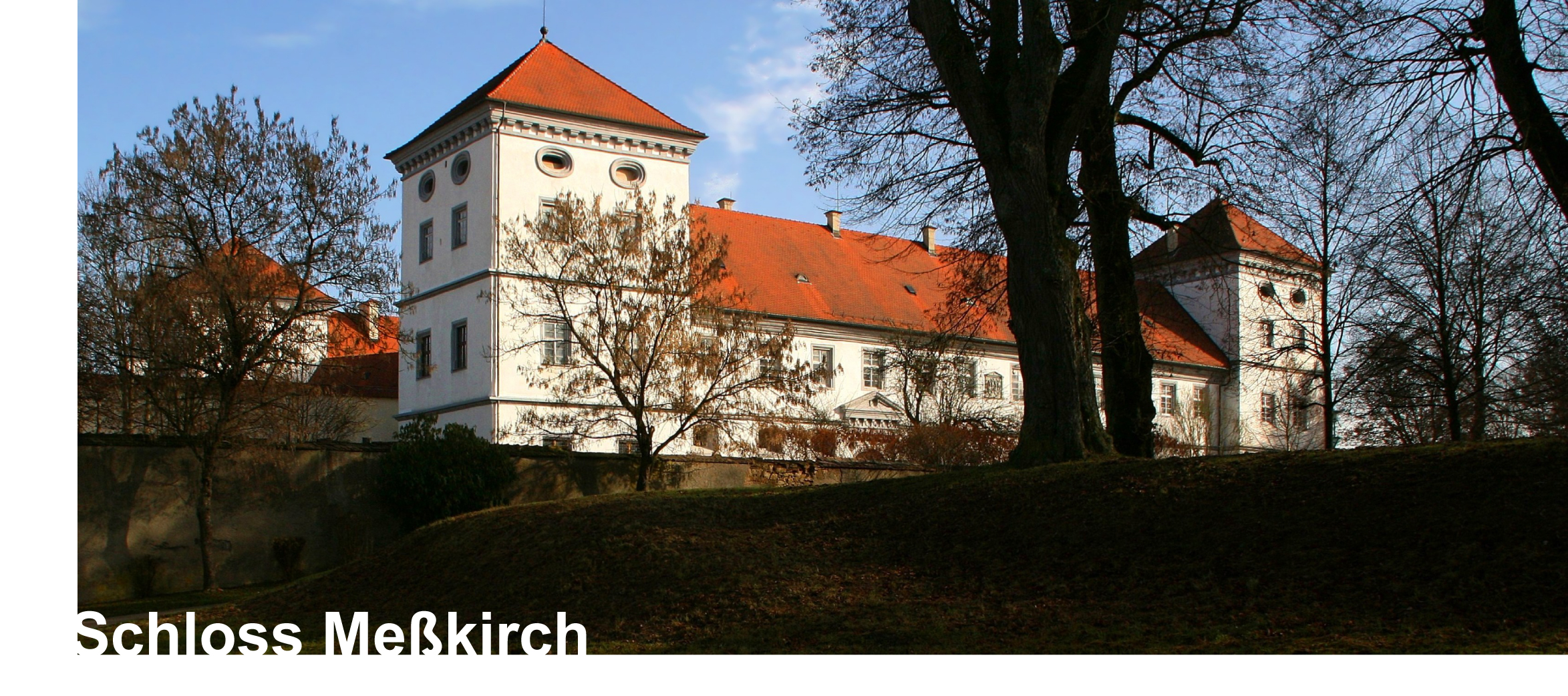
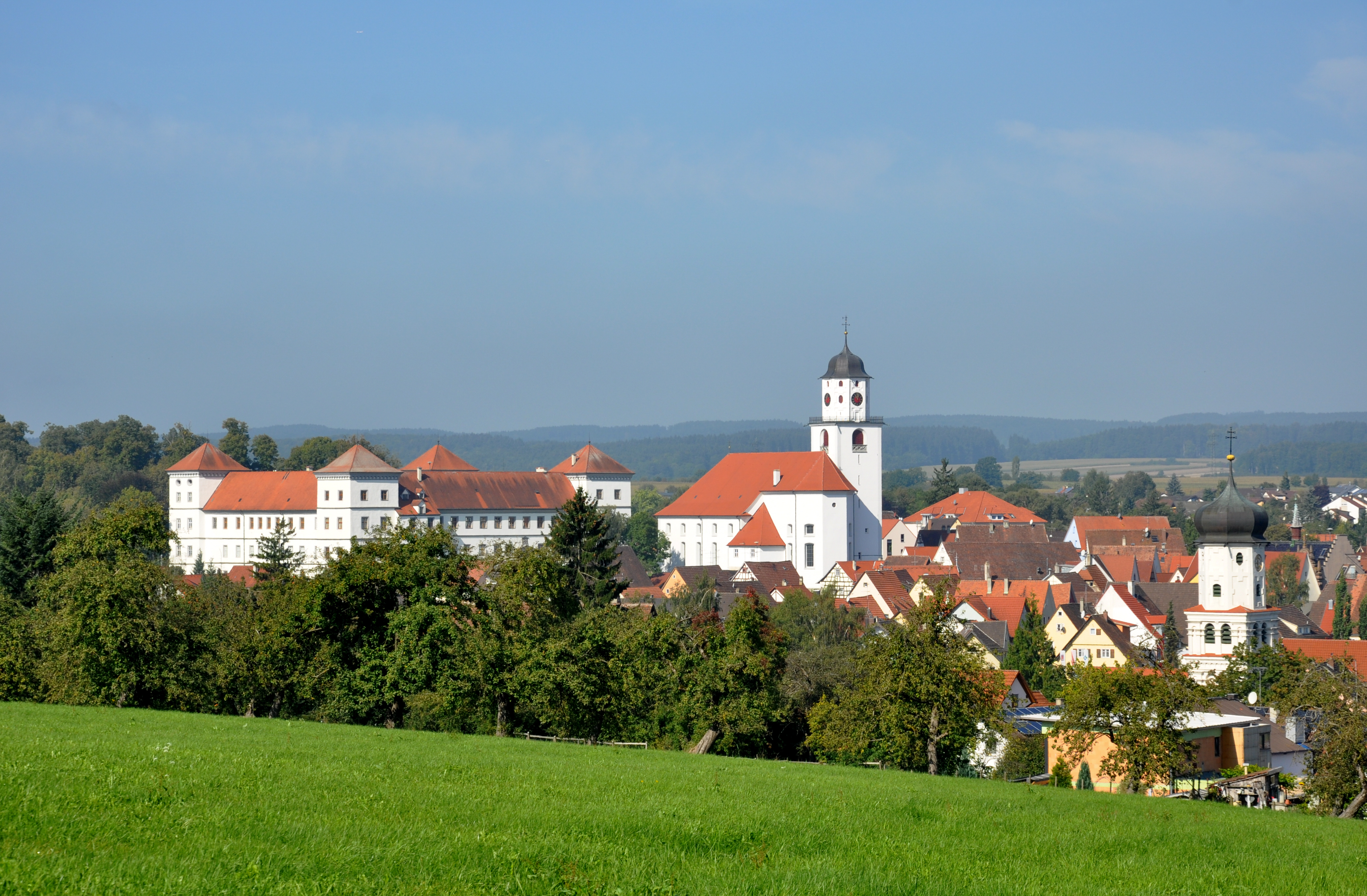
Castle and Park in Messkirch – Photo Credit: schloesser-bawue.de

Toughened up by the frequent spankings I often took on the role of the victim in the ‘Cowboys and Indians’ games I played with my friends in the beautiful park of the Messkirch castle. On one occasion I allowed myself to be captured and tied with ropes onto a tree. In a bizarre combination of fun and cruelty the ‘Indians’ were howling and dancing around the tree taking turns at punching me in a ritual of crime and punishment. Later on when they had released me, they praised me as their hero for so stoically and silently taking their punches. I delighted in their accolades. The role of the cooperative sufferer with real life experience in the domain of pain suited me well. However, its enjoyment was indicative of a character warped by the loveless and punitive atmosphere in the carpenter’s household.

Castle and Park in Messkirch - Photo Credit: schloesser-bawue.de

Messkirch – Photo Credit: schloesser-bawue.de

One rainy afternoon I had to stay indoors after school and spent time at the carpenter’s shop downstairs. Herr Stoll and his three apprentices had been working on various woodworking projects. I was standing next to the first-year apprentice at the very front of the workshop. He had taken a liking to me and often found time to chat with me. It was near closing time. While the young man was cleaning up his workplace, I teased him by hiding his plane he been working with just a few minutes before. The young man was puzzled by its sudden disappearance. While he searched for it, Herr Stoll like a raging bull came racing down the aisle. Without giving a simple word of explanation he grabbed me by the neck and dragged me to the back of the workshop, where he beat me in his furious anger, slapped me in the face, banged me around and threshed my behind. When my cries had turned into a mere whimper and then into silence, Herr Stoll decided that the first part of my punishment had been successfully completed. Nearby was a small storage room for plywood and other wood products. That’s where he threw me for the second installment of my punishment for distracting the apprentice from his all-important clean-up job. I sat on the bare floor aching all over. For how long I sat there I cannot remember. In the darkness of the storage room I contemplated on the crime I had committed against one of my master’s employee. I was still stunned by the traumatic experience, when after a very long time the door of my prison cell opened and the bright outside light made my eyes squint. The shadowy silhouettes of Herr and Frau Stoll like phantoms of the netherworld were looming in front of me. Looking down on this miserable human bundle, Frau Stoll glanced at me as if expecting a word of apology for my misbehavior. Wondering about my silence she remarked to her husband, “Look how guilty he must feel. He is not saying anything at all.”

From this time on I was desperately thinking of escape. Anxiety about this horrific life and homesickness often drove me to the balcony on the north side of the building. There I stretched out my arms towards my home village Rohrdorf as if to invoke some magical force to rescue me from this intolerable situation. But there was no rescue and no home to flee to. The Klopp family once so miraculously reunited was beginning to show signs of disintegration. The failure of the farming venture resulted in a debt load that created a lot stress. Father suffered under long episodes of backaches. From time to time he found temporary employment in the village, while Mother worked hard in a household in the town of Sigmaringen to make ends meet. Karl had gone to Göttingen to study economics. Adolf, who had worked at the Bizerba factory in Messkirch, emigrated to Canada in 1953. He was tired of handing over all his hard-earned money to cover family expenses. Eka (Lavana) had begun her nurses’ training in Hamburg and Gerry had moved to Switzerland to enter a toolmaker’s apprenticeship program. By looking back at the extended periods of separation between Father and Mother I am sure that their relationship was already greatly strained. At the time when I was desperately yearning for the comfort of an intact home, it had ceased to exist.