Ernst Klopp (1900 – 1964) Part 22

My Mother’s Ordeal in Pomerania 1945 – 1947

 While Father slaved away in a Soviet coal mine, Mother had to endure indescribable hardships. Escape across the River Oder, where the area was still in German hands, was no longer an option. The Russian troops were heading in that direction and there was heavy fighting. She was left behind at the forestry with my brother Gerhard and me and the four orphans, whom she had taken along during the arduous trek from Gutfelde. That she and thousands of other women from West Prussia and Pomerania did not despair, did not give up and did not fatalistically slip into a state of utter hopelessness gives me cause for great admiration. After the forestry building burned to the ground, Mother wandered around in search of food, shelter, and relative safety. Eventually she obtained permission from a commanding Russian officer to travel with us children to Belgard in the hope of finding my brothers Karl and Adolf. To her great disappointment she discovered that they had decided to leave school and town, when they had heard that the Red Army would be in Belgard within days.
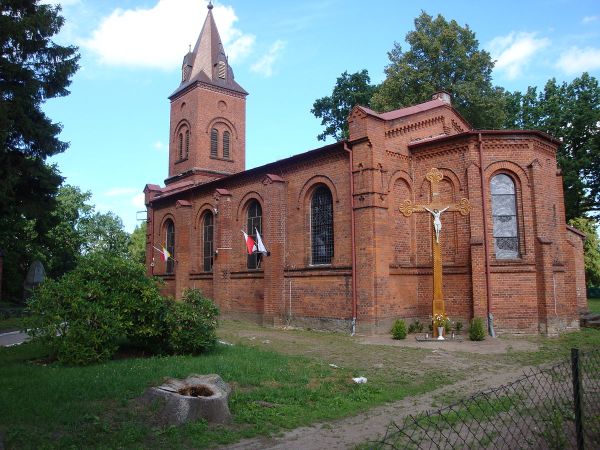
Belgard, Pomerania (now Polish: Bialogard) – Photo Credit Wikipedia

While the town of Belgard remained relatively unscathed from the ravages of war, Mother had to suffer under the harassment and abuses of the new masters in town. In the secret treaty in 1940 between Nazi Germany and the Soviet Union Stalin had acquired control over the eastern parts of Poland and wanted to keep them in compensation for the stupendous losses in life and material during the German invasion of Russia. So he ordered the Poles to leave their homes and their farms and settle in the German provinces east of the Rivers Oder and Neisse.
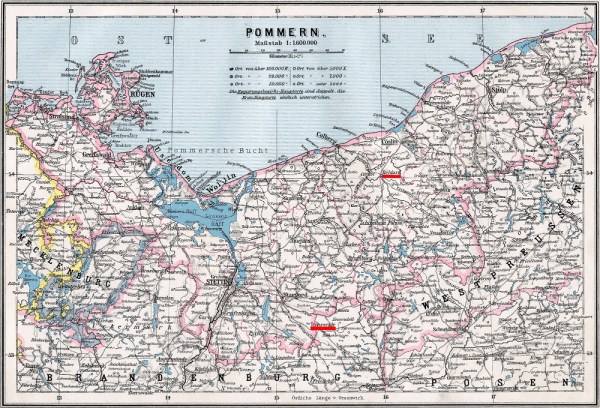
Pomerania, now part of Poland

Now in an ironic reversal of roles, the Poles were now the masters of former German farms and exercising control over the towns and cities. For the Germans, who wanted to stay or could not escape in time, it was now their turn to experience harassment and abuse. Mother refused to be forced into a role in which she would lose her dignity, especially, as it often occurred, if she felt that she was confronted with injustice. She knew about the century old animosity between the Russian and the Polish people. So whenever she felt that the Polish authorities had unfairly treated her, she would go straight to the Russian officer in charge of the district and complain about the incident. To her great satisfaction she received justice ironically from the hands of an enemy officer.

Apart from her inner strength that allowed her to show courage where others would have meekly knuckled under, one must also consider the fact that Russian officers had a heart for the plight of little children. One could dismiss this thought as stereotypical and sentimental bias, if what Mother had experienced in Belgard with the six children in her care had been an isolated case of kindness. But such tender feelings on the part of Russian soldier had been documented so frequently as to attest to their truth.


Natural Splendour of the Arrow Lakes

Wednesday’s Photos

Our Colourful World in the Fall

Last week the forecast was for much colder weather with the possibility of snow. So far we have been very lucky and did not have any frost. I still have lettuce and red beets growing in the garden, which is highly unusual for our region in late October. Prompted by the wintery forecast my wife and I went for a walk and captured the beautiful autumn atmosphere of the Arrow Lakes. Enjoy.

Ernst Klopp (1900 – 1964) Part 21

Release from the Soviet Forced Labour Camp

As already mentioned earlier, my father Ernst Klopp and thousands of other German citizens were captured by Red Army soldiers and as a non-combatants were deported with full approval of the other Allied powers to forced-labour camps in the Soviet Union. At Wikipedia we read: “The capture and transfer of civilian ethnic Germans to the Soviet Union began as soon as countries with a German minority began to be overrun in 1944. Large numbers of civilians were taken from countries such as Romania, Yugoslavia, and from the eastern parts of Germany itself.”

At this tragic juncture, the Ernst Klopp family was scattered all over the eastern provinces of Germany. My mother was left to fend for herself. From Arnswalde she travelled north with four orphans, my brother Gerhard and me in search of the older sons Karl and Adolf to Belgard (today Polish Bialogard). There, they had attended the local high school and had boarded with family friends.  But the 16-year and 14-year old brothers had already taken off to escape from the approaching Red Army. For the longest time, Mother did not know their whereabouts.  Furthermore, my sister Erika attended school at Hirschberg, Silesia, where she stayed with uncle Bruno’s widow and her children Hartmut, Elisabeth, and Jürgen. Writing a cohesive account of all members of the family during the postwar years is very difficult and has to wait until I have concluded my father’s life story.

In the meantime Father had a major accident, while he was working in the coal mines in the Donbass region of the USSR. He received treatment for his head injury and would have been sent back to work, if he had not feigned continual headaches. Thus, he succeeded in getting an early release and was sent back to Germany. When he arrived at Uncle Günther’s place in Erfurt, he heard that the entire family had survived the war. He established contact with Mother and the children and in 1947 moved to Rohrdorf, a small village in Southern Germany between the River Danube and Lake Constance. There he found employment with the regional branch of the Fürstlich-von-Fürstenberg forest administration. Eventually the entire Klopp family was reunited. Although now extremely poor, often hungry, and dispossessed, the family was finally together again and could attempt a new beginning.

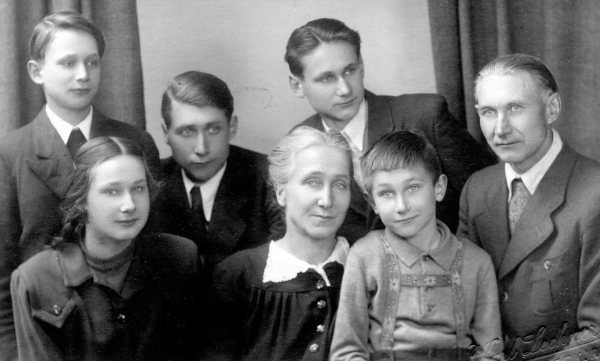
First Photo of the Reunited Ernst Klopp Family in Rohrdorf 1950

Natural Splendour of the Arrow Lakes

Wednesday’s Photos

Fall is Mushroom Season at the Arrow Lakes

The most common mushroom varieties in our area are the pine mushrooms, the chanterelles (Pfifferlinge), and the lobster mushrooms. Mushroom buyers are setting up their stations as early as September. In October people from all over the province are flocking into our woods in search of the precious pine mushrooms which fetches as an export article the highest price. My wife most probably a direct descendent of the ancient hunters and gathers is also bitten by the annual pine mushroom fever, while I am content with my passion with photography. We drive into one of the lucrative forest areas where we part for one hour or two. Then I always find something worth photographing. Two weeks ago, my focus was on the very small mushrooms, which have a special beauty of their own. Enjoy.

From this magnificent viewpoint we go down to the mushroom forest.

Perhaps some of you mushroom experts may be able to identify the mushrooms. The last mushroom could be a boletus but I am not sure.

Ernst Klopp (1900 – 1964) – Part 20

Ethnic Cleansing 1945 – 1948

Reparations in Kind

With the article below describing the topic of an open lecture hosted in 2010 by the prestigious Unviversity of Waterloo, Ontario, Canada, I am going to provide some background of the tragic events which engulfed the Ernst Klopp family in the 1945 to 1948 time period. My father was one of the over two million Germans who were deported to forced labour in the Soviet Union and our family was one of the 14 million ethnic Germans who were driven from their homes in the eastern provinces. Considering that more than 2 million Germans perished, I cannot help but declare that the survival of the entire family was a first-class miracle.

Recently during my family research, I read online the following announcement by the U of W and I quote:

Pursuant to the 1945 Nürnberg indictment and 1946 judgment the forced deportation of civilians for purposes of demographic manipulation and/or forced labour constitute war crimes and crimes against humanity. Several Nazi officials were found guilty of having perpetrated these crimes. At the same time as the Nuremberg Trials were conducted, more than 14 million Germans were expelled from their homes in East Prussia, Pomerania, Silesia, East Brandenburg – territories that were part of the defeated German Reich, from Bohemia and Moravia, from Hungary and Yugoslavia. Nearly two million ethnic Germans were deported to forced labour in the Soviet Union as “reparations in kind”. The Statistisches Bundesamt in Wiesbaden and subsequent scientific demographers have estimated that more than two million ethnic Germans perished as a result of their expulsion, either as victims of lethal violence or as a consequence of exposure, hunger and disease. In his 1946 book entitled “Our Threatened Values” Victor Gollancz appealed to a general sense of justice and morality: “If the conscience of mankind ever again becomes sensitive, these expulsions will be remembered to the undying shame of all who committed or connived at them … The Germans were expelled, not just with an absence of over-nice consideration, but with the very maximum of brutality.” Alas, the expulsion of the Germans was given scant press coverage and was seldom discussed or even mentioned in history books. The first UN High Commissioner for Human Rights Jose Ayala Lasso, in a statement to the German expellees assembled at the Paulskirche in Frankfurt am Main on 28 May 1995 stated: “I submit that if in the years following the Second World War the States had reflected more on the implications of the enforced flight and the expulsion of the Germans, today’s demographic catastrophes, particularly those referred to as ‘ethnic cleansing’, would, perhaps, not have occurred to the same extent.” Unfortunately there were no “lessons learned” from the expulsion of the Germans. In 1992 the UN General Assembly called the policy of Ethnic Cleansing in the former Yugoslavia “a form of genocide”. The ICJ and the ICTY similarly found that the massacre of Srebranica constituted genocide. How many massacres of ethnic Germans 1945-48 reached the threshold of genocide or crimes against humanity? Several professors of public international law have raised this issue and insisted that International Law and human rights law cannot be applied à la carte. The UN General Assembly has affirmed the right to truth. The German expellees and their descendants have at least this right.

Natural Splendour of the Arrow Lakes

Wednesday’s Photos

Of Tree Stumps, Mushrooms and Ferns

While my wife has been picking pine mushrooms in our nearby forests, I have been searching for objects that typically represent the autumn scene in our area. Old tree stumps and tree trunks have always fascinated me, as they so wondrously symbolize the end and the beginning of a new life cycle. Mushrooms are pushing through the forest floor to release their spores for the next growing season. Ferns are bending low under the weight of old age while retaining their graceful shapes of geometric patterns for us to admire. Of course, the brightly shining sunflower wheel must always be part of the visual presentation of the wonderful autumn season. Enjoy.