Chapter 24 of the Peter and Gertrud Klopp Story – Part V

Of Good Luck Charms and Love Potions

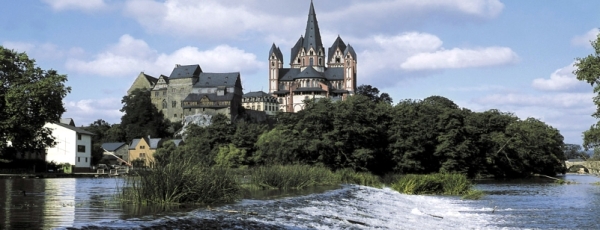
goodwp-com_32419-limburg

Limburg at the River Lahn – Photo Credit: goodwp.com

The wall, which had caused so much grief, had finally collapsed. A fresh breeze of lightheartedness entered our hearts and prompted us to write more cheerfully about our feelings towards one another. We felt safe to joke and banter about our relationship. For example, when I referred to Don Giovanni, the lover of over a thousand women, and boldly declared  that my favorite line was ‘but in Spain already one thousand three’, Biene teasingly asked if she was perhaps Don Pedro’s 1003rd. In that case she would plan her revenge and demand that for me to be forgiven I would have to sing her an aria to demonstrate my true repentance.

At the end of our visit to the opera Biene managed to slip a good luck charm into my coat pocket. It turned out to be an effective substitute for the originally intended love potion. This talisman was a little man made out of wood with lots of hair spreading profusely into all directions. Biene truly believed that he would do its magic and completely surrender my heart to her. While I was less inclined to lend credence to such superstition, her strong belief proved her right. The little man with its exuberant hair both amused and endeared me to Biene all the more so, as my army buddies knowing its romantic origin and loved that cute little fellow and constantly teased me about it. Of course, I reported back to Biene how much I loved her good luck charm. When she feigned jealousy over Don Pedro’s love affair, I lectured her good-naturedly that since my cute new friend was a gift from her I considered him part of her and therefore incredibly she would be jealous of herself. Of course, I relished the excitement and bantering Biene’s gift had generated in Room 328. One morning I discovered my roommates had braided his hair. When they threatened tongue-in-cheek to cut it off, I made them all sign a written promise in a letter to Biene that they would not utter such threats again. Just to be on the safe side, from that moment on I kept the little man locked up in my closet.

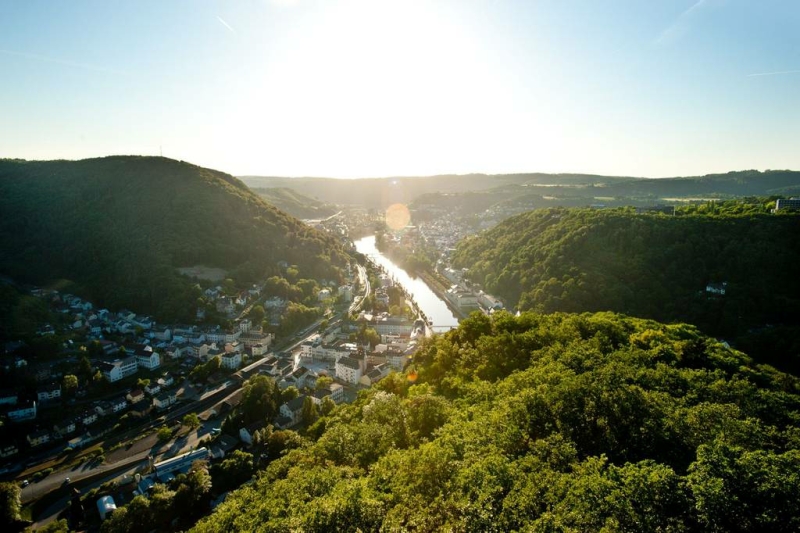
csm_blick_ins_lahntal_bei_bad_ems__4793_ebce03c32b-romantic-germany-info

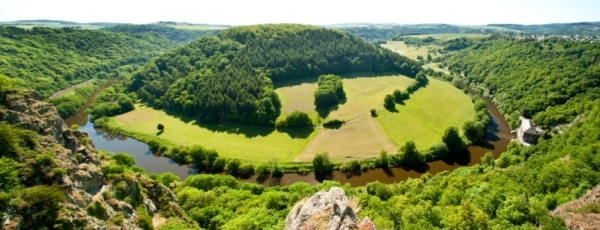
View into the Lahn Valley – Photo Credit: Romantic-Germany.info

It was also during the weeks before Christmas that my roommates being aware of my expertise in electronics started bringing their broken-down radios to me. Fortunately the radios suffered only from minor defects, such as blown fuses or tubes needing replacement and similar problems, which I was only too happy to fix. At home I began to assemble from a still functional transistorized tuner and electronic components from my parts box a little radio that I planned to use as a farewell gift for Biene before leaving for Canada.

Amid all this happiness there was just one fly in the ointment. Every once in a while with the regularity of the lunar cycle Biene would feel depressed and so miserable that according to her own words only I would have been able to comfort her, if only I had been present at such time. She would wake up in the middle of the night or even cry in her sleep. Quite frankly, not knowing anything about the so-called evil days that were often used in the German language as a euphemism for the monthly period, I was quite bewildered by the disturbing lines about her distressed state of mind. I felt an uncanny foreboding and wondered why the great joy she felt would not be strong enough to carry her across the occasional ups and downs. Afraid to walk across an emotional minefield, I chose to ignore such sentiments. I still had to learn that avoiding a problem was no way of solving it.

74

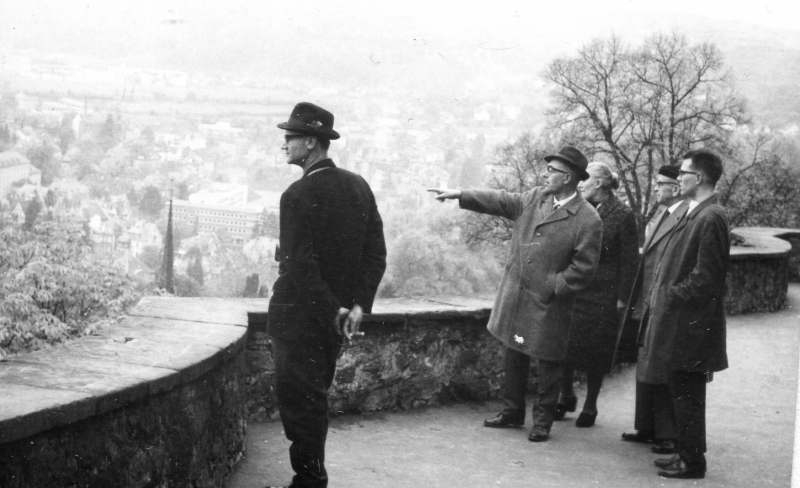
My Brother Adolf at the Marburg Castle 1964

For Christmas I mailed her an LP with excerpts of the best musical pieces from Mozart’s Don Giovanni, which immensely delighted her. She quickly regained her balance. Listening to the familiar tunes recreated the imagery of us two sitting together and holding hands. She in turn sent me a guitar booklet with easy to learn hillbilly songs, such as ‘My wife and I live all alone in a little hut we call our own’. Chords, which I learned and practiced to accompany the songs, supplemented the tunes.

At Christmas I had guard duty at an ammunition depot deep in the woods of unknown location. On my lonely night rounds along the eight-foot fence with the stars shining brightly from a cloudless sky above me, I had ample time to make plans for the future. That’s when I made up my mind to talk to Biene about them on our next rendezvous in the New Year. Indirectly I had prepared her for this by presenting one more time my thoughts on what according to my opinion fate was and perhaps more importantly what it was not.

“December 24th, 1964 – one hour before guard duty

My dear Biene,

 … For I believe that we have still a lot of things to talk about. You know, a great decision will have to be made. But no matter, what it will be, it need not mean our permanent separation. Look, dear Biene, this is also the point, in which I have always voiced a different opinion. Fate can bring us death, turn us into cripples, take away father and mother, drag us into war, but we have in our hands the tender threads of happiness, and fate will take them only out of our hands, if we are incapable or unwilling to make use of them. I can promise you, ‘I come back again’. You can promise me,’ I will follow you’. This is our decision and not one of fate. And whether we both abide by it and act accordingly will be the proof of our love for each other. Now it is getting dark, and I must soon put on helmet and uniform. Have a wonderful holiday and always believe that I think of you often!

Your Peter”

 Amidst feverish preparations for our next get-together in the second week of January Biene mailed along with her Christmas letter two beautiful poems, one of which I like so much that I made an attempt to translate it into English.

          Eyes

 Eyes gleam like a sea at night,

And softly your gaze submerges.

But your gaze is only a weak glimmer like the starlight,

Which on the dark sea winks and blinks

And yet does not fathom the mystery of the deep.

30766481925_a1952dfc4d_b

Windows to the Soul by Gertrud Klopp


STEEP AND CROOKED … by Late Writer, Artist & Castle Builder Bill Laux – Chapter 2

STEEP AND CROOKED: THE MINING RAILROADS OF THE CANADIAN BORDER

 By Bill Laux

CHAPTER TWO

THE CRY FOR A RAILROAD

1889 – 1896
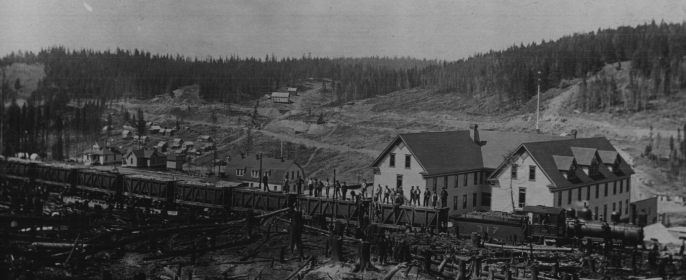
Photo taken from Bill's Archive

Photo taken from Bill’s Archive

Daniel Corbin had from the beginning intended that his Spokane Falls and Northern Railway should enter Canada and reach the shores of Kootenay Lake where half a dozen mining camps needed transportation for their ores.   Before his graders began moving dirt, he went to Victoria, B.C. to petition the legislature to grant him a charter for a railroad from the border point, Waneta, to Nelson, B.C.   His line was to run up Beaver Creek to an easy pass over to the Salmo River, and follow that stream to its source.   From there it would descend Cottonwood Creek to Kootenay Lake at Five Mile Point. Here, it would reverse direction and run along the shoreline into Nelson.

Corbin knew the continuing desire of the Vancouver an Victoria business communities for a direct route through southern B.C. to the Kootenays which had been fermenting ever since Captain Ainsworth’s persuasive plan of 1884.   The building of a “Coast to Kootenay” railway had been vigorously urged on anyone thought to have the resources to undertake such a project.[i]   Corbin therefore accompanied his request with a second petition for a charter for that “Coast to Kootenay” railway branching off his SF&N line at Marcus, and running up the Kettle River valley into Canada and the then westward to Vancouver.   He was intentionally vague about its route for which he had no survey.   His proposal stated only that the two lines he petitioned for, “…would form one continuous line of railway from the south (sic) end of Kootenay Lake to the Coast, with a short detour into American territory, rendered necessary by the difficulties of penetrating the chain of mountains on the west bank of the Columbia River.”[ii]

For the second time, an American was appealing to the nationalistic sentiments of Canadians to secure a charter and land grants for an American railroad.   Nelson, largely American in population, was strongly behind Corbin.   But the merchants on the Coast remembered how they had been duped by Captain Ainsworth.   It all depended on how you looked at the map.   One could read it from the north as a line of railway running from Nelson, on Kootenay Lake, dipping into the U.S. at Marcus, where a branch line ran to Spokane, and then back into Canada to run west to Vancouver.   Or, if one turned it around and looked at it from the south, it appeared to be two lines feeding Spokane from Nelson and from the B.C. Coast.   After an initial burst of enthusiasm for Corbin’s scheme, the coastal merchants turned distinctly cool, realizing that it was another American effort to capture Kooteany trade for themselves.

Corbin needed a Canadian ally to front for him.   He turned to Colonel James Baker, member of the provincial legislature for East Kootenay.   Colonel Baker had been promoting his own B.C. Southern Railway to run from the rich coal deposits of Crowsnest Pass to the Coast, but had been unable to raise the money to build it.   He saw in Corbin the man with the funds to build his line, and proposed trading his political influence in the legislature for Corbin’s financing of his B.C. Southern.                    Corbin accepted this partnership at first, but when he saw Baker’s bill, which chartered and gave land grants to Baker’s line, but left Corbin in a distinctly subsidiary role, he quickly backed out.   Without any influential support in the legislature, Corbin’s two charter proposals were voted down.[iii]

Corbin did not give up.   Since both the Dominion and Provincial Governments could issue charters for railroads and grant subsidies, he went to Ottawa to present his charter petitions to the Federal government.   But B.C. Premier, John Robson, who feared all American schemes, sent a telegram to the parliamentary Railway Committee, suggesting that his government would support Corbin’s petitions only if Parliament expressly stipulated that both railroads would be built simultaneously.[iv]   The City of Vancouver made its opposition known as well, stating that it believed the “Coast to Kootenay” line was just a bait to get a charter for a very profitable Spokane to Nelson connection.   Final and definitive opposition came from President Van Horne of the Canadian Pacific Railway. He promised that if Corbin’s proposals were rejected, the CPR would build its own railroad into the Kootenays.   This satisfied the overwhelming majority of parliamentarians, many of whom admitted that they had entertained Corbin’s proposals only to force the CPR to commit itself to build into the Kootenays.[v]

Back in Nelson, the residents were outraged at losing a rail connection to the world, and vented their anger by boycotting Canadian goods, and continuing to send their mail out via the U.S.A.   In the first year of its operation, one third of the stamps sold by the Canadian Post Office in Nelson were American.

Dan Corbin had learned from his two failures the deep suspicions with which Americans were regarded in Victoria.   He therefore allied himself once again with Canadian partners, though this time of more probity than Colonel Baker.   A group of Kamloops merchants, John Mara, Frank Barnard and Captain John Irving, had organized the Columbia and Kootenay Steam Navigation Company to build and operate a fleet of sternwheel steamers on the Columbia River and Kootenay Lake.

Captain Ainsworth’s portage railway between the river and the lake was now the CPR subsidiary, Columbia and Kootenay Railway.   Using the rail line as a connection, the CKSN steamers began a very profitable service, moving the Kootenay Lake silver lead ores to the C&K at Nelson, and receiving them at Robson on the Columbia for forwarding to the Revelstoke smelter.   But the badly mismanaged Revelstoke smelter proved a failure. During a protracted dispute with the government about who was responsible for stabilizing the eroding riverbank under it, the smelter collapsed into the Columbia River.   The ore than began to move the other way, from Robson downstream to Dan Corbin’s railway at Little Dalles.   Dan Corbin, even without crossing the border with his rails, had by 1891, much of the Kootenay ore and most of its trade.[vi]

Van Horne had not forgotten his promise.   He was determined to shut Corbin out and monopolize Kootenay trade for the CPR.   He sent his surveyors out to discover whether the much discussed “Coast to Kootenay” railroad was feasible, and what route it could take.   They reported that such a line, though difficultmand costly, could be built.   The C&K portage railway would form its center segment.   A line in from Alberta could join it at Nelson, and from its terminus on the Columbia, a line could be built west to the CPR main line opposite Hope.   Meanwhile, Corbin, with his new allies and their Columbia and Kootenay Steam Navigation Company, had his dual charter petitions presented a second time to the B.C. legislature.   This time five respected British Columbians asked for the Nelson and Fort Shepherd charter and Corbin petitioned for his Marcus to Vancouver line.[vii]   The legislators were so indignantly preoccupied with rejecting the American’s request, that they granted the Nelson charter to the five Canadians without a thought.   His ruse had worked; Dan Corbin now had his way cleared into Canada.[viii]

Corbin at once pushed his graders across the line and began building toward Nelson.   But Van Horne moved to block him.   Corbin’s line, descending the steep grade out of Cottonwood Creek, had to contour around the bluffs above Nelson to maintain its grade and reached the lake five miles east of town.   It was then to run back along the lakeshore to enter Nelson from the east.   Van Horne persuaded the the B.C. government to grant the CPR exclusive rights to the foreshore of Kootenay Lake east of Nelson as a right of way for his proposed line from Alberta.   When Corbin’s graders reached the lake at Five Mile Point, the found the route into Nelson blocked by the CPR Railway Reserve.

Undaunted, Corbin built a line down beach to the water where freight and passengers could be transferred to the obliging CKSN steamers for the last five miles into Nelson.   Corbin opened his Nelson and Fort Shepherd in 1893, and that winter the Columbia froze solid from Revelstoke down the Arrow Lakes, severing the CPR connection until May.[ix]   Corbin’s trains, however, ran daily to Spokane, all winter long.

That severe winter of ‘93 -’94, and Dan Corbin’s railway, definitively attached the Kootenays to Spokane.

Van Horne gave order to build a branch line south from Revelstoke along the river to Wigwam to bypass the winter ice blockades, but it was not until 1896 that the line was completed.   Continuing ice problems south of that point required the line to be extended all the way to Arrowhead in 1898.   There were ice problems farther south in the Arrow Lakes as well, and the wooden hulls of the early sternwheelers were being ripped and splintered by combats with ice.   It was not until the Minto and Moyie were built in 1898 with steel sheathing along their waterlines, that the CPR had a pair of sternwheelers capable of breaking ice.     Ordinarily, after a freezeup of the Lakes, a sternwheeler would push a wooden barge with steel sheathing along the waterline to break the ice.     The barge, wider than the steamer, would make a channel through which succeeding trips could be made with a bare steamer. Using a barge on every trip would have made the trip much too slow to keep the schedule.

Meanwhile, Daniel Corbin was clearly winning.   Up at Red Mountain, he had selected for his railroad land grant a tract which included everything north of First Avenue in the Rossland townsite.[x]   This land was in a kind of legal limbo until Corbin could finish his N&FS line, whereupon the land would be turned over to him.   It was alienated railroad grant land, but still without title or ownership.   On this squatter’s paradise sprung up a shabby collection of shacks, nondescript saloons, dance halls, 24 hour restaurants, gambling rooms and used goods emporiums between the town of Rossland and the mines.   It was called “Sourdough Alley,” and its dubious attractions lined the muddy trail up to the mines.   Beyond the reach of the law, it was a place wholly without authority.   The miners, coming off shift, had to pass the music of its dance halls, the cries of its barkers, the boozy smells from its bars, and the inviting plank walks leading to the red curtained windows of Popcorn Kate, Scrap Iron Nell, and Broken Hip Georgia.   Few men got home on payday without being waylaid by one or another of the Sourdough Alley hucksters or their female colleagues.[xi]

                When the grant was turned over to Corbin, he knew he had the key to the Red Mountain mines in his grasp.   No railroad, Van Horne’s, or Colonel Baker’s, or the Northern Pacific, could now reach the mines without crossing his grant. [xii]

The Le Roi Mining Company built a toll road in 1892 leading out of the west end of Rossland through the shallow pass leading to Little Sheep Creek.   It ran down the creek to the border and on to the Columbia River opposite Northport.   Forty extra- heavy, 5 ton ore wagons were placed on this road hauling Le Roi ore to the river and supplies back up to Rossland.   A small reaction ferry took the wagons across the river to Dan Corbin’s railroad.   A reaction ferry was a barge tethered to an overhead cable running from towers on both banks.   By angling the barge to the current with a hand winch, the force of the current would push the barge across the river. For the return trip the angle to the current would be reversed.

This road connection to Northport and Corbin’s railroad, bypassing Trail altogether, alarmed Colonel Topping and the Trail merchants.   They vigorously lobbied the B.C. legislature for funds to build a Trail – Rossland wagon road up Trail Creek gulch.   Funds were appropriated; the road was graded, and a connecting road was built on the east side of the Columbia, south to the N&FS rails at Sayward.

Haulage on the American route down Little Sheep Creek to Northport cost $4.00 per ton.   On the Canadian route the cost was $4.25.   With wagon haulage at $4.00, mining costs averaging $12.00 per ton, and rail freight plus smelter charges amounting to another $10.00 per ton, $26.00 ore could now be moved from those stockpiles at the mine to the Montana smelters. Still, $26.00 ore only accounted for a fraction of the material in the veins under Red Mountain.   A railroad to the mines, hauling ore for something like $1.00 a ton, was required if the mines were to have more than a short life.

Railroad men were interested, but the great depression of 1893 – 1898 had set in and capital was hard to find.   Moving B.C. ore to Montana was not the sole attraction. Every ton of ore required roughly a half a ton of coal to mine and smelt it.   At Red Mountain the mine hoists, the pumps, the air compressors, the lighting generators were all worked by steam.   At that time the all those steam boilers were fired with wood from the surrounding forests (on Corbin’s grant).   As the mines went deeper, the machinery got bigger, and the mountainsides around Rossland were stripped of their timber.   The woodcutters were having to move farther out and the cost of their wagon haulage increased.   Coal for the Rossland mines became a topic of speculation in southeastern B.C.   Paper railroads were drawn up from the coal mines of the Nicola Valley, near Merritt, to Rossland.   The Canadian Pacific had a profitable business hauling coal from mines on Vancouver Island, and wanted no competition.   It saw to it that the paper railroads remained just that.   Dan Corbin was bringing coal into Nelson and Northport from the Roslyn mines on the Northern Pacific.   The empty Le Roi ore wagons brought some of it up the steep toll road to Rossland at considerable expense.   There was also a problem at the border.   Canadian law required that only Canadian horses could haul freight in Canada.   This meant a change of horses at Patterson, as the American horses could haul empty wagons in Canada, but not loaded ones.

Steamers were still the chief means of transport.   Rossland travelers to Spokane took the stage down the steep wagon road to Trail and boarded one of CKSN Company’s sternwheelers.  The new steamer, Columbia, was built in Northport in 1891 expressly for this service with dimensions, 152’ x 28’, and 534 gross tons.[xiii] Under the command of Captain Gore, she left Revelstoke on Mondays and Thursdays at 5:00 AM with passengers and freight off the CPR main line for points south.   She arrived at Robson at 6:00 PM the same day where passengers could take the C&K train to Nelson.   It was impractical to attempt to make the tricky run down the shallow and twisting Columbia to Trail at night, so she tied up at Robson until morning.   A steamer pilot had to be able to see down into the water ahead to identify sandbars, snags and rocks.   No acetylene searchlight could give the Captain a view of the bottom of the river ahead.

On Tuesdays and Fridays, at 5:00 AM, Captain Gore would pilot the Columbia down the riffles of the river for an 8:00 AM arrival at Trail.   Picking up passengers for Spokane, the Columbia would proceed down river and arrive at Northport at 10:00 AM.   This schedule could only be maintained in the good water months.   In winter and early spring, low water limited the tonnage a boat could carry downstream from Robson.   In extreme low water, runs below Robson were canceled.

When delivery of urgent freight required runs to be made through rapids or over gravel bars, two methods were used to get the vessel through.   At Rock Island Rapids, below Trail, at Cottonwood Narrows, opposite Burton, and at Death Rapids, above Revelstoke, iron ring bolts were set in the rock bluffs along the riverbank.   The crew would drag out a steel cable, wading through the shallows, and hook the end in the ring bolt.   Then, using the steam powered capstan on the foredeck, the Captain would winch his boat up through the rapids or over the gravel bar.   This “lining through” was used nearly every winter at Burton until the 1950s.

When a vessel had to cross a sand or gravel bar, and no ring bolt was available, the steamer could be “grasshoppered” through, an heroic method which drastically shortened the life of the vessel.   In “grasshoppering,” 8” x 8” timbers were pivoted vertically to the sides of the vessel and let down so that their submerged ends were slightly below the level of the boat’s keel.   They were then set pointing forward at a slight angle, and the boat run at the bar at full speed.   The lower ends of the timbers would jam into the bar and the inertia of the boat would cause them to pivot, raising the steamer as they passed dead center.   This violent “jumping” of the vessel on its “grasshopper legs,” alarmed some passengers and delighted others.   Few of the lightly built river steamers could survive many episodes of “grasshoppering.”   But in the practice of the day, a river sternwheeler was expected to pay its construction cost in three trips.   When, such violent use rendered the hull “hogged” (loose and humpbacked) the boiler and engines would be removed, placed in a new hull, and the old one converted to a scow.[xiv]

The Columbia burned in 1894, and was replaced on the Robson – Trail – Northport run by the smaller Lytton.   The service from Revelstoke down the Arrow Lakes to Robson was handled by the palatial and much larger, Nakusp, at 1080 tons.   The big Nakusp drew too much water to navigate the shallows downstream from Robson, so freight and passengers were transferred to the Lytton for the run through Tincup Rapids to Trail, and Rock Island Rapids to Northport.   As more and more of the Red Mountain mines came into production, the Trail – Northport business boomed.   The Lytton was making the run daily by 1895, leaving Robson at 5:00 AM and arriving at Trail at 8:00 AM.   The border point, Waneta, was reached at 9:00 AM, and arrival at Northport was at 10:00 AM.   At 1:00 PM she left Northport for the difficult upriver run, not reaching Waneta until 3:00 PM, and finally, Trail at 4:30.   In that three and a half hours of churning at full speed, the Lytton had climbed 70 vertical feet in twenty miles, about the same as ascending the Panama Canal without the locks.   It was a considerable feat, performed daily.   In winter she was often obliged to “line through” Rock Island Rapids, which took an extra hour.[xv]

Disaster overtook the North American West in 1893.   The nearly unlimited coinage of silver in the U.S. had created a run on gold, as the newly rich Nevada and Colorado silver millionaires rushed to convert their silver to gold.[xvi]   Banks, short of gold, failed, and a general financial panic turned into the most profound and lasting depression the American continent had known.   With the repeal of the Sherman Silver Purchase Act, the U.S. Treasury suspended silver purchases, and the price of the metal began to drop.   Then, the Government of India, the next largest world buyer of silver, suspended coinage of the silver rupee.   Silver dropped to $.62 and ounce and silver mines all over the west closed.   Only gold, in short supply, was booming.   And Rossland,with its gold mines, was filing up with American miners, turned out of the Idaho, Nevada and Colorado mines.

In Spokane, young Jay P. Graves, who had come from Illinois with his brother, Frank, had invested heavily in city real estate.   With the depression of 1893, he found his properties’ values rapidly deflating.   With his Spokane business at a standstill, he accepted an offer from a group of Montreal speculators, including former Prime Minister, Sir Charles Tupper, and ex-parliamentarian, Charles Pope.   Pope’s Big Three Mining Company, with claims and mines in British Columbia, was headquartered in Spokane, the only location that made sense in those years when ice closed down winter transportation in the Kootenays.

Jay Graves was known to Pope, and although Graves considered mining an objectionably risky venture, his brother, Frank, was making a good thing out of his investment in the Le Roi.   Pope asked Jay Graves to take over the management of the Big Three’s B.C. mines.   With nothing else doing, Jay Graves accepted, and hired the knowledgeable Yolen Williams from one of the closed Coeur D’Alene mines, as his superintendent.   Graves moved his family to Rossland where he took over the California Mine, just 600 feet west of the Le Roi.   The Le Roi was turning out $84,000 of gold – copper ore every twenty four hours, and the nearby California, on the same veins, was expected to prove equally rich.[xvii]

As Jay Graves sat in his frame office at the California mine watching the lumbering ore wagons of the Le Roi Company passing below on their way toward Northport, he was sometimes visited by prospectors from the mountain farther west.   Believing he represented some of the richest men in Canada, a fiction Graves blandly sponsored, they showed him ore samples from the Boundary Range of the Monashee Mountains.   Copper and gold.   Would Mr. Graves interest some of his Eastern principals in buying their claims? they asked.   Graves looked at he specimens.   His older brother, Frank, had bought into the Le Roi after a similar inspection of Colonel Topping’s specimens.   And now the Le Roi was supposed to be the richest gold mine in the world.   Jay Graves looked at the specimens and hesitated.   The Monashee country was wholly unknown. No roads at all, just that notorious Dewdney Trail.   If there should be rich ore there, how could it be gotten out?

Graves thanked the prospectors and put their samples on his shelves.   The Second of the Great Boundary Bonanzas had been located, although no one yet knew its value.

Over on the other side of the Le Roi mine, at the War Eagle, the Clark bothers, Patsy and James, also from Spokane, were in charge.   They had joined the syndicate which had bought the War Eagle from Moris and Bourgeois, and had found the main vein which previous leasers had missed.   The War Eagle had become a bonanza producer in 1895, and now they were visited by prospectors as well.   These were American prospectors, displaying their ore samples after swearing the Clarks to secrecy. For the specimens had come from the Colville Indian Reservation where prospecting was forbidden and entry was barred to whites.   But, the men hinted, one might venture onto those lands with the perfectly legal intent to trade horses with the Indians, and on the way, might pick up an interesting rock to show the Clark brothers.   In fact, the men confided in hoarse whispers, a clandestine mine had already been opened on Toroda Creek.   It was the Bodie, and its gold was being smuggled out to the Okanogan River steamer ports.[xviii]   If the Clarks, as important Spokane investors, could bring influence through their congressman, to have that part of the Colville Reservation opened to white entry, they suggested, there was a great mineral potential there.

The Clarks made a note to speak to their U.S. Senator, Wilson.   The third Boundary Bonanza had been noted, though for the time being it remained a close secret among a few adventurous prospectors.

Dan Corbin was the first to answer the cry for a Red Mountain railroad by sending his engineer, E. J. Roberts to locate a route in 1894.   Canadians will recall Roberts as a former Canadian Pacific surveyor who is shown in the famous Last Spike photograph at Craigellachie, the young man on the right in the slouch hat.

Roberts staked out a line, starting just across the Columbia from Northport, and running up Big Sheep Creek and then its tributary, Little Sheep Creek, into Canada and climbing the pass into Rossland at the White Bear mine.   But a serious obstacle had be overcome before grading could begin.   The whole line, from the Columbia River to the Canadian border, lay within that same forbidden Colville Indian Reservation.   Permission to cross it would have to be obtained from a distant and obdurate Congress.

Down at Trail, the residents worried.   Dan Corbin’s application to cross the Reservation lands was before the American Congress.   If it were approved, Corbin would build his line, and Rossland ores and passengers would go out to Northport and the U.S.A.   Rossland then, and not Trail, would become the commercial center of the Kootenays, and Trail would wither to a dusty steamer landing of no importance.   Colonel Topping’s townsite was in jeopardy.   Its fate was in the hands of a distant Congress, its residents powerless to affect the decision.   They wondered if it were not time to sell out and move to Northport.

There were some efforts to save Trail.   Peter Larsen was an American railway contractor from Butte Montana.   He had built part of Corbin’s Nelson and Fort Shepherd line in 1893 and become interested in the Red Mountain mines across the Columbia.   One of his next jobs was standard gauging the Canada and Great Falls Railway from Lethbridge, Alberta to Great Falls, Montana.   The completion of that job left him with a great tonnage of light narrow gauge rails.   Just right for a line to bring that Red Mountain ore down to the Columbia.     Larsen announced on June 1, 1895, that he had otained a Federal charter for his Trail Creek and Columbia Railway Co. This would be a light tramway from Trail up to the Red Mountain mines.   He brought a barge load of those used 28 pound rails from the Alberta Railway and Coal Company whose lines he was standard gauging out of Lethbridge.   The rails were barged down the Columbia from Revelstoke and dumped on the beach.   Someone proposed to supply a horse to pull tram cars up to the mines on these rails if they should be laid.[xix]

However, nothing was done; no one would invest in Larsen’s scheme.   Dan Corbin was building a real railroad, standard gauge, to the mines whenever he should get permission from Congress.   It was doubted that a competing tramway could be profitable.   Then A.E. Humphries and Martin King proposed an aerial cable way to bring ore down from their Iron Horse mine above Rossland.   Like Larsen’s project, no one came forward to invest.

The situation in Trail appeared grim.   At any day, Corbin’s permission might arrive from Congress.   Trail would be dead. Rossland and Northport would triumph.               Then, precisely at that anguished moment, three young and close-mouthed Americans strode down the gangplank of the Lytton to inspect the Red Mountain mines.   They were James Breen, mining engineer, J.D. Farrell, a railroad man, and that same A.E. Humphries of the abortive cable way scheme.   Humphries modestly gave his vocation as “Promoter.”   The three examined the Red Mountain mines with great thoroughness.   Engineer Farrell produced and instrument and began checking possible grades and distances up to the mines.   Promoter Humphries engaged Colonel Topping in confidential conversation regarding his real estate.   Would the Colonel consider offering them an interest in his townsite, say two thirds? in exchange for the erection of a smelter which would be the making of his town?

The Colonel was ecstatic.   Salvation for his town at the last moment ! It was just like Moris and Bourgeois walking into Hume and Lemon’s store in Nelson to make over the Le Roi claim to him five years before!   Henceforth, the Colonel would never distrust his luck.

Topping offered 40 acres on the level bench north of town, and one third of the townsite company.   Breen, meanwhile, concluded a contract with the Le Roi Mining Company for 37,500 tons of ore and a promise of 37,500 tons more when the smelter should be up and the railroad running.   As the signatures dried on the documents,

the three men, all in their twenties, revealed themselves to be agents for Frederick Augustus Heinze of New York and Butte, Montana, an American mining and smelting millionaire, just 26 years of age.
 

Chapter 24 of the Peter and Gertrud Klopp Story – Part IV

The Wall Comes Tumbling Down

Excerpts from our Correspondence Half a Century Ago
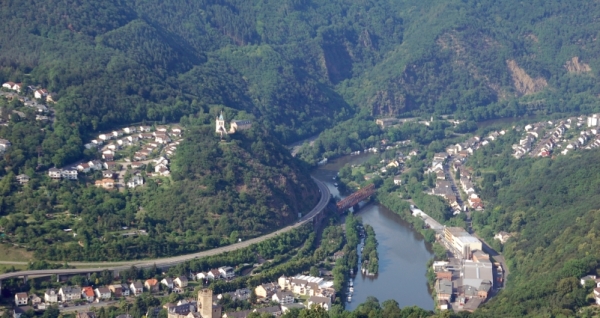
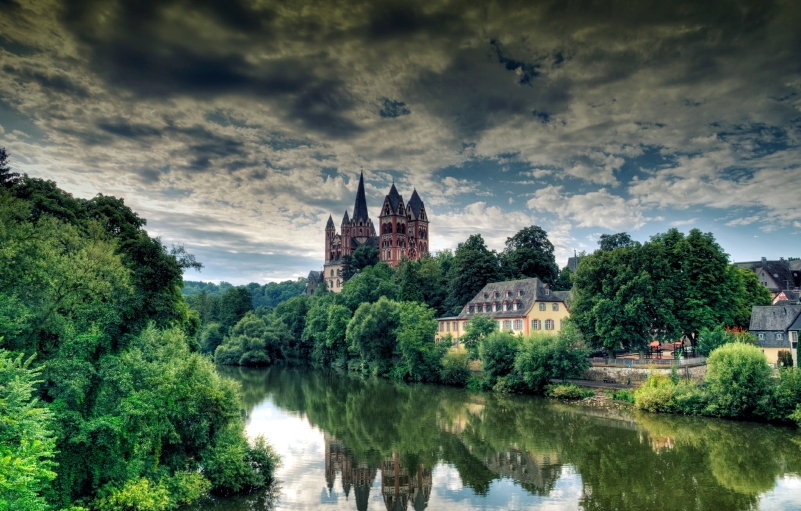
Limburg in the Lahn Valley - Photo Credit: Allemagne Romantique

Limburg in the Lahn Valley – Photo Credit: Allemagne Romantique

After the night-long train ride I was physically exhausted, but somehow refreshed in mind and spirit. In the next couple of days I felt like I was riding high above cloud nine.On my walks to the nearby derelict mill the dreary landscape shrouded in dense fog did not conjure up depressive thoughts. On the contrary, I let the new-found tender feelings guide me. I was whistling and singing bold scout and army songs and offered Mother a cheerful good morning, when I arrived at our home’s doorstep. A few days later I received Biene’s letter.

November 16th, 1964

         ” My dear Peter,

I would so much like to ask you: Come back right away and stay with me and no longer depart from me. Alas, I know that it is not possible and that you would come immediately if you could. I felt so miserable, when I walked off the platform. What would I have given to step on the train with you to travel anyplace with you no matter where. I feel so unspeakably lonesome, and the question gives me pain: For what do I live and for whom?  I am so distressed and it hurts me so much in the terrible knowledge that you can only come to go away again and soon forever. Dear Peter, please forgive me. I don’t want to reproach you for anything. With your visit you brought me much joy and you undertook the long, strenuous journey, and yet I am sad and my longing for you is even greater. I would like to love you so much and be with you and make you happy. When I have calmed down a little bit, I will write you again.

          Your Biene”

Meandering Lahn River - Photo Credit: allemagne romantique

Meandering Lahn River – Photo Credit: allemagne romantique

No rhyme nor reason will ever explain why during my reading of her lines a dark cloud would cast a shadow over my entire being. Instead of rejoicing over her letter, I was deeply disturbed, not so much by her pain, suffering and longing for my presence, but rather by my own stubborn refusal to wholeheartedly accept her declaration of love. I was stewing over Biene’s sudden turnaround regarding the wall, which she had erected for whatever reason and which I had so foolishly and cowardly accepted. After I had brought the emotional stew, a mixture of confused anger and painful stubbornness, to the boiling point, I rashly wrote her a response. I told her that I had gotten used to the wall as a sort of protection against another blow of fate. Distrust had entered my heart and I was unwilling to start all over again. I had barely thrown my letter into the mailbox, when I felt sorry. I had a broken a promise I once made to myself, never to reply in haste and thoughtlessness. I was expecting the worst. Within 48 hours her reply arrived in the mail.

Dear Peter,

Something in your letter has frightened me. For I have again recognized how much I had hurt you at the time when it appeared to you as if I wanted to erect a wall between us in order to protect myself against your affection. Oh Peter, believe me that I had never wanted this, instead I had always longed for your affection. Perhaps you had also felt it. For why did you write in spite of everything and were so kind to me? But you are distrustful, because you could never really understand me. Maybe you don’t know or just cannot believe how I cling to you and how much I love you. For the longest time I myself did not think it possible that it is so, and therefore I wanted to warn you in order not to disappoint you; for I really did not know whether I really loved you as much as it seemed. Dear Peter, this is one reason; alas there were also many other reasons, which I cannot so quickly explain to you. Only after you had come to me did I dare to admit how much you mean to me; and now, Peter, I know it for sure. And now it is certainly too late; for you yourself say that you have resigned yourself to the limits of our friendship and no longer have the same longing as before. It oppresses me very much that it no longer means as much to you that I love you, as it would have meant to you before.

And now, when I want to dream something beautiful about us, this thought destroys it: It will not be! How much I wished now you would still dream about us studying together and be together every day. See, dear Peter, such thoughts are entering my mind and many more…

How I’d wish that I could bewitch you and give you a love potion just like it happens in fairy tales so that I won’t lose you…

Your Biene”
 

Castle Lahneck in the Lahn Valley - Photo Credit: wikipedia.org

Castle Lahneck in the Lahn Valley – Photo Credit: wikipedia.org

Not waiting for a response from me, she quickly sent another letter making a last ditch effort to save what appeared to have already been lost.

My dear Peter,

Guess Peter, what I did last night. I took all your letters out of the portfolio and read them all once more. Alternately I became quite sad and quite happy. How strangely things have come to pass with us, if I think only about the past year!  In my subconscious I must have always loved you. When I look back, I recognize it, this feeling had to struggle first through much darkness and confusion to the light. And now Peter, it is the most beautiful feeling that I have ever experienced. I believe that if I could really be every minute with you, I would fall apart experiencing so much happiness.

          To you dear Peter, I send a secret Christmas kiss, which you would get under the Christmas tree.

          Your Biene”

After reading Biene’s Christmas letter, the realization hit me with stunning clarity that if I could not see a wall, could not feel a wall, then in all likelihood there wasn’t a wall. Indeed, at the trumpet call of love from deep within her heart the wall had come tumbling down. The dam had been broken, and I found myself swept up by the torrent, against which no further resistance was possible and would have been sheer foolishness. Willingly I went with the flow and felt the tug carrying me unerringly into the direction of my dreams.

STEEP AND CROOKED … by Late Writer, Artist & Castle Builder Bill Laux – Chapter 1

For information on the author search for Bill Laux on this blog or click here.

STEEP AND CROOKED: THE MINING RAILROADS OF THE CANADIAN BORDER

 By Bill Laux

CHAPTER ONE

THE PROSPECTORS

1887 – 1890


            From the days of the Hudson’s Bay Company fur traders, the established routes into the Kootenay country in British Columbia had been up the river valleys from the Washington Territory. Six north – south mountain ranges made entry from east or west extremely difficult and impossible in winter. The first prospectors came north from Walla Walla and Colville.   They followed the Indian and Hudson’s Bay Company trails on foot or ascended the rivers in boats.   There was a good Hudson’s Bay Company trail running up the Okanagan Valley from Fort Okanagan to Kamloops.   Prospectors could leave this trail at Osoyoos and bear east to get into the Rock Creek placer grounds.   There also existed an Indian trail running north from Spokane Falls to present Sandpoint and Bonner’s Ferry to the Moyie River.   This river would be followed on the Indian trail to reach the placer grounds at Wild Horse Creek in the shadow of the Rockies.   The Columbia River was the third and easiest route.   From 1865 until 1874 when it was laid up, the small sternwheel steamer, Forty Nine, based at Little Dalles, could be hired to carry parties of miners up the Columbia into Canada.

            The Victoria, B.C. merchants, frustrated at seeing the Kootenay trade all going to the Americans, lobbied their legislature for a trail to connect the Kootenay mines with the Coast.   $80,000 was appropriated in 1865, and Edgar Dewdney was given the contract to build the trail, four feet wide and 400 miles long, from Hope, on the Fraser River, to Wild Horse Creek on the Upper Kootenay.   Much is made of the construction of this trail in B. C. histories as the first communication between the Coast and the Kootenays.   However, the stretch between Hope on the Fraser and Fort Shepherd on the Columbia was a mere brushing out and improvement with rock walls and bridges of the old HBC fur brigade trail, over which the HBC sent out their furs (and the first placer gold in 1854) to New Westminster.   The sole section of the trail which was new, and not an existing trail improvement, was the 50 mile portion between the Columbia at Ft. Shepherd and the Kootenay near Ockonook.   From that point the trail followed the old Wild Horse Trail of 1863.

            The Dewdney Trail was a laborious scramble over five mountain ranges, and through the notorious bogs and across the six swift running rivers between them.   In an effort to compel prospectors and miners to use this trail and keep their trade for British Columbia, the government raised customs duties at the border and tried (with little success) to enforce an export tax on gold.[i]

            In 1887, a pair of prospectors, George Leyson and George Bowerman, traveling the Dewdney Trail, found silver bearing quartz at the divide between Little Sheep Creek and Trail Creek, just two miles north of the border.   They staked the Lily May claim and took out some tons of ore.   Lacking any means of getting it to the Columbia, they left it there on the dump until such time as the Dewdney Trail should be improved to a wagon road.

            The Lily May claim lapsed, but it was re-staked by Newlin Hoover and Oliver Bordeaux of Colville in 1889.   D.C. Corbin was building his Spokane Falls and Northern Railway through Colville to the Columbia that year, and with the arrival of rail transportation, lapsed mining claims like the Lily May were now of interest.   Oliver Bordeaux recruited Joe Moris, another French-Canadian prospector wintering in Colville, to go with him in March of 1890 to do the assessment work on the Lily May.   When the work was done, Moris joined with Joe Bourgeois, who had come up Trail Creek to examine the strange, red rock mountain some five miles north of the Lily May.[ii]   On that mountain the two men discovered a continuous ledge of strongly mineralized ground and located five claims along it.

            In Nelson the assays of their samples proved so disappointing that they were unwilling to pay the $12.50 fee per claim to record their finds.   Instead, they traded their fifth claim, the Le Roi, to Colonel Topping, the Deputy Mining recorder in exchange for his paying the recording fees on the four claims they kept.[iii]   Nelson was an American town at this time, and Colonel Topping, an American writer and prospector, was its unofficial postmaster, selling only American stamps.   So isolated was the Kootenay from the rest of British Columbia that there was no Canadian mail service.   Nelson mail went out by boat to Bonner’s Ferry, to the Northern Pacific at Kootenai Station, and on its trains to American and Canadian addresses.

            Moris and Bourgeois returned to Red Mountain, followed by Colonel Topping and others, to dig on these new finds.   As they went deeper into the veins the assays of the ore improved spectacularly.   The news got out at once.   A rush began, largely of Americans from Colville and Spokane Falls.   Colonel Topping preempted a townsite at the mouth of Trail Creek, sure that a city would arise there if the mines proved out.   The twice weekly sternwheel steamer service between Dan Corbin’s SF&N railroad at Little Dalles and the Canadian Pacific at Revelstoke was bringing miners, prospectors and merchants with every trip, from all over the Northwest, and Topping’s tiny Trail Creek Landing began to grow.

            The ore Bourgeois, Moris, Colonel Topping, and others were hauling to the surface on Red Mountain was copper, with gold and silver.   Although their best ore contained $300 to $400 in gold for every ton, it could not be milled on the site.   Copper ores had to be shipped to a smelter to extract the metals, and the nearest copper smelters were in Montana, 700 miles away.   From the mines themselves, 2300 feet above the Columbia, there was only that four foot wide Dewdney Trail winding down Trail Creek Gulch to the river.   Sacking the ore and sending it down on horseback was prohibitively expensive.   Winter rawhiding was the preferred means of transport.   A horse could carry but 400 pounds on its back, but if the sacked ore were wrapped in a green cowhide, hair side out, a horse could easily pull 1500 pounds down a snow covered trail.   The best ore was rawhided down the mountain that first winter of 1890-91, and stockpiled on the riverbank to await the opening of navigation in the spring.   The Upper Columbia was closed by ice every winter; steamer schedules could be maintained only from Mid-May to December.

            Upriver from the Trail townsite, the Canadian Pacific was building Captain Ainsworth’s isolated portage railway around the falls and rapids of the Kootenay River so that Columbia River steamers could connect with Kootenay Lake steamers.   The Columbia and Kootenay Railway was put into service in 1891, and ores from the Kootenay lake mines, the Silver King mine above Nelson, and the gold mines of Forty Nine Creek could now be put aboard the steamer, Lytton, at Sproat’s Landing.   The Lytton took them down river to the US. and D. C. Corbin’s rails at Little Dalles.   The SF&N and Northern Pacific forwarded them to the smelters in Idaho and Montana.

It was as Captain Ainsworth had foreseen ten years before: the compelling topography of interior British Columbia made the Kootenays a logical extension of American commerce with Spokane as its supply and financial center.

            In his Trail townsite, Colonel Topping needed money to clear streets of tree stumps, to install a water system, and to put some sort of bridge or causeway across the delta of Trail Creek which flooded his proposed business district every spring.   For funds he would have to put up a part of his Le Roi mine.   In the fall of 1890, he took some samples of his best ore, and booked passage down river to Little Dalles where he boarded the train for Spokane.   On board he met two Spokane lawyers, George Forster, and Colonel William. H. Ridpath.   He showed them his samples and described his mine.  The men were impressed.   In Spokane they introduced him to some investors, including Judge George Turner, Colonel W. W. Turner and Colonel Isaac N. Peyton.

            These men were all investors in mining properties in Eastern Washington and northern Idaho.   Peyton, Ridpath, George Forester and Judge George Turner were at that time partners in the Dead Medicine silver mine north of Colville.   The Dead Medicine had ceased paying dividends after the silver price crash of 1893 and the impoverished syndicate was looking for a paying gold proposition.   Judge George Turner was a well known personality in Stevens County.   He had come west from Missouri in 1884 and the next year was appointed Teritorial Judge by President Grant the next year.   He held court in Colville until 1888 and later became a U.S. Senator.

            Topping, a colonel among colonels, was in his element.   He was able to convince the group to take a bond on 16 thirtieths of the Le Roi.   This obliged them to spend at least $3,000 sinking a shaft, and gave them the option to buy the 16 thirtieths by June 1, for $16,000.   Promising to furnish the money were Colonels Ridpath, Turner, Peyton, and Major Armstrong, plus the civilians, Judge George Turner, Alexander Tarbett, and Frank Graves.   With them was the respected and experienced mining man, Oliver Durant, who would manage the mine.   As all of the investors owed considerable back rent and board to their host, hotel owner, Bill Harris, they took him in as a full partner as a settlement of their debts.   Oliver Durant later confirmed that the $3,000 to sink the shaft had come from him.[iv]

            Durant put his foreman, Ed Kellie, and four men to work on the Le Roi that winter.   By spring they had the shaft down 35 feet and had ten tons of good ore on the dump awaiting the resumption of the Lytton’s runs down the Columbia.   When the ice went out and the river rose, the Lytton carried the ore to the SF&N and it was shipped to the smelter in Butte, Montana.   The smelter returns were $70 in gold (at $18 per ounce) per ton, and 5 percent copper.   Delighted with these results, the Colonels took up the bond and paid Colonel Topping his $16,000.   For another $16,000 they bought his remaining 14 thirtieths, and became the sole owners of the Le Roi.[v]

            Colonel Topping now laid out and cleared the streets of his townsite, put in a water system,and began a brisk sale of lots.   His town began to fill with people drawn by the success of the mines on Red Mountain.   Up on that mountain, Ross Thompson had some of the steep ground surveyed and platted another townsite he called Rossland.   It too, attracted buyers, as good ore was struck in the Centre Star, the War Eagle and other mines.   Still, isolation was hampering the development of the full potential of the Red Mountain mines.   Only the highest grade ore would bear the cost of rawhiding down to the Columbia over the snow covered trails, and the costly manhandling of the sacked ore onto the steamer, and then onto the freight cars at Little Dalles.   Most of the ore being hoisted from the mines was not rich enough to support the cost of this pioneer transportation.   It was stockpiled at the mines, huge dumps of it, worth $20 to $30 a ton at a smelter, but 2300 feet up on a remote mountainside, worthless.   Trail and Rossland desperately needed a railroad for cheap, year round transportation.   If one were not forthcoming, the spectacularly rich fraction of Red Mountain ore would be quickly exhausted, and the camp, like so many others in the West, would shrivel and die.


Chapter 24 of the Peter and Gertrud Klopp Story – Part III

Rendezvous at the Wuppertal Opera House

On the Sunday morning of November 15th, I boarded the train at Giessen and was on my way to Wuppertal, where I was to meet Biene at the train station.

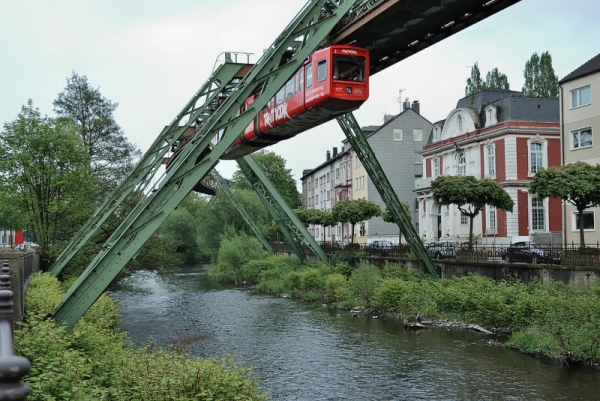
Floating Tram in Wuppertal - Photo Credit: wikipedia.org

Floating Tram in Wuppertal – Photo Credit: wikipedia.org

During the three-hour train ride I had ample time to reflect on the strange nature of my relationship with Biene. In the angry exchange of words with my friend Hans I had allowed the word ‘marriage’ to slip out of my mouth, which must have seemed totally ridiculous to him and seemed to me now as well. Hadn’t she set new boundaries for the two of us? Hadn’t I acknowledged them in my letters and promised to respect them? And what was the purpose of friendship in the light of my planned emigration to Canada? Hadn’t I lost within less than a year friends and classmates, who were living closer than a half-day’s train ride from me? Would any of my friends sit for hours in a train just to attend an opera in a distant city on a Sunday evening and then in a grand loop, including annoying late night transfers, return home at eight o’clock in the morning? Why was I doing this? It seemed to me that in spite of my promises to the contrary I still wanted to climb over the wall that Biene had erected between the two of us.

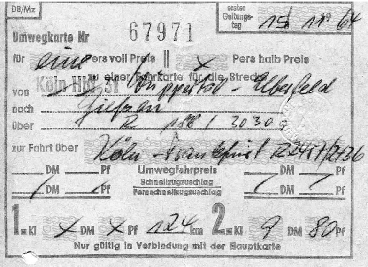
Return Ticket of November 15, 1964

Return Ticket of November 15, 1964

As the express train was approaching my destination, I put myself in Biene’s shoes and began to ponder what had made her so eager to meet me. Why would she go through the trouble of traveling to Wuppertal to buy tickets and then exchange them a few days later, because I had postponed the date of my arrival? Would anyone do this for a mere friend? In spite of my disagreements with Dieter, Gauke and Hans, they had been right in one thing. An actual face-to-face encounter is worth more than a hundred beautifully written love letters. I remembered how annoyed I was in my grief, when Private Gauke romanticized about that happy moment when he saw his sweetheart waiting for him at the end of the platform with her hair undulating in the evening breeze. After our transfer back to Koblenz we had lost sight of each other. I felt thankful now for the care and compassion of a true friend and for the romantic image that was almost identical to the one that I envisioned now. It had vividly come back through Biene’s instructions in her postcard, “I will be standing under the railway clock near the exit behind the ticket gate.”

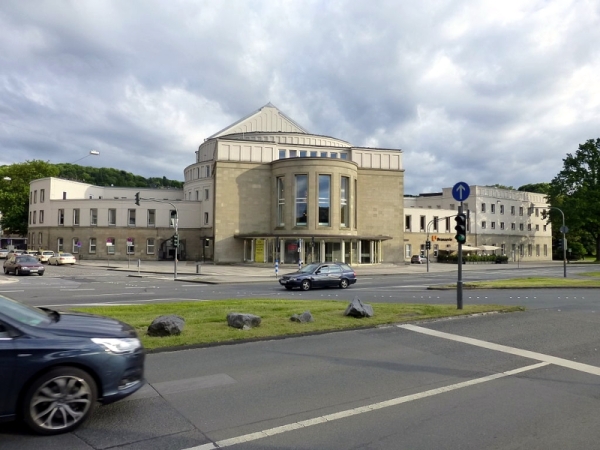
Opera House Wuppertal - Photo Credit: wikipedia.org

Opera House Wuppertal – Photo Credit: wikipedia.org

Then we met. During the afternoon we immersed ourselves into the mellow sensation of togetherness that resisted any attempt to spoil it with talk about how we felt about each other and what destiny held in store for us. In my memory the exuberant feeling, which I experienced while being together with her so powerfully dominated my heart that all else was drawn into a blissful blur. Later on I could not tell where and how we had spent the twilight hours before we entered the opera house to take in the sights and sounds of Mozart’s ‘Don Giovanni’. For me, who had never gone out on a date before, the experience was almost overwhelming. We were thankful for the silence imposed upon the audience by the theater’s etiquette. Any casual conversation would have ruined our sense of happiness. Instead we communicated the feeling of physical closeness to each other by the gentle squeezing of our hands. Too soon the three-hour long opera came to an end. I had to catch the last train to take me home in a veritable odyssey. By German traveling standards the round trip of more than ten hours with its many stopovers and waiting times had been an ordeal. Although I arrived at Mother’s place tired and exhausted, I felt happy. I sensed that our late night rendezvous at the opera had sprung a hairline crack in the invisible wall that Biene had erected.

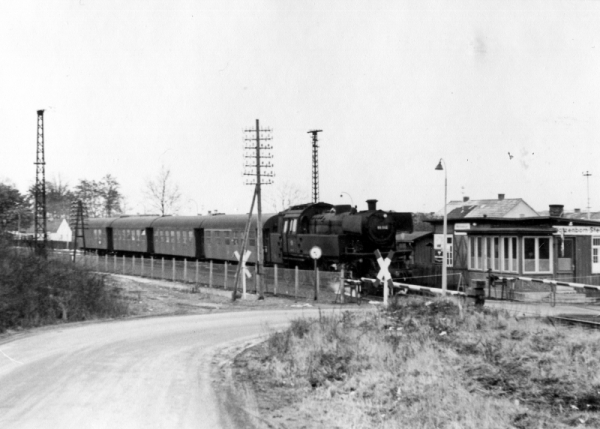
Train Arriving at Home Base: Watzenborn-Steinberg (Now Pohlheim) near Giessen

Train Arriving at my Home Town Watzenborn-Steinberg (Now Pohlheim) near Giessen (1964)

While the monotonous click clack of the train lulled me into sleep, I was blissfully unaware of the profound sadness and feelings of desperation, which had gripped Biene the very moment my train had vanished like a phantom into the darkness of the night.