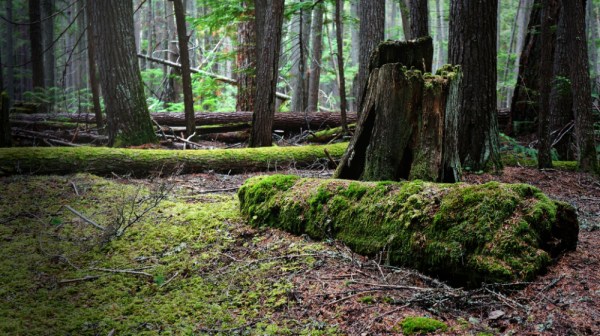
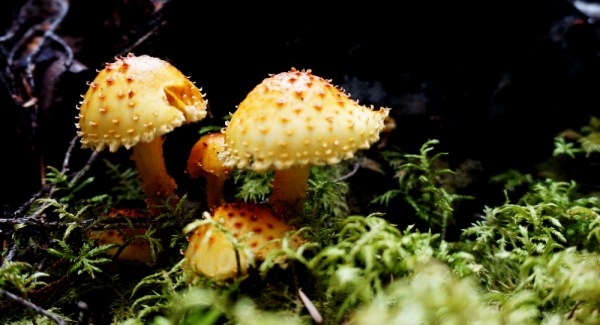
While my wife has been picking pine mushrooms in our nearby forests, I have been searching for objects that typically represent the autumn scene in our area. Old tree stumps and tree trunks have always fascinated me, as they so wondrously symbolize the end and the beginning of a new life cycle. Mushrooms are pushing through the forest floor to release their spores for the next growing season. Ferns are bending low under the weight of old age while retaining their graceful shapes of geometric patterns for us to admire. Of course, the brightly shining sunflower wheel must always be part of the visual presentation of the wonderful autumn season. Enjoy.
The German management of Gutfelde under my father’s administration abruptly ended on the 12th and 13th of January 1945 with the family’s flight from the advancing Red Army. A few hours before, the attack began, which turned out to be the most massive offensive ever-recorded in international military history. Under the command of Marshal Schukow and Konjew the Soviet army groups conquered Warthegau and advanced within days all the way to Sagan, Silesia. Panic and chaos spread among the defending forces and the civilian population. The flight with as little baggage as possible succeeded in the direction of Landsberg in spite of bitter cold temperatures and icy, snowed-over roads, which were hopelessly overcrowded with people, horses and wagons.
There was an agreement between the NS leader (Ortsgruppenleiter) in Seebrück (Rogowo) and the German farmers including all administrators of the region to join together in order to escape in one single trek. My father found out that the party leaders and NS officials had secretively taken off to safety on their own. He became quite enraged over this lack of leadership on the part of the very people who through courage and fearless guidance were supposed to set an example. While the lonely three trek wagons (Klopp, Kegler, and Dwinger) were slowly heading west, my father on a fast one-horse buggy was racing from farm to farm to warn stragglers of the impending danger and say good-bye to his Polish friends.
Photo Credit: Planet Wissen
The trek managed to get as far as Arnswalde (Choszczno), Pomerania, where the family found temporary shelter in the forestry Kühnemühle. As the place appeared safe at least for the time being, Father decided to stay there longer than warranted by the critical circumstances created by the Soviet armies advancing westwards at lightning speed. Precious time was being wasted with useless discussions and playing Doppelkopf. Perhaps a trace of unfounded hope that the enemy on the eastern front could still be thrown back through a heroic effort by the German troops lingered at the back of everybody’s mind and caused them to dawdle. Suddenly in early February Red Army soldiers arrived at the forestry and took Father as prisoner of war although he was no combatant and assigned him to hard labor in the Soviet Union. In a forced march he returned to Posen (Poznan), to the very region whence he had escaped. Then the Russians shipped him by train to the Donbas area, where somewhere between Charkow and Rostow on the River Don he had to work in the coal mines.
Recently I observed a woodpecker preoccupied with drilling holes into the old tree stump that has served as a stand for our wash basket. It did not notice me with my movie camera. So I managed to get as close as five metres away from this colourful bird. The result is this short video. Enjoy.
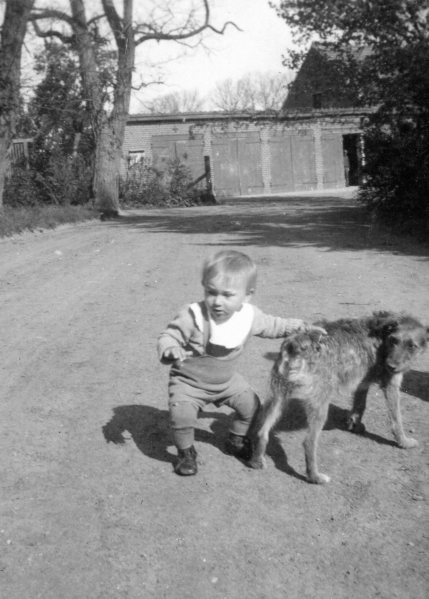
Spring came early in 1943. I spent a lot of time outside exploring the world around me. I learned to stand up on my own and ventured to make my first stumbling steps. Jupp, the friendly family dog, was my steady companion and my best friend for a while. Unlike my older siblings I refused to take the bottle and from my first birthday on I proudly drank my milk from the cup. When people were watching, I did my best to entertain them and show off my newly acquired skills. With the good weather also came a stream of visitors to enjoy the peaceful environment and the hospitality they found at Gutfelde. These visits spread over a couple of months were quite enjoyable for hosts and guests alike, even though some stayed for as long as three weeks or even longer. On top of it all, Karl and Adolf came home for the Easter holidays. Karl had acquired a certain degree of stardom with his excellent performance at the Belgard High School and his rapid development of his piano playing skills. As always, when he was home, he was asked to demonstrate his progress at the family piano. This went over very well, especially as his music teacher was also present and accompanied him on Father’s violin.
Peter and his Friend Jupp
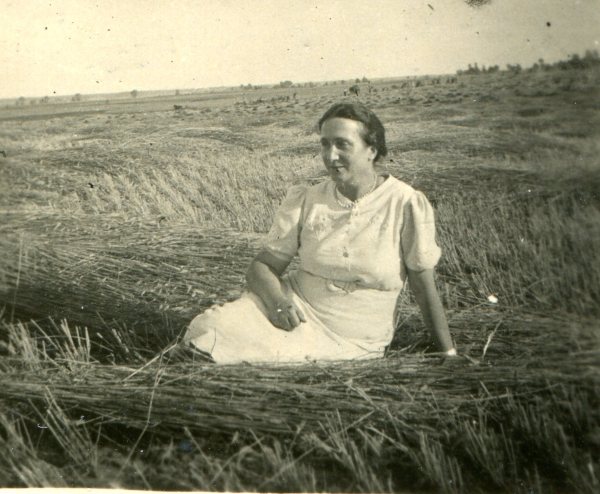
Mother was honoured for the second time on Mother’s Day in Seebrück (Rogowo), a near-by town southwest of Gutfelde. With her five children, four of whom were male, she ranked very high among all the mothers in the region. Mother’s Day was a state supported festival, upon which a lot of emphasis was given to the meaning of motherhood mostly for ideological and mythical reasons based on ancient Teutonic folklore. Women in general were considered not weak, but very precious who had to be protected at all cost from any involvement in war activities. Germany was the only nation that did not employ women in the war effort in any shape or form. Young girls in colourful dresses presented flowers to the mothers. This year it was Father’s turn to make a speech to the assembly. What he was saying about motherhood and family came straight from the heart and with his genuine admiration for all mothers and especially for his beloved wife left a lasting impression on all those who were present.
Peter’s Mother in a Rye Field 1943
Mother’s diary of the first 15 months of my life came to a sudden end, because she had simply reached the last page and did not want to start another booklet. If one considers that this diary with the many tiny photographs pasted into it and written in beautiful Sütterlin handwriting was from among all the other precious goods the only object that she managed to bring safely to West Germany, one must concede that we are dealing with a little miracle. The far greater miracle, the survival of the entire Klopp family in the closing days of World War II and afterwards, will be the subject of the next chapter.
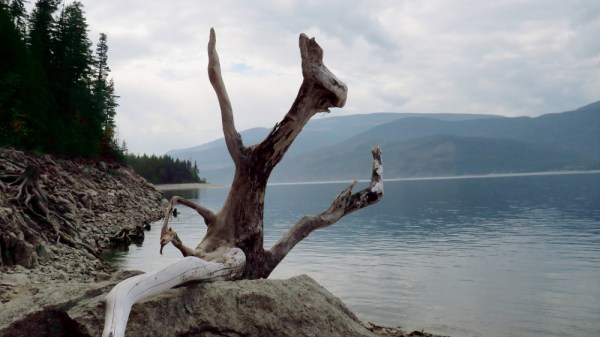
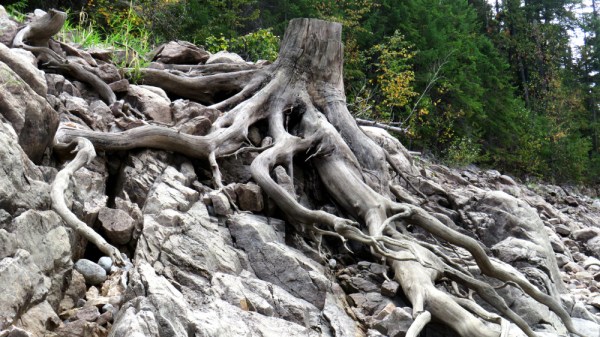
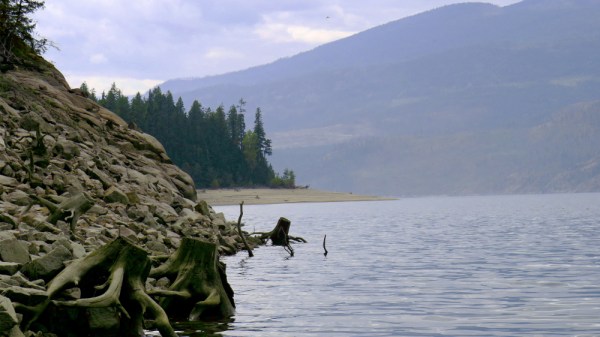
Last week I indulged in capturing a hover-fly feasting on the pollen of a daisy. On that same canoe trip, I could not resist taking photos of a driftwood sculpture and a beautifully shaped root formation laid bare by the constantly rising and falling lake level. Also the first rose hips have made their appearance, a sure sign that the fall season is upon us. Enjoy.
The sculpture would make a scary ghost on Halloween Night.
This was once a mighty tree before the flooding of the lake more than 50 yers ago.
Even on a dreary day the landscape exudes tranquillity and peacefulness.
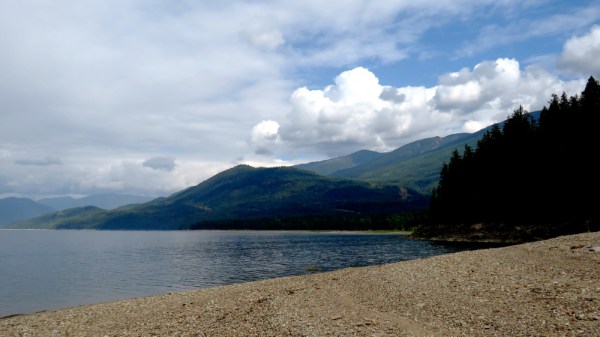
Nothing here to disturb the peace.
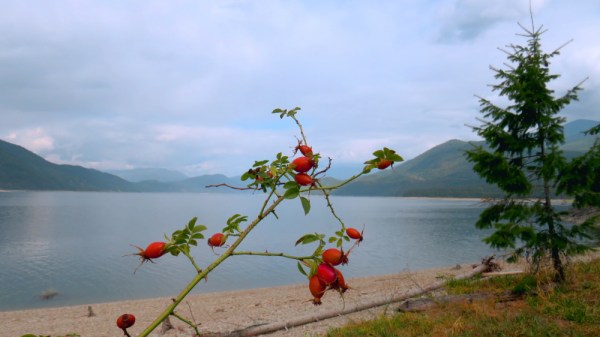
The rose hips of the Alberta wild rose have made their first appearance.
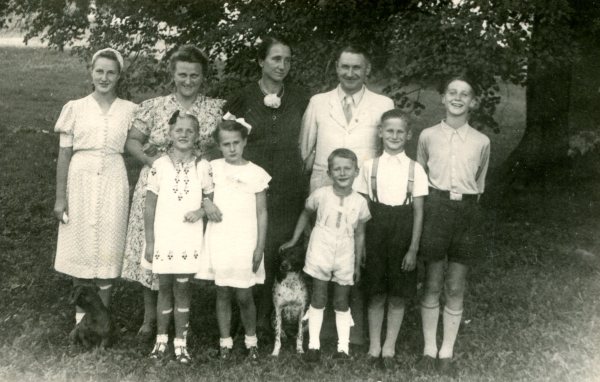
Family Photo Gutfelde 1941 – The six people on the right: My brothers and sister in the front, Ernst and Erika Klopp, my parents in the back
At the time of my birth, Father as manager and inspector was in charge of the estates Silberberg, Oberhof and Gutfelde totalling an area of approximately 3000 ha. Although he must have been thankful to the authorities for landing him such challenging and prestigious position and therefore may have harboured a favourable disposition towards the Nazi regime, he always strove to keep his humanity in dealing with his fellow human beings, Germans and Poles alike. In particular, through his actions he distanced himself from the policy that forbade German citizens to fraternize with the defeated enemy. It is a great testimony to his moral independence from the dark and sinister sides of Nazi Germany that he allowed Polish men and women to live and work closely and cordially with the Klopp family at the Gutfelde residence and the agricultural headquarter for the region.
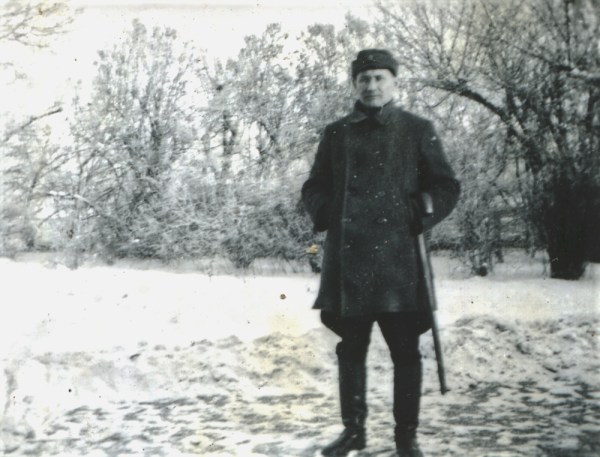
My Father Ernst Klopp 1941
From the stories I picked up from my mother I speculate that Father owed his survival to his reputation of treating fairly and equitably all the people who worked for the large estate under his directorship. Other administrators notorious for their arrogance, cruelty and injustice in dealing with the Polish population were rounded up, lynched, hanged or shot in the closing months of the war. On a Polish website with a special focus on mansions, manors, and castles of Poland, I found an entire page devoted to Gutfelde – now an agricultural training center with orchards, wheat and corn under cultivation, 800 cows and 8000 pigs. The same page to my great surprise also mentioned my father’s name as an administrator during WW2!
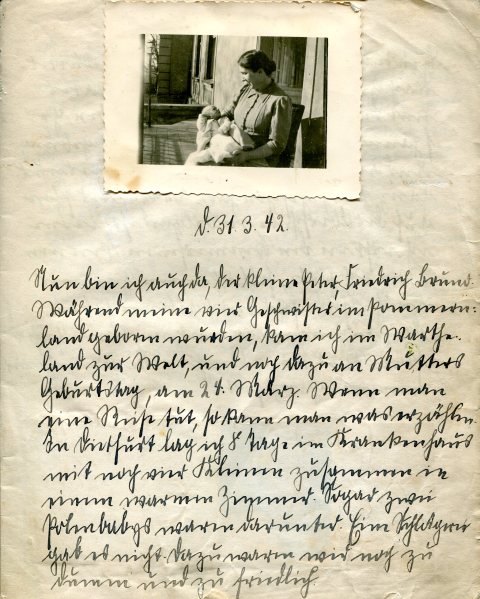
The following are excerpts from my mother’s diary which she wrote from baby Peter’s perspective.
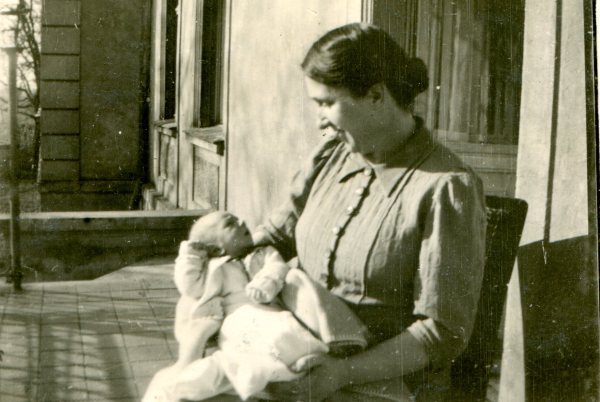
Mother and Baby Peter
When I arrived with Mother at Gutfelde, I received a truly royal reception. My brother Karl, who attends a boarding school in Belgard (Bialogard), would see me a few months later at the beginning of his summer holidays. But the others including my proud father did everything to welcome the fifth child in the family. Flags were waving. Fir branches and a big welcome sign decorated the door to my very own room. Inside the sunny and warm room several pots with beautiful flowers created a cheerful atmosphere for the latest arrival in Gutfelde.
First Page of my Mother’s Diary
Father must have kindled my passion for music and my desire for writing. For he often spent time at my crib telling me long stories, singing with his deep beautiful voice or whistled many a lovely tune. His birthday was coming up. The entire family had prepared a wonderful celebration. For the first time the five children were together. Early in the morning of June 28th, Karl, Adolf, Eka and Gerhard entered the parental bedroom and presented to Father a bouquet of flowers and started off the day with cheerful ‘Happy Birthday’ wishes. Later when good friends of the family, the Döpelheuer couple, had arrived, Karl sat at the piano and played a few pieces to show what he had learned. For accompaniment, Father and Auntie Döpelheuer played on their violins with great enthusiasm. The trio created a really festive atmosphere.




 The Peter and Gertrud Klopp Family