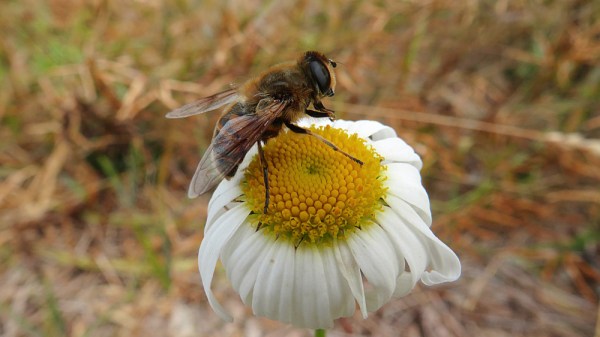
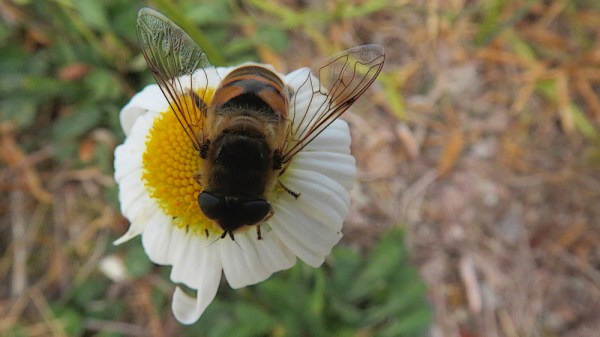
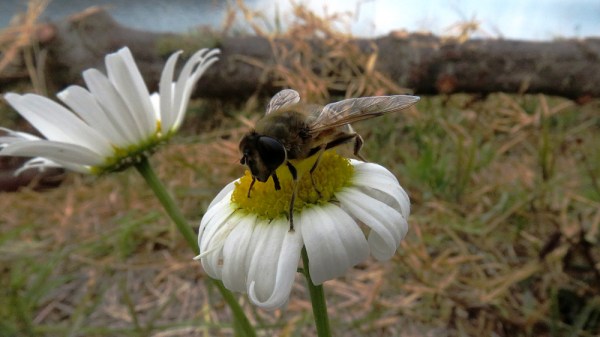
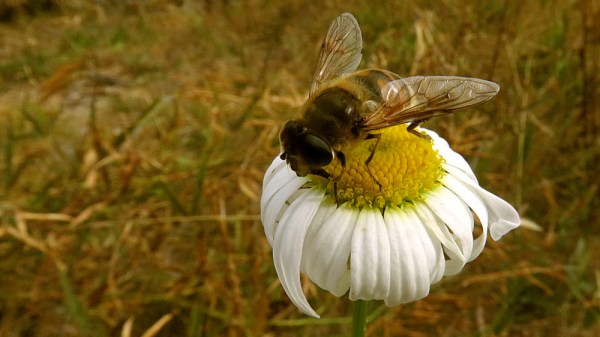
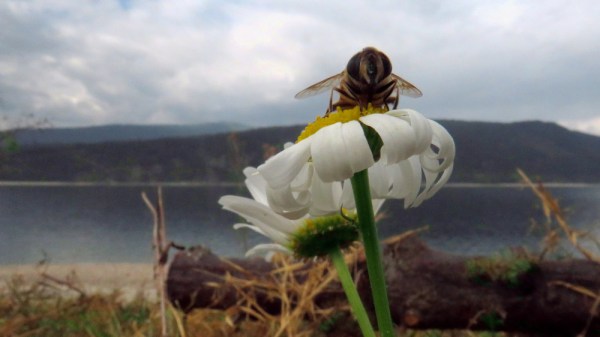
On a recent canoe ride, heading south from our favourite Taite Creek campground, we stopped at a deserted apple orchard a few kilometres from the Taite Creek bay. Biene spotted an abundance of apples in the abandoned orchard and being the inveterate gathering she started picking claiming they make excellent apple sauce. Myself being inspired by my blogging friend Steve Schwartzman was eagerly looking for some wildflower. But all I could find was a bedraggled daisy with its petals curved downward. Great was my joy when I discovered a hoverfly sitting down for a late pollen dinner. She was so preoccupied with feasting on the pollen that she paid no attention to my camera a mere five cm away from the flower. Here are five photos of the same insect and the same flower. Enjoy.
Thank you my little hoverfly for being so cooperative!
This is the third part of the guest post written by my cousin Hartmut Kegler, who also wrote the children’s seminary on Albert Schweitzer I published a few months ago in the original German. I waited until now because it throws some additional light on my father Ernst Klopp and on the happy years in Gutfelde (Zlotniki).
The Hunting Firearm
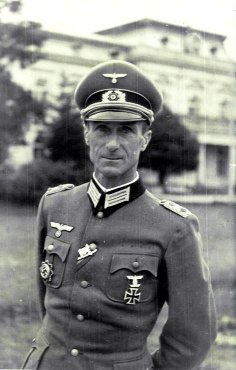
Finally, still vivid in my memory is another experience that was connected to a visit by my uncle Gerhard Kegler. [In January 1945, he was sentenced to death for disobeying Himmel’s insane order to defend the fortress and town of Landsberg, where thousands of innocent townspeople would have lost their lives. His story can be found here.] He was a colonel on the eastern front at that time and was on vacation in Gutfelde. One day, he asked me if I could shoot with a gun. Since I carried on my shirt the shooting badge of the German Youth Organization, I proudly answered yes. My problem, however, was that as a cub I had only been using a light pellet gun. But my uncle entrusted me with a heavy hunting firearm. At my uncle’s visit I was eleven or twelve years old but went full of pride out into the field. Then I spied a riot of crows which were sitting on a high poplar tree. I loaded the gun, raised it, aimed and pulled the trigger. The recoil of the firearm and the loud bang almost knocked me over. The crows flew away. I had not hit any. Since then I have never touched a gun, and never needed to nor was I forced to use one.
Generalleutnant Gerhard Kegler – Gutfelde 1944
The relationship of Uncle Ernst and Aunt Erika with the Polish personnel was, as I recall it, fair and respectful. I believe that they owe their successful escape from the Red Army to the proper treatment of the Polish personnel. The farm workers prevented through their cooperative actions that Uncle Ernst was captured by the Soviet soldiers. Through a series of adventurous moves he managed to safely make it to West Germany. [The actual tragic events that my cousin Hartmut Kegler did not know will be published on a later post.]
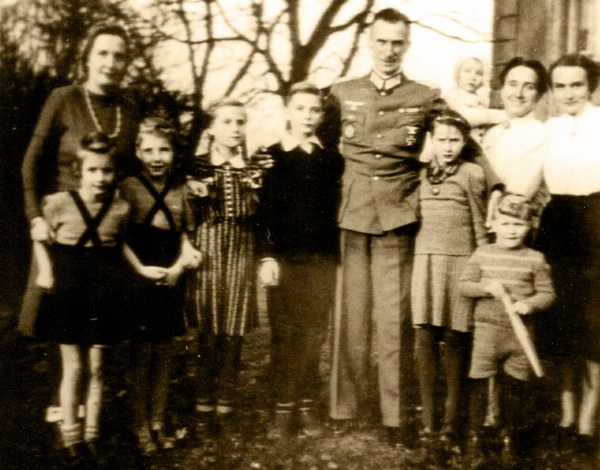
1943 Family Photo – My mother on the right with me on her arm
While at the fronts and the bombarded German cities, in concentration and POW camps innumerable people found a horrible death, we children enjoyed happy days during our vacation in Gutfelde. Much later I began to think about the darker sides of life. At any rate, I am thankful to Aunt Erika and Uncle Ernst for their hospitality and for giving us the freedom to romp around at our hearts’ content.
In the past few weeks, my wife and I crossed the Arrow Lake and the Needles Ferry Path a number of times. I proudly announced that we travelled up the Whatshan River to the waterfalls. When I recognized that I had made a mistake and heard that the waterfalls were far more inland, I invited my wife to go exploring. Attempting to climb the steep embankment almost turned into a disaster. Biene struggled very hard on all fours to inch her way up to the top from which I could only shout words of encouragement. When she finally stood on safe and stable ground, she was very happy that she did not give up. We were both rewarded with a splendid view and hike to the elusive waterfalls, which is the content of the video below. Enjoy!
This is the third part of the guest post written by my cousin Hartmut Kegler, who also wrote the children’s seminary on Albert Schweitzer I published a few months ago in the original German. I waited until now because it throws some additional light on my father Ernst Klopp and on the happy years in Gutfelde (Zlotniki).
The Games we played in Gutfelde
In the pond of the park, we enjoyed going for a swim but also played ‘war’ on it. We scrounged up wash-bins and tubs, we used as our battleships and loaded them up with chunks of sod that were our ammunition. On these ships, we rowed around the pond and fired at each other with the clumps of grass and dirt. The ‘ships’ that had been hit often tipped over so that we were forced to swim with them ashore. However, we did not succeed rescuing a particularly valuable zinc tub, which sank in the deep water. Together we tried to retrieve the tub by diving but could not find it. Aunt Erika to whom we had to report the loss naturally was very angry with us and we were much ashamed of our misdeed. The tub most likely still lies today at the bottom of the pond.
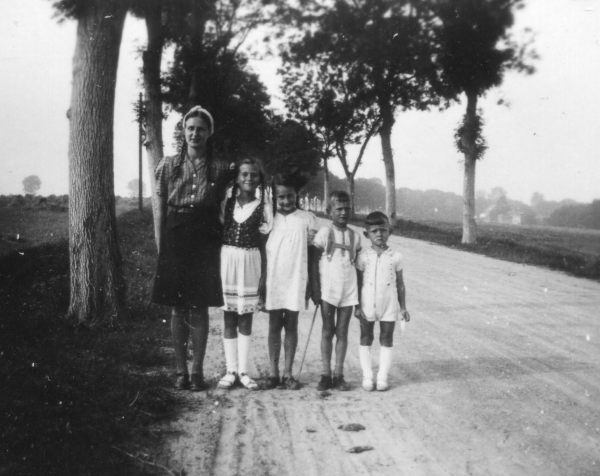
Happy Children at Gutfelde
We also played peaceful games. One of them was circus performances. In the park, there stood next to beautiful shrubbery a big old tree. There we presented our acrobatic showmanship. From the sturdy branch hung a swing, which we skillfully used for our performances. In addition, we did gymnastics exercises complete with headstands and rolls spiced up with oodles of clownery. Our mothers and other spectators generously provided applause and praise.
In Gutfelde, we had our own carousel. At the lower end of the estate building was a horse-operated gin. It consisted of a massive wood beam that was mounted on a large cogwheel, which in turn was connected to a shaft leading into the house. Its purpose was most likely to drive a generator inside the building. The beam was pulled by a horse, which trod around in a circle and was guided by the coachman. We children sat down on the beam and with great delight, we turned cozily round and round on this most unusual carousel.
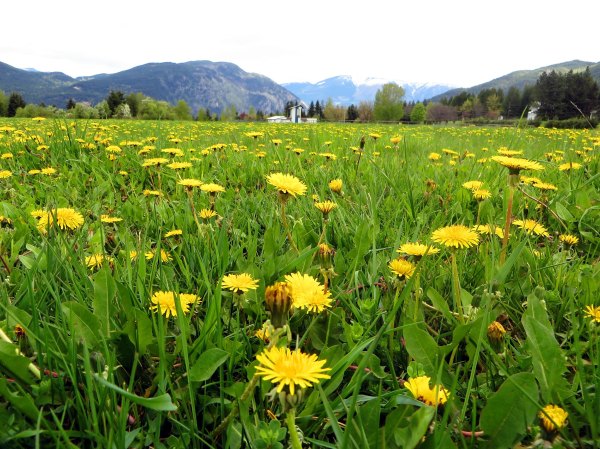
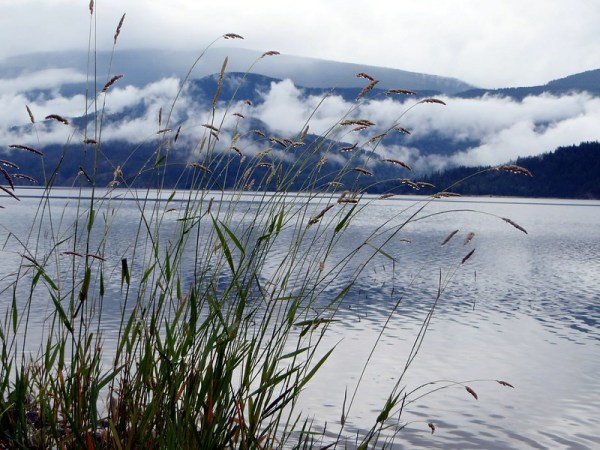
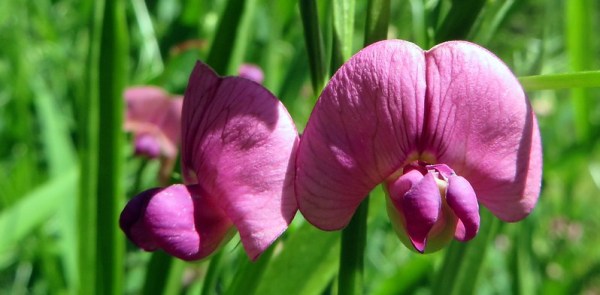
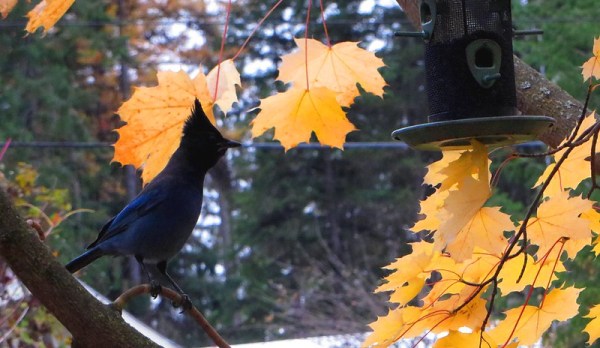
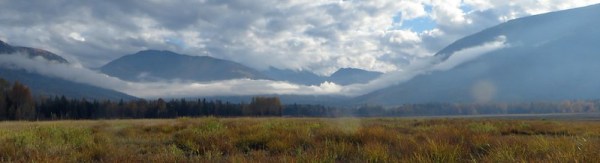
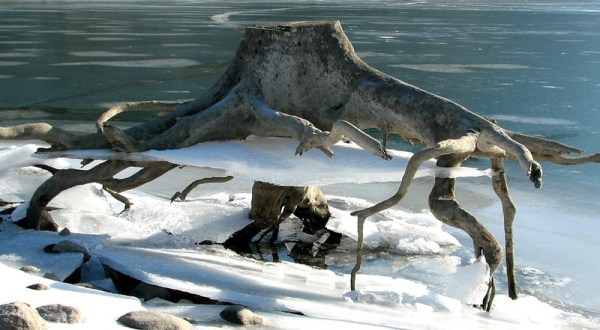
The days are getting shorter, the air is crisp in the early morning hours, bees and bumblebees slumber longer on our sunflowers, the redfish are spawning, the signs of autumn are written on Nature’s colourful pages. As we journey from one season into another, it is seems fitting to devote a blog post to the eternal cycle of our four seasons country. I selected a few images from my archive presenting Spring, Summer, Fall and Winter in that order. Enjoy.
This is the second part of the guest post written by my cousin Hartmut Kegler, who also wrote the children’s seminary on Albert Schweitzer I published a few months ago in the original German. I waited until now because it throws some additional light on my father Ernst Klopp and on the happy years in Gutfelde (Zlotniki).
Playing War Games
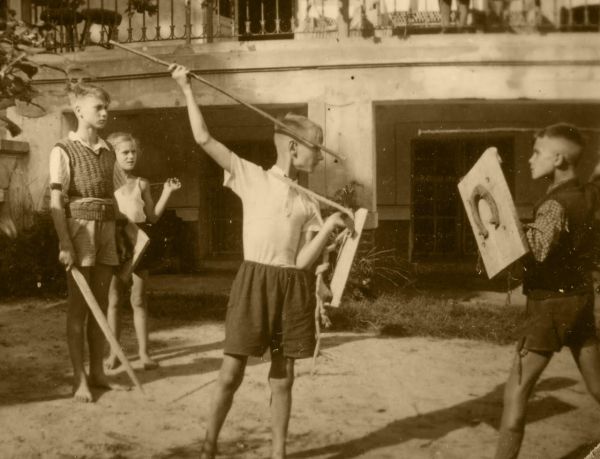
According to the prevailing circumstances our games often took a war-like character. I still have the following events vividly in my memory:
– Within the wide boundaries of the estate was a horse pasture. There, the yearlings were kept and could roam wild and free. We had fun chasing these horses around a bit so they would gallop over the entire pasture. It so happened that my four or five-year-old brother Jürgen had run away from us and somehow wound up among the galloping herd. We older children watched and gasped in horror. But Jürgen took the terrifying moment in stride without blinking an eye and miraculously stayed out of harm’s way. For his bravery, we awarded him the ‘Iron Cross first-class’.
– The big hay barn was the place where we played paratroopers. The barn had two floors allowing us to jump from the upper nearly 5 m high floor into the soft hay below. I do not know any more whether everyone had the courage to jump but some dared to take the plunge and even performed a midair somersault.
The ‘Warriors’ at Gutfelde
– The war games also had a sinister side which we children did not recognize as such. It showed how children at a very young age were already shaped by the dominating culture of the Nazi era. We launched a ‘campaign’ into the settlement of the Polish farm workers, which was adjacent to the park of the Gutfelde estate. There we captured Polish children about our own age and made them ‘prisoners’. We ‘deported’ them to the estate mansion and handed them over to Uncle Ernst. However, he read us the riot act and sternly informed us that one does not do such cruel things and sent the Polish boys and girls back to their village.







 The Peter and Gertrud Klopp Family