Walter Panknin (1898 – 1977) and His Family Ch 8 Part 1

The Eternal Recurrent of the Same

The Challenge of Raising Teenagers in the Early 1960’s

Peter writes from the present post onward.

The children now love luxury; they show disrespect for elders and love chatter in place of exercise. Children are tyrants, not servants of the households. They no longer rise when their elders enter the room. They contradict their parents, chatter before company, gobble up dainties at the table, cross their legs, and tyrannize over their teachers.’ This quote is attributed to Socrates. While it has not been authenticated, it reflects the idea, based on painful parental experiences, that, throughout the millennia, children have always been perceived as unruly, rude and disrespectful to their parents and those in authority.
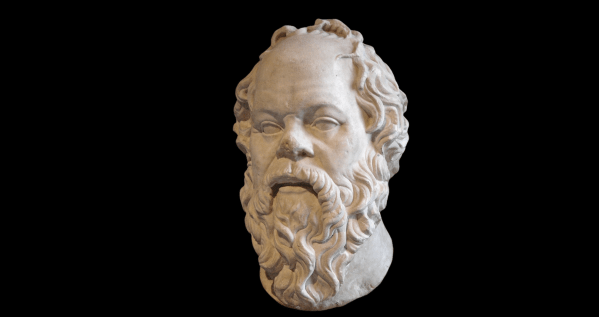


Portrait of Socrates. Marble, Roman artwork (1st century), perhaps a copy of a lost bronze statue.

Papa Panknin wrote many letters addressing and responding to friends and relatives. His literary ruminations could easily exceed the volume of a 500-page novel. The correspondence entailed a plethora of topics, such as politics, the rapidly changing customs and mores, the ills of post-war West Germany, and the challenges of bringing up their two teenage twins, Walter and Gertrud (Biene).

I will focus only on matters relating to the history of the Walter and Elisabeth family and their children. Furthermore, to make the final chapters more colourful and authentic, I will at times deviate from the strictly chronological path. I will make extensive use of Papa’s correspondence and will try my best to translate the German passages to give all of you a genuine understanding of my father-in-law, mother-in-law, Walter and Gertrud (Biene). Biene and I, as some of you may recall, met on the Pentecost weekend at Lake Baldenay and four years later, got married in Calgary on the Victoria weekend in 1966.
Walter Panknin (1898 – 1977) and His Family Ch7 Part 20

A Perilous Sailing Adventure

Sailing Adventure Part 2

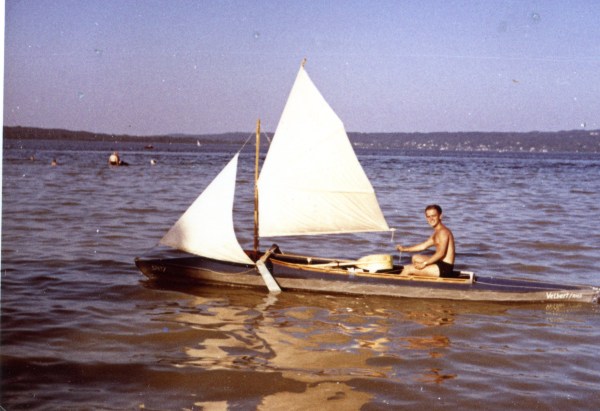
In no time we reached the middle of the lake.  “Strange”,  I suddenly thought,  “there are no other boats here. Why do they  keep on sailing parallel to shore?”  I tried to gently shift my weight to look back to our now distant beach. Suddenly there was a strong gust of wind billowing our sails.  My brother frantically tried to maneuver the sails.  “Sit on the edge of the boat, quick! ” he commanded sternly looking worried.  Although I had reservations, I did not dare to voice an objection. I quickly lifted myself up to sit on the narrow rim of the boat,  when the wind shifted again without warning. Then everything happened like in slow motion.

I see the look of horror on my brother’s face while I am gently tilted backwards into the water with the white fluttering sails tipping in my direction. I am sinking deep down into the cold water.  When I finally surface I see my brother beside the capsized boat looking shocked and angry.  My first reaction is a fit of hysterical laughter.  “What happened?” I stupidly ask while trying to catch my breath.  It all seems so unreal.  “Stop laughing!” my brother yells holding on to the overturned boat. When he tells me to cry for help I am racked by another fit of laughter.  “Why don’t you?” I manage to reply.  “We’ll swim to shore”,  I suggest.  I am a strong swimmer with lots of stamina. Almost beside himself, my brother shouts back, “Never!!! We must stay with the boat”  Slowly I am regaining my sanity.  I am looking around trying to assess the situation.  We are in the middle of the lake far from either shore.  The waves are high. The water is churned up and cold.  We don’t have life vests. No boats are in sight except the sailing boats looking like miniature toys in the distance.  Suddenly panic seizes me.

Our desperate attempts to right the boat fail.  The weight of the water-logged sails is beyond our strength.  One of our paddles floats away on the waves.  My brother does not allow me to retrieve it.  We continue to cling to the boat bobbing in the waves, occasionally crying out for help which we realize is useless.  Nobody can hear us. 

To be continued …

Walter Panknin (1898 – 1977) and His Family Ch6 Part 29

Foreshadowing the Turbulent Adolescence Years

Biene wrote this post.

Gisela’s grandparents always received us warmly when Gudrun and I came for a visit, and they treated us with delicious homemade refreshments. They took a genuine interest in our lives and liked to tell us stories of their exciting past,
Unlike Gisela, Gudrun was very outgoing and radiated warmth. She always had a sweet smile on her round face. Blond, blue-eyed and well-developed, she liked to take life easy and have fun. While I still wore hand-me-down clothes from my second cousins, Gudrun had the most beautiful skirts, blouses and dresses, which her mom sewed for her.
Like Gisela’s mom, her mother was a war widow and a seamstress. She also had a tailoring business at her home. Gudrun’s grandma lived with them. But her grandfather was dead. Gudrun’s Oma did the household chores while her mom sewed on a big long table in the corner of the spacious kitchen close to the window.
Gudrun’s well-dressed mom looked glamorous with her fashionably styled blonde hair, heavy makeup and bright red, enormously long fingernails. They were curved like claws. I secretly wondered how she could handle delicate materials with them. She would take frequent smoke breaks showing off her long fingers by gracefully holding the cigarette. She half closed her eyes leisurely and slowly exhaled the smoke through her rounded red lips. Smoking looked so pleasurable and alluring to us girls.
Periodically. a male friend of the family who was a truck driver for a brewery would visit Gudrun’s mom. At those times, much laughter and joking occurred, and thick clouds of smoke were coming from the sewing corner, distracting us from studying for school. I think her mom’s friend was a father substitute for Gudrun.
Gudrun had a record player, a luxury our family could not yet afford. She owned records of the top hits, most of them gifts from her mother’s friend. We would listen with excitement to the catching songs and rhythms of Little Richard, Elvis Presley. Connie Francis and Brenda Lee. We would even dance around as soon as Gudrun’s mom and Oma ran errands. When our top idol Elvis sang, “Love me Tender,” we were mesmerized and started dreaming of first love.

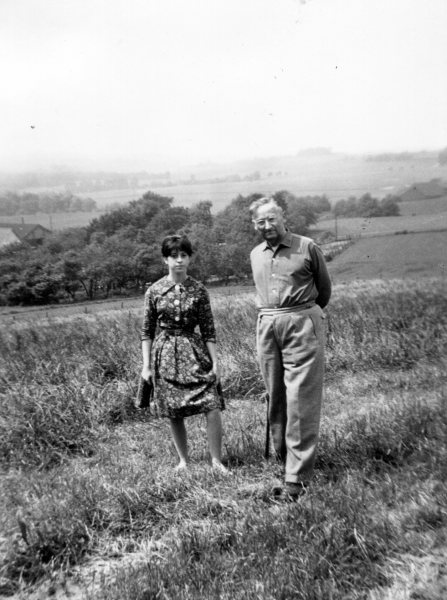
Biene Hiking with her Father Walter Panknin

With this final post of chapter 6, Biene concludes her contribution to the Walter Panknin story. I will carry on with this family history in Chapter 7.

Walter Panknin (1898 -1977) and His Family Ch6 Part 27

Papa’s Shocking Letter from Home

Biene wrote this post.

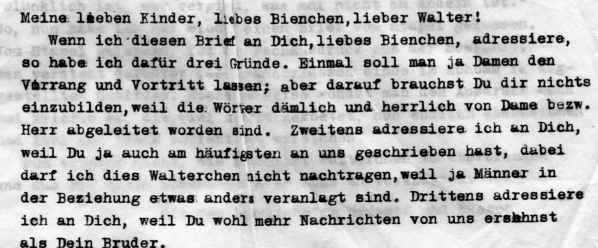
One day, we were all supposed to write a postcard home. I wrote a desperate plea to my parents to come and get me as soon as possible. A few days later, I received a letter from my father.  I eagerly opened this welcome message from home with joyful anticipation. But what my father wrote to me seemed to top off all the bullying I had endured. Instead of comforting words, my father wrote what he may have thought to be a witty  “dissertation.” He explained the linguistic origin of the German words ‘dämlich’ and ‘herrlich,’  roughly translated as ‘dumb’ and ‘masterful.’   Unfortunately, the allusions and fine points of his linguistic examinations are lost in translation.  There are no equivalents in the English language. He told me that the word “dumb” derives from the word “dame.”  On the other hand, “masterful” or “manly” originates from master or man,  and ‘Herrlich’  also has the connotation of wonderful or glorious.

Extract of Papa’s Letter in German (1956)

I could not finish reading my father’s letter because tears of shame and disappointment blinded my vision.  But miraculously, my pain was short-lived.  A supervisor approached me and told me I had a visitor waiting for me in the main office.  When we entered, there was my beloved mother!  It seemed like a miracle. She had made the long and costly trip by bus and train to see me against my father’s advice. I was overjoyed.  We spent the beautiful afternoon together walking in the forest and talking.  I unburdened my heart, and she listened with empathy.   When evening approached, she gave me the choice of going back home with her or staying for the remainder of the vacation.

One thing my father’s letter had accomplished. It stirred up my pride and courage. I was going to show him that I was not that ‘dumb’  weak ‘dame’  intimidated by the ‘wonderful masters.’ I would not give him the satisfaction of proving his point. I decided to stay.I enjoyed the remainder of my time at the youth camp. I learned to ignore verbal assaults and not take them personally. I avoided playing unsupervised games with rough boys and sought out the company of friendly girls.  I also noticed that the supervisors intervened more readily when they saw inappropriate behaviours. Maybe due to my mother’s visit, they were more vigilant.

Summer camp, in many respects, was a great learning experience for me and made me stronger. Thanks to my mother’s love, I felt happy and relieved that I did not quit or give in to fears and feelings of insecurity.  In retrospect, I also appreciate my father’s words.  Although it was not so obvious,  he acted out of concern for me.  He knew that by taunting me, I would rise to the challenge.   In his words, I learned to  ‘master’ my fears.

Walter Panknin (1898 – 1977) and His Family Ch6 Part 26

Summer Camp at Bergneustadt

Biene wrote this post.

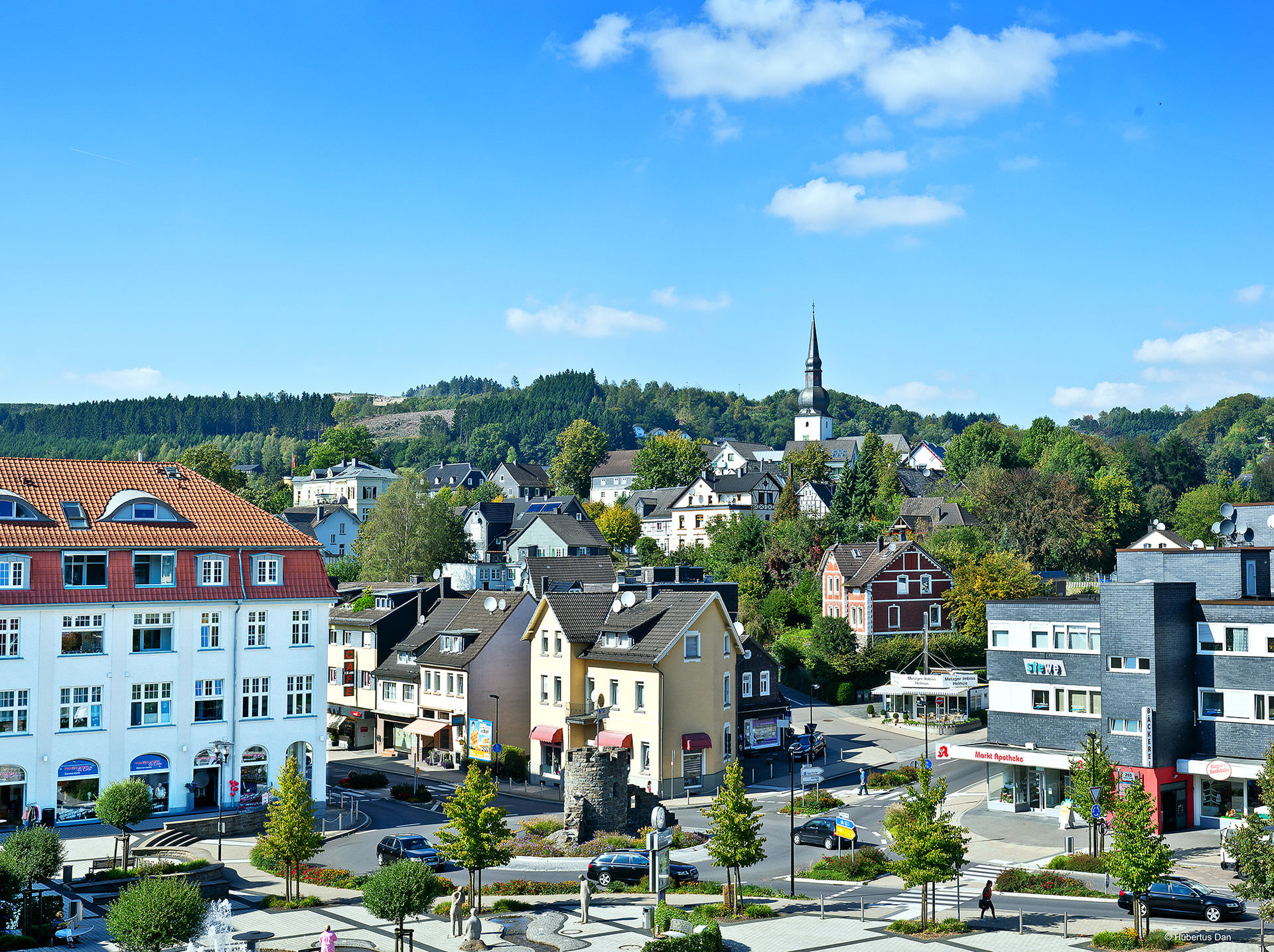
In August 1956, our parents sent us to a summer camp in Bergneustadt, a beautiful town in the forested hills close to Cologne. A charitable organization sponsored us for refugee children from the east. Like many of my classmates, the prospect of having a real vacation away from home seemed exciting at first. But then separation anxiety from my parents took hold of me. Eventually, my mother succeeded in persuading me to go. My brother didn’t appear to have mixed feelings and was eager to leave for new adventures.

Bergneustadt – Photo Credit: neustadt-in-europa.de


The big, bright youth hostel was nestled in the forest. There were many children our age, about 10 to 14 years old. We slept in large dormitories. It reminded me of the refugee camp in Aurich. I felt intimidated by the crowds of strange children, especially the boisterous teenage boys. There were a few bullies who made life miserable for some of us. They verbally abused us and were physically rough when we played unsupervised games. These boys mercilessly teased us and gloated when they saw that they had upset or hurt us. The group leaders were overwhelmed by the many kids in their care. They often overlooked or did not seem to notice these negative behaviours. Since I was timid, I did not dare to complain; I suffered silently.
We did some exciting excursions to the Aggertalsperre (dam at the river Agger) and the Atta limestone caves. We hiked in the beautiful natural surroundings. Nevertheless, I felt increasingly homesick. I couldn’t eat or sleep. I withdrew even from girls who were trying to be friends with me.

Walter Panknin (1898 -1977) and His Family Ch6 Part 25

Biene’s Friend Angelika is Very Sick

Biene wrote this post.

I have wonderful memories of the time I spent with Angelika at her loving home.  Her parents would do anything to make life after school pleasant for us.  They’d take us to fancy pastry shops, and we could choose the delicious cakes and sweets for our afternoon snacks. After we completed our assignments we would sit on Angelika’s bed,  our feet dangling onto Torro’s warm fur and we would talk and daydream and joke around, laugh and giggle. Her mom and dad seemed to like to hear us laugh and giggle.

One morning in school Angelika was missing.  Mecki told the class that she was very sick and would not be in school for a while,  I was shocked.  She seemed fine the day before. My mother looked very concerned when I came home and told me that I could not visit Angelika because she was too ill.

I was very worried and missed her terribly.  Finally one day my mother told me that Angelika’s parents wanted me to see her because she had asked for me. Angelika’s mom looked pale and thin.  She took me by the hand. “Please, don’t tell her how shocked you are when you see her”, she pleaded.  In spite of the forewarning, I was shocked.  Angelika was lying in her bed.  She had sores all over her skin and mouth, and she looked very pale.  But she managed a small smile in greeting.  Her eyes even sparkled a bit.  She told me that she had a severe blood disorder and needed a bone marrow transplant.  But now she was on the road to recovery.    She told me about all the strange things she had to eat to get better.  “Next time you come you have to try sprouted wheat”, she told me.  When I told her stories from school, she even managed to laugh a little.  “The sores in my mouth still hurt a bit”. she said, but she seemed proud that she had overcome her illness.  “I could have died, but I made it”.

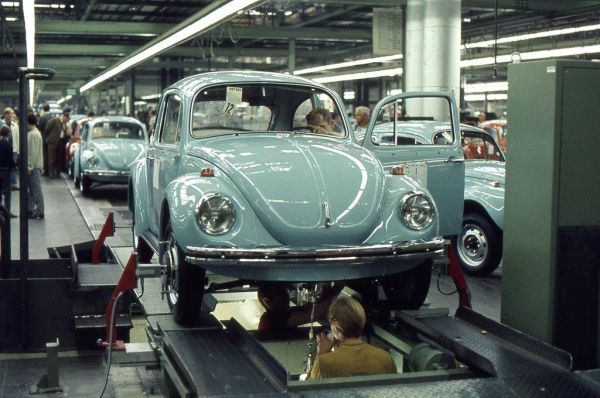
Angelika’s father worked here. Photo Credit: Pinterest

Every day I visited her after school, and I could see how she was getting stronger.  But she never came back to school.  Another shock was waiting for me. Angelika’s dad was being transferred to Wolfsburg where the famous Volkswagen was manufactured.  They would be moving soon.