THE MINING ERA OF THE CANADIAN COLUMBIA by Bill Laux – Chapter 4

CHAPTER FOUR

THE ORIGINS OF WESTERN MINING

Although a few of the Americans moving west in the 1840s had seen gold panning practiced along the the mountain streams of North Carolina and Georgia, it was the Mexicans who were the first miners in the west.    A great silver rush began in Mexico in 1543, and in the next ten years more silver was produced than had been seized in the Spanish Conquest.   Mexico had a school of mines from 1792, while up until 1849 the United States had not a single public assayer.

In the European monarchical tradition, gold and silver were “Royal Metals,” belonging to the Crown.   Miners might be licensed to extract them, but the Crown would then take from them  its “Royal Fifth.”   This seizure was bitterly resented, and miners sought to evade it in whatever way they could.   Within the settled parts of Mexico, a discovery of mineral had to be “denounced” to the local authorities, the equivalent of staking a claim.    And from that moment the miners were subject to close supervision to ensure that the “Quinto,” or “Royal Fifth” did not escape the Crown.    A wealthy or well connected mine owner might induce the authorities to look the other way by judicious bribery, but poor miners with no influence at the Vice Regal Court were  subject to harassing  exactions by local authorities as well as the forfeiture of the “Quinto.”    They had but one recourse.   

The Court of Spain had drawn the “Rim of Christendom” at the boundary of Arizona and New Mexico with Sonora and Chihuahua.    The lands north of that line were declared to be “in partibus infidelorum,” the lands of the infidels.    These lands were to be entered only with military escort to protect the traveler from hostile Aboriginals, and in the case of miners, to seize their “Quinto” for the Crown. 

To evade these forfeitures, a system of clandestine mining in the frontier regions evolved.

Each spring, quiet groups of Mexican miners would set out from their wintering places at Sonora or Chihuahua City to slip over the “Rim of Christendom” without escort, and once in the Indian lands, would hire Apache Indians as guides and interpreters to secure peaceful passage through the Aboriginal lands.    These clandestine Mexican miners moved surreptitiously, avoided contact with the American fur trappers, and mined in total secrecy, closing their workings at the end of each season, so that others would not find them.    Old Spanish/Mexican workings have been found in all of the Southwest states as far north as Utah and Wyoming.

When the gold seekers of 1849 entered California they found the Mexicans already in place, washing the gold from the gravel bars of the Sierra.   James Marshall is credited with the “discovery” of gold in California, but the clandestine Mexican miners had been quietly removing California gold for some time.  The same was true in Colorado in the 1870s; the Mexican miners were already on the silver deposits when the Americans arrived, and were the only ones who knew how to extract silver bullion from its ores.     The Americans learned their mining techniques from the Mexicans, but it was not in their nature to adopt the characteristic Mexican secrecy about their work.    There was no “Quinto” in America; minerals found in the earth could be claimed in full by the man who dug them.   In the absence of existing regulations, the California miners made their own “Miners Law,” establishing number and size of claims permitted each man, days of work — Sunday was sacrosanct — and the means whereby claims might be held, sold or leased. 

When the California miners heard the news of a gold strike in British Columbia and headed north, they were to cross, at the 49th Parallel, another rim, the “Rim of Republican Institutions,” and enter into a British possession, where the Monarchical Doctrine still held: gold and silver were “Royal Metals,” and belonged absolutely to the Crown.

The tiny Colony of Vancouver Island was then ruled by “Old Squaretoes,” Chief  Factor James Douglas, of the  Hudson’s Bay Company, which operated the only stores Governor Douglas permitted to exist.    As well, he was Agent Manager for the Puget Sound Agricultural Company which operated the HBC farms and ranches.  Further, as Land Agent for the HBC, he was the sole seller of lands in the Colony.   The Colonial Office had sent out Richard Blanshard as Colonial Governor, but poor Blanshard had found that there was no Governor’s house for him; he had to board and room at the HBC post.   As he was not an employee of the HBC he had to pay the full 300% markup on any purchased.    As well, Governor Blanshard found he had no servants, no police, no judge, nothing whatever with which to set up an administration.   After an ineffectual year in which he was barely tolerated by the HBC, and without a private fortune,  he acknowledged defeat and went back to England.    James Douglas, “Old Squaretoes,” was then named Governor by default.   Thus, with all the economic power in the colony absolutely in his hands, Chief Factor Douglas now had all political power delivered to him as well.    He ruled with a legislative council he had appointed, consisting of himself, John Tod, former HBC Chief Trader at Fort Kamloops, and Captain James Cooper who had begun farming with some Kanaka labourers brought from Hawaii.   There was also a single immigrant in the colony, Captain Grant, who began farming outside Victoria.

It was tight little company Colony, 3000 miles from Hong Kong, the nearest British base, and 2000 miles from Canada over a wilderness which had only foot trails and canoe routes for communication.    San Francisco was its market for hides, dried fish, potatoes and livestock, and the Colony functioned as an economic satellite of California, only politically British. 

There was scant immigration.   Governor Douglas, and the Colonial Office, fearing American annexation, if U.S. settlers poured in to set up their own government as they had in Oregon, framed the immigration rules specifically to keep out Americans.   To discourage them, the price of land was set at £1 (appx. $5) per acre, with a minimum purchase of 20 acres.   For every hundred acres purchased, the settler must bring with him at his own expense “five single men or three married couples” to work the land.   It was a Squire and Tenant society that the Governor Douglas sought to reproduce in his colony, a little England.   But at the same time, any English freedman could step across the 49th parallel, become naturalized as an American, and select land in Oregon or Washington for 25¢ per acre.   And this was what many HBC employees, having completed their term of service, chose to do.   There was no profit in freedmen farming Vancouver Island; the HBC’s Puget Sound Agricultural Company was furnishing all the local market could absorb; an independent farmer had no market unless he exported his produce to the U.S. or Hawaii.

  The HBC indentured labourers on the Company’s farms and mills earned £17 per year (about $85), while the going rate for free labor was £70 ($350) per year.  As a result, many of them deserted to the American Territories.   The Colony was loosing as many immigrants as it gained; the immigration policy was a failure.   “Old Squaretoes” apparently liked it that way.    He was absolutely in charge, and was determined his Colony should stay as it was: British, orderly, and respectful of its betters.    Only one factor could change that, the Americans, and Governor Douglas feared and hated them.

GOLD

  To the south, in California  by 1850, were tens of thousands of restless miners whose claims were no longer yielding “an ounce a day,” the minimum deemed sufficient to support one man.   They were beginning to filter north, seeking new gold fields.    There had been reports of gold finds in the Queen Charlotte Islands, north of the Colony.   On August 18, 1850, the unfortunate Governor Blanshard had written to Colonial Secretary, Earl Grey,

“I have seen a very rich specimen of gold ore, said to have been brought by the Indians of Queen Charlotte’s Islands.”

The HBC officers at Fort Simpson had got hold of some California nuggets and had asked the Indians if they had seen anything similar.   The Indians said that they had, and some weeks later an old Indian woman came in with a 21 ounce specimen of gold in quartz.   The next year, following the Haida Indians’ directions, the HBC men found at Mitchell Harbour on the west coast of Moresby Island, a vein, 6 inches wide in quartz, striking northwest, parallel with the coast.   The HBC men had come prepared with powder and chisels and blasted out the vein.  But the Haida Indians, quite naturally supposing themselves to be the owners of the mineral, would rush in after each blast, pick up all the gold they could, and carry it off with cries of triumph.   They defended their right to do so with drawn knives, and harassed the HBC men at their work.    The handful of company men felt this work was proving to be too hazardous, and after sone days work, fearing bloodshed, they withdrew.

However, the news of gold on the Queen Charlottes leaked out and in 1851 two ships set out from Puget sound with 60 American miners headed for the Queen Charlotte discovery.

The Queen Charlotte Islands were not part of the Vancouver Island Colony.   They were claimed by the British and the HBC had the exclusive right to trade with the Haida who lived there, but beyond that, Douglas had no legal authority.   The Puget Sound miners found small pockets of placer gold, but harassed by the warlike Haidas, and disappointed by their meagre takings, gave up.

The following year Governor Douglas learned that six ships had set sail from San Francisco with 500 men bound for the Queen Charlottes.   He communicated his anxiety to the Colonial Secretary in London,

“These vessels are chartered by large bodies of American adventurers, who are proceeding thither for the purpose of digging gold; and if they succeed in that object, it is said to be their intention to colonize the island, and establish an independent government, until by force or fraud, they become annexed to the U.S.”   

The six ships were real and bound for the Charlottes, but any plan to colonize the island was most probably Governor Douglas’ hostile fantasy.   Placer gold miners have very seldom been colonists.    The Californians’ object was to find gold, to dig it, and to take it back to San Francisco to spend in high living.   The idea that they might try to colonize a wilderness of islands where there was not a thing to buy with their gold, was absurd.    Governor Douglas obviously wanted to exclude all foreigners from the gold fields, and he was angling with the Colonial Office for authority to do so.

          The Colonial Office, not wishing to anger the Americans by excluding them, but concerned that some authority be placed over these nomadic miners, made “Old Squaretoes” Lieutenant Governor of all the British lands west of the Rockies, but it specifically required him to treat all nationals equally with the British.   With this new authority, Governor Douglas hastily imported a set of Australian mining regulations and proclaimed them for the Queen Charlotte Islands.   The doctrine of the “Royal Fifth” had lapsed in England, but precious metals were still the property of the Crown and could be mined only by licence from the Queen’s representative.

The Australian regulations now proclaimed for the Colony, the islands, and the mainland, required a miner to pay the government $3.00 per month for a license to mine gold, and claims could be no greater than 12 ft. by 12 ft., one to a man.

To further discourage the Americans, Governor Douglas recruited HBC men to go north at once, establish themselves on the vein and face down the Haidas.   When the U.S. ships arrived they found the one vein of gold taken over by the HBC men, and unable to find any other deposits, they sailed for home, not bothering to put in at Victoria to pay their licence fees.   The danger past, Governor  Douglas and his tight little colony lapsed back into the accustomed somnolence of English colonial gentlemen.

 

THE MINING ERA ON THE CANADIAN COLUMBIA by Late Local Author Bill Laux

My apologies for having missed publishing Bill’s introduction to his book: The Mining Era on the Canadian Columbia. It is a part of Bill’s work and should be published before I continue with Chapter 2.

THE MINING ERA ON THE CANADIAN COLUMBIA

One must take the trouble to find out what is peculiar in each nation; and do it without being infected by its greed.   One must stand apart, a devotee of none, but profoundly and honestly interested in all of them.” 

Elias Canetti

INTRODUCTION

The Columbia River and it tributaries drain the mountainous southeast corner of British Columbia, an area roughly the size of Nova Scotia or the state of Maine.   This triangular region, of some 26,000 square miles, comprising the present East and West Kootenay districts plus the Boundary District, is closed off by the Rocky Mountains on the east and the Monashee Mountains on the west and north. Only to the south, along the international boundary, does the Kootenay-Boundary region lie open to easy entry up the river valleys which drain its mountain slopes.    Within this great triangle, moated by the encircling Kootenay and Columbia Rivers, the space is wholly filled by closely spaced, north-south trending mountain ranges, from east to west the Selkirks, the Purcells, the Valhallas, and the Rossland and Boundary Ranges of the Monashees, with their intervening lakes and river valleys.    It is a folded and crumpled landscape of high, forested mountains, and deep, narrow valleys with but very few riparian strips suitable for farming.     With scant agricultural potential, and formidably difficult of access, except from the U.S., it has always been one of the hinterlands of British Columbia.   Indeed, it should have remained as empty as the Omineca, but for one circumstance it contained rich deposits of valuable minerals.

Had it not been for the presence of gold, silver, copper, and coal in quantity, costly mountain railways would never have been built into Kootenay-Boundary.   Nor would the Americans have been interested in entering this isolated region to prospect and mine.   Without the mineral wealth which brought the railways, there would have been no settlement at all, save for perhaps a few ranchers shipping cattle into the Spokane market.      

The Mining Era on the Canadian Columbia, the period from 1854 until 1929, was largely  American inspired, American financed and supplied.   The mineral deposits of the Kootenay and Boundary Districts were close to the border, in some cases straddling it.   They were relatively easy of access by American trails, roads, steamer routes, and railroads from the growing inland entrepot of Spokane.    Capital to open and develop the mines was available in Spokane at a time when the coastal merchants of British Columbia had turned their backs on the Kootenays after two unfortunate experiences.   For them it was a district too isolated behind its mountains, and too dominated by Spokane interests to make it a worthwhile risk for their capital.

Only when Canadian railroads and steamer lines penetrated this mountain-ringed fastness did Canadian and British investors enter to buy back its mining assets from the Americans who had been first on the scene.

The period of American incursion and the great mining boom left its mark on the Kootenay-Boundary.   As the automobile era began in 1920, Interior British Columbians were driving on the right hand side of the road, as did the Americans, while motorists in Vancouver and Victoria drove on the left.   Kootenay and Boundary families did their Christmas shopping in Spokane, a few hours away by train or down easy roads, rather than take the longer train trip  to Vancouver.   If an auto trip to the Coast was necessary, one crossed the border, and used the U.S. highways.   There was no road connection at all between the Interior and the Coast until 1927.      

The easy entry into Interior British Columbia from the U.S., and the commercial aggressiveness of the Americans had always been a matter of anxiety to British Columbia governments, both Colonial and Provincial.    From the year the first group of Oregon-bound settlers laboured across the summit of the Blue Mountains in 1820 into the vast basin of the Columbia River, the Colonial officials of the British lands in the Northwest began to fear an American invasion and possible annexation.    These armed and often unruly American settlers were steeped in the doctrines of Republicanism, self government, and, especially dangerous in the British view, “Manifest Destiny,” the assertion that Americans alone had some special, quasi-divine right to rule and enlighten the entire North American continent, from the North Pole to Panama, and from the Atlantic Ocean to the Pacific.     In the mouths of their jingoistic politicians, “Manifest Destiny” became an incitement to military conquest, and a continuing nightmare to the rulers of British North America.

 Had the British reflected, they might have seen that “Manifest Destiny” was simply the American version of their own Imperial Doctrine, which held that the English, by virtue of their uniquely stable government, and supposed talent for wise rule, were favoured  by God as the prime civilizers and most capable administrators of the globe.

The lands that became the Colony and later the Province of British Columbia never suffered the feared American invasion, but were subject to successive incursions of preponderant numbers of  Americans with a single object in view the availability of gold, silver, and copper to the man who would dig it.     These sudden rushes of armed and populist Americans across the line, mouthing the slogans of greed, and ruthless exploitation,  changed the culture and customs of British Columbia.    From a lethargic Crown Colony, with a British Naval Base, ruled and dominated by a single London trading corporation, autocratic, class bound, and unashamedly monopolistic, British Columbia was suddenly plunged into a wild, fast-profit mining economy.   Its citizens,  influenced by the get rich quick values of San Francisco, became fierce exploiters of the hinterlands, grasping for huge, unrepeatable profits in minerals, fish, timber and ranch lands.  The province, for its first fifty years was a turbulent, unruly, scarcely governable region of unrestrained private plunder and  official corruption, obsessed by a piratical fever to rush in, seize the resource, and get out swiftly with the gains.

The Colonial Governments were obliged to bend their laws, and even to recast them to accommodate wishes of the overwhelming number of American miners moving onto their soil.        Imperial mining laws were revised to conform with those in the U.S.    In all but one of the the rushes, Americans outnumbered  British fifty to one, and were accustomed to making their own law as they had in California.   The Colonials had to accede or risk a confrontation with a superior force.   To the horror of the Colonial Office in London, coins were minted of miners’ gold in American denominations.    American dollars were the universal medium of commercial exchange, only the Government and the Hudson’s Bay Company kept their accounts in pounds sterling.     Further, as the merchants found their own bonanzas in provisioning the successive gold rushes, they actively catered to them, subsidizing ship passage for gold seekers, circulating handbills and advertisements in California and Oregon cities to solicit placer miners, and promising easy and well traveled routes to the gold fields.    To accommodate the miners and the B.C. merchants’ efforts to supply them, the government built roads and trails to the mines, and an armed Gold Escort service was maintained to transport the miner’s bullion to the B.C. mint.     

The scarcity of arable land and the severe disincentives put in the way of independent agricultural immigration by the Colonial Government prevented the Nineteenth Century province from developing a typically Canadian political base of independent farmers, stable and conservative.    Instead, a wholly exploitive society of speculators evolved, not seeking land, but rather its plunderable resources.   Miners, gamblers in their souls, later fishers, mining the coastal waters,  ranchers, exploiting ever larger acreages of public grasslands, and lumbermen, stripping the mountains of their forests, created the buccaneer values of this isolated Province, values which still dominate its turbulent and murky politics.

The first Colonial Governors had apprehended an American attempt to seize their Colony by force, and discouraged by restrictive legislation, any American immigration which they feared might lead to annexation.   The later Governors and Premiers sought to cash in on the gold rushes by advertising them in the manner of a World Fair.   Miners, they learned with relief,  seldom settled, and could be counted on to safely leave when the gold ran out.   Meanwhile they could be provisioned at great profit.    This continuing obsession with easy riches, with the high stakes gambles of mining, fishing, and lumbering, left an unacknowledged  mark, a looter’s mark, on the consciousness of British Columbians.

In the great railway building era from 1896 until 1916, the Provincial politicians dangled railway charters with huge land grants to entice Americans and Canadians alike to build a railway network into the southeast of the Province to develop the mineral potential there.    It became a somewhat cynical game, baiting with grants of cash and lands the American companies to build the lines which would force Canada’s reluctant national railway to extend its own competing tracks into the area.   The always commercially aggressive Americans built quickly; the more deliberate Canadian Pacific was forced to respond with tracks of its own.

  In the Kootenay-Boundary districts, the American incursion and the inauguration of the mining industry by American capital was chauvinistically forgotten as British and Canadian financiers after 1895 bought back the industry from the Americans, and with the exodus of U.S. mine owners, Kootenay-Boundary society became, for the first time, Canadian, only its distinctively U.S. architecture betraying its origin.

The mining era had brought in the costly railroads to move the ores out and coal and merchandise in.    With the decline of mining, the presence of this rail network on the ground encouraged the development of a forest industry utilizing these easy export routes to U.S. markets.     In a reversal of mining history, the major forest enterprises begun by Canadians in the 1920s were acquired by American firms in the 1950 – 1990 period.    When, as is bound to happen, the profitable timber is gone and the American firms, like their mining companies, leave, the Kootenay- Boundary will likely become another Yukon, living on seasonal tourist catering, and romanticized versions of its past for the entertainment of visitors.

It was the exploitation of minerals, and nothing else, that brought the railways, the population, and supported the tiny pockets of agriculture in this sea of mountains.   How that mining era began, flourished and declined, and the changes it wrought along the Columbia, the Kootenay and the Kettle Rivers is the subject of this work.    

THE MINING ERA OF THE CANADIAN COLUMBIA by Bill Laux – Chapter 1

BEFORE THE EUROPEANS

THE GEOLOGY

British Columbia’s attachment to Canada has always been tenuous.    Not just politically and socially,  but geographically as well.   In the almost inconceivable reaches of geological time, some billion years ago, whatever continent existed in the western hemisphere of our globe split apart somewhere west of where the Rocky Mountains are now.   In the Northwest, the split ran through what is now the extreme eastern parts of Washington State and British Columbia.   Whatever land existed west of that split was rafted off on the fiery mantle of the globe as a tectonic plate, much as a lump of butter skids across a hot griddle.    It is believed to have skidded off somewhere to the northwest, and probably became part of Siberia and northern China.  We believe that because rocks in eastern Siberia and Northeast China exactly match the rocks of western Canada of the same age, while the present rocks of  Washington, Oregon, and British Columbia are a total mismatch with the rest of North America.

After the western continent lost its western portion in this way, the Pacific Ocean, or whatever ocean was out there, lapped at a broad coastal plain where the Rockies are now,  probably looking similar to the Atlantic coastal plain of today.   For about 800 million years nothing happened, at least nothing we know about.   But roughly 200 million years ago, things began to move.    The Atlantic Ocean opened, splitting the existing  land mass into Europe and North America.    The opening of the Atlantic Ocean created the continent of North America and pushed it westward.   As the Atlantic Ocean opened, shoving North America west, the Pacific Ocean shrank, and old ocean floor was pushed down under the edge of the westward advancing continent.

When ocean floors are driven down into the hot mantle of the earth, they melt.    Ocean floors are composed of all the sand, gravel, and silt that eroded from the hills and mountains, ran down the rivers, and formed beds of sediment under the seas.    Along with the sand, clay and silt were the minerals contained in the original mountains, ground fine by their long tumble to the ocean.   When these old sea floors were shoved down into the mantle and melted, they were lighter than the surrounding rock since they contained water, oxygen, and carbon dioxide.   This lighter melt rose through the surrounding heavier rock as lava.   The water it contained, at several thousand degrees Centigrade, dissolved the mineral grains, and carried them along with the rock to the surface in plumes of mineral-rich superheated liquid.     This boiling soup of water and minerals cooled, and deposited those minerals in fractures of the surrounding rock..    If the surrounding  rock were limestone, it acted as a sponge and soaked up the mineral soup.  If it were impermeable granite, the minerals were laid down in thin veins.   If the rising mineral bearing plume encountered a lake or swamp at the surface, it flattened out and spread as a horizontal bed of mineral enriched lake bottom sediment which, heated from below, slowly turned to stone.   In time these new, mineral-rich rocks would be shoved up as mountains.   And in time these mountains would in their turn be eroded away, and tumbled down the rivers to form new seabeds.    Such beds would, in the fullness of geologic time, be shoved under another  moving tectonic plate, and melted, recycling the minerals again into ascending columns of superheated  water.     The earth constantly recycles its constituents in this way, and will continue to do so.    In distant time our junk-choked land fills will be worn away, tumbled into rivers, and the old bottles, tin cans, and  wrecked cars distributed as tiny grains of mineral in sea floor sediments.   And those grains will eventually be melted and dissolved to plume upward into the surface rocks to be mined all over again by whatever or whomever does the mining, some hundreds of million years from now.

In our area of B.C. and Washington, 200 million years ago, with the swallowing of old sea floors, the western coastal plain was crumpled up and forced against the continent.   All its sedimentary rocks now form what is known as the Kootenay Arc, a tightly folded belt of limestone and sandy rocks that marks the former western edge of North America.    Underneath, the molten ocean floor with its water and minerals rose toward the surface, forming volcanic vents and bulging up huge masses of granite lying below the old smashed up coastal plain.    The great Nelson batholith which underlies most of the central Kootenay, was one of those rising bulges of old ocean crust.

As North America continued to be pushed westward across the globe it encountered whatever islands happened to be in the eastern Pacific at that time.   Some were large islands on the order of the size of Japan or Borneo or New Zealand.   The collision was very slow, a few inches a year, but the force was immense, so great that these small island continents welded themselves onto North America.   The first was the Okanagan micro-continent which welded onto the Kootenay Arc some 100 million years ago.  The melting of its basement rocks in the mantle formed a chain of volcanoes which erupted about 50 miles inland all along what are now the Okanagan Highlands and Monashee mountains.   A new west coast was formed approximately down the line of the Okanagan Valley and the Columbia River into Oregon.

Fifty million years ago the Cascades micro-continent, was encountered and welded itself onto that Okanagan Coast.  Its chain of Cascaded volcanoes, again about 50 miles from the  new coast, are still occasionally active today.    The next micro-continent to collide, is the present Vancouver Island, moving inexorably toward the mainland at 2 inches a year.   Some millions of years onward, when it is welded onto us, it will have its own chain of volcanoes down its spine as well.     

It is evident, that geologically considered, British Columbia does not belong to Canada, or even North America, at all.   Our land is a collage of large, Pacific Islands, assembled haphazardly onto the continent by welds of once molten rock.

THE PEOPLE

Spookily, our human history reflects the geological record.   Isolated in deep and narrow valleys between the old volcano chains, human communication had always been difficult.   The  Aboriginals, living in their mountain-divided domains, developed some forty different dialects of seven main language groups, a greater diversity than in any other North American region, a mark of the isolation in which they developed.

And we Ex-Europeans of the B. C. Interior today, dotted in small settlements along winding valleys remote from the centers of culture and power, exist, in some ways not unlike aboriginal societies, culturally self sufficient and socially self absorbed, almost as though these were the still wild Pacific Islands, uncertainly joined to an unknown continent.   In the depth of winter, even today, with the mountain passes closed or rendered dangerous by snow and avalanches, we inhabit, in our tiny, fragmented colonies, the ancient Pacific night.

At the time of the first European contact with the Aboriginals, the best estimates are that  there were perhaps 100,000 Indians living in what is now British Columbia, and perhaps another 100,000 in what now comprise Washington and Oregon.   The more northerly forest peoples lived in mountain valleys and pockets of grasslands along the rivers.   All these northern  Indians subsisted on the plentiful salmon of the rivers and the game of the grasslands.   Trails and river corridors permitted trade during the summers with the Indians of the Coast.   Winter brought total isolation, and a dependence on stored food.

South of approximately the 48th parallel of latitude, the dense fir and cedar forest gave way to open grassy plains of the semi-arid Columbia Plateau.   The grasslands Indians living here had all acquired horses by the end of the Eighteenth Century.   The horses of the Mexicans had been spread northwards by persistent Indian trading and theft, and a semi-nomadic horse culture, similar to that of the Great Plains east of the Rockies, was adopted by the Columbia Basin Indians.   The ownership of horses allowed annual treks over the Rockies to kill buffalo, the meat being packed  back on horses for winter food.    North of the 48th parallel, only the Kootenay Indians had horses, as they had extensive grasslands in the East Kootenay to pasture them.   Ownership of horses permitted much more trading and intercourse between bands, and the Salish language, with its many dialects, prevailed as the means of communication.    By the time of the arrival of the Europeans, the grasslands Indians ranged over the entire Columbia – Snake Basin and were allied by marriage with their neighbours.    North of 48 the Indians lived in isolated pockets of grassland, and only in summer were in communication with their neighbours.    The forest trails and mountain passes were the summer links between the Kootenais and the Lakes (Sinixt) Indians, the Shuswaps and Okanagans.   As well, the passes though the Bitterroot and southern Rocky Mountains linked the Kootenais with the Flatheads and were used each fall by the buffalo hunters coming and going.

Today our annual auto trips, always dreading snow,  across the succession of mountain passes to visit relatives in Calgary or Vancouver, or to consult some obdurate government bureau in Victoria, duplicate exactly the family treks of the Aboriginals two centuries before.   In British Columbia, more than in any other province, our geography determines our customs, just as it always had those of the First Nations.   Their borrowed horse culture made these trips possible for them; the automobile makes it possible for us.   The Columbia Basin Indians counted their wealth in horses; we count ours in automobiles, and deface our homes with two and three car garages. 

Introducing Bill Laux, Late Local Artist, Writer and Castle Builder

1960A051Bill Laux

Bill Laux: Writer, Artist and Castle Builder

From the Obituary Column of the Arrow Lakes News

The Arrow Lakes lost another of its World War II veterans. William Arlington Laux, age 79, resident of Fauquier for 42 years died of cancer in the Arrow Lakes Hospital on October 7, 2004. He is survived by one brother, Jim Laux, in Florida, USA as well as three nephews. Bill’s wife, Adele predeceased him in 1967. Bill was born in La Crosse, Wisconsin, on February 28, 1925. He entered the US Army in 1943 and served with the Allied Army troops that crossed France and northern Germany ending World War II in 1945. After the war Bill studied English at university, but chose not to be an academic. Instead he worked outdoors. First with the Forest Service, then the California Park Service and finally as grounds superintendent at Yosemite National Park. While at Yosemite he met and married his wife, Adele Osborne. Bill and Adele immigrated to Canada in late 1962, where they were apprentices to Jack and Janie Ise of Vaki Batiks who moved their business from Mexico to Cedar Springs Farm, south of Fauquier on the lakeshore. A couple of years later, the Wises sold the business to the Laux’s who continued making and selling batiks, an enterprise Bill continued for many years after Adele’s death. In the early 1980s Bill started a new career as historian searching out the stories and locations of the early mines and railways of the West Kootenays and eastern Washington state. He published many magazine articles, though his books are unpublished. Bill is known for his endeavours as an artist, a writer, a builder of buildings made of mud-cement bricks, a small hydroelectric plant operator, as well as an exotic evergreen tree nurseryman.

When looking through the archives at the Fauquier Communication Centre, where Bill Laux’s unpublished works are located, I came across a few old floppy disks that contained among other documents two of his major unpublished books on the railroad and mining history in the Kootenays. The data that I found were recorded in the ancient Apple format. It took me considerable time and effort to have these data decoded. As I publish them one chapter at a time, I will also make them available to the Arrow Lakes Historical Society headquartered in Nakusp. In doing so I hope to pay homage to a great local artist, writer and castle builder, who died too soon to see his historical research published. The book that I published last year was on the colourful history of the railroads . The second book focuses on the era of the mining industry in the Kootenays. Both railroads and mining are intimately connected with each other, as one could not exist without the other.


STEEP AND CROOKED … by Late Writer, Artist & Castle Builder Bill Laux


EPILOG

HISTORY BECOMES NOSTALGIA

phoenix7

Phoenix BC at the Height of the Mining Boom – Photo Credit: Global News

          Today the Boundary Bonanzas are nearly forgotten except in Republic where miners still extract the low grade deposits of Cooke Mountain.   The Burlington Northern has cut back its Republic line to the sawmill at San Poil Lake.   A weekly freight makes the run from Kettle Falls to Republic picking up loads of lumber and abrasives from the industries at Grand Forks and lumber from the San Poil mill.

          Phoenix is utterly gone.   Only the WWI cenotaph with its list of the fallen of 1914 – 18 stands at the rim of an abandoned pit a half mile across and 400 feet deep, where the town once roared with life.   The graveyard, a mile down the road, had no copper under it, and has survived, visited by curious tourists each summer.

            Rossland continues a vibrant city, a bedroom community for the smelter workers commuting to Trail each day.   The mines have been leveled and sealed. The huge dumps of waste rock have been hauled away to fill the gulches that once fingered through the town.   And excellent museum and underground tour of the Black Bear workings give visitors a sampling of Rossland’s glory days.   Red Mountain today is renowned for its ski hill and the champions who got their start there.

            The great smelter at Trail roars night and day, processing the ores of the Sullivan mine at Kimberley and the Red Dog mine in Alaska.   The sulfurous fumes that once kept Trail children indoors on bad days are now collected and converted into sulfuric acid from which fertilizer is made at the Warfield plant.   Each morning a pair of diesel locomotives with three or four cars of chemicals crawls up the 4.6 percent grade from the smelter to Warfield and the fertilizer plant.

            At Northport the smelter has long since been demolished, and a sawmill operates on its site.   The great railroad bridge is gone, but the Burlington Northern trains still run up Dan Corbin’s Spokane Falls and Northern tracks to Sayward, Fruitvale and Salmo.

            In Grand Forks Shelley Dahl and Mario Savaia pilot their switch engine down the fragment of the Hot Air Line that has outlasted the mighty CPR in the Boundary, and the Canadian traffic goes out on the Burlington Northern.   The CPR which rushed into the Boundary District in a panic in 1900, abandoned it in another irrational panic in 1995 and Jim Hill’s line, under the old Vancouver, Victoria and Eastern charter, remains, still hauling Boundary products to Spokane

            Of the men and women who found and developed the Boundary Bonanzas, only photographs of those confident, Nineteenth Century faces remain.   Joe Moris lived out his long life in Rossland under the slopes of the mountain that made him famous.   Joe Bourgeois went on to discover the Sullivan mine in the East Kootenay, now, after a hundred years of exploitation, nearing exhaustion.

            Colonel Topping never did find his “Second Le Roi,” although he spent most of his fortune looking for it in Oregon, Washington and northern B.C.   After Frank Hanna’s death in Texas, he and Mary Jane were married in Rossland in September, 1906.   They moved to Victoria to live out their lives in retirement.   Colonel Topping died January 17, 1917, at the age of 73.   Mary Jane moved to Ventura, California to live with her daughter, Estella.

            Fritz Heinze died in New York in 1914 of cirrhosis of the liver at the age of 45, surrounded, as he had been all his life, by a cloud of litigation.   He and his brothers had held off the established Eastern financial community until the panic of 1907 when he was driven from his bank.   In the end, worn out, sick and perhaps unfairly discredited, he died in disgrace.

            Jay Graves was caught up in the Interurban Railway boom of the Teens and Twenties.   With his profits from Granby, he built a 117 mile electric line from Spokane to Colfax, Washington and Moscow, Idaho, and a hydroelectric plant of the Spokane River to furnish its power.   His Inland Empire Railway was a pioneer of 25 cycle, single phase, alternating current for electric traction and his electric locomotives were the most advanced of the day.   Unfortunately, the building of his interurban railway came at the beginning of the automobile revolution.   As all season roads were built, patronage dwindled and his line slid into bankruptcy in the 1920s.   He was able to sell it as a steam operated freight line to the Great Northern, which held most of its debt.

            Jay Graves invested what funds remained to him in a series of unsuccessful mining ventures.   Like Colonel Topping seeking another Le Roi, Graves counted on a second Knob Hill.   He never found it, dying in retirement in California in 1948, leaving his widow $45,000 and the worthless stock of six mining companies.   In a curious irony, eighteen years later, the International Nickel Company opened a glory hole on Jay Grave’s old California mine ground on Red Mountain and mined molybdenum from it until 1972.

            The pompous Charles Mackintosh remained Rossland’s resident “Guinea Pig,” the nominal head of the BAC company, until its mines passed to Cominco.   He and his wife than bought the Halcyon Hot Springs on Upper Arrow Lake, built a spa and hotel, and bottled the springs’ lithia water for sale in England.

            James J. Hill died of infected hemorrhoids in 1916.   With his passing, the great railway war subsided.   His son, Louis, took over the Great Northern, and free from his father’s obsession with the CPR, suspended work on the “Third Main Line” (Spokane to Vancouver).   Hill’s incursions into southern British Columbia are barely mentioned in his biographies and are given only cursory mention in Great Northern Railway histories.   Hill’s total investment in his Canadian subsidiaries exceeded $38.5 million.   Of these lines, only the Crowsnest Southern ever paid a dividend.   The rest were, in the words of Hidy, Hidy, Scott & Hofsommer”s recent history, The Great Northern Railway, “costly failures.”   The reason cited by American railroad historians for building these B.C. lines, was to offset the Soo Line’s rate making advantage from Minnesota and North Dakota to the West Coast.   If that were truly the case, the Canadian expenditures were wasted.   The Soo was not defeated.   Hill never obtained control over it.   It flourishes today as the successor to the Milwaukee Road’s Midwest lines.

            William Cornelius Van Horne resigned from the presidency of the Canadian Pacific on June 15, 1899, frustrated and worn out from his long struggle with J.J. Hill and the machinations of George Stephen.   After his departure he built railroads in Cuba, even selling four shares worth $200,000 to Jim Hill.  In his retirement he collected French Impressionist paintings and divided his time between Cuba and his summer home in New Brunswick.   He died on September 15, 1915.

            Thomas Shaugnessy took over the CPR from Van Horne, and held the presidency until 1918, when he turned the position over to Edward Beatty, the first Canadian to become CPR president.   Shaugnessy died in 1923, grief stricken at the death of his son, Fred, in the Great War.

            Tracy Holland became an unpopular mayor of Grand Forks, probably owing to the unusual method that put him into office without a vote.   He had to face at least one public meeting calling for his resignation.   At the conclusion of his term he moved to Vancouver and disappears from the record.

            Volcanic Brown lived to see four railroads running from Grand Forks to the Cardinal Points.   He was among a group of prospectors who located the great Sunset Copper mine near Princeton, B.C.   He sold his interest in it for $45,000 and had a dentist make him a set of solid gold false teeth.   Thereafter, children on the streets of Grand Forks would beg him to smile for them, which he obligingly did. Brown died a prospector’s death in 1930.   At the age of 82, the unstoppable Volcanic Brown went up the Pitt River alone, searching for John Slumach’s gold discovery.   When he did not return a search party went in to look for him. They found his abandoned camp and a screw top glass jar with 11 ounces of coarse gold on pieces of quartz.   His body was never found, nor to this day, the source of that gold. .

            The Boundary Bonanzas demonstrated in the space of ten years, a single pattern of economic development, three times repeated.   A rich mineral strike was followed by both an American and a Canadian railroad making their steep and crooked way to the mines.   A period of fierce rate competition ensued, with each of the lines intent on monopolizing the traffic.   In each case, as soon as the ores were exhausted, the foreign railroad withdrew at once, leaving the domestic line to furnish government mandated service until abandonment could be granted.

            It might be thought that the construction of these duplicate lines was wasteful and unnecessary.   Paradoxically, the opposite was true.   The savage competition reduced haulage rates to “bare cost” or below.   This in turn made the low grade ores commercial and permitted the processing of many thousands of tons of ore which would have been left in the ground if only one rail line, making its own rates, had served the mines.

            This mining beyond normal returns by artificially low haulage rates, extended the life of the mines, and supported with substantial payrolls, the growth of the cities of Rossland, Trail, Phoenix, Greenwood, and the town of Republic.   Equally important, an agriculture was initiated in these districts otherwise remote from markets, to feed the thousands of miners and related workers.   Although fewer than one in a hundred mining claims made a mine, and fewer than one mine in twenty made money, it was the “wasted” investments in unsuccessful mines that made the boom.   “Wasted investments employed miners, created retail businesses, established farms and ranches, built railroads, set up banks, and started lumbering and saw milling that exists to this day.   Capital does not always move rationally; “wasted” money is never wholly lost.

            Although by 1912, the Roaring Days of Rossland were over with the mines consolidated into one enterprise and the town settled into a normal course of life, the wild days of gold and glory were fondly remembered in Spokane.   For those who had been there in ‘94 and ‘95, the experience had been unforgettable.   The intensity of life in a bonanza mining camp was like nothing else on earth.   Poor men were made rich overnight.   Substantial investors were fleeced of their very boots.   Wages were the highest in North America, and were spent with careless extravagance.   It was a roaring, woman-less town of three thousand with forty-two saloons, seventeen law offices, and five dance halls.   Men worked harder than they ever had in their lives before; more money passed through their hands than they had ever seen.   Optimism was not just the pervading spirit, it was the only spirit, and it infected everyone.   And then, slowly, the bankers took control, the mines consolidated, and it was all over.

            The American Mining Congress met in Spokane in 1912.   To entertain the delegates, local mining men constructed a replica Rossland, called “Spokane Diggin’s” in a hockey rink.   The intent was to recreate those gaudy days on Red Mountain with a saloon, gambling tables and a dance hall.

            The “Diggin’s” were a huge success with the public who were delighted to celebrate those days of gold and unreason.   By the second night, 5000 people crowded into the “Diggin’s” to relive an exotic past.   The evening was climaxed by a dance hall girl stripping nude on the stage and scampering off to the whistles and stamping of an enthusiastic audience.

            This slightly scandalous recreation of Rossland’s notorious International Dance Hall brought out the Spokane clergy, its women’s groups, even, curiously, its Socialists, to indulge themselves in a public display of moral indignation.   There were some aspects of the past, they felt, that ought not to evoke nostalgia.

            This early Theme Park demonstrated the public hunger for a nostalgic re-creation of the Roaring Days of but a few years before.   That wild intensity of life, which was a bonanza camp, seems available to us now only in the chemical bonanza of drugs. The rest of us pay to have our past slicked up and served to us in a thousand theme parks and Hollywood fantasies.   We are today much too cynical, much too timid, to pick up a shovel and begin digging furiously on a wild hope. The real bonanzas are out of bounds for us now.


STEEP AND CROOKED … by Late Writer, Artist & Castle Builder Bill Laux

CHAPTER SIXTEEN

SLOW DEATH:THE DEMISE OF THE HOT AIR LINE 1902 – 1921

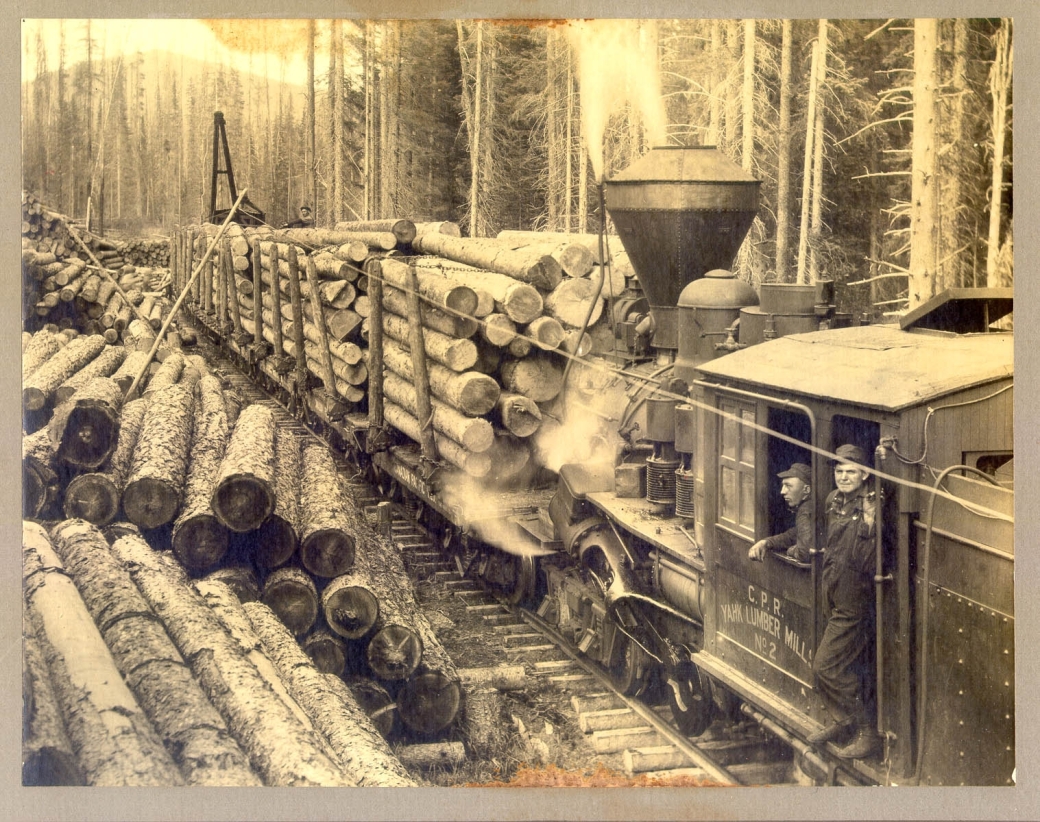
CPR Logging Train

        After the arrival of the W&GN rails in Republic in 1903, the production of the mines was split between the two railroads.   Approximately 1000 tons per week was going out, with the GN taking the largest share.   Most of this ore had been stockpiled at the mines awaiting the rails.   Almost all of the 30 carloads a week being shipped, went to the Granby smelter.   Very high grade ores went to Everett and Tacoma, Washington where the smelters were willing to pay premium prices for Republic ores with their high silica and lime content, to blend with their “wet” (high in sulfur) ores to make a desirable slag in the furnaces.

        Once the stockpiles of ore had been shipped, traffic began to dwindle from 35,000 tons with a value of $350,000 in 1903 to a mere 195 tons with a value of $9,000 in the panic year of 1907.   It was not an indication that the mines were exhausted.   Recovery of the gold values was the problem, not exhaustion of the deposits.   When better concentrating methods were installed in the larger mines, production increased.

            With better concentrating machinery installed in 1908, shipments began to pick up with 584 tons shipped for a value of $20,000.     Shipments steadily climbed to 44,000 tons in 1911 with a value of $900,000. Meanwhile, the Hot Air line limped along, with Republic Agent O.E. Fisher, picking up what business he could.   He contracted log hauls to sawmills along the line, and organized rail excursions on Sundays to the popular picnic grounds on Curlew Lake  The Great Northern’s W&GN, however, with its direct connection to Spokane, took the majority of the the passenger business.

            Train No. 256 from Spokane dropped its buffet car at Curlew, and continued on west to Oroville where it terminated.   Return train, No. 255, originated there at 6:30 AM, and stopped in Curlew to board passengers bound for Grand Forks or Spokane, and to pick up the buffet car.   The 2-1/2 percent grades on the Midway – Oroville portion of the line made it prudent to leave the heavy buffet car at Curlew, since the locomotives assigned to this service were older machines from Dan Corbin’s SF&N with limited pulling capacity.   At Karamin, not listed in this timetable, but at Mile 163, passengers and freight were set out for the narrow gauge Belcher Mine Railway which pulled its single passenger car 8 miles up Lambert Creek whenever Conductor Ike Mc Clung had paying traffic.

            In the Teens and Twenties of this century, Marcus, Washington was the center of action for all these mining lines.   Daily, at noon, the town came to life with sudden energy.   No. 259, the morning train from Nelson would arrive at 12:40 with the passengers and express that had come down the Red Mountain Railway to board at Northport.   The passengers would hurry into the restaurant, a neatly panted two story building just west of the station, congratulating themselves on being the first to arrive with a choice of tables.   No. 259 would be quickly wyed by its crew and set out beside the station on the north leg of the wye to return to Northport and Nelson as No. 260 after lunch.   Once parked on the house track, its hungry crew would make their way to the table in the restaurant reserved for GN employees.

               At 12:50, No. 255 from Oroville, Curlew and Grand Forks would come rumbling across the great Columbia River bridge to halt on the west leg of wye opposite the restaurant and its passengers would pour off and crowd into the building.   At he same time, 12:50, No. 256 was arriving from Spokane and its passengers were on the vestibule steps ready to make a run for the restaurant, shouting their orders as they crowded through the door.

              No. 255 was due to depart for Spokane in ten minutes, so its passengers had time only to pick up their box lunches ordered by telegraph from Laurier.   At 1:l0, both No 260 for Northport and Nelson, and No. 256 for Grand Forks, Curlew and Oroville were whistling for departure.   The diners cursed, shoving last mouthfuls of food into their faces, put down their napkins and hurried out to their trains, suffering the first pangs of heartburn and damning Jim Hill for his belief that twenty minutes was ample time to order and consume a noon meal.   The trains, probably a few minutes late, chuffed off, leaving the restaurant employees time to sit down, put their feet up and enjoy a smoke.   The whistle blasts from the three trains, resounding from the mountains, died away, the long rumble from the Columbia Bridge was silenced, and the sleepy, riverfront town of Marcus relaxed into a quiet afternoon snooze.   It would all happen again at noon the next day.

           In Grand Forks, the Hot Air management, defeated by Jim Hill’s competition at Republic, had turned to their North Fork line.   They had built 18 miles up the river and then stalled for want of funds at Lynch Creek.   An arrangement with the CPR allowed the Canadian Pacific’s trains to use the Hot Air track through town, and its station on 4th Avenue in exchange for Hot Air trackage rights from Westend to Smelter Junction on the CPR line.   The North Fork line then ran alongside Smelter Lake, serving a sawmill there, and on up the valley through the settlements at Niagara, Troutdale and Humming Bird where ore from nearby mines was loaded.   At two places north of Humming Bird, the wagon road was side by side with the tracks, and to keep the locomotives from frightening horses on the road, a high board fence was erected to separate the track from the road.   The road was frequently impassable in bad weather and couples would then resort to pumping a hand car down the Hot Air rails to attend dances at Volcanic Brown’s Camp.   The Hot Air was a home town railroad and when locals needed transportation, borrowing a railroad hand car and pumping down the line was customary practice.

             The Franklin Camp gold mines, 40 miles to the north were the line’s immediate goal.   An ambitious extension was planned to cross Monashee Pass and reach the Okanagan at Vernon, and beyond to the coal mines of the Nicola Valley. However, no one wanted to risk investing in a line Jim Hill had publicly announced he would destroy.   A hotel was built at Lynch Creek, the jumping off place for prospectors and miners, and a wagon road to Franklin Camp brought out its ore to be loaded on the Hot Air cars for the Granby smelter.

               In 1919, the Trail smelter was interested in getting fluorite from the Rock Candy mine to use as flux.   The CPR built the Lynch Creek bridge and extended the Hot Air rails two miles to Archibald where an aerial cable way brought the fluorite to a loading bunker.   This, together with log shipments to the sawmill and cedar utility pole shipments, allowed the Hot Air to maintain a weekly service, since the copper mines along the line had shut down with the closing of the Granby smelter.

               In the 1930s, the Hecla Mining Company, of Wallace, Idaho, bought the Union mine at Franklin Camp.   They built a concentrator and mill, and shipped their concentrates by truck to the Hot Air at Archibald, staving off the line’s abandonment for a few more years.  In 1921 the Hot Air’s wooden bridge over the Kettle River between Cuprum and City Station was damaged and there was no money to repair it.   That part of the line was abandoned and the CPR trains backed and out of City Station.   That accounts for the mileage on the timetable above being figured from Westend, which was the CPR interchange.   By 1935 mine traffic on the North Fork line had ceased and the sawmill at Lynch Creek had closed.   With no remaining traffic, the CPR pulled the rails.   The present steel highway bridge across the North Fork at Bumblebee is the only remaining artifact of the North Fork branch.   In September, 1952, the CPR ceased backing its passenger trains into the downtown station and those tracks were pulled. The Great Northern pulled out of Grand Forks on June 15, 1943, closing its station, and pulling its tracks back across the Kettle River to the “Big Y”, three miles south of town where a tiny station was maintained for passengers.             Ever since the Hot Air lost most of the contracts for hauling ore from the Eureka Creek mines to the Great Northern, the managers of the Trusts and Guarantee Company back in Ontario had wanted desperately to unload this ailing railroad.   In 1906 they sent out James Warren, the former manager of the White Bear mine at Rossland, to either make the Hot Air profitable, or abandon it.

            Warren saw at once that the Republic line, in direct competition with Hill’s Great Northern branch, was a loser.   It’s only salvation could be as a Canadian Gateway Line for one of the four American transcontinentals in Spokane.   Accordingly, the Hot Air had been reorganized in 1905 as the Spokane and British Columbia Railway with lawyer, W.T. Beck, of Republic as president.   The line claimed three locomotives, two passenger cars, and sixteen freight cars.   These, lettered for the Spokane and B.C.., ran on all Hot Air branches, from Eureka Creek to Lynch Creek.               Beck and Warren sent out surveyors to stake out a grade from Republic to Spokane.   The location survey ran down the San Poil river to the Hedlund Lumber Company Mill at West Fork which was expected to provide substantial traffic.   To encourage investors, a short length of isolated track was laid here, just as had been done on Clark Avenue in Republic in 1902.   The survey followed the San Poil south to the Columbia at Keller where the Indiana corporation was planning to build a smelter to process ore from the Keller mines.   The Granby company, as well, had issued bonds in 1902 to finance the extension of the Hot Air to the Keller mines so that it could bid for their ores.   From Keller, the S&BC was to run along the north bank of the Columbia to the mouth of the Spokane River.   A bridge was to cross the Columbia here and the line was to ascend the Spokane River and enter Spokane across the flat prairie north of town.   The line was announced with great fanfare in Spokane, and purchases of land were made, not so much for right of way, but as speculations on the development of north Spokane should the S&BC ever build track.   A further scheme was announced by which the S&BC would skirt the north edge of town and connect with Dan Corbin’s Spokane International which he had built to bring the Canadian Pacific into Spokane from Yahk, B.C.   The idea was to provide a water level coal route from the Crowsnest mines to the Granby and Greenwood smelters, bypassing the CPR’s costly barge route across Kootenay Lake with its “double dockage” charges on every carload of coal, and that costly haul, with double-headed freights, over Mc Rae Pass.   Such route, if built, would break Jim Hill’s monopoly on coal to the Granby smelter, something that the CPR dearly wished for.   Jim Hill, for his part, sent his surveyors to stake out a parallel line.   It was graded, Bluestem to Hawk Creek, and that was a sufficient message to potential investors.   The message was received, and the S&BC languished.

            Warren and the Hot Air were not alone in these schemes to bring cheaper coal to the Kootenay and Boundary industries.   Frederick Blackwell, who had completed his Idaho and Washington Northern Railroad from a Spokane connection to Metalline Falls, a few miles from the Canadian border, maintained a cutoff line from Blanchard to Athol on Corbin’s SIR, so that coal could come over over his line to Trail, B.C. if only the CPR would build a 35 mile connecting line from Trail, up the Pend Orielle River to tie into his rails at Metalline Falls.   CPR officials looked at the proposal.   It would give them an easy grade to Trail and bypass the awkward Kootenay Lake barge link. But in the end, they rejected the scheme.   For the same amount of money required to build up the Pend Orielle, they could put CPR rails around the south end of Kootenay Lake to Nelson, eliminating the barge line and having an All-Canadian line.   Having made this decision, they then characteristically omitted to build the Kootenay Lake Line, and barging went on until the 1930s.

            Meanwhile, the Milwaukee bought Blackwell’s Idaho and Washington Northern in 1912. Warren and the Hot Air approached the Union Pacific with their Spokane and B. C. Gateway proposal.   The UP considered, but in 1917, opted for 50% of Corbin’s SIR and an interchange with the CPR at Yahk. This American timetable gives times and mileage only from the border at Danville.   The Belcher mine had closed the previous year, though there are reports that the Mine Railroad still hauled logs for the sawmill at Karamin.

           As with the Canadians up the North Fork, the American residents of Danville used the railroad’s hand cars to attend dances in Curlew. Since trains did not run on Sunday, the baseball teams would use the handcars as well to get to games in Republic. With the destruction of the Hot Air’s Grand Forks depot and offices by fire in August, 1908, the early records of the line perished.   However, U.S. sources record that from the period March 1, 1909 until June 30, 1915, total revenues of the American segment of the line were $122,956, and expenses $292,461.   Possibly, revenues from the North Fork line may have offset this loss to some extent, but it is doubtful that the Hot Air ever operated in the black.   Certainly, the Republic line was always a loser.   One trip, related by Harry Lembke, illustrates the parlous state of the Hot Air line in its last years.   The Lembkes were buying logs from the Trout Creek area and having them brought to Curlew by the Hot Air train.   On one trip to pick up logs, the Hot Air locomotive began to lose water through cracked boiler tubes.   With the tank empty, they stopped on the Trout Creek Trestle and tried to dip water from the creek with a rope and bucket. But they found the engine was losing water from her boiler as fast as they could pour it in the tank.   The crew took the train to the siding just south of the trestle where all piled onto a flat car and coasted all the way back to Danville.   (More likely to Curlew, and pumped a hand car from there to Grand Forks.)   Another locomotive was fired up at Grand Forks and run down the line to bring back the leaking locomotive and its train.

            With the failure to peddle the Spokane and B.C. to an American railroad, J.J. Warren turned to the last remaining asset the Hot Air Line possessed, that charter authorization to build west to the Coast.   It was fanciful to believe that the Hot Air, a bankrupt railroad, barely able to run its trains, could be the corporation to accomplish that “Coast to Kootenay” railroad that British Columbians had wanted for so long.   But, astonishingly, Warren thought it could.   He somehow convinced the CPR that the way to beat Jim Hill’s “Third Main Line” to the Coast, was to lease the Hot Air for its charter, and then finance it to build the long hoped for line.   In 1913, the CPR agreed, and leased the Hot Air.   Warren and his directors renamed the corporation again (the Canadian part).   This time it became “The Kettle Valley Railway,” and with CPR backing, began building west from the Columbia and Western’s dead end at Midway.   Under Warren’s direction, and with CPR money, the Hot Air finally succeeded with a hair-raising mountain line through to Hope B.C. and a connection with the Canadian Pacific’s main line to Vancouver.

            The Republic line, under its U.S. charter as the Spokane and B.C.., was allowed to declare itself bankrupt in 1920, and ceased operations.   It was not worth saving; the CPR in 1921, allowed its assets to be auctioned off and its rails pulled up for salvage.   Washington State Highway 21 was built on its grade from Danville to just north of Curlew, and from the present Curlew High School south to Karamin.   The Karamin turnoff follows the grade to Trout Creek and the upper part of the Barrett Creek road is on its grade to Swamp Creek.

            The Great Northern trackage up Eureka Creek was seeing slight use in the 1930s as the mines were now using a cyanide process to recover the gold and smelting was no longer required.   When a sudden flood washed out the north approach to the great looping trestle over Granite Creek trapping a train up Eureka Creek, the railroad decided to pull its tracks back to the Republic station. A temporary fill was put in to rescue the stranded train, and in 1940, the tracks were lifted and an ore loading platform was built near the station to accommodate carload shipments to the Tacoma smelter.

           The Day Brothers of San Francisco, bought and consolidated a number of Eureka Creek properties in the 1930s, and kept them in production with modern concentrating machinery and methods. Hecla Mining Company acquired the Day Company’s Eureka Creek properties in 1981 in an unrelated transaction. Hecla engineers, in inspecting the Day properties in Eureka Creek, found them worth working.   Hecla worked the mines until 1995 when the Knob Hill mine was finally closed.   It had been an extremely long run; 99 years of nearly continuous production from a single mine, extracting 2 million ounces of gold, surpassing Phoenix and Rossland.

               Today, (1997) Echo Bay Mining operates several low grade properties on Cooke Mountain, not far from the old Belcher Mine.     Santa Fe Pacific Gold Corporation has leased the Golden Eagle claim from Hecla and is drilling on it to assess its value as a possible open pit mine.   Republic, the longest lived of the three Boundary Bonanzas, still thrives as a mining town.

                 Paradoxically, a fragment of the Hot Air Line has outlasted the Canadian Pacific in the Boundary District.   When, in 1995, just after completing a tie replacement program on the C&W Midway-Castlegar line, the Canadian Pacific, apparently suffering another panic attack, pulled its tracks back to Castlegar, the industries of Grand Forks were left without a rail connection.   The Burlington Northern was still running down its line to Republic, south of town and a surviving piece of Hot Air track still ran from Cuprum to Coopers’ Wye (“Big Y” locally), the BN interchange.   To serve the Grand Forks industries, the CPR stationed a diesel switcher at Cuprum and taxied a crew over from Nelson once or twice a week to perform industry switching and interchange cars with the BN.   This was wasteful and ridiculous.   The crew taxied over from Nelson had to be paid railroad mileage for the trip as union rules required, and the switcher, unprotected from the weather, had to be idled all winter long to keep the coolant from freezing.

            Pope and Talbot, operators of the sawmill undertook to form the Grand Forks Railway Company to take over the switching job.   Each morning the personnel of the Railroad, Dennis John, Manager, Mario Savaia, Conductor, and Miss Shelley Dahl, Engineer, switch the Grand Forks industries and run the loads down the 1-1/4 miles of Hot Air Track to the BN interchange at Cooper’s Wye.   Pope and Talbot provide a shed for winter storage of the switcher.   Headquarters is at Cuprum.