STEEP AND CROOKED … by Late Writer, Artist & Castle Builder Bill Laux

  CHAPTER FIFTEEN

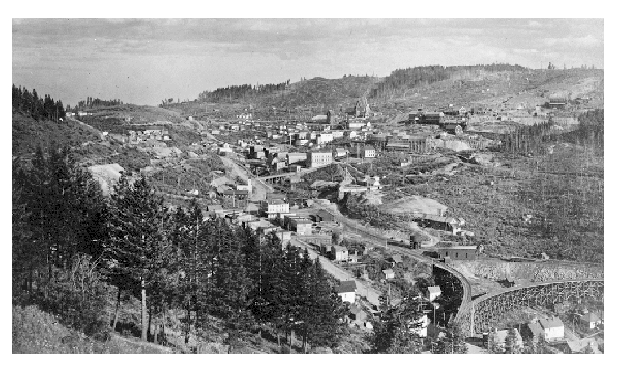
RED MOUNTAIN: BOOM AND DECLINE 1900 – 1997
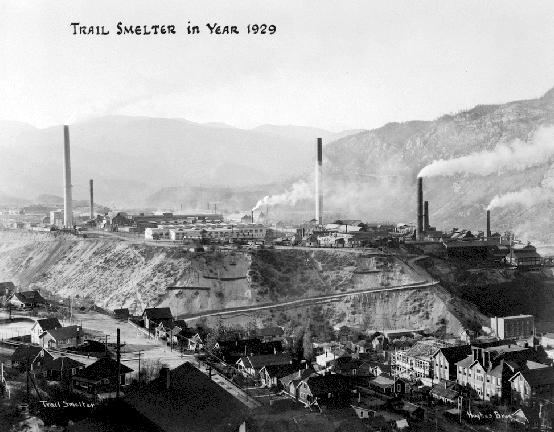
Trail_Smelter_in_Year_1929

Trail Smelter 1929 – Photo Credit: wikipedia.org

When standard gauging its Rossland line, the CPR moved the Rossland yards to a flat between Second and Third Avenues, extending from Washington to Butte.   A commodious station was built on the site now occupied by the Rossland fire hall.   On the north side of the four track yard, a freight shed was erected, and at the east end, near Butte, a two stall engine house.   Alongside the yard tracks private interests put in a coal yard, a feed store, and a drayage warehouse.     Down in the lower town at Cook Avenue, a roofed platform for passengers was built at the water tower.   As in its narrow gauge days, this was still called “Union Avenue.”

 With both the CPR and the Great Northern in town, their bitter rivalry was not long in breaking out.     At the west end of Rossland, the Red Mountain Railway had a spur up behind the present museum which hauled ore from the Black Bear mine, delivered coal for its power plant, and timbers for mine props.  Further east and some hundreds of feet up Red Mountain was the second class dump of the great Le Roi mine.  The Northport smelter had installed a concentrating plant and now wanted that ore.

Accordingly, in the first days of November, 1900, the Red Mountain Railway sent out its engineers to stake out a line climbing west from the Black Bear spur to a switchback on the Annie claim.   Reversing there, the line climbed back east to the Le Roi second class ore dump and on to the end of the CPR track at the War Eagle ore bunkers.   This line would allow the Northport smelter to bid for both the Le Roi second class ore and for the War Eagle ores.

            For once in its long life, the CPR moved with dispatch. On the Ninth of November, the train from Nelson brought a full crew of workmen, engineers, and their tools.   The next morning, as the dawn sun was glimmering through the fog-shrouded town, the CPR men with teams and scrapers assembled at the War Eagle ore bunkers.     Running west and slightly downhill was the line of Red Mountain survey stakes.   After a careful sight through his instrument, the CPR engineer pronounced the Red Mountain grade suitable.   At once the CPR crew began to grade it with shovels, picks, wheelbarrows and horse drawn scrapers.  It was not until the next day that an outraged Red Mountain crew arrived from Marcus to find the CPR had graded their own line down to the Black Bear mine on the Red Mountain survey and were preparing to lay ties and rails

.               Howls of indignation went up, but this was Canada, and no pistols were drawn.   The Red Mountain telegrapher in Rossland sent out an SOS to Spokane.   Spokane wired Jim Hill in St Paul.   The mighty Empire Builder raged.   His Spokane lawyers were roused from their beds at midnight and bustled onto a hastily assembled special train at the Spokane depot.   They were to be in court in Rossland promptly at ten in the morning.   On came the Lawyers’ Special, storming up the hill to Rossland, and screeching to a halt at the Spokane Street station.   A squad of shivering and sleepless attorneys descended, and clutching their briefcases, hurried down to the courthouse on Columbia Avenue.

           But, as they were to learn, the CPR was a power in Canada.   The legal arguments were many, learned, and passionate.   Still, the owners of the mining claims over which the disputed rails passed, raised no objection; they were quite delighted to have rails at their mine mouths.   His Honour could find no injured party.

            On December 14, the judge upheld the CPR rails and the Spokane lawyers departed.   On the 16th, the Red Mountain capitulated, and connected its rails at the Black Bear with the CPR tracks.   Both lines could now compete for ore from the Black Bear, the War Eagle, and the Le Roi second class dump.   Belatedly, on the 23rd, the CPR published its “Notice of Application to Build a Branch Line to the Black Bear Claim.”   That closed any legal loopholes, and the Red Mountain Railway resigned itself to the interchange track.

                 With the end of regular sternwheeler service, the CPR removed the tracks from Bay Avenue and the Trail station to a more central location at Cedar and Farwell (where the Super Valu market now stands).   A wye was installed here to turn the engines. The War Eagle and Centre Star mines were bought in 1906 by the newly organized Consolidated Mining and Smelting Company (COMINCO) which began a policy of buying mining properties to assure the smelter of a continuous and predictable supply of ore.   The Northport smelter was still bidding for ores and faced uneconomic shutdowns when they were not forthcoming. As Rossland entered the present century, the results of the early high grading days became evident.   The Red Mountain mines had been opened in a virtual wilderness by the Spokane Colonels and Canadian Honourables when only the richest shoots of ore could pay their way to a railway siding by pack team or rawhiding.

              In 1896 the ore shipped out ran an average of 1.45 oz. in gold, 2.34 oz. silver, and 40.9 pounds of copper per ton.   That rich ore was worth $32.64 per ton.   The charges at the pioneer smelters were high, between $10 and $14 per ton, reflecting the high cost of getting coke and coal to the smelters by the roundabout rail and water routes.   Two years later, the average ore being mined contained only half as much gold, but owing to a doubling of the copper price, was still bringing a profit of about $20 per ton.

            The Le Roi, hoisting twenty six carloads daily in 1901, could claim ore values of only $13.16 per ton.   With the CPR bringing coal and coke directly from the Crowsnest fields, the smelter charges were more modest.   Combined mining, haulage and smelting charges averaged just $10.72 per ton.   This yielded a profit of $2.44 per ton, a tenth of what it had been three years earlier.   $2.00 per ton remained an average profit for the red Mountain mines for some years thereafter. High grade ore shoots were still being uncovered from time to time; each was announced with great fanfare in the mining press. But breathless publicity was largely a device to bolster stock prices and keep investors buying.   As the mines went deeper, the tenor of the ore steadily declined.   Smelter managers sent ore buyers into the field to purchase ores with a high sulfur content which would reduce the amount of coal required in the furnaces.     For this reason it was economic to bring in the bornite and chalcopyrite ores from Phoenix to blend with the lower sulfur Rossland ores.   The much lower mining costs at Phoenix where the massive deposits could be worked with power shovels from huge glory holes, more than offset the cost of hauling these ores over the Monashees to Trail or around by Marcus to Northport.

           With a progressive decline in the quality of ore as their mines went deeper, the Rossland mine managers blamed their inability to pay dividends on high labor costs.They refused to honor the legally mandated eight hour day, and instituted a change from an hourly wage to a contract system, paying their miners so much per ton or per foot of tunnel dug.   The Rossland miners refused and struck on July 11, 1901. The strike was long and bitter, but eventually failed as the local union broke away from the Western Miners Federation in Denver, uncomfortable with its openly Socialist ideology.   With the miners now on a contract system, the mine managers were no longer able to blame their failure to produce rich dividends on excessive labor costs.   The truth was was that the Le Roi, the Centre Star and War Eagle had been bought from the Spokane Colonels at vastly inflated prices in the speculative boom of 1898.   The ore being mined after 1898 could simply not pay the dividends demanded.     General informed belief was that the miners had been scapegoated.   The British Columbia Mining Record editorialized that the real reasons for the unprofitability of the Rossland Mines after 1898 were, “…the exaggerated anticipations on the part of investors; extravagance and incompetence on the part of the representatives of the investors” (the mine  managers); “over taxation… and extensive swindling on the part of company promoters.”

                To reduce mining costs Aldridge of the Trail smelter proposed uniting all the major producers into one company.   All were interconnected underground; amalgamation would allow all hoisting to be done through one shaft, and a single compressor station and lighting works would serve all the mines.   The owners refused, believing the proposal to be a CPR grab for monopoly control.   Aldridge was persistent; he believed that if the CPR did not buy the mines, the Great Northern would.[v]     Gradually, opposition weakened, except for Mc Millan, manager of the Le Roi.   He was especially obstructive, attacking the condition for merger that gave the CPR all the haulage of the combined ores, and the Trail smelter all the treatment.   Aldridge saw Mc Millan as representing Jim Hill’s interests.   This was true.   J.J. Hill, in far off St Paul, had been myopically buying shares in the declining Le Roi for the express purpose of preventing the CPR from getting hold of it, and denying Hill’s Red Mountain Railway of its traffic.

            In 1905 Aldridge was able to buy the War Eagle/Centre Star (already consolidated) from the Gooderham-Blackstock families in Toronto for $825,000. With these and other purchases, the Consolidated Mining and Smelting Company, Ltd. (COMINCO) was created in 1906.   Cominco was capitalized at 5 million dollars, a wringing out of the excessive capitalization which had hamstrung the separate companies.   It comprised the War Eagle,. Centre Star, the Trail smelter, The Rossland Power Company (an ore concentrating works), and the St Eugene mine, a lead-silver property in the East Kootenay which Aldridge optimistically expected to replace the Le Roi as the primary supplier of ore to the smelter.   The St Eugene was largely owned by the Spokane Colonels.   They had its manager, James Cronin, working his miners overtime in the months before the merger, a repetition of their 1898 stripping of the Le Roi, by removing as much of the high grade ore as possible to show a high valuation.   The St Eugene, as a result of the Colonels’ manipulations, was assigned 49.8% of the new Cominco stock, while the War Eagle-Centre Star got 33.2%, the Trail smelter, 15.8 % and the unsuccessful Rossland Power Company 1.2%.   Turning over their virtually depleted St Eugene mine to Cominco, the Spokane Colonels retired with half the Cominco stock, having fleeced the Canadians once again.

           Five years later, the worked out St Eugene was abandoned to a few leasers to pick its bones foe what they could find.   Cronin, when the deception was discovered, was unceremoniously removed from the Cominco board. Mc Millan of the Le Roi, doing Jim Hill’s bidding, refused to join the merger.   But Hill’s intransigence could not save his mine.   Five years later, in 1911, the Le Roi went into liquidation and was sold to Cominco for $250,000. As the supplies of copper-gold ores diminished in quantity and value, Cominco switched its interest to the huge deposit of low grade lead-silver ores of the Sullivan mine at Kimberly in the East Kootenay.

            This had been another of the Spokane Colonels’ properties, but here they had lost their shirts.   They had spent millions building a smelter to process its zinc-contaminated ores.   Then the usually shrewd Colonels became victims of their own exuberance.   Hiring by mistake, the brother of the engineer they had intended to employ, the smelter he built for them was an utter failure.   They sold out to the Guggenheims’ American ASARCO combine. Asarco as well was unable to treat the Sullivan ores successfully, and Cominco picked up the mine nobody wanted in 1910 for $116,000.  The separation of the troublesome zinc was finally achieved with a flotation process, and the Sullivan, together with the Bluebell (the deposit the Indians and Hudson’s Bay Company employees cast their bullets from in the 1840s) on Kootenay Lake furnished the bulk of Cominco’s ores until the 1970s.

         Still, copper-gold ores continued to come down the steep and crooked rails from Rossland, though, after 1916 in diminished tonnage.   By 1910, the CPR M4 series Consolidation locomotives were assigned to the Rossland run, and for these heavier engines the existing 60 pound rail was replaced with 85 pound steel.   Rails on the tight 20 degree curves had to be braced against the weight of these engines with ties wedged between the outside rail and the embankment.   On other curves the outside rail was cabled to an iron pin driven into bedrock.

               Braking on the downhill runs was always a problem.   The older cars with wooden brake beams often arrived at Smelter Junction with the beams so badly scorched they would need to be replaced before the car could be sent up the hill again. A judicious handling of the brakes was required so as not to burn off the brake beams and lose the train brakes.   In the Twenties all steel gondolas arrived with steel brake beams and the problem was eliminated.

           In the early years, the Rossland branch used tiny 4 wheel cabooses just 15 feet long.   These had been built in 1907 and 1908.   They lasted until the CPR banned 4 wheel equipment in the 1920s.   They were replaced by standard plan cabooses which had been shortened by ten feet.   A home made flanger, built on the single car truck, lasted well into the 1940s.

            After WWI the end was in sight for the Rossland mines.   They were following leaner and leaner veins down into the mountain, almost down to the level of the Columbia.   A plan was mooted to drive a tunnel from Warfield to intercept the deep workings and allow the ore to come out near present Haley Park.   This would have eliminated the need for trackage above Warfield.   The tunnel was begun, but too late.   The Red Mountain mines were nearing exhaustion and further expenditure was not justified.

               The Northport smelter had closed after the war for lack of ore.   On July 1, 1921, the last Great Northern train departed from Rossland and the Red Mountain Railway was closed.   In 1922, the rails were pulled and a one lane gravel road graded, most of it on the old railway line.   The great Columbia bridge at Northport was given a wooden deck for automobile traffic.   It served, an increasingly shaky structure old timers remember, until 1948, when one span collapsed and a ferry had to be put in service until a new highway bridge could be built.

               With the closing of the Phoenix mines in 1919 and the diminishing amounts of ore coming out of the deep levels of the Red Mountain mines, Cominco decided in 1929 to close its Rossland mines.   The next year it ended its copper smelting operations, and smelted exclusively lead-zinc-silver ores from the East and West Kootenay.   A good many of the Rossland miners found work in the Trail smelter, and a Rossland-Smelter Junction commuter coach was added to the 6:00 AM passenger train to Nelson.   The coach would be dropped off at Tadanac, as Smelter junction had been renamed.   On the return run from Nelson, the train would pick up the miner’s coach at 4:15 PM and haul them back up the hill to Rossland.

           When the great depression struck in the Thirties, the demand for metals dwindled and many smelter workers were laid off.   To assist these men, Cominco leased its Rossland mines from 1933 to 1940 to its laid-off employees.   A truck dumping facility was established on Washington Street.   The miners would truck their ore to the ramp and raise the body with a chain fall to dump the ore into the CPR gondolas.   The ore cars ran again in the three times per week service the CPR maintained to Rossland.

               A paved highway down the hill to Trail opened in 1937.   The miners then established their own commuting bus service to the smelter, a fifteen minute trip, as compared to an hour by train.   That year, all passenger service to Rossland was withdrawn.   Still, the freight climbed the hill three times a week, as Rossland, high above the smelter fumes, became the favored bedroom community for Trail employees.

           Conversion from coal to oil fired locomotives came in the late 1940s.   In 1953, diesel locomotives replaced steam.   In 1962 the line down the gulch to the Trail City station was lifted, and in March, 1966, the Rossland line was abandoned.   Track was lifted down to Warfield where the Cominco fertilizer plant still requires regular freight service bringing in phosphate and potash rock for conversion into fertilizer with the sulfuric acid formerly wasted up the stack.

            The Red Mountain mines and the steep and crooked line that served them, had outlasted Phoenix which had sunk into its own pits.   Rossland today remains a thriving community, and the Trail smelter, one of the world’s largest, processes ores brought from Alaska’s North Slope to Sayward up those historic Spokane Falls and Northern rails.   At the Sayward transfer facility, the ores are transferred to trucks for the remaining six miles to Trail. The failure of Fritz Heinze, in 1895, to keep his promise to Dan Corbin to lay track from Trail to Sayward is perpetuated today in that costly and irrational trucking operation.

            The inexplicable failure of the CPR to underbid BN for the Alaska ore traffic, has ended the procession of heavy ore trains from Cranbrook to Nelson to Trail, and the line from Yahk to Warfield has been sold to its employees.   The Canadian Pacific, reluctant in the beginning to enter the Kootenay-Boundary country, has hastened to leave it, abandoning its rail future to the always aggressive Americans.   BNSF trains still call at the old Great Northern points, at Sayward, at Salmo, at Grand Forks, at San Poil, and Curlew.   The departing CPR has sold the Trail Smelter, and pulled all of its track west of Castlegar.   Kootenay rail transport is back to where it was in 1899.
 

STEEP AND CROOKED … by Late Writer, Artist & Castle Builder Bill Laux

THE MINING RAILROADS OF THE CANADIAN BORDER

 By Bill Laux

CHAPTER FOURTEEN

TWO RAILROADS; FIVE SMELTERS 1905 – 1921

Phoenix,_British_Columbia

Phoenix BC 1905 – Once the Highest Town in Canada (4610 ft)

Having bought Granby for $4.00 a share, William Nichols and his associates in the copper refining and marketing business, got up a special train and traveled west to see for themselves what they had acquired.   At Grand Forks, Jay Graves, Stephen Miner, and Aubrey White toured them through the smelter.   Then the CPR put on two locomotives and pulled their train up the steep grades to Phoenix where they stepped out in the highest town in Canada at 4610 feet.   There they were shown the claims and the producing mines of the company.   These were knowledgeable men, and they were enthusiastic at what they saw.   Analyst Stanton admitted, “Nowhere have I seen superior methods.”   J.B. Hereshoff, perhaps a rendered a bit light-headed by the elevation, rhapsodized, “…a magnificent, monotonous mass of homogeneous ore…”

These men, now his bosses, instructed Jay Graves to do two things.   First, pay a dividend.   Second, do more development work to determine precisely how much ore they had.   He did both.   A modest dividend was forthcoming, and he had his men begin a tunnel from the 4400 foot elevation at the foot of Church Street in Phoenix, to burrow under the town and tap the ore body 400 feet beneath its discovery point.   He ordered that the shaft from the Victoria be deepened as well, to meet the tunnel on the 400 foot level.   Then crosscuts were to be made to explore the ore body from end to end and side to side to discover its extent at the deep levels.

Eholt had become a busy railroad town with a five stall roundhouse, five tracks, four hotels, 25 houses, and half a dozen commercial establishments.   Switchers bustled around the small yard day and night, making up cuts of cars for the five smelters the mines were serving, the Granby in Grand Forks, the B.C. Copper in Greenwood, the Dominion Copper in Boundary Falls, the Trail smelter and the Northport smelter.

For passenger service to Phoenix , the CPR ran a mixed train from Eholt.   The ten mile trip uphill took 50 minutes, but downhill, with a heavy train of ore cars and the passenger car trailing, the time was an hour and twenty minutes, though the timetable suggests otherwise.   Mixed trains were obliged to stop and cool brakes on the way down, and limited to ten miles per hour.   Pure passenger consists could keep the published schedule.

The 1:55 PM train leaving Eholt boarded passengers from westbound CPR train No. 41 from Grand Forks, Robson West, Castlegar and Nelson which had arrived at Eholt at 1:55 PM.   Obstreperous miners returning from alcoholic and other endeavors in Grand Forks could be a problem on the trains.   Conductors learned to turn the train heat control wide open.   In ten minutes, they reported, the cars would be hot and the miners snoring peacefully.   Awakened in Phoenix, they would be bundled out into the cutting mountaintop winds to find their way to the “Rampasture,” their name for the Granby Company’s large employee boarding house at the top of Second Street.

With the steep, 3.4 percent grade and 600 tons of ore behind the locomotive, a brake failure on this line could be disastrous.   On the 23rd of August, 1904, Shay 1901 (formerly No. 111 from the Rossland branch) lost train brakes half a mile above B.C. Junction.   Engineer Alf Kenward and Fireman Charlie Haggart jumped and escaped injury, but the Shay left the tracks at the curve just above the Oro Denoro mine and the following ore cars piled up on top of it.   Fortunately, this was not the afternoon mixed; no passenger coach was attached.   So imperative was it to restore service at once, that a short trestle was built around the wreck and traffic went on while the mess was cleaned up.   It was crucial not to interrupt the flow of ore to the smelters, as shutting down the furnaces and restarting them was both costly and shortened the life of the furnace linings.     Shay 1901 was repaired and put back into service.

On February 2, 1907, CPR Consolidation No. 1384 with a heavy train of ore wrecked a short distance below the Rawhide mine when it spilled a switch.

The VV&E had its share of wrecks as well.   On Sept. 20, 1909, both the engineer and fireman were killed at Phoenix when their locomotive overran the tail of switchback and rolled down the mountainside.   Just one month later, Engineer McAstocker was killed and Fireman Beatty injured when their locomotive derailed and rolled coming down the 2.2 percent from Phoenix.   Snow on the rails was believed to be the cause.   1909 was an unlucky year for trainmen; a week after the VV&E wreck just mentioned, CPR engine No. 1385 running light, Phoenix to Eholt, left the rails just below B.C. Junction and rolled.

The VV&E service did not require a change of trains.   Still, it was one hour, 25 minutes, Grand Forks to Phoenix, and one hour, 20 minutes, Phoenix to Grand Forks.   These were mixed trains, trailing a coach behind the ore cars, with a stop for water at Hale, and on the downhill run, one or more stops to cool brakes.   Weston station served West Grand Forks, the former Columbia.   The Spencer flag stop served the Athelstan and Jackpot mines, as the CPR spur line to them did not have passenger service.   The Hale flag stop served the Summit Camp including the B.C. Copper mine.   Glenside served the Tiger mine.

By 1905, Granby and the Phoenix mines were in full bonanza.   Jim Hill himself came out by special train on those VV&E tracks that had cost him so much ire and invective to build.   His seven car train came snorting up its spiral grade to Phoenix.   Down from its platform stepped the short, broad, and scowling Cyclops of St Paul.   Behind him came a hunched Jay Graves and a young and athletic George Baker Jr. who danced about in a series of hopping and arm swinging Swedish exercises popular at the time, all the while praising the invigorating qualities of mountain air.

While Director Baker danced and inhaled his mountain air, a driving rain commenced, and J.J. Hill, watching these antics without comment, allowed a company slicker to be draped around him and be led off for a tour of the property.   The party inspected the mines, watched one of the Thew steam shovels loading Granby ore into Granby patent cars, and then retired to one of the Granby offices for confidential talks.   Graves was in an ambiguous position with Granby.   He was vice President and General Manager, but a second to Abel Hodges.   The New Yorkers preferred to keep control in the hands of their own men.   Graves owed his position to the influence of J.J. Hill who as now a major shareholder in Granby.   Graves must have had something he wanted to discuss with J.J. Hill as well.   He had incorporated The Spokane and Inland Railway the previous December and had been trying to convince New York investors that Mr Hill was behind him in this enterprise.   Hill was not; his son Louis was trying to persuade him to break with Graves whom he did not trust.   Graves certainly, on his own ground in Phoenix, must have tried to persuade Mr Hill to grant his new railway some sort of public approval.   There is no evidence that he was successful.

When, by 1905, electricity reached Phoenix from Granby’s Cascade Power development, it replaced steam for haulage and underground work.   The three Davenport saddle tank 0-4-0s then moved ore and waste on the surface while a fleet of 4 wheel Baldwin electric ‘mules’, taking 600 volt power from trolley poles, moved the ore underground.   The locomotive fleet, divided among the five big Granby mines, comprised 3, 36” gauge Davenports, 3, 36” gauge electrics, nine 20” gauge electrics, one 20” gauge Baldwin steam locomotive, one 18” Baldwin steam loco, and two Thew 36” gauge steam shovels converted to electricity in 1905 to work underground.

The multiplicity of gauges reflects the five different mines, each with its own choice of track gauge, that now comprised Granby.

At the smelter the service tracks were 3 foot gauge with a Davenport 0-4-0 saddle tanker and five Baldwin electric mules handling the coal, ore, and flux to the furnaces. A standard gauge Davenport, piloted by Bill Euerby, moved cars on the elevated ramp over the receiving pockets and hauled the huge 6 ton slag pots loaded with red hot molten slag to the slag dumps along the riverbank east of the smelter.

The furnaces roared day and night and Grand Forks old timers remember how the dumping of the pots of molten slag at night would light up the skies with a red glow over the river.

Ore trains coming from Phoenix and Republic would leave their cars on the yard tracks, and depart with strings of empties.   Bill Euerby would sort the loads out and move them with his Davenport to one of the five elevated tracks on the north side of the smelter, and spot each car over the appropriate bin below.   Ore from each mine had to be kept separate, as each carload had to be assayed for metal content so proper payment could be made to the shipper.   Custom ores were blended by the smelter men with the Granby ores, depending on which of their individual contents was desired in the furnaces.   Republic ores, with their high lime and silica content, were used to flux the more sulfurous of the Phoenix ores.

Up at Phoenix, at the urging of the new American directors, production was pushed.   300,000 tons of ore were produced in 1903, 500,000 in 1904, and 550,000 tons in 1905.   Beginning about 1904, the price of copper was manipulated to 25 cents a pound by the Amalgamated Copper Trust ( Standard Oil) which had captured all but Fritz Heinze’s mines in Butte.   Amalgamated was withholding 7,500 tons of copper from the market to drive the price up Granby was engineered to produce copper profitably at 12 cents; at 25 cents, it was paying liberal dividends and ores previously thought too lean to mine were now commercial.   The smelter’s eight furnaces were smelting 80 carloads of ore every day.   Three GN ore trains brought down most of the Granby ore and two CPR trains hauled the non Granby ore destined for the Trail and Greenwood smelters.

In spite of the boom in the copper market, Granby’s exploratory tunnel and shafts probing the 400 foot level of the great Knob Hill ore body were returning troubling news in 1905   On the 200 foot level the ore deposit was 300 x 300 feet.

But down at 400 feet the ore body had shrunk to 150 x 150 feet.   Worse news was to come.   At 430 feet down, the ore bottomed out.   This was kept a close secret between Yolen Williams, Graves and Abel Hodges, all of whom had substantial stock holdings in Granby.   Graves quickly bought the Gold Drop, Curlew and Monarch claims, on the east side of Knob Hill for Granby and opened them.   The extent of their ore bodies were unknown, but Graves hoped they would keep Granby going when the Knob Hill was exhausted.   As a further precaution, Graves sent Yolen Williams out to find other copper claims that Granby might buy into.   Williams found three promising deposits, and Graves presented them to the New York Directors, who were being kept in ignorance of how near the big Phoenix ore body was to exhaustion.   The Directors chose the Hidden Creek deposit, on the Alice arm of Observatory Inlet, just north of Prince Rupert, B.C.   It was purchased for $400,000, and just in time, for in 1910, the storm broke.

In 1909 Abel Hodges had stated in the Granby annual report to its stockholders, that, “Our ore reserves are largely increased and we have ore in sight for many years to come.”   Still, in Grand Forks, the local rumors could not be silenced.   Miners working at Phoenix knew what the exploratory tunnels had found.

In 1910, Abel Hodges, Granby’s Superintendent and the most important person in Grand Forks, unexpectedly announced that he was leaving to take a position in Peru. A great farewell banquet was mounted. Hodges was toasted in champagne and presented with a gold watch, his wife with a diamond ring.   But as the celebrants made their way home through the windy March streets, certain suspicions crystallized.

The next morning, those who held Granby stock, quietly instructed their brokers to sell.

The rumors from Phoenix, the stock sales, reached the market in New York and Granby prices began to sink.   The directors sent a geologist, Otto Sussman, to Phoenix to take over from Hodges and investigate. His report exploded on the boardroom table like a bomb. Hodges had high-graded the mine, he reported; Granby ores would be mined out in five years.   The mining industry raged.   Granby, capitalized at $15 million in 1905, was a bust, five years later.   Hodges was blamed, but he was unreachable, safe in Peru.   Jay Graves was summoned from his comfortable wintering spot, the Hotel Maryland in Pasadena where he spent his days playing poker with Otto Mears, the Colorado mining and railroad entrepreneur, also a winter resident.   Busy with his Inland Empire Railroad, Graves had not been to Phoenix for 18 months; he disclaimed any knowledge of Hodge’s deception.   After all, he had been cut off from the board, by the 1905 reorganization.

The mining world was deeply shocked by the disclosures.   The Engineering and Mining Journal editorialized, “No event has done so much to destroy public confidence in mining investments.” The company was obliged to bare the facts to the public.   Its 1910 report advised stockholders that but 4-1/2 years of ore were left.

Howls of outrage went up from the stockholders and the Granby share price plunged.

Jay Graves, again, was phenomenally lucky.   He was able to calm the storm with the Hidden Creek property, an ore body richer than Phoenix, which had been bought on his urgent recommendation.   Granby was saved by Graves’ perhaps not so innocent foresight.   Plans were made to develop Hidden Creek as the Phoenix ores were exhausted.   The crisis passed; Graves and Aubrey White buying all the Granby stock they could manage at its low level.

The massive tonnages being mined, feeding five smelters, would have indeed exhausted the ore bodies along the crest of the Boundary Range if it were not for the outbreak of World War I.   The copper price in 1914, which was between 11 and 13 cents per pound, rose precipitately, climbing steadily to an unprecedented 26 cents in 1918.   This meant that lower grade ores, below the 1 percent copper, that Granby had been mining, were now commercial.   The 4-1/2 year deadline could be extended. Old workings were reopened and new mines were brought on line.   The depressed Granby stock, which Graves had bought on credit in 1910, rose to $120.   Jay Graves, grasping once more for control of Granby, approached Jim Hill.   Many of Nichols’ associates had either died or disposed of their Granby stock in the debacle of 1910.   If Mr. Hill would supply him with money Graves, argued, he would now be able to acquire a majority control of Granby for himself and Mr. Hill.   Graves suggested that he then “…might be elected president and be a dominating influence in the company.”   Hill refused the bait.   As previously, Jim Hill would use Jay Graves where he could, but he would not permit himself to be used by Jay Graves.

The 0-4-0 Davenports working at the smelter were now needed at the Curlew and Gold Drop mines as they went into full production.   An Alco 0-6-0T, No. 20, was bought for smelter switching duties.   Two more 0-6-0 switchers appear on the roster, but they were evidently sent to work the new Hidden Creek mine and its smelter at Anyox.

The end for Phoenix came in 1919.   Copper prices plunged with the end of the war, and the low grade ore Granby was mining was now uneconomic.   Worse, a persistent series of strikes in the ill-managed Crowsnest mines shut off the supply of coal and coke.   Coal could be obtained from other mines, but Crowsnest had the only coking ovens in the Northwest.   As well, Jim Hill was dead.   His son, Louis, taking over, could see no reason for continuing the feud with the CPR , and began closing down the uneconomic British Columbia lines.

There were vast reserves of low grade copper still under Phoenix, the rail network was in place, the miners and the machinery were at hand.   With careful management and an ore concentrating plant, the low grade might still be smelted at a profit.   The strike in the coal fields, however, continued unresolved, and in Grand Forks the smelter furnaces went cold for lack of fuel.   The directors decided to move everything to Anyox and close the Phoenix mines.

The town of Phoenix, 1750 inhabitants, emptied at once.   People simply took what they could carry, walked out of their houses, and boarded the train, thankful that the tracks were still in place.   Many expected to return when the strike in the East Kootenays was settled and the coke began to arrive again.   But the strikes continued, and in Phoenix neither houses, stores or businesses could be sold.   Most of the miners who remained moved to Greenwood where electricity and other amenities were to be found.

At this time, the Canadian Pacific, remembering the old Columbia & Western location along the Kettle River in the U.S., queried the Great Northern about using their water level grade from Grand Forks to Midway.   This would eliminate the helper grades over the Eholt summit.   But the Great Northern, even with the great Empire Builder gone, was still infected with his dark suspicions of the CPR.   If the CPR transferred their Boundary service to the GN tracks, they reasoned, then they might be permitted to abandon their Phoenix line at once and leave the GN with a legal obligation to continue a Phoenix service.   The Great Northern refused, and hastily pulled its Phoenix rails.   By the end of 1919, they were gone, removed back to Copper Junction.

The spur to the smelter was kept for another year in case it should open again and receive Republic ores.   In 1920 it was pulled and the tracks cut back to the Weston yards and the Grand Forks station.   The CPR, as the last rail link, was obliged to continue service to Phoenix until the government convened hearings on abandonment.

In the thirties, with traffic diminishing on its Curlew – Oroville line, the Great Northern reversed itself and opened discussions with the CPR about leasing them the Kettle River Line.   But the CPR remembered the 1919 snub, rejected the idea.   It would be better, they believed, to let the GN abandon its Curlew – Oroville line, and leave the CPR as the sole railroad serving the Midway – Rock Creek district.   In 1935, the GN pulled its rails back to Curlew and the subject was closed.   The old antagonism between Van Horne and Hill still hung ghostly over railway policy in the Boundary district.

The smelters at Greenwood and Boundary Falls were closed at the end of the war and their machinery moved out.   Up in Phoenix the CPR hung on for a few years, moving small lots of ore from local miners leasing the old diggings.   All those pillars of ore that had been left underground to support the roof of the workings were mined out, one by one, with wood cribbing put in place to hold up the roof.   The cribbing was intended only as a temporary measure while the miners removed the last bits of commercial ore.   After that, the wood slowly rotted and collapsed, with the abandoned town of Phoenix above sinking slowly into the old pits.   The buildings first sagged, then leaned, and finally, year by year, sank into the flooded workings below.

By 1921, the CPR had won permission to pull its tracks.   The last train left Phoenix forever with engineer, Thomas Needham pulling the throttle.     Needham, who had brought the first train into Grand Forks twenty years before, sounded a continuous note of farewell on his whistle as he brought his cleanup train of miscellaneous cars down the steep grade past a score of abandoned mines and through a young forest growing up on the mountainside so laboriously cleared by the woodcutters of 1900 – 1905.   Like mining camps all over the West in the post war years, it was finally all over.

Well, not quite. William Bambury, Robert Denzler and some 30 miners moved into the best houses in town and stayed, leasing old pits and working outlying pockets of high grade ore too small to have been of interest to the large mining companies.   Adolph Sercu, known as “Four Paw,” or “Forepaw,” for the iron hook he had in place of an arm, closed his livery stable and moved into the old City Hall.   There he appointed himself constable, and with a large billy club and a tin star cut from the bottom of a tomato can pinned to his shirt, he patrolled the sagging, sinking buildings until his death in 1942.

Phoenix was now mined for boards, windows, doors and plumbing fixtures.   Over 200 buildings had been salvaged for their lumber or moved away by 1927.   As one hotel was being stripped for its fine interior paneling, a hidden room was discovered with full gambling equipment in including a roulette wheel.   The gamblers had been in too great a hurry to leave to bother taking it with them.   The indoor skating rink was sold to a Vancouver buyer.   With the proceeds, a cenotaph was commissioned to commemorate the Phoenix war dead of 1914 – 1918.   It still stands on the road overlooking the site.

William Bambury, a genuine eccentric, “a man of polished education and widely read,” remained in Phoenix, its last inhabitant.   He had come from England as a carpenter and located in Phoenix in 1902.   He had seen the entire rise and fall of the town, and now, as a pensioner, was determined to stay.   With he departure of the population, he had the pick of the houses in Phoenix, and chose to live in Dr. Boucher’s fine home rent free, his presence a guarantee to Mrs. Boucher that the building would remain unvandalized.   An omnivorous reader, he made minute corrections in the margins of everything he read, and carried on a voluminous correspondence, sticking stamps with the likeness of King George VI on his envelopes upside down as a mark of loyalty to Edward VIII, “the true King of England.”    Daily, he observed the slow caving of the abandoned town into the underground workings.   His diary for May 28, 1950 reads,

“Little traffic besides a Grand Forks boy named Cochrane, who came up with his girlfriend on a motorcycle. “In strolling around this morning I observed the wreckage of the King’s Hotel with that of the Bolivia Hotel seems to have sunk considerably, giving the impression that a mine cave-in has caused the subsidence. Water not far below apparently.   No sign of a break in the ground outside the wreckage.   Cut some wood.”

Local miners bought the Granby claims and continued to pick at the remaining pockets of ore.   In the 1950s, with copper prices over $1.00, the Granby Company bought back its claims from W. E. Mc Arthur and dug out a huge open pit under what had been Phoenix. The ore went out through a tunnel to a concentrator on the east slope just below the old C&W grade.   The Phoenix ore was supplemented by ore trucked from the Lone Star mine across the border on what was to have been the C&W spur surveyed to that mine in 1905.   The open pit operation closed in 1978.   There still remain a million tons of low grade in the Monarch and Rawhide claims awaiting exploitation.   Nothing whatever remains of Phoenix but the cenotaph.   Where the town existed, is now a huge, raw hole in the ground half a mile across and 400 feet deep.


STEEP AND CROOKED … by Late Writer, Artist & Castle Builder Bill Laux

THE MINING RAILROADS OF THE CANADIAN BORDER

 By Bill Laux

CHAPTER THIRTEEN

THE BELCHER MINE RAILWAY 1906 – 1914

Lambert Creek WA seahorsecorral.org

Lambert Creek WA – Photo Credit: .seahorsecorral.org


            The Belcher mine was located on Cooke Mountain, in Ferry County, Washington.   The ore deposit was pyrrhotite, a sulfide of iron, which on Cooke Mountain contained appreciable quantities of gold.   When smelters opened at Grand Forks, Greenwood and Boundary Falls, there was a market for this ore, since the iron was in demand as a slag forming mineral, and the smelting process recovered the gold.

            H.C. Lycett opened the mine and built a three foot gauge railroad in 1906 from Karamin up Lambert Creek to the Belcher Camp, below the mine.   The transfer point to the standard gauge was just a quarter mile north of Karamin where a pile of rusty looking dirt (pyrrhotite) beside the BN track indicates the former ore bunker.   The two lines were just a few feet apart, the highway being on the old Hot Air grade.

            There was a reversing loop on the flat above this transfer point, and the line ran south along the hillside with a double switchback to gain elevation to enter Lambert Creek. In early morning light, the switchback grade can be easily seen today, looking east from the Karamin intersection.   The track ran up the north side of Lambert Creek for 8 miles to the Belcher Camp which was on the flat by the creek.   The camp comprised some 40 to 50 persons, a school, a store and post office and bunkhouses for the miners and railroad crew.   The railroad looped around the camp and had a loading bunker on the south side of the creek where a three-rail gravity tram came down from the mine 1500 feet up on the mountain.   The tram had two, 5 ton cars connected by a steel cable that ran over a sheave at the top.   The loaded car, coming down, pulled the empty car up. A passing tracks with spring switches in the center, allowed the cars to pass each other.   Kenneth Fairweather, the tram operator, had to climb the steep trail to the mine on foot each morning and hoist the crew in the empty car. At the end of the day he had to let them down again and then descend on foot. He got an extra half hour pay for this.

            A daily ore train ran down the line to the Karamin transfer bunker.   When someone needed to go to town, or when there were company officials on the property, the single passenger car was attached to the ore train by Conductor, Ike McClung.   Ed Williams was engineer, Dan Mc Dougal was fireman, and only the brakeman’s first name, Ralph, is remembered.   In addition to the ore shipments which went to the B.C. Copper smelter in Greenwood, the settlers along Lambert Creek hewed railroad ties for a cash income and sent them out via the Mine Railway.  At the Karamin transfer point the ore was loaded into W&GN ore gondolas to be taken up to Grand Forks.   There was no interchange between the GN and CPR in Grand Forks, so the single car of Belcher ore would be coupled to a GN train of empty ore cars bound for Phoenix.   The car would be dropped at the Coltern interchange with the CPR, and a CPR train would take it down the hill to Eholt.   A westbound freight would then pick it up and take it to Greenwood.   The CPR Shay would move it up to the B. C. Copper Company’s smelter on its Motherlode turn.

            The Belcher Mine Railway owned two locomotives.   No. 1 was a Baldwin 2-8-0, c/n 11005, of June, 1890, built new for the Alberta Railway and Coal Company.   It had 16 x 20 cylinders and 37” drivers.   No. 2 was another one of the Alberta Railway and Coal Company’s Hinkleys, a 2-6-0, and may very well have been former Trail Creek Tramway No. 1, as that machine was noted at Midway in 1905.   As well, the line owned a baggage car, little more than a boxcar with a side door and windows, also probably from the AR&C.   The single passenger coach, carefully lettered, “No. 1,” may well have come from the “Turkey Trail,” as it was of the same pattern as those cars.   The ore cars appear to have been identical to the old link and pin coal cars of the Trail Creek Tramway.   They may have been those cars or others from the Alberta line.

            As flags from both Canada and the U.S. were equally displayed on the passenger train for its inaugural run, some Canadian ownership may be inferred.   The mine and Belcher Camp lasted until 1914; Ike Mc Clung’s wife, Madge, taught school and the Belcher Camp store supplied the stump ranchers along Lambert Creek.   The railroad may have lasted a little longer.   A photo of the old Karamin lumber mill shows a narrow gauge track alongside.   The Belcher Camp was reported to have carried logs out of Lambert Creek to this mill, possibly prolonging its life for a year or two.

            Today Echo Bay Minerals works several gold mines on Cooke Mountain, not far from the old Belcher, and trucks the ore to their concentrator above Curlew Lake.


STEEP AND CROOKED … by Late Writer, Artist & Castle Builder Bill Laux

THE MINING RAILROADS OF THE CANADIAN BORDER

 By Bill Laux

CHAPTER TWELVE

JIM HILL BUILDS TO PHOENIX 1903 – 1905

eholt.jpg

It was certain that as soon as Jim Hill got his tracks into Grand Forks and around Observatory Mountain to the Granby smelter, he would begin building to Phoenix.   From the days back in the 1870s when he took over the ailing St Paul and Pacific, Hill had maintained that, “every mile of track must pay its way.”   So, with his “Third Main Line” plan, he intended to make every mile along the VV&E pay by competing for every carload of traffic offered.   As well, Hill had bought heavily into Granby, seeing its smelter as a market for coal.   He had bought an interest in the Crowsnest Coal Company in the East Kootenay, and built a railroad from his main line to its operations to supply his locomotives.   Hill could move Crowsnest coal over his water level routes to the Granby smelter, while the CPR route had a 30 mile barge trip plus climbs over two mountain ranges on 2.2 percent grades.

As soon as the Hot Air blockage was removed by Holland’s compromise, the VV&E men began bridging the Kettle River and laying track north toward the smelter. Just outside the Grand Forks municipal boundary, a wye was installed, called Columbia Junction.   From the east leg of this wye, track extended down what is now 68th Avenue, and a station built at Boundary Drive.   On the west leg of the wye, the station of Weston was established with a five track yard, a locomotive servicing facility, coal bunker, water tank, and engine house.   This line continued northwest, and

at mile 2 (Km. 3.2), from Cooper’s Wye (now called “Big Y,”) where the Grand Forks line diverged from the main line to Curlew and Republic, another wye was laid, called Copper Junction.   The east leg of this wye, at mile .6 (Km. 1), bridged the CPR line with a 1000 foot trestle and single span Howe truss bridge.   The grade then went around the east shore of Ward Lake and paralleled the CPR smelter spur on a slightly higher alignment just a few feet south.   At the North Fork (Granby) River, a trestle and two span Howe truss bridge, 660 feet in all, bridged both the CPR smelter spur and the river.   On the north bank the VV&E ran parallel and just uphill of the CPR line into the smelter yards at mile 3.3 (Km. 5.3), from Copper Jct.

Hill then set his men to grading a loop from the west leg of the Copper Jct. wye to climb around Eagle Mountain and enter Fourth of July Creek.   This was slow work since much of the grade had to be blasted out of granite bluffs.

While Hill’s men were methodically grading toward Phoenix, expecting to reach the camp in 1904, Nichols and the New Yorkers who had bought Granby, decided to Americanize the company.   With an American railroad shortly to be completed from the Phoenix mines to the smelter and to Spokane, they saw no more need to conciliate the Canadian Pacific or their Canadian directors.   In June, 1904, Nichols requested the resignations of Granby’s Canadian directors.   All but one, Robinson, resigned.   In their place, the American directors made Abel Hodges, whom Graves had hired in 1898, Granby’s General Superintendent, reporting directly to the board.   Jay Graves kept his vice-presidency, and became non-resident General Manager.   Yolen Williams, Graves’ trusted lieutenant, was retired and given the honorary position of consultant.   That Graves held his place at all was due to J.J. Hill, whose man, George Baker Jr., represented Hill on the board.   Hill’s interest, though studiously and repeatedly denied by the company, was quite evident. Graves, for his own purposes, floated the legend that he, through Granby, was the trusted associate of J.J. Hill.

With his line to the smelter, Hill had captured the Granby coal market with his lower rates.   Now his men were on their way to Phoenix where he intended to take the ore haul away from the CPR as well.   The VV&E grade, which is very visible today from Highway 3 just west of Grand Forks, climbed Fourth of July Creek toward Summit Camp, on the divide between the Brown’s Creek and Eholt Creek. Here, at mile 14.3 (Km. 23), a station called Hale was laid out with a 2000 foot passing track and water tank.   The loaded ore trains would take the siding here, while the up trains passed.   At mile 15.9 ( Km.25.6) the track passed right though the Oro Denoro mine, a large and irregular glory hole, with a 1000 foot siding for loading ore and a station named Denoro.   The CPR’s Phoenix line was just a few feet uphill, climbing in the opposite direction.

At mile 16 (Km. 25.7), and the Emma mine, the VV&E tracks passed under the CPR trestle bridging the gulch.   An interchange to the CPR was laid here, and the place was called Coltern (the CPR called this point B.C. Junction).   Now on the north slope of Montezuma Hill, and running west on a continuing 2 percent grade, the line crossed the canyon of Glenside Creek at mile 18.1 (Km. 29.1) on the huge, Deadman’s Creek trestle, 672 feet long, 195 feet high, and built on a 14 degree curve.

A loop into Providence Creek came next with another curving trestle at mile 21.4 (Km. 34.4).   Turning the corner into Twin Creek at mile 22 (Km. 35.7), the line came out of the dense fir forest and onto open, grassy slopes facing south.   The VV&E entered Phoenix on the 4300 foot contour, just above the road up from Greenwood.

Phoenix was built in a shallow gulch; the VV&E entered town with a wye on trestle work at the intersection of Dominion Avenue and Banner Street. The left leg led to the depot at mile 23.4 (Km. 38.8) and the foot of Phoenix Street.     The west leg of the wye crossed Twin Creek and climbed to a switchback at the 4400 foot level, and then ran back to the Idaho mine ore bunker at the 4500 foot level.   From this spur, a second switchback climbed the slope of Knob Hill, and reversed back to the Victoria ore bunkers at the 4600 foot level.   With the Americanization of Granby, the VV&E was invited to install loading tracks on the lower side of the Victoria mine ore bunkers, while the CPR loaded from the uphill side.   Here, an interchange track connected the two lines.

On February 15. 1905, the VV&E hauled its first train load of Granby ore.   By building a climbing spiral clear around the mountain on which Phoenix was located, VV&E engineer Kennedy had constructed a longer but easier grade than the short but steep CPR branch.   Both railroads now had their tracks at the mine mouths and ore bunkers of the Granby Company’s biggest producers, and it was clear that the lowest rates would determine who got the haulage.

With its 2.2 percent grades, the VV&E could bring down more loaded cars in a single train and haul more empties uphill.   That gave it a cost advantage over the C&W with its 3.4 percent grades.   The CPR typically ran ore trains of 15 cars down to Eholt; the VV&E ran 22 car trains down its grade to the smelter.   The CPR immediately reduced its rate for hauling Phoenix ore to the Granby smelter from $1.00 per ton to 25 cents, which President Shaugnessy agonized loudly, was “bare cost.”   If 25 cents was “bare cost” the previous $1.00 had represented a substantial profit.   But Hill was not to be outdone.   He reduced his rate below “bare cost,” and got the bulk of the traffic.      From 1905 on the VV&E was hauling 70% of Granby’s ore.[i]

Although running different routes, the two lines were almost exactly the same length.   The CPR line from Phoenix to Eholt was 9.7 miles (15.6 Km.) of 3.4 percent grade, plus Eholt to Smelter Junction, 12.5 miles (20 Km.) of 2.2 percent grade, plus 2.2 miles (3.5Km.) of nearly level grade into the smelter, 24.4 miles(39.1Km.), in all.   The VV&E had 22.3 miles (35.7 Km.) of 2.2 percent grade, Copper Junction to Phoenix, and 2.2 miles, (3.3 Km.) into the smelter, a total of 24.3 miles (39 Km.).   The CPR ran its short ore trains down to the Eholt yard, where they were broken up and separate cuts of cars made up made up for the four smelters to which they were consigned.   When a sufficient number of cars had accumulated for the Granby smelter, a train would be made up for that destination.   Cars destined for the Trail smelter would be attached to eastbound freights, those for the B.C. Copper or the Dominion Copper smelters, attached to westbound freights.

The CPR went after the traffic from those outlying mines not served by the VV&E.   From Hartford Junction, a spur was extended east .8 miles (1.3 Km.) to serve the Winnipeg and Golden Crown mines.     A short spur running south along the ridge top from Hartford Jct. reached the Buena Vista.   As previously described, other spurs served the B.C. Copper mine in Summit Camp and the Jackpot and Athelstan mines above Spencer.   In 1909 a short spur was built west from Hartford Junction to the terminal of an aerial cable way which brought ore down from the Boundary/War Eagle mine on the south slope of Knob Hill.

As the CPR line made the loop at Hartford and climbed the east slope of Knob Hill, short spurs ran in to the Rawhide, Gold Drop, Snowshoe and Curlew mines, all of which were big producers.   The west leg of the wye at the Phoenix station was extended down the north side of Twin Creek to reach the Brooklyn mine.   A few hundred feet west of the Brooklyn, it switch backed down to the Stem winder, below the Brooklyn.

Granby, however, was still the largest producer, with the VV&E loading at tunnels 2 and 3; the CPR at tunnel 2.   Hill’s line was tying Grand Forks and the Boundary District closer to Spokane and the U.S.   By 1905, the Hill lines had 60 percent of all classes of Boundary rail traffic.   The Rossland experience was being repeated.   There the steep Trail Creek Tramway had won the race to the mines, but the better engineered Red Mountain Railway took the bulk of the traffic and by far the most passengers who were bound for the American trading center of Spokane.   Now, at Phoenix, though the CPR had won the race and covered the mountains with its twisting spurs, the Hill line with its better grades and its direct connection to Spokane, was taking most of the business.


STEEP AND CROOKED … by Late Writer, Artist & Castle Builder Bill Laux – Chapter VII

STEEP AND CROOKED: THE MINING RAILROADS OF THE CANADIAN BORDER

 By Bill Laux

sc9-1-edited

  CHAPTER SEVEN

RAIL OPERATIONS, TRAIL TO ROSSLAND  (1896 – 1929)

On the narrow gauge line to Rossland, three freight trains ran daily, bringing ore down to the smelter, and hauling coal, machinery and supplies to the Rossland Camp from barges on the Columbia.   At the riverfront, a steep track ran diagonally down the riverbank to a switchback, and reversed down to the extreme low water line.   A steamer or a barge moored alongside the track at any stage of the river allowed transfer of freight or passengers directly to the little cars of the Trail Creek Tramway.

Dispatching was from the Tramway office at Smelter Junction, a two story building, with operations on the first floor. The second floor was comfortably fitted up as accommodations for Fritz Heinze where he spent one week of every month in Trail looking after his Canadian enterprises.  The freight schedule had one train loading at the ore bunkers above Rossland, while another was on the line, and a third unloading at the smelter. The ore cars were the 12 ton wooden coal gondolas that had come from Alberta.   They had link and pin couplers, hand brakes, and typically ran in trains of seven cars with no caboose.   Upgrade, the little Hinkleys would have been taxed to their tractive limit by eight empties, or fewer if a car of coal was in the uphill consist. The Tramway ran several passenger trains daily between the Trail waterfront station and Rossland.   Passenger service began on June 5, 1896, with a morning and an afternoon train each way.   The fare was $2.00.   As the Tramway had no proper passenger cars as yet, three freight cars had windows cut in their sides, wood stoves installed, and a double bench was run down the length of the car, the passengers facing outward, back to back, and bracing their feet against the sides of the car for the rough ride up the hill.

The afternoon train of these improvised coaches left Trail at 5:00 PM, and , according to the Trail Creek Times, regularly carried a hundred or more passengers, local people, and travellers disembarking from the sternwheelers down at the riverfront.   At times space in the train was fully occupied and passengers sat on the car steps, on the roofs, and even on the locomotive pilot.   Frequently, in those early days, extra cars had to be added to handle the baggage off the boats, and a second locomotive had to be coupled onto the train to haul it up the steep grades to Rossland.    These were bonanza times, and in their eagerness to get to the golden promise of the mines, travellers were undeterred by such inconveniences; the more overcrowded the trains, the more wonderful the mines above must be.   Miners, promoters, salesmen, saloon keepers, gamblers, prostitutes: everyone was frantic to get in on the roaring days while they lasted.   Farmers and ranchers from the surrounding district rode the Tramway as well.   They made regular trips to Rossland to solicit restaurants, hotels, grocers, for contracts for their produce, fruit and meat.   Many of the orchardists along the Arrow Lakes would contract their entire crop to a retailer in Rossland and ship the fruit, as it came ripe, on the daily CPR sternwheelers that would pause at every rural wharf where boxes of fruit were stacked.   Taken off the steamer that same day at Trail, these perishables would ride the cars up the steep and twisting rails to Rossland.   With this coordinated boat-rail service, strawberries, cherries, raspberries, apples and pears, could be in the Rossland grocers’ windows the day after being picked.   It is deceptively easy for us to dismiss the 19th Century as crude and rustic.   A look at the wilted produce at the market today should remind us that we often grossly overestimate the fruits of progress. Similarly, in the cold months of the year, when lack of refrigeration was no problem,. fresh killed pork, beef and lamb rode the boats and rails to the mines.   Retired farmers and orchardists assert that the golden days of the Rossland Bonanza were the making of their homesteads.   The Red Mountain mines made millionaires out of the Spokane Colonels, but more importantly, it kick-started a brand new Kootenay agriculture which flourished in those years as it has not done since.

The Spokane passenger train left that city at 8:45 AM daily, and its Northport connection on the Red Mountain Railway did not get into Rossland until 4:10 PM, too late to catch the last passenger train down the hill.   They would likely have taken the stage down the steep, twisting wagon road the last eight miles to Trail.   The 10:00 AM Red Mountain Railway departure from Rossland got its passengers into Spokane at 5:35 PM, making the 147 mile trip at and average of 19 miles per hour.   Chartered private trains, not obliged to make station stops, probably made the journey in two thirds of that time.

The timetable above shows that the passenger schedules on the Rossland hill left two daylight windows for freight operations, one from 9:15 AM to 11:00 AM, probably for a run of empty ore cars up to the mines, and another from 1:30 PM to 3:00 PM, to bring down the first loads of ore.   Nighttime was open, and the other two freight runs were certainly made in the dark.

Motive power on the narrow gauge consisted of the two Hinkley 2-6-0 locomotives bought second hand from the Alberta Railway and Coal Company, successors to the Northwest Coal and Navigation Company, when they standard gauged their “Turkey Trail” line to Great Falls, Montana. Hinkleys No. 1 and No. 2 were construction numbers 1780 and 1781 respectively, with 12 x18 cylinders and tiny, 31” drivers which gave them 13,000 pounds of tractive effort.   The Hinkleys were built as 0-6-0 machines with the pilot truck added later.   They probably handled the passenger runs on the narrow gauge with the more powerful Brooks locomotive making the freight runs.   The Brooks was construction number 578, with 14 x18 cylinders, 42 inch drivers, and weighed 20 tons.     Two more moguls were reportedly obtained in 1899.   No. 4 was a Mogul of unknown origin, and No. 5 was a 2-6-0 from the Canadian Locomotive Company of Kingston.   No photographs are known to exist.   Possibly one or both were bought for spare parts. On December 6, 1896, the refurbished private car made its first trip up the line to Rossland with Heinze and a party of contractors who had come to bid on the C&W line to Robson West.

The Trail Creek Tramway from the outset was worked as hard as its diminutive equipment would allow, to bring down the tonnage Heinze required for his smelter.   In the summer of 1896 a new blast furnace was installed at the smelter and capacity was raised to 500 tons per day. This was more than the little 12 ton cars could handle.   In the middle of August, 1896, the tramway was delivering 200 tons a day.   50 tons came from Le Roi, 50 from the War Eagle and a hundred tons from other mines.   A further 50 tons of very high grade ore in sacks was brought down daily and taken to the riverbank to be put aboard the Lytton for Northport and rail shipment from there to the Tacoma smelter. Heinze boasted his tramway was earning $25,000 a month.   In October of 1896, fourth freight run was instituted and the tramway was able to bring down 325 tons daily.   About half this ore was was coming from the stockpiles accumulated at the mines during the years before the railway had come.   The mines themselves were not producing more than 175 tons daily, all told.  When the tramway should have caught up with this backlog, the smelter would need new ores or have to cut back to a reduced capacity.   This prompted Fritz Heinze to go after those Slocan silver-lead ores with his C&W line to Robson West.

The Trail Creek Tramway did not keep its employees long.   The pay was low, only $1.75 per day, from which $1.25 was deducted if one used the company boardinghouse.   As well, the operation was a difficult and hazardous one, bringing heavy trains down one of the steepest railroads in the West at night and without air brakes.   Brakemen had to ride between the cars, with a foot on each, and twist down the brake wheel, with a pick handle for leverage, at whistle signals from the engineer.   In winter the job was particularly brutal.   Most men stayed only long enough to earn a grub stake, then moved on.

In one instance, remembered by freight conductor, Tom Peck, the entire train crew rebelled.   During the obligatory stop at the Tiger switchbacks to let the wheels and brake shoes cool, the grumbling men discovered that they were of one mind: Fritz Heinze could have his damned railroad in a place that would cause him severe discomfort.   Led by conductor, “Lean Dog” McLean, they took a sight on a lighted window in Anable and walked off in a body, leaving the train to look after itself.  For such a steep and difficult line, accidents were surprisingly few.   A passenger train demolished an ore car which had somehow strayed onto the main line in July of 1896.   In August of 1897, the second loaded ore car of a ten car train left the rails on the Davis Street curve in Rossland, just above the Spitzee mine. Conductor Abercrombie and his crew made two unsuccessful attempts to re-rail the car with track frogs.   On the third try, Hackett, the impatient engineer,. took slack, threw the Johnson bar over and opened the throttle wide.   The sudden jerk, instead of pulling the car up onto the frog, threw it over on its side, tumbling it down the embankment, and pulling the first car and the locomotive with it.   Engineer Hackett, Fireman Harkness, and another man leapt free from the locomotive as it rolled, and scrambled away, uninjured.   No. 3, the Brooks Mogul, came to rest upside down, its drivers still turning until someone closed the throttle.   The wreck came at the wrong time, as No. 2 was in the shop for repairs, and Hinkley No. 1 was left to run the Tramway by itself.   Tragedy came during the efforts to right the wreck, and get No. 3 back up on the rails.   The company’s blacksmith, trying to loosen a bolt, had his wrench slip, and falling backward, crushed his kidney on a tree stump.   The injury proved fatal, the first casualty of the little line.

After three years of operation as a narrow gauge line, the Canadian Pacific, when it took over, standard gauged the line in 1899.   The loops at Warfield were widened from 25 to 20 degrees, and at Tiger, the alignment was changed.   The switchbacks could not be dispensed with, but the line linking them was lengthened to reduce the grade.   All but one of the line’s tight curves were eased to 20 degrees, but still the standard CPR Mikado locomotives were never able to be used since their trailing trucks lacked the swing necessary to negotiate a 20 degree curve.   The grade on the line after standard gauging was still 4 percent with short stretches of 4.6 percent, and two sections of 4.8 percent, one at Anable and the other on Le Roi Avenue in Rossland.

In the process of conversion, standard gauge ties were slid under the rails, and the old six foot ties were sent down to the smelter to be used as fuel.   60 pound rails replaced the old 28 pound steel, but one 28 pound rail was left in place so that the narrow gauge traffic could continue uninterrupted during the changeover.   60 pound rail for all the standard gauge switches was cut and set out, and on June 15, 1899, a hundred men, in six gangs, replaced the 14 narrow gauge switches with standard gauge, and the changeover was complete.   By 3:15 PM, on that same day, the first standard gauge train, following the changeover crews up the hill, arrived in Rossland.

The narrow gauge equipment was sold by the CPR.   Hinkley No. 1, went in November, 1899, to Mc Lean Brothers, contractors working on the C&W extension to Midway.   It worked at Bulldog tunnel, on the long fills above Dog Creek and doubtless at other locations as well.   It was reported in 1905 at Midway, working on the abortive Midway and Vernon grade.   In 1907, a locomotive of identical appearance shows up in a photograph as No. 2 of the Belcher Mine Ry, an 8 mile narrow gauge line serving the Belcher mine up Lambert creek near Karamin in Ferry County, Washington.   This may have been Trail Creek Tramway No. 1 or a sister locomotive from the Turkey Trail in Alberta.

Master Mechanic Garlock, left Trail to work in Seattle for the White Pass and Yukon Railway.   He was charged by them with the job of finding narrow gauge equipment for the new line.   He bought Hinkley No. 2 in October, 1900 and shipped it to Skagway where it worked on the White Pass as its No. 64.   It was scrapped there in 1918.   No. 3, the Brooks Mogul, was also bought by Garlock in July,1900, and shipped north to become WP&Y No. 65.   When it was replaced some years later by heavier locomotives, the White Pass sold it to Tanana Mines in Alaska to become their No. 51. It was scrapped by the Alaska Railroad, probably in 1917, when it standard gauged the Tananna Mines line. The fate of Mogul No. 4 is unknown; some reports have it sent back to the Alberta Railway and Coal Company.   No 5, the C.L.C. locomotive, went to McDonnell and Gzowski, contractors, and was put to work on the construction of the spiral tunnels above Field as No. 15.   Its ultimate fate is unknown. There are reports in Trail that Garlock sent the first class passenger coach and Heinze’s private car to the WP&Y as well.   However, there are no records in Skagway to bear this out.

The early coaches on that line have been thoroughly rebuilt and no evidence of origin remains.  However, early photos of the WP&Y show a “duckbilled” roof Billmeyer and Smalls coach, which could have come from either the Trail Creek Tramway or the Coeur D’Alene Railway which was standard gauged about the same time. In 1900, the CPR bought the first of three large three truck Shay locomotives to work the Rossland Hill.   No 111, the first of the Shays, was a 90 ton machine, (120 tons in working order with a full boiler and tank) with three 15 x 17 inch cylinders and 41” drivers.   The big Shay had greater tractive power than any other locomotive the Canadian Pacific possessed at that time.   As the CPR intended to run mixed trains on the Rossland hill, the Shay was fitted with an elegant wooden cowcatcher as the law required for a passenger locomotive.   Wooden cowcatchers were favored by the CPR for mountain districts in the early years of the century.   It was noted that on encountering a boulder on the track at speed, a wooden cowcatcher would disintegrate into splinters, while a steel pilot would be mangled into mass of bent metal, which, passing under the wheels, would frequently derail the locomotive.   But Shay 111, though powerful, was slow, and it is doubtful that the mandated cowcatcher was ever able to overtake a cow in good health.

The Shay could bring eight steel gondolas up the hill, while the light Consolidations assigned to the branch could bring up but four.   Capacity of the Shay on the hill was 213 tons, the Consolidations, 184 tons.   For winter service it was found necessary to sheathe that elegant wooden pilot with steel to throw the snow, and to also extend steel sheathing outside the front truck to keep wet snow from balling up in the gears.   The curves on the Rossland line were too tight to permit a standard snowplough to operate; its long wheelbase caused it to overhang the sharp curves and derail when pushing snow.   A special short coupled plough was built for the Rossland line, and a tiny flanger was constructed on a single truck, weighted with lengths of rail.

The CPR bought two more Shays to the same pattern as 111, for the Motherlode and Phoenix branches, and these locomotives probably worked the Rossland hill as well.   No 112 came in 1902, and was scrapped after a wreck in 1911.   No 113 arrived in 1903.   In 1913 it was sold to become No. 5 on Dan Corbin’s coal line in the East Kootenay.   It was sent to Contractors’ Machinery in Seattle the same year in trade for a lighter Shay, and disappears from the record.   Probably it served out its time on some Northwest logging line.

Winter brought special problems at the ore receiving pockets at the smelter.   All of the Red Mountain ores came out of the mines wet, and in the winter whole train loads of ore would come off the hill frozen solid.   A special thawing house was built at the smelter into which the cars of frozen ore would be shunted and the doors closed.   Stoves would lit to raise the temperature, and steam lances employed in the wooden cars to loosen the ore. Later, when steel ore jennies were introduced, oil fired torches would be played against their sides and workers with sledge hammers would pound the cars until the ore could be broken up.   The scorched and battered sides of these cars testified to dozens of combats with frozen ore.   Finally, the engineering department built a car shaker to break up frozen ore.

Other problems abounded on the steep and crooked line, even in summer.   T.L. Bloomer, who worked on the Rossland hill, remembered, “One of the most trying difficulties on the Rossland Hill in the old days was bad rails caused by smoke from the smelter combining with dew or mist from the heavens.   All sorts of schemes have been tried for overcoming this combination — steam jets to blow it off and different methods of sanding.   I have seen it so bad that the train crew had to get shovels and throw dirt from the side of the track onto the rails, and still the engine would slip.” As the smelter stack was belching tons of sulfur dioxide, the oxygen of the air and the dew on the rails, converted it into sulfuric acid, an oily liquid. Another slippery rail problem was caused by caterpillars in the summer, which, Bloomer reported, “…would cluster on the rails for warmth when the sun went down.   And how they would smell!”

Acid rain, shivering caterpillars, unremarked on a normal railroad, became serious on the 4.6 percent grades, stalling trains and magnifying the trivial into the serious.            Bloomer, and other engineers on the Rossland hill, noted that a light day snow gave ideal traction on the tight curves.   It held the sand on the rail and provided just enough moisture to lubricate the flanges. The trains always ran better through the loops, the crews found, when the outer drivers had just the right amount of slippage on the super-elevated outer rail.   The Rossland hill was a challenge for engineers and train crew, winter and summer.

Coming down the hill with a loaded train or ore, a stop had to be made .4 miles below the old narrow gauge wye for a safety switch.   Here retainers were set up to hold 15 pounds of air on the brakes, the switch was thrown, and the train proceeded down the hill.   The switch was normally lined for an old quarry and if the descending train was unable to stop, the switch would divert it into a pile of loose rock in the quarry.

Freights were limited to 10 miles per hour downhill, passenger trains to 20.   At the Tiger switchbacks, freights had a mandatory stop of ten minutes, to allow brakes and wheels to cool before proceeding down to Warfield.   Most tricky of all, was bringing down a light engine.   The engine brakes in that case could be used only sparingly, for if the steel driver tires overheated, they would expand and come off the drivers, derailing the locomotive.   Engineers put the Johnson bar in the second notch of reverse and open the cylinder cocks slightly and came down on compression, rather than on brakes.

Up above Rossland, the Highline leading to the War Eagle and Le Roi ore bunkers crossed Acme Creek (Centre Star Gulch) on a high trestle built on a 26 degree curve.   Only the Shays and rod engines with blind second and main drivers could negotiate it.   Later, new ore bunkers were built down on the lower line and the ore sent down to them by cable trams to eliminate this awkward spur.

The Canadian Pacific operating department never did like the Shays bought for the steep mine branches.   With their limited speed, they were not interchangeable with rod engines for mainline service.   In 1910, with the coming of the heavy Consolidations of the M4 class, these engines were assigned to the Rossland hill and the Shays confined to the the Phoenix and Motherlode branches in the Boundary district.   The M4 3400s and 3500s were rated at 184 tons on the Rossland hill, and could when required, work the line to Castlegar and Nelson, or wherever else they might be needed. The Shays could out pull them, but that was all.   Later, the N2 class Consolidations worked the hill, the heaviest engines permitted on the line.

With the standard gauging of the line in 1898, passenger connections to Nelson, where all court and government business had to be transacted, and to the outside world, were greatly improved.   A 1905 timetable shows daily except Sunday departures from Rossland at 6:55 PM, dropping down to Trail to pick up passengers, and then climbing back to Smelter Junction to take the line to Castlegar.   The train arrived at the dock at Robson West at 9:00 PM, and passengers would board the sternwheeler “Rossland,” “Kootenay,” or “Minto,” leaving at 11:00 PM for the sixteen hour run up the lakes to the rail connection at Arrowhead.   Arrival at Revelstoke was at 5:30 PM to make connections with trains to Vancouver or Calgary and the East.

On the inbound trip, passengers would leave Revelstoke at 8:15 AM on the branch line train to Arrowhead where they would board whichever one of the three sternwheelers was running that day at 9:15 AM for a 10:15 AM departure.   Arrival at Robson West was at 8:30 PM, after a fast ten hour run down the lakes.   Waiting at the dock would be the Rossland-Trail train, departing at 8:50 PM, and reaching Rossland at 10:50 that evening.   The Nelson and Grand Forks trains would be at Robson West as well, for passengers bound to those destinations.

Robson West was a busy place with a twice daily interchange of steamer and three trains.   At 9:24 AM the Rossland train arrived, followed six minutes later by the arrival of the Nelson train.   After transferring passengers, the train from Rossland departed for Grand Forks and Midway.   At the same time, the train from Midway which had been standing all night, departed for Nelson, and a third train departed for Rossland.

At 8:30 in the evening, the Revelstoke steamer would arrive and ten minutes later, trains began arriving.   First, the Nelson train, then five minutes later,the train from Grand Forks, Greenwood and Midway. Fifteen minutes later, the Rossland train would pull in.

Passengers from the boat boarded their trains; train passengers boarded the boat, and at 8:45 all three trains departed, for Rossland, for Nelson and for Midway.   The steamer took on coal, and at 11:00 PM she departed up lake.   Nothing remains of Robson West today but a double line of rotting piles where the trains used to back down the long, sloping ramp to lie alongside the steamers to transfer freight and passengers.   Directly across the river was the terminus of the Columbia and Kootenay line to Nelson and in the early years, after the steamer had discharged its passengers, it would barge rail cars across to the line on the other side.   In 1902, the CPR bridged the Columbia at Castlegar and the Robson terminus was abandoned.   Robson West continued to function as the rail-boat transfer point until the last sternwheeler, the “Minto,” was withdrawn in 1954.

All of the trains from Rossland, bound for Nelson, or Grand Forks, or Robson West, stopped at Smelter Junction, (now called Tadanac) and backed down the switchback line to Dublin gulch, took the switchback, and proceeded down Trail Creek to the Trail City Station on Cedar Avenue.   Passengers and express would be loaded and the train would back up the gulch to the switchback and then up the 3.9 percent grade to Smelter Junction.   In the 30s trim Ten Wheeler D10g class locomotives were assigned to the Trail- Nelson run.   Gibson Kennedy reports that some engineers with their light, two car train, would work the grade with a short cutoff which yielded a satisfyingly sharp bark from the stack, but produced a surge in train motion with every revolution of the drivers.   This caused the clerks in the mail and baggage car to lose their footing while trying to sort mail. They registered a complaint to the company and engineers were subsequently ordered to moderate their efforts to save fuel on this particular grade.


STEEP AND CROOKED … by Late Writer, Artist & Castle Builder Bill Laux – Chapter V

STEEP AND CROOKED: THE MINING RAILROADS OF THE CANADIAN BORDER

 By Bill Laux

Please note if you are interested in reading an action packed adventure story, but don’t have the time to read the entire chapter, scroll down to the first word in blue and bold letters and read from there.

train-at-mine

CHAPTER FIVE

TWO RAILROADS — TWO SMELTERS 1896 – 1898

With the completion of Heinze’s Trail Creek Tramway, the future of the two communities, Trail and Rossland, seemed assured.   On June 19, 1896, editor Thompson of the Trail Creek News, rhapsodized, “It is marvelous — the amount of tonnage arriving at Trail this spring, with three steamers running into Trail, yet the C&KSN Co. cannot keep the consignments of freight to Trail cleaned up. In two days last week, the steamers of the C&KSN Co. landed in Trail 500 tons of coal, coke and lime rock and general merchandise.   Every day sees the steamers of this company in Trail loaded down to their full capacity.   Yesterday, the steamers, “Nakusp,” “Trail,” and “Lytton, ” and the train of the Columbia and Western Railway were all in Trail at one time, and the aggregate number of passengers served by the three boats and the train was over 400, while the tonnage handled in that day amounted to over 250 tons.   And this is a town not yet a year old, and the season has just begun.”

This was June, with a full river, and even steamers drawing a full four and a half feet of water, as did the Nakusp, could make it down the difficult channel from Robson to Trail.   In December the low stage of the water would hold the big boats at Robson, with the little Lytton relaying their cargoes down across the sandbars, and through the shallow riffles.   A smelter had to have uninterrupted supplies of coal, coke, and flux (lime and silica rock), to operate.   With winter steamer operations interrupted by ice and low water, Heinze had to find a better way to bring in his fuel. He could, of course, have Dan Corbin bring in Roslyn coal and coke to Rossland, and then have it hand shoveled into his narrow gauge cars.   But this would put him into Corbin’s hands, an unacceptable situation.   His trip to England to raise money for his Columbia and Western extension was a failure.   He therefore mortgaged some Montana properties and let bids on the first section of the new railway.   It was not to run through the mountains from Rossland.   Instead, it would run up the right bank of the Columbia from his smelter to Robson West. This would give him year round access to the deep water of the Arrow Lakes and an assured coal supply.

Although the new town of Trail was growing and prospering, things were not well with the three companions who had founded it.   Success had had an unfortunate effect on Frank Hanna.   He and Mary Jane became estranged over his increasingly blatant immorality.   He owned two brothels in Trail and his own daughter, Olive, complained of her father’s sexual misconduct with a Mrs. Crossman in the same bed in which Olive was sleeping.   Mary Jane applied to the court for sole custody of her children, and on the grounds alleged, it was granted.   In the interests of propriety, Colonel Topping found it best to move out of the Trail House hotel and set up living quarters behind his office.

With the new Le Roi Company smelter at Northport in operation, the Le Roi mine was paying a dividend every month, and its owners were rapidly growing very rich.   Le Roi stock, which the Colonels had bought up for 25 cents a share, was now selling for over $5.00.   The Rossland mines and in particular, the Le Roi, were becoming well known all over the world for their extraordinary richness.   In London, speculators begin to consider the Red Mountain mines for investment.

Whittaker Wright, one of the more successful of those speculators, had formed the British American Corporation to invest in B. C. and Alaska mining properties.   Wright was one of those flamboyant mendacities that flashed like meteors across the financial heavens at the end of the Victorian era, occasioning awe, moral outrage, and corrosive envy in the British public.   H.G. Wells was so fascinated by him as a symbol of the absolute sovereignty of the money power, as to use him as a model for Edward Ponderovo in his novel, Tono Bungay.

An Englishman, Wright came to the United States, worked in the Pennsylvania oil fields, and was present at the Leadville, Colorado silver boom.   He was in Philadelphia in the 1880s, forming companies to buy Colorado and New Mexico mines, and to market their stock to Pennsylvania investors.   Learning the techniques of stock jobbing, Wright moved to London in the 1890s and began floating mining companies based on the West Australian gold mines around Kalgoorlie.   Wright’s game was not to mine gold, but to organize the mine company and then to sell stock in it, a greater value of stock than there was gold in the ground.   This was enormously successful as long as he could pay huge dividends, most of which came out of stock sales, rather than from whatever bullion was being produced.   As long as new companies could be floated, with their stock sales covering the dividends of previous companies, the game could go on.

Wright’s ostentatious mode of living was legendary with the British public.   They could not hear enough of his private yacht, his private stable of fifty horses, his private observatory, his private velodrome, his private theatre, and his private hospital. He had built an artificial lake on his Surrey estate, and, at the bottom of it, had constructed an underwater billiard room with a glass ceiling through which his guests could view his private fish.

Such an obvious command of large sums of money seemed to signify to the British investors a soundness of his financial empire, which it did not deserve.   To keep on grossly overcapitalizing his mines, Wright required continuing press reports of bonanza finds and sensationally rich mines which he could market.   The Rossland mines were being reported in the London press in 1897 as being the richest in the world. It did not matter whether they were or not; the perception was enough to bring investors running. Wright needed to own these mines to inflate the value of his stocks. He capitalized his British America Corporation at 1,500,000 pounds sterling, and sold its stock at an unprecedented 5 pounds sterling par value.   Its prospectus boldly stated that the Corporation was acquiring the Le Roi and other Rossland and Alaska mines. The well publicized Le Roi name brought the investors crowding in; they bought up more than a million shares at the first offering.

As his managing director and confidence inspiring “Guinea Pig,” Wright brought in a man with Canadian connections, the Hon. Charles Mackintosh, retiring Lieutenant Governor of the Northwest Territories.   He then sent Mackintosh to Rossland by private railway car to acquire the mines his investors were told they owned. Mackintosh was an imposing figure, with all the social skills of the British upper class, but he knew next to nothing of practical mining.   The British Columbia Review commented,  “…of his many social qualities we are well aware, but there is no mining man in Canada but would laugh at the idea of ‘Charlie Mackintosh’ having any idea of the value of an ore body.”

In Spokane the Le Roi Colonels were astonished. They had not heard their mine was being bought. Colonel Peyton remarked quite accurately, “To my mind it looked much as if the people who drew that prospectus used the name of the Le Roi Mine to attract the attention of the English investing public.”

Mackintosh arrived in his private railway car, had it run up the steep Red Mountain line to Rossland, and, flush with Whittaker Wright’s money, began buying mines. He purchased the Josie, the Great Western, the Poorman, the Columbia and Kootenay, and the Nickel Plate mines. He then sent a pompous telegram to London, which Whittaker Wright read to the assembled B.A.C. investors to loud applause. “The British America Corporation has secured and holds the key to a majority of the golden treasure houses of British Columbia. We will practically control the mineral resources of this Province.”

This bombast, while applauded in London, was greeted with derision in British Columbia, and with wicked glee in Spokane. The Colonels now knew that Mackintosh had to make good on his boast; he was obliged to buy their Le Roi, whatever the price. What followed can be interpreted in two ways: either an honest disagreement, or a very clever hoaxing of Charlie Mackintosh and Whittaker Wright.   Historians have tended to accept at face value a bitter disagreement dividing the Le Roi directors, as reported in the press; mining men have tended to smile knowingly.   The author sides with the mining men; believing that Mackintosh, in what followed, was gloriously hoaxed.

Two of the Le Roi Company’s directors, Colonel Peyton and Judge George Turner, went to London to entertain offers for their company.   This is odd; Mackintosh was in Rossland, ready to buy their mine.   Apparently they wanted to see what other tenders might be made.   Colonel Peyton went directly to the B.A.C. and Whittaker Wright.   He was offered three million dollars cash, and accepted, pending agreement by the other directors in Spokane.   But Judge Turner, independently negotiating, reported that a mysteriously unspecified source had offered him five million.

On their return to Spokane, a director’s meeting was convened on June 27, 1898, and Colonel Peyton displayed a check for $500,000 as a down payment on their mine. By the rules of the company, the three principal directors had to agree on any action.

Colonels Peyton and William H. Turner (not the Judge, but the Colonel) accepted the check, but Judge George Turner refused it on the grounds that they could get more than the B.A.C. was offering.   The directors now split into two camps, the majority, led by Colonel Peyton, and Judge Turner’s minority, including Colonel Ridpath, Major Armstrong, Bill Harris, the flamboyant hotelier and Le Roi mine manager, and Frank Graves.   Ostensibly, the sale was blocked by the disagreement between the two groups.   While they argued, Le Roi mine manager, Bill Harris, halted all development work (tunneling for new deposits), and put his miners to work stripping the veins of what high grade ore was in sight, and shipping it to the Northport smelter.   The mine was going to be sold; the only dispute was about the price.   The more ore that could be removed before the sale, the more profit for the owners.   The longer the sale could be delayed, the more they would make.

At a second meeting, this time with Charles Mackintosh in attendance, the two groups displayed a mutual enmity for his benefit.   Colonel Peyton, of the majority group, revealed that he had already tendered the 284,000 shares of his group to Mackintosh at $6.00 per share.   Those shares constituted a majority interest, and Mackintosh then declared that under British law, the B.A.C., as majority stockholder, now had the right to control the company.   But Judge Turner rose for the minority, and pointed out that the Le Roi Company was a Washington Company, and governed by the laws of Washington State.   And further, that the laws of Washington held that aliens could not own real estate within the State of Washington.   Since the Le Roi Company’s Northport smelter was in Washington, the B.A.C., as alien, could not control it, although it could control the mine in Canada. On this basis, Judge Turner secured a court injunction restraining Colonel Peyton from making a legal transfer of his group’s shares.

At this point affairs took on a momentum of their own and events moved swiftly.   The following account is taken from the newspaper reports of the day in the Rossland Miner and Spokane Spokesman Review.   The author is responsible for the probable dialog hinted at in the press reports.

L. F. Williams, secretary of the Company and a member of Colonel Peyton’s group, realized that Judge Turner, using the Washington law was in an unassailable position, and made a quick call to Austin Corbin, President of the Spokane Falls and Northern Railway.   He ordered a fast special train to be made ready for a dash to Canada.   In haste, he gathered all the Le Roi Company records plus its official seal from the Spokane office, and jumped into a horse cab for the depot. The one car train whistled off, and Williams inside, relaxed, convinced he was removing the company records from beyond the reach of Judge Turner and U.S. law.   But, the cunning Bill Harris had not been deceived.   Suspecting Williams might attempt precisely this, he had taken the precaution of removing the Le Roi Company’s official seal from its accustomed hook above Williams’ desk, and substituted the seal of another company.   On his arrival in Rossland, Williams discovered to his horror, that he had the wrong seal, and that no company business could be transacted until a duplicate seal could be made.            Judge Turner’s group, in possession of the precious seal, now hired deputy sheriffs to enforce the Washington Court’s injunction against Mackintosh and the B.A.C. people.   Mackintosh decided that the whole matter of the sale of the Le Roi had best be taken out of the State of Washington where Judge Turner appeared to have the advantage, and moved to Canada where British law would prevail. He had his private railway car coupled to Austin Corbin’s fastest locomotive, No. 7, a 4-4-0 with 63 inch drivers and capable of forty miles an hour on good track. He invited the majority directors, including the three trustees of the pooled Le Roi shares, to accompany him to Rossland, where, with a majority of the directors present and voting, the sale of Colonel Peyton’s shares could be ratified, and company business conducted — as soon as a duplicate seal could be obtained.

Mackintosh, with his majority directors, boarded his private car, and gave the signal to depart.   But Spokane County deputy sheriff Bunce entered his car to display a County Court order obtained by Judge Turner, and to tell Mackintosh that he must not proceed.   Armed deputies, he told the Governor, were waiting at the city limits, with legal authority to stop any train headed for Canada.

Mackintosh, quite baffled by the machinations of the American Law as expounded by Judge Turner, was now in his element as a British gentleman. Calmly lighting a cigar, he offered the deputy one.   With exquisite politeness, he explained to deputy Bunce that under the Common Law of both Britain and the United States, “A man’s home is his castle,” and that a gentleman’s private railway car is just as much his castle in the eyes of the law, as any monument of ancestral English stone.   That being the case, would not the deputy, as a gentleman bound to be scrupulous in his observance of the law, realize that his presence here without a warrant was an unfortunate trespass?

Deputy Bunce, awed, backed himself out the door, which was locked behind him.   Then he descended, went forward to the engine, boarded it, and ordered the crew not to move the train.   The train crew referred the matter to Austin Corbin, president of the line.   Corbin came down from his office and explained to Bunce that his injunction was against foreigners, the B.A.C. Company, and not against a law-abiding American railroad.   Bunce might order the gentlemen in the car behind, not to leave the United States, but his injunction gave him no right to prevent a railroad not named in the order, from running its trains where so ever it chose.

Deputy Bunce boarded the platform of Mackintosh’s private car once more and pounded on the locked door.   The engineer whistled off and the train began to move.From inside the car Mackintosh shook his head reprovingly at Bunce; the door remained locked.   As the train gathered speed, deputy Bunce climbed up on the tender and standing uncertainly on top of the pile of coal, drew his revolver.   He pointed it at the engine crew and ordered them to stop.   His shouts were lost in the sharp exhaust of the accelerating locomotive.   He clambered down into the locomotive cab and gestured with his drawn pistol.   The engine men shook their heads.   Holding his gun on the two men, Bunce pointed to the group of deputies blocking the track ahead and ordered the engineer to halt.   In response, the engineer pulled the whistle cord and threw the throttle wide open.   Down on the track the deputies scattered for the lives, and the train raced out onto the prairie ahead.

No. 7 was running wide open on the rough track, the private car lurching and swaying behind.   Deputy Bunce, with pistol in hand, was no doubt reflecting that the engine crew belonged to the Rail Brotherhoods.   It had been that group, but a few years before, in the Coeur D’Alene mines, he had dragged Tom Kneebone off his job and shot him dead for testifying against a railroad engineer in the Frisco Mill bombing.   It was a period of extreme union militancy in the West, and the Brotherhoods’ contempt for the law was well established.   Bunce prudently holstered his revolver and climbed back across the coal pile in the tender to Mackintosh’s private car.   Standing on the platform in a shower of cinders and soot from the stack, he pondered what to do.Inside the car, he could see whiskey decanters passed around, and the directors, in wicker chairs, puffing on their cigars.   Bunce knocked.   The directors turned their backs to him.   He held his court order against the glass and pounded the door.   No one paid him any attention.

It was a hot June day across the grasslands of Stevens County.   The train raced on.   Back in Mackintosh’s car, the windows were opened to catch the breeze and fragrant fumes of the Governor’s best Havana tobacco streamed out across the farmlands and stump ranches.   Bunce, on the platform, turned up his collar against the rain of cinders from No. 7’s stack.

It was 147 miles, Spokane to Rossland.   Seven hours, 25 minutes by timetable.   The men in the private car had promised the engine crew a champagne dinner at the Allen Hotel in Rossland if they made the run in under five hours.   Loon Lake, Chewelah and Colville came up.   The scheduled trains were waiting in the sidings as the Special flashed by.   Past Colville, Number 7 screamed down the long grade to the Columbia at Marcus, and began the long series of S curves as the rails followed the east bank of the river.   Grimly, Deputy Bunce, coattails flying, clung to the swaying platform of Mackintosh’s private car, still determined to do his duty.   At mile 130, Northport came into view.   Here the engine would have to stop to take on water for the final, steep climb to Rossland, 2400 feet above.   Bunce swung down from the platform, as the engineer spotted the tender under the waterspout. Bunce planted himself in front of the locomotive, displayed his court order to the gathering crowd, and drew his revolver.   With the crowd as witnesses to his lawful act, he announced, the train would move again only over his dead body.

But here, in full frock coat and embroidered vest, his shiny silk hat on his head and gold watch fob bouncing on his paunch, came the sometime Lieutenant Governor of a Canadian Territory, which, though scantily populated, was still fully as big as the entire United States minus Alaska.     Mackintosh offered the deputy another cigar.   Bunce had to holster his pistol to accept it.   Mackintosh then explained, with that same charitable politeness, that the Canadian border was but eight miles ahead, and if the deputy persisted in his attempt to stop a lawful train by force of arms, he would be arrested at the border for carrying a deadly weapon into Canada, an offense that carried a severe penalty under Canadian law.   “A word to the wise, Sir,” His Honour remarked amiably, and with a friendly pat on the shoulder, made his way back to his private car.

The fireman raised the waterspout as the tender overflowed, and shouted at Bunce, still planted in front of the locomotive, “Well, what’s it going to be, deputy?   You going to shoot a Brotherhood man or get out of our way?” Deputy Bunce flourished his weapon, the crowd of small boys and station loungers looked on in fascination.   A few quick wagers were made.   The engineer blew three blasts, shoved the Johnson bar into its top notch, and opened the throttle. The train, to deputy Bunce’s great relief, backed away, backed toward Spokane.   Then the deputy holstered his pistol with a grin to the onlookers.   But why were they laughing?   What was the joke?   Bunce peered down the track. The train was still backing.   At the far end of town it disappeared around a curve.   An idler in the crowd remarked, “You sure stopped ‘em, mister.   Only you was at the wrong end.”   The crowd burst out laughing.   They were laughing at him, deputy Bunce realized.   What had happened?

Then, from down at the far end of town, came two derisive whistle blasts.   Bunce saw the train come into view again on the distant trestle, leading, he now realized, to the great Columbia River bridge.   The stop at the station was merely for water. The line to Rossland branched off a half mile south.   The engineer had backed his train to the switch and taken the line for Canada.   In the distance, the little one car train rumbled over the bridge, whistled once more and headed up Sheep Creek for Canada.       Bunce walked to the station platform, sat down, and lit up the Lieutenant Governor’s cigar.   To the assembled crowd he muttered contemptuously, “God damned foreigners, anyway!”   He puffed for a moment.   “Not a god damned thing to do with me,” he said, blowing smoke into the air. But the station platform was empty.

With the dispute now transferred to Canada, Mackintosh tried to settle it under Canadian law.   A directors’ meeting was called for July 3, in Rossland.   SF&N No. 7 was washed and polished, hitched to a parlor car, and then the Turner minority group came up to Rossland by special train.   At the meeting, Judge Turner managed to have the $500,000 check returned to the British America Company as premature.   Beyond that, there was stalemate, and No. 7 trundled the minority directors back down the loops of Little Sheep Creek to the U.S. A. and Spokane.

A second meeting was called for Spokane.   Another special train ran up to Rossland to bring the majority group down.   They were, as they reminded themselves, the owners of the richest gold mine in the world, and must travel as such.The railroad performed these services as perfectly as its rough track would permit, but the meeting was a total deadlock.

In Rossland, Mackintosh tried a new tactic.   Bill Harris, the mine manager, and member of the minority group, had had his men stripping the stopes of all the high grade ore they could find, and shipping it to Northport to be converted into dividends for the owners.   The delay in consummating the sale was not only embarrassing to Mackintosh; it was depleting the mine of valuable ore.   The Governor determined to get rid of Harris.   Lacking a company seal, and unable to perform official acts, the Governor applied to Judge Spinks, of the Kootenay County Court, to have the Le Roi Company placed in receivership.   The Judge agreed and W. A. Carlyle, a former Provincial Geologist, was appointed receiver.   Carlyle dismissed Bill Harris and appointed a new mine manager with instructions to reinstitute development work and reduce ore shipments to a minimum in order to starve the smelter of ore, and the owners of dividends, while the sale was still pending.

Bill Harris had been shipping 350 tons of the Le Roi’s best ore every day; the majority group had been obliged to watch this high grading before their eyes.   Their anger had become physical as Judge Turner and Colonel Peyton found themselves both occupying the same hotel, the Allen, in Rossland.   Accidentally meeting in the lobby, a scuffle took place, with Judge Turner attempting to bodily eject Colonel Peyton from the hotel.   Peace was restored; the combatants, or play actors –it is impossible to be sure which — were parted.

The minority group, with their manager removed from the mine, then went to Victoria, B.C. to institute a suit against Colonel Peyton, the B.A.C., Mackintosh, and Whittaker Wright, to recover $780,000 for an alleged conspiracy to buy Le Roi shares at less than their real value.   While this suit dragged on, the group were able to get a Victoria court to overturn Judge Spinks’ receivership.   Bill Harris was reinstated as mine manager, and at once he resumed stripping the Le Roi of its best ore.            This was intolerable to the B.A.C.   Their best ore was being removed out of Canadian jurisdiction, smelted at Northport, and the bullion recovered held in the U.S. for the owners.   The owners were making roughly $6,500 each day the sale was delayed.   To try to get the receivership reinstated by Washington law, the B.A.C. sent its lawyers down to Spokane — by special train, of course.   This time, the minority completely reversed its previous bellicose behavior.   They met their Canadian colleagues with profuse apologies for past incivilities, and solicitous concern for their comfort and well-being.   This they accompanied by a continuous series of toasts to amity and international cooperation.   So alcoholic was the fellowship, and so long continued, that the B.A.C. lawyers, in a boozy haze, completely lost track of time and missed their appointment at court.   With their non-appearance, the court dropped the case from the docket, and the rivals were once again plunged into teeth gnashing rage, real or feigned.

The news of these scandalous proceedings was gleefully reported in the mining papers, and reached London, where the effect was to depress the value of B.A.C. shares.   Soon they dropped below par.   Whittaker Wright was compelled to find some way to conciliate the minority directors, and complete the sale, or his B.A.C. would be in serious trouble.   Judge Turner was reporting he had received an offer from Wright of $8.12-1/2 for his shares.   This the B.A.C. vigorously denied.   The Judge responded by suggesting that another British consortium had offered him $8.50.   True or false, the publicity was becoming painfully embarrassing for Whittaker Wright. He would have to compromise.

Finally, on November 22, 1898, all the shares in what had been the world’s richest gold mine, changed hands at $7.40, plus payment for ore en route to the Northport Smelter.   The last of the minority hold-outs, Bill Harris, had to come down from Rossland to Spokane to sign the agreement.   He made the trip, as might be expected, by special train.

It is impossible to know whether or not the whole affair was a charade played out for the benefit of the pompous and gullible Mackintosh.   For 130 days, during the time the sale had been held up, Bill Harris had been Le Roi manager, stripping the mine of its best ore.   $845,000 of ore had been removed, smelted and sold, and monthly dividends paid, while Mackintosh was stalled.   This amounted to $1.69 per share realized from the high grading, while the compromise with Whittaker Wright added only an additional $1.40 per share.   The figures powerfully suggest that the protracted dispute played out in the courts, on special trains, and hotel lobby tussles, may have been a gigantic, profitable, and hilarious hoax.

With the final agreement and sale, the B.A.C. got full control of the mine and smelter, but the dubious look of the affair made Whittaker Wright’s mining empire look shaky in London.   The success of any stock jobbing operation depended on its shares rising in value.   Should they begin to fall, as had those of the B.A.C., the price of the stock could only be supported by the company’s assets.   B.A.C. investors now began to query just what were the Le Roi Company’s assets.   An answer was not forthcoming.

The B.A.C., on purchasing the Colonels’ Le Roi Company for $4,000,000, had formed a new British company, the Le Roi Mining Company, and sold the mine and smelter to it for $4,750,000.   Wright chose a former anti-union thug, Bernard Mc Donald, who had worked for him in the New Mexico mines, as Le Roi manager.  But now manager Mc Donald, began sending alarming reports to London.   The mine had no more high grade ore in sight.   Bill Harris had indeed stripped the mine.   The British investors who had bought up all 200,000 shares in the new Le Roi Company at $25 each, in just three days, wanted their dividends.   Monthly, they had been promised.

In Rossland, manager Mc Donald was obliged to report the shattering news that the mine was actually operating at a loss.   In 1899, the ore coming out of the Le Roi was netting $12.50 a ton, but mining, smelting and shipping costs totalled $15.14 a ton.   With the huge value of the shares outstanding, and an operating loss, the mine could pay no dividends at all.   Worse, after purchasing the mine from the B.A.C. for $4,750,000, the new Le Roi Company had but $250,000 left in its treasury for working capital, not nearly enough for a vigorous program of development to find new high grade ore bodies in the network of veins it owned.

At this time similar discoveries were coming to light in Whittaker Wright’s Western Australian mines, and a bear attack on his stocks began in London.   Furious investors, finding themselves to have been duped, lobbed the British Parliament for redress.   An official investigation of Whittaker Wright’s financial and mining empire began.

In Spokane, the Colonels, congratulating themselves on their coup, having sold their mine just as it was going barren, retired to their clubs and began to invest in other mining properties in B.C., notably the St Eugene mine on Moyie Lake.   Perhaps the game could be played again. Colonel Ridpath, and Judge Turner, no longer adversaries, bought the Sullivan mine in Kimberly, B.C., and planned a smelter there to handle its lead-zinc-silver ores.

Half way around the world, Whittaker Wright went on trial for frauds unrelated to the Le Roi affair.   He was found guilty, and sentenced to seven years imprisonment. He did not go to jail.   Immediately after the sentence was read, he conferred briefly with his lawyers over some last arrangements, then stepped into a side room and swallowed a capsule of cyanide.   Returning, he collapsed on the floor and died.   A loaded revolver was found in his pocket.

The collapse of Whittaker Wright’s stock jobbing empire damaged the reputation of the mining industry in the London market for years, but for a future American president, it presented a golden opportunity.   Herbert Hoover, a mining engineer, only 23 years years of age, was sent out to Western Australia by the engineering firm of Bewick-Moreing to see what could be done to rescue the mines that went down in the Whittaker Wright scandal.   There, Hoover met with the new chairman of the Lakeview mine.   Convinced that the Lakeview had an unrealized potential, Hoover convinced Bewick-Moreing to take over its management.   The Lakeview proved to be a solid success, and launched young Mr Hoover on an impressive career in mine engineering.   By 1928, he was President of the United States.   By 1985, Bewick-Moreing was boring the Channel Tunnel.            The sale of the Le Roi brought to an end the period of gaudy unreality in Rossland.   The mines were still there, but the ore was becoming leaner as they went deeper. For Rossland, the bonanza days were over. Conservative, scientific management was in charge, and profits could henceforth only be made from volume of ore shipped, not spectacular finds.

Down in Trail, Colonel Topping continued to insist that he expected to find another Le Roi very soon, and that in the meantime he had some very promising mining claims to sell.   He was planning a trip, he announced, to the newly formed mining districts in the Colville Indian Reservation to investigate some remarkable gold properties there. Deputy Bunce was looking for work.   A furious Judge Turner had seen to it that he was a deputy no longer.