Ernst Klopp (1900 – 1964) and his Family – Part 32

The Ös Farm

Then suddenly in the summer of 1950 an opportunity presented itself to Ernst Klopp. An elderly farmer by the short name of Ös decided to retire and leased his farm house and a few parcels of land not more than 6 ha in size to my father on credit. By comparison to the 3,000 ha Ernst had administered in Gutfelde, the total of arable land available for farming was minuscule. The house was adequate and a vast improvement over the upstairs dwelling of the ‘poor house’.  It came with a large barn with a hay loft, a sufficient quantity of farm implements, a fair-sized kitchen, the ubiquitous manure pile in front of the kitchen window and an outhouse. The only luxury item that I recall was the large tile stove (Kachelofen in German) providing warmth and a cozy ambience for the entire dwelling. Many of my sweet childhood memories are going back to the Ös farm, as we often irreverently called it.
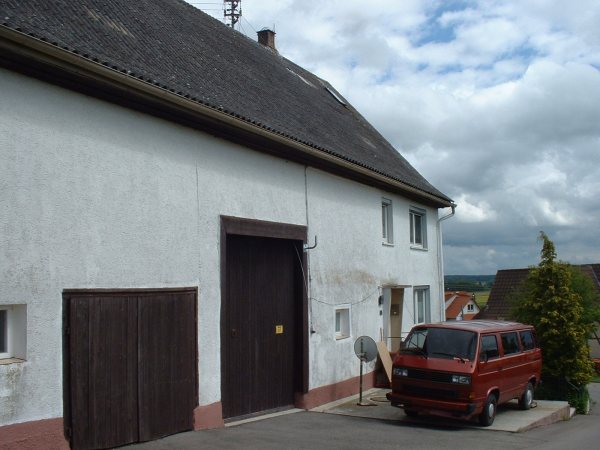
The Ös Farm – 2003

So here my father Ernst Klopp tried with little prospect of success to pick up his life-long dream again to running a farm under his very own management. Having no capital to spend on much needed supplies, he heavily depended on loans, which created a heavy financial burden. He must have counted on the help from my older siblings for turning the farming operation into a successful venture. 
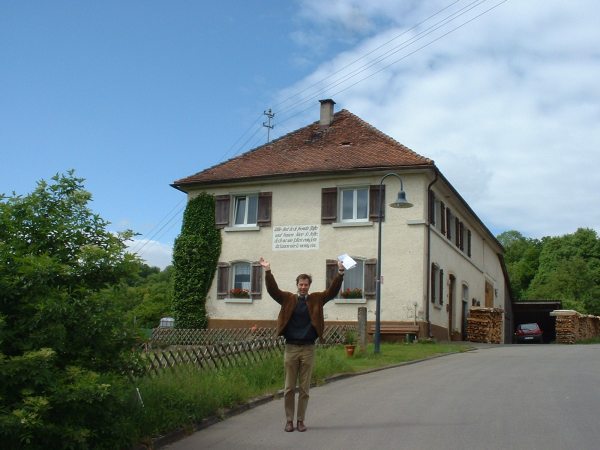
  The Farm House opposite to the The Ös Farm – Visit by our sons Robert and Stefan in 2003

Soon after his high school graduation Karl left home to study economics at the university of Braunschweig. Adolf, my second eldest brother, barely 18 years old found work at the Bizerba Factory in Meßkirch. Since that time in the early 1950s the Bizerba Company GMBH has developed into a world leader in weighing technologies for industry and trade. Adolf had to contribute most of the money he earned in order to keep this fledgling farming operation financially afloat. Three years later, Adolf was getting tired to support what in his opinion was a hopeless enterprise. Together with another refugee son by the name of Waldemar Klein he immigrated to Canada. Soon thereafter, my sister Erika also left home to take up nurses’ training in the City of Hamburg. In 1954, Gerhard managed to get an apprenticeship placement in a prestigious institute of technology in Switzerland.

Ernst Klopp (1900 – 1964) – Part 20

Ethnic Cleansing 1945 – 1948

Reparations in Kind

With the article below describing the topic of an open lecture hosted in 2010 by the prestigious Unviversity of Waterloo, Ontario, Canada, I am going to provide some background of the tragic events which engulfed the Ernst Klopp family in the 1945 to 1948 time period. My father was one of the over two million Germans who were deported to forced labour in the Soviet Union and our family was one of the 14 million ethnic Germans who were driven from their homes in the eastern provinces. Considering that more than 2 million Germans perished, I cannot help but declare that the survival of the entire family was a first-class miracle.

Recently during my family research, I read online the following announcement by the U of W and I quote:

Pursuant to the 1945 Nürnberg indictment and 1946 judgment the forced deportation of civilians for purposes of demographic manipulation and/or forced labour constitute war crimes and crimes against humanity. Several Nazi officials were found guilty of having perpetrated these crimes. At the same time as the Nuremberg Trials were conducted, more than 14 million Germans were expelled from their homes in East Prussia, Pomerania, Silesia, East Brandenburg – territories that were part of the defeated German Reich, from Bohemia and Moravia, from Hungary and Yugoslavia. Nearly two million ethnic Germans were deported to forced labour in the Soviet Union as “reparations in kind”. The Statistisches Bundesamt in Wiesbaden and subsequent scientific demographers have estimated that more than two million ethnic Germans perished as a result of their expulsion, either as victims of lethal violence or as a consequence of exposure, hunger and disease. In his 1946 book entitled “Our Threatened Values” Victor Gollancz appealed to a general sense of justice and morality: “If the conscience of mankind ever again becomes sensitive, these expulsions will be remembered to the undying shame of all who committed or connived at them … The Germans were expelled, not just with an absence of over-nice consideration, but with the very maximum of brutality.” Alas, the expulsion of the Germans was given scant press coverage and was seldom discussed or even mentioned in history books. The first UN High Commissioner for Human Rights Jose Ayala Lasso, in a statement to the German expellees assembled at the Paulskirche in Frankfurt am Main on 28 May 1995 stated: “I submit that if in the years following the Second World War the States had reflected more on the implications of the enforced flight and the expulsion of the Germans, today’s demographic catastrophes, particularly those referred to as ‘ethnic cleansing’, would, perhaps, not have occurred to the same extent.” Unfortunately there were no “lessons learned” from the expulsion of the Germans. In 1992 the UN General Assembly called the policy of Ethnic Cleansing in the former Yugoslavia “a form of genocide”. The ICJ and the ICTY similarly found that the massacre of Srebranica constituted genocide. How many massacres of ethnic Germans 1945-48 reached the threshold of genocide or crimes against humanity? Several professors of public international law have raised this issue and insisted that International Law and human rights law cannot be applied à la carte. The UN General Assembly has affirmed the right to truth. The German expellees and their descendants have at least this right.