Ernst Klopp (1900 – 1964) and his Family – Part 33

Signs of Disintegration

The only child left in 1954 with his parents Ernst und Erika Klopp was the 12-year old Peter. With no family workers left on the farm that produced little more than a few eggs from the henhouse and milk from a goat or two, my father’s health being on rapid decline, there remained scant hope  for a successful farming operation and inevitably Father’s dream came to a sudden end. All the Ernst Klopp children eventually emigrated and settled in Western Canada.
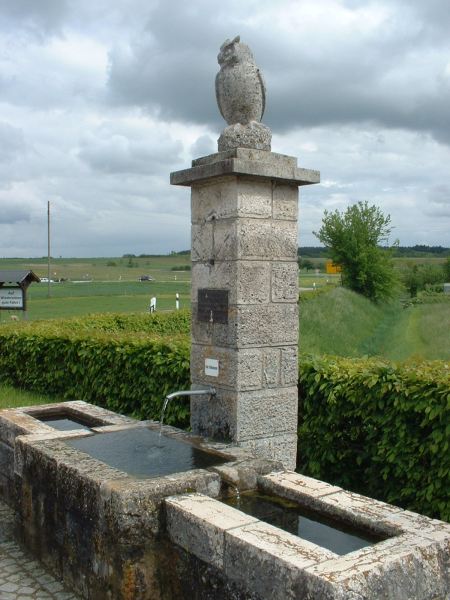
The Fountain at the Intersection in the Lower Village – 2003

Four years after the lease agreement with retired farmer Ös came into effect, my father gave up and burdened with a heavy debt load became officially unemployed. He moved into a tiny house at the bottom of the hill where he was often bed-ridden suffering from intense backaches for long stretches of time. In the meantime, my mother found employment as a housekeeper and cook at the Hohenzollern Castle at Sigmaringen. In the meantime, carpenter master Stoll and his wife in Meßkirch took care of little Peter in the role of foster parents, while he was attending the local high school.
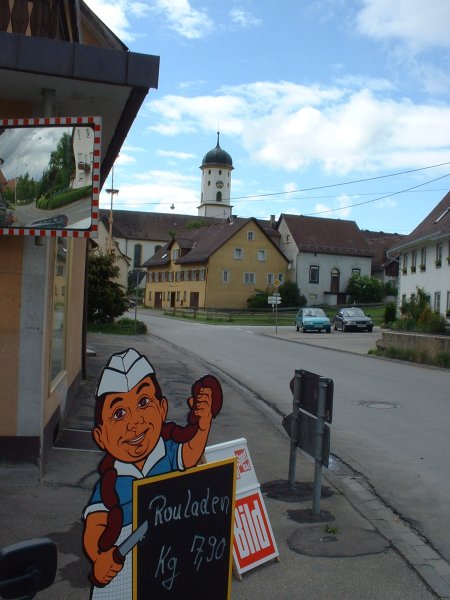
Store in the Upper Village – 2003

So after what had begun with a miraculous escape from death and destruction in their home province Pomerania and a promise of fetching a few morsels of the former happiness, the glue that once held the family together loosened and showed definite signs of disintegration.
Ernst Klopp (1900 – 1964) and his Family – Part 32

The Ös Farm

Then suddenly in the summer of 1950 an opportunity presented itself to Ernst Klopp. An elderly farmer by the short name of Ös decided to retire and leased his farm house and a few parcels of land not more than 6 ha in size to my father on credit. By comparison to the 3,000 ha Ernst had administered in Gutfelde, the total of arable land available for farming was minuscule. The house was adequate and a vast improvement over the upstairs dwelling of the ‘poor house’.  It came with a large barn with a hay loft, a sufficient quantity of farm implements, a fair-sized kitchen, the ubiquitous manure pile in front of the kitchen window and an outhouse. The only luxury item that I recall was the large tile stove (Kachelofen in German) providing warmth and a cozy ambience for the entire dwelling. Many of my sweet childhood memories are going back to the Ös farm, as we often irreverently called it.

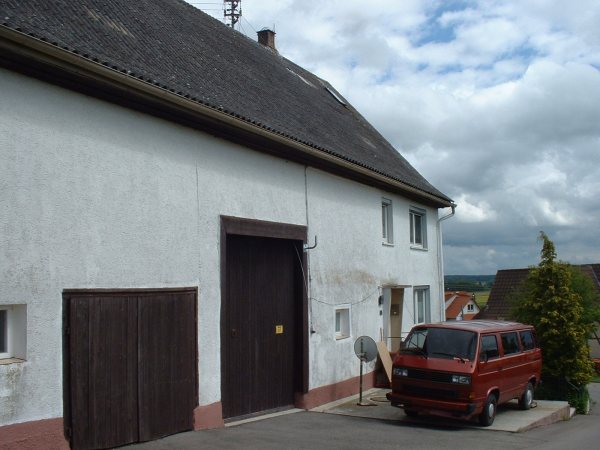
The Ös Farm – 2003

So here my father Ernst Klopp tried with little prospect of success to pick up his life-long dream again to running a farm under his very own management. Having no capital to spend on much needed supplies, he heavily depended on loans, which created a heavy financial burden. He must have counted on the help from my older siblings for turning the farming operation into a successful venture. 

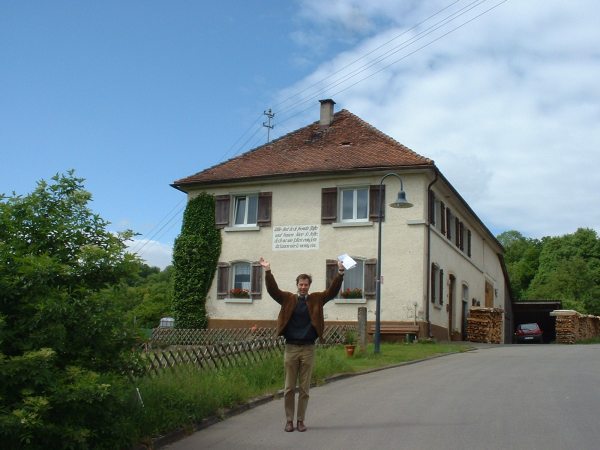
  The Farm House opposite to the The Ös Farm – Visit by our sons Robert and Stefan in 2003

Soon after his high school graduation Karl left home to study economics at the university of Braunschweig. Adolf, my second eldest brother, barely 18 years old found work at the Bizerba Factory in Meßkirch. Since that time in the early 1950s the Bizerba Company GMBH has developed into a world leader in weighing technologies for industry and trade. Adolf had to contribute most of the money he earned in order to keep this fledgling farming operation financially afloat. Three years later, Adolf was getting tired to support what in his opinion was a hopeless enterprise. Together with another refugee son by the name of Waldemar Klein he immigrated to Canada. Soon thereafter, my sister Erika also left home to take up nurses’ training in the City of Hamburg. In 1954, Gerhard managed to get an apprenticeship placement in a prestigious institute of technology in Switzerland.

Ernst Klopp (1900 – 1964) and his Family – Part 31

A New Beginning in Southern Germany

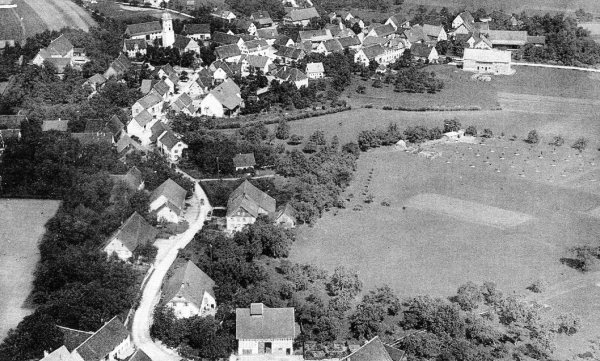
Rohrdorf as seen on an old postcard – about 1950

In June 1947, Ernst Klopp established himself anew in Rohrdorf , a small village near Meßkirch in Southern Germany. After finding employment as a forestry worker of the Fürstlich-von-Fürstenbergischen Forestry Administration located at Donaueschingen with a branch office in Meßkirch, he was able to reunite with his wife Erika and children. Adolf and Erika (see my sister’s report in an earlier chapter) joined them after a two- years interim with Uncle Günther in Erfurt.

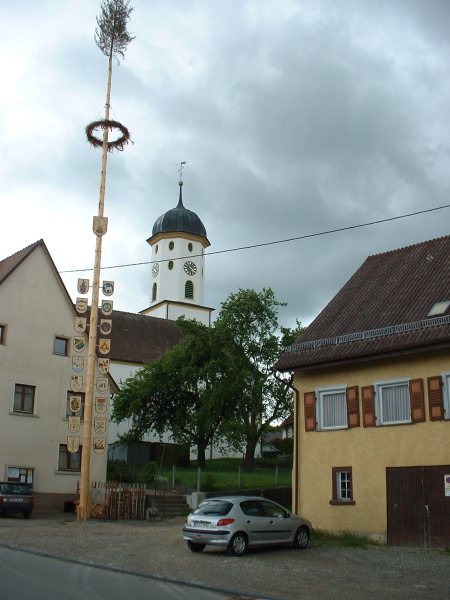
May Tree with St. Peter and Paul Church in the background – 2003

Karl, the eldest son, was the last one to join the Ernst Klopp family. The von Waldenfels couple, having to flee from their Panwitz property, had settled at their newly acquired estate Pentenried near Munich. In February 1948, they took the 19 year-old Karl into their care and provided food and shelter  for about a year. After an agricultural apprenticeship in Nellenburg near Stockach, Karl was finally able to join his family.

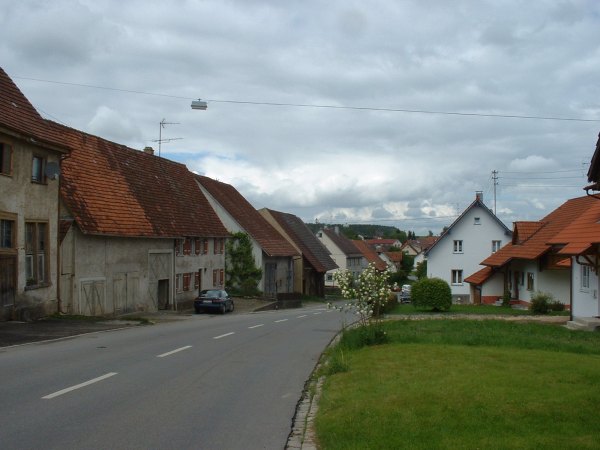
Street connecting the Upper and Lower Village of Rohrdorf – 2003

Rohrdorf consists of a long drawn-out assembly of farms and houses divided into a lower and an upper village. In the upper village we find the places where most of the social activities took place in the late 40s. There were at least two inns, a grocery store, a branch of the Credit Union, a dairy operation on the road to Meßkirch, an elementary school and the catholic St. Peter and Paul church. Our family lived in the lower village in the upstairs portion of a house, which my siblings called the ‘poor house’. Its primitive tight living quarters were a far cry from the spacious and luxurious estate in Gutfelde. Being the youngest child, I felt nothing of the stress that the other family members experienced during these difficult times of the postwar era.

Ernst Klopp (1900 – 1964) and His Family – Part 23

Report by Peter’s Sister Lavana (Erika}

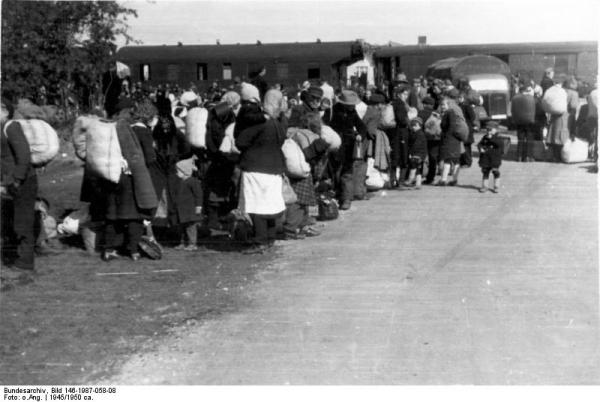
The war came to an end with Germany’s unconditional surrender on May 8th, 1945. But nothing changed in Mother’s life for more than a year until early in the summer of 1946 when she was expelled along with millions of other Germans from her homeland. In a well-calculated program of ethnic cleansing all German nationals were forced to leave in order to make room for the Polish people who had been displaced in turn by the Russians in their eastern provinces. Thus, the Pomeranian lands that had once been settled and cultivated for a period of over 500 years by industrious German pioneers and farmers were put under permanent Polish administration and are now part of Poland. 

Arrival of Refugees in West Germany

By now I was a little over four years old. What I have been writing about myself, I had gleaned from Mother’s diary, from my second-generation cousin Eberhard Klopp, who did extensive research on the Klopp family going back some four hundred years, from Uncle Günther’s Kegler Chronicles and other sources. I am especially thankful and greatly indebted to my brothers Karl (died in 2019) and Gerhard  and my sister for their personal accounts of their incredible ordeals. I decided to insert them here as documents of a tumultuous period and as a testimony to their inner strength and courage without which they would not have survived.

Report by my sister Erika who adopted a new name Lavana Kilborn in the early 1980s

My Journey from 1943 to 1947

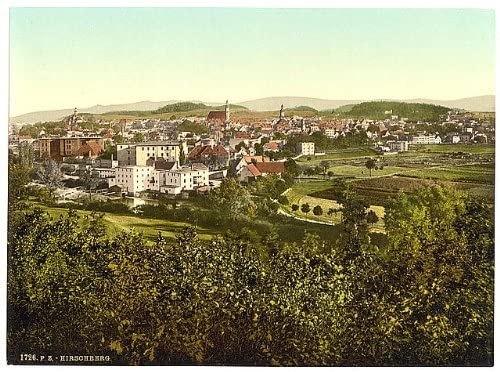
In the summer of 1943, my mother and I left by train for Hirschberg, where relatives of mine resided. As we lived in the country, it was necessary for me to move in order to obtain proper schooling. My host-family consisted of my widowed aunt Johanna, her parents and three cousins of mine, one of them being a girl, named Elisabeth and two boys. After a few days my mother returned home. 

Hirschberg near Breslau,  Lower Silesia

I got along very well with my new family, in particular with Elisabeth, who was of the same age as myself. We sat side by side in school and became good friends. The beautiful city had a large swimming pool, surrounded by grass to sunbathe, play ball etc. On weekends the family would go hiking in the nearby mountains, where the source of the mighty Elbe River is located. The song “Oh du schönes Riesengebirge, wo die Elbe heimlich rinnt …” still makes me melancholic, when I sing it. We also skied on wooden skis. There were no lifts then, but how much fun it was. All these activities were new and exciting experiences for me. 

To be continued …

Ernst Klopp (1900 – 1964) Part 21

Release from the Soviet Forced Labour Camp

As already mentioned earlier, my father Ernst Klopp and thousands of other German citizens were captured by Red Army soldiers and as a non-combatants were deported with full approval of the other Allied powers to forced-labour camps in the Soviet Union. At Wikipedia we read: “The capture and transfer of civilian ethnic Germans to the Soviet Union began as soon as countries with a German minority began to be overrun in 1944. Large numbers of civilians were taken from countries such as Romania, Yugoslavia, and from the eastern parts of Germany itself.”

At this tragic juncture, the Ernst Klopp family was scattered all over the eastern provinces of Germany. My mother was left to fend for herself. From Arnswalde she travelled north with four orphans, my brother Gerhard and me in search of the older sons Karl and Adolf to Belgard (today Polish Bialogard). There, they had attended the local high school and had boarded with family friends.  But the 16-year and 14-year old brothers had already taken off to escape from the approaching Red Army. For the longest time, Mother did not know their whereabouts.  Furthermore, my sister Erika attended school at Hirschberg, Silesia, where she stayed with uncle Bruno’s widow and her children Hartmut, Elisabeth, and Jürgen. Writing a cohesive account of all members of the family during the postwar years is very difficult and has to wait until I have concluded my father’s life story.

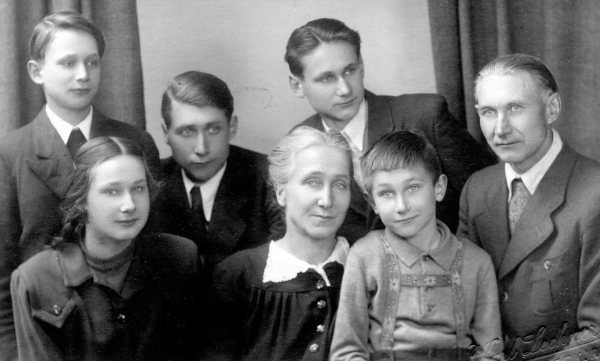
In the meantime Father had a major accident, while he was working in the coal mines in the Donbass region of the USSR. He received treatment for his head injury and would have been sent back to work, if he had not feigned continual headaches. Thus, he succeeded in getting an early release and was sent back to Germany. When he arrived at Uncle Günther’s place in Erfurt, he heard that the entire family had survived the war. He established contact with Mother and the children and in 1947 moved to Rohrdorf, a small village in Southern Germany between the River Danube and Lake Constance. There he found employment with the regional branch of the Fürstlich-von-Fürstenberg forest administration. Eventually the entire Klopp family was reunited. Although now extremely poor, often hungry, and dispossessed, the family was finally together again and could attempt a new beginning.

First Photo of the Reunited Ernst Klopp Family in Rohrdorf 1950

Ernst Klopp (1900 – 1964) Part 18

Peter’s Second Year – Mother’s Day 1943

From My Mother’s Diary

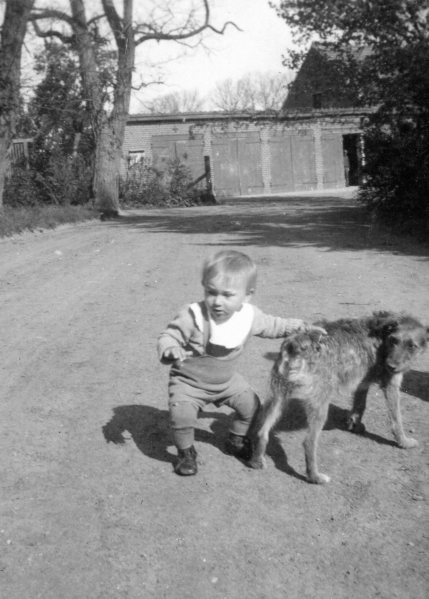
Spring came early in 1943. I spent a lot of time outside exploring the world around me. I learned to stand up on my own and ventured to make my first stumbling steps. Jupp, the friendly family dog, was my steady companion and my best friend for a while. Unlike my older siblings I refused to take the bottle and from my first birthday on I proudly drank my milk from the cup. When people were watching, I did my best to entertain them and show off my newly acquired skills. With the good weather also came a stream of visitors to enjoy the peaceful environment and the hospitality they found at Gutfelde. These visits spread over a couple of months were quite enjoyable for hosts and guests alike, even though some stayed for as long as three weeks or even longer. On top of it all, Karl and Adolf came home for the Easter holidays. Karl had acquired a certain degree of stardom with his excellent performance at the Belgard High School and his rapid development of his piano playing skills. As always, when he was home, he was asked to demonstrate his progress at the family piano. This went over very well, especially as his music teacher was also present and accompanied him on Father’s violin.

Peter and his Friend Jupp

Mother was honoured for the second time on Mother’s Day in Seebrück (Rogowo), a near-by town southwest of Gutfelde. With her five children, four of whom were male, she ranked very high among all the mothers in the region. Mother’s Day was a state supported festival, upon which a lot of emphasis was given to the meaning of motherhood mostly for ideological and mythical reasons based on ancient Teutonic folklore. Women in general were considered not weak, but very precious who had to be protected at all cost from any involvement in war activities. Germany was the only nation that did not employ women in the war effort in any shape or form. Young girls in colourful dresses presented flowers to the mothers. This year it was Father’s turn to make a speech to the assembly. What he was saying about motherhood and family came straight from the heart and with his genuine admiration for all mothers and especially for his beloved wife left a lasting impression on all those who were present.

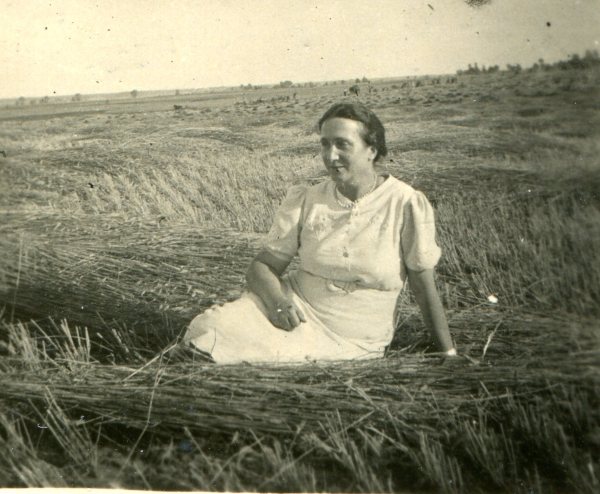
Peter’s Mother in a Rye Field 1943

Mother’s diary of the first 15 months of my life came to a sudden end, because she had simply reached the last page and did not want to start another booklet. If one considers that this diary with the many tiny photographs pasted into it and written in beautiful Sütterlin handwriting was from among all the other precious goods the only object that she managed to bring safely to West Germany, one must concede that we are dealing with a little miracle. The far greater miracle, the survival of the entire Klopp family in the closing days of  World War II and afterwards, will be the subject of the next chapter.