Ernst Klopp (1900 – 1964) and his Family – Part 32

The Ös Farm

Then suddenly in the summer of 1950 an opportunity presented itself to Ernst Klopp. An elderly farmer by the short name of Ös decided to retire and leased his farm house and a few parcels of land not more than 6 ha in size to my father on credit. By comparison to the 3,000 ha Ernst had administered in Gutfelde, the total of arable land available for farming was minuscule. The house was adequate and a vast improvement over the upstairs dwelling of the ‘poor house’.  It came with a large barn with a hay loft, a sufficient quantity of farm implements, a fair-sized kitchen, the ubiquitous manure pile in front of the kitchen window and an outhouse. The only luxury item that I recall was the large tile stove (Kachelofen in German) providing warmth and a cozy ambience for the entire dwelling. Many of my sweet childhood memories are going back to the Ös farm, as we often irreverently called it.
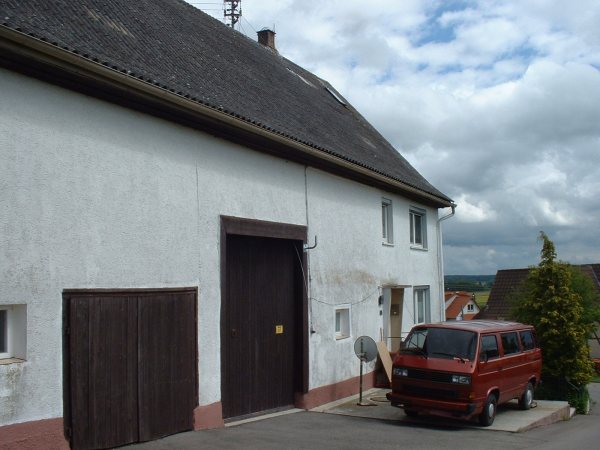
The Ös Farm – 2003

So here my father Ernst Klopp tried with little prospect of success to pick up his life-long dream again to running a farm under his very own management. Having no capital to spend on much needed supplies, he heavily depended on loans, which created a heavy financial burden. He must have counted on the help from my older siblings for turning the farming operation into a successful venture. 
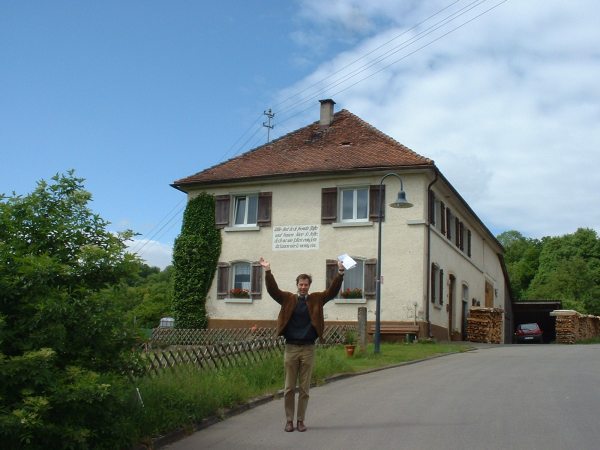
  The Farm House opposite to the The Ös Farm – Visit by our sons Robert and Stefan in 2003

Soon after his high school graduation Karl left home to study economics at the university of Braunschweig. Adolf, my second eldest brother, barely 18 years old found work at the Bizerba Factory in Meßkirch. Since that time in the early 1950s the Bizerba Company GMBH has developed into a world leader in weighing technologies for industry and trade. Adolf had to contribute most of the money he earned in order to keep this fledgling farming operation financially afloat. Three years later, Adolf was getting tired to support what in his opinion was a hopeless enterprise. Together with another refugee son by the name of Waldemar Klein he immigrated to Canada. Soon thereafter, my sister Erika also left home to take up nurses’ training in the City of Hamburg. In 1954, Gerhard managed to get an apprenticeship placement in a prestigious institute of technology in Switzerland.
Like-Minded People of Applegrove Road – Part II

LIKE-MINDED PEOPLE

A BRIEF HISTORY OF APPLEGROVE ROAD

By late Bill Laux

Aspinalls had a farm at the Fauquier end of Applegrove Road, the present De Boer property. The Spillers had come from Austria in 1913 and taken up land on Heart Creek, which they reached off the Applegrove trail, which Mr. Spiller must have widened to a wagon road to access his property from the Ferry landing.

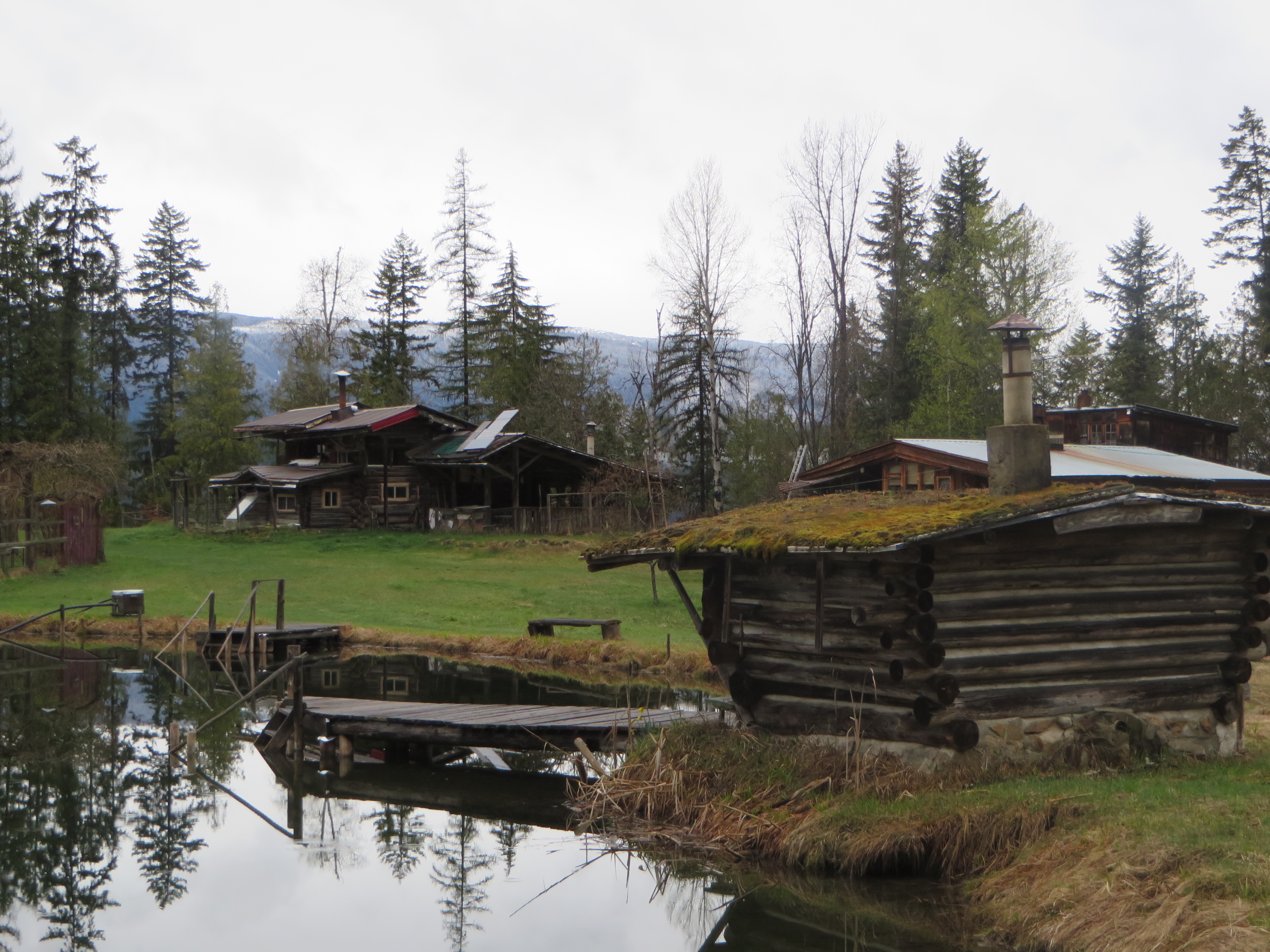
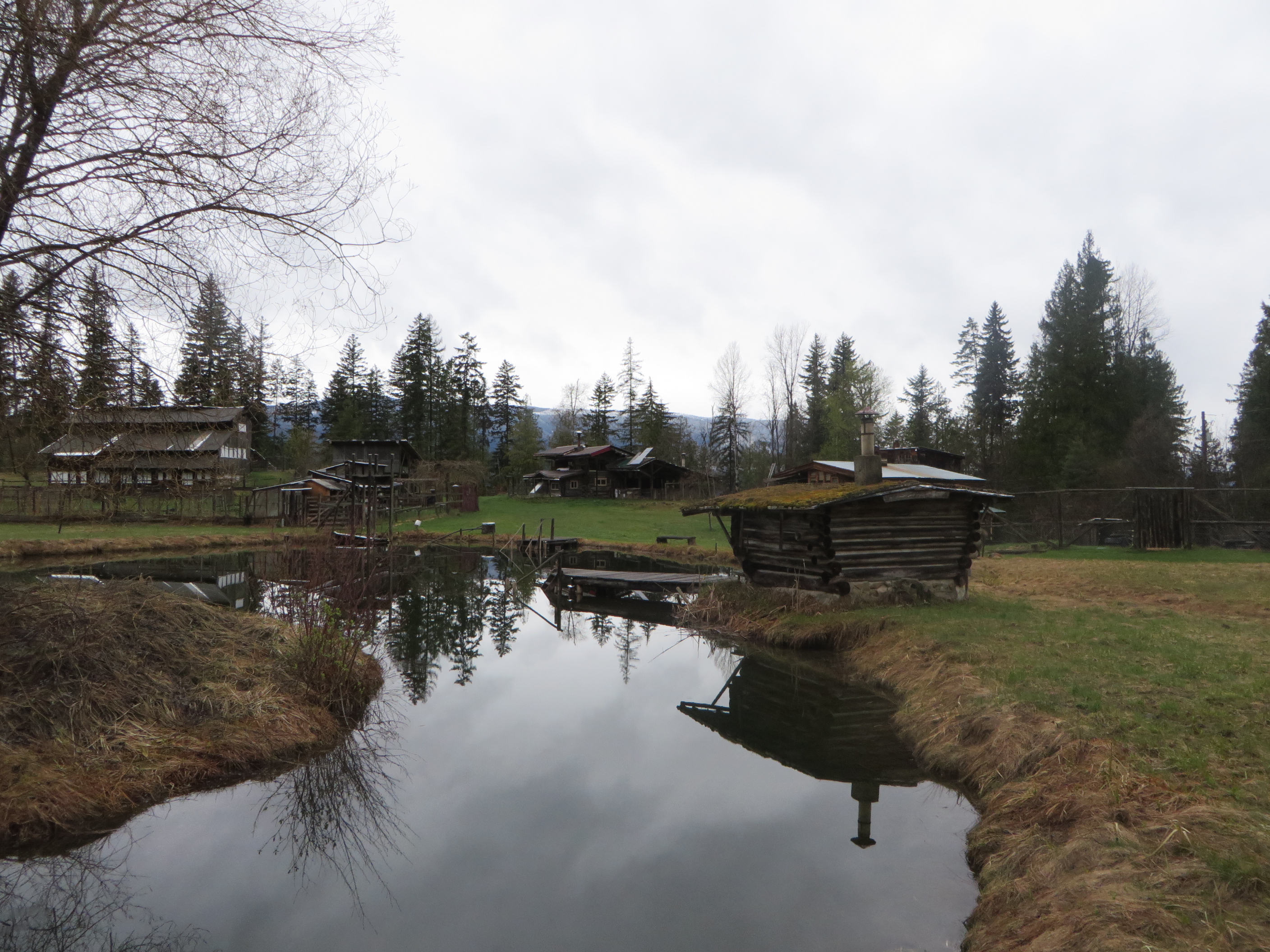
The Mead-Eichenauer Property with Sauna and Pond in the Foreground

The Mead-Eichenauer Property with Sauna and Pond in the Foreground

Others, opening up the trail, took up land at each promising meadow or marshy location, which looked suitable for draining. It was, in those first years, crucial to have a hayfield while the heavily timbered lakefront land was being cleared and stumped. Gaustein took up the land along März Brook in 1920 (the present Netting property since 1966). Apple trees were planted and these early orchardists engaged in horse logging to make a living until their apples should come into production. The logs were horse-hauled to the lake shore, decked on the beach in the winter to await high water and the tug to tow them to Waldie’s mill at Robson. It seems certain that by the Twenties there was a wagon road as far as the Mosheimer Place and probably another kilometer past it to a house, which had been built on the clearing at the top of Eichenauer’s hill. The name of this settler is not known. Percy Schlag, who had an orchard in Fauquier, opened up a meadow on the south side of Heart Creek at the source of März Brook and drained it with a ditch to make a hay field. During the years when the lake shore lands had to be cleared and stumped for orchards, any mountain meadow or drainable swamp was a prize location to be preempted and   put into production for hay.

IMG_5272

From about 1913 Apple Packing Schools were held in the Valley to show the new orchardists how to get their fruit into commercial channels. Only perfect fruit was acceptable, no blemishes permitted. This left, especially in bad scab years, a great deal of fruit unharvested. These apples were used by many to fatten pigs for sale and most everyone made apple juice. With the addition of a bit of wine yeast, fermentation took place and hard cider was produced. August Scribe took the process farther and built a still. He located it under his pig shed to conceal the odour and took care to have a dry-hinged gate, which would squeak loudly, if anyone approached. He planted wormwood nearby to use as a flavoring, telling his customers he had made absinthe. It is said he shipped the product in cream cans to Nelson on the Minto with each can sealed with dairy stickers only to be removed by the milk inspector.

Mosheimer had his feet badly crushed in a logging accident and had to give up farming. He and his wife moved to Vernon where they opened a laundry. The property was bought by Mr. Kendricks of Needles, who leased it out for hay and pasturage. It came to be known as Kendricks Place (close to the present day Mead-Eichenauer Place). Gaustein, as well, left, though we do not know when.

All these years the slashed trail to Applegrove was still used as a route for Fauquier farmers to take their teams down to Taite Creek where from time to time horse logging jobs were available. Several wagon roads were built off Applegrove Road to reach the magnificent old-growth timber up the various creeks. One road ran up Heart Creek a short distance to reach a particularly fine stand of large cedars. Another extended Percy Schlag’s road from the south end of the Funk Meadow up and around the north end of Mineral Ridge to reach the timber on the North Fork of Taite Creek. In the early Sixties logging contractor Steiner built the Pin Road to harvest the Mineral Ridqe timber and the Heart and Pin Creek drainaqes. Applegrove became little more than a log dump.

Continue reading