Friedrich Wilhelm Ferdinand Klopp (1879-1952) – Part II

Turmoil in the Parental Home at Wolmirstedt

Klopp Family Tree

Chart I – II

Around the turn of the century the rope maker’s apprentice Ferdinand Klopp turned 21 years of age. The family structure in the overcrowded house in Wolmirstedt threatened to fall apart. The business of rope making was just beginning to secure an income to feed the family. It was also quite foreseeable that the continuously expanding family would soon reach the breaking point.
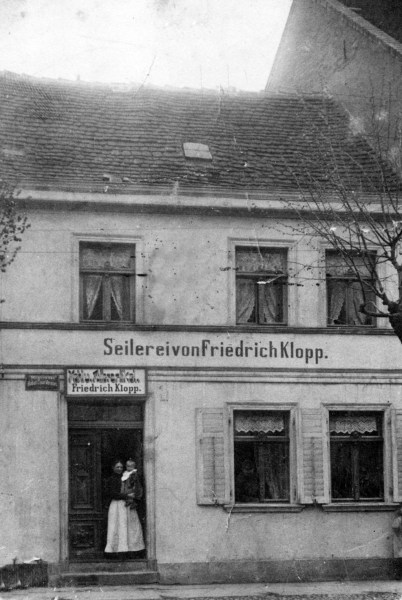
4 Seilerei Klopp

Although the siblings Jula and Karl, the nineteen-year old Rosa, the eighteen-year old Alma, possibly also the fifteen-old Anna had most likely been placed elsewhere, the parents Emma and Peter Friedrich Klopp still had to care for the remaining five sons and three daughters. In addition, they had to cope with the newly-weds Friedrich, their eldest son, and Marie-Luise Klopp, who was expecting her first child. This all happened at the same time, as my grandmother Emma was expecting her 16th child, my father Ernst Klopp.
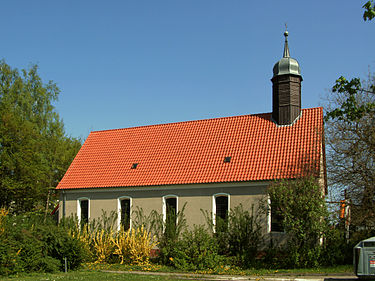
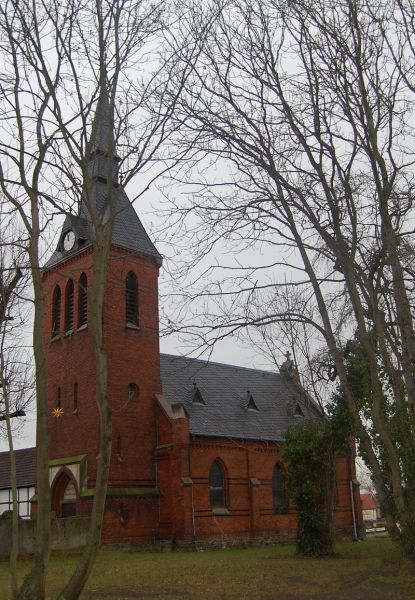
375px-Wolmirstedt_Kirche_Josef

St. Joseph Church in Wolmirstedt – Photo Credit: wikipedia.org

In this tense and often emotionally charged atmosphere lack of control and anger were heaped onto the ‘Late Bloomer’ Ferdinand. His father P.F. Klopp turned violent and beat him up on several occasions. The dummy, as Ferdinand was often branded never forgave this kind of humiliation. Father Klopp in the meantime was seeking comfort through beer and schnaps in ‘Fatjes Hotel’ or in the ‘Anchor’. One night in May 1900 his alcoholic excesses cost him his life, when on his way home he fell off his horse.

Friedrich Wilhelm Ferdinand Klopp (1879-1952) – Part I

A Somewhat Rocky Start

for Ferdinand Klopp

Klopp Family Tree

Chart I – II
Magdeburg - Photo Ctedit: wikipedia.org

Magdeburg – Photo Ctedit: wikipedia.org

On November 22, 1879 the fourth child was born in the house on Hemmsack Street in Osterweddingen near Magdeburg. Anyway, these houses – some still existing today- are traditionally ascribed to the dwellings of mill leasers and workers since the 19th century. Already in 1881 Ferdinand moved with his parents back to Jerslebe3n, spent three years there  at the Düppler Mill and in 1885 entered the Elementary School of Wolmirstedt, the birth place of my father Ernst. In the nearby town of Jersleben, Ferdinand’s father P.W.F. Klopp had found work as miller master.

Church at Jersleben - Photo Credit: wikipedia.org

Church at Jersleben – Photo Credit: wikipedia.org

In 1893 Ferdinand was sent to Hannoversch-Münden to attend a dairy apprenticeship program. When he returned to his father’s great disappointment after only one year of training, his father forced him to work with his eldest brother Friedrich as a rope maker’s apprentice in the Wolmirstedt house. He had probably shown little interest in his work in Hannoversch-Münden and further increased the image of a good-for-nothing worker under the whip of his elder brother and rope making master Friedrich. The disrespectfully treated Ferdinand was from then on called rather degradingly clown (“Klon”).

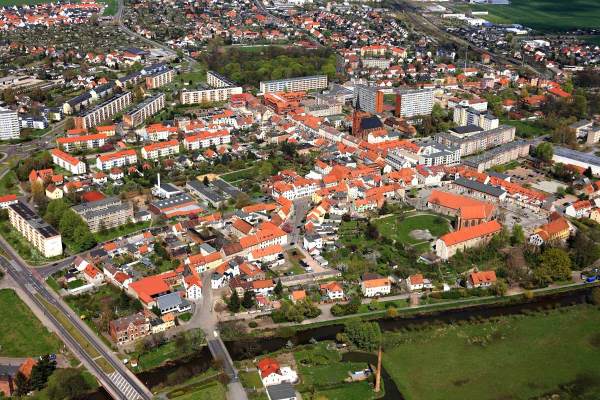
Arial Photo of Wolmirstedt - Photo Credit: wolmirstedt.de

Arial Photo of Wolmirstedt – Photo Credit: wolmirstedt.de

The Rise and Fall of the F. Klopp Rope Making Enterprise

The Collapse of the Wolmirstedt Business Venture

Adapted and translated from Eberhard Klopp’s Family Chronicle

Chart I – II

Within five years the Klopp and Weihe families had added amongst and against each other so many wounds that only after a century one can look at them with a certain emotional detachment. They should not remain the last ones. Within the course of one generation, the two families had drifted apart and  the deep gulf of enmity between them was steadily widening. In the Weihe family the daughter did no longer communicate with her mother, in the Klopp family mother, brothers, sisters no longer with Emma’s eldest son. In the Klopp/Weihe family – no longer worth being called a family – all members completely acted out their mutual dislikes emerging out of the most varied and unlikely causes.

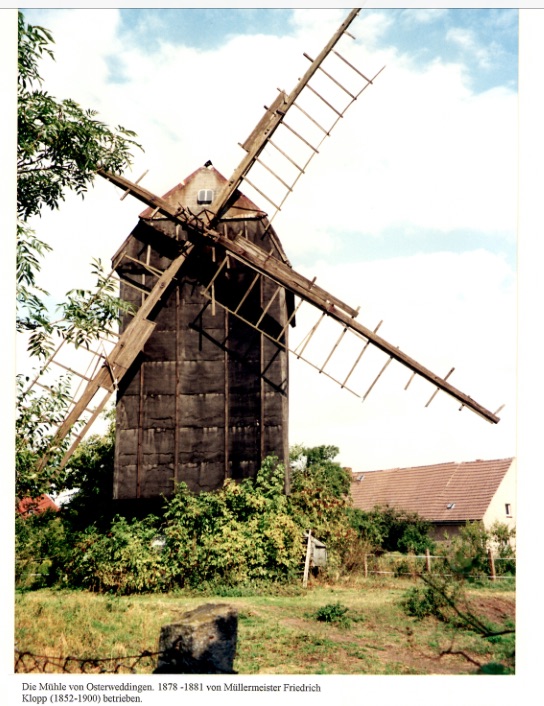
Windmill

The mill my grandfather Peter Friedrich Klopp owned and operated is now a German heritage site.

In the Klopp house in Wolmirstedt Friedrich devoted all his energies to the business. For the boat people on the River Ohre he produces ropes and cords, which the rope manufacturing plant ‘Seilerei von Friedrich Klopp’ kept ready for his costumers. Furthermore, he acquired a piece of land with a workshop south of the Ohre bridge on the right side on the road to Elbeu. There Friedrich and his workers twisted hemp fiber into ropes, The length of the ‘rope course’ was 15 m. In front of the bridge ramp the last house on the left at the Magdeburg Str. was the inn ‘At the Anchor’ (Zum Anker). It served as the meeting place for the Ohre boaters and was strategically located only 40 m from Friedrich’s factory and residence. Diagonally across stood ‘Fatje’s Hotel’, which served as a kind of exchange agency for goods and services, where the Wolmirstedt business elite would do their trading transactions. At the business table would often sit among other dignitaries Carl Loß (1865 – 1937), owner of a nobleman’s estate and of the largest sugar and starch factory of the region. Through him Friedrich primarily sold his various rope products. Ropes and nets were very useful and much-needed during harvest time. In order to secure the safe transport of sugar beets on the horse-drawn wagons they found much use in the Loß’s agricultural enterprise.

In these years 1907 and 1908 two more children were born to the Friedrich Klopp family. Under slowly deteriorating economic conditions Friedrich managed to provide food and shelter for his growing family until 1912, when he gave up his business. The steady decline of shipping  on the Ohre River reduced the profitability of his business. The taking down of the old wooden Hindenburg Bridge in 1908 and the long wait for the construction of the new stone bridge cut off Friedrich’s access to the market, further diminishing his already declining business. Add to these problems new attempts by his brother Ferdinand to seize house and business and we find the perfect recipe for financial ruin and disaster.

To be continued ….