Walter Panknin (1898 – 1977) and His Family Ch 8 Part 3

Papa Panknin’s Comments on Gertrud’s Eating Habits

Some of my blogging friends are quite right in pointing out that just because Biene was a picky eater does not mean that she was anorexic. To summarize this rather sad development, I let Papa Panknin speak through his letters to friends and family between 1959 and 1963. Hopefully, not too much of Papa’s sarcasm and irony is getting lost in translation.

1959-12-20 “After many years, we are looking to a joyful Christmas. For the first time in eighteen years, I have been thinking about having once again a roasted goose on the table and a bottle of wine. But that thought evaporated into thin air. The kids reject any poultry with an expression of utmost disgust. My wife and I cannot eat an entire goose all by ourselves. So we are planning to have a rabbit dinner. There is no harm in having two eaters less at the dinner table.”
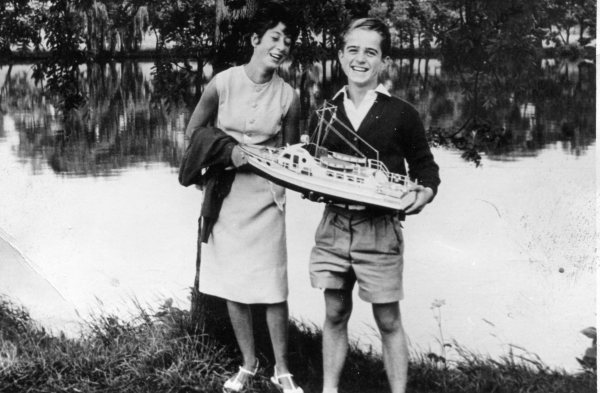
The Twins Gertrud (Biene) and Walter Panknin 1961

1961-12-06 “Gertrud is adopting an unnatural lifestyle. It is God’s plan that a young girl should work and be in constant motion from dawn to dusk. Instead, the kids sit on school benches all morning and lazily spend the afternoons on couches. Biene only eats apples. According to books and magazines, eating apples makes you slim and good-looking. Which woman and, even more so, which girl isn’t prepared to make big sacrifices on the altar of beauty. When fashion moguls declare that an old jam pot would serve as a fashionable head cover, it would be done without questioning. Of course, the industry would not do such a stupid thing and suggest something to reduce their profits. Mamma worries a lot about our daughter’s lack of appetite. Biene eats nothing, almost nothing, only fruits. Consequently, she has no bowel movements. Someone who eats nothing has no bowel movements. I know this from my time as a POW.”

Walter Panknin (1898 – 1977) and His Family Ch7 Part 15

Outdoor Activities through Camping and Boating

Ten years passed before the Panknin family could dream about camping and canoeing again. After securing financial security, they started with short local trips to the nearby Baldeney Lake at the Essen-Werden Campground. When they fled Soviet-controlled East Germany in 1954, they had to leave their belongings behind, including their camping gear and folding boats. So they bought, bit by bit, tents, air mattresses, cooking utensils and, of course, last but not least, folding kayaks. It was at the Werden Campground where I met, under the most mysterious circumstances, my future wife Gertrud Panknin (Biene) on the long Pentecost weekend in May 1962.

At this time, Papa had already given up his dream of going on extensive boating excursions with his family due to the children’s reluctance to accept their father’s river paddling fantasies. Also, Mama’s health was rapidly declining, and she was no longer willing to participate in strenuous travel adventures.

In 1960, Papa, prompted by sweet nostalgic memories of his journey on the Danube in 1939, decided on a similar expedition on the idyllic little River Weser that flows northwestern into the North Sea. No matter how carefully he had planned the river adventure down to the last detail, he could not order suitable weather for their journey. Always good with words, especially when presented in writing, he describes with a bitter touch of regret the misery his rebellious family was no longer willing to endure.

Walter Panknin (1898 – 1977) and His Family Ch7 Part 13

Papa Panknin, the Popular Hiking Guide

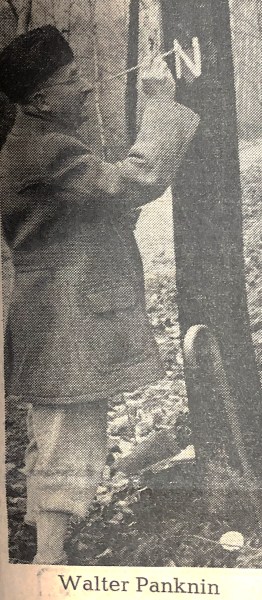
Retired Major Panknin enjoyed being out in nature and helping revitalize old trails that had fallen by neglect into disrepair and marking them by following strict environmental guidelines. While reading over the pamphlet on how to prepare a route for the enjoyment of the hiking community, I was impressed by how carefully the details were described, such as the kind of paint to use, where to place the sign, which trees to use and which trees to avoid. I liked the rule: Better to have no sign at all than a sign confusing by its inaccuracy. His daughter Biene often accompanied him in the rewarding outdoor activity.

What Papa Panknin enjoyed the most was serving as a hiking guide for the frequent excursions through the forested hill country of the Velbert territory. Biene tells me that the participants were primarily women. That may have also been part of the reason why he enjoyed becoming a trailblazer for his club.

During his involvement in the SGV Velbert, he received plenty of praise and recognition for his invaluable contribution from participating hikers, the press and the local club president. In a newspaper clipping, I read how much his work was appreciated. “So we see Walter Panknin walking through the woods with a can of paint and a brush as an apostle of a great idea, of the concept of hiking in the automobile age, leading us back to Mother Nature, to the source of healing power. Walter Panknin selflessly serves this idea for others from person to person.”

Walter Panknin (1898 – 1977) and His Family Ch6 Part 28

New Friends on the Road to Adolescence

Biene wrote this Post

After our return from summer camp in Berg Neustadt, our parents told us the exciting news that the construction of the apartment building was nearing completion. If all went according to schedule, we would celebrate Christmas in our new home.
Angelika had moved to Wolfsburg during the summer. My friend and I had been an inseparable pair, mainly keeping to ourselves. Angelika did not like to “share” me with other girls and had jealously guarded our friendship. I felt lost without her. I was apprehensive about going back to school, fearing being without friends. Once in a while, Angelika and I were invited to for a special occasion to Gisela’s house. Gisela was the girl from Eisenach, the famous town close to Gotha, where the Wartburg castle is located.
But as so often in my life, my fears were unfounded. Gisela and her friend Gudrun felt sorry for me and asked if I wanted to walk with them during recess. They also invited me to do homework at their homes. They always took turns. Knowing my situation, they did not mind that I could not ask them back because of the Old House. I promised them they could always come to my place once we moved. They were okay with this prospect.
Gisela lived with her grandparents, her mom and her older sister in a new apartment not far from our prospective home. Gisela’s pretty mom, a petite, dark-haired woman, was a war widow. Gisela had never known her dad, a pilot, who was killed shortly before her birth.

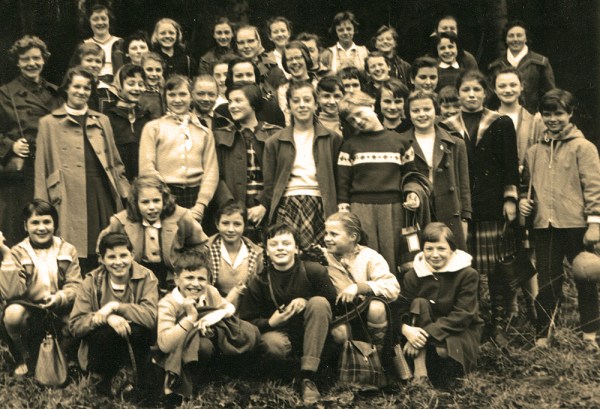
School Photo with Biene at the Centre


After the war and their flight from east Germany, Gisela’s mom worked as a seamstress while her parents took care of the household chores. Gisela, a tall, long-legged girl with big brown eyes, always wore the most stylish and beautiful dresses which her talented mom designed and sewed for her. Gisela was a bit more serious and reserved than most classmates and appeared to be older.

Walter Panknin (1898 – 1977) and His Family Ch6 Part 10

The New School

Biene wrote this post.

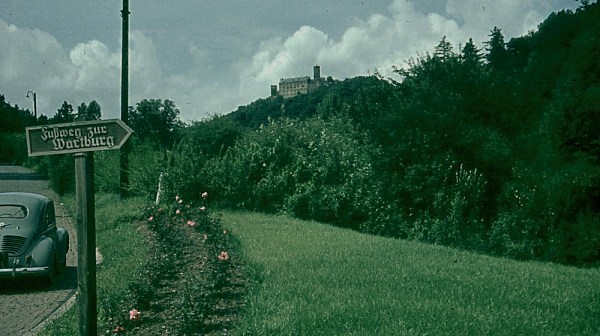
The school looked new and bright. Our teacher was a young, tall man with a severe expression. He didn’t smile at us once. About thirty students quietly stared at us when we entered the classroom. I recognized a girl and a boy I had seen last night at the Old House. When our teacher introduced us as refugee children from Thuringia, a tall girl with big brown eyes smiled at me. Gisela was her name, and she eventually became one of my best friends. She still lives close to Velbert, Germany. We have only seen each other twice after moving to Canada, but we have been corresponding for almost 50 years. I soon discovered that she was born in the “East” and from Eisenach, close to Gotha in Thuringia. Eisenach is renown for its imposing Wartburg castle.

Historical Photo of the Castle Wartburg (late 1960s)

When school was dismissed, a girl from one grade higher than us approached me and introduced herself as Margit. I had briefly seen her through the window at the Old House this morning. Margit smiled at me warmly and invited me to walk back with her. She became my closest friend when we lived at the Old House. Margit was mature beyond her age. She was a motherly type and a born leader. We liked her cheerful and outgoing personality. Fights amongst us kids never lasted long because she was a peacemaker, and we trusted in her judgement. 

About 15-20 kids about our age lived in the Old House, and we spent most of our time playing in the big yard around the old building. The Old House used to be a beer garden restaurant with a bowling alley in its younger days. The hedged-in yard with old trees had been the garden area of the venue where people would eat and drink on warm and sunny days.

Walter Panknin (1898 – 1977) and His Family Ch6 Part 6

Moving to Another Camp

Biene wrote this post.

One day in early spring, our mother told us that we would soon be leaving the camp in Aurich, East Frisia; we would move to Velbert, situated in the Rhineland region of  West Germany.  My mother sounded very excited and joyful because she was born and raised in the Rhineland, a beautiful part of Germany. It meant saying goodbye to my best friend Ingeborg and all our other playmates with whom we had shared so many exciting adventures and experiences.

However, before moving to Velbert, we first had to spend several weeks in a transitory camp in Massen,  a small town near Unna, close to Dortmund,  our second station in the “Golden West.”   I remember from that short stay that my mom was quite upset because we had to sleep in a big dormitory again with lots of strangers.  And to make things worse, we had to lie on straw mattresses.  But my parents consoled themselves with the prospect that we would soon move to Velbert.  That’s where apartment buildings for refugees were being constructed rapidly.

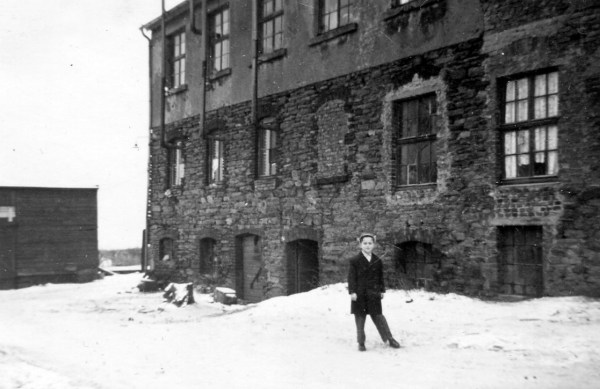
Biene’s Brother Walter Standing in Front of Transitory Camp in Massen

On a bright, sunny day in early Spring, we were loaded with all our luggage and several other families onto the open back of a big, old transport truck with makeshift benches. My brother and I had rarely ridden in a car.  This was my first time in a vehicle. For us, it was exciting!  My mom thought it was odd that we were transported like baggage. She didn’t like that we were all crammed together in this small, draughty and not too clean space. But my brother and I were laughing with the other kids and some boisterous men enjoying the cool breeze and the changing scenery. After a few hours, we were all shaken up by the bumpy ride.  The increasing cool drafts, the loud noise of the motor, and the vehicle’s rattling started to make us feel sick. Suddenly the truck came to an abrupt halt beside an old, dilapidated stone building that looked almost like a dungeon, dark and foreboding.