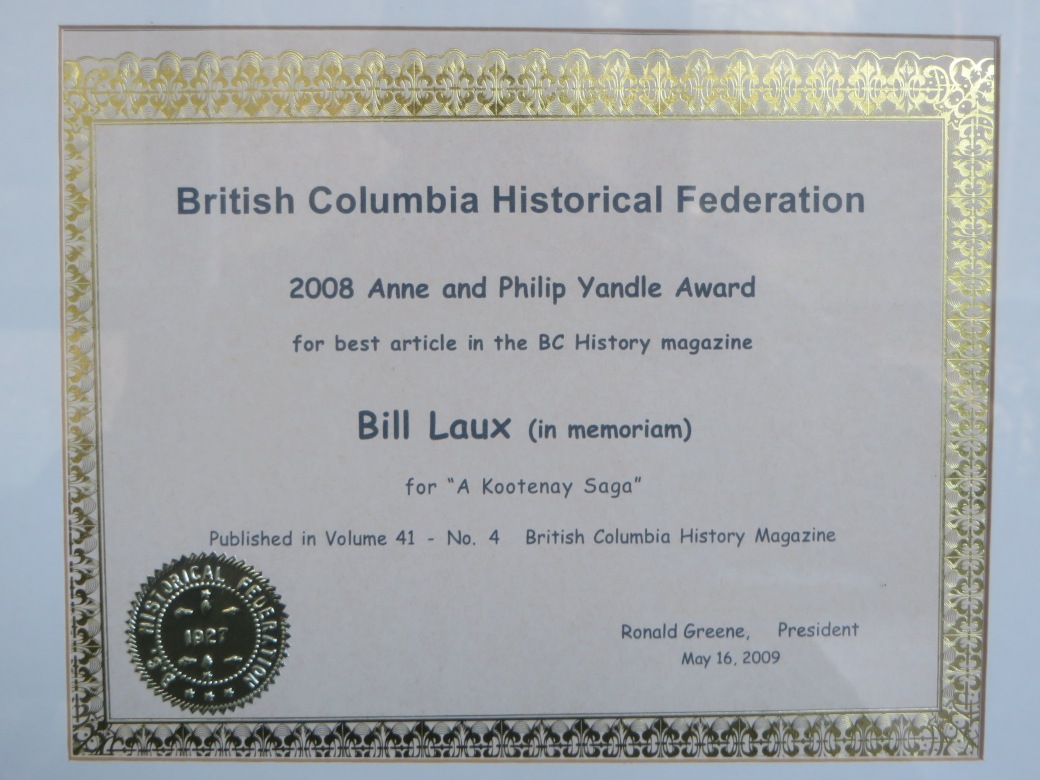
STEEP AND CROOKED … by Late Writer, Artist & Castle Builder Bill Laux – Chapter IX

STEEP AND CROOKED: THE MINING RAILROADS OF THE CANADIAN BORDER

 By Bill Laux

CHAPTER NINE

  GRANBY 1895 – 1902

Granby-Smelter

Jay P. Graves at the California mine on Red Mountain had held his breath in 1895 and taken the plunge.   He bought into a pair of copper prospects on Knob Hill in the Boundary range of the Monashee Mountains a few miles north of the border.   An old and trusted acquaintance, H.P. Palmerston, had come to him with a proposal.   Palmerston had been offered one quarter of their claims on Knob Hill by the Greenwood prospectors, Henry White and Matthew Hotter, on a promise that he would raise development money.   Palmerston was ill and unable to interest anyone in these remote claims.   He sold his interest in them to Jay Graves.

Graves put his Spokane boarder, Aubrey White, a bookseller, to peddling stock in these claims to Spokane mining speculators in 1896.   White could get no more than 10 cents a share; on the Spokane Mining Exchange they traded for just 5 or 6 cents.   This was failing to raise enough capital to begin work, so Graves sold his house and moved his family into the Spokane Hotel. With the money from this sale, he hired Henry White, the original locator, to begin to clearing the forest from the claims and digging a trench to expose the top of the ore body.   When the extent of the deposit had been established by trenching the shallow overburden of soil, Graves bought a boiler, a steam powered hoist and a steam pump to begin sinking a shaft into the ore. This machinery had to be hauled by wagon from Bossburg on the SF&N line to Grand Forks.   Then a road had to be brushed out up to Knob Hill on the ridge top west of town. The claims that Graves had bought did not contain the rich, narrow veins plunging steeply into the mountain, as at Rossland.   The trenching had showed that the copper was a large, saucer-shaped ore body just below the surface.   How thick it was, no one knew.   It was only 1 or 2 percent copper, but there was a great deal of it, and it contained minor amounts of gold and silver.   A pit could be opened and the ore quarried cheaply out of the hillside.   Still, more development money would have to be raised to determine the full extent of the ore body.

Graves had incorporated the two claims with 1,500,000 shares for the Knob Hill and 1,000,000 shares for the Old Ironsides.   In 1899 he sent out Frank Hemmenway, a Spokane bank teller who doubled as a miner in the summer, to work with Henry White, trenching and taking samples for assay.   Hemmenway had a sound reputation with Spokane mining investors, and his favorable report boosted the stock price on the Spokane Exchange. It also started a rush of prospectors and promoters to the Knob Hill discoveries.   All those who had been too late to cash in on the Red Mountain bonanza now swarmed over Knob Hill, and claims were staked for several miles in all directions. The trenching White and Hemmenway had done on Grave’s Knob Hill claims suggested the presence of a very large ore body, much large than the original 600 by 1500 foot claims.  Graves used the money stock sales were bringing in to buy the adjoining claims and acquire the entire ore body.   Encouraged by reports of other ore bodies in the district, other serious investors were moving in.   In 1897 the Dominion Copper Company was formed to acquire the Idaho, Brooklyn and Stemwinder claims across the valley of Twin Creek from Graves’ developments.   All of the deposits found, while large and close to the surface, were of low grade.   None of them would pay for the long wagon haul to the railroad at Bossburg or Marcus.

Railroads were coming; Dan Corbin was surveying his line from Marcus to Greenwood.   Fritz Heinze was surveying his route over Mc Rae Pass.   The CPR was, with agonizing slowness, creeping in from Alberta.   The railroads had made Rossland, and Jay Graves was confident that when one reached his mines, there would be a boom bigger than had yet been seen.   A smelter would be required.   To raise money for it, Graves and Aubrey White went east to enlist Montreal investors.   Their pitch to the Montreallers was that it was a patriotic duty for Canadians to invest in these British Columbia mines, and not let them fall into the hands of the greedy Americans. The spectacle of a couple of Americans, Graves and White, glibly promoting Canadian patriotic sentiment was a replay of Captain Ainsworth’s arguments to the B.C. Legislature, twenty years before.   Graves and White were helped by the fact that Canada was in the midst of its great Free Trade Election and the issue of American domination of Canadian business was being fought out at the polls.   The anti Free Trade forces won and so did Graves. He enlisted the support of Stephen Miner, a Quebec industrialist with connections to the Montreal banking community.   Miner wanted a recognized mining engineer to submit a report on Graves’ to circulate to his wealthy friends.   Graves sent out another Spokane Colonel, Nelson Linsley, the head of the Spokane Mining Bureau, and a respected mining engineer, to assess the value of his claims on Knob Hill.

The report was favorable.   In Montreal, Stephen Miner showed it to his friends, and introduced them to Graves who, with his tongue stuck solemnly in his cheek, warned them of the dangers of Americans getting control of this valuable Canadian resource.   Might not even political annexation follow? he asked with a melodramatic shiver.   Miner’s friends were impressed.   The combination of patriotism plus profit was irresistible.   There is something embarrassingly familiar about this to Canadians.   It seems it always takes an American to arouse Canadian patriotism.            With a group of wealthy Montreal investors behind him, Graves went across town to the CPR.   He began lobbying the CPR directors to lay rails to his mines.   The directors were skeptical.   Three mountain ranges would have to be crossed, and they doubted that Grave’s low-grade copper would pay for the construction costs.   Jay Graves was at an impasse.   The railroad was essential to his mines.   Without a firm promise of one, he and Miner could not sell stock in the Old Ironsides and Knob Hill.   And until his mines demonstrated their profitability, the CPR would not move.            And just as it was the threat of American control that brought the Montreal investors into Graves’ scheme, it was Dan Corbin, lobbying for a charter for a railroad to the Boundary mines, that aroused the CPR.   They easily blocked his charter application in Parliament, but when Jim Hill bought Corbin’s railroad, the CPR had to act.   Almost in a panic, they sent their engineers and surveyors into the Monashee snows to rush a line to the Boundary Copper camps.

The arrival of Canadian Pacific rails in Grand Forks in 1899 was marvelous luck for Jay Graves and Stephen Miner.   With the CPR laying track toward their new mining camp of Phoenix, the future of their Granby Company was assured.   However, Graves knew very well the CPR’s intention to create a transportation monopoly in the Boundary district, just as they had attempted in the Kootenays.   And with the knowledge that only a second and competing railroad could bring the CPR ore hauling rates down to the lowest possible figure, Graves went to Jim Hill in St Paul.   He showed him Colonel Linsley’s reports on the Old Ironsides and the Knob Hill.   Would Mr. Hill build Dan Corbin’s line to the Boundary?   Jim Hill said nothing.  His game was bigger.   If Grave’s ore body was as big as Colonel Linsley said, and as cheap to mine, a rail haul, while profitable, would not be enough.   Jim Hill wanted the mines and the smelter as well.   Very quietly, he began buying stock in Graves’ and Miner’s companies. Graves and Miner had organized three companies in 1899, the Old Ironsides, the Knob Hill, and Granby, to control the properties they owned on the ridge between Grand Forks and Greenwood.   Graves brought Yolen Williams over from the California mine at Rossland, made him a director, and hired him to work out plans to extract the ore. Then, at the head waters of Twin Creek, just below their claims, Graves and Miner preempted a town site, called it Phoenix, built a water system, and began selling lots to merchants, saloon keepers, hotel men, and others moving to the new camp.            The town site was a huge success.   Buyers flocked in, scenting a new Rossland.   Within 24 hours of going on sale, nearly every lot was sold for between $500 to $600.   It was said that the town site sale brought in $100,000 to Granby.   Graves and Miner now had enough for a down payment on a smelter, and began to build one on the North Fork of the Kettle River, just over Observation Mountain from Grand Forks. Breathlessly, miners, businessmen and investors, watched the CPR’s branch line to Phoenix being graded around the eastern slopes of Deadman’s Hill toward the mines.   With the CPR laying tracks to their ore, and with directors, Miner and Gault, handling stock sales in Montreal, Aubrey White moved to New York and began selling shares there.   They began moving briskly in the range of 80 cents.   This was delightful news to the Spokane speculators who had bought their shares for a nickel.   And at 80 cents, Jay Graves was now a rich man.

The Guggenheim brothers at that time dominated American metal smelting and refining.   Walter Aldrige at Trail had served in one of their Colorado operations.   Now Graves hired another one of Guggenheim’s smelter engineers, Abel Hodges, to put up a first class smelter on the North Fork site.   With all this activity, the CPR queried Walter Aldridge, whether the Phoenix development was serious. Aldridge, who badly wanted the Phoenix ores for his Trail smelter, told President Shaughnessy that it was quite serious, and that the Old Ironsides held enough ore to support a small smelter.   Shaughnessy was asked by Graves to build a 2-mile CPR spur into the smelter site from the C&W main line at Ward Lake.   It was needed as quickly as possible, Graves emphasized, as the smelter machinery to be installed would be much too heavy for freight wagons.   Aldridge and Shaughnessy wanted the Phoenix ore for the Trail smelter, and were in no mood to facilitate a competing smelter.   They told Graves Granby would have to pay for the smelter spur itself, but the cost would be refunded if the smelter production should reach 100 tons per day.   Aldridge underestimated Granby.   The Phoenix ores were lean, averaging only 1-1/4 percent copper, and would require several smeltings to concentrate them enough for refining.   Abel Hodges assured Jay Graves that he could smelt 150 tons of Phoenix ore a day, and that the spur cost would be recovered. 

The CPR’s Phoenix branch left the main line at the Eholt summit and climbed up Coltern Creek on a 3.4 percent grade.   At the head of the creek a small side hill cut, exposed a mass of chalcopyrite, a sulfide of copper and iron.   An alert workman quickly drove stakes on it and sold it to the Dominion Copper Company as the Emma Mine.  Aldridge and Shaughnessy were in no hurry to serve Jay Graves’ interest, and at this spot they abandoned the climb to Phoenix and ran a 2-1/2 mile spur out to the B.C. mine.   Aldridge urgently wanted that mine’s ore, almost pure copper pyrites, for his Trail smelter, as its high sulfur content would only require enough coal to ignite it in the smelter furnace.   From then on the burning sulfur itself would smelt the ore.    Graves was furious.   The CPR was hauling Boundary ore to Trail before putting rails into his deposit.   If Jim Hill were only on the scene, the CPR would not be trifling with him in this way.   Angrily, he had to send his first ore shipments down the mountain by wagon to the Granby Smelter for its opening on April 11, 1900, exactly as the Le Roi had had to do from Rossland, four years previously.            Finally, the CPR sent its crews back to the Emma mine, and began grading up the east side of Deadman’s Ridge toward Phoenix.   Not a quarter mile from the Emma, their grading exposed another mass of copper ore, and with no Trail engineer present, it was staked as the Oro Denoro, and sold to the Dominion Copper Company.

From that point the graders carefully examined every stone for traces of copper, but no further bonanzas were uncovered in the steep climb to the ridge top flat at the Wellington Camp (later Hartford).   At the chaotic Wellington Camp the ground was covered with stores, tents and cabins whose owners demanded exorbitant prices for a right of way.   The CPR hastily put in a switchback on perfectly level ground rather than pay for the land needed for a loop.   (Later on, when the Wellington Camp declined, a loop was built.)   The switchback reversed the line north where it climbed through the Rawhide, Gold Drop, Curlew, and Snowshoe claims, and turned into a shallow pass at an elevation of 4500 feet to enter the head waters of Twin Creek, the new town of Phoenix and the Granby Company’s mines.

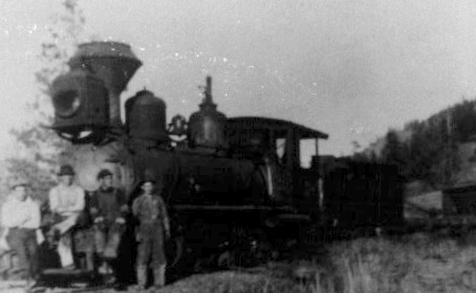
In June of 1900, the rails were spiked down, and the line was complete.   On July 11, the first trainload of ten 30-ton cars of ore from the Old Ironsides mine departed Phoenix behind CPR L class Consolidation No. 317.   At Smelter Junction, the train was split, with five cars set off to be forwarded to the Trail smelter, while the remaining five cars were trundled down the 2 mile spur to the to the Granby Smelter. They arrived at 5:30 PM and were received with elaborate ceremony. Jay Graves and his family, together with C.H.S. Miner, Abel Hodges, and their families, were present.   A local brass band played, and the whistle cords of the engines were tied down to express the jubilation of all present.   It had been a tremendous gamble, but Jay Graves had won.            The two smelter furnaces were fired up the next day, and another trainload of ore arrived, the beginning of daily shipments from Granby and the other mines in the region.   Jay Graves at once ordered two Thew steam shovels on flanged wheels for 36” gauge track.   Quarry faces were blasted into the ore bodies at the Old Ironsides and the Knob Hill, 36” track was laid, and the two shovels began digging out the broken ore and loading it into 4 ton mine cars.   Davenport 0-4-0 saddletanker locomotives hauled the mine cars out of the quarries to a loading platform where they were dumped into the CPR 30 ton ore gondolas below.   At least one of the Davenport saddletankers was a special model for underground use, cut down to a five foot height, and requiring its engineer to operate it and fire it from a sitting position.   This squat steamer could enter the caverns blasted into the quarry walls and pull out ore from underground.

All this mechanization was wonderfully efficient.   Jay Graves boasted accurately to reporters that the Granby ores moved from quarry to smelter untouched by human hands.   Dumping the mine cars was mechanized a few years later when a Granby employee invented the self-dumping Granby mine car.   A wheel on the outside of the car would ride up on a slanting rail fixed to a vertical bulkhead in the dumping shed and tip the car as the Davenport pushed it over the chute.   This “Granby Car” was sold all over North America in subsequent years. As soon as the CPR tracks reached the mines at Phoenix, production went on a six-day week.   The ores rolled in short trains down the steep 12 mile grade to Eholt where they were made up into trains for the Granby smelter and cuts of cars for Trail to be picked up by the next way freight.   A second Shay locomotive, No. 112, identical to the 111 working the Rossland hill, was ordered and put to work on the Phoenix line hauling ore down the hill, and bringing coal and freight up to Phoenix.

With the completion of the Phoenix line, the CPR shifted its crews to Greenwood to build another steep and crooked branch up Motherlode creek to serve the Deadwood, Sunset and Motherlode mines.   The branch left the main line just a few hundred feet north of the C&W station, and climbed the rock bluff above Boundary Creek on a 3.8 percent grade to enter Motherlode Creek above the new smelter being built by the B.C. Copper Company.   From the smelter, the line climbed the left bank of Motherlode Creek to the town of Deadwood, and the Greyhound and Deadwood mines, also open quarries like the Phoenix mines.   From Deadwood the line was built on that same 3.8 percent grade up Castle Creek to a switchback (later replaced with a loop) which reversed it out of Castle Creek and up Motherlode Creek again to the huge Sunset open pit, or “glory hole,” as they were then called.   A quarter mile farther on it reached the Mother lode mine and its even bigger glory hole.   Shay 113 was purchased in 1903 to work this branch.

The CPR surveyors had continued past the Motherlode mine, locating a line winding in and out of creek valleys and looping around the noses of ridges to Dan Corbin’s King Solomon mine.   This location was known as Copper Camp, at 4400 feet elevation, with the King Solomon and Enterprise as the major producing mines.   The line past Motherlode, however, was never graded or built.   Probably because the CPR demanded the mine owners pay for it, with reimbursement after a certain tonnage had been shipped.     Agreement was evidently never reached, and the end of track remained at Motherlode with the King Solomon and Enterprise ores coming down to that point on wagons.

From the Canadian Pacific’s point of view, the building of the Columbia and Western with its spurs and branches was more a defense against Jim Hill than a profitable investment.   They had spent an estimated 7 million dollars to put rails into the Boundary country from Robson West, and yet the mining companies had spent but 4 millions in their developments.   Worse, the startling news came that Jim Hill had bought the supposedly defunct charter of the Vancouver, Victoria and Eastern and his surveyors were staking grades into the Boundary country and up into Phoenix itself.

The CPR built a further spur from the Eholt-Phoenix line to serve the Jackpot and Athelstan mines, and surveyed two more grades long the spine of the Midway range across the border to reach the City of Paris and No. 7 mines at White’s Camp, and the Washington and Lone Star at the head of Big Goosmus Creek in Washington.These two last branches were never built; again, the owners would not pay, and found they could build a 5-mile aerial cableway to transport their ore back across the border into Canada and down to a second Boundary Creek smelter being erected by the Dominion Copper Company.   It went into operation in 1901.   With three smelters competing against him for Boundary copper, Walter Aldridge was finding it difficult to obtain sufficient ore for his Trail smelter.   His Canadian Mining and Smelting Company was obliged to buy or lease producing mines to secure a dependable supply of smelter feed.

By 1902 the Granby smelter was operating at capacity, and still more ore was coming down from the huge Knob Hill and Old Ironsides pits.   Graves and Miner merged all their Companies into Granby Consolidated Mining, Smelting and Power Company, Ltd. and issued $15 million in stock.   $11 million went to the stockholders in the old syndicate; the rest was put on the market to raise funds for enlargement of the smelter, the installation of a converter to produce nearly pure copper, and for a hydroelectric plant at Cascade, on the Kettle River, to furnish additional power for the smelter and to electrify the mines at Phoenix.   This enormous capitalization looked suspicious to many.   No one knew how deep the Old Ironsides and Knob Hill ore bodies were.   Did they really have $15 million dollars worth of ore?   Neither Graves nor Miner could answer this question definitively.   Speculators wondered if Graves and Miner were preparing to sell out at this inflated value before the ore bottomed out.

For his part, Graves had a new scheme.   This minor real estate developer from Spokane was going to try to play the two hostile railroad barons against each other for his own interests.   Graves was never shy; he approached Thomas Shaughnessy,  President of the CPR, with a plan to keep Jim Hill out of Phoenix.   He proposed that Granby should continue to smelt its own ores in its own smelter.   But since there was more ore now coming out of the ground on the heights around Phoenix than the Granby smelter could handle, and the cost of transporting ores to Trail over McRae pass was uneconomic, the CPR could build a second Grand Forks smelter, a custom smelter to handle all the ores from the mines not owned by Granby, B.C. Copper, or Dominion.   These ores could not stand the shipping charges to Trail and were going begging for treatment.   If the CPR would build this custom smelter, Graves promised he would offer as security for loans to build it, 28 options he held on mines in both the Phoenix area and also down in Republic, Washington in the new Eureka Creek mines.   If the CPR accepted his offer, he would guarantee them the haul from all these mines to the custom smelter as well as the Granby haul to its smelter.   Graves estimated revenue from these hauls to be $800,000 per year.   It was not unreasonable; CPR was already getting $380,000 a year from its haul to the Granby smelter alone.   It was a clever scheme; by using the capacity of a second Grand Forks smelter to contract for all the Boundary ores offered, nothing at all would be left for Jim Hill to haul.   He might run his rails up to Phoenix if he wished, but when he got them there, there would be nothing to load into his cars.

If the impetuous Van Horne had still been in charge, he might well have agreed.   But the cautious, conservative Shaugnessy was now President.   He sought advice from Walter Aldridge.   Aldridge told him the Boundary mines were overrated, that they were shallow deposits that would soon play out, that Graves could not demonstrate proven reserves of ore.   Shaugnessy turned down Graves’ offer.   As it turned out, this was a spectacular mistake.   Copper prices would soar during World War I making even the poorest Phoenix ores profitable.

Undismayed, Graves turned around and sounded out Jim Hill.   His new scheme, which he put to Hill, was nothing less than a proposal that the two of them should buy Granby outright.   He asked Jim Hill for a loan of $2 million to buy 500,000 shares of Granby at $4.   With the 150,000 shares he owned or controlled through relatives and employees that would give Hill and himself control. With control of Granby, Hill, when his rails reached Phoenix, could then take all of the Granby traffic and the CPR would be starved of ore.   After promising funds, Hill had second thoughts.   His suspicious nature which George Stephen had played upon so successfully, asserted itself.     He could not bring himself to participate in another man’s scheme.   When Graves got to Montreal to make his stock purchases, there was no money waiting for him.   He found the Granby directors ready to sell, as he had predicted to Hill.   They thought the future for copper was speculative, and wanted to get out while the stock price was favorable.   They were selling, however, to William H. Nichols, a New York copper refiner.   Frantic letters to Hill produced no result. Graves’ scheme was slipping away from him.   When the other directors, unaware of Graves’ intentions, invited him to go along with them and sell to Nichols, he had to agree.   Hill eventually sent him a stingy $25,000 in New York in case Nichols should change his mind, but it was too late.   Nichols and his New York associates had bought Granby outright.

One has to wonder at the eagerness of the Canadian stockholders to sell out to the Americans when it had been appeals to their patriotism that had brought them into Granby in the first place.   Emotionalism is probably much more a factor in business than most will admit. In 1902 Jim Hill’s men crossed the border into Canada at Cascade and began grading toward Grand Forks.   There they were halted by an injunction obtained from the court by one of the most preposterous railroads ever to run a train, Tracy Holland’s “Hot Air Line.”   Jim Hill had encountered his newest and most pestiferous adversary.
 

STEEP AND CROOKED … by Late Writer, Artist & Castle Builder Bill Laux – Chapter V

STEEP AND CROOKED: THE MINING RAILROADS OF THE CANADIAN BORDER

 By Bill Laux

Please note if you are interested in reading an action packed adventure story, but don’t have the time to read the entire chapter, scroll down to the first word in blue and bold letters and read from there.

train-at-mine

CHAPTER FIVE

TWO RAILROADS — TWO SMELTERS 1896 – 1898

With the completion of Heinze’s Trail Creek Tramway, the future of the two communities, Trail and Rossland, seemed assured.   On June 19, 1896, editor Thompson of the Trail Creek News, rhapsodized, “It is marvelous — the amount of tonnage arriving at Trail this spring, with three steamers running into Trail, yet the C&KSN Co. cannot keep the consignments of freight to Trail cleaned up. In two days last week, the steamers of the C&KSN Co. landed in Trail 500 tons of coal, coke and lime rock and general merchandise.   Every day sees the steamers of this company in Trail loaded down to their full capacity.   Yesterday, the steamers, “Nakusp,” “Trail,” and “Lytton, ” and the train of the Columbia and Western Railway were all in Trail at one time, and the aggregate number of passengers served by the three boats and the train was over 400, while the tonnage handled in that day amounted to over 250 tons.   And this is a town not yet a year old, and the season has just begun.”

This was June, with a full river, and even steamers drawing a full four and a half feet of water, as did the Nakusp, could make it down the difficult channel from Robson to Trail.   In December the low stage of the water would hold the big boats at Robson, with the little Lytton relaying their cargoes down across the sandbars, and through the shallow riffles.   A smelter had to have uninterrupted supplies of coal, coke, and flux (lime and silica rock), to operate.   With winter steamer operations interrupted by ice and low water, Heinze had to find a better way to bring in his fuel. He could, of course, have Dan Corbin bring in Roslyn coal and coke to Rossland, and then have it hand shoveled into his narrow gauge cars.   But this would put him into Corbin’s hands, an unacceptable situation.   His trip to England to raise money for his Columbia and Western extension was a failure.   He therefore mortgaged some Montana properties and let bids on the first section of the new railway.   It was not to run through the mountains from Rossland.   Instead, it would run up the right bank of the Columbia from his smelter to Robson West. This would give him year round access to the deep water of the Arrow Lakes and an assured coal supply.

Although the new town of Trail was growing and prospering, things were not well with the three companions who had founded it.   Success had had an unfortunate effect on Frank Hanna.   He and Mary Jane became estranged over his increasingly blatant immorality.   He owned two brothels in Trail and his own daughter, Olive, complained of her father’s sexual misconduct with a Mrs. Crossman in the same bed in which Olive was sleeping.   Mary Jane applied to the court for sole custody of her children, and on the grounds alleged, it was granted.   In the interests of propriety, Colonel Topping found it best to move out of the Trail House hotel and set up living quarters behind his office.

With the new Le Roi Company smelter at Northport in operation, the Le Roi mine was paying a dividend every month, and its owners were rapidly growing very rich.   Le Roi stock, which the Colonels had bought up for 25 cents a share, was now selling for over $5.00.   The Rossland mines and in particular, the Le Roi, were becoming well known all over the world for their extraordinary richness.   In London, speculators begin to consider the Red Mountain mines for investment.

Whittaker Wright, one of the more successful of those speculators, had formed the British American Corporation to invest in B. C. and Alaska mining properties.   Wright was one of those flamboyant mendacities that flashed like meteors across the financial heavens at the end of the Victorian era, occasioning awe, moral outrage, and corrosive envy in the British public.   H.G. Wells was so fascinated by him as a symbol of the absolute sovereignty of the money power, as to use him as a model for Edward Ponderovo in his novel, Tono Bungay.

An Englishman, Wright came to the United States, worked in the Pennsylvania oil fields, and was present at the Leadville, Colorado silver boom.   He was in Philadelphia in the 1880s, forming companies to buy Colorado and New Mexico mines, and to market their stock to Pennsylvania investors.   Learning the techniques of stock jobbing, Wright moved to London in the 1890s and began floating mining companies based on the West Australian gold mines around Kalgoorlie.   Wright’s game was not to mine gold, but to organize the mine company and then to sell stock in it, a greater value of stock than there was gold in the ground.   This was enormously successful as long as he could pay huge dividends, most of which came out of stock sales, rather than from whatever bullion was being produced.   As long as new companies could be floated, with their stock sales covering the dividends of previous companies, the game could go on.

Wright’s ostentatious mode of living was legendary with the British public.   They could not hear enough of his private yacht, his private stable of fifty horses, his private observatory, his private velodrome, his private theatre, and his private hospital. He had built an artificial lake on his Surrey estate, and, at the bottom of it, had constructed an underwater billiard room with a glass ceiling through which his guests could view his private fish.

Such an obvious command of large sums of money seemed to signify to the British investors a soundness of his financial empire, which it did not deserve.   To keep on grossly overcapitalizing his mines, Wright required continuing press reports of bonanza finds and sensationally rich mines which he could market.   The Rossland mines were being reported in the London press in 1897 as being the richest in the world. It did not matter whether they were or not; the perception was enough to bring investors running. Wright needed to own these mines to inflate the value of his stocks. He capitalized his British America Corporation at 1,500,000 pounds sterling, and sold its stock at an unprecedented 5 pounds sterling par value.   Its prospectus boldly stated that the Corporation was acquiring the Le Roi and other Rossland and Alaska mines. The well publicized Le Roi name brought the investors crowding in; they bought up more than a million shares at the first offering.

As his managing director and confidence inspiring “Guinea Pig,” Wright brought in a man with Canadian connections, the Hon. Charles Mackintosh, retiring Lieutenant Governor of the Northwest Territories.   He then sent Mackintosh to Rossland by private railway car to acquire the mines his investors were told they owned. Mackintosh was an imposing figure, with all the social skills of the British upper class, but he knew next to nothing of practical mining.   The British Columbia Review commented,  “…of his many social qualities we are well aware, but there is no mining man in Canada but would laugh at the idea of ‘Charlie Mackintosh’ having any idea of the value of an ore body.”

In Spokane the Le Roi Colonels were astonished. They had not heard their mine was being bought. Colonel Peyton remarked quite accurately, “To my mind it looked much as if the people who drew that prospectus used the name of the Le Roi Mine to attract the attention of the English investing public.”

Mackintosh arrived in his private railway car, had it run up the steep Red Mountain line to Rossland, and, flush with Whittaker Wright’s money, began buying mines. He purchased the Josie, the Great Western, the Poorman, the Columbia and Kootenay, and the Nickel Plate mines. He then sent a pompous telegram to London, which Whittaker Wright read to the assembled B.A.C. investors to loud applause. “The British America Corporation has secured and holds the key to a majority of the golden treasure houses of British Columbia. We will practically control the mineral resources of this Province.”

This bombast, while applauded in London, was greeted with derision in British Columbia, and with wicked glee in Spokane. The Colonels now knew that Mackintosh had to make good on his boast; he was obliged to buy their Le Roi, whatever the price. What followed can be interpreted in two ways: either an honest disagreement, or a very clever hoaxing of Charlie Mackintosh and Whittaker Wright.   Historians have tended to accept at face value a bitter disagreement dividing the Le Roi directors, as reported in the press; mining men have tended to smile knowingly.   The author sides with the mining men; believing that Mackintosh, in what followed, was gloriously hoaxed.

Two of the Le Roi Company’s directors, Colonel Peyton and Judge George Turner, went to London to entertain offers for their company.   This is odd; Mackintosh was in Rossland, ready to buy their mine.   Apparently they wanted to see what other tenders might be made.   Colonel Peyton went directly to the B.A.C. and Whittaker Wright.   He was offered three million dollars cash, and accepted, pending agreement by the other directors in Spokane.   But Judge Turner, independently negotiating, reported that a mysteriously unspecified source had offered him five million.

On their return to Spokane, a director’s meeting was convened on June 27, 1898, and Colonel Peyton displayed a check for $500,000 as a down payment on their mine. By the rules of the company, the three principal directors had to agree on any action.

Colonels Peyton and William H. Turner (not the Judge, but the Colonel) accepted the check, but Judge George Turner refused it on the grounds that they could get more than the B.A.C. was offering.   The directors now split into two camps, the majority, led by Colonel Peyton, and Judge Turner’s minority, including Colonel Ridpath, Major Armstrong, Bill Harris, the flamboyant hotelier and Le Roi mine manager, and Frank Graves.   Ostensibly, the sale was blocked by the disagreement between the two groups.   While they argued, Le Roi mine manager, Bill Harris, halted all development work (tunneling for new deposits), and put his miners to work stripping the veins of what high grade ore was in sight, and shipping it to the Northport smelter.   The mine was going to be sold; the only dispute was about the price.   The more ore that could be removed before the sale, the more profit for the owners.   The longer the sale could be delayed, the more they would make.

At a second meeting, this time with Charles Mackintosh in attendance, the two groups displayed a mutual enmity for his benefit.   Colonel Peyton, of the majority group, revealed that he had already tendered the 284,000 shares of his group to Mackintosh at $6.00 per share.   Those shares constituted a majority interest, and Mackintosh then declared that under British law, the B.A.C., as majority stockholder, now had the right to control the company.   But Judge Turner rose for the minority, and pointed out that the Le Roi Company was a Washington Company, and governed by the laws of Washington State.   And further, that the laws of Washington held that aliens could not own real estate within the State of Washington.   Since the Le Roi Company’s Northport smelter was in Washington, the B.A.C., as alien, could not control it, although it could control the mine in Canada. On this basis, Judge Turner secured a court injunction restraining Colonel Peyton from making a legal transfer of his group’s shares.

At this point affairs took on a momentum of their own and events moved swiftly.   The following account is taken from the newspaper reports of the day in the Rossland Miner and Spokane Spokesman Review.   The author is responsible for the probable dialog hinted at in the press reports.

L. F. Williams, secretary of the Company and a member of Colonel Peyton’s group, realized that Judge Turner, using the Washington law was in an unassailable position, and made a quick call to Austin Corbin, President of the Spokane Falls and Northern Railway.   He ordered a fast special train to be made ready for a dash to Canada.   In haste, he gathered all the Le Roi Company records plus its official seal from the Spokane office, and jumped into a horse cab for the depot. The one car train whistled off, and Williams inside, relaxed, convinced he was removing the company records from beyond the reach of Judge Turner and U.S. law.   But, the cunning Bill Harris had not been deceived.   Suspecting Williams might attempt precisely this, he had taken the precaution of removing the Le Roi Company’s official seal from its accustomed hook above Williams’ desk, and substituted the seal of another company.   On his arrival in Rossland, Williams discovered to his horror, that he had the wrong seal, and that no company business could be transacted until a duplicate seal could be made.            Judge Turner’s group, in possession of the precious seal, now hired deputy sheriffs to enforce the Washington Court’s injunction against Mackintosh and the B.A.C. people.   Mackintosh decided that the whole matter of the sale of the Le Roi had best be taken out of the State of Washington where Judge Turner appeared to have the advantage, and moved to Canada where British law would prevail. He had his private railway car coupled to Austin Corbin’s fastest locomotive, No. 7, a 4-4-0 with 63 inch drivers and capable of forty miles an hour on good track. He invited the majority directors, including the three trustees of the pooled Le Roi shares, to accompany him to Rossland, where, with a majority of the directors present and voting, the sale of Colonel Peyton’s shares could be ratified, and company business conducted — as soon as a duplicate seal could be obtained.

Mackintosh, with his majority directors, boarded his private car, and gave the signal to depart.   But Spokane County deputy sheriff Bunce entered his car to display a County Court order obtained by Judge Turner, and to tell Mackintosh that he must not proceed.   Armed deputies, he told the Governor, were waiting at the city limits, with legal authority to stop any train headed for Canada.

Mackintosh, quite baffled by the machinations of the American Law as expounded by Judge Turner, was now in his element as a British gentleman. Calmly lighting a cigar, he offered the deputy one.   With exquisite politeness, he explained to deputy Bunce that under the Common Law of both Britain and the United States, “A man’s home is his castle,” and that a gentleman’s private railway car is just as much his castle in the eyes of the law, as any monument of ancestral English stone.   That being the case, would not the deputy, as a gentleman bound to be scrupulous in his observance of the law, realize that his presence here without a warrant was an unfortunate trespass?

Deputy Bunce, awed, backed himself out the door, which was locked behind him.   Then he descended, went forward to the engine, boarded it, and ordered the crew not to move the train.   The train crew referred the matter to Austin Corbin, president of the line.   Corbin came down from his office and explained to Bunce that his injunction was against foreigners, the B.A.C. Company, and not against a law-abiding American railroad.   Bunce might order the gentlemen in the car behind, not to leave the United States, but his injunction gave him no right to prevent a railroad not named in the order, from running its trains where so ever it chose.

Deputy Bunce boarded the platform of Mackintosh’s private car once more and pounded on the locked door.   The engineer whistled off and the train began to move.From inside the car Mackintosh shook his head reprovingly at Bunce; the door remained locked.   As the train gathered speed, deputy Bunce climbed up on the tender and standing uncertainly on top of the pile of coal, drew his revolver.   He pointed it at the engine crew and ordered them to stop.   His shouts were lost in the sharp exhaust of the accelerating locomotive.   He clambered down into the locomotive cab and gestured with his drawn pistol.   The engine men shook their heads.   Holding his gun on the two men, Bunce pointed to the group of deputies blocking the track ahead and ordered the engineer to halt.   In response, the engineer pulled the whistle cord and threw the throttle wide open.   Down on the track the deputies scattered for the lives, and the train raced out onto the prairie ahead.

No. 7 was running wide open on the rough track, the private car lurching and swaying behind.   Deputy Bunce, with pistol in hand, was no doubt reflecting that the engine crew belonged to the Rail Brotherhoods.   It had been that group, but a few years before, in the Coeur D’Alene mines, he had dragged Tom Kneebone off his job and shot him dead for testifying against a railroad engineer in the Frisco Mill bombing.   It was a period of extreme union militancy in the West, and the Brotherhoods’ contempt for the law was well established.   Bunce prudently holstered his revolver and climbed back across the coal pile in the tender to Mackintosh’s private car.   Standing on the platform in a shower of cinders and soot from the stack, he pondered what to do.Inside the car, he could see whiskey decanters passed around, and the directors, in wicker chairs, puffing on their cigars.   Bunce knocked.   The directors turned their backs to him.   He held his court order against the glass and pounded the door.   No one paid him any attention.

It was a hot June day across the grasslands of Stevens County.   The train raced on.   Back in Mackintosh’s car, the windows were opened to catch the breeze and fragrant fumes of the Governor’s best Havana tobacco streamed out across the farmlands and stump ranches.   Bunce, on the platform, turned up his collar against the rain of cinders from No. 7’s stack.

It was 147 miles, Spokane to Rossland.   Seven hours, 25 minutes by timetable.   The men in the private car had promised the engine crew a champagne dinner at the Allen Hotel in Rossland if they made the run in under five hours.   Loon Lake, Chewelah and Colville came up.   The scheduled trains were waiting in the sidings as the Special flashed by.   Past Colville, Number 7 screamed down the long grade to the Columbia at Marcus, and began the long series of S curves as the rails followed the east bank of the river.   Grimly, Deputy Bunce, coattails flying, clung to the swaying platform of Mackintosh’s private car, still determined to do his duty.   At mile 130, Northport came into view.   Here the engine would have to stop to take on water for the final, steep climb to Rossland, 2400 feet above.   Bunce swung down from the platform, as the engineer spotted the tender under the waterspout. Bunce planted himself in front of the locomotive, displayed his court order to the gathering crowd, and drew his revolver.   With the crowd as witnesses to his lawful act, he announced, the train would move again only over his dead body.

But here, in full frock coat and embroidered vest, his shiny silk hat on his head and gold watch fob bouncing on his paunch, came the sometime Lieutenant Governor of a Canadian Territory, which, though scantily populated, was still fully as big as the entire United States minus Alaska.     Mackintosh offered the deputy another cigar.   Bunce had to holster his pistol to accept it.   Mackintosh then explained, with that same charitable politeness, that the Canadian border was but eight miles ahead, and if the deputy persisted in his attempt to stop a lawful train by force of arms, he would be arrested at the border for carrying a deadly weapon into Canada, an offense that carried a severe penalty under Canadian law.   “A word to the wise, Sir,” His Honour remarked amiably, and with a friendly pat on the shoulder, made his way back to his private car.

The fireman raised the waterspout as the tender overflowed, and shouted at Bunce, still planted in front of the locomotive, “Well, what’s it going to be, deputy?   You going to shoot a Brotherhood man or get out of our way?” Deputy Bunce flourished his weapon, the crowd of small boys and station loungers looked on in fascination.   A few quick wagers were made.   The engineer blew three blasts, shoved the Johnson bar into its top notch, and opened the throttle. The train, to deputy Bunce’s great relief, backed away, backed toward Spokane.   Then the deputy holstered his pistol with a grin to the onlookers.   But why were they laughing?   What was the joke?   Bunce peered down the track. The train was still backing.   At the far end of town it disappeared around a curve.   An idler in the crowd remarked, “You sure stopped ‘em, mister.   Only you was at the wrong end.”   The crowd burst out laughing.   They were laughing at him, deputy Bunce realized.   What had happened?

Then, from down at the far end of town, came two derisive whistle blasts.   Bunce saw the train come into view again on the distant trestle, leading, he now realized, to the great Columbia River bridge.   The stop at the station was merely for water. The line to Rossland branched off a half mile south.   The engineer had backed his train to the switch and taken the line for Canada.   In the distance, the little one car train rumbled over the bridge, whistled once more and headed up Sheep Creek for Canada.       Bunce walked to the station platform, sat down, and lit up the Lieutenant Governor’s cigar.   To the assembled crowd he muttered contemptuously, “God damned foreigners, anyway!”   He puffed for a moment.   “Not a god damned thing to do with me,” he said, blowing smoke into the air. But the station platform was empty.

With the dispute now transferred to Canada, Mackintosh tried to settle it under Canadian law.   A directors’ meeting was called for July 3, in Rossland.   SF&N No. 7 was washed and polished, hitched to a parlor car, and then the Turner minority group came up to Rossland by special train.   At the meeting, Judge Turner managed to have the $500,000 check returned to the British America Company as premature.   Beyond that, there was stalemate, and No. 7 trundled the minority directors back down the loops of Little Sheep Creek to the U.S. A. and Spokane.

A second meeting was called for Spokane.   Another special train ran up to Rossland to bring the majority group down.   They were, as they reminded themselves, the owners of the richest gold mine in the world, and must travel as such.The railroad performed these services as perfectly as its rough track would permit, but the meeting was a total deadlock.

In Rossland, Mackintosh tried a new tactic.   Bill Harris, the mine manager, and member of the minority group, had had his men stripping the stopes of all the high grade ore they could find, and shipping it to Northport to be converted into dividends for the owners.   The delay in consummating the sale was not only embarrassing to Mackintosh; it was depleting the mine of valuable ore.   The Governor determined to get rid of Harris.   Lacking a company seal, and unable to perform official acts, the Governor applied to Judge Spinks, of the Kootenay County Court, to have the Le Roi Company placed in receivership.   The Judge agreed and W. A. Carlyle, a former Provincial Geologist, was appointed receiver.   Carlyle dismissed Bill Harris and appointed a new mine manager with instructions to reinstitute development work and reduce ore shipments to a minimum in order to starve the smelter of ore, and the owners of dividends, while the sale was still pending.

Bill Harris had been shipping 350 tons of the Le Roi’s best ore every day; the majority group had been obliged to watch this high grading before their eyes.   Their anger had become physical as Judge Turner and Colonel Peyton found themselves both occupying the same hotel, the Allen, in Rossland.   Accidentally meeting in the lobby, a scuffle took place, with Judge Turner attempting to bodily eject Colonel Peyton from the hotel.   Peace was restored; the combatants, or play actors –it is impossible to be sure which — were parted.

The minority group, with their manager removed from the mine, then went to Victoria, B.C. to institute a suit against Colonel Peyton, the B.A.C., Mackintosh, and Whittaker Wright, to recover $780,000 for an alleged conspiracy to buy Le Roi shares at less than their real value.   While this suit dragged on, the group were able to get a Victoria court to overturn Judge Spinks’ receivership.   Bill Harris was reinstated as mine manager, and at once he resumed stripping the Le Roi of its best ore.            This was intolerable to the B.A.C.   Their best ore was being removed out of Canadian jurisdiction, smelted at Northport, and the bullion recovered held in the U.S. for the owners.   The owners were making roughly $6,500 each day the sale was delayed.   To try to get the receivership reinstated by Washington law, the B.A.C. sent its lawyers down to Spokane — by special train, of course.   This time, the minority completely reversed its previous bellicose behavior.   They met their Canadian colleagues with profuse apologies for past incivilities, and solicitous concern for their comfort and well-being.   This they accompanied by a continuous series of toasts to amity and international cooperation.   So alcoholic was the fellowship, and so long continued, that the B.A.C. lawyers, in a boozy haze, completely lost track of time and missed their appointment at court.   With their non-appearance, the court dropped the case from the docket, and the rivals were once again plunged into teeth gnashing rage, real or feigned.

The news of these scandalous proceedings was gleefully reported in the mining papers, and reached London, where the effect was to depress the value of B.A.C. shares.   Soon they dropped below par.   Whittaker Wright was compelled to find some way to conciliate the minority directors, and complete the sale, or his B.A.C. would be in serious trouble.   Judge Turner was reporting he had received an offer from Wright of $8.12-1/2 for his shares.   This the B.A.C. vigorously denied.   The Judge responded by suggesting that another British consortium had offered him $8.50.   True or false, the publicity was becoming painfully embarrassing for Whittaker Wright. He would have to compromise.

Finally, on November 22, 1898, all the shares in what had been the world’s richest gold mine, changed hands at $7.40, plus payment for ore en route to the Northport Smelter.   The last of the minority hold-outs, Bill Harris, had to come down from Rossland to Spokane to sign the agreement.   He made the trip, as might be expected, by special train.

It is impossible to know whether or not the whole affair was a charade played out for the benefit of the pompous and gullible Mackintosh.   For 130 days, during the time the sale had been held up, Bill Harris had been Le Roi manager, stripping the mine of its best ore.   $845,000 of ore had been removed, smelted and sold, and monthly dividends paid, while Mackintosh was stalled.   This amounted to $1.69 per share realized from the high grading, while the compromise with Whittaker Wright added only an additional $1.40 per share.   The figures powerfully suggest that the protracted dispute played out in the courts, on special trains, and hotel lobby tussles, may have been a gigantic, profitable, and hilarious hoax.

With the final agreement and sale, the B.A.C. got full control of the mine and smelter, but the dubious look of the affair made Whittaker Wright’s mining empire look shaky in London.   The success of any stock jobbing operation depended on its shares rising in value.   Should they begin to fall, as had those of the B.A.C., the price of the stock could only be supported by the company’s assets.   B.A.C. investors now began to query just what were the Le Roi Company’s assets.   An answer was not forthcoming.

The B.A.C., on purchasing the Colonels’ Le Roi Company for $4,000,000, had formed a new British company, the Le Roi Mining Company, and sold the mine and smelter to it for $4,750,000.   Wright chose a former anti-union thug, Bernard Mc Donald, who had worked for him in the New Mexico mines, as Le Roi manager.  But now manager Mc Donald, began sending alarming reports to London.   The mine had no more high grade ore in sight.   Bill Harris had indeed stripped the mine.   The British investors who had bought up all 200,000 shares in the new Le Roi Company at $25 each, in just three days, wanted their dividends.   Monthly, they had been promised.

In Rossland, manager Mc Donald was obliged to report the shattering news that the mine was actually operating at a loss.   In 1899, the ore coming out of the Le Roi was netting $12.50 a ton, but mining, smelting and shipping costs totalled $15.14 a ton.   With the huge value of the shares outstanding, and an operating loss, the mine could pay no dividends at all.   Worse, after purchasing the mine from the B.A.C. for $4,750,000, the new Le Roi Company had but $250,000 left in its treasury for working capital, not nearly enough for a vigorous program of development to find new high grade ore bodies in the network of veins it owned.

At this time similar discoveries were coming to light in Whittaker Wright’s Western Australian mines, and a bear attack on his stocks began in London.   Furious investors, finding themselves to have been duped, lobbed the British Parliament for redress.   An official investigation of Whittaker Wright’s financial and mining empire began.

In Spokane, the Colonels, congratulating themselves on their coup, having sold their mine just as it was going barren, retired to their clubs and began to invest in other mining properties in B.C., notably the St Eugene mine on Moyie Lake.   Perhaps the game could be played again. Colonel Ridpath, and Judge Turner, no longer adversaries, bought the Sullivan mine in Kimberly, B.C., and planned a smelter there to handle its lead-zinc-silver ores.

Half way around the world, Whittaker Wright went on trial for frauds unrelated to the Le Roi affair.   He was found guilty, and sentenced to seven years imprisonment. He did not go to jail.   Immediately after the sentence was read, he conferred briefly with his lawyers over some last arrangements, then stepped into a side room and swallowed a capsule of cyanide.   Returning, he collapsed on the floor and died.   A loaded revolver was found in his pocket.

The collapse of Whittaker Wright’s stock jobbing empire damaged the reputation of the mining industry in the London market for years, but for a future American president, it presented a golden opportunity.   Herbert Hoover, a mining engineer, only 23 years years of age, was sent out to Western Australia by the engineering firm of Bewick-Moreing to see what could be done to rescue the mines that went down in the Whittaker Wright scandal.   There, Hoover met with the new chairman of the Lakeview mine.   Convinced that the Lakeview had an unrealized potential, Hoover convinced Bewick-Moreing to take over its management.   The Lakeview proved to be a solid success, and launched young Mr Hoover on an impressive career in mine engineering.   By 1928, he was President of the United States.   By 1985, Bewick-Moreing was boring the Channel Tunnel.            The sale of the Le Roi brought to an end the period of gaudy unreality in Rossland.   The mines were still there, but the ore was becoming leaner as they went deeper. For Rossland, the bonanza days were over. Conservative, scientific management was in charge, and profits could henceforth only be made from volume of ore shipped, not spectacular finds.

Down in Trail, Colonel Topping continued to insist that he expected to find another Le Roi very soon, and that in the meantime he had some very promising mining claims to sell.   He was planning a trip, he announced, to the newly formed mining districts in the Colville Indian Reservation to investigate some remarkable gold properties there. Deputy Bunce was looking for work.   A furious Judge Turner had seen to it that he was a deputy no longer.


STEEP AND CROOKED … by Late Writer, Artist & Castle Builder Bill Laux – Introduction

For information on the author search for Bill Laux on this blog.

STEEP AND CROOKED:

THE MINING RAILROADS

OF

THE CANADIAN BORDER

By

Bill Laux


INTRODUCTION


In the last decade of the Nineteenth Century, the discovery of three successive copper-gold bonanzas along the international border between Washington and British Columbia, brought the railroad builders of the Northwest into a fierce rivalry to get their tracks to the new camps and control the traffic in ores, coal and merchandise.

The mining potential of the Kootenay country in southeast British Columbia had been known since the 1840s.   The voyageurs of the Hudson’s Bay Company had been shown the lead deposits on the shores of Kootenay Lake by the local Indians, and for years had melted down those silver-rich ores on wood fires to cast bullets for their muskets.[i]

The Big Bend gold strike of 1864 on the Upper Columbia in British Columbia attracted the attention of Captain John C. Ainsworth of Portland, Oregon and the Oregon Steam Navigation Company.   The Oregon Steam Navigation Company had a near monopoly on steamer transportation on the Columbia and Snake Rivers and Captain Ainsworth was determined that any development in Interior British Columbia should be made tributary to Portland merchants through his steamers.   He therefore financed the building of the small sternwheel steamer, Forty Nine, (named for the Forty Ninth Parallel, the international boundary), at Marcus, Washington Territory.   By the next year, 4000 miners, mostly Americans, were at work, washing the gravel bars of the Big Bend.   All were supplied by Captain Leonard White and the steamer, Forty Nine.[ii] The Big Bend boom fizzled out in a few years, and with no one to hire her, the Forty Nine was beached.

The next effort to exploit Kootenay minerals came in the 1870s when Henry Doan, a Colville prospector, claimed to have a deposit of very rich ore on the shore of Kootenay Lake.   It was actually that same deposit the Hudson’s Bay fur traders had been exploiting for their musket bullets.   Doan sent what he claimed was a sample from his deposit to George Hearst (later Senator) of San Francisco.   In fact it was not.; it was high grade silver-lead ore, probably from Colorado.   Hearst came north by train, steamer, and stagecoach to Colville, and engaged Albert Pingston,[iii] mate of the Forty Nine, to take him, Doan, and an assay outfit to Kootenay Lake by rowboat.   Pingston rowed the party up the Columbia from Marcus to the mouth of the Kootenay River.   During the long portage around the falls and rapids of the Kootenay, Doan secretly proposed to Pingston that he should “lose” the assay outfit so that Hearst would not be able to make any tests on the deposit Doan was going to show him.   Pingston indignantly refused, and brought the two men and the assay kit successfully to Kootenay Lake.   Hearst, on testing the ore, saw that he had been duped; it did not resemble the sample sent to him.   Furious at having come all the way from San Francisco, Hearst refused to let Doan into the boat for the return.   He proposed to abandon the man there on that wilderness lake.   Pingston told Hearst, “You can go and thrash him if you like but you cannot leave him here to starve and you must let him come back in the boat to where he can get something to eat.”[iv]

Pingston was concerned more for his reputation than for Doan.   There was a tradition on the Upper Columbia that one never left a penniless prospector on the beach in that wild and empty country.   Hearst went back to San Francisco, damning the Kootenay and its scoundrelly prospectors.

Captain Ainsworth, however, was still interested.   The Northern Pacific Railway would be been completed in 1883 putting Kootenay minerals within reach of a transcontinental railroad.   Small quantities of rich silver-lead ores were beginning to come out of that country by boat to Bonner’s Ferry and from there by pack-horse to the Northern Pacific at Kootenay Station (a few miles east of Sand Point).   A party of his people, including his son, George, made their way into the Kootenay and visited the small mining camps that were springing up on Kootenay lake in 1882.   They staked some claims, laid out a townsite called “Ainsworth,” (still in existence), and proposed a portage railway around those falls and rapids in the lower Kootenay River so that a rail and steamer service could link the area via the Columbia River to Portland.[v]     To that end, Captain Ainsworth had, the year before, commissioned Albert Pingston to make a survey of the Columbia River from Wallulla to its confluence with the Kootenay, to see if a through steamer service would be feasible.   Pingston reported that with three portage sections, boats could navigate the Columbia as far as Rickey’s Rapids (below Kettle Falls) “for 2/3 of the year.”   However, a portage railway would definitely be needed around the twenty foot drop of Kettle Falls.[vi]

Ainsworth lobbied the U.S. Congress for the navigation improvements Pingston had recommended.   Congress sent out Lt. Symons in the fall of 1881 to repeat Pingstone’s survey, and report on what engineering works might be necessary.[vii]

To get a charter from the B.C. Government to build the portage railroad, it would be necessary for Captain Ainsworth to present the project as a thoroughly Canadian plan to keep the Kootenay trade for B.C. merchants.   Accordingly, Ainsworth went to Victoria posing as a friend of Canada.

Captain Ainsworth’s plan was to construct a wagon road from the head of navigation on the South Thompson River over Eagle pass to the Columbia River at Big Eddy (Revelstoke).   He promised the legislators that he would then put his steamers on a route down the Columbia and through the Arrow Lakes to the mouth of the Kootenay River.   Here he would build a forty mile portage railway to Queen’s Bay on Kootenay Lake.   This “All Canadian route” would secure the Kootenay trade for the B.C. merchants.

The B.C. legislature, alarmed by the rumor that the just completed Northern Pacific was planning to tap the Kootenay Lake trade with a branch from Sandpoint to Bonner’s Ferry on the Kootenai River, gave Captain Ainsworth his charter and a wildly generous land grant of 750,000 acres of Kootenay land.   Only when the charter was submitted to the Dominion Parliament for approval, did someone actually look at a map.[viii]   What the Federal Railway Commissioner saw, was that Kootenay traffic, moving down the portage railroad to the Columbia, could just as easily move south, down the river into Washington and on to Portland via the canals and portage railways Congress was expected to authorize.   The Dominion Government therefore disallowed the B.C. legislature’s charter, creating outrage in the Province.   In an attempt to resolve the bitter conflict following, the whole affair was thrown into the courts to wind slowly through their procedures for seven years.     Eventually the Ainsworth syndicate, getting nowhere in courts, sold their charter to the Canadian Pacific Railway, which satisfied both the Dominion Government and most British Columbians.

The completion of the Northern Pacific in 1883 was bringing the era of steamboat transportation on the Middle Columbia to a close.[ix]   Captain Ainsworth sold his Oregon Steam Navigation Company to the new Oregon Railway and Navigation Company.   The American Congress took note of this and failed to vote any new river improvement projects for the Columbia.   Railroads, not dredged waterways, were to be the new mode of access in the Northwest.

As the new railway era opened in the Northwest, it was Daniel Chase Corbin, a Spokane mining and railroad investor, who was the first to lay tracks toward the Kootenays.   The Northern Pacific was receiving ores from the Kootenay Lake mines via a laborious wagon haul from Bonner’s Ferry to Kootenai Station.   Corbin’s plan was to run his rails all the way to Kootenay Lake via Colville, the Columbia and Salmo rivers.   His survey included, as a branch, Captain Ainsworth’s portage railway for steamer traffic around Kettle Falls, just in case Congress changed its mind.   Corbin began building his Spokane Falls and Northern Railway in 1890, and reached Colville that year.   The following year he had his rails to Little Dalles, a steamer landing, on the Columbia, seven miles north of Marcus.[x]   From Little Dalles he had navigable water all the way to the Canadian Pacific main line at Revelstoke.

Corbin joined forces with a syndicate of Kamloops, B.C. businessmen who had organized the Columbia and Kootenay Steam Navigation Company to link the two transcontinentals with a sternwheel steamer service from Revelstoke to Little Dalles.[xi]

                Corbin kept his track layers moving north.   In 1893 his rails crossed the border at Waneta and climbed Beaver Creek to a low pass leading to the Salmo River.   From the headwaters of the Salmo his graders laid the line steeply down Cottonwood Creek to reach Kootenay lake 5 miles east of Nelson.   But her he found himself blocked by William Van Horne ofthe mighty Canadian Pacific.

The CPR was in no position to build a new rail line into the Kootenays from Alberta. It was still paying off its construction debt and was financially cripples by having to rebuild hundreds of miles of line washed out by the great flood of 1894 in B.C.   However, it had Captain Ainsworth’s charter for that portage railway around the falls in the Kootenay River.   Van Horne believed that by building that portage railway and buying the CKSN steamship company he could control Kootenay traffic by rail and boat service to the main line at Revelstoke. He had also committed to the CPR building at some future time, that rail line in from Alberta over Crowsnest Pass.   To secure that right of way and to block Corbin’s line from entering Nelson, Van Horne had the B.C Government declare a “Canadian Pacific Railway Reserve” along the south shore of Kootenay Lake.

Corbin, blocked out of Nelson, simply ran his tracks down to the water where freight and passengers would transfer to a steamer for the five miles to Nelson.


The lure of a substantial mining and coal traffic now brought James J. Hill and his unfinished Great Northern Railway into the contest.   His Great Northern was to run through Bonner’s Ferry, from which a boat service down the river to Kootenay Lake would give him access to the new mining districts there at Ainsworth, Nelson and Bluebell.

The entry of J.J. Hill alarmed his bitter adversary, William Van Horne, President of the Canadian Pacific.   As Hill had patiently built his Great Northern across the Dakota and Montana prairies, he had run feeder lines up to the border to siphon off Canadian traffic.   Van Horne knew he had to preempt the Kootenays for the CPR or lose them to the aggressive J.J. Hill.  He sent his surveyors out to locate a line from Lethbridge, Alberta to Hope, B.C. through the mineral-rich Kootenay and Boundary country.   They reported back that such a line was possible, but would be difficult and very expensive to build.       Jim Hill countered this by incorporating the Bedlington and Nelson Ry. to connect at the border with his American branch, the Kootenay Valley Ry running up from from his main line at Bonner’s Ferry.[1]   When built,that line would put Great Northern steel on Kootenay Lake.   Van Horne had no choice.   His rail steamer service was summer only.     When the Arrow Lakes froze each winter, service had to be suspended until spring.   Van Horne began laying track through Crowsnest Pass to enter the Kootenays in 1898.

With the three great Captains eying the increasing rich Kootenay mines, and each intent on seizing the traffic for his railroad, a serious clash was imminent.   It came in the 1890s when three great gold-copper bonanzas of international importance were uncovered along the border, at Red Mountain and Phoenix in British Columbia, and at Eureka Creek in Washington.   Now the railroad wars were on.                     Daniel Chase Corbin, William Van Horne, James Jerome Hill, and a newcomer, Frederick Augustus Heinze, a 26 year old American mining millionaire, were all determined to put their own rails to the new mining camps.   In the ensuing struggle to control the mineral traffic, seven steep and crooked mining railroads were built from the main lines.     Each of the now four great captains was determined to put his tracks to the mouth of every substantial mine to freeze out the other three.     Engineers were called in and tracks were laid, competing sets of them, switchbacking up dangerously steep grades, over towering wooden trestles, and around cranky curves to mouths of the mines themselves.   Mine owners, finding two competing sets of tracks at their loading bunkers, bargained for lower and still lower rates.   The railroads, fighting for the ore hauls, dropped their rates to cost. And then to below.   At 75 cents a ton, even low grade ores, discarded as uncommercial, could be shipped to the smelters, and the great boom was on

.

This is the chronicle of those seven small railroads through their short and contentious lives from 1896 until 1921.


NOTES TO INTRODUCTION    [i]   Letter of Archibald Mc Donald, HBC factor at Fort Colvile (not “Colville”), to James Douglas,                         Governor of the Colony of British Columbia, September 29, 1844.   It is quoted in Edward                         L. Affleck, Kootenay Lake Chronicles, (Vancouver, 1978), p. 33.

[ii]   Affleck, Columbia River Chronicles, (Vancouver, 1976), p. 49 & 58, note 4.   Letter from                                 Magistrate Haynes at Osooyoos to Colonial Secretary, August 11, 1865, “A steamer is now             being built near Fort Colville by a company represented by one Captain White, which will, I                 am told, be ready to start in about six weeks.   I would beg for instructions as regards U.S.                  steamers running up here.”   Quoted in Affleck, op. cit., p. 54, note e.

[iii]   The name is spelled “Pingstone” in the US and “Pingston” in Canada.

[iv]   Related by William Fernie in a letter to S.S. Fowler, manager of the Bluebell mine, in 1909.               Quoted in Affleck, Sternwheelers, Sandbars and Switchbacks, (Vancouver, 1973), p. 8.                    Fernie was an early Kootenay settler and trail builder.

[v]   Affleck, Kootenay Lake Chronicles, pp. 25 – 26.

[vi]   Albert Pingstone, A Memorial to Captain John C. Ainsworth, n.d. in WSU library, Pullman.

[vii]   Symons’ Report, Sen. Ex. Doc. No. 186, 1st Session, 47th Congress.

[viii]   Affleck, Columbia River Chronicles, p. 125.

[ix]   In British Columbia, “Lower Columbia” meant that part of the river in the U.S.; the “Upper                         Columbia “ designated that part of the river inth Rocky Mountain trench, above Boat                 Encampment.   In Washington State “Lower Columbia” meant the part of the river from             Portland to the Pacific, “Middle Columbia” referred to the river from Portland to the                           confluence with the Snake, and the “Upper Columbia” meant the remainder of the river in               both countries.

[x]   Fahey, Inland Empire, p.  10       Affleck, Sternwheelers, Sandbars and Switchbacks, p. 18.

11   Ibid. pp. 19 & 20.

Breaking the Code – Part II

Finding the Drive to Unearth Bill’s Files

One evening last spring I spent some time at the Fauquier Communication Center. More precisely, I stood in awe at the section dedicated to the late writer and artist Bill Laux of Fauquier, BC. There in the archives I discovered a wealth of books from Bill’s private library, complete manuscripts of mostly unpublished plays, short stories, and even novels, research papers on the 19th century railroad and mining industries of the Pacific Northwest. As already mentioned in Part I of this series, what fascinated me the most were the many floppy disks that I had found on the side shelves of the archive. What mysterious files would they contain on those poorly labeled plastic squares?

vaki3

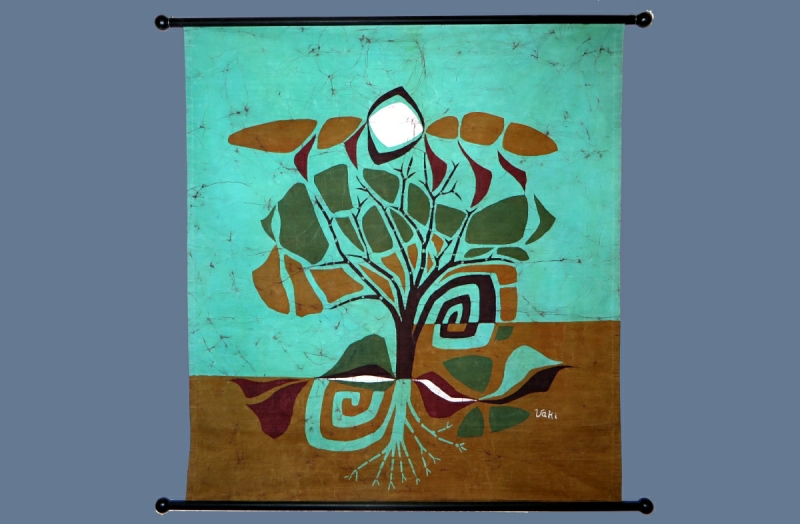
Batik by Bill Laux

The oldest working computer, which my wife once used, is a Toshiba laptop. Unfortunately, it does not have a floppy disk drive. Searching the world wide web, I found that there are two ways to get to the files locked away in outdated storage systems.

  • 1) mail the disk to floppytransfer.com, a company in California, which downloads the files and transfers them onto a USB flashdrive. That would have been OK, if I had only a few disks to copy. But with such a great number to copy I rejected this option. It would have demanded an exorbitant price tag.
  • 2) Buy an external drive that connects to a USB port on my computer.

Full of joyful anticipation, I ordered such a device from China for as little as 10 dollars shipping and handling included. Two weeks later the item arrived in the mail. Imagine my utter disappointment, when – no matter which of Bill’s disks I inserted into the machine – I got the same horrible message. ‘This disk must be formatted before it can be used.’could  For those not familiar with technical jargon, formatting is the death sentence for any files residing on the disk. For they will permanently erased.

Bill Laux

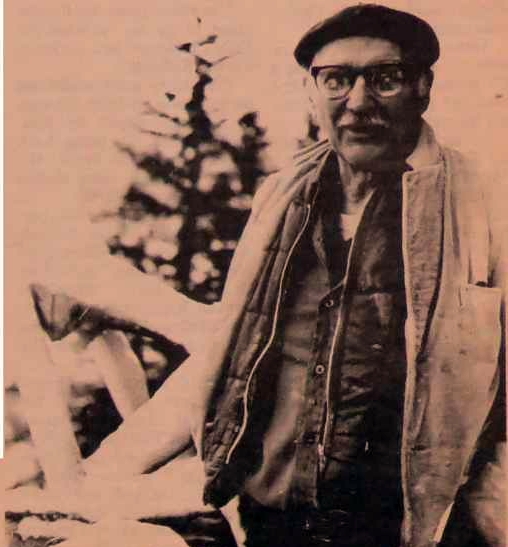
Artist, Writer, and Castle Builder Bill Laux

Starting a search on the Internet all over again, I stumbled on a great deal at amazon.ca (for our American neighbors I guess you could use amazon,com with similar results). I decided to give it one more shot and buy a floppy disk drive that came with the guarantee of being capable of reading all the files. After another anxiety ridden waiting period I experienced a most peculiar sequence of initial euphoria followed by a free fall into utter frustration.

 vaki6

To be continued next week in Part III