Ernst Klopp (1900 – 1964) and his Family – Part 34

The Writing on the Wall

Who can read the signs, when the fabric of family unity begins to unravel, when the glue that once held the clan together breaks loose under the load of stressful times? It is easy to answer such questions as we are looking back more than sixty years into past events. But at the time when the eldest son left the house, it appeared perfectly normal. After all, grown-up children with a few exceptions have always abandoned their nests to assert their independence and eventually have a family of their own. Yet, with hindsight we can probe a little deeper below the appearance of normalcy. Why would Adolf, the second oldest son, choose to immigrate to Canada, which turned out like the promised land, which however he did not know at the time he made the decision to emigrate? Or was it not rather the desire to escape his financial obligation to support the little farm in Rohrdorf with his meagre income? And why would Gerhard, the second youngest son, follow in Adolf’s footsteps if not for the same reasons. But most importantly, we children had no clue about the strain that the failed farming venture exerted on our parents. Ernst Klopp, once responsible as manager and director for a 3000 ha farming operation, utterly failed in turning the puny farmstead into a profitable venture. The psychological blow to my father must have been devastating.

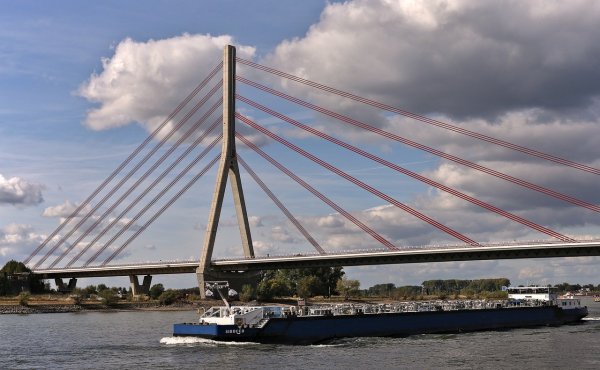
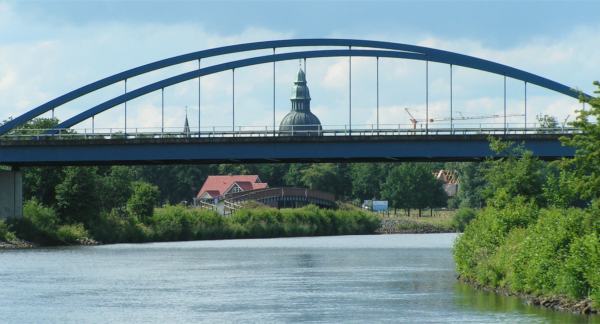
Haren, Ems Bridge – Photo Credit: wikipedia.org

In 1954, Father in search for meaningful employment moved to Haren at the Ems River in Northwest Germany. He worked in the office of the weaving factory of his nephew Georg von Waldenfels. The manufacturing plant was primarily producing cloth which was in high demand at the time. The newly created West German army (Bundeswehr) turned out to be a lucrative market for the son of Anna von Waldenfels. Unfortunately, Ernst Klopp and his meddlesome employer’s mother-in-law did not get along very well. The friction often resulted in unpleasant scenes, which wore him out and caused him to leave in 1957.

Rudersberg

In the meantime, my mother Erika Klopp had taken on a supervisory position in the kitchen facility of a senior citizen home in the town of Rudersberg northeast of Stuttgart. Her sister Maria Kegler, an elementary school teacher at the small village of Brünen near the city of Wesel took the 12-year old Peter under her wings. From there, he took the bus to attended the all-boys high school in Wesel, a city that ten years after the war had still many parts lying in ruins.

Lower Rhine Bridge at Wesel – Photo Credit: Thomas Biermann Pixabay

Rebuilding the city in the mid 1950s was in full in swing and the pressure of the extreme housing shortage was beginning to ease. Through some fortuitous connections, aunt Maria, also endearingly called Mieze, was able to find an apartment. An invitation went out to her sister Erika in Rudersberg to run her household in exchange for free roam and board. So it happened that in 1955, while Father was still doing office work at the cloth factory in the Ems Country, Peter’s mother finally found a place she could call her home again.

Chapter X of the P. and G. Klopp Story – Part III

Creative Use of Margarine Cards and Early Insights into Marital Spats

When Mother had a day off, we were able to do things together. What I liked the most was to go with her on hikes through the wooded hill country surrounding the town. At the end of a two- or three-hour leisurely walk along the highways that were not plagued too much by traffic, we always found a cozy roadside inn, where we dropped in for some refreshment and relaxation. Mother would order a cup of coffee for herself and for me a glass of mineral water or some homemade apple juice. On one occasion the innkeeper, who was running a small farm on the side, was too busy to stay with us being the only guests. So Mother and I spent the afternoon alone in the guest room and watched a movie on the small b/w TV screen. This was the very first time that I watched TV. I was thrilled getting acquainted with the new media that was just beginning to conquer the German entertainment market. The film most likely boring by today’s standards caught my immediate interest with its simple but captivating story about an immigrant from Europe who was on death row in an US state prison. He asked for and was granted permission to write letters to his aging mother in the Old Country. Within two weeks he wrote more than a hundred post-dated letters describing his imaginary tale about his proud achievements leading him from rags to riches in the New World. After his execution a prison guard with a heart sent off a letter every few months to his mother. A sad, but compelling story I remember vividly to this day.
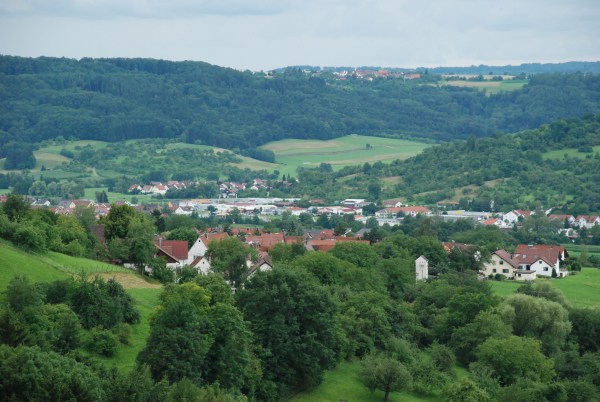
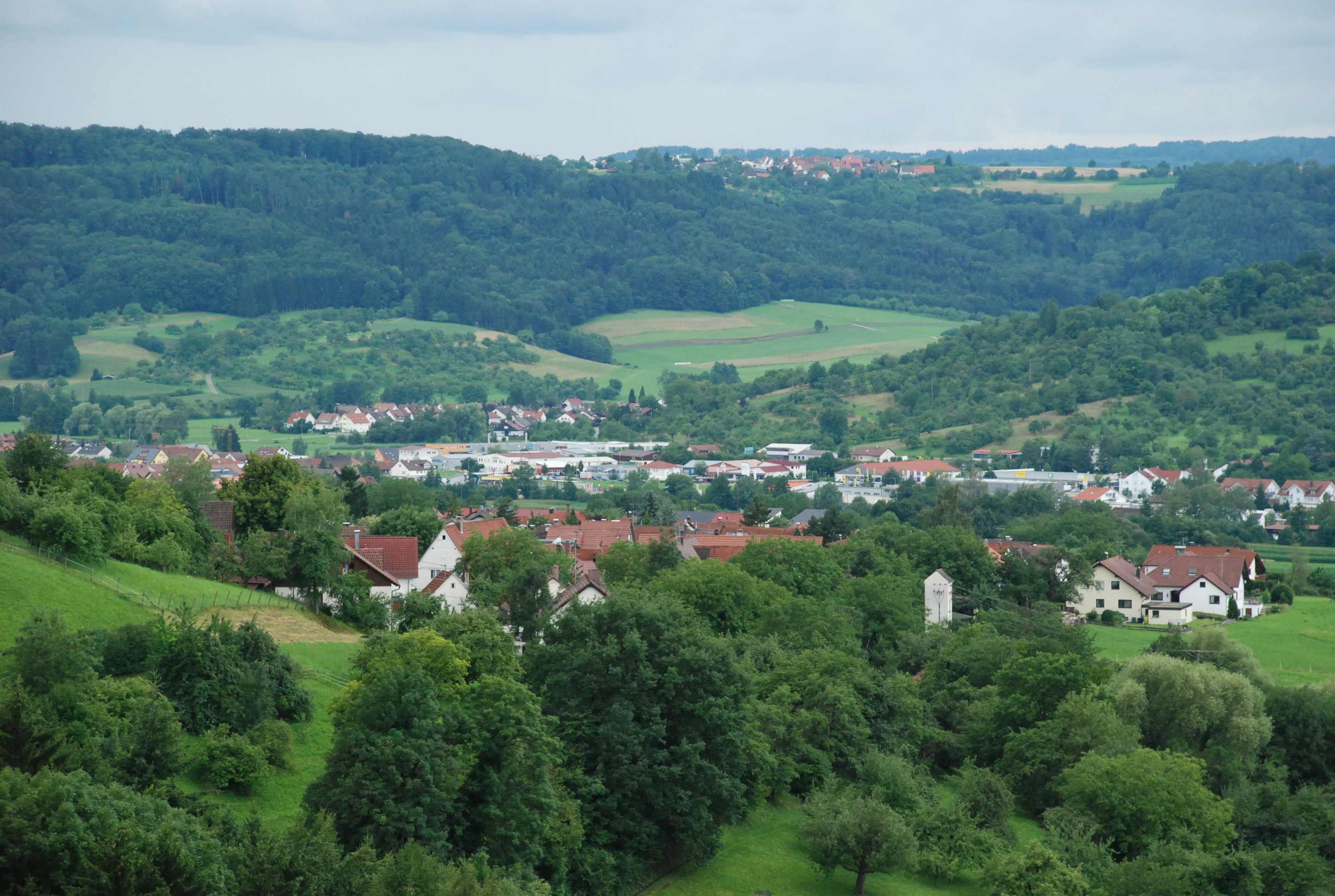
Rudersberg - Photo Credit: weather-forecast.com

Rudersberg – Photo Credit: weather-forecast.com

On the few rainy days, when we could not go on our beloved hikes, we stayed in Mother’s room and played her particular variation to the German card game ‘Six-and-Sixty’ with a double-deck of cards, which allowed us to unite in ‘marriage’ lots of queens and kings. Each marriage resulted in twenty more points than the marriage before. On these occasions Mother inspired by a glass of local wine or a satisfying victory in the card game would talk about her life in Pomerania, both sad and humorous stories. At times she would back to her childhood years in Grünewald. Proudly she told me that what she enjoyed the most. She liked horsing around and roughhousing with her brothers, which, although not becoming for a girl, was very much respected by her older brothers. Curiously she did not talk much about Father, nor did I ask any questions about him. I lived in the present; the future and the past did not yet have any meaning for me.

Back in Brünen, where the excellent food from the Wefelnberg country kitchen did miracles to the still slightly undernourished pre-teenage body of mine. In no time I gained enough weight so that I suddenly appeared quite chubby, perhaps even a little stout. There are no photos of the time, but I remember distinctly that I easily won wrestling matches with boys of my age by simply pinning them to the ground on account of my sheer weight.

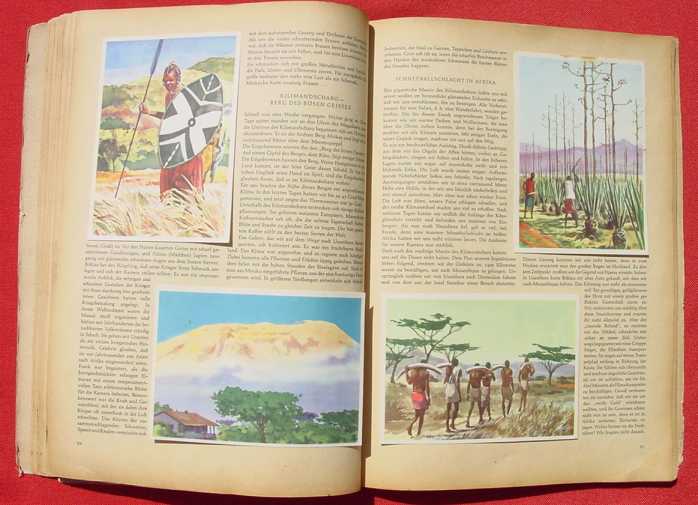
Sanella Album of Africa - Photo Credit: delcampe.net

Sanella Album of Africa – Photo Credit: delcampe.net

Butter was still expensive in the mid-fifties. Many households therefore were using margarine made of vegetable oil as an alternative to butter. One of the major margarine manufacturers added picture cards in the size of a standard 4 by 6 in. photo to their packaging and encouraged customers through their advertising to collect them and eventually paste them into booklets available from the company for a small fee. These booklets contained text and additional drawings, maps and illustrations for the cards and when completed represented a veritable treasure trove in the geography of Germany and other countries. I eagerly collected these cards. Frau Welfelnberg made sure that I would get them, when she opened another margarine package. Since there were many doubles, I traded them like stamps with many like-minded friends in the neighborhood. Since I had no money to order the corresponding booklets, I sorted them by themes of my own creation and glued them together to make a roll of forty to fifty pictures. Out of a sturdy cardboard box I fashioned a miniature stage. I cut out a rectangle roughly the size of one picture, inserted a round wooden peg on the right side of the box to serve as a pick-up spool for the roll of colorful images that would slip through the rectangular viewing area one picture at a time.

Now it was time to invite all my friends together with their younger brothers and sisters for the show that would take place in the natural theater of the backyard. The children sat on the lawn, while I presented the pictures very close to them on a small table taken out of the house for the performance. I invented the accompanying story and presented it extemporaneously in the form of a travelogue. The slide presentation became an instant success. The spectators not yet spoiled by children’s TV shows wanted to see more episodes. To help me they gathered as many picture cards they could scrounge up at home. What a creative way on the part of the Sanella margarine company to get people to buy their product!

One evening, while I lay on my bed that was wedged between the walls of my tiny bedroom, I overheard a conversation between the young miller and his wife, whose names I have completely forgotten. I witnessed a most peculiar spat between husband and wife behind the wall that separated their bedroom from mine.

Wife: How do like my new dress?

Husband: It looks beautiful on you.

Wife: Don’t you think it is VERY beautiful?

Husband: It is beautiful, indeed.

Wife: Now, now, you must admit that it is VERY beautiful.

Husband: There is nothing to admit here. It is my honest opinion that the dress is beautiful.

Wife: But you must see that my dress, the dress I bought with my own money, is VERY beautiful.

Husband: Whether you or I paid for it has nothing to do with its beauty. That’s illogical, my dear!

Wife: Leave me alone with your logic. Don’t you want me to look VERY beautiful?

Husband: Indeed, indeed! I want to …

Wife: So then, why don’t you say that the dress looks VERY beautiful on me?

Husband: Because there is a difference between beautiful and very beautiful.

Wife: So what you’re saying is that I look less than very beautiful. Why don’t you come right out and say I look VERY ugly in my new dress.

The conversation went on for a long time and became more and more animated and vociferous, but suddenly and rather abruptly ended with the wife sobbing quite miserably and with the husband deciding that it would be wiser to add no more fuel to the heated argument. It was time for the couple to make peace. A few minutes later the not so quiet springs of the marital mattress announced that love had overcome their verbal sparring. I had often pondered about the meaning of this curious episode.
Chapter X of The P. and G. Story – Part II

Appearance and Reality

Dangerous Adventure on the Roof Top

In the summer holidays I traveled by train to Mother’s work place, the Senior Citizens Home in Rudersberg less than half an hour’s drive from the commercial hub and center of southwest Germany, the city of Stuttgart. Here I spent six carefree weeks alone or with a newfound friend, who spoke a similar dialect as the people in Rohrdorf. When it comes to language, I had and still have, to a lesser degree, the ability to quickly assimilate a new dialect. Looking back at the first few months at the Wesel High School, where very formal and standard German was spoken, I am amazed at the speed, at which I lay aside all traces of my southern dialect.

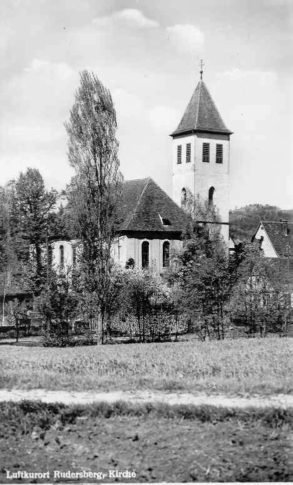
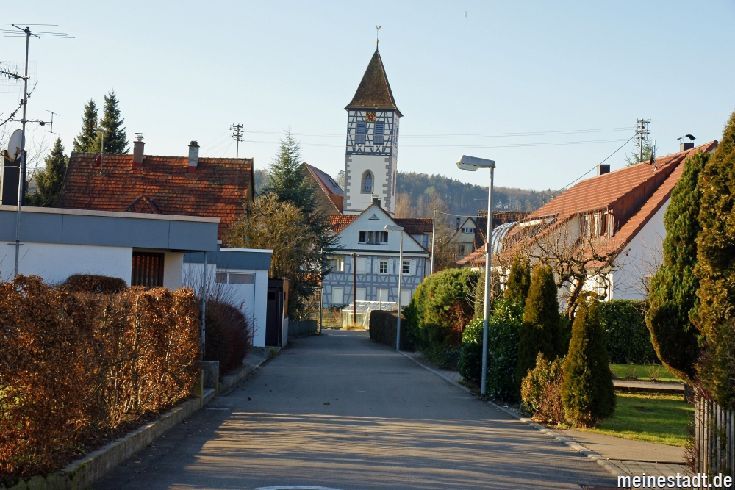
Church of Rudersberg

Church of Rudersberg

Right across from the Seniors Citizen Home was a small two-storied house with stone stairs leading up to the main entrance. Here a girl by the name of Ursula perhaps a year or two younger than I lived on the first floor. The two of us often sat on the steps chatting, swapping information about school life, our hobbies and the like. When the sun was coming around the building and it was getting too warm to sit on the stairs, we withdrew into the shade under the staircase. On a particularly hot afternoon we had spent quite a long time in our cool hiding place – perhaps a bit too long in the eyes of suspicious people who saw evil where there was none. When we eventually emerged and stepped into the glaring light, a barrage of angry words came raining down on us out one of the windows from the building across the street. An older woman all dressed in dark clothes shocked us with a seemingly endless tirade on the decline of morals, on the shameless and open display of inappropriate conduct between two, oh so young and already so corrupted individuals and all that so close to a Christian home for the elderly. “Shame on you! Shame on you!” she exclaimed, before she slammed the window shut. Apparently she had been following the invisible drama in her own imagination that was as far apart from reality as night is from day. We both were stunned by this outburst of incomprehensible accusations. Perhaps if we had been a few years older, we would have understood what this woman’s rage was all about. As for me, the unknown person in dark had already created an ever so vague impression that there was something unwholesome, sordid and morally questionable in dealing with the opposite sex, something I did not yet know what it was, but which came back to haunt me later in my adolescent years.

Town of Rudersberg - Photo Credit:

Town of Rudersberg

There happened to be a kermesse, in size and variety of entertainment, quite similar to the one I had attended in Messkirch the year before. This was a welcome distraction for me. Not having much money in my pocket, I simply enjoyed milling around in the crowds, going from booth to booth, from merry-go-round to roller coaster, listening to the rock n roll that was just beginning to penetrate the German pop music. I watched people play games or buy little toys and trinkets from noisy peddlers. As long as the kermesse lasted, I walked down to the fairgrounds every afternoon. One day I invited two elderly ladies who were sitting on a bench in front of the Seniors Home to walk with me down to the fairgrounds. From their reaction I could tell that this had never happened to these venerable old ladies before. A twelve-year-old boy offered to take them to the town square. After they had gotten over their surprise, they encouraged each other, and then nodded with a smile as a sign of acceptance. The scene that followed was quite comical, actually downright hilarious. Swaggering down the hillside sidewalk, one lady hooked in my arm on the left, the other one on the right, so full of joy, we were giggling and laughing all the way down to the fair grounds. What a wonderful feeling to bring happiness into people’s lives and not to care how crazy it might appear to bystanders or what they might think or say!

My desire to explore the things around me led me once into gravest danger. I had discovered by chance the stairs leading up to the huge unused attic space in the building of the Seniors Home. Inside the attic it was pitch dark. Overcoming my fear of darkness, I waited until my eyes had adjusted sufficiently to see that there was a hatch, which a storm perhaps may have pried open just a crack to let a shaft of sunlight shine through onto the wooden floor. Towards that single source of light I was directing my steps. When I had arrived near the far end of the attic, I discovered that the hatch had a simple locking mechanism. To let more light in, I pushed the hatch fully open. Now my eyes had to adjust again this time to the overpowering brilliance of the midday sun, which was flooding the beautiful landscape around the town before me. The ridge was less than three meters from the hatch. I thought that I would have a much better view if I climbed over the slate tiles onto the ridge. I immediately turned this daredevil thought into action, even though I severely suffer from acrophobia. It helped that the massive roof surface prevented me from seeing how high I was above from the parking lot below. So I slowly and carefully crept up on all fours until I reached the top and sat proudly on one of the ceramic ridge tiles. For extra measure of security I straddled the ridge and feasted my eyes on the magnificent panoramic view. Then the thought occurred to me that if I slid tile by tile forward I would reach the opposite end of the roof whence I could look down on the entire town of Rudersberg. Totally ignoring my fear of heights, I boldly went ahead. After thirty minutes of lifting and lowering alternately arms and legs in caterpillar-like fashion I arrived at the end of the roof. Far down below, people looked like ants and cars like matchbox toys. Had I before just seen mostly the roof surface with the lovely scenery on each side, it seemed to me now as if I was looking into a bottomless chasm. Three stories high on the rooftop I felt the first signs of a vertiginous attack making the world spin around me. Sensing the oncoming vertigo, I instinctively closed my eyes, lay prostrate with arms and legs straddling the ridgeline. I displayed, if anyone could see it, a picture of humble admission to my total stupidity and ignorance of the truism, what goes up must come down.

After the horrid sensation of twirling motion had ebbed away, I dared to open my eyes again. Then another fear far worse than the first seized me. I realized I was trapped. I could not get back to the hatch without turning around. And I could not turn around without falling off the roof. The thought crossed my mind to call for help. It would have been the most sensible thing to do in my situation. But what made sense, my pride did not allow me to do. So I lay there for a long time thinking and taking some comfort in the fact that as long as I did not move, nothing could happen to me. Many life-threatening situations require prompt decision and action. However, this one was different. After a long time that seemed like eternity I found the courage to sit up. Forcing myself not to look down in order to avoid another onslaught of dizziness, I moved my bottom backwards the short distance of a single ridge tile, stopped for a while, then encouraged slid back to the next tile a little further away from the house front. Now I knew that I had found the solution to my own rescue. Once the dizzying depth was out of sight, I regained my calm and retreated more quickly at a steady and rhythmic pace. Hands down, bum up, slip back one tile, bum down, short break and repeat. Finally I reached the hatch, climbed through it and felt at last the solid wooden attic floor under my feet.