Chapter XI of the P. and G. Klopp Story – Part VII

Trouble at School and Sex Education from the Gutter


When English had been added to the curriculum in the fourth high school grade and French in the fifth, school was getting a lot tougher for me. The process of eliminating students and the scholarly race towards graduation in the nine-year program had begun. I still lived in the world of the immediate present, where the past and the future carried very little meaning. When I came from school, I worked on my favorite electronic projects, read science-fiction novels from the public library, went to the movies, or received friends in my room. I always put homework, now an essential part of learning, on the back-burner. Not that I deliberately ignored my responsibilities as a high school student or that I did not fear my strict teachers. On the contrary I dreaded the severe consequences, the corporal punishments, the twisting of the ears or slapping on the cheeks, or the mental anguish I suffered under the barrage of verbal abuse. “Forgotten! He has forgotten to do his homework!” I can still hear the sarcastic and mocking tone of my teacher’s voice.

Candy Gun - Photo Credit: teachers.d11.org

Candy Gun – Photo Credit: teachers.d11.org

On top of all this hassle about my work habits came an incident that almost resulted in my expulsion from school. I had brought a gun to school, not an ordinary gun, but a candy gun, which was sold at the local vending machines. It was quite harmless as long as one was using the ammunition that came with package, a plastic bottle filled with candy bullets. In a streak of total stupidity I replaced the innocuous bullets that you could shoot into your mouth by colorful ball headpins. When I shot one pin into a classmate’s woolen sweater, he reported the attack to his teacher, the teacher to the principal, and the principal to Mother, who had to meet the staff. They had the weapons on prominent display on the staff room table. Obviously she was not very pleased with the prospect of having me kicked out of school.

The more the anxiety grew, the more in a strange psychological twist I developed the art of selective amnesia. I truly forgot to do my assignments in the afternoon, only to remember them the next morning on the way to school. It so happened that on a particularly dreary and foggy morning I turned left instead of right at the intersection on the way to the school and headed to the River Rhine instead. Skipping school, a far more serious offense than neglecting homework assignments, became a new source of anxiety. Fortunately my absenteeism had fallen through the cracks of the school’s cumbersome system that required a letter of explanation from my mother upon my return. So in the winter when it rained a lot and the sun rarely showed its face in Wesel I spent altogether three or four mornings at the river bank watching the cargo ships as they were going north-west to the Netherlands delivering the black gold from the Ruhr coal-producing area and Dutch goods destined to places as far south as Basel, Switzerland. Since the captain and family man would be away from home for weeks at a time, his wife and preschool children were also on board. One could tell by the cotton diapers fluttering on makeshift clothes lines in the breeze.
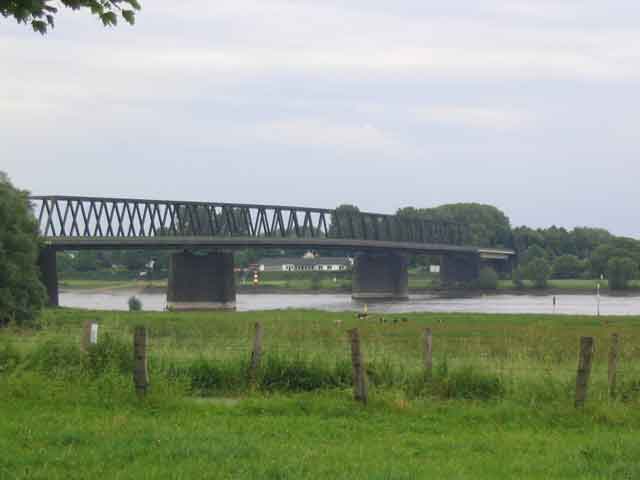
Bridge over the River Rhine - Photo Credit: bicyclegermany.com

Bridge over the River Rhine – Photo Credit: bicyclegermany.com

When I was getting bored, I would climb to the main highway leading up to the Rhine bridge and observe the vessels below, as they would emerge ghost-like out of the distant mist. Looking down into the grayness of the rushing waters around the pilings, I experienced the same dizziness as on the roof of the seniors’ home in Rudersberg. I wonder what the car and truck drivers thought of the young man leaning over the bridge railing as they were passing by. I definitely felt the tug of a dark irrational force coaxing me to jump and end my troubles at school. Shocked and frightened I dashed from the sinister bridge and arrived home to greet Mother in the kitchen. It looked like I had returned from my morning classes. From this moment on my homework was done on time, although not always neatly and diligently as required, and my marks were gradually improving.
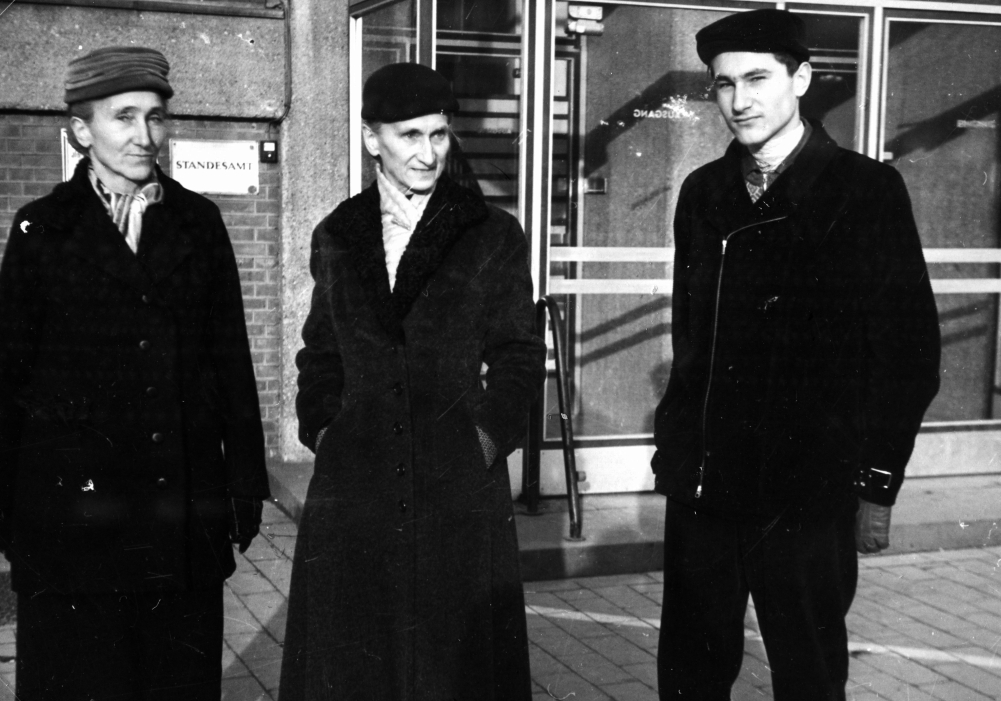
Mother, Aunt Mieze and I in Typical Garb (flat cap, corduroy jacket and leather gloves)

Mother, Aunt Mieze and I in Typical Teenage Garb (flat cap, corduroy jacket and leather gloves)

One floor down from our apartment lived Franz-Dieter, who lived with his aunt Sister Elisabeth, a devout catholic nurse. He had lost both parents in a bombing raid. He was lonely and forced his companionship on me. We had very little in common. When he came home from his apprenticeship work, he invited me in his congenial, but very assertive way down to his place. We played some checkers and other board games, while his aunt served us some tea and delicious Danish biscuits. Her warmth and kindness, perhaps the reason why I was willing to befriend Franz-Dieter, was in stark contrast to his rebellious and provocative conduct towards her and her religious views. She was extremely sensitive toward anything related to her faith, including all major personalities of the Christian Democratic Union, the governing party of Germany at the time. Her nephew, influenced by the leftist and partisan views of his working class peers, would harass her with sarcastic remarks about her ‘political friends’, such as the minister of defense, Franz-Josef Strauss. In his opinion they were all criminals and should be impeached and executed. Poor Sister Elisabeth tried in vain to soften his outrageous views in her tender tone of voice. But to no avail! In his arrogant self-righteousness he insisted, “They are all parasites of the state and should be shot!” Having not yet displayed any interest in politics and being politically ignorant, I was embarrassed and remained silent taking another cookie instead.

There was, however, another aspect to his character that I found far more disturbing. Having reached pubescence, he was driven by his urges that expressed themselves in a rather crude way in thought, word and deed. His notions of sex and love were clearly those of the gutter. Up to this point in my life I have been living in a complete vacuum as to the enlightenment about ‘the birds and the bees’. Clearly, his barnyard talk did not contribute in providing a factual and clean sex education. His views on girls as targets and the need to ‘score’ troubled me. I began to avoid seeing him by visiting my friends in the late afternoons. But I did not always succeed. One day, when his aunt was at work, he asked me, if I could do him a favor. I sensed evil. Being immediately put on red alert by this strange request, I replied that I needed to know first what that favor would be. Unwavering, I gave my response in a kind, but firm voice. It was clear to him that I would not budge on this point. Not long after this incident our family moved to the north end of town into an apartment away from the heavy traffic of downtown into the so-called green belt around Wesel. Thus, the foreboding association with Franz-Dieter had fortunately ended.
Chapter VIII of the P. and G. Klopp Story – Part IV

 Great Acting, a Chocolate Stand and a Scary Tale

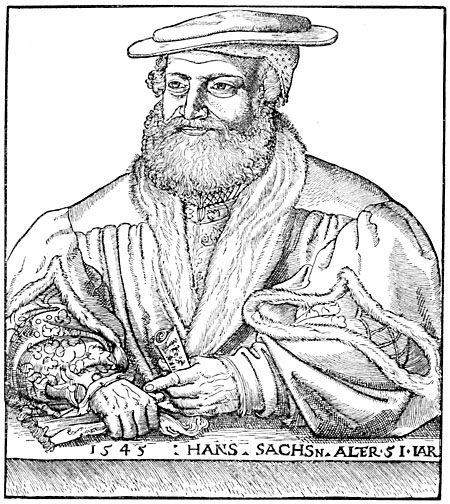
 Each year the school organized a concert for the parents and the general public. We students would sing in a choir, recite poetry, and put on plays. In this annual event we had an opportunity to showcase our artistic achievements. As to the drama performance this year, Frau Schroff was especially ambitious. She selected a medieval play, the farcical comedy: The Wandering Scholar from Paradise. The author Hans Sachs gained international fame as the central figure of Richard Wagner’s opera: Die Meisteresinger von Nürnberg. Sachs was a Meistersinger or mastersinger, who plied his trade as a shoemaker in the city of Nurnberg. He was also a creative narrator in the local guild of poets and musicians. ‘The Wandering Scholar from Paradise’ is about a farmer’s gullible wife, who falls victim to a traveling student’s claim that he had seen her beloved first husband in paradise. Frau Schroff decided that I would be the best candidate to play the role of the wandering student. And I did not disappoint her. As it turned out this challenging comedy was such a success on our modest school stage that we three actors received a standing ovation. Needless to say our teacher was beaming with pride over our success. At the end of the concert, she took me aside to tell me that I had earned with my spectacular performance the price of a new ruler. She also promised not to write that ominous letter to my parents. So I did not only bask in the glory of a wonderful performance that evening, but I also felt a great relief from the anxiety caused by my recklessness in the classroom.

Hans_Sachs

Hans Sachs, Author of ‘Travelers from Paradise’ – Image Credit: Wikipedia

It is one thing to do something creative because it is a school function, such as organized and directed by a competent teacher. It is quite another when young children prompted by their own inspiration start an activity strictly for their own enjoyment. This is exactly what happened in a group of seven boys, which we called ‘The Rohrdorf Village Musicians’. Once or twice a week, when the weather was fine and the grass was dry, we would get together on a sunny hillside between the Upper and Lower Village at least two km away from the nearest farmhouse, where nobody could disturb us during band practice. Our immensely talented bandleader was Klaus. His personality radiated confidence and enthusiasm. I remember the energetic movements of his arms, hands and fingers controlling our musical endeavors with the élan worthy of a professional conductor. But what was there to conduct, since we had hardly any musical instruments? There were only two, one was a tin bucket placed upside down, which served in combination with two wooden spoons as the drum section. The other was slightly more complicated and consisted of a large comb with widely spaced teeth and a sheet of wax paper loosely wrapped around it. The musician had to hum and barely touch the wax paper with his lips to create a rasping musical note. Today one can buy a metallic kazoo for as little as two dollars. The boys without instruments would add variety to the sonorous qualities of the kazoo and the tinny clang of the drum by whistling and humming. My friend Günther even managed to complement the drum by clicking his tongue. I for my part added tonal depth to the ensemble by creating a flute-like sound. To do this I clasped both hands, interlocked my fingers and thus created a hollow between my palms. All I had to do was to blow at a certain angle between the thumbs changing the pitch by expanding or contracting the cavity. With each band session our repertoire of the most common German folksongs grew until we were able to play for half an hour without repeating any of the tunes. Even though we never played for others, it was a most enjoyable experience, a definite highlight of my childhood years.

Continue reading

Chapter VIII of the P. and G. Klopp Story – Part III

 Sledding Accident and Trouble in School

After the first heavy snowfall the boys and girls of the Lower Village took out their sleds to celebrate the beginning of winter on our long and steep hill. The Davos sled named after a Swiss village, where this most popular sled in the world originates, is traditionally fashioned from hardwood and is 80 to 130 cm long accommodating up to three persons in an upright position. Two metal runners in this otherwise all-wood construction ensure a smooth and stable ride. The Klopp children had only one long sled. So we took turns to take on the 1 km run down the street that had next to no traffic in the winter. Gerhard would lie down on the slatted seat and I would sit on top. Safety helmets were unknown in those days. The speed increased with each run, as the snow was packed down and turned into a icy surface. Exhilarating was the experience, when I felt the fresh air in my face and the sensation of being part of the fun in the community of children young and old. Soon someone came up with the idea to form a human train by hitching the sleds together. One simply had to hook the feet into the upward-curved front of the next sled. Up to half a dozen sleds connected this way and expanded into a super long snake-like figure. The pilot alone in the front had to make sure that the trip down the hill would be safe and would not result in broken bones. Often I was allowed to sit on the back of the front man. Being the only one sitting erect, I felt like an admiral in charge of an entire fleet. When I think of having so much fun together with friends and family, very fond memories still linger in the crevices of my mind after all these years.

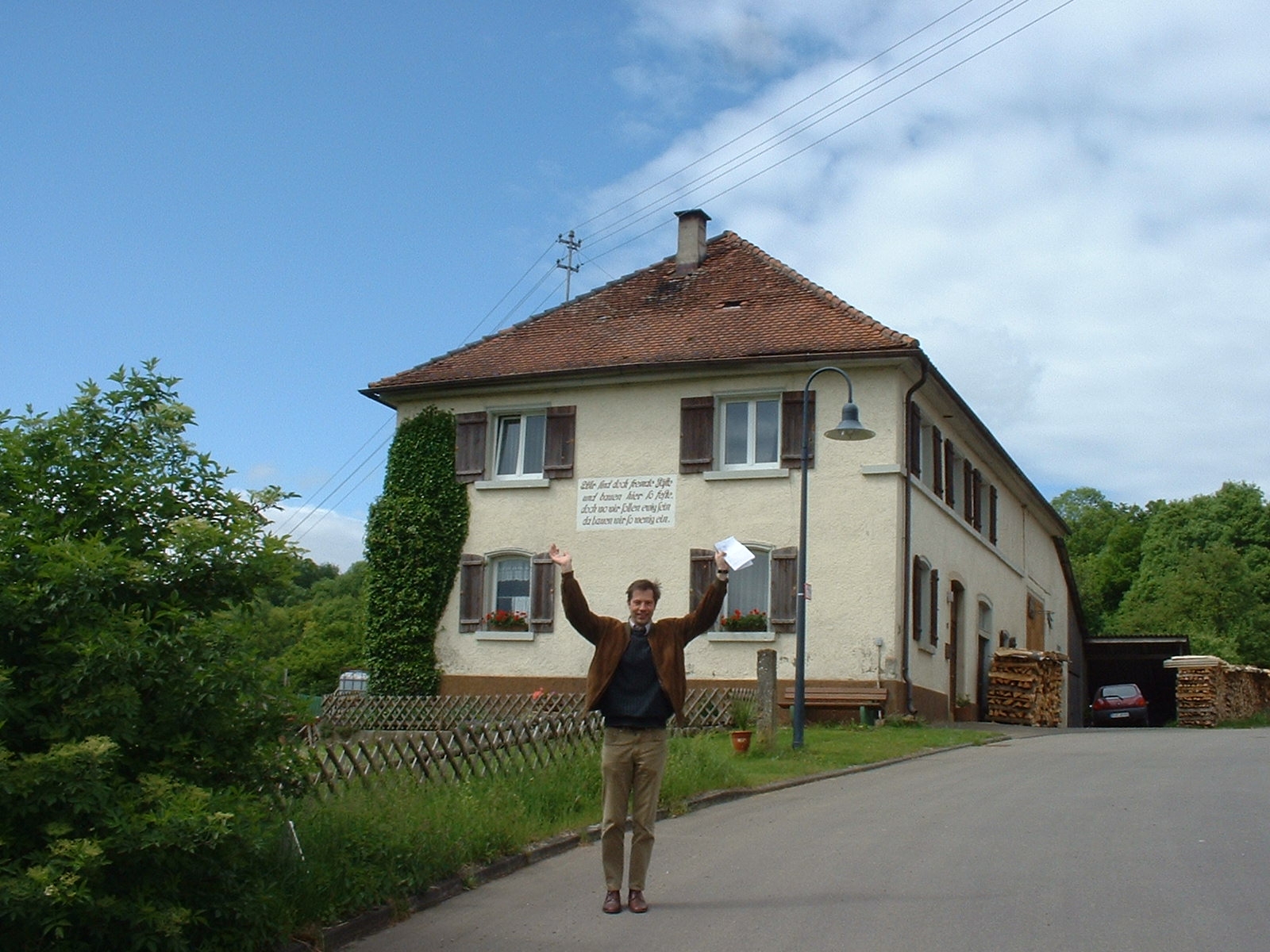
House across from the Ös Farm 2003 - Photo Credit: Stefan Klopp

House across from the Ös Farm 2003 – Photo Credit: Stefan Klopp

 When I was a little older, perhaps 10 or 11, I was allowed to use the family sled to go sledding with my friends on a nearby hill. Cattle would be grazing there in spring, summer and fall. It was completely fenced in except for a gate just wide enough to allow a hay wagon to pass through. When cows were on the pasture, the farmer simply closed the gate by sliding two poles through the horseshoes that were hammered into both end posts of the fence.

The frost in the night before had turned the snow into a crusty surface strong enough that we could with some care walk on it without breaking through. As we were climbing up to the top, an idea suddenly occurred to me,

“Hey, guys, how about making a single pair of tracks with our sleds on the first run. Then we don’t have to plow through deep snow on the following runs and we will go faster, faster, and FASTER.”

“Plus”, I added, “guess what? We don’t have to steer anymore. We will be zipping down the track like a speeding freight train!”

The plan found instant approval with loud cheers. In less than three trial runs we created the double track. And indeed, as I had predicted, our speed increased, because with each trip down the hill the sleds’ runners packed down the snow more and more into a hard and slippery surface. It was about the tenth time that I had climbed to the starting point.

As before I shouted, “Clear the gate opening! I’m coming”, and in one jump I landed belly-down on the slatted seat.

Now I zipped down the track reaching top speed about half way down the hillside. Looking up for the first I noticed that my friends had ignored my warning and were still blocking the gate. Even if they moved out of the way now, it would be too late. Fear of crashing into them gripped and paralyzed me. I was less than twenty meters away. I could have rolled off the sled and let it continue to speed toward the human target, but I didn’t. The collision seemed inevitable within just a few more seconds. Suddenly another force took control over my mind, a force that ignores all danger to oneself and only cares about the welfare of one’s fellow human beings.

My left foot dug deep into the snow. It exerted enough force to make the sled jump out the tracks and veer to the left and away from where my buddies were still idly standing. But now I had to think of myself, as the barbed wire fence and its posts appeared to rush toward me. In a desperate attempt to reduce speed I used both feet now and pushed my boots as far down into the icy crust as possible. I slowed down a bit. But it was too late. The post, worse the iron horseshoe on the post, was less than a meter away. An automatic reflex made me raise my right hand and cover my forehead, before everything around me submerged into complete darkness. When I came to, only a few of my friends were standing around me. Some had run home to get help, but others had left the gory scene of the accident, because they had never seen so much blood before. I was bleeding profusely. Eventually I was able to get up. Completely dazed I took my sled and stumbled home with injuries to the hand and forehead, which the visiting doctor later determined as a severe concussion. The scar under my right index finger reminds me to this day how my hand covering my forehead had softened the potentially fatal impact.

Continue reading