Ernst Klopp (1900 – 1964) and his Family – Part 33

Signs of Disintegration

The only child left in 1954 with his parents Ernst und Erika Klopp was the 12-year old Peter. With no family workers left on the farm that produced little more than a few eggs from the henhouse and milk from a goat or two, my father’s health being on rapid decline, there remained scant hope  for a successful farming operation and inevitably Father’s dream came to a sudden end. All the Ernst Klopp children eventually emigrated and settled in Western Canada.
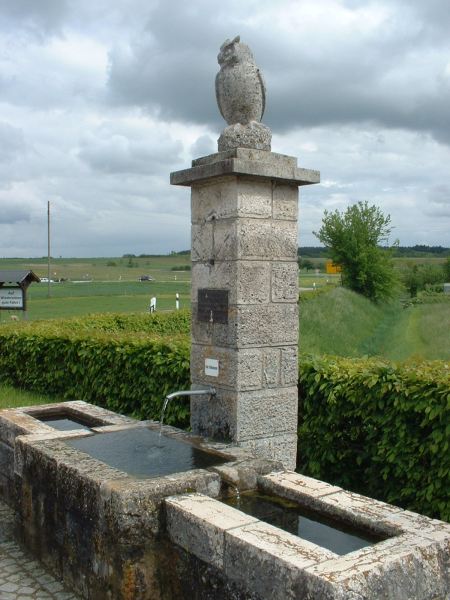
The Fountain at the Intersection in the Lower Village – 2003

Four years after the lease agreement with retired farmer Ös came into effect, my father gave up and burdened with a heavy debt load became officially unemployed. He moved into a tiny house at the bottom of the hill where he was often bed-ridden suffering from intense backaches for long stretches of time. In the meantime, my mother found employment as a housekeeper and cook at the Hohenzollern Castle at Sigmaringen. In the meantime, carpenter master Stoll and his wife in Meßkirch took care of little Peter in the role of foster parents, while he was attending the local high school.
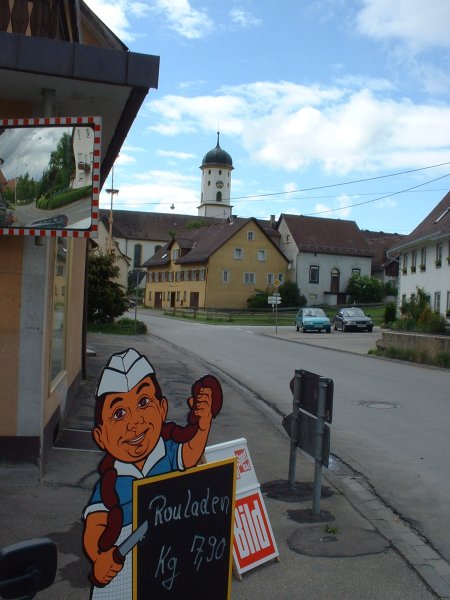
Store in the Upper Village – 2003

So after what had begun with a miraculous escape from death and destruction in their home province Pomerania and a promise of fetching a few morsels of the former happiness, the glue that once held the family together loosened and showed definite signs of disintegration.
Ernst Klopp (1900 – 1964) and his Family – Part 32

The Ös Farm

Then suddenly in the summer of 1950 an opportunity presented itself to Ernst Klopp. An elderly farmer by the short name of Ös decided to retire and leased his farm house and a few parcels of land not more than 6 ha in size to my father on credit. By comparison to the 3,000 ha Ernst had administered in Gutfelde, the total of arable land available for farming was minuscule. The house was adequate and a vast improvement over the upstairs dwelling of the ‘poor house’.  It came with a large barn with a hay loft, a sufficient quantity of farm implements, a fair-sized kitchen, the ubiquitous manure pile in front of the kitchen window and an outhouse. The only luxury item that I recall was the large tile stove (Kachelofen in German) providing warmth and a cozy ambience for the entire dwelling. Many of my sweet childhood memories are going back to the Ös farm, as we often irreverently called it.

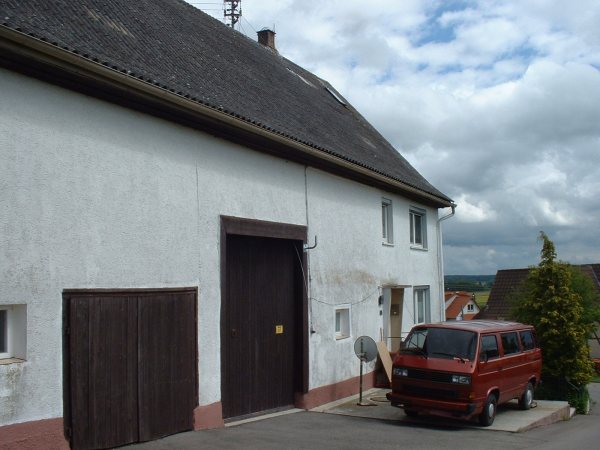
The Ös Farm – 2003

So here my father Ernst Klopp tried with little prospect of success to pick up his life-long dream again to running a farm under his very own management. Having no capital to spend on much needed supplies, he heavily depended on loans, which created a heavy financial burden. He must have counted on the help from my older siblings for turning the farming operation into a successful venture. 

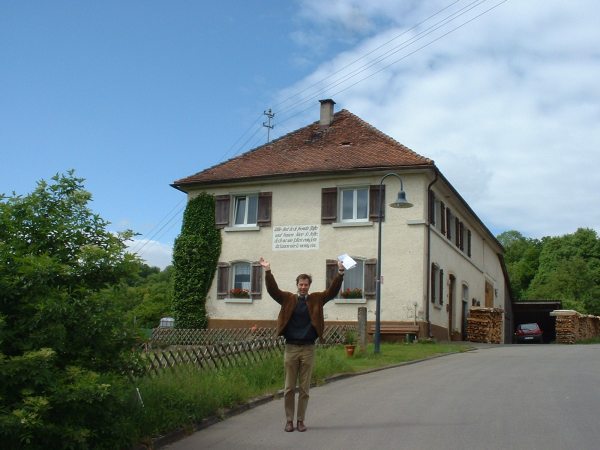
  The Farm House opposite to the The Ös Farm – Visit by our sons Robert and Stefan in 2003

Soon after his high school graduation Karl left home to study economics at the university of Braunschweig. Adolf, my second eldest brother, barely 18 years old found work at the Bizerba Factory in Meßkirch. Since that time in the early 1950s the Bizerba Company GMBH has developed into a world leader in weighing technologies for industry and trade. Adolf had to contribute most of the money he earned in order to keep this fledgling farming operation financially afloat. Three years later, Adolf was getting tired to support what in his opinion was a hopeless enterprise. Together with another refugee son by the name of Waldemar Klein he immigrated to Canada. Soon thereafter, my sister Erika also left home to take up nurses’ training in the City of Hamburg. In 1954, Gerhard managed to get an apprenticeship placement in a prestigious institute of technology in Switzerland.