Walter Panknin (1898 – 1977) and His Family Ch7 Part 13

Papa Panknin, the Popular Hiking Guide

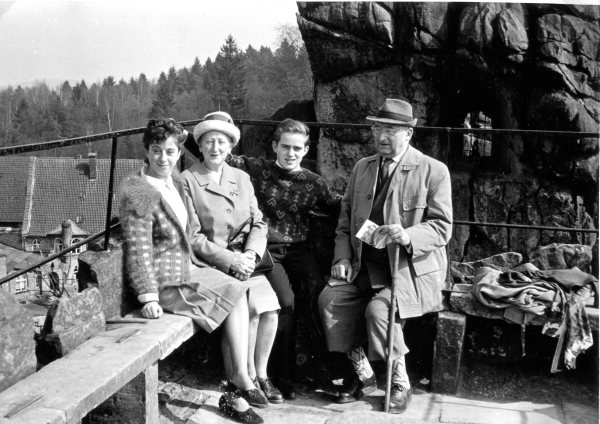
Retired Major Panknin enjoyed being out in nature and helping revitalize old trails that had fallen by neglect into disrepair and marking them by following strict environmental guidelines. While reading over the pamphlet on how to prepare a route for the enjoyment of the hiking community, I was impressed by how carefully the details were described, such as the kind of paint to use, where to place the sign, which trees to use and which trees to avoid. I liked the rule: Better to have no sign at all than a sign confusing by its inaccuracy. His daughter Biene often accompanied him in the rewarding outdoor activity.
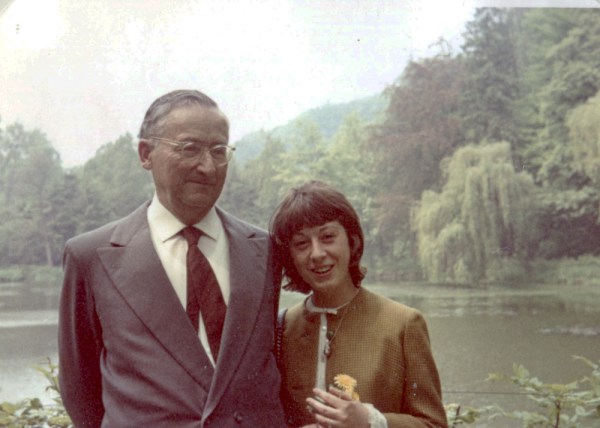
What Papa Panknin enjoyed the most was serving as a hiking guide for the frequent excursions through the forested hill country of the Velbert territory. Biene tells me that the participants were primarily women. That may have also been part of the reason why he enjoyed becoming a trailblazer for his club.
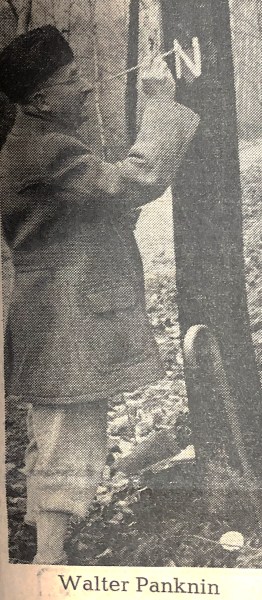
During his involvement in the SGV Velbert, he received plenty of praise and recognition for his invaluable contribution from participating hikers, the press and the local club president. In a newspaper clipping, I read how much his work was appreciated. “So we see Walter Panknin walking through the woods with a can of paint and a brush as an apostle of a great idea, of the concept of hiking in the automobile age, leading us back to Mother Nature, to the source of healing power. Walter Panknin selflessly serves this idea for others from person to person.”
Walter Panknin (1898 – 1977) and His Family Ch7 Part 12

Papa and the Hiking Club

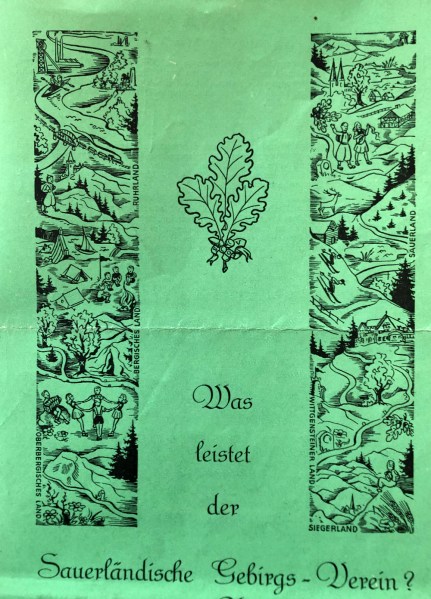
In 1962, my father-in-law joined the Sauerland Hiking Club and remained active until 1967. Living in Velbert, he became a member of the local subdivision founded in 1912. His new hometown is a green oasis surrounded by the big cities Essen, Düsseldorf, and Wuppertal. It is located at the northern border of the mountainous region of Sauerland. The entire organization SVG, of which the Velbert Club is a part, manages a hiking trail network of over 43,000 km. Hundreds of volunteers mark trails, create new ones, digitize maps for the modern hiker, and do the necessary paperwork to run this vast organization.

During his five-year involvement, Papa Panknin took on many tasks. Having had lots of practice with letter writing during his legal battle for justice years before, he did most of the organization’s correspondence, made sure that materials for the hiking trails were purchased and paid for, and even fought a few legal battles on behalf of the club. Like I experienced here in Canada, many landowners believed they owned all the roads, woods, and lakeshores surrounding their property. 

The gist of one of the letters he wrote to a government agent, a copy of which is shown below, is the following. “Due to the lack of police officers and other persons in authority, farmers and property owners, to an intolerable extent, started to block the roads and trails leading through their property in various ways. These obstructions often occur without the knowledge of the local authorities ….”

Walter Panknin (1898 – 1977) and His Family Ch7 Part 10

Papa the History Buff

During his time as a POW in 1945, Papa attended many scholarly lectures that some learned fellow prisoners gave in open-air forums on various topics. As writing was strictly forbidden, he secretly wrote down on the tiny sheets of cigarette paper the authors of books recommended by the lecturers. He was especially interested in history books, which he intended to read later. Fifteen years have passed. Now the time has come to fulfil one of the dreams he had for his retirement. Among the history authors, he admired the famous 19th-century historian Leopold von Ranke the most.  He especially liked the quote that underlines the importance of objectively presenting historical events: “Let the author be quiet, but let the events and documents tell the story.” Proudly Papa wrote in a letter to his friend Herr Kampmann that he had already devoured eight of Ranke’s twenty-five volumes.

The correspondence with his pen pal mainly dealt with political issues of the German postwar era. He drew the most relevant information and its polemic spirit from the German news magazine “Der Spiegel.” Its claim to fame was the publisher’s uncanny ability to uncover and publish government secrets, cases of corruption and scandals. Major Panknin, in retirement, wrote his multi-paged letters on his old typewriter, using carbon paper to have copies for his record. They fill binders carefully ordered by year, month and day. The letters reveal his critical view of the West German political landscape. They describe his disgust over how deep his beloved Germany has sunk into the quagmire of dishonesty and scandalous behaviour. His diatribes take on a familiar ring when we fast forward into the 21st century.

Did I digress from telling the Walter Panknin family story? Having Ranke’s quote in mind, I declare, “Let Papa’s immense correspondence and insatiable appetite for reading history books and historical novels tell the story.”

Walter Panknin (1898 – 1977) and His Family Ch7 Part 09

The Sunset Years

Before the ‘golden years’ arrived, the division of labour was fair for both husband and wife. In the following posts, I will talk about the injustice of the heavy burden for Frau Panknin as a mother, housekeeper, cook, and wife. I will also show how much, on the other hand, Papa enjoyed his sunset years as a father, hiker, traveller, hobbyist, and history enthusiast.

Grocery shopping has drastically changed since the early 1960s. Nowadays, well-to-do families living in their homes or modern high-rise apartment buildings take the elevator down to the ground floor, step into their car and drive to a nearby shopping centre. After they are done shopping, they may have time to dine in a family restaurant and take the kids to a bowling alley or the movies for some weekend entertainment.

Elisabeth Panknin on her 60th Birthday – 1960

Sixty years ago, in the little town of Velbert, Elisabeth Panknin went shopping at least twice a week. She takes two large cloth bags and descends the 120 steps down to the ground floor of the three-story building. The tiny neighbourhood corner store only carries bare essentials, like bread, milk and butter. Frau Panknin takes the bus to a larger city. She only buys as much as she can carry. Public transportation poses a problem when the bags are filled to the hilt, and there is no seat for a sixty-year-old woman in an overcrowded bus reeking from the nauseating fumes of cigarette smoke. It is also time-consuming. If you miss the bus, you may have to wait up to an hour to catch the next one. Mutter Panknin finally stands at the entrance of the apartment building. Huffing and puffing, she climbs up the staircase with the two heavy bags of groceries. Then, you will not believe this. She immediately starts cooking the evening meal for her husband and the twins Gertrud and Walter.

Walter Panknin (1898 – 1977) and His Family Ch7 Part 8

The Turning Point

In late 1960, shortly before Christmas, a letter from the highest state court arrived at the Panknin residence with the long-awaited good news. Their request for Papa’s pension and the refugee status associated with all the rights and privileges had been granted. However, having battled for seven years with the various government agencies, they had paid a high price. Frau Panknin had been travelling by bus and train to talk to the officials in person. At the same time, Papa Panknin did the massive paperwork to make requests and provide written proof to the authorities. One day, Elisabeth Panknin collapsed from juggling the nerve-wracking travels and her housekeeping chores at home. Papa had to write the Christmas letters to all their relatives and friends, as his wife was too weak to do so. Fortunately, Mutti recovered just in time to prepare the Christmas dinner for the family. After over ten years, they could finally sit down on Christmas Eve and enjoy feasting on a sumptuous goose dinner with all the trimmings.

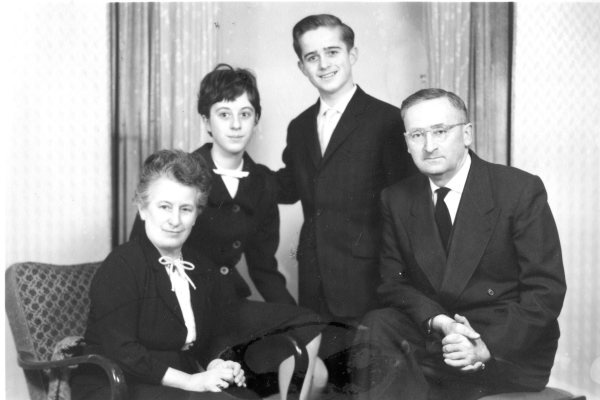
From left to right: Elisabeth, Gertrud (Biene), Walter Junior, and Walter Panknin 1960


The celebration of their victorious battle with the West German bureaucracy marked the end of their financial woes. It also turned out to be the end of their workload’s fair and equitable sharing. Up to this point, the couple had performed their domestic and professional duties along traditional lines. Papa, as a police officer, worked under highly stressful conditions under the Nazi regime, while his wife, in charge of their beautiful home, lovingly took care of the children. In those days, it was rare in most societies to have the predefined roles of husband and wife reversed. Today, it is very common, especially in Western societies, for a wife with higher qualifications to go out to work and leave the nurturing of the children to the father. Unfortunately, the basic things of life, such as shelter, food, and transportation, have become so expensive that both need to provide an income to make ends meet. They have to entrust their children to others all too often at an exorbitant price.
Coming back to my father-in-law, I believe that he was so deeply rooted in the culture of a bygone era that he, without any qualms, left the entire burden of the household to his wife while he was experiencing to the fullest extent the joys of early retirement.

More details in the next post …

Walter Panknin (1898 -1977) and His Family Ch7 Part 5

The Judiciary That Sentenced 50,000 People to Death

Walter Panknin’s Fight for Justice – Part 2

I chose the title from the West German News Magazine as the heading for this post. It confirms what my father-in-law had described in a letter to a friend. The title reveals a dark chapter in the judicial system of postwar West Germany. The article, as quoted in the previous post and continued here, is an eye-opener for the legal battles Herr and Frau Panknin had to fight in their struggle for justice.

“Now the halls of justice were even staffed with judges who had once served on the Nazis’ People’s Court (Volksgerichtshof), which was set up in 1934 to handle “political offenses” and became notorious for the frequency, arbitrariness and severity of its punishments. Nevertheless, the civilian courts handling the de-Nazification process merely classified them as “hangers-on.” In 1953, at least 72 percent of judges on the Federal Supreme Court, Germany’s highest court for criminal and civil law, had former Nazi connections. The number increased to 79 percent by 1956 and, in the criminal division, it was at 80 percent by 1962.”


Now we understand the anger and frustration my in-laws experienced for more than five years. Poor Papa Panknin, having demonstrated and documented through his actions before and during WW2 his anti-fascist position, encountered, in an ironic twist of fate, one humiliating rejection of his applications after another. The former Nazi judges were back, making ideologically motivated decisions. In Papa’s correspondence, I found names such as Franz Schlegelberger – Minister of Justice (1941 and 1942), Hans Globke (he participated in drafting the Nuremberg race laws), and Theodor Oberländer – as an academic laying the foundation of the Final Solution. Many were found guilty in the Nuremberg trials, and some were sentenced to life imprisonment, then released after a few years, going into judiciary service or early retirement with a pension six times higher than the average worker in the Federal republic.

https://www.spiegel.de/international/germany/from-dictatorship-to-democracy-the-role-ex-nazis-played-in-early-west-germany-a-810207.html

https://en.wikipedia.org/wiki/Franz_Schlegelberger

https://en.wikipedia.org/wiki/Hans_Globke

https://en.wikipedia.org/wiki/Theodor_Oberl%C3%A4nder