Walter Panknin (1898 – 1977) and His Family – Part 21

Microscopic Note Writing

Finally, on May 7, the weather showed signs of improvement, and on the following day, the sun broke through the cloud cover, bringing much-needed warmth for body and soul. However, Papa’s feet and toes were numb; he felt a tingling sensation throughout his lower limbs and could barely walk. His heart began to give him trouble. He knew that he would not have lasted much longer. But now, as he was feeling better and his feet were no longer bothering him and after he was finally able to clear himself of all the dirt on his body, wash his shirt and socks, a sense of new optimism was surging through his entire being. Rumours were also circulating through the camp that the POWs would get permission to go home. The war was over now. Why would the Americans want to keep them any longer? Would it not be cheaper to make them go home and save the expense of looking after, feeding and guarding 80,000 men? But just as Papa was looking in vain for blue patches in the leaden sky, so all his hopes for early dismissal vanished into thin air. Camp life went on with its daily routines. The camp guards became rather more severe as days dragged into weeks and weeks into months. They meted out ruthless punishments after some POWs in constant search for firewood had ripped off some of the toilet seats from the camp latrines.
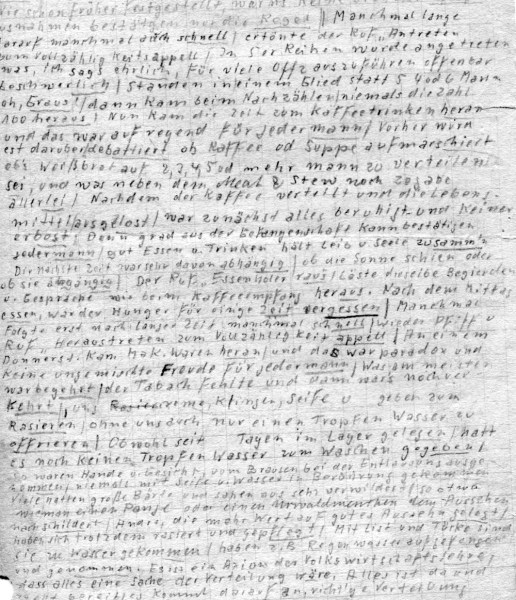
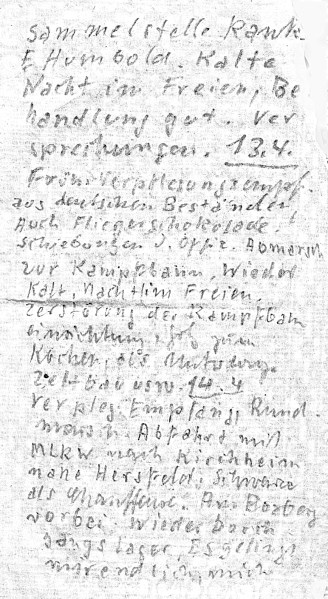
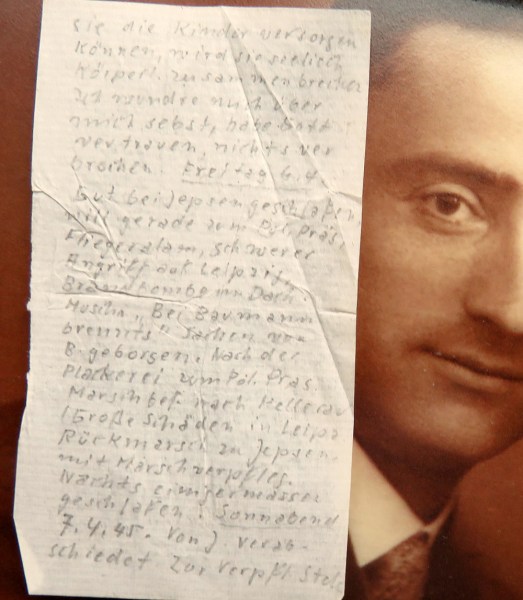
It is truly amazing how much information Papa Panknin could cram onto a small piece of paper.

Papa was not the type who would not want to idle away the time by just sitting around in the sunshine or play cards for endless hours, even if it was his favourite card game, ‘Skat’. He wrote his notes now on slightly larger paper but continued with the same microcosmic handwriting. Of course, Papa knew that it was strictly forbidden to record his experiences at the camp and therefore was extremely careful not to let anyone see him write. I guess the reason for these rules was that nothing should ever go out to the outside world that might tarnish the image of the Americans.
Walter Panknin (1898 – 1977) and His Family – Part 20

Coping with Rain, Mud, and Hunger

Suddenly, the weather changed from one day to the next and brought rain and more for the next seven days. Temperatures plunged to near freezing at night, while water soon filled their clay huts and made it impossible to sleep on the ground. Poor Papa Panknin tried to sleep while standing on one leg for a couple of minutes, then switching to the other. Once, he succeeded in catching a few winks, only to wake up in horror discovering to his utter dismay that he had plunged face down into the mud. He summarized his dismal experiences as triple torture of standing, starving and freezing. From the highest-ranking officer down to the common soldier, every POW had to endure the cold nights and the rainy days. The weather made no distinction. It fooled the prisoners by raising their hopes when short periods of clear skies promised a sunny, dry day, only to revert to more rain during the day.

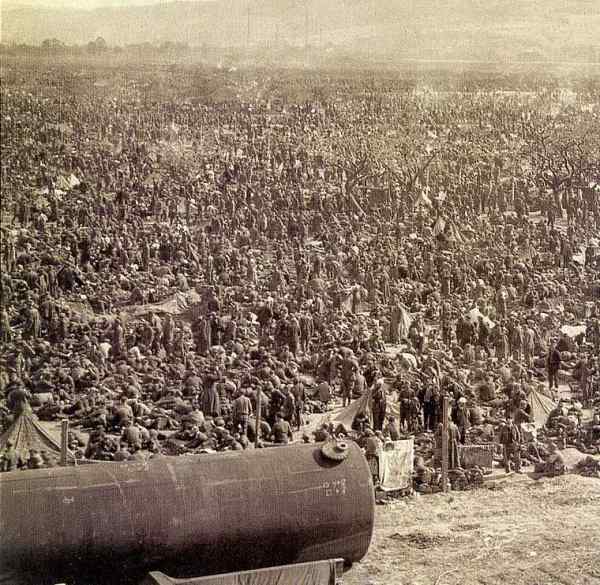
One of the many overcrowded POW camps: The Rhinewiesen Camps, where Papa landed in April 1945

In the first week of May, the sun did not show its face for five long days. Papa was constantly scanning the sky for a sign of change in the weather. His long gaze created the hope that if he looked hard enough, he would perhaps discover a patch of blue on the murky horizon. Indeed, Papa thought he had found a definite shift from gray to blue. When he proudly announced his comrades the changes he had observed in the clouds, they all laughed at him. Like a desert traveller fancying an oasis, where there is none, so Papa had fallen victim to the mirage that had formed in his desperate mind. Perhaps hot, nutritious meals would have helped a little to provide some strength and warmth. Alas, the thin soups were getting lighter and often arrived cold at their swampy mud hole.

The posts on Walter Panknin are based on the notes he had written on tiny cigarette paper before and during his POW time. How he could write his experiences on such miniscule paper will be perhaps be forever a mystery.

During one night, Papa tried to find some rest for his tired feet by sitting on a water container, but completely exhausted fell two times asleep and into the muck. Unkempt and unshaven, covered in filth, he felt more like an animal than a human being. There was strife and petty spats over tiny morsels of food. There was no wood to make a fire, not even for roasting the few potatoes that had been made available for the hungry men. Papa built a primitive grating tool out of a tin can, into which he had punched some twenty holes. Now he could shred a potato into a porridge-like pulp, which he ate raw to get some badly needed nutrients, minerals and vitamins into his belly.

Walter Panknin (1898 – 1977) and His Family – Part 19

Arrival at the Rheinwiesen Camp

 Soon an army truck pulled up at the house to pick up the prisoners. The order was to move them farther to the west. After all, the war wasn’t over yet.  The prisoners had to be as far away from the battlefield as possible. The Germans had built the concrete superhighways, the so-called Reichsautobahns, to carry troops and supplies under the motto ‘The wheels must roll for victory.’ Now they ironically assisted the enemy in bringing in war materiel even faster while moving the POWs away from the front. Together with thousands of other POWs, their final destination was Bad Kreuznach, a picturesque town west of the River Rhine. But the camp near the city was anything but romantic. Sheer horror seized Papa when he saw a giant empty field surrounded by a high barbed-wire fence. It did not even remotely look like a camp. There were no buildings for shelter against the cold and the rain. Soon it began to dawn on him that the cramped quarters at the confiscated house in Hersfeld were luxury accommodation by comparison to this desolate place without tents or barracks.

Papa Panknin wrote his POW experiences on cigarette paper. The example above is one of the over 60 papers I found among his belongings. Only after scanning and magnifying them I was able to read his notes. How he was able to write on these tiny pieces of paper with a pencil is a mystery.

Like cattle, the guards drove them onto this field of muck and clay. There they left them without any provisions for shelter during the night. Before nightfall, the American camp officers organized the new arrivals into companies and then ordered them to build primitive hovels out of clay. They were somewhat like the sandcastles that tourists would make on the beaches of the Baltic Sea. Fortunately, although the nights were uncomfortably cold in late April and early May, the bright sunshine and fair weather contributed a lot to make life quite pleasant for the POWs. Some were sunning themselves, while others played games to while away the time. It didn’t take Papa, a passionate Skat player, very long to find partners for the most popular card game in Germany.

Walter Panknin (1898 – 1977) and His Family – Part 17

Life is More Important than a Clean Shirt

On Monday, April 9, Captain Panknin received yet another marching order. German troops were retreating to Weimar, where he was supposed to report for duty. After hearing that the trains were no longer running in the area, he debated whether he should walk there or try to get somehow to Erfurt. He decided to go to the latter, where he received a decent meal and accommodation at the local police station. He complained in his diary that he had not taken a bath for several weeks. Also, the dirty clothes on his body began to bother him. But when he heard that Schmira was under attack by enemy shellfire and was burning, he realized that he had been lucky again and that life was more important than the temporary inconveniences caused by lack of hygiene and cleanliness.

Front Lines April 1945

The following night Opa wrote another letter to Mutti in the relative security of the HQ. At 23 hours, he had just stretched out on his bed when enemy shells exploded in closest proximity to the building, where Opa was trying to find some rest. He quickly rushed down the stairs to the basement that served as a bomb shelter. Many people from the neighbourhood were packing the already overcrowded facilities. Opa had to sleep in the hallway. But it was not a night of good sleep, as stragglers were stumbling over his cot. During these fitful moments of sleeplessness, he was debating in his mind whether he should attempt to walk to Weimar the very next morning. For all train services into and out of Erfurt had been discontinued. An inner voice advised him to stay put and wait with the other police force members until the end of these crazy chaotic conditions. I heard the desperate silent cry of despair while reading the question in his notes, “When will finally somebody come and take us prisoners?”

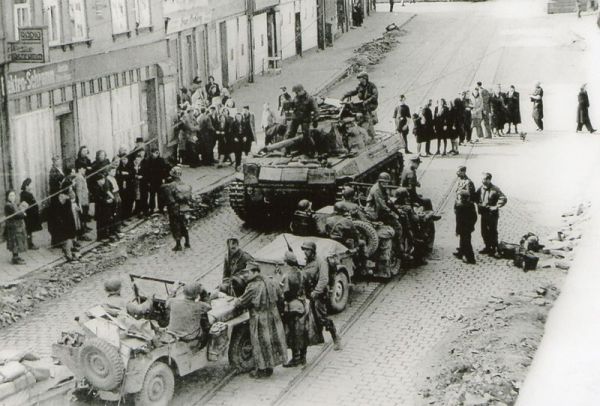
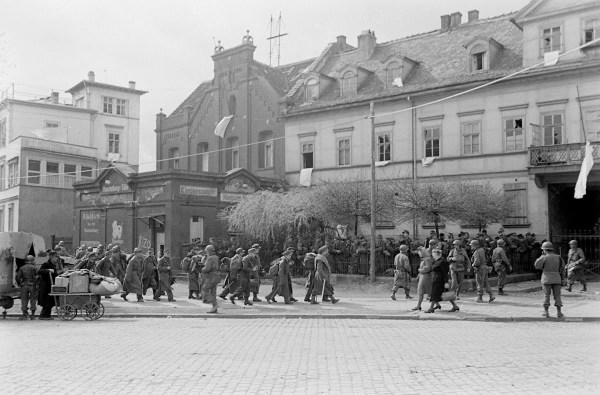
American Army at Erfurt April 12, 1945 – Photo: erfurt.de


At last American soldiers appeared at the basement door. An army captain was calling him and his bedraggled troop to come out of the basement. Earlier other German soldiers had put on civilian clothes. There was one among them who had some command of the English language. When the Gi’s stormed the building, he cried out with a pleading voice, “Don’t shoot. I am not a German Hitler soldier!” These were the final moments when around eight o’clock in the morning of April 12, 1945, Opa became a POW of the US forces in Thuringia.

Walter Panknin (1898 – 1977) and His Family – Part 16

Papa Lending a Helping Hand

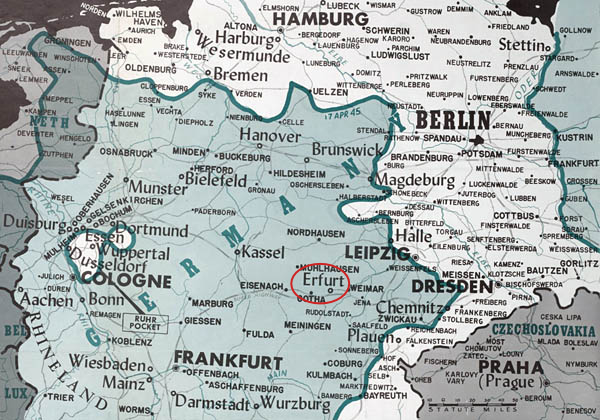
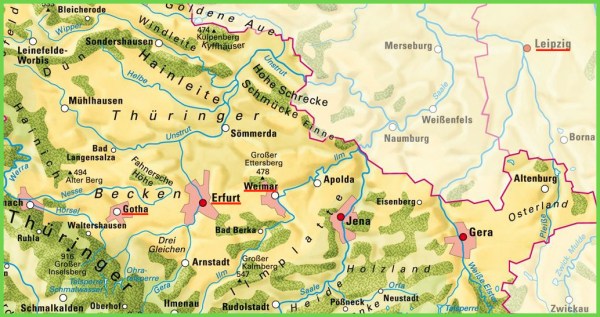
Places Walter Panknin Mentioned in his Notes

The following night Jepson invited Captain Panknin to sleep at his place. For the first time in weeks, Papa had a good night’s rest. Refreshed from a deep sleep, having recharged his internal batteries, he set out to go to the police HQ to receive further instructions. He had barely walked a few steps when Leipzig came under a sudden and unexpected aerial attack. The bombs were already falling when the sirens belatedly began their alarming howling in the city. An incendiary bomb plunged into a neighbour’s house, which almost immediately burst into flames. Papa helped the poor inhabitants with salvaging valuables from the burning inferno. His clothes singed by the fire and exhausted from the hard work, he arrived at the HQ, where to his greatest surprise, he was presented with yet another marching order, this time to Dresden-Hellerau. He had hardly received his provision for this eastern journey when the order was replaced by yet another, which sent him back to the latest hotspot at the western front near Weimar, where the Americans had launched a major offensive under General George Patton.

On April 8, shortly after midnight, he arrived by train at Weimar, where he went straight to the police HQ. By 06:15, he was climbing with a small troop under his command onto an army truck, which took him straight to the provisional front line near Erfurt. From there, they marched to Schmira amidst a barrage of shellfire and attacks from the air. Upon arrival, Papa looked in amazement at the bewildering array of the hastily set up feeble defence measures, most peculiar-looking anti-tank obstacles, and highly questionable battle preparations. It was dead quiet; the shellfire had suddenly ceased. Was it the calm before the storm? In the ominous stillness of impending doom, Papa found time in a nearby inn to write a letter to Mutti and family, which he passed on to a female communication aid to deliver it if at all possible to his wife in nearby Gotha. All day long, he could hear the droning of enemy planes over Erfurt. After a restful sleep in the basement of the police HQ, he felt his confidence returning, especially regarding Mutti and the children. He began to contemplate the best strategy to survive during the remaining few weeks of the war.  In anybody’s reasonable mind, the fighting should stop. However, the regime-loyal fanatics were bent on dragging the German people into even greater misery than they had already suffered so far. Should he stay at the frontline and count on becoming a POW of the American forces? Or should he follow the marching order to Dresden, which was most likely already occupied by the Red Army and try his luck as a POW of the Soviet forces? As a higher ranking police officer, not quite fitting into the overall scheme of an increasingly chaotic defence plan, he had, in contrast to the common soldier, at least some freedom to move.

Walter Panknin (1898 – 1977) and His Family – Part 15

The Horrors of War

Small army units had found temporary shelter and accommodation in private homes. Opa and his war-weary comrades slept in a basement from 22 hours till three in the morning when enemy shellfire woke them up. The barrage lasted for three hours. Some shells exploded in close vicinity of the house, where he was staying. At 7:30, a series of fierce skirmishes erupted while Allied dive-bombers were pounding their position at Steigerwald, a district of Erfurt. One bomb hit their temporary home. It smashed through the roof and exploded inside, causing the building to collapse like a house of cards. Fortunately, the civilians had all been evacuated, thus preventing unnecessary injury and loss of life.

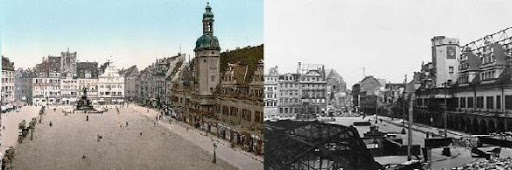
Incendiary Bombing of Leipzig – Before and After Photo Credit: Leipzigbuch


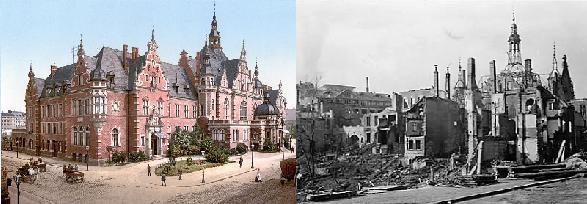
On Wednesday, April 5th, following the first marching order, Opa arrived by train in Leipzig at 22 hours. He quickly hid the wooden box filled with food supplies intended for his family while sirens were announcing another bombing raid. He managed to find shelter in a private basement room, from where he made a phone call to his superior and old acquaintance by the name of Jepsen. The German signal corps was still able to keep the lines of communication open, whereas the public telephone system had been out of order for some time. Opa received a heart-warming reception from his former colleague and friend. While he was being brought up to speed on the current frontline situation, he also received instructions about his role in the constantly shrinking space being held by German troops. Another bombing raid rained terror, fire and death from the unprotected sky. At three in the morning, Opa finally went to bed and found some much-needed rest. But he could not fall asleep.

Incendiary Bombing of Leipzig – Before and After Photo Credit Leipzigbuch


Worries about his family kept him awake. Hundreds of questions occupied his mind, to which he had no answers. Had the Americans already reached Weimar? Was the rumour true that their tanks have pushed their way to Gotha? How was his wife faring under these chaotic conditions? Was she still alive? And what about his stepdaughter Elsbeth? Then his thoughts turned to his twins Gertrud and Walter, whom he had held on his arms only two months ago? How were they doing? Was Mutti able to take care of them? When seen through the eyes of a caring and loving father, who must serve as a soldier fighting for his country, war takes on a new horrific dimension that goes beyond killing the enemy, worrying about getting killed, about death and destruction all around you. For every soldier killed in action, a mother will mourn the loss of her son. A sweetheart will never meet her lover again. A wife will have lost her husband and the father of her children. But when a soldier survives the horrors of the killing fields and returns home from a POW camp, and discovers that his entire family had perished in one of the horrendous aerial attacks, then what more is there to say about the utter and total senselessness of war? Having been a conscientious police officer and army captain faithful to country and convictions, Opa meditated deeply about things of concern to him. He often liked to share his views with friends and relatives in his massive correspondence later in the early sixties, from which I derived a lot of valuable information.