Walter Panknin (1898 – 1977) and His Family – Part 14

Utter Chaos and Contradictory Orders

Near the end of March 1945, SS-Colonel Josef Dietrich had taken over the defence of Vienna. A few days later, artillery fire was thundering and warning that the Soviet frontlines were moving closer. Opa fortuitously recalled his marching orders commanding him to report for duty at his hometown Gotha. So with these documents on hand, it was in the eyes of the military authorities quite proper and legitimate for him to leave the endangered Austrian capital and not be considered a deserter. Yet, with his keen survival instinct, he saw a golden opportunity to be near his family in his leaving the city. Papa also saw a chance to get through the final stages of the war alive. To fall into the hands of the Americans as a POW was, in his mind, the lesser evil. He managed to reach Erfurt by train a short distance east of Gotha, which was already under attack by US troops and tanks. This event prevented him from taking on his new assignment there. So on the highway to Gotha, where he was walking, he joined the German forces in full retreat from the enemy. Papa did not indicate in his notes the army units under his command in the final stages of the war.
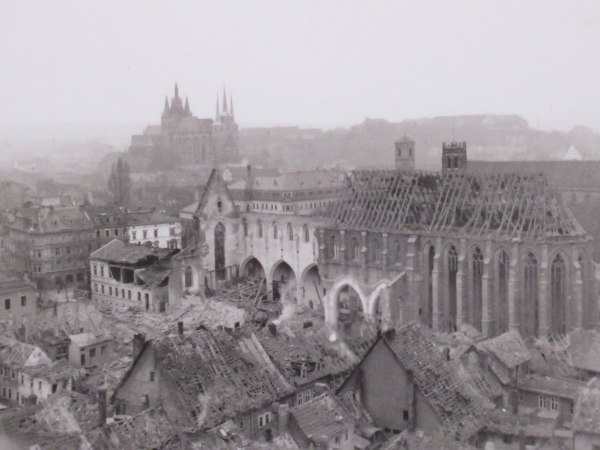
Erfurt 1945 – Photo: Wikimedia


Later, on a beautiful sunny April morning, when he would have preferred to take a relaxing hike with his family through the Thuringia Forest, he walked instead in the direction of the Central Station in search of provisions. When he passed by the railway station, the ordinarily busy and often overcrowded place was utterly deserted. Enemy tanks had bypassed the town during the afternoon on the previous day and threatened to cut off the local defence lines set up for the region around the city. Rumour had it that an order would come that very same night regarding a desperate attempt to hold the town with troops drawn from the so-called ‘Volkssturm’ brigades long enough for the bulk of the battalion to reconnect with the German defence lines farther east. Despite the town mayor’s opposition to the inevitable house-to-house combat and the danger of more destruction to his beloved city, the order was carried out to the effect that the regime-loyal Nazi officials had also taken flight together with a remnant of the retreating army. Expecting the arrival of the American vanguard of tanks and troops at any time and being no longer afraid of their oppressive regime, audacious town folks tore down the pictures of Adolf Hitler from public buildings and the walls inside the railroad station.
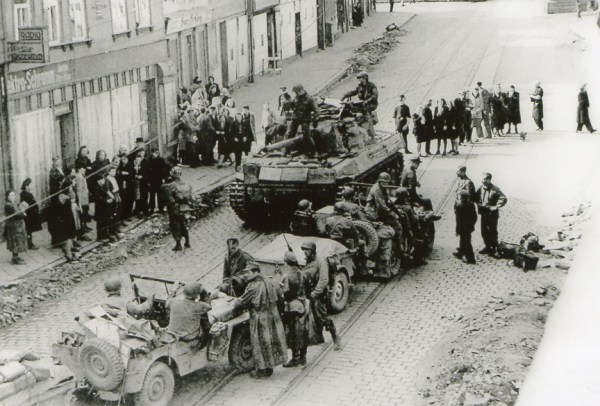
American Troops in Erfurt April 12, 1945 – Photo: erfurt-web.de

For Papa, these were turbulent times. With a small company of soldiers, he stayed behind, having received an order to fight as long as possible to delay the advance of enemy units converging on the city of Erfurt. On April 2nd, 1945, he recorded on his notes that the lines of command and communication were in a complete state of disarray. In the chaos and the rapid disintegration of the command lines, coordination of troop movements became increasingly more challenging to maintain. Often conflicting orders were sent out by the high command resulting in total confusion for the officers in charge down the military hierarchy. For instance, since his return from Vienna, Opa had received two marching orders, one for Leipzig and another for Dresden, while at the same time, he was supposed to provide leadership in the defence of Erfurt.
Walter Panknin (1898 – 1977) and His Family – Part 13

The Vienna Slivovitz Hunter

Being cut off from his unit in Zavidovici, Papa returned to Vienna to report for military duty and to prepare a newly formed battalion to defend the city. Fortunately for him, there was not much action during the next two months except for the endless allied bombing raids on the capital of Austria. Since there were virtually no German fighter planes, American bombers brazenly made daily attacks in broad daylight on the beautiful city on the River Danube. With the regularity of a clock, they flew in from their air bases in France.

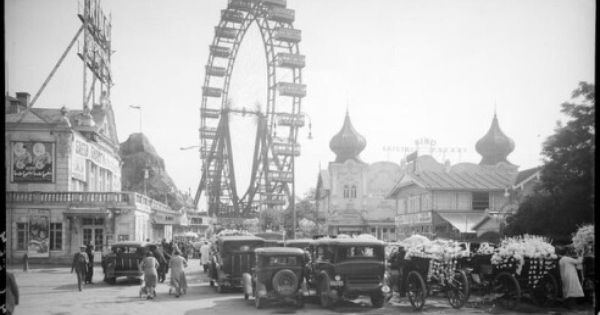
Vienna Amusement Park Prater in the 1930s – Photo Credit: pinterest.com

Ignoring the lethal blows to entire neighbourhoods, Papa remarked in one of his letters employing his peculiar kind of sarcasm that the Americans were knocking down one café after another. He would soon have none left to go and enjoy with a colleague a game of chess while sipping coffee and tasting delicious Viennese pastry. Knowing that the war would soon be over and all his money worthless, Papa spent his off-duty time scouring the local liquor stores for the liquid gold, his cherished slivovitz. He perceived it to be more valuable than the war-tarnished currency of the German Reich. On his final official leave at the end of February, Papa had assembled a dozen 1-litre bottles of his favourite plum brandy, for which he had a wooden crate especially built for the transport on the train to Gotha. However, he did not quite satisfy the desire for this precious drink. Indeed, he had also considered its trade-in value for scarce essential items later down the road. He managed to scrounge up a keg containing about 10 litres of slivovitz, which he stuffed into a huge rucksack.

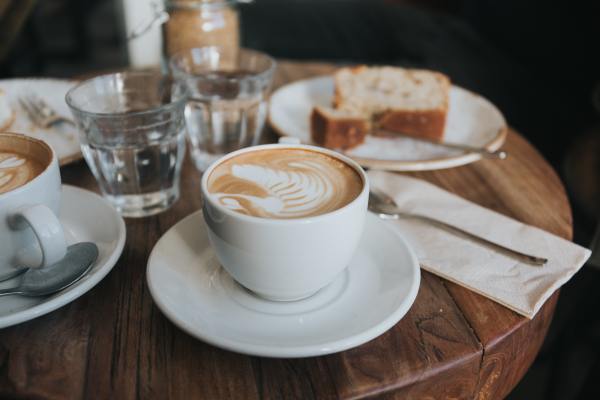
Vienna Coffee House – Photo Credit: unsplash.com

With all these goods unavailable in Gotha and a suitcase full of foodstuff for the family way back home, he had to struggle to make his way to the railway station with a rucksack on his back, suitcase on the one hand and a small cart loaded with a box full of bottles on the other. People must have watched in amazement the most peculiar sight of an army officer that Papa offered to the curious Viennese onlookers. He was homeward bound and did not care much about the image that a German army officer was supposed to present to the public eye. Despite constant propaganda promising final victory, Papa and everyone else knew that the war was lost and that it was time to think of survival and to ignore how ridiculous one might look when plodding along with a load of valuables on the sidewalks of Vienna.

Walter Panknin (1898 – 1977) and His Family – Part 11

A Gruesome History Lesson

No Photos Here – Let The Words Suffice

In response to the wartime atrocities committed by the Nazis, the partisans stilled their thirst for revenge first on members of the Waffen-SS. According to a report, on Pentecost Sunday, 450 soldiers were shot near Reichenberg, their arms tied together with telegraph wire in groups of six, all shot in the back. At the capture of Krusevac, 2,000 soldiers of the “Prinz Eugen” division were murdered. In Reichenegg, the partisans forced POWs into a bunker and dynamited it. When the stench became too intense, survivors had to cover the bunker with dirt. At Susegrad, partisans undressed 90 soldiers and chased them into the Sava River. Whenever possible the inmates buried the dead and marked the graves with stones or wooden crosses. In 1948, after the last POWs had left the provisional camps, locals dispersed the rocks, gathered the crosses and burned them.
Most of these former regular Wehrmacht troops perished in postwar Yugoslavia in three stages. As already mentioned above, during the first stage more than 7,000 captured German troops died in Communist-organized “atonement marches” stretching 1200 km from the southern border of Austria to the northern border of Greece. During the second phase, in late summer 1945, many German soldiers in captivity were summarily executed or thrown alive into large karst pits along the Dalmatian coast of Croatia. In the third stage, 1945-1955, an additional 50,000 perished as forced labourers due to malnutrition and exhaustion.
The total number of German losses in Yugoslav captivity after the end of the war including ethnic “Danube German” civilians and soldiers, and “Reich” Germans, may therefore be conservatively estimated at 120,000 killed, starved, worked to death, or missing. One may wonder why I would go to such length to describe the gruesome details of past events in an area of seemingly minor importance to us. There are two reasons. Firstly, I noticed so many similarities in the brutal treatment of the German civilian populations in East Prussia and Pomerania, where my parents and grandparents had their roots, and Yugoslavia, where Biene’s Papa spent most of the war years. I found it appalling that so little can be found in today’s historical literature about these events.

Additional information on the treatment of other ethnic groups in Yugoslavia: https://en.wikipedia.org/wiki/Bleiburg_repatriations

Walter Panknin (1898 – 1977) and His Family – Part 10

Papa’s Miraculous Escape

In the first week of January 1945, Papa took the train to Zagreb, the capital and largest city of Croatia, from where he began the long train ride to Vienna. The resistance forces under the leadership of Josef Tito were cutting off all the supply lines from the north, which included the rail connections to Germany. So when Papa arrived in the capital of Austria, he heard that he had been on the very last passenger train that succeeded in leaving Yugoslavia. If we consider all the horrific atrocities that Tito’s guerilla army revengefully committed against German ethnic groups living in Yugoslavia in general and against German officers and ordinary soldiers in particular, it is fair to say that the birth of the twins had saved Papa from certain death.

On May 6, 1945, General Kesselring told Colonel-General Löhr, the commander of the southeast army, that Germany would capitulate on May 9. Löhr then contacted Tito to work out the capitulation details. The Yugoslavs ignored anything agreed upon as soon as the Germans had surrendered and had laid their arms down. They forced the POWs to march in so-called Sühnemärsche (atonement marches). The Geneva Convention states that POWs can march no more than 20km (12.5 miles) a day. One of the POW groups walked 75 km in 20 hours. Whoever straggled or was begging for water or food was shot. Ten thousand perished during those marches.

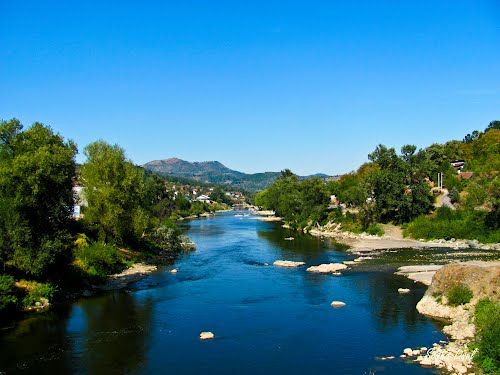
Picturesque Modern Day Croatia

Camp life was no better. Hardly any food was available. The prisoners had to gather herbs and cook them. The result was diarrhea and dysentery. “Death worked with a scythe” in Belgrade Camp # 1. The dysentery barracks housed eight hundred; it was called the death barracks. The death count was at least ten corpses each day. The camp masters worked the inmates to death in lumber camps and mines. They also forced them to clear minefields without the proper equipment. At times, at the end of a shift, hundreds of POWs were chased onto the cleared field to ensure that no mines remained. Those who died were buried in unmarked graves. The camp authorities did not attempt to record their names.

Walter Panknin (1898 – 1977) and His Family – Part 9

The Good Life in Zavidovici

Papa, who had recently advanced to the rank of a captain, enjoyed an excellent rapport with his staff. He carried out his business in a strict but fair manner, which earned him the respect of his officers and the people of the Bosnian district around Zavidovici. They were grateful for the security that his troops provided. Tito’s bands and the German army alike were terrorizing towns and villages elsewhere in their attempts to gain control over the enemy. For Captain Panknin, there was just one fly in the ointment. He also had to deal with troublesome disciplinary matters arising from a company of volunteer soldiers under his command soon after Germany attacked the Soviet Union in June 1941. The company mainly consisted of exiled Russians, former Belorussians or their children. As Papa described them in a letter to a friend after the war, they were drunkards, thieves, and good-for-nothings. In his opinion, the military police should have arrested them and put them in an army jail for all kinds of significant infractions. Breaking military rules and criminal activity within and outside the barracks were examples that Papa mentioned in his report. But documenting all the individual cases and summoning witnesses to support the evidence would have taken too much valuable time. The little episode corroborated what I learned from my brothers’ reports in Book I.  It may come as a surprise to most readers that many young men from European countries were willing to fight for Germany against the Bolshevik threat to take over all of Europe.

This image has an empty alt attribute; its file name is c08d752f9f621d92cf384efb5278b638.jpg
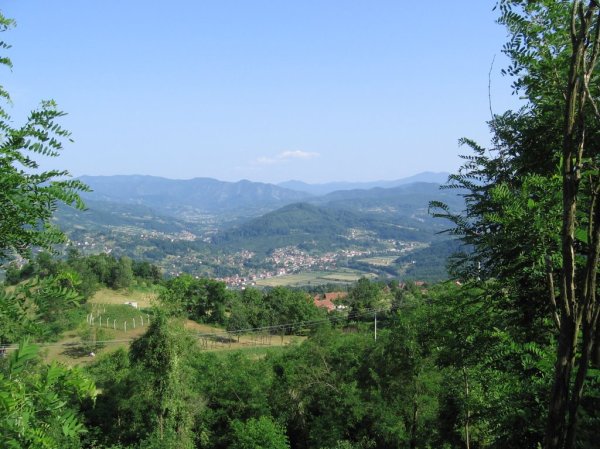
Picturesque Landscape near Zavidovici, Croatia

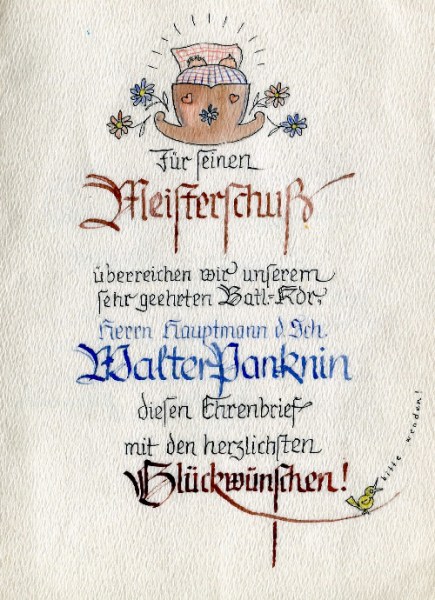
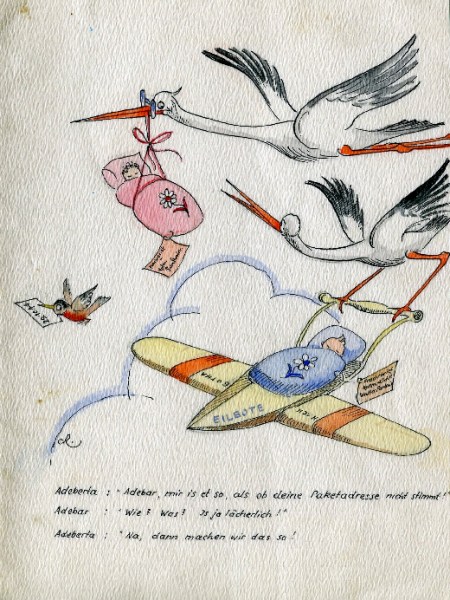
On October 30th, 1944, a telegram arrived from the Gotha police headquarters informing Captain Panknin of a very joyful event back home. The message read as follows: TWINS ARRIVED ON 29/10 44 BOY AND GIRL MOTHER AND CHILDREN ARE WELL. Great was Papa’s joy. What a blessing to have twins when it had appeared that he would not have any children of his own after fourteen years of marriage! His staff was equally delighted and created for their boss the most beautiful congratulatory card I have ever seen.

This image has an empty alt attribute; its file name is birth-congrat-44-cropped.jpg

There must have been an artist among the officers. No commercial card could have matched the quality of the picture depicting two storks delivering the babies, the touching message for their dear commandant, and a lovely poem to boot signed by the entire staff. Of course, this extraordinary event called for celebration. But the best part for Papa was that he was granted a rare leave in the New Year from war-torn Yugoslavia to travel home to see his wife and children.

This image has an empty alt attribute; its file name is birth-congrat-44_2.jpg

Walter Panknin (1898 – 1977) and His Family – Part 8

Joyful Times in Croatia

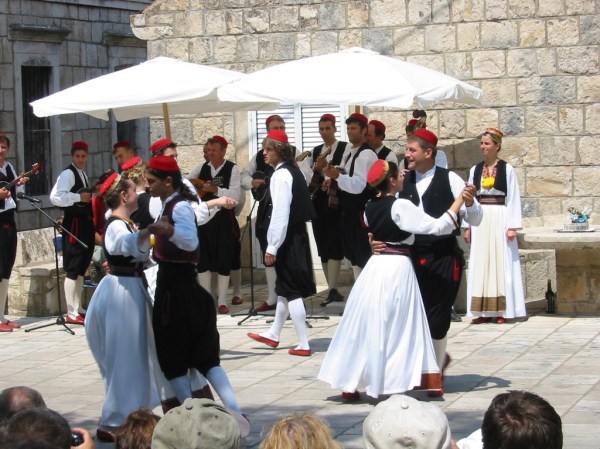
Papa loved the people and their culture. Although they were poor and had to work hard to make a living, they knew how to celebrate. After they brought in their harvest in the fall, or when they gathered at a wedding banquet or welcomed a newborn child into their community, they made good use of these festive occasions. Many of the songs Papa was so fond of listening to come from the Balkan Roma, the people once called Gypsies.

Folk Dance Group of Dalmatia, Croatia – Photo Credit: Wikipedia

If one grew up on a steady diet of Western pop music, Balkan melodies take a little bit of getting used to. While many of the tunes use familiar rhythms, including the driving rhumba beat, some Balkan tunes add spice using asymmetrical meters. The music tells only half the story. The dancers, prompted by the intoxicating rhythm and the ever-increasing tempo, suddenly emerge from the cheerful crowd. The steps in the Balkan dances can be delightfully simple or maddeningly complex. Most are line dances; they rarely occur in couples. What does the music sound like that Papa loved so much? It depends on where you go. In Croatia and Serbia, there is the tamburica tradition of plucked-string instruments. But the musicians are also using accordion, violin and woodwinds. Add to this the wailing melodies delivered by wedding bands that play songs popular across the entire region. Now we will understand Papa’s fascination with the Balkan people, their music, dances, and customs.

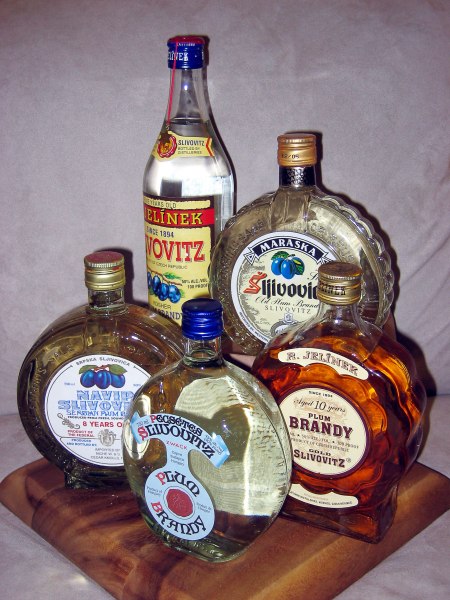
Collection of Slivovitz Bottles – Photo Credit: Wikipedia

When it came to alcoholic beverages, nothing would appeal to Papa’s taste buds more than the famous Slivovitz. Orchardists have been producing the sweet, velvety plum brandy for hundreds of years, primarily in Croatia, Serbia, Poland, Hungary and Bulgaria. Late-summer plums are the most commonly used: deep purple, ovoid and freestone, such as damson and Italian prune types. The fruit is pierced, covered with sugar and alcohol and stored in a cool, dark place for months. The most exquisite and complex slivovitzes age in casks, like wine or bourbon.