Visitors from Berlin
Summer 1941
Please note that my thoughts on my father’s life appear in green print. What is shown in regular print is translated from my cousin’s book on the Klopp family.
Uncle Artur’s report about their summer vacation at Silberberg far away from the capital city in a carefree rural setting was a joyful moment in time for the entire family. The Klopp children, Karl, Adolf, Erika, and Gerhard (I wasn’t born yet) and the visiting cousins Ingrid and Gerlinde had lots of fun exploring the fields and visiting the farm animals, the cows, horses and even a mule. They took an immediate liking to the three dogs, which added excitement and often real drama to their vacation in the country.
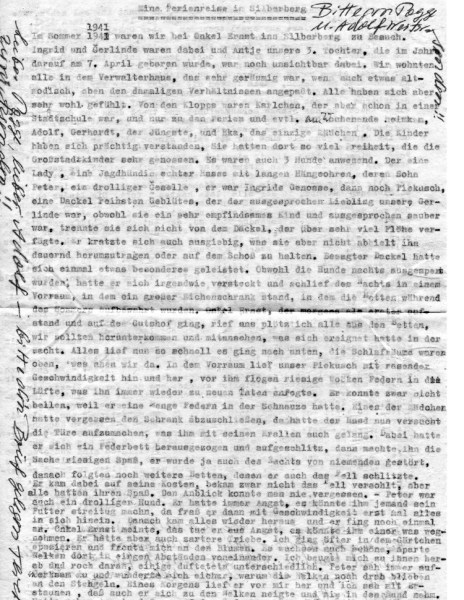
Piekusch, the dachshund, Gerlinde’s favourite dog, managed to pry open the closet door in the middle of the night, pulled out a pillow stuffed with goose down, ripped it open and sent the feathers a-flying. Jumping high and chasing those elusive goose feathers were too much fun to enjoy all by himself. Yapping and howling he drove himself into a frenzy, waking up the entire family in the upstairs bedrooms who came rushing down to behold the spectacle. The event caused so much laughter and merriment that Piekusch got by with just a stern reprimand.
Watching the horses running wild and free on the nearby pasture was not without danger. One day a string of horses came galloping straight towards the children. It became frighteningly obvious the ferocious beasts would not bother to race around the children. In a split-second they leaped into the thicket of a bush, which saved them from being trampled to death.
Some other time the visitors from Berlin took a ride in a horse-drawn carriage to a village, where a wandering troop of performers offered some small town circus entertainment. Nobody was particularly worried as the carriage was gaining speed. As it turned out the coachman had fallen asleep and the horses had gone out of control. Luckily, the coachman woke up just in time to rein in the horses. Otherwise the horses would have dragged the carriage into the lake a mere hundred metres ahead of them.
Freshly caught carp from the pond frequently provided meat relished by all the guests and family members. Uncle Ernst always ready to crack a joke described a ten-pound carp as the venerable elder among the carp tribe.
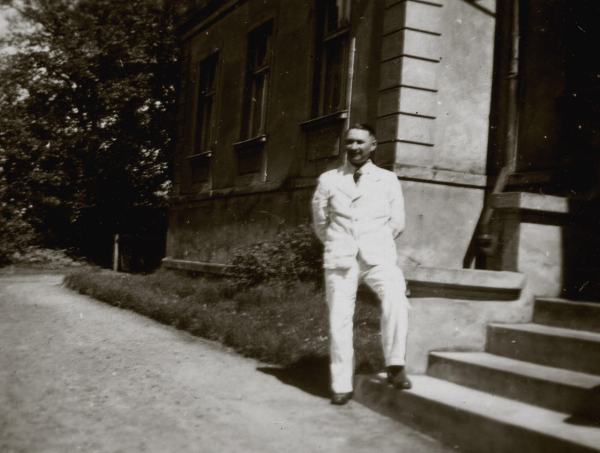
In those days fridges were unheard of in the remote rural community in the land of the Warthe. But the cellar below the main floor was filled with ice. The children had free access to the barrel which contained an huge amount of pickles. Crunchy and tasty the pickles were a refreshing delight during the hot summer days. I could not leave “Uncle Artur’s” vacation report unpublished as insignificant as it may appear. For it gives the distinct impression of peace and happiness at a time of war and destruction in many parts of Germany and the world.
 The Peter and Gertrud Klopp Family