Chapter IX of the P. and G. Klopp Story – Part II

Progress at School with Father’s Help

Our school and its yard was surrounded by a brick wall about two meters high and looked more like a prison than a place of learning. The huge iron gate would open fifteen minutes before school started. At eight o’clock sharp the janitor locked the gate and any late student would have to ring the bell at the main entrance, over which was chiseled in stone ‘NON SCHOLAE SED VITAE’ (NOT FOR SCHOOL BUT FOR LIFE). The janitor would then take the delinquent scholar to the vice-principal’s office, where he had to explain the reason for his tardiness. After a severe dressing down and reprimand, he would receive a slip of paper signed and stamped which allowed him to enter his classroom.
15flip

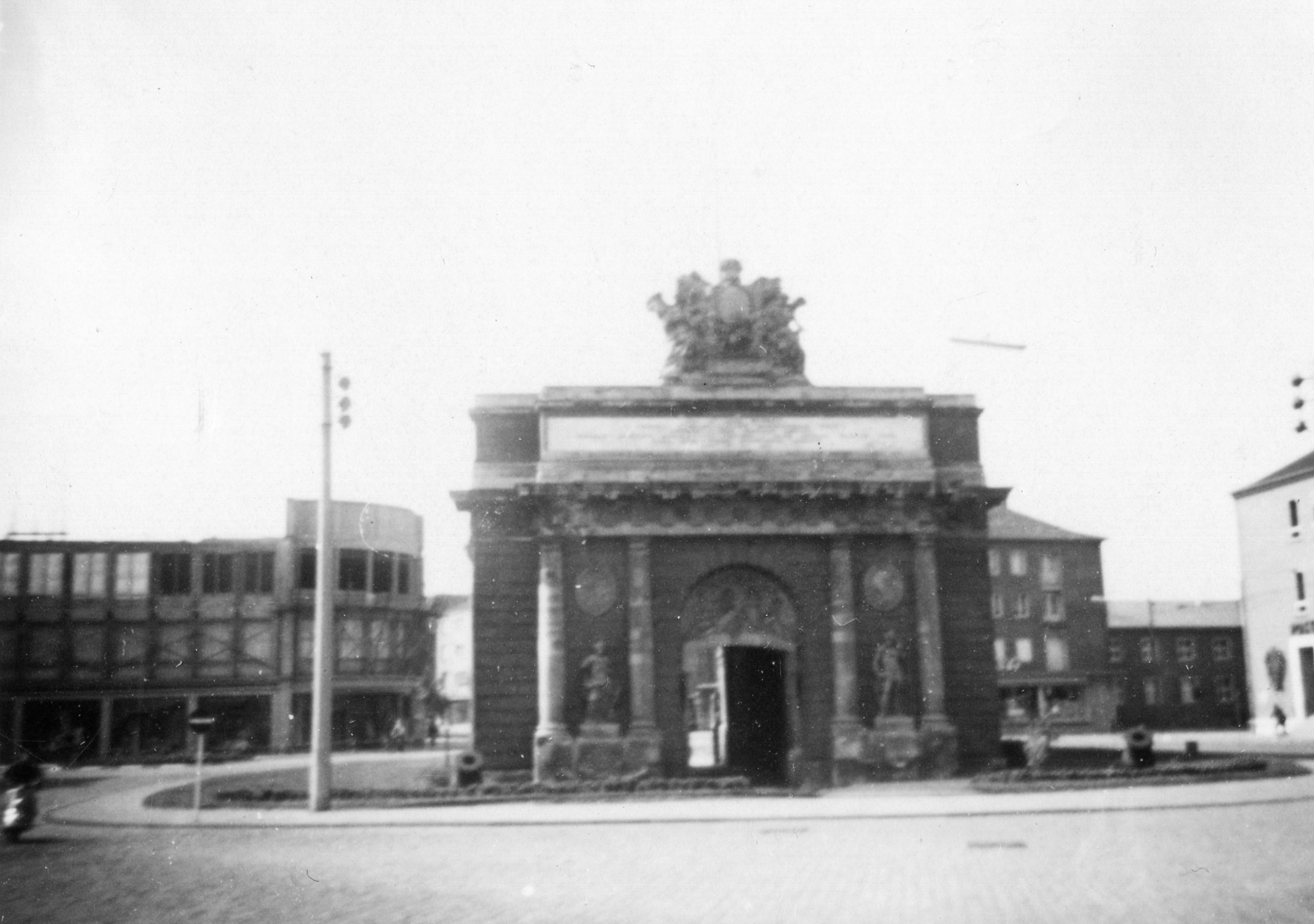
Berlin Gate at Wesel 1956

My second year at the Wesel High School turned out for me to be a very happy one. Having been placed back to the first high school grade the year before helped me overcome my deficiencies in Latin and made me feel superior in all other subjects, especially in Math. I quickly made friends with three other students. Being one year older and quite a bit taller, I took on the delightful role during recess and lunch breaks of the big, bad wolf and chased my friends, the three little piglets, all over the schoolyard. In the German comic books published under the worldwide license by the Walt Disney Company the wolf’s name was Ede. From this time on my nickname had been Ede for all those who belonged to the inner circle of my friends.

Berlin Gate at Wesel 2012 - Phot Credit: wikipedia.org

Berlin Gate at Wesel 2012 – Photo Credit: wikipedia.org

Great was my joy, when Father arrived. After two years of living only with Mother and Aunt Mieze this was a welcome change for me. What I didn’t know at the time was that my parents were drifting apart due to circumstances beyond their control. Mother having no employable skills had allowed herself to be bound completely to Aunt Mieze’s generous arrangement by taking over housekeeping duties in exchange for room and board, all expenses for herself and me. Father suffering from periodic back pains and other health issues could no longer find meaningful employment. His former administrative talents in agriculture were not in demand, especially not in the city of Wesel. Mother expected him to take up any employment. Even sweeping the streets or working for the sanitation department would have been all right in her eyes, she once confided to me. So as time went on, Father was facing a dilemma, either to continue to depend on Aunt Mieze’s charitable hospitality or to seek work completely out of line with his agricultural expertise.

But while he stayed with us, half a year or more, he did his best to create a sense of togetherness between himself and me, a kind of late bonding between father and son. He took great interest in my studies at the high school. He had heard of my difficulties in Latin and devised a motivational scheme to help me with grammar and vocabulary, which he himself had never learned. He also noticed that if I did get into trouble at school or at home it was primarily due to the fact that I, often wrapped up in my dream world, lost track of time. His plan, which I immediately embraced with great enthusiasm, was that I should earn my very first watch by studying Latin with him. For every exercise from my text-book, for every successfully completed vocabulary drill, for each translation into Latin he awarded me one point and recorded it meticulously with date and type of work into a little writing booklet. Once I had obtained the grand total of 500 points, he would give me the promised brand-new watch. When he left, I was not only the proud owner of a watch, but also more importantly my marks in Latin had soared to the second highest level one could get on the report cards. Moreover, I had accumulated so much knowledge that I was coasting along for four more high school years before slipping back to the more common satisfactory standing. It was also during Father’s short stay that he taught me how to play chess. His legacy was not only that I had developed a lasting passion for the ancient language of the Romans and the royal game of chess, but also that I harbor only the fondest memories of and feelings for my father. Little did I know that I was not going to see him again for six long years.
Chapter XI of the P. and G. Klopp Story – Part I

 Until one has loved an animal, a part of one’s soul remains unawakened.
Anatole France

 Adventures Above and Below the City of Wesel

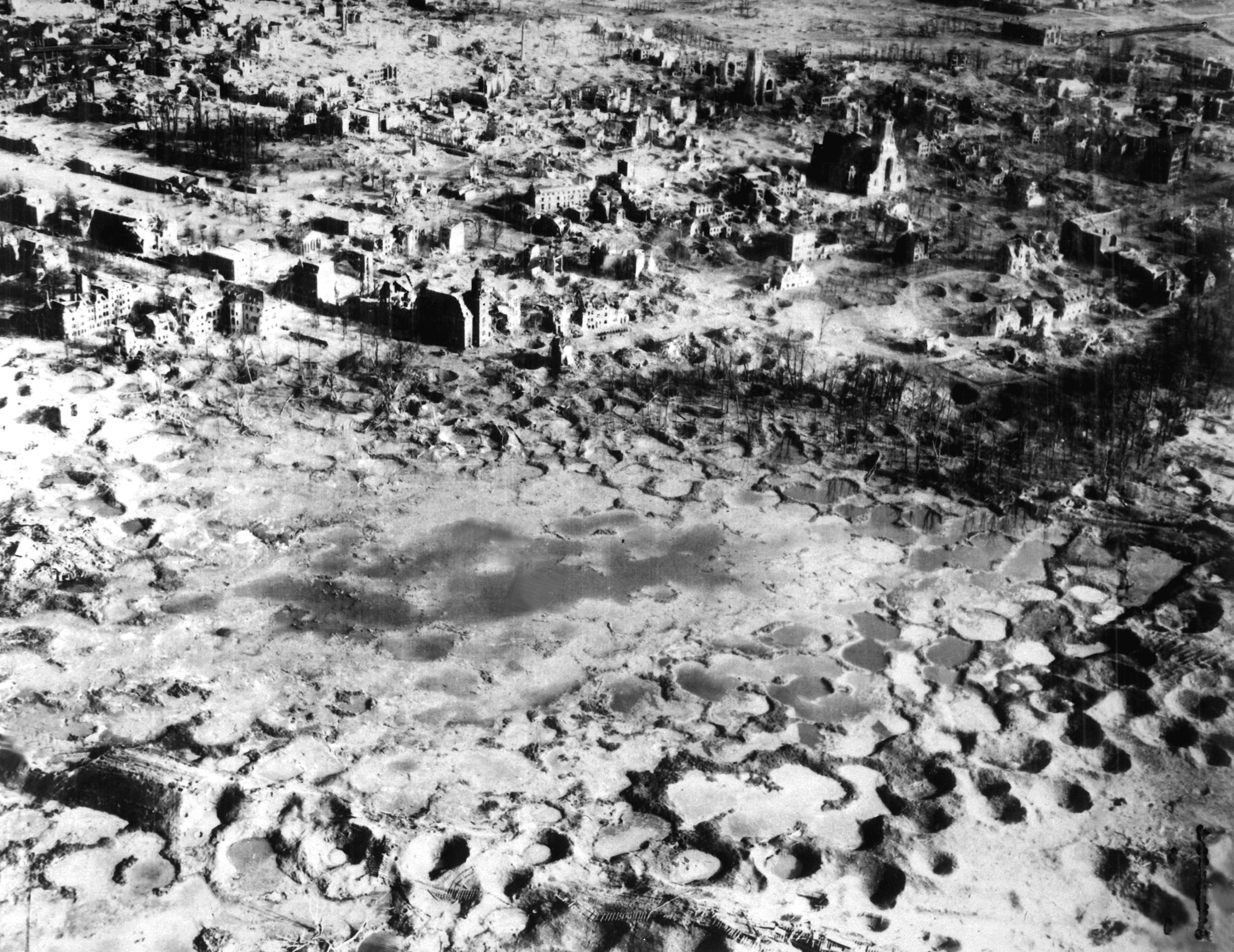
In 1956, the same year my brother Gerhard (Gerry) immigrated to Canada, Mutter, Aunt Mieze and I moved into our brand-new apartment near the center of the city of Wesel. Just a little over a decade after the war, the city lay still to a large part in ruins. Reconstruction was in full swing. Looking from my bedroom window I had an unobstructed view of a three km stretch with no houses standing all the way to the railroad station.

Walls of houses of Wesel still stand, as do the churches, but a great part of the town was destroyed when the German commander forced the Allied troops to fight their way street by street through the ruins.  Germany, 1945.  Army.  (OWI) Exact Date Shot Unknown NARA FILE #:  208-N-39903 WAR & CONFLICT BOOK #:  1336

Wesel after Allied Bombing Raids in March 1945 – Photo Credit: wikipedia.org

Of course, from a boy’s perspective, the city was an exciting place waiting to be explored. With my friend Hartmut I went on adventurous exploration into the huge bombed-out area not far from the street with the melodious-sounding name Auf dem Dudel, where I lived. Not finding much in the rubble that had been picked clean long time ago, we felt the magnetic pull of the few houses, which had been declared unsafe by the authorities. There were warning and ‘no trespassing’ signs. Did curious teenagers ever heed such notices? Hartmut and I found a window at the back that the city workers had forgotten to board up. Assisting each other we gained quick access to the interior of the house that had miraculously escaped total destruction from the Allied carpet-bombing raid a decade ago. We climbed up a fancy wooden staircase to explore the upper rooms. From the ornamental engraving and carving of the railing and the decorative oak panels on the walls we knew we had entered a small mansion. Eagerly we scurried from room to room in search of some treasure that the owner might have left behind. To our greatest disappointment the rooms were bare and the floors had been swept clean. Only the old-fashioned flowery wallpaper offered a hint that this little mansion had seen better days. To get at least one benefit out of our discovery, we decided to come back and turn one room into the headquarters of our secret society that we soon formed under the mysterious name “The Black Hand”. Unfortunately on the following excursion, we made the sad discovery that the only remaining opening into our hiding place had been properly nailed shut.

Friend Hartmut on the River Rhine at Wesel

Friend Hartmut on the River Rhine at Wesel

At the outskirts of the city there was a brand new sewage treatment plant. Construction workers were still busy installing underground concrete pipes more than two meters in diameter. A few weeks before the town sewage and drainage system was to be connected to the new facility, Hartmut and I came across an open manhole, which led down via an iron ladder to one of the underground tunnels. Our plan was to come back the next day with flashlights and to embark on a new adventure underneath the city of Wesel. The following afternoon we descended into what seemed to our excited imagination Minotaur’s labyrinth. Fear of the unknown and the desire to prove our courage heightened the excitement. Iron rung by iron rung we lowered ourselves into the municipal underworld, where three giant pipes joined to form a Y-connection. We decided to follow the larger pipe that led away from the city. It was eerie to walk through the dark passageway, where the feeble flashlights could not reach farther than a few meters. The echo of our steps reverberated a million times from the smooth concrete walls. We did not dare to speak, for we were afraid of our own hollow sounding voices. Every ten minutes or so we encountered a shaft leading up to a manhole. But they were all securely closed and the metal lid would have been too heavy for us to lift. With some trepidation we realized that we had to return to the manhole we had just climbed through, if we wanted to get out of this gloomy environment. We were just about ready to turn around, when I saw a faint circular light. It was the proverbial light at the end of the tunnel. It gave us hope to escape a little sooner from this frightening darkness, since our flashlights were already beginning to fade. We were moving faster now toward the exit. Soon we were close enough to hear the grinding noises and then we felt the vibrations from heavy machines. Just then a crane was lowering another pipe section into place, when the foreman of the work crew spotted us emerging from the darkness into the broad daylight.

“What the hell are you little devils doing down there? Get out of there this very minute! I want to talk to you.” Seeing the man seething with anger and hearing the verbal abuse that came raining down upon us, we stood there stunned and paralyzed for a short while as if glued to the edge of the pipe. But when he threatened to call the police, we regained our mobility. We quickly turned around and rushed back into the safety of the underworld that just a moment ago we were so eager to escape from. With the flashlight flickering and threatening to go out completely we raced back without granting ourselves a single break fearing all the time that the foreman had sent his work crew to catch us. The two or three kilometers seemed endless, but all of sudden we had reached, huffing and puffing, the Y-section, where our adventure had begun. Except for our heavy breathing no footsteps from the other end could be heard. The light from the open manhole above signaled that we were safe. We were totally exhausted from the run, but very happy to see the light of day again.

Chapter X of the P. and G. Klopp Story – Part I

Problems with Latin and Yearnings of a Miller’s Maid


One cannot answer for his courage when he has never been in danger.
Francois de La Rochefoucauld


Mother had taken a new position in a senior citizens’ home in Rudersberg near Stuttgart. Aunt Mieze (Aunt Marie), her eldest sister, found a teaching position in Brünen near Wesel in the province of North Rhine Westphalia. In the mid-fifties the rebuilding of the 98% bombed-out Wesel was in full swing. Aunt Mieze had applied for an apartment and for a transfer to the Wesel Elementary School. About the same time she must have invited Mother to run the household in exchange for free lodging for her and me, the youngest son. This arrangement would become reality, as soon as the apartment already under construction would be available. How Father on a long-term basis would fit into these plans, I have never been able to figure out. While Mother was still working for another year in Rudersberg, I was going to live with my aunt at the farm-like residence across from the historical Wefelnberg mill that had lost its wings, but with the aid of electric motors was still turning grain into flour until the early seventies.

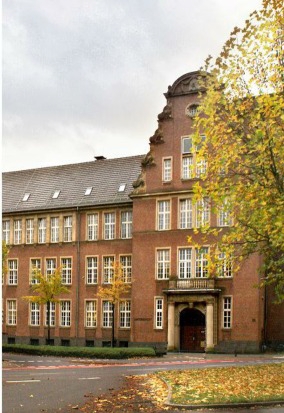
Staatliches Gymnasium Wesel

Staatliches Gymnasium Wesel

From here I took the bus to attend the high school for boys in Wesel. In those days smoking was still permitted on public transport. I often felt sick from breathing in the lingering smoke of cigarettes and cigars. Things did not go very well at school either. I had started with French as the first foreign language. Here at the ancient language school, Latin was taught first and carried on for nine long years. Although I had received some private tutoring in Latin, it became abundantly clear after my first report card with an F in Latin that I had to repeat the grade. In order to survive in a school, whose claim to fame was being the toughest in the region, there was no other option.

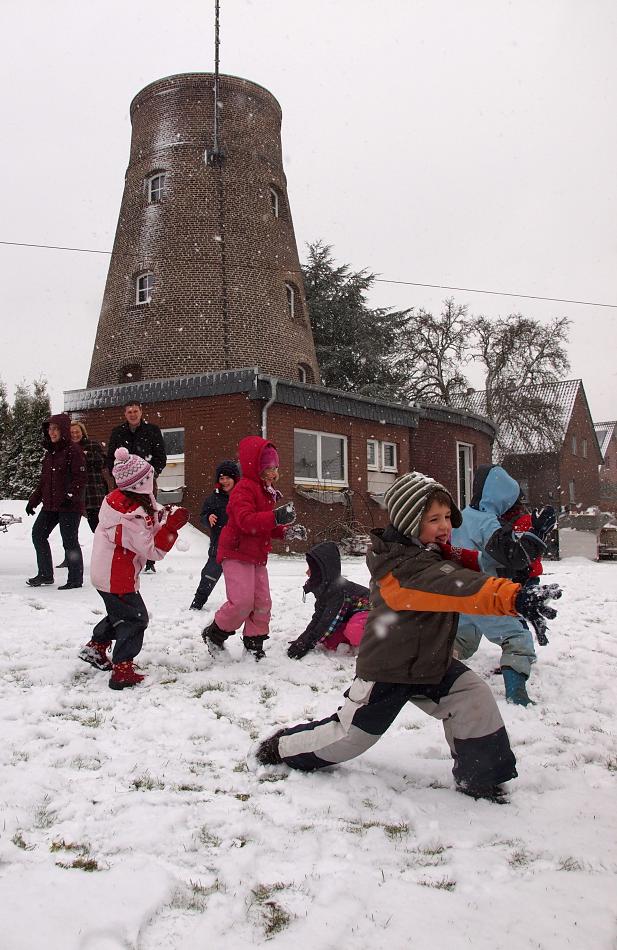
Historic Wefelnberg Mill now used for Kindergarten School

Historic Wefelnberg Mill now used for Kindergarten Classes

At the opening assembly Dr. Marx, the principal, announced that out of the hundred students there would only be one-quarter left at graduation nine years later. There was no doubt in our minds that the process of weeding out the feeble and incompetent would be ruthless and merciless. My high school years were going to be fraught with stress and anxiety. At least at the miller’s home in Brünen I had a good life. Aunt Mieze was strict, but fair. When she felt the needed to teach me a lesson, I deserved the punishment. When she gave me on rare and exceptional occasions a spanking, it was intended to correct unacceptable behavior. Love and care for her nephew were her main motivation, not anger and rage as I had experienced at the Stoll house.

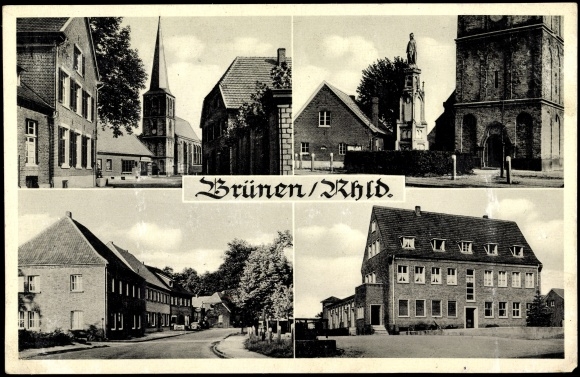
Post Card of Brünen near Wesel

Post Card of Brünen near Wesel

There were at least seven people in the Wefelnberg household: Aunt Mieze and I, robust widow Wefelnberg in her early sixties, her daughter, who had remarried, after she had lost her first husband in the war, a 10 year old daughter from her first marriage, and Leni, the maid. The couple had their bedroom next to mine. The new husband and experienced miller had taken over the duties of running the mill. With so many widows eager to remarry and competing for the few men that survived the war, it seemed that the young man had made a good choice. My tiny room of less than six square meters, even judged by the standards of the cramped living conditions in postwar Germany, would hardly qualify as a bedroom. It used to be a storage facility located under the slanting roof and was now skimpily furnished with a cot, a chair and a small desk on which I could do my homework. The door on the left of the wooden staircase was in the shape of a square just large enough for me to crawl through. On the upper floor to the right were Aunt Mieze’s office, living room and bedroom all combined in an area not larger than twenty-five square meters. At the far end on the right was Leni’s bedroom. She was responsible to assist Mrs. Wefelnberg with general household duties and was happy like most unmarried young women to have employment for free room and board and a little bit of extra pocket-money.

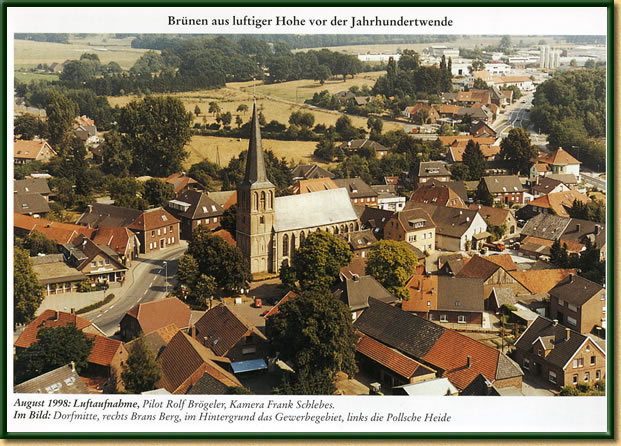
Protestant Church in the Village of Brünen - Photo Credit: See caption above.

Protestant Church in the Village of Brünen – Photo Credit: See caption above.

          Aunt Mieze’s room in spite of its shortcomings was a very cozy place and created with a comfortable sofa, coffee table, desk and books on the shelves a pleasant ambiance that my Spartan attic room could not match. Here I sat often in the evening hours, when my aunt, a very conscientious teacher, had gone back to school to prepare her lessons for the next day. Leni, who had taken a liking to me, often, especially when nobody was around, dropped in to chat or to play a game of checkers with me. The latter I liked very much. Although being at least ten years younger I was able to beat her by managing to convert my pieces into kings more quickly than she did. For someone who was at the time in school emotionally wrapped-up in a fierce struggle of survival, the survival of the fittest, our principal would say, these small victories and the praises Leni lavished on my battered ego were indeed balm for my soul.

          One day after being defeated again and providing heart-warming accolades for my strategic prowess, Leni unexpectedly slid over to my end of the sofa. What followed would have been a perfect scene for a comedy hour. The miller’s maid generously endowed by Mother Nature burning with desire of which I did not have the slightest inkling sat uncomfortably close to me, the twelve-year-old boy, and almost in a whisper asked me to kiss her. As for me having been raised in a family, where physical closeness, such as kissing, embracing and hugging, was rarely experienced, where aloofness and demureness were the norm rather than the exception, I was shocked at the maid’s incomprehensible request. For five marks as a prize I once ate an earthworm sandwiched between two slices of bread. But to touch those lips longing to be kissed, for my lips to make actual contact with her mouth was a most horrifying thought to me. When I refused, she pleaded with me, this time more urgently with a considerably louder voice, “Please do me this small favor. Please, please I want you to kiss me …” Suddenly the door burst open. At the door stood the miller’s wife and ordered Leni in a stern, authoritative tone to get into her room and never ever be seen again in Frau Kegler’s room. Whether she had been eavesdropping or even spying on us through the keyhole, I do not know. But to this day I am grateful to her for rescuing me from one of the most embarrassing moments of my life.