A Most Touching Love Story Written in German – Chart IV – III & IV

Sein letzter Besuch

Beitrag von Norbert Werner

Nach einer Begebenheit „Weihnachtszeit 1942“, gewidmet von Elsbeth Panknin an Paul Werner.

                                                                   Gotha, im Jahre 1943

Sternenklar war der Abend, und pfeifend strich der Wind um die Ecken. Hart klang jeder Schritt, und wenn es nicht so bitter kalt gewesen wäre, so hätte man Lust verspürt, stundenlang spazieren zu gehen, den Blick nach oben, um die Millionen von Sternen zu bewundern. Man kann sich an ihnen einfach nicht satt sehen, so wie man immer und immer wieder ein schönes Bild betrachten muss.
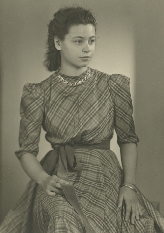
Elsbeth Panknin

Elsbeth Panknin

Das Mädchen ging raschen Schrittes und trug unter dem Arm ein kleines Päckchen. Flüchtig war das weisse Papier um die weihnachtliche Hülle gelegt, und der Wind zerrte daran, als ob er damit spielen wollte. Nachher wird sie das Papier zerknüllen und rasch in die Manteltasche schieben, als sei es nie dagewesen. Dann wird nur die hübsche Packung zu sehen sein. Gewiss wird er sich sehr freuen, und überhaupt sprachlos wird er sein, wenn sie ihn so unerwartet am Theater erwartet …

Das Bim-Bim der Trambahn riss die Gedanken des Mädchens auseinander. Nur im Eiltempo erreichte sie noch die Strassenbahn.- Es war noch sehr früh. „Ich werde einige Stationen weiter fahren, gehe dann langsam zurück, damit ich nicht so lange warten muss.“ So dachte das Mädchen und betrachtete die Fahrgäste, nur um etwas zu tun. Sicher wollten einige zum Bahnhof. Wer fährt sonst um diese Zeit in die Stadt? Das junge Mädchen dort hat sicher Nachtwache, und der Herr dort mit den Blumen will noch mit grosser Verspätung einer Einladung Folge leisten. Alles schaut langweilig und trübe. Es ist doch seltsam, dass man in der Strassenbahn immer dieselben gleichgültigen Gesichter sieht. Nur die Soldaten draussen sind lustig. Sie stehen bei der Schaffnerin und werfen Scherzworte hin, und schlagfertig werden sie zurückgegeben.

„Hindenburgstrasse“. „Ach, da steige ich aus, bis zum Bahnhof ist es doch ein wenig weit.“

Draussen umfing sie starre Dunkelheit, und einen Moment musste sie ruhig stehen bleiben, um sich daran zu gewöhnen. Dann schien es ihr wunderbar hell, und mit leichten unruhigen Schritten ging sie ein Stück des Weges wieder zurück. Im Geiste malte sie sich die Überraschung aus, wenn er sie so unerwartet unten in der Theaterhalle sehen würde. Draussen würde er rasch ihren Arm nehmen mit der ihm eigentümlichen Gebärde, und mit sprudelnden Worten wollte sie ihm den Grund sagen, der sie dazu bewogen hat, ihn abzuholen, und nicht wie verabredet zu Hause seinen Abschiedsbesuch abzuwarten. Dabei würden sie mit Bummelschritten heimwärts gehen. Sie würden sich irgendwie unterhalten über das Theater oder sonstwas, es wäre auch ganz belanglos. Auf jeden Fall würde sie sich die vielen Sterne betrachten und an etwas ganz Schönes denken. Er müsste das eben auch tun. So wäre es schön, und sein letzter Urlaubstag mit ihr fände dann einen romantischen Abschluss, wo sie sowieso die ganze Woche keine Zeit gehabt hatte.

Ja, und dann wären sie auf einmal schon zu Hause gewesen. Sie würde fragen, ob er nicht noch auf einen Sprung mit hereinkommen wolle, ihren Eltern Lebewohl zu sagen. Bestimmt würde er dankend ablehnen, es sei schon sehr spät. Vielleicht hätten sie noch eine Weile vor der Tür gestanden, dann hätte sie ihm zum Abschied rasch mit wenigen erklärenden Worten das Päckchen in die Hand gedrückt, und lachend hätte sie ihm dann ihre Hand entzogen, wäre raschen Schrittes ins Haus geeilt.. So malte sich das Mädchen alles aus.

Die Vorhalle im Theater war nur schwach beleuchtet. Einige Leute standen wartend in den Nischen. Sie warten genauso wie ich, dachte das Mädchen und fühlte eine innere Befriedigung dabei, dass sie nicht alleine war. Die Zeit verging sehr langsam. Manchmal kamen neue Leute hinzu. Eine Frau lief mit immer gleichmässigen Schritten auf und ab. Es klang furchtbar monoton. Einige Jünglinge unterhielten sich auffällig, leise dabei lachend. Sicher waren es Tanzstundenjünglinge und warteten hier auf ihre Damen. Jetzt tauschten sie wahrscheinlich Erlebnisse aus und machten sich über diese oder jene lustig. Es ist doch immer das Gleiche. Schon lange ist der Uhrzeiger auf 21 Uhr gewesen. Da sollte das Stück beendet sein. Aber die Logenschliesser machen noch nicht die geringsten Andeutungen. Gähnend stehen sie vielmehr bei den Garderobenfrauen und horchen manchmal gespannt auf das ersehnte Schlusswort. Unten in der Halle geht die Frau noch immer auf und ab, auf und ab. Ach, das Warten macht furchtbar müde. Es wird übrigens gar nicht so einfach sein, nachher die Menschenmassen zu überblicken, wenn sie alle den Ausgängen zuströmen. Man müsste statt zwei Augen vier haben, um gleichzeitig alle Ausgänge überblicken zu können. Das Mädchen dachte darüber nach, wo es wohl am günstigste sei, sich hinzustellen. Entweder gleich oben bei den Garderoben oder unten in der Mitte zwischen den Ausgängen.

Während sie noch hin und her überlegte, wurden oben die Türen geöffnet. Lautes Beifallklatschen ertönte und erreichte auch die Wartenden unten in der Halle. In die starren Gesichter kam Leben. Die Jünglinge hörten auf zu schwatzen, und auch die Frau stand jetzt still. Das Mädchen lief nach oben zu den Garderoben. Nur einzelne Menschen kamen jetzt. Es waren die Ersten, die gleich beim ersten Herablassen des Vorhanges sich von ihren Plätzen erheben und hinausstürzen. Nun kommen schon mehr, man kann sie bald nicht mehr überblicken, es ist der grosse Schwung. Das Mädchen wird unruhig. So geht das nicht, dachte es, ich stelle mich doch besser unten bei den Ausgängen hin.

Lärmend drängen sich die Leute den Ausgängen zu. Auch viel Militär ist darunter. Ob er Uniform oder Zivil trägt, überlegte das Mädchen verzweifelt. Man kann aber auch schier gar nichts erkennen bei der mangelhaften Beleuchtung. Wäre man doch wenigstens etwas grösser, ach es ist schrecklich. Angestrengt springen die Augen von einem zum andern. Alles geht so furchtbar rasch. Nun kommen schon die Letzten, die Bummler, und noch immer nicht hatte sie ihn entdeckt.

Leise schliesst sie die Haustür auf und legt fast mechanisch ihren Mantel und Hut an der Flurgarderobe ab. Der Besuch war nicht gekommen. Na, ist ja auch jetzt gleichgültig. Einfach sagt sie zu der Mutter: „Ich habe ihn nicht getroffen, es waren der Menschen zu viele.“

Verlassen liegt das Weihnachtspäckchen in der Küche. Es vergehen Minuten, eine halbe Stunde, und niemand kommt. Die Standuhr schlägt die volle Stunde aus. Still bei sich denkt das Mädchen: „Er hat doch noch ein Mädel nach Hause begleitet, sonst müsste er schon längst hier sein. Wie konnte ich nur einen Augenblick seine Natur verkennen.“ Laut sagt sie zu der Mutter: „Er wird nicht mehr kommen. Ich werde zu Bett gehen.“ Sie erhob sich, um Gute Nacht zu wünschen. In dem Augenblick klingelt es. Also kam er doch noch.

Freundlich, als hätte sie ihn so nebenbei erwartet, empfing das Mädchen ihn an der Haustür. Er legte trotz seinem Widerstreben an der Garderobe Mantel und Mütze ab. Dann trank man mit den Eltern noch ein Gläschen Wein zusammen, unterhielt sich dabei zwanglos, fragte nach dem Schauspiel, ob es gefallen hätte und bedauerte, dass der Urlaub schon zu Ende sei. Dann verabschiedete man sich, wünschte ein frohes Weihnachtsfest da draussen im Bunker, alles Gute für das neue Jahr, hoffte dabei auf baldigen Frieden und wünschte zum Schluss noch eine gute Reise. Das Mädchen half ihm draussen in den Mantel, probierte lachend seine Mütze auf und drückte ihm zum Abschied das Päckchen in die Hand. Seine Überraschung und Freude waren wirklich echt. „Du schreibst mir aber auch“, waren seine letzten Worte, die schon im Dunkel der Nacht verhallten, und dann klangen auch seine Schritte immer ferner.
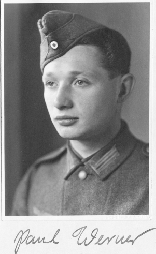
Paul Werner

Paul Werner

Und noch stand das Mädchen und versuchte, sich voll Verständnis in die Psyche des jungen Soldaten hineinzudenken.

Nachsatz

Mein Vater war ab 1940 beim Militär. Nach der Rekrutenzeit kam er 1941 zur Feldeinheit nach Frankreich an die Kanalküste und die Normandie. Im Juni 1944 geriet er bei der Invasion in Gefangenschaft. Von Frankreich ging es über England nach Boston/USA. Die Gefangenschaft verbrachte er vorwiegend im „Camp Perry/Ohio“. Die Rückführung nach Frankreich/Le Havre erfolgte 1946. In französischer Gefangenschaft war er bis Dez. 1947. 1948 heiratet er Elsbeth Panknin.

Sein Kriegstagebuch endet mit den Worten:

„Jetzt gilt es, meine ganze Kraft für den Aufbau des zerstörten Vaterlandes einzusetzen!“
Friedrich Klopp (1875 -1946) Conclusion – Chart I – II

The Last 5 Years of Friedrich’s Life (1941 -1946)

In the summer of 1941 Friedrich Klopp’s eldest son, Friedrich (1905 – 1988), the father of the author Eberhard Klopp, paid the only visit to his family in Gardelegen. During World War 2 family members exchanged a few postcards, which have been preserved and indicate that to a minimal extent some important information, such as deaths, was being passed around in spite of the prevailing family feud.

At one point Friedrich mentioned in his correspondence Emma Klopp, but did not know about her death in 1941, a clear indication that forty years after the deplorable events in Wolmirstedt his sister Anna von Waldenfels (1885 – 1967) had maintained her distance to her brother Friedrich.

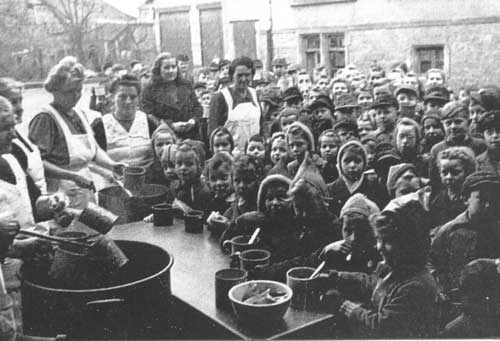
People Gathred around Soup Kitchens - Photo Credit: digada.de

Children Being Fed 1945 – Photo Credit: digada.de

The tragic death of his 9-year grandson Hermann badly shook him up. In the summer after the war Hermann and several of his friends had carelessly played with an anti-aircraft shell, which they had found lying around from old German army stocks. The shell went off with devastating effects. Hermann and several of his playmates were killed. (Chapter XIII of the P. and G. Klopp Story will also deal with the danger of playing with WWII ammunition, which still posed a threat to life and limb in the forests, where battles were fought near the end of war).

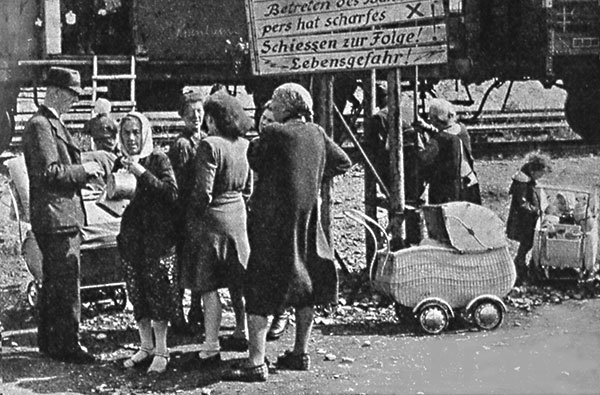
In Search of Food and Shelter 1945 - Photo Credit: kiel.de

In Search of Food and Shelter 1945 – Photo Credit: kiel.de

Grandfather  Friedrich died in Gardelegen on November 3, 1946. In the cold and wintry postwar period his eldest son Friedrich succeeded in making the perilous trip from Naumburg to the  funeral in Gardelegen. On his way he had to run the gauntlet of all kinds of armed guards of the Soviet Occupied Zone and also of the Russian military police. They were aggressively searching for former soldiers and ‘other fascists’, black market dealers and smugglers, people crossing the border and those fit to be deported into labor camps. All these men and perhaps women too were the preferred targets in the overcrowded, filthy and unheated trains of those days, Under such conditions in the former Soviet Zone Friedrich undertook the journey of almost two days in a life threatening experience. A special permit of the Leuna Works in Merseburg rescued Friedrich Klopp out of quite a few unpleasant situations. Two brothers and two sisters saw each other for the last time at their father’s grave site.

Here ends the story of Peter and Emma’s eldest child and my uncle Friedrich Klopp.

Chapter XII of the P. and G. Klopp Story – Part II

Baltic Sea 1957

This year marked the very first time that Mother and Aunt Mieze went on a longer vacation since the end of the war. Finances were tight and did not allow anything fancy for food and accommodation. It was decided to go to Möltenort, a small fishing village near Kiel at the Baltic Sea.

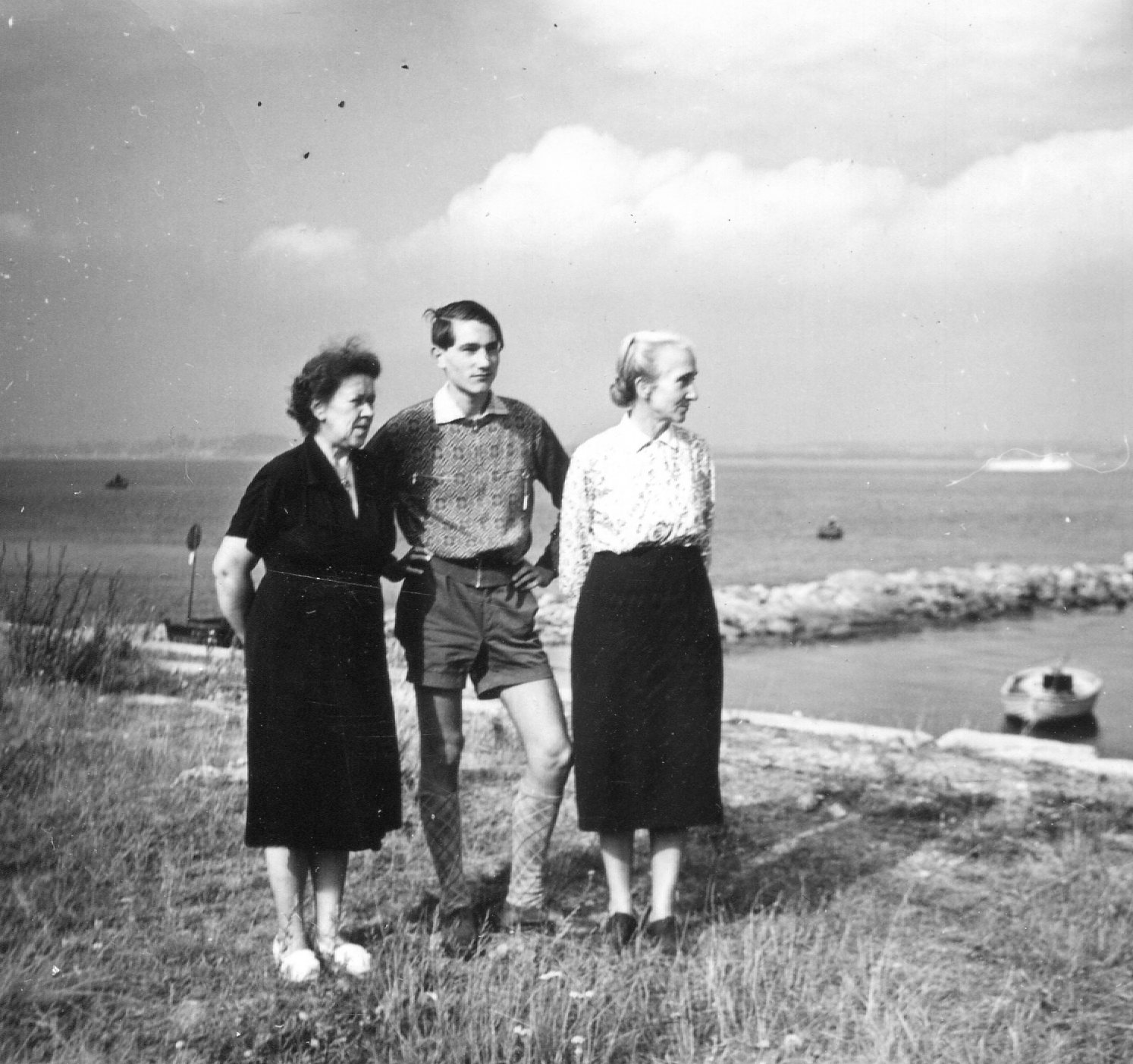
Our Hostess, Peter and Mother at the Baltic Sea

Our Hostess, Peter and Mother at the Baltic Sea

There we enjoyed a pleasant 3-week stay at a humble cottage at the north end of the village. We were blessed with mostly sunny weather that allowed us to spend the daytime hours at the sandy beach. When young and old had been frolicking enough in the shallow waters of the sea, we would withdraw to our roofed wicker beach chair (Strandkorb in German) that Aunt Mieze had rented for a small weekly fee. Apart from offering protection from the cold breeze, they were comfortable and large enough for people to change into dry clothes, sunbathe, read a book, or simply relax. The Germans are very possessive when it comes to claiming a place in the sun. If the less well-to-do tourists couldn’t afford the expense of these mini-cabins, they simply spread a towel on any free spot on the beach. And that was for the rest of the day their very own place that no one else was allowed to touch. But a true German Strandkorb is not complete and does not lend that sense of privacy and security unless you surround it with a wall of sand. Then you truly have that ‘my-home-is-my-castle’ feeling. I soon became friends with a young girl from Berlin whose parents had their Strandkorb next to ours. After swimming and playing around in the gentle waves of the Baltic Sea, we helped each other build the castle walls for our parents. We even thought of making out of wet sand the city crest of Berlin, the emblem of the bear, at the entrance of her castle. Upon Mother’s suggestion we decorated ours with the mystical griffin, the official coat of arms for Pomerania.

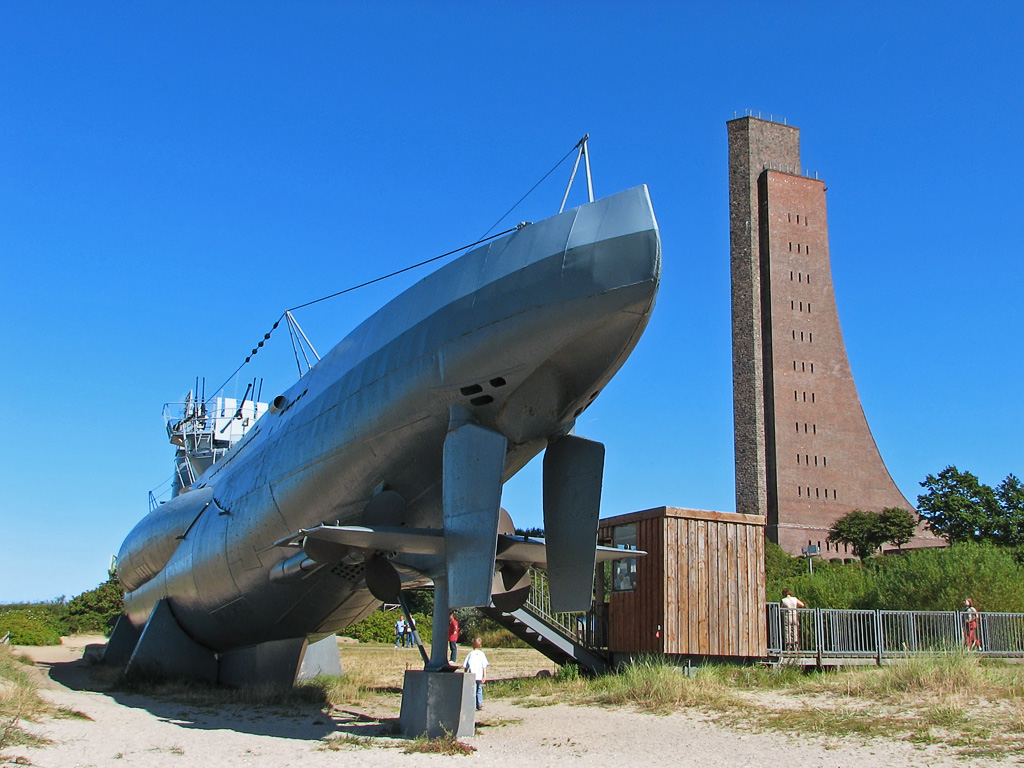
U-Boat 995 and Marine Memorial Tower - Photo Credit: wikipedia.org

U-Boat 995 and Marine Memorial Tower – Photo Credit: wikipedia.org

At the south end of the beach stood in a stark silhouette against the sky the Laboe Naval Memorial. The 72-meter monument originally memorialized the WW1 dead of the Imperial Marine, but now stands for all sailors in the world who died for their services at sea. The monument today consists of an observation deck on top of the tower, a hall of remembrance and a veritable tourist attraction, the German submarine U-995, the only submarine of this class that had survived WW2. I remember how on gray days not suitable for spending time at the beach I approached the awe-inspiring tower pointing its tall front to the sea that had swallowed up many a sailor both in peace and war times. The area around the monument was nearly deserted. Attached to the inside wall was a giant open staircase zigzagging to the observation platform. Leaving Mother behind who suffered even more than I from acrophobia, I climbed up the stairs first very boldly. Then I slowed down and anxiously clung to the railing with its large gaps, which opened up an intimidating view down to the concrete floor below. Near the top I had to stop frequently and close my eyes to fight the oncoming vertigo. But I could not admit to Mother that I was afraid, so in small frightening installments I climbed to the top and was rewarded with the most memorable view of the sea and proudly waved to Mother below as if I had just conquered Mt. Everest.

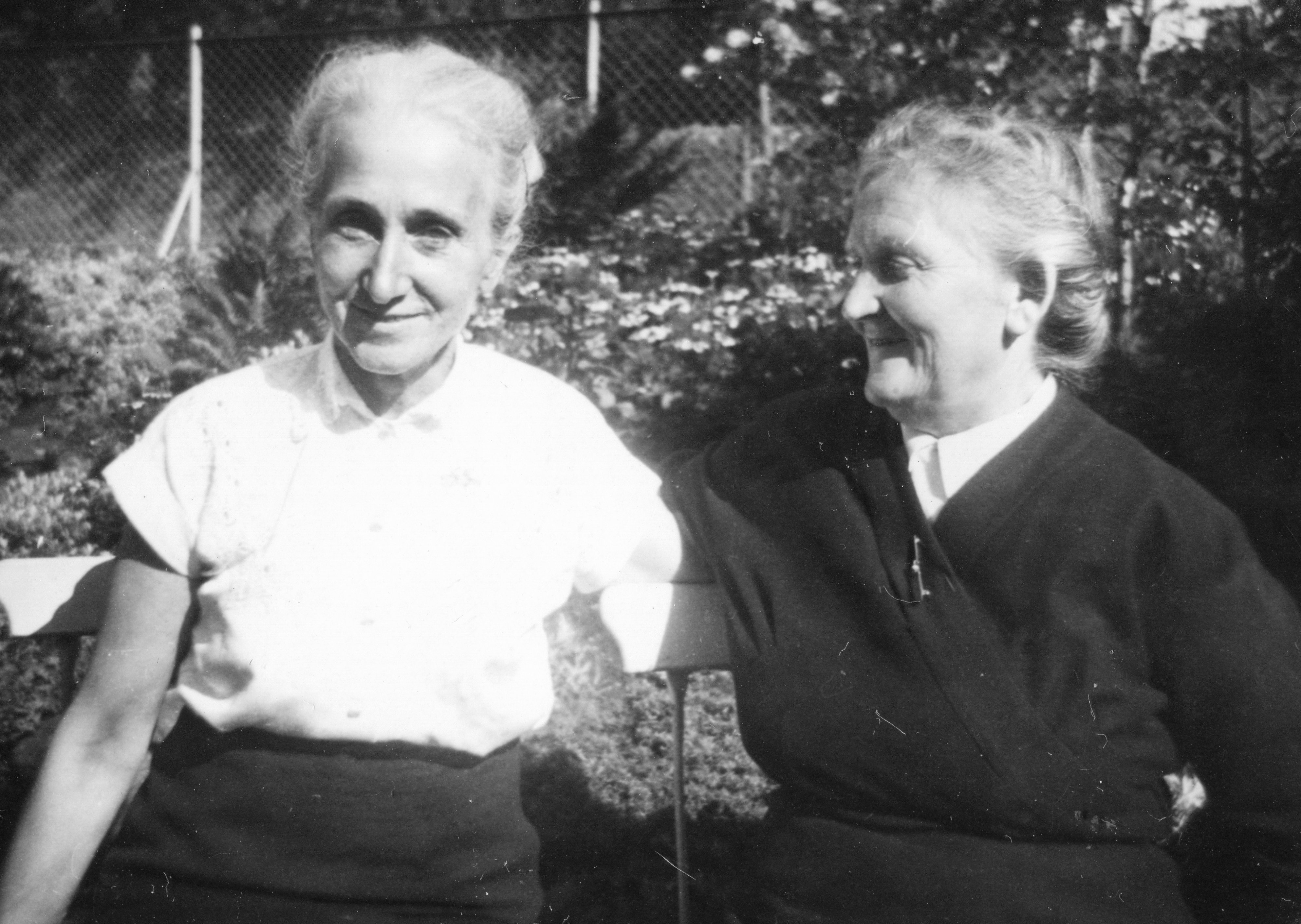
Mother and Tante Ella

Mother and Tante Ella

On the way home, Mother and I stopped by at Auntie Ella’s place. She received me very kindly, as if I had never caused her any grief with those horrendous telephone bills the year before. After a brief visit to the Hamburg harbor and shipyards, we traveled back to Wesel having enjoyed a most relaxing and very happy vacation.


Chapter XII of the P. and G. Klopp – Part I

Summer Vacations

Don’t walk behind me; I may not lead. Don’t walk in front of me; I may not follow. Just walk beside me and be my friend. Albert Camus

Hamburg 1956

Among our family acquaintances and friends I had a few aunts to whom I was not related. Out of convenience and lack of a better word I called them so. One was Auntie Pippi, who had known me from the time in Gutfelde (Zlotniki). She had lost her first husband in January 1945 and had married Ernst Grohmann, a well-to-do master of the chimney sweeper guild in Hamburg. From her first marriage she had a son whose name was Thomas about my age. Since Mother and Auntie Pippi were very good friends, they decided that I should travel to Hamburg and spend my summer holidays with Thomas. Auntie Ella, another of Mother’s close friends, agreed to provide bed and breakfast for me in a nearby district of the city.

City of Hamburg - Photo Credit: hamburgbuch.de

City of Hamburg – Photo Credit: hamburgbuch.de

Thomas and I had a great time together. We played outdoor games in the yard, climbed trees, or played chess when it was raining. But what I regretfully remember most are the utterly foolish and thoughtless things we did in the name of having fun. Relatively mild in retrospect were our chess games we conducted over the phone. Using the European method, we identified each move by a combination of letters and numbers. Moving the king pawn two squares from its original position would be e2 – e4. What we did not realize in our enthusiasm for the royal game was that a local call at that time was charged by the minute. As all chess players know a good game lasts at least one hour. After a dozen games that we played during my stay in Hamburg the telephone bills must have been quite a shock for poor Auntie Ella.

4

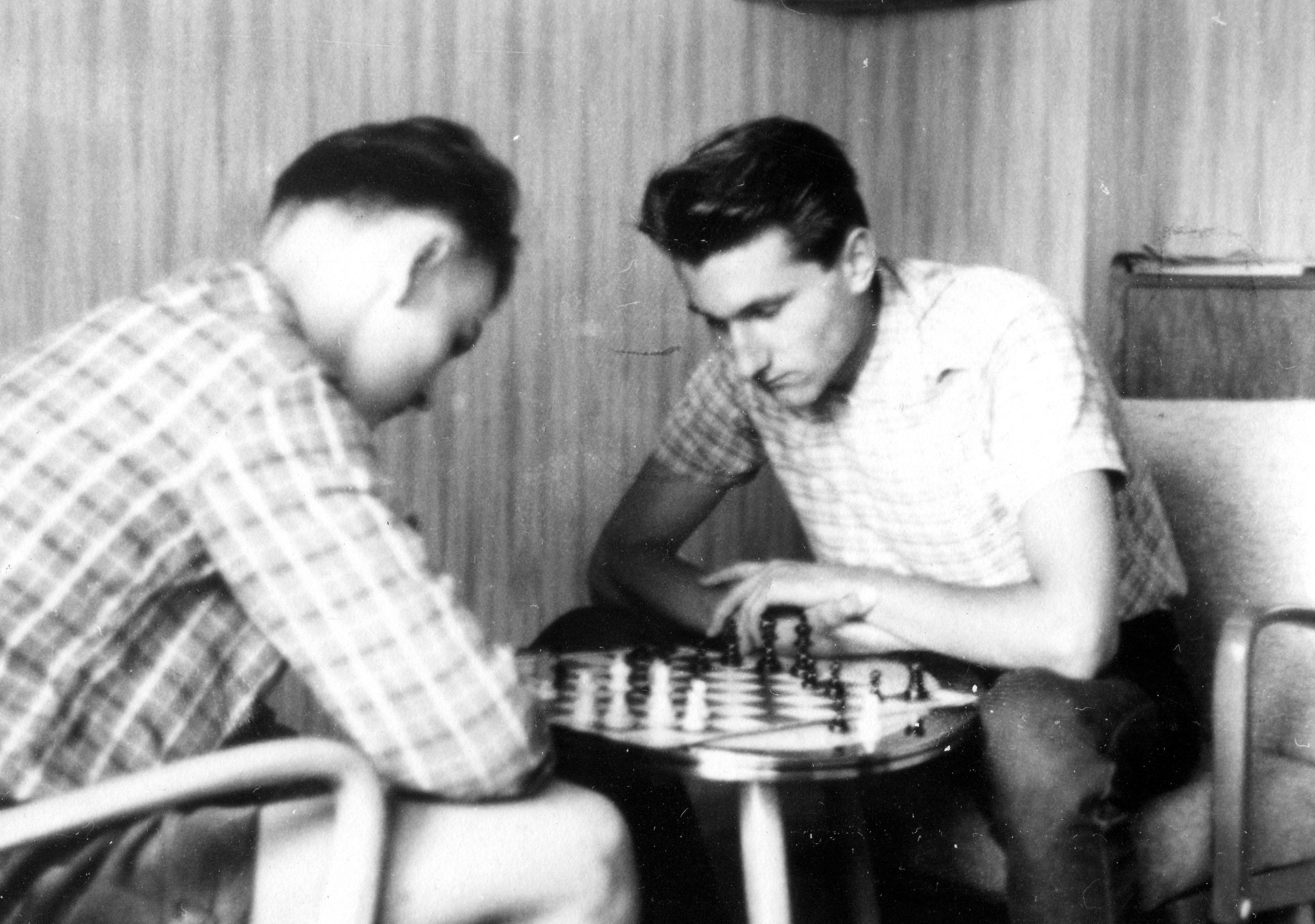
Playing Chess with a Friend a Few Years Later

Getting bored with spending the afternoon hours on trees and itching to do something more exciting, we decided to build traps for imaginary wild animals in the neighborhood. We dug 30 cm deep holes, covered them carefully with twigs and dead branches and camouflaged them with clumps of grass to blend in nicely with the lawn. Just as we were digging another hole at the far end of the yard, Auntie Pippi stepped out from the backdoor and walked across the lawn to bring us some refreshment. She was a heavy lady weighing at least three hundred pounds. Not that she was overindulging in calorie rich food; on the contrary she was literally starving herself to keep herself from gaining more weight. She was suffering from a severe case of malfunctioning thyroid glands. In horror we saw her walking straight to the first trap. Why we did not call to warn her is hard to understand. Perhaps we were stunned, perhaps we hoped that she would miss the trap and we would not be scolded for digging unsightly holes. But she stepped right onto the camouflaged twigs and plunged her right foot deep into the hole. With a loud terrifying shriek she dropped the tray and managed to land on both hands cushioning the impact of her massive body on the ground. She could have easily broken her ankle. Great was her anger over our stupidity and thoughtlessness. For punishment we had to restore the lawn to its original state of perfection, which we gladly did.

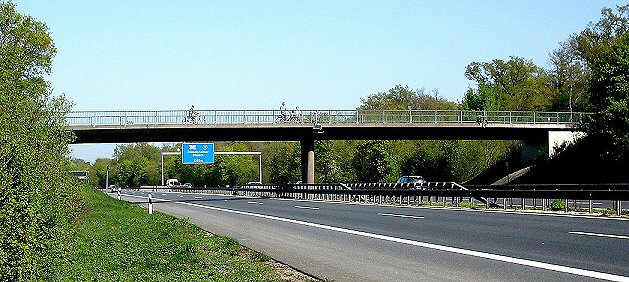
Typical Autobahn Bridge - Photo Credit cdu-nauheim.de-

Typical Autobahn Bridge – Photo Credit: cdu-nauheim.de-

One day we went to a pedestrian overpass to watch cars and trucks traveling north and south on one of Germany’s busiest freeways. It is one thing to throw flat stones onto the surface of a lake to make them skip, but it is unquestionably a most reckless prank to lob small pebbles onto the cargo areas of passing trucks from an overpass. In our adolescent fervor to seek excitement at all cost we were blind to the grave danger of causing damage, injury or even death to the drivers below. We had not dropped too many pebbles, most of which had luckily fallen onto the pavement, when one landed with a loud clang onto the top of a truck’s cabin. Before we had time to rejoice over the successful throw, the truck pulled over to the emergency lane and came to a complete stop. The driver emerged from his vehicle and seeing us young punks at the railing immediately started racing up the hill that separated the overpass from the highway. In our attempt to escape the angry truck driver, we broke all athletic school records in the one-kilometer run for our age group. Even though we managed to escape, I often felt guilty and even more so considering what could have happened if the truck driver had not taken any action and had not stopped our dangerous game. To this day I am being reminded of this event and cringe when I hear reports in the news of similar mindless behavior on our city bridges and overpasses.

Gerhard Kegler, the general, who dared to disobey Himmler – Part IV

The Woldenberg Division and Himmler’s Order to Defend Landsberg

Excerpt Taken from the book ‘The Siege of Küstrin: Gateway to Berlin 1945’ by Tony Le Tissier, Publishers: Pen and Sword Books

If you missed reading the related posts, go back to May 13 May 22, and June 5.
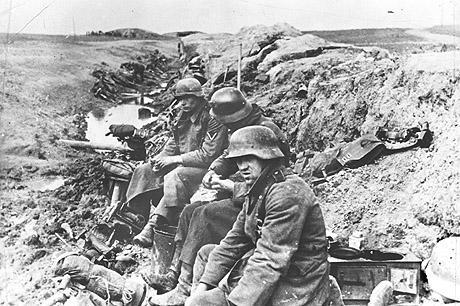
Eastern Front 1945: Worn-out and Ill-equipped German Soldiers - Photo Credit:: taringa.net

Eastern Front 1945: Worn-out and Ill-equipped German Soldiers – Photo Credit: taringa.net

Lieutenant Rudolf Schröter continues his report:

I had to overcome the resistance of the staff officers to get through to the general. Major-General Kegler was astounded but open to my arguments:

  1. Once an order had been given it must be adhered to in order to keep up the morale of the troops.
  2. The Army Headquarters’ radio message ‘Report situation and intentions’ unusually left open the decision. If this was not so, the message would have read: ‘Report situation. Hold Vietz.’ While it was expected that the Army would correctly use tactical language and especially stressed ‘Report situation’, it meant that it was holding open the opportunity for us to decide for ourselves in this special situation, and our decision was ‘Withdraw’.
  3. There had also been instances in this war in which troops had withdrawn against orders in recognition of their hopeless situation, had upheld the morale of their troops and the officers had received high decorations.
  1. The decisive argument, General, is in accordance with one’s own conscience. The responsible officer must, if common sense is to prevail, understand that slavish obedience in a hopeless situation only condemns him to a senseless bloodbath, which he should spare his men.

These arguments, especially the last, visibly moved Major-General Kegler. He then went briefly into an adjoining room. When he returned, he was white in the face. He asked me where I had lost my right arm, praised the discipline and commitment of my youngsters and also my objections at the conference a few hours ago. Finally the following dialogue ensued:

‘Do you think that you can withdraw the division in good order in this situation?’

‘Yes, if I have your support in doing so.’

‘Then I hereby beg you to undertake it on my staff.’

I immediately sent all the staff officers to the units, where they with the sector commanders were to stop the units and individ­uals retreating and incorporate them into the local defense.

Then I prepared to retake Vietz station with a platoon of my infantry and a Königstiger and while doing so a runner brought me a letter from the general. It read: ‘I have given up command of the division. Kegler, Major-General.’

I then asked a colonel to take over command of the division as a matter of seniority, which he accepted under the condition that I assumed tactical control.

The withdrawal of the division was made ready and all sector commanders summoned to an order group in Vietz at 1500 hours.

After stabilizing the situation in the town I made a recon­naissance in the amphibious jeep with the SS-sergeant-major and one of my recruits, using Major-General Kegler’s map. I discovered that:

  1. The road to Küstrin was not blocked by the Russians.
  2. There were no Russians in Gross Cammin, the nearest enemy movement being in the northerly neighbouring village of Batzlow.

I stuck to the original plan. A radio message was sent to Küstrin fortress about the division’s withdrawal. The order to withdraw was given at 1500 hours and went without problems. When I later went into Vietz with the amphibious jeep to check the enemy situation, the first enemy scouts were already feeling their way forward.

At dawn on February 4, the remains of the ‘Woldenberg’ Division began crossing the anti-tank ditch that blocked the Landsberger Chaussee at the eastern end of Küstrin. They had already come to within 10 kilometres of the town the previous day but had waited for darkness to get through the area occupied by Soviet forces.

General Busse had sent a young liaison officer to meet them, but without any instructions for Major-General Kegler. When the latter arrived in Küstrin he was promptly given orders to report to the standing court-martial in Torgau, thus becoming one of the last to leave Küstrin by the normal road. As the witnesses to the events leading up to Kegler’s court martial were now trapped in Küstrin, evidence had to be obtained from them by telephone.

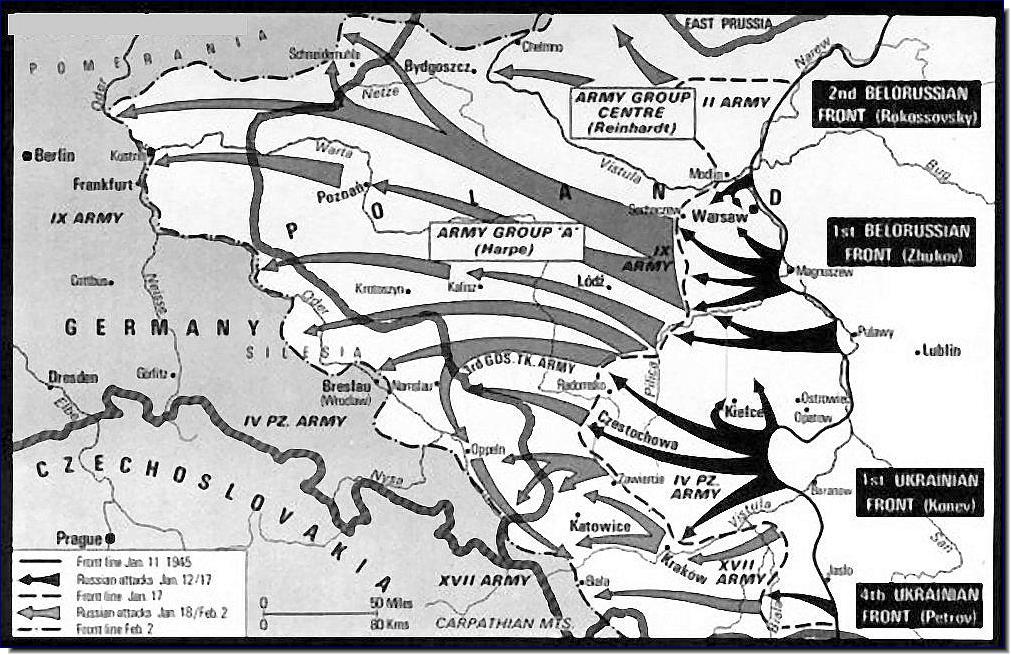
Soviet Advance across Poland - Photo Credit: historyimages.blogspot.com

Soviet Advance across Poland – Photo Credit: historyimages.blogspot.com

To be continued with a translation of the court-martial report and verdict on my next post.