THE MINING ERA OF THE CANADIAN COLUMBIA by Bill Laux – Chapter 9

THE WILD HORSE RUSH

THE WILD HORSE RUSH

The Two Boundary Commissions, British and American, arrived on the Columbia in 1860, to build their barracks, the Americans at Pinckney City next to the U.S. Army camp, the British just north of the HBC post at Fort Colvile on the Columbia. Sections of boundary were assigned alternately to British and American surveying crews, and in 1861 they went to work.

The British Boundary Surveyors were the first to report finding gold. When they returned to their barracks in the fall of 1862 they brought specimens of gold in quartz which they had obtained from from the upper Kootenay River Indians.   Once again, it was the Aboriginals  who produced the gold for the Europeans to “discover.” 

When these samples were displayed in Colville, the prospector’s hotels emptied into the streets at once. A throng of wildly excited men demanded information.The gold was examined, the surveyors repeatedly questioned as to where it had been found.   Partnerships were instantly formed, parties organized to exploit the new strike in the spring. Prospectors sought grubstakes from local merchants, a grant of supplies for the coming season, with the merchant to receive half of what might be found. The larger parties were organized with a leader and regulations as to what size of claim was to be allowed, the days of work (Sunday was universally established as a day of rest), and the duties of each member on the trail and at the diggings. Merchants sent off orders for provisions and supplies to come up from Portland by boat to White Bluffs (opposite the present Hanford Nuclear Site) and from there up the wagon road to Colville. The town took on a look of excited prosperity, all based on what the miners hoped to find the next summer.

When the snows melted off the mountains in April of 1863,  Robert. L. Dore led the first party out of Colville up the wagon road to Pend Oreille where an old HBC trail led north.  Five hundred men, from Colville and from Walla Walla, were on the trails that spring, and the Wild Horse rush was on. The route was across the open grasslands to Pend Orielle Lake.   From there the miners went up the Pack River, crossed the low divide to the Kootenay River where rafts or crude boats had to be made to effect a crossing.   One of the men, Edwin L. Bonner, bought a piece of land at the crossing from Chief Abraham, established Bonner’s Ferry, and settled down to collect tolls.   

Once across the Kootenay the trail crossed Serviceberry Hill to the Moyie River, and over the height of land to Joseph Prairie (present Cranbrook). From there open grasslands led down to the Upper Kootenay River where John Galbraith saw his chance and built a ferry to carry miners across.  Wild Horse Creek was a few miles farther on, up river.

It should not be thought that all on the trails were miners.   Many were merchants who were veterans of other rushes and had seen what extraordinary prices provisions could command in an isolated mining camp.   Daniel Drumheller tells of his trek to Wild Horse.   

“…we were receiving flattering reports of the rich placer discoveries on Wild Horse Creek in the East Kootenays of British Columbia.   I bought a half interest in a pack train from Charley Allenberg… we bought our goods, packed our animals and started for Wild Horse Creek…. When we reached the Kootenay River… I met E.L. Bonner, R.A. Eddy, Dick Rackett, and John Walton, all old friends of mine… when they reached the Kootenay River they saw a chance to make some money by building a ferry boat.   They had a whip saw with them and were engaged in sawing lumber to build the boat… Bonner and Eddy both accumulated large fortunes.   

“We finally reached our destination, Wild Horse Creek, B.C., June 15, 1864… and found about 1,500 miners already on the ground,and about 200 straggling miners arriving daily.   We built a little   shack of logs a few rounds high and covered it with canvas and then opened up a little store.   My partner, Charlie Allenberg, was more merchant than packer, so he took charge of the store.   I sold out little pack train and then devoted myself to prospecting and mining.

“When I was ready to go prospecting I met an old California placer miner by the name of Steve Babcock.   I asked Mr. Babcock what he thought of the camp.   He said he had done some prospecting, but found nothing, and believed the diggings were going to prove quite limited.   The camp was on the widest part of a high flat or bar.    This bar as about one mile in length and its widest place was 300 yards.   The creek running along this side of the bar was the richest ground in camp.

“One morning Babcock and I took our mining tools and what grub we could pack on our backs and started to go out about six miles to prospect a stream called Stony creek.   We had only proceeded a hundred yards when we stopped to arrange our packs.   We were then near the upper end of the bar on which the camp was built.   When we had our packs arranged, I said to Bab:

“’I’m a poor packhorse and why not prospect this bar before going further.’

“Bab consented and said he had several times in mind to sink a hole in this bar.   Without further ceremony we went to work.   The bar at this point was perhaps 330 feet wide.   We put down five prospect holes to bedrock across this bar about 50 feet apart.   It was from four to six feet to bedrock.   We found but very little gravel in any of our prospect holes even on the bedrock and no gold.

“The bedrock was of slate formation, craggy and checkered with deep seams.   Neither Bob nor I had any experience of mining on that kind of bedrock.   After finishing our fifth hole we went out and prospected Stony Creek, but found no gold.   We were gone about 10 days, and on returning to camp, when we came in sight of our five prospect holes, hundreds of men were standing around then.    I said to Babcock that very likely some drunk had fallen into one of our prospect holes and broken his neck.   When we approached these men I asked one of them I know what was causing all the excitement.   He said:

“”Haven’t you heard the news?”’  I said, ‘No.’   When this man was able to speak again he said:

“”This morning Jobe Harvey, the barkeeper, was looking down into one of your old prospect holes and saw something glittering  in a deep crevice in the bedrock.   When he got it out it proved to be a nugget of gold weighing $56.’

“We were too late to secure a location.   This bar produced more gold than all the balance of the camp.”

On arriving, the Colville prospectors fanned out, checking all the creeks in the vicinity.   They found they were not the first on the ground.   A party of  lawless Montana men were already present.  They had come in via the trail from Flathead Lake and the Tobacco Plains.   Many of these were violent men who had been ordered out of Montana by the various “Vigilance Committees.”  While they had been wintering at Frenchtown, near present Missoula, a mixed breed Indian from the Findlay band in the East Kootenay came to visit the French settlement.   With him he had some gold nuggets he said he had picked up out of seams in the bedrock in a small stream flowing into the Kootenay River 40 miles above present Fort Steele.

The prospectors hired this Indian to lead them to the place, leaving Frenchtown the First of March.   When the men reached Wild Horse Creek they left their exhausted horses with three of their men, Pat Moran, Mike Brennan and Jim Reynolds.   The rest walked upriver to Findlay Creek but found little gold.   In their absence, the three men left behind with the stock began prospecting on the open sections of Wild Horse creek.   Four miles upstream in a box canyon they struck rich ground.    At once they held a miner’s meeting and drew up laws to govern size of claims and the means to hold them.   “Uncle Dan Drumheller,” tells what happened next,

“There had been a great feud existing between the miners from the east of the Rockies and those from the west… and there was a free-for-all fight in a saloon.   One man, Tommy Waker, was killed.   Overland Bob was hit over the head with a big hand spike and a fellow by the name of Kelly was stabbed with a knife in the back.  “A mob was quickly raised by the friends of Tommy Walker for the purpose of hanging Overland  Bob and East Powder Bill.   Then a law and order organization numbering about 1000 miners, of which I was a member, assembled.   It was the purpose of our organization to order a miners’ court and give all concerned a fair (hearing).   The next morning  we appointed a lawyer by the name of A. J. Gregory as trial judge and John Mc Clellan sheriff, with authority to appoint as many deputies as he wished.   That was the condition of things when Judge Haynes, the British Columbia (Gold) commissioner,  rode into camp.

“’Fifteen hundred men under arms in the queen’s dominion.   A dastardly usurpation of authority, don’t cher know,’ remarked Judge Haynes.   But that one little English constable with knee breeches, red cap, cane in his hand, riding a jockey (English) saddle and mounted on  a  bob-tailed horse, quelled that mob in 15 minutes.”    

This “English constable” was John Carmichael Haynes, rancher at Lake Osoyoos, appointed Gold Commissioner for southern British Columbia and sent 300 miles east via a long detour into Washington territory to Wild Horse to issue miners’ licences, register claims, collect duties and the gold export tax.   In his report to the Governor he confirmed a thousand men on Wild Horse and Findlay Creeks.   As “Uncle Dan” reported, they had drawn up the mining laws of the district to regulate the work and avoid disputes.   These were accepted by  Haynes and enforced by his constable.   But however cooperative the miners were in matters of mining and criminal law, they were extremely reticent about the amount of their takings, since they wished to evade, if possible, the export tax on gold.     Governor Douglas had imposed a tax of 50 cents per ounce on exporting gold in a vain effort to compel the miners to sell their dust and nuggets to the HBC post at Tobacco Plains for forwarding to New Westminster.   

Again as had happened on the Fraser, the miners, in absence of local authority, drew up their own laws and appointed their own officials.   But once a self-assured representative of Colonial authority manifested himself and demonstrated probity, and ability to keep the peace, the Americans were quite willing to accept his rule.    Except, of course, in that matter of the “un-American” gold export tax.   On that, the Magistrates and Gold Commissioners had to accept the pragmatic dictum that only those laws can be enforced, which the citizens are willing to have enforced.

In the fall all but a few of the men headed back down the trails to the Washington Territory to share their take with the merchants who had grub staked them, pay their hotel bills, and find a warm room for the winter.   For the few that stayed on the placer grounds, the winter was trying.   Flour cost $2.50 per pound, tobacco was $15, and opium, quite legal, and the widely used remedy for “cabin fever,” went for $12 an ounce, nearly as much as gold.   The two supply trails, one to Colville, the other running southeast across the Tobacco Plains into Montana and east to Fort Benton, the head of navigation on the Missouri River, were open during good weather in the winter as the dryer Rocky Mountain Trench was spared the deep and impassible snowfalls of the Columbia and Kootenay Lake districts.   By the end of May supplies were being packed in at $.28 per pound.   As well, the previous year’s miners were returning to take up their claims and locate new ones. 

Good locations the summer of 1864 were paying $60 per day.   With the news out and pack trains coming in from both Montana and Colville, food was plentiful.      Haynes, named Magistrate in 1864, through his constable, issued twenty-two traders’ licences, twelve liquor licences,and over six-hundred miners’ licences.   In the month of August alone, the revenues amounted to over $11,000, of which more than half was customs duties.   By fall, a sawmill had been packed in pieces and assembled to saw flume and cabin lumber.    Several sluice companies had dug ditches, and built flumes to bring the water to the best locations.   These  companies, with five to twenty-five men, each, were taking out from $300 to $1000 per day.  The gold was remarkably pure, going for $18 per ounce.   A town called Fisherville had spring up, then had to be moved the next year, as gold was discovered underneath it. 

The Colonial Secretary, A. N. Birch was sent (via Washington Territory)  by Governor Douglas to investigate.   On his return he carried the Government receipts, seventy-five pounds of gold, to New Westminster.

More miners stayed over the second winter, but the food situation again became difficult.   The B.C. constable stationed there wrote Judge Haynes at Osoyoos on Dec. 1,

“Provisions are becoming scarce already.   Flour is $65 per hundred pounds, and little left.”

The winter of 1864 – ‘65 was severe, and the remote camp at Wild Horse was not prepared for it.   The Colonial official wrote,

“There are no more than 300 men remaining here.   I  yesterday recorded 12 claims on a creek called “Canyon, ” about 200 (miles) from here.   Many have returned after much hardship, not one of whom succeeded in reaching the new diggings.”

By spring the situation was serious.   The constable wrote on April 1,

“The winter is one of unusual length and severity.   Mr. Linklater of the Hudson’s Bay Company reports more snow than for twelve years previously in residence at Tobacco Plains.   Upwards of 200 head of cattle have perished there and many packers have lost their trains.   We now have 500 men in camp.   No breaches of the peace.    Mr. Waldron reports that of two men starting before him (on the Walla Walla trail) one died from frost-bite, and the other will probably lose his legs.   Money is scarce; provisions scarcer.  In another week, not a pound of food can be purchased at any price; $100 would not purchase a sack of flour today.   The last flour sold at $1 per lb.   All that is left is a little bacon at $1.25 a pound.   Some twenty pounds of  H.B. rope tobacco brought in today was sold in twenty minutes at $12 per pound, a hundred more would fetch the same.”

At these prices merchants were eager to get in a pack train of supplies and set up a log store.   The profits to be made from a mining camp exceeded any other sort of enterprise and no digging was involved.   It was especially galling for Victoria and New Westminster merchants to read these reports from the Kootenay country where men desperate for provisions were being supplied entirely and at huge profit from the Montana and Washington Territories.

A few weeks after the above report, the first miners of the new season arrived.   The Wild Horse official wrote Commissioner  Haynes,

“Four men from Flathead Lake (Montana) arriving yesterday tell me of a train of goods there waiting to get in.   The goods were brought from Fort Benton on the Missouri to Flathead.   If they do not arrive, and with beef cattle, in the  promised  twelve or fourteen days… we shall suffer semi-starvation. Many are now reduced to bacon and beans without flour, and not a few are without food of any kind.”

It may be wondered, that these hardy men in the midst of a country, plentiful in game and fish, should face starvation.   This was typical of all the gold camps.   In their obsession with gold, miners gave every waking hour to pick, shovel and pan, washing out the gold.   When creeks froze in winter, they would be out whipsawing lumber to construct flumes to bring the runoff water in the spring to their claims to flush the gold bearing gravels into their sluices.   Miners were not “mountain men,” living off the country.   Almost all of them were townsmen, accustomed, winter and summer, to living off purchased provisions.   Fish and game they would buy from the Indians when they brought them to the camps, but sparing time to grow a garden or to hunt or fish, while their fellows might get a lead on them in digging the bars, was unthinkable.   The miner with lard buckets full of gold dust and nuggets under his bed, considered himself a rich man, purchasing his provisions, and scorned those who produced them.   It was the madness of greed, and was repeated in every gold camp in the West.

The cool heads, of course, observed all this, took note of the fact that while a few miners came out in the Fall rich, most, like Uncle Dan Drumheller, lost money on their prospecting expedition, spending every ounce of gold they panned on costly provisions. A merchant with a pack train of supplies and particularly liquor, could not lose money in a gold rush; most prospective miners did.

In 1865, with the Cariboo District on the decline, Gold Commissioner O’Reilly was sent to Wild Horse instead of Barkerville.   Fisherville became a town of 120 houses and some 1500 to 2000 men were in the district.   The Victoria Ditch was completed at  cost of $125,000 to bring water to 100 dry claims, and shafts were being sunk through the gravel as much a 80 feet to reach the bedrock where the gold lay.   

1865 was the banner year for Wild Horse.   Government revenues reached $75,000.   The New Westminster Government under its new Governor Seymour, prodded by the merchants who wanted to get in on the trade, sent out two parties to locate an all-British route to Wild Horse.    One party, led by George Turner, former Royal Engineer, started from Kamloops, and went up the South Thompson River to Shuswap Lake.   They then took the old HBC trail from Seymour Arm to Death Rapids, just below the Big Bend of the Columbia River.  The intention was to brush out the old HBC trail up the Columbia past Windermere Lake and down the Kootenay to Wild Horse.   However, the party ran out supplies at Big Bend and had to turn back, noting that local Indians were finding a little gold near the mouth of the Canoe River.

The other party had better luck.  Led by J. J. Jenkins, they took the Dewdney Trail from Hope to Similkameen, visited Judge Haynes at his Osoyoos Ranch, climbed Anarchist Mountain and descended to the now largely deserted diggings at Rock Creek.   Almost all of its miners had moved on, either to the Cariboo or Wild Horse.   Jenkins and his men pushed on over the Boundary Range, down into the Kettle River Valley, past Christina Lake and over the Rossland Range to the Columbia at Fort Shepherd.  Their route tip-toed just north of the border, in many places using the swathes cleared through the timber by the Boundary Surveys.    From Fort Shepherd, they crossed the Columbia, ascended Beaver Creek and crossed the high Kootenay Pass to the Kootenay River Flats.    The river came across the border from the U.S., so they were obliged to climb the mountains again and cross to the Moyie River where they struck the miner’s Colville – Wild Horse trail.

Jenkin’s route was adopted by Governor Seymour, and money was appropriated  to have Edgar Dewdney extend his Hope to Osoyoos trail to Wild Horse, four feet wide and 400 miles long.   But as a counter to the American routes, this extended  Dewdney Trail was a laborious grind.  Climbing the Cascades out of Hope it crossed Hope Pass at an elevation of 5900 feet.(1799 meters).    Obliged to stay north of the border, the trail crossed the Okanagan Range at 4000 feet ( 1220 meters), the Boundary Range at 4200 feet (1281 meters), the Rossland Range at 5300 feet (1616 meters), and the Kootenay Pass over the Bonnington Range at 6000 feet (1830 meters).  This meant that the trail was closed by snow most of the year, really only usable from July through October.   American trails, running up the river valleys from the Washington Territory crossed nothing higher than the gentle 3400 foot (1037 meter) height of land between Moyie Lake and Joseph’s Prairie.   This gave the American pack trains an 8 month’s season as against a four month’s season on the Dewdney Trail.   On the Dewdney trail from Fort Shepherd to Wild Horse one of the the HBC pack trains was 14 days on the trail and lost six horses on the way.   Its use was practically limited to HBC supply trains for the Tobacco Plains post and the comings and goings of Colonial Officers.    The Americans had the river crossings on the Colville and Walla Walla trails covered by ferries.  None existed on the Similkameen, Okanagan, Kettle, Columbia or Lower Kootenay on the British route.  To cross, an Indian had to be found and his canoe hired.   The Dewdney trail did, in a laborious fashion, link New Westminster to the Columbia and Kootenay regions, but it is doubtful that any but a few Magistrates and Constables ever took it twice.    And the Kootenays, as before wide open to the  American merchants, remained connected to the Coast, the government, and the British commercial establishments only by a 400 mile horse trail.

In a vain effort to keep miners supplies and provisions from coming in via the Washington and Montana trails, the Colonial Government sent in Constables to collect the customs duties and gold export tax.   At Osoyoos, Magistrate Haynes, a local rancher, had two constables and a collector of customs to intercept pack trains on the old HBC trail from Fort Okanogan.   At Fort Shepherd on the Columbia, one constable was stationed.   At Rykerts, on the Kootenay River north of Bonner’s Ferry, one constable.  At Wild Horse, a magistrate, two constables and a collector.   At Galbraith’s ferry, on the Colville/Walla Wall trail, one constable.  At Tobacco Plains, watching the Montana trail, one constable.    These twelve men were expected to guard and area the size of Ohio, plus 300 miles of border.   Remarkably, they did, keeping order and collecting at least some of the duties as required.    A letter to the Colonial Secretary praises their  vigilance, but of course, that is what they wished their superiors to hear. 

“In fact it is almost impossible to evade duties, as there are but three trails by which goods can be imported (to Wild Horse) — one by Tobacco Plains, one by the junction on the Moyie, and one from Colville to Fort Shepherd, all of which converge about twenty miles from the mines.  The long, low stretches of land on the Kootenay, flooded during the summer months, and the unbridged and unfordable Kettle, Goat and Salmon (Salmo) Rivers render the (Dewdney) trail almost impassible, and travelers and pack trains are obliged to make a detour of 160 miles through American territory, by Colville, Spokane Prairie and the Pend d’Orielle (sic), meeting the Fort Shepherd (Dewdney) trail at the Junction on the Moyie River, about sixty miles from the mines. Until this detour is made unnecessary, colonial merchants, on account of the increased pack distance charges and the American bond system, cannot establish mine branches (stores at the mines) and compete with Walla Walla.   These obstacles prevent the unfortunate people here from having any regular mail system.   There is no communication of any kind in winter, and even in summer they receive an Express but four times.    

There were urgings to the Colonial Government to attempt to keep the Dewdney Trail open in winter, at least from Hope to Osoyoos.   Post houses were recommended every ten miles, to shelter the traveler and his animals.   However, the Colony had assumed a crushing debt in building the Cariboo Road, and had no wish to spend money on another rush which might prove short-lived.   The Dewdney Trail remained a fair weather route, and dubious even then.    Judge Haynes wrote from Fort Shepherd on May 3, 1866,

“The trail between this place and Kootenay (Wild Horse) is, owing to snow, impassible for animals and by all accounts it will, in its present unfinished state,  be more so by high water.   Dewdney’s Trail; between this and Boundary Creek (the section from Rock Creak to the Columbia) is as yet impassible owing to snow.”

Notwithstanding the presence of some 5,000 armed miners, rabid with gold fever, all reports attest to the lawful behaviour of the men once a magistrate and his two constables were sent in.   To the south, Montana was in the throes of vigilante justice, with murders and extralegal executions frequent.    The Buffalo Hump camps in Idaho were unruly and murderous, and only the Army, it seemed, was keeping the peace in eastern Washington.   Still, when Colonial Secretary A. N. Birch arrived on  tour of inspection in 1864 he found,

“…the mining laws of the Colony in full force, all customs duties paid, no pistols to be seen, and everything quiet and orderly.”

Magistrate O’Reilly in 1865 was obliged to arrest three Americans for bringing in and circulating counterfeit gold dust, but he reported in his summary  for the year,

“It is gratifying to be able to state that not an instance of serious crime occurred during the past season, and this is perhaps the more remarkable if we take into consideration the class of men usually attracted to new gold fields and the close proximity if the Southern Boundary, affording at all times great facilities for escape from justice.”   

O’Reilly did, however, admit in his report that he had received but $6,900 in export duties on gold, which he suggested represented but a fifth of the gold actually taken out.   The conclusion is, that although the Americans were perfectly willing to submit to a fair and incorruptible administration of the criminal law by men they respected, they reserved to themselves the right to evade laws which had no counterpart in the U.S.    The American placer miners on the Columbia, the Thompson, the Fraser, and the Wild Horse, were willing to have the criminal laws and their own mining regulations enforced by British authority, but when it came to a charge on their gold,  a relict of that ancient “Quinto,” they, like the Mexicans, probably like miners worldwide, would evade it if they possibly could.  

At Wild Horse a final irony was to come.    As the Indian labourers under foreman William Fernie, were completed the final section of the extended Dewdney Trail from Joseph’s Prairie to Wild Horse in 1865, they found an almost deserted camp.   The Wild Horse miners had decamped to a new bonanza.    The Big Bend Rush was on.    The Dewdney Trail, a hopeful artery of commerce on paper, had been an utter failure on the ground. 
Natural Splendour of the Arrow Lakes

Wednesday’s Photos

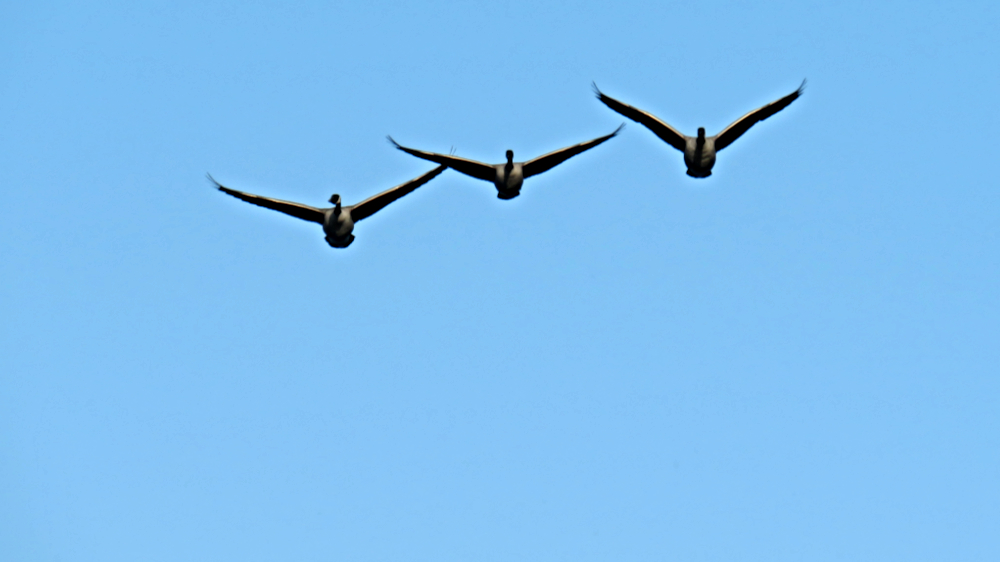
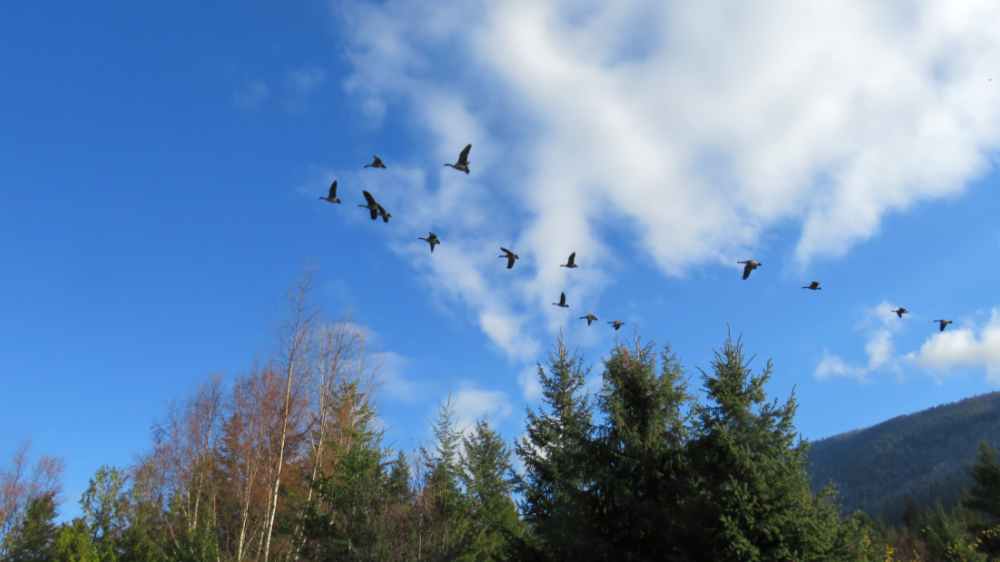
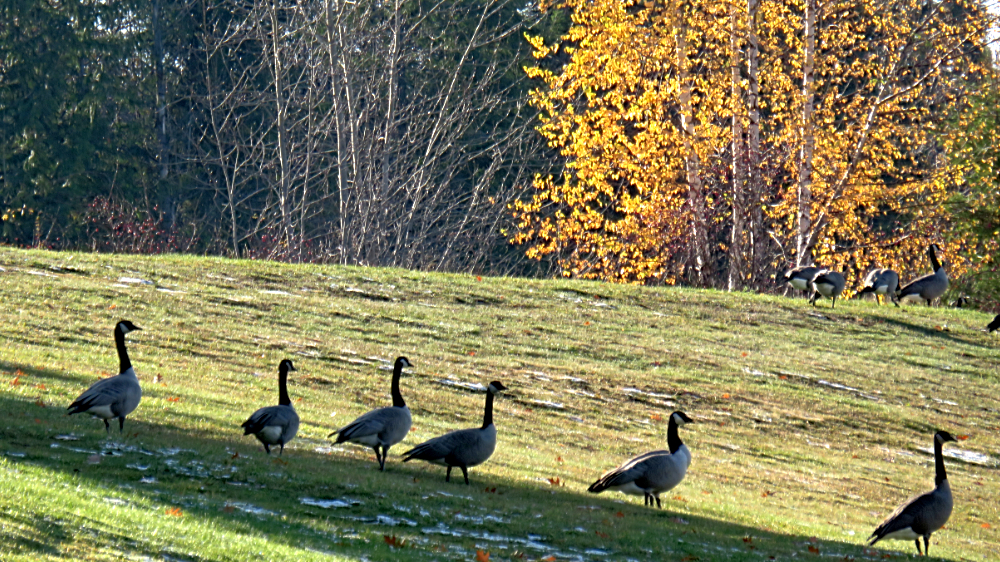
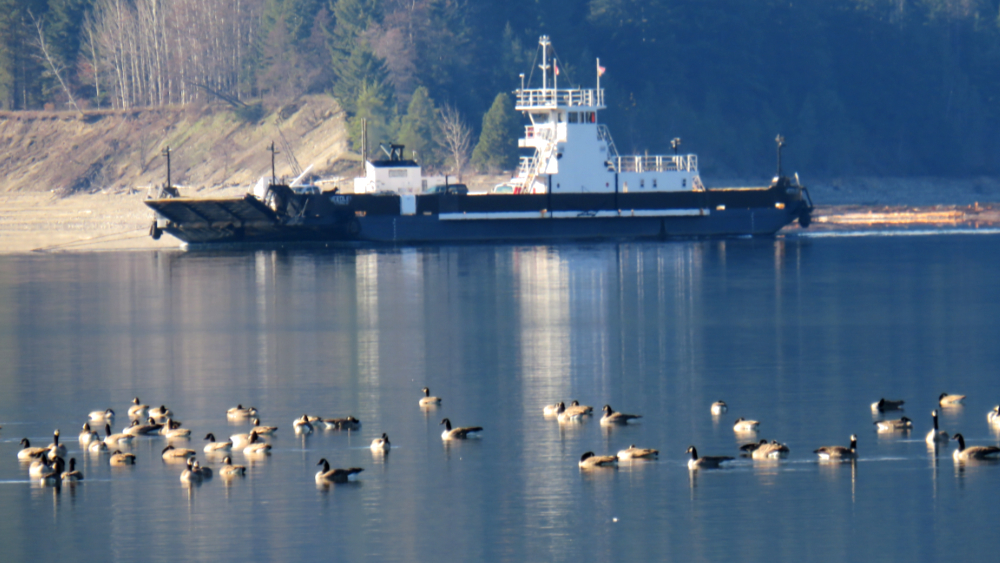
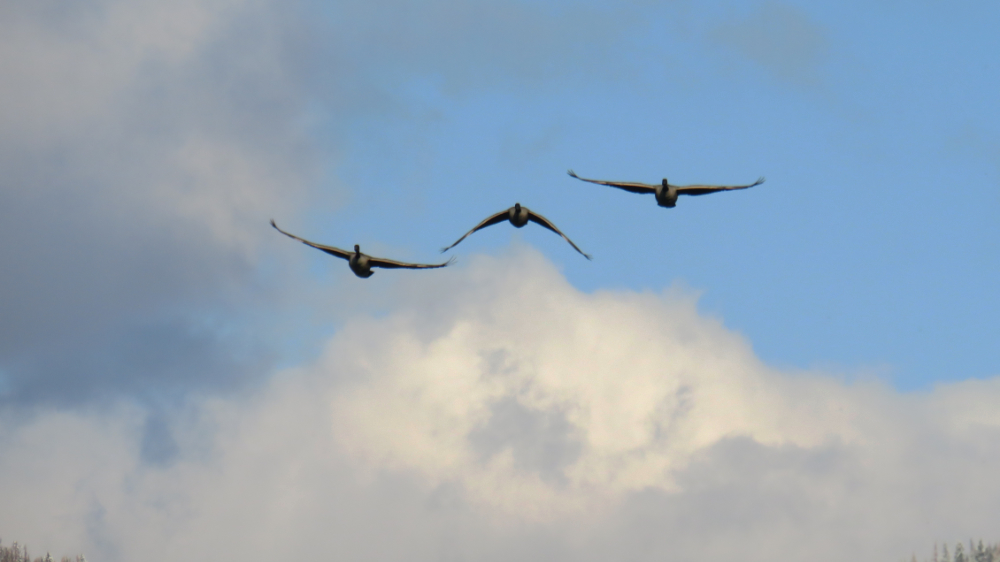
A Visit with our Canada Geese in December

Even though we had our first snow our friends, the Canada Geese, decided to stay a little longer to enjoy the green grass still growing abundantly on our golf course at the lakeshore. I captured them in the air, on the ground and on the water. Calm conditions and brilliant sunshine made our walk down to the Fauquier boat dock a memorable event. Enjoy!

IMG_4980G5IMG_4981G1IMG_4985G6IMG_4995EDIMG_5012ED

The Peter and Gertrud Klopp Story – Chapter XXVIII


 Cross Country Canada

My dream is for people around the world to look up and to see Canada like a little jewel sitting at the top of the continent.

Tommy Douglas – 7th Premier of Saskatchewan

Late Start in Montreal

It was almost noon when after hours of waiting we finally got our turn to go through Canada customs. The officials were friendly and efficient. The long delay was due primarily to the large number of passengers whose innumerable suitcases, boxes and crates needed to be checked. Afterwards we stowed away our stuff in rental lockers and took a taxi to the City of Montreal. Our sister had already said good-bye to us, as she was going to board the next available train to Calgary. So Adolf and I were on our own in search for a car dealer. My brother needed a reliable vehicle that would carry us across the North American continent.

160

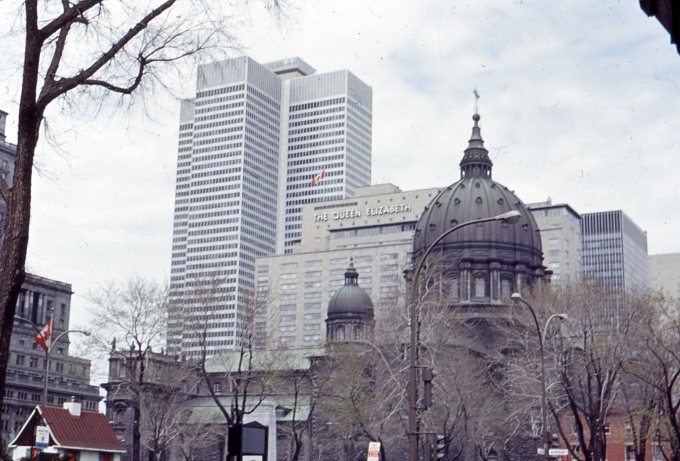
Queen Elizabeth Hotel at Montreal – May 1965

Near the city center we got off the taxi and decided to make use of the much cheaper transit system or cheaper and healthier yet to just walk. Now I had a chance to take a few photos of the new office buildings that were popping up everywhere like mushrooms after a heavy rain. I found that the Elisabeth Hotel towering over a much smaller church building was especially interesting, as the structure symbolized the transformation of Quebec from a church dominated province to a secular society. I was getting a little worried, while Adolf dragged me from one car dealer to another. He had not yet found, what he had in mind and was already talking about taking the train as well.

161

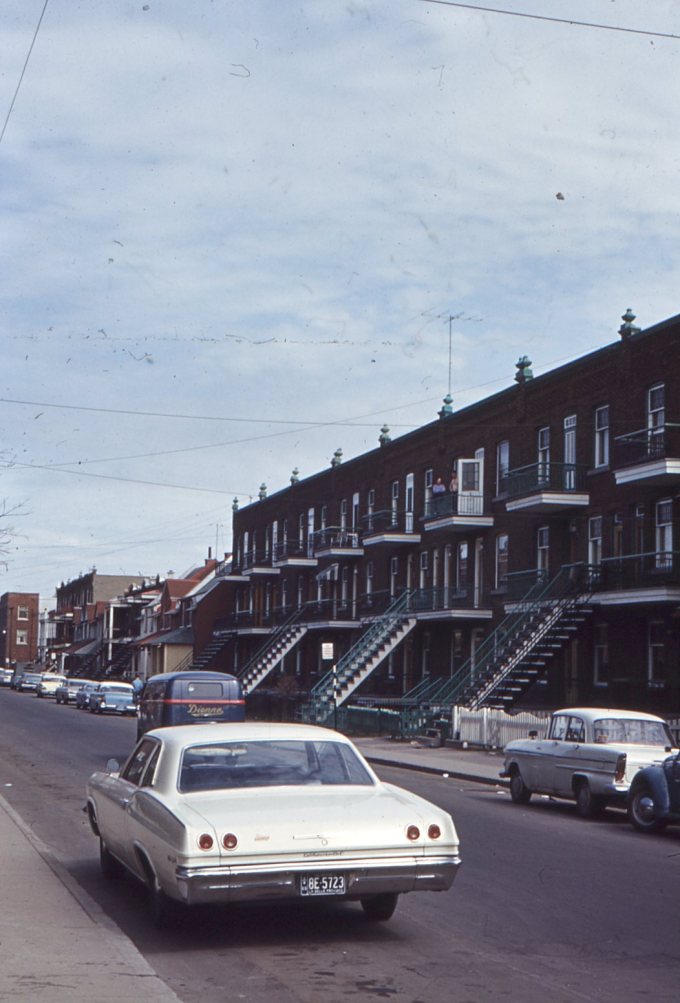
Typical Outside Staircases in a Residential Area

As we were roaming through the streets of a residential area searching for another car dealership, I noticed the peculiar construction of most of the houses. In order to gain more living space, they had no interior staircases but had metal stairs leading up to the entrance doors at the second and even third floor. I was thinking of the densely populated cities back in Germany, where floor space for renters was at a premium. How much more apartment space could be generated with this typical French-Canadian building concept.

170

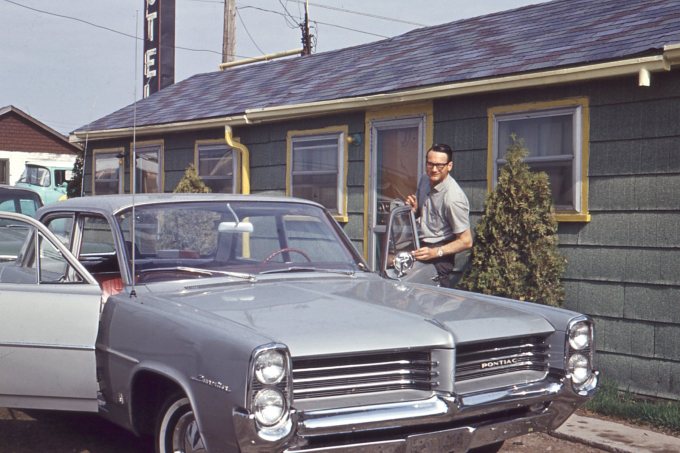
Proud Owner Adolf of a Used Pontiac

Finally Adolf had found a good, used 8-cylinder Pontiac at an equally good price of $2,500. The manager, apparently very pleased with my courageous attempt to communicate in French with him, made an arrangement with Adolf that quickly consolidated the sale. It happened exactly the way my brother had once explained to me on our summer wine tour to Trier. He paid the full amount in cash. In return M. Gagé allowed him to travel with the dealer’s license plates to Alberta to save him the high provincial sales tax. Those were the days when business transactions were concluded with a handshake based on mutual trust. M. Gagé expected Adolf to mail back the plates to Montreal.

I had never sat in the such comfort of a huge and powerful American car before. It was even equipped with automatic transmission quite rare in Germany during the mid 60’s. I really enjoyed the ride back to the storage facilities, where we picked up our suitcases and wooden crates with all our belongings. It was already getting late in the afternoon, when our cross-country Canada trip began.

Peter’s Immersion into the English Language

Looking across the Ottawa River into Gatineau QC

Heading west our first goal was Ottawa. On a secondary road following the densely populated St. Lawrence valley, we drove quite slowly. The leisurely pace allowed me to take a closer look at the landscape near the river. Hundreds of islands were glowing in the evening sun. Many a romantically inclined individual had built his dream cabin on a treed retreat surrounded by water away from the hustle and bustle of the nearby City of Montreal. The properties on the mainland were generously large, where people had built their homes according to their fancy. Some dwellings were constructed entirely out of wood, others were stone buildings, some were imposing castle-like mansions, but most were simple and of modern design. Adolf must have noticed my admiring glances and remarked that in contrast to the Old Country – he always referred to Germany as the Old Country – hard working people from all walks of life could afford to live in their own house with a bit of help with a mortgage from a financial institution. His remarks swept away any remaining doubts and worries about the plans I had made with Biene earlier this year. Now I was almost certain that barring any unforeseeable adverse circumstances there was no turning back. It was here in Canada where I wanted to put my roots down. Looking at the setting sun that flooded the valley and immersed it into liquid gold, I felt energized, optimistic, and adventurous all at once. I also realized that the obstacles ‘Fate’ would throw into my path would be there to test my resolve to stay. It was almost dark when Adolf pulled up at a roadside motel, where for $6.00 we spent a restful night in comfortable beds somewhere between Montreal and Ottawa.

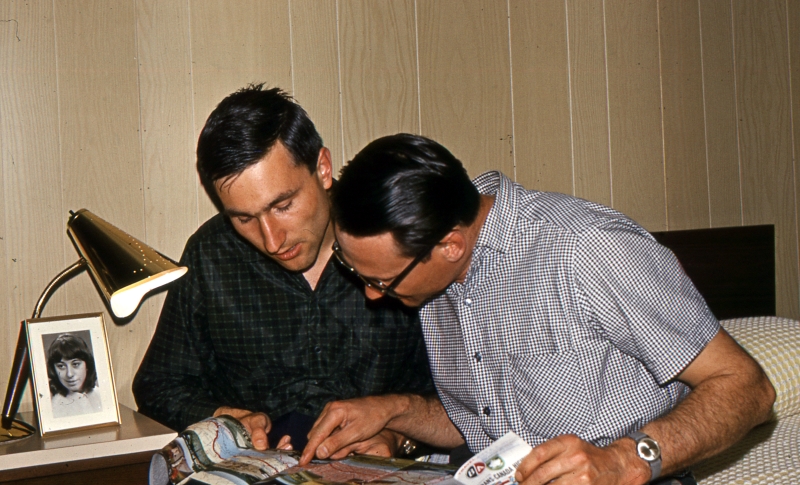
Adolf and Peter Studying a Road Map

The next morning at a nearby coffee shop I had my first Canadian breakfast, which consisted of two eggs fried over easy, two strips of crisp bacon, hash browns with plenty of ketchup, four slices of toast, all sorts of jam in tiny plastic cups and the standard not-so-strong coffee. Hunger is the best sauce, as the English proverb asserts. So for me this simple meal was a culinary delight. With Adolf switching to English only conversation, my English immersion program began, when he explained the difference between eggs over easy and eggs sunny side up. Obviously such fine details about the different ways of frying eggs had not been part of our English curriculum at the German high school. But there was much more to learn, especially in the use of idiomatic expressions. The waitress came by our table and asked me whether I wanted her to warm up my coffee. I replied a little taken aback by this seemingly silly question, “No thanks, my coffee is still warm!”

Fortunately, my strong German accent made it clear to her that I had not understood what she offered and that it had not been my intention to insult her. With a shrug she moved on to another table and asked the same question. “You idiot”, Adolf scolded me. “All she wanted was to give you a refill!”

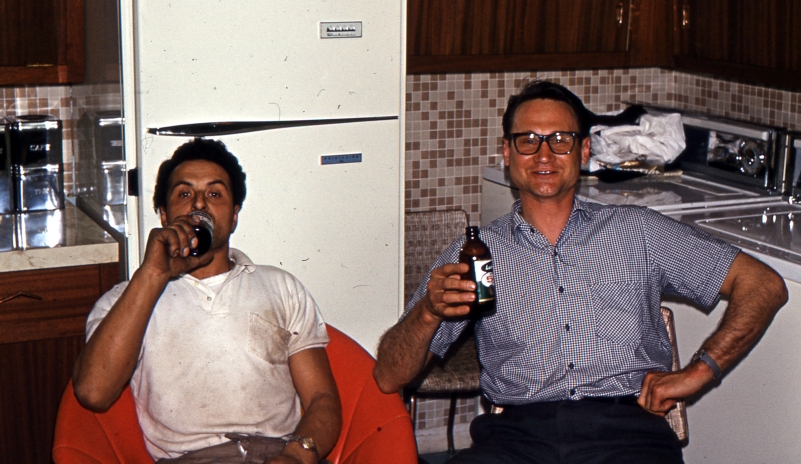
My brother and his buddy Waldemar enjoying a beer

Having received my first English lesson under somewhat embarrassing circumstances, we traveled on to Ottawa and then crossed the Royal Alexandra Bridge over the Ottawa River into Hull now better known as Gatineau. There my brother had a friend by the name of Waldemar Klein from Rohrdorf, who immigrated with him to Canada in 1953. His house looked like it was in need of repairs on the outside, downright ugly from a critical perspective. In Germany a residence including its surrounding hedge or fence and even the lawn had to be prim and proper. Much later I found out that some property owners deliberately keep the exterior of the house unfinished with unsightly tar paper nailed to the walls in an attempt to keep the property taxes low. This was obviously the case with Waldemar’s home. However, the inside presented an entirely different view. It seemed to me that every spare dollar was invested into making their home feel more comfortable, cozier and more beautiful. The modern kitchen was equipped with the latest appliances to make life easy for Waldemar and his wife. She spoke mostly French and very little English, which made communication almost impossible. Obviously, she did not like strangers to enter her home. When she had at last comprehended that Adolf was her husband’s old buddy form Germany, she invited us in for coffee and called Waldemar from work. He was making good money as an independent contractor installing windows in the new federal office buildings that were popping up all around the city center. When he showed up shortly after the call, the joy of seeing his friend Adolf was great. Over a case of beer they revived old memories and exchanged the latest information on the Klopp and Klein families. Then it was time to move on.

A Brief Visit to Ottawa and a

Four-Hour Drive into the Night

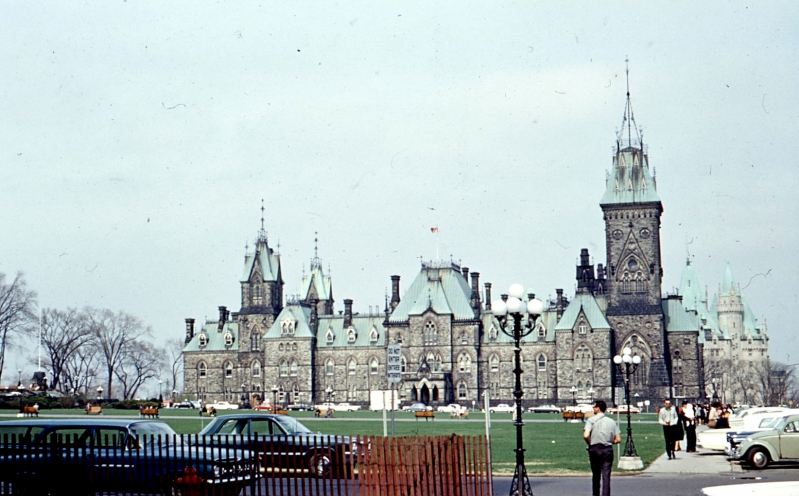
Canada’s Parliament Buildings in Ottawa – May 1965

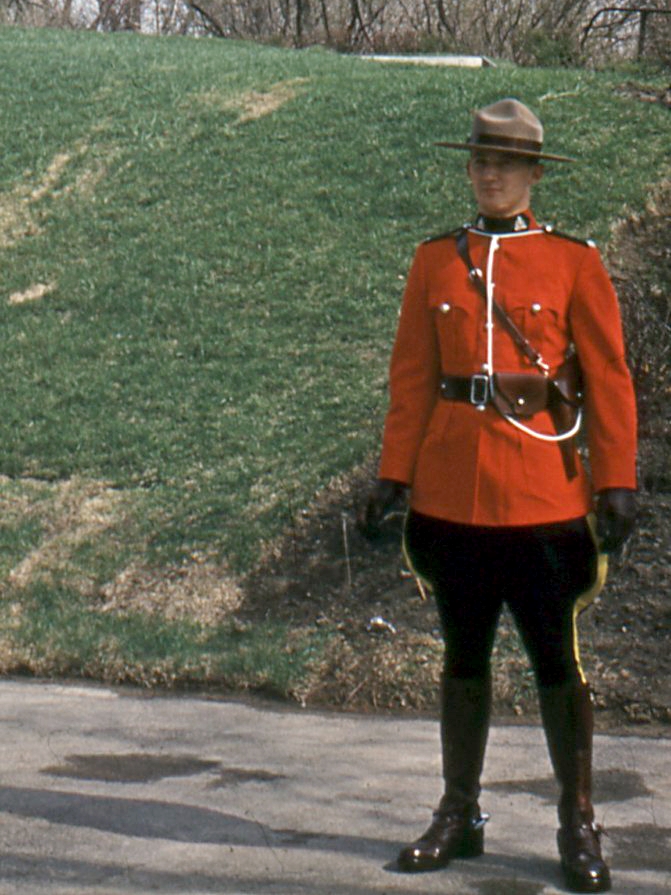
We crossed again the Ottawa River and half an hour later we were standing in front of the Parliament Buildings that was not in session at the time. Its Gothic revival suite of buildings serves as the home of the Parliament of Canada. The huge square looked almost deserted. A lonely mountie, short for a member of the Royal Canadian Mounted Police, was kind enough to let me take a picture in his red uniform. Too bad that the tulips were not out in full bloom yet! They would have added some much needed color to the somewhat dreary early spring landscape. Just then the afternoon sun was breaking through the cloud cover reminding us with its warm rays that spring was not too far off even in these northern climes of Canada.

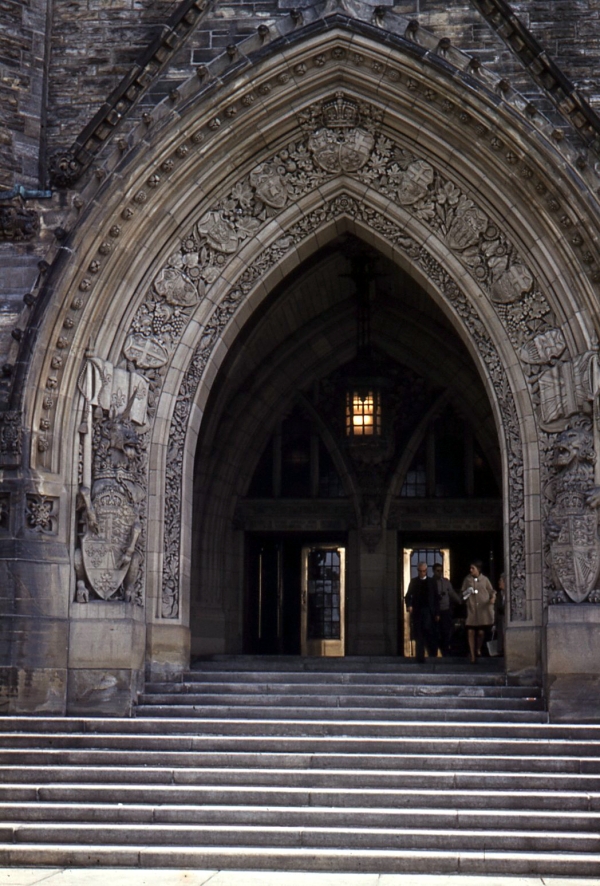
Main Entrance to the Parliament

Back in the car we figured we had about three or four hours of daylight left to cover until dark a few hundred kilometres on the Trans Canada Highway. It is, along with the Trans-Siberian Highway and Australia’s Highway 1, one of the world’s longest national highways spanning more than 6,000 km from Victoria, BC to St. John’s, NL. As we were rolling through the great Canadian Shield, the largest and oldest rock formation in the world, towns and villages became sparser and except for the road there were few signs of human encroachment on the stark beauty of the bare undulating hills, pristine forests, crystal-clear lakes and wild rivers. I was fascinated by the images of the constantly varying scenes and yet conveying the feeling of one unified untouched wilderness.

A Mountie in Traditional Uniform posing for a Picture

All of a sudden like in a bad dream barbed wire fences, military installations, artillery shooting ranges and barracks emerged in the distance. ‘What would it be like to be a Canadian soldier?’ I asked myself. But I instantly brushed aside this silly question, which had brought back some bad memories. Shortly afterwards we drove by a nuclear research facility at Chalk River. What was the purpose to have it operating out here in the bush far away from the big population centres of Toronto and Montreal? Was it concern for public safety that motivated the Ontario power corporation to experiment with radioactive materials? Or would there perhaps be less criticism, less public opposition out here in the wilderness? These were some of the questions Adolf and I raised and could not answer.

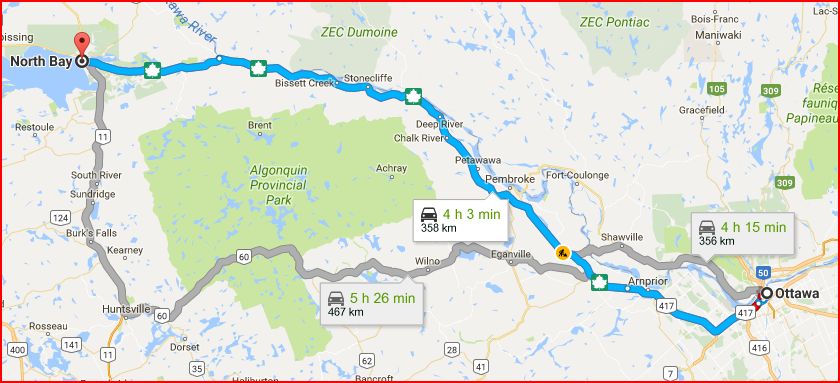
Route on the Third Day of our Cross-Country Journey

We were now following the Ottawa River in a northwesterly direction. It once had provided access for the intrepid voyageurs and enterprising fur traders to the vast interior of Ontario. My brother switched on the headlights, as it was getting dark. He also drove a lot faster now. The next service station and motel was still more than two hours away. One hour before midnight we finally arrived at a small motel at the outskirts of North Bay. Needless to say we were dead tired and slept like a log in our cozy motel beds.

Canada’s Natural Splendour

And the Price of Economic Growth

172

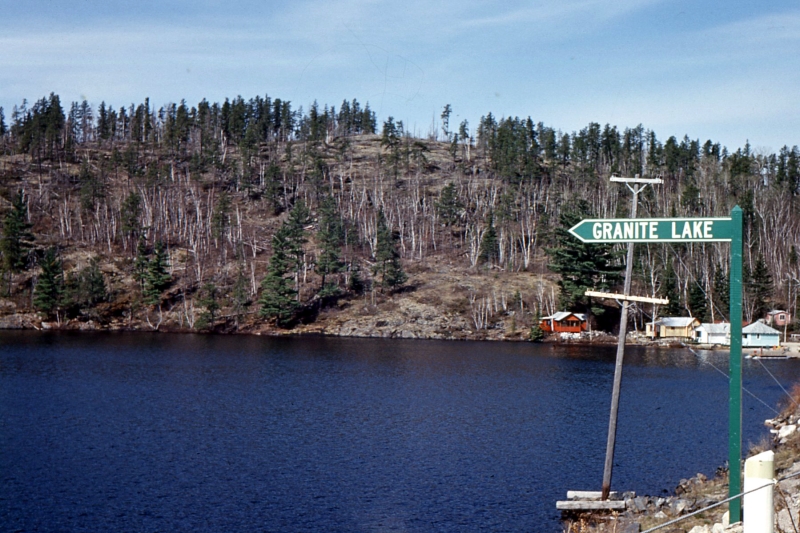
Granite Lake, Ontario – One of the many Lakes Dotting the Landscape on Highway 1

The next morning we had to put up with an annoying delay. Adolf, having noticed disturbing vibrations from the front wheels, decided to have them balanced. Unfortunately, the mechanic of the small town service center took his time showing up for work on this Sunday morning. He gave us the distinct impression that he would rather go fishing than manning the lonely service station and doing repairs on a car that should have been fixed on a weekday. On second thought, we were lucky that we did not have to wait till Monday.

day 4

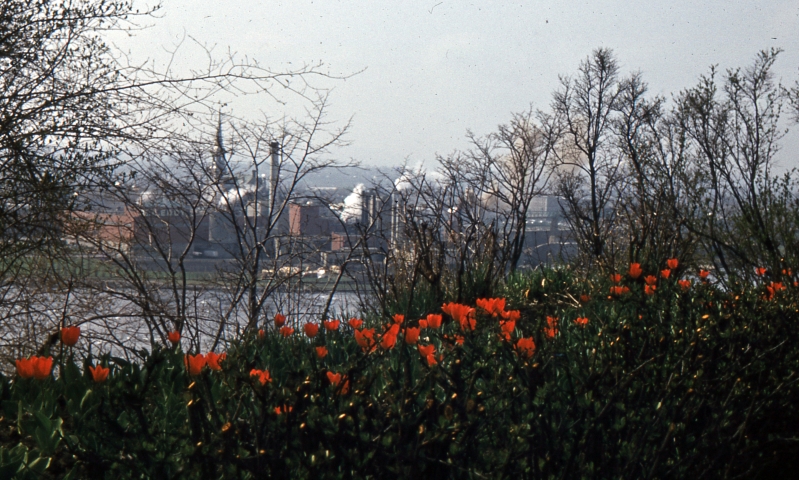
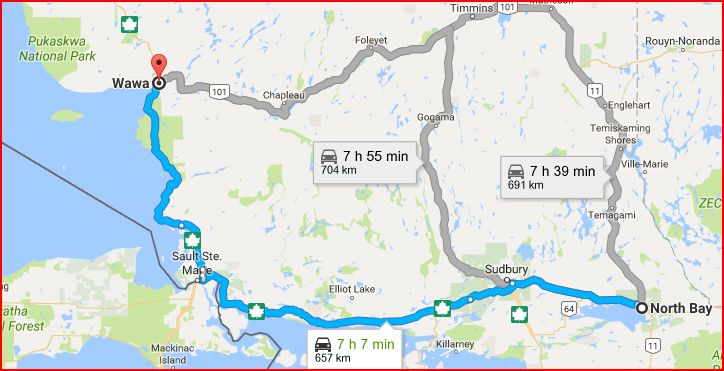
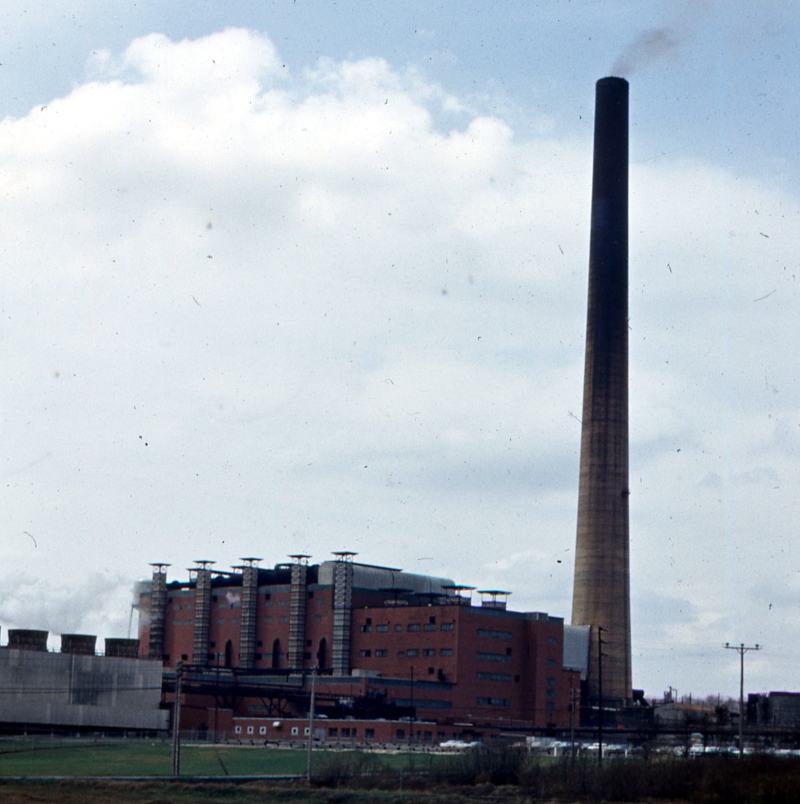
To make up for lost time Adolf especially on the long straight stretches exceeded the speed limit often clocking 130 km/h on the speedometer. I was not too unhappy about it, since the landscape, as we were approaching Sudbury, looked more and more like a moonscape, barren and desolate. The city named after a town in England had once been a major lumber center, but now was a booming mining community, where high concentration of nickel ore was being mined. Looking at the treeless industrial wasteland, where big processing plants with their tall chimneys belching out a mix of steam and smoke, I had a first real inkling of what man’s emphasis on economic growth could do to nature. I was not interested at all how many thousands of tons of ore were being processed in the Nickel Capital of Canada. One could even read these facts on picture postcards and travel brochures.

X332

Nuclear Research Station 

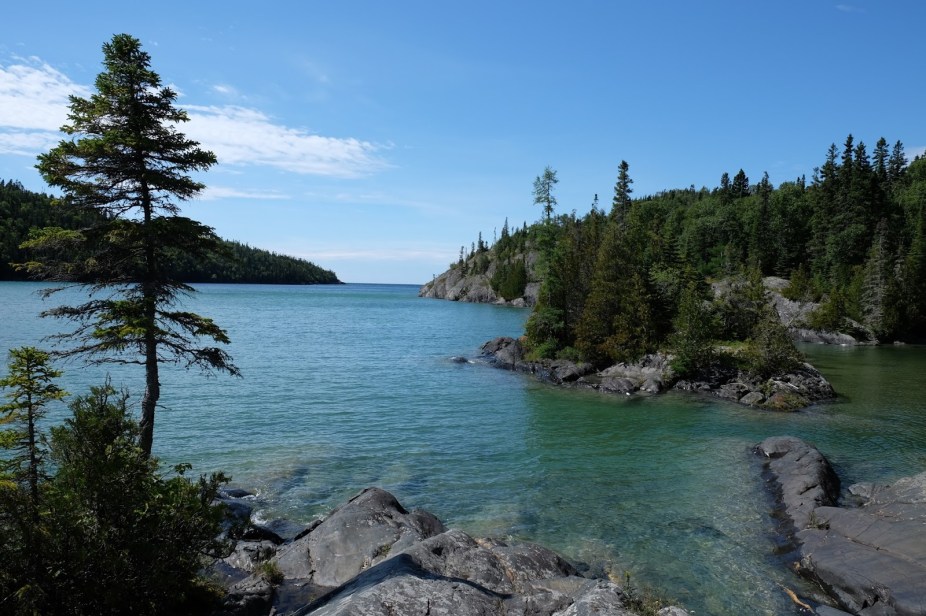
Adolf stopped for lunch at a downtown restaurant where the food was good and the prices were reasonable. While we were eating a juicy hamburger, I softened a little my critical stance on the devastating effects of industrial exploitation. I realized that people in order to live needed work. I also found out later that much larger regions, some greater in size than the two Germanys put together, remained untouched and unspoiled wilderness. I could see that Adolf was right after we left the dust and grime of the city, where a quarter of all its workers were employed by the giant nickel company Inco. Once we had traveled past Sault St. Marie, a steel manufacturing town just across from the State of Michigan, I was in for a visual treat. All of a sudden we were back in the forest driving past idyllic lakes and streams, then through the Lake Superior Provincial Park. All I remember is a blur of images and impressions of one the greatest freshwater sources in the world. Whenever we drove close to the shoreline of Lake Superior, fantastic scenery would present itself to our eager eyes. When I glimpsed a chain of islands large and small within an easy reach by canoe, many of them treed, I enthusiastically exclaimed, “Adolf, as soon as I have earned enough money, I am going to buy one these lovely islets for Biene and me.”

Adolf put on a sardonic grin and replied, “To earn money, you need a job, perhaps in a place like Sudbury.”

174.jpg

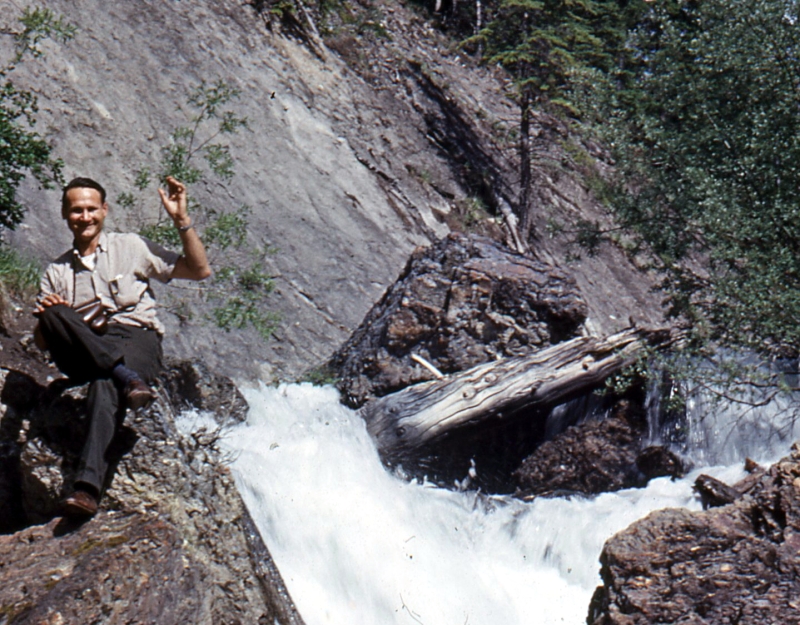
My Brother Adolf Taking a Break at a Picturesque Waterfall

We stopped at one of the recreational areas with its robust wooden picnic tables near the edge of the water. It seemed like we had the entire park to ourselves, as it was still early spring for tourists to venture out to this remote natural paradise. In the cool of the approaching evening fog patches settled over both land and water creating a magical effect. The islands with their spruce tops sticking out in dark silhouettes against the orange evening sky appeared to be drifting like ghosts across the tranquil lake. Then we drove on to the small community of Wawa, the gateway to the hunting and fishing grounds of Northwestern Ontario. On this night we slept in a hotel for a change, having spent altogether $23.00 for gas, repairs, food and lodging.

Romantic Rhapsody About Canada

Lake Superior.JPG

National Park at Lake Superior – Photo Credit: camperuno.blogspot. com

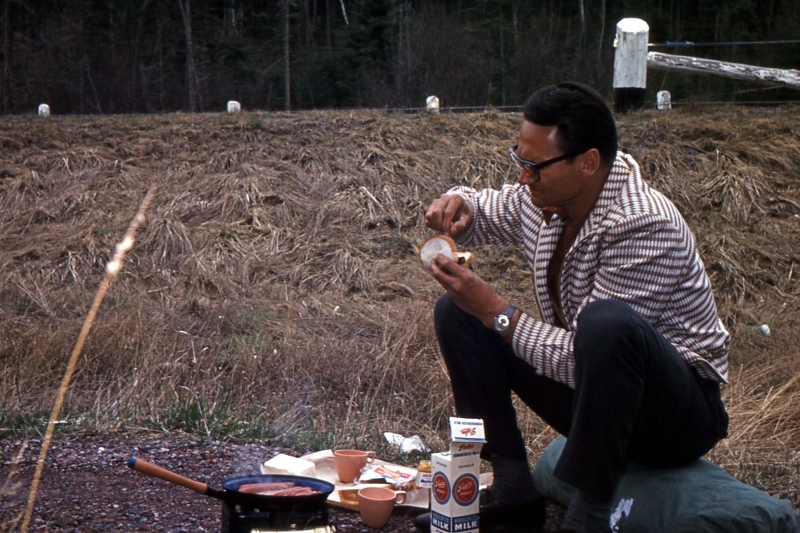
Up with the lark we walked through the sleepy town of Wawa. At 9 o’clock we stepped into a Chinese restaurant to have breakfast. The owner, cook and waiter all under the same hat looked just as sleepy as the town. He took a long time to prepare and serve the usual bacon, eggs and toast for the only two customers. We were quite annoyed with the delay and decided to buy our own food for the remainder of the trip, such as ready-made meals in cans, butter, bread, milk, fruit juices, oranges and apples. At a service station I bought gasoline for the camp stove, on which I planned to heat up the chunky soup at any of the roadside rest areas. At a hardware store we picked up basic cooking and eating utensils. By the time we had eaten breakfast and finished our shopping, half the day had already slipped away on us.

180.jpg

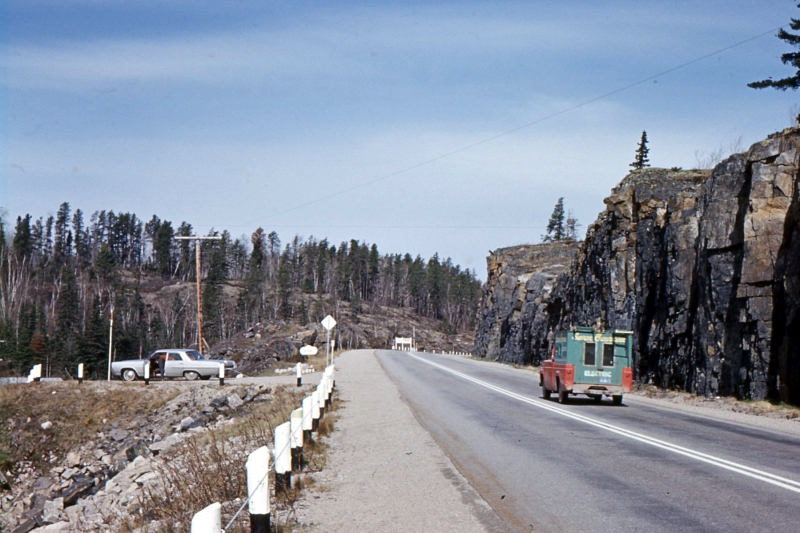
Early May on the Trans-Canada Highway – Adolf’s Car on the Left

Then we were on the road again at times traveling through dense forests often very close to Lake Superior. Unfortunately, fog and low clouds obstructed our view. They were so dense at times that Adolf had to turn on the headlights. At the entrance of a small village, whose name I have forgotten, was a large billboard, which claimed in large letters to hold the record at –72º F for being the coldest place in Canada. On we drove now along the seemingly endless shoreline. The impenetrable blanket of fog prevented us from viewing the lake. At a picnic area we stopped for lunch and unpacked our victuals in the frigid air. When the icy mist briefly lifted, we could hardly believe our eyes. A finger thick coat of ice still covered the Great Lake at a time, when on the same latitude on our planet flowers were already announcing the arrival of spring! We ate our frugal meal of homemade sandwiches not far from the city of Port Arthur, which a few years later amalgamated with Fort William to become today’s city of Thunder Bay. The only noteworthy thing about the drab scenery around these two towns were the huge grain elevator strategically placed near the railroad tracks. They stored the prairie wheat waiting to be shipped as far away as Vancouver and Montreal.

X331

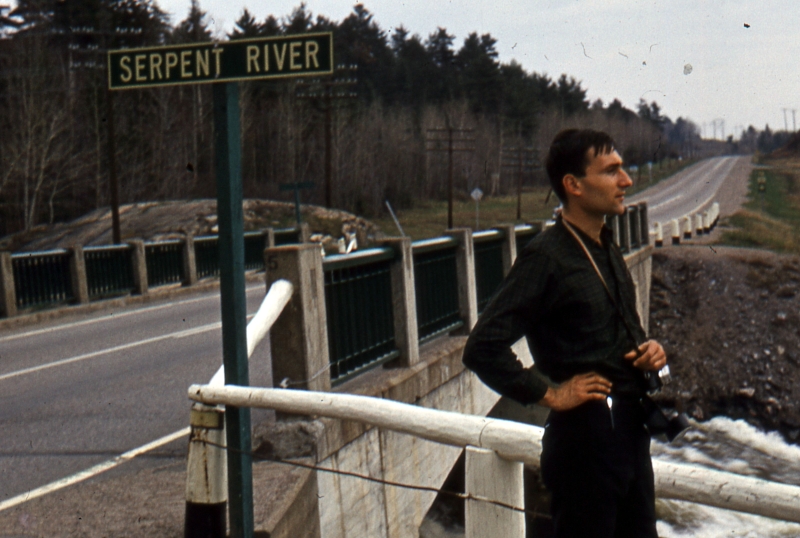
Peter Taking in the Sights at Serpent River Ontario

Heading north into the Land of Thousand Lakes, we began to cheer up as the sun finally broke through the clouds. A look at the map of Northwestern Ontario will convince anyone that the description of this boreal region is not an exaggeration. On the contrary, I would call it the Land of Ten Thousand Lakes. What incredible mazes of lakes and rivers branching out in all directions, which the native canoeists, early explorers and the dauntless coureurs des bois had to navigate without the aid of any maps!

As if to underline the upbeat mood I was in, I took my harmonica out of my briefcase and played one merry tune after another. I was amazed how many different songs I could string together in a potpourri of folksongs, scout melodies and pop music. Adolf contributed to the sense of camaraderie by cheerfully whistling or singing along, while we were driving into the setting sun.

28_5

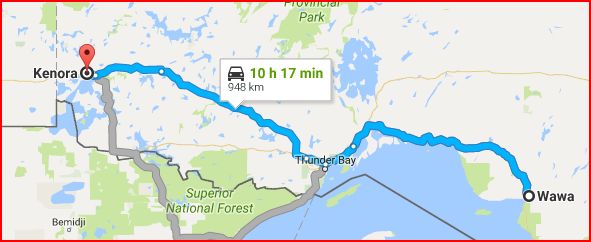
At Vermillion Bay I would have liked to call it a day. A cozy motel located directly at a lake beckoned us to stay. But our goal was Kenora near the Manitoba border. Also we had just gained over the past three days another hour of daylight in our journey to the Western Provinces. So after a short break we decided to roll on. The sun was almost blinding us. Adolf lowered the visor to protect his eyes from the glare. A few minutes later the fireball nearing the horizon was shooting crimson rays through the forest, flickering and dancing in a kaleidoscopic display of color and motion. At dusk myriads of tiny lakes swept by our left window like precious pearls strung up on invisible threads. In the absolute stillness on their glassy surface black spruce trees mirrored themselves with such clarity that on a photo one would have had problems in telling which were the trees and which were their reflections. Looking at this beautiful monochromatic scenery, I thought, as I often did when I discovered another facet of nature’s beauty, ‘One day, I will take Biene on a road trip to experience all these wonderful places that we are now having to rush through.’

On the Home Stretch

Kenora_ontario_skyline_2.jpg

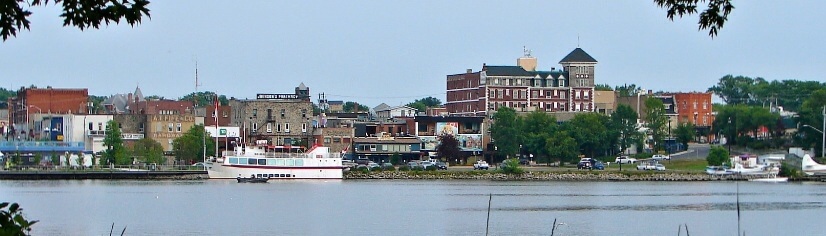
Kenora Ontario – Photo Credit: Wikipedia.org

I have no recollection of Kenora, where we spent the fourth night. In those days it was just a small town on the main highway between Thunder Bay and Winnipeg. In the fifty years since then it has seen a major transformation from a backward lumber town to a modern city with a sharp focus on tourism and support for recreational ventures at the Lake of the Woods with its 105,000 km of shoreline making it the longest coastline of any Canadian lake. Its name did not hint in the least at the wonders it had to offer to the outdoor enthusiasts. There was an incredible number of over 14,000 islands on this sixth largest lake after the Great Lakes. Surely there had to be a separate island for each canoeist and camper to land on here.

Kenora_Swift Current

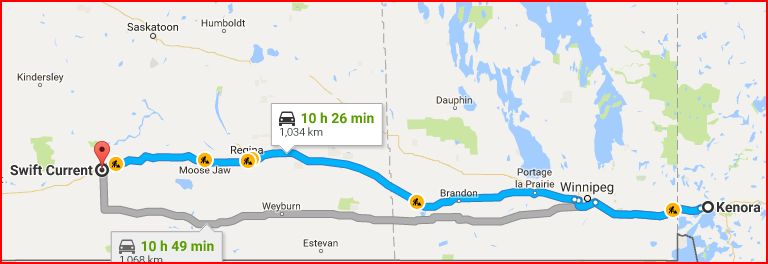
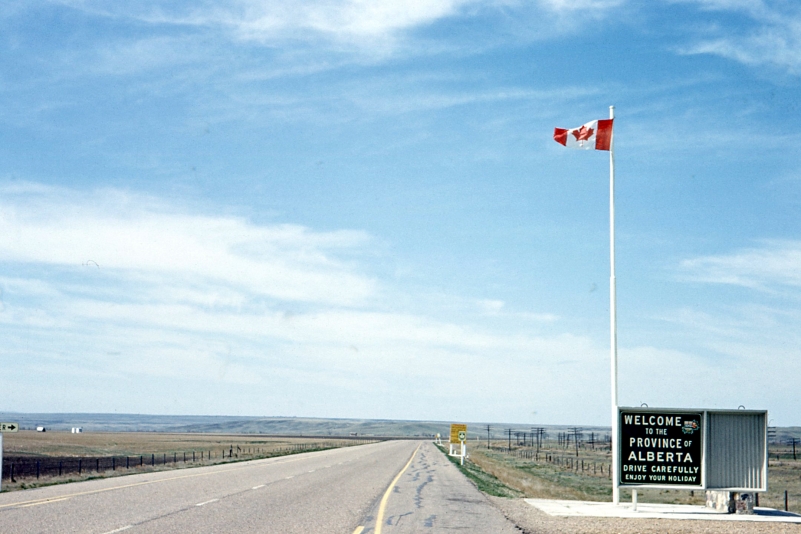
As we crossed the provincial border into Manitoba the next morning, the lakes became rare, the forest denser, the land increasingly more level, and the highway had fewer curves. Adolf and I began to get bored. We were both eager to get to Calgary as quickly as possible. When we left the trees behind and entered the open prairie, which was only now beginning to show some signs of spring, Adolf stepped on the gas to cover as many miles as the speed limit would allow. The grey monotony of the fields still waiting to be planted with wheat and the unfiltered harsh sunlight made our eyes burn. I was feeling tired, although I was only sitting on the comfortable car bench. I began to view the second last lap of our trip more as a burden than a pleasure. Adolf, my good brother in times, when my spirit was noticeably drooping, encouraged me, “You should come back here in June, when the wheat fields begin to green or better yet in the fall, when an ocean of golden stalks greets you with waves of ripe wheat stirred up by the wind and is putting on a show that you don’t want to miss.”

183

Roadside Lunch

185.jpg

He was right. I should not have allowed my enthusiasm for the land to sag so quickly. Looking back at the marvellous sights of the past few days, I felt thankful to Adolf for having taken me on this trip. A few kilometres past Port La Prairie we stopped at a roadside rest area to have a lunch break. I delighted in seeing the first signs of spring in the green grass already growing around our picnic table. Cooking a simple meal like chunky soup from cans was really fun on the little gasoline stove that had been useful so often since my boy-scout years in Wesel. After this short rest in the sunshine we put in six or seven more gruelling hours of travel time and eventually dropped in at a small modest motel in Swift Current, Saskatchewan. It was going to be our last night on our way to Calgary. Thanks to Adolf’s tireless driving often at speeds going over the posted speed limits we arrived at Gerry’s house on Fyffe Road two days earlier than we had planned.

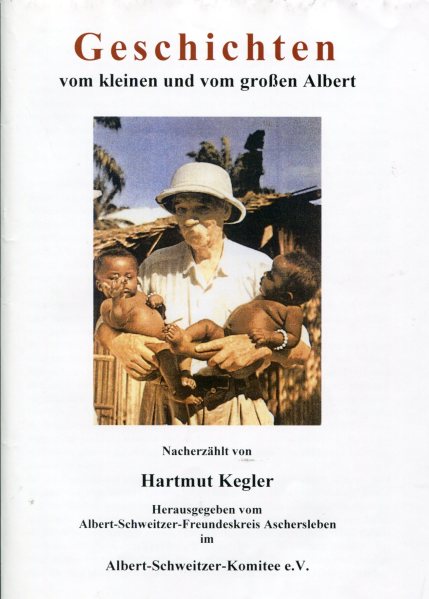
Albert Schweitzer – Seminar #10

Die Geschichte von Albert als Professor, der Regenwürmer aufhebt und eines Tages seine Fahrt nach Afrika vorbereitet.

Nachdem Albert sein Studium beendet hatte, schrieb er wissenschaftliche Bücher und wurde gleich zweimal Doktor: Doktor der Theologie und Doktor der Philosophie. Auf der Universität gab er Studenten Unterricht, was man Vorlesung nennt. Albert Schweitzer war nämlich inzwischen Professor geworden. So heißen die Lehrer an der Universität. In der Kirche hielt er Predigten, denn er war gleichzeitig Pfarrer. Außerdem spielte er auf der Orgel und gab Konzerte.

Albert Schweitzer war schon als junger Mann sehr berühmt durch seine Bücher und seine Konzerte. Aber er ist immer bescheiden geblieben und hat alle Menschen geachtet, ob sie reich waren oder arm, ob sie alt waren oder jung, ob sie sehr klug waren oder nicht so sehr, ob sie eine weiße Hautfarbe hatten oder eine schwarze, ob sie an Gott glaubten oder nicht.

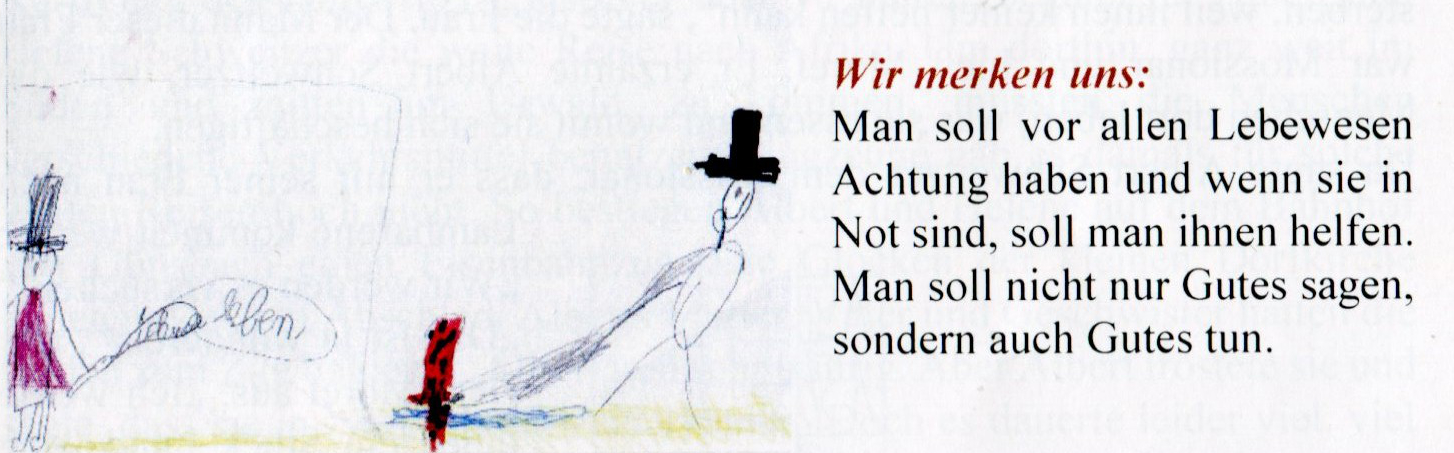
Aber er hatte auch große Achtung vor allen Tieren. Denn Tiere wollen ja auch leben, so wie wir Menschen leben wollen. Und Tiere haben ebenso Hunger wie wir Menschen und spüren ebenso den Schmerz. Deshalb war er immer gut zu allen Tieren, ganz gleich, ob es ein altes Pferd, ein bellender Hund, eine stechende Biene oder ein Regenwurm war.

Eines Tages ging Albert Schweitzer nach einem Gewitter durch einen Park. Man sah, wie er sich ab und zu bückte, etwas vom Weg aufhob und ins Gras legte. Es waren Regenwürmer! „Warum tun sie das, Herr Professor?“, fragte ihn ein Spaziergänger, „das sind doch bloß Würmer?“ Albert Schweitzer antwortete: „Weil bald wieder die Sonne scheint. Dann vertrocknen die Würmer und müssen sterben! Vorher haben sie aber noch große Schmerzen, wie die Menschen beim Sonnenbrand“, antwortete er. „Im feuchten Gras aber können sich die Regenwürmer vor der Sonne schützen und wieder tief in die Erde eingraben. So bleiben sie am Leben.“ „Ach so“, sagte der Spaziergänger, „daran habe ich noch gar nicht gedacht!“

Albert Schweitzer hat auch nie eine Blume oder ein Blatt mutwillig abgerissen und weggeworfen. Denn auch eine Pflanze will ja leben und sich über die Sonne und den Regen freuen. Die Pflanzen spenden uns Nahrung und gesunde Luft, ohne die wir alle nicht leben können. Obwohl Albert Schweitzer Professor und Pfarrer und ein großer Künstler war, wollte er etwas Anderes. Er wollte nicht nur reden und schreiben und spielen, sondern etwas ganz Gutes an anderen Menschen tun. Dabei dachte er immer an Jesus, der die Menschen aufgefordert hat, Gutes zu tun.

Als Albert erfuhr, dass es in Afrika viele kranke Menschen gibt, die keinen Arzt und kein Krankenhaus haben, entschloss er sich, Arzt zu werden und nach Afrika zu gehen. Deshalb begann er mit dreißig Jahren Medizin zu studieren. So setzte er sich als Professor neben jungen Studenten wieder auf die „Schulbank“. Seine Frau Helene Schweitzer war ein ebenso gütiger Mensch. Wie wir noch sehen werden, half sie ihm, wo sie nur konnte, erlernte den Schwesternberuf und kaufte viele Sachen, die ein Arzt braucht.

family199