Rowboat Adventure and a Visit to the Reeperbahn
Summer Holidays 1958
In the following summer Mother allowed me to return to Möltenort with my friend Rainer Schüler, a classmate in the modern language branch of our high school. I was thrilled by the degree of individual independence and trust that Mother had placed on me. She had reserved the same cottage we had rented the previous year. Breakfast was included and offered so much food to sustain us till early afternoon. We followed the German custom of eating our main meal at noon in the local resort restaurant. Rainer and I lived frugally to save money for purchases in Hamburg, where we were going to drop in later at Auntie Ella’s place. We bought two eating passes for our two-week stay at the Baltic Sea. When we dined together, we discovered that we were getting less meat, vegetables, dessert than if we had eaten separately. Therefore, we decided to eat our meals individually about thirty minutes apart. For the same cost we enjoyed larger portions and we both were very proud about our clever plan to get more for less.
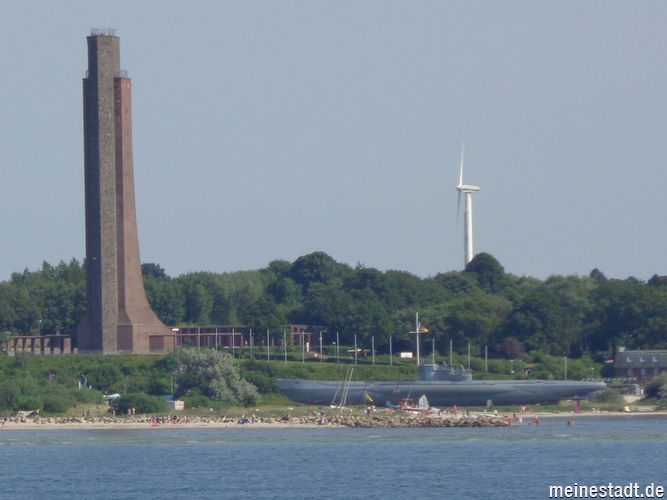
Modern Laboe – Photo Credit: meinestadt.de
In the afternoons we spent many happy hours at the beach, where we soon became acquainted with an easygoing doctor, his wife and their five or six children. They had come all the way from Bad Kissingen for their vacation at the Baltic Sea. The Baudachs had rented a Strandkorb. And Rainer and I helped them build a large wall around it. It did not take very long to feel like being part of the family sharing their good company at the beach and as an extra bonus the snacks and refreshments of which there seemed to be an endless supply in the wicker basket. I no longer remember what Christine, the eldest 15-year-old daughter, looked like, but Rainer and I spent a lot of time with her. After our swim we would sit down on our towels and tell her about our ambitious plan to ride our bikes all the way to Southern Germany making a circle tour with Lake Constance being the farthest point away from home. Christine found it very exciting to listen to us, as we were dreaming aloud about our adventures the following summer. She must have talked to her dad about these plans, because Dr. Baudach surprised us with an invitation to drop in and use their home as a stopover on our bicycle tour. We gladly exchanged addresses and promised to write as soon as we had finalized the details of our trip.
The lady who was running the bed and breakfast business had an old decrepit rowboat that had definitely seen better days. The paint was peeling off, the ancient registration number, no longer valid, was barely visible, and as we found out later the vessel had a small leak and was hardly seaworthy. One day we asked the lady if we could drag it down to the seashore and take it for a little excursion. ‘As long as we hug the coastline within swimming distance’, was her somewhat vague reply. While we were rowing, we noticed that water was indeed penetrating through a hairline crack and collected in small puddles in the bottom of the boat. Staying close to the shore we proudly glided by the populated beach area heading south toward the Laboe Memorial Monument. Then Rainer, who acted as the temporary pilot at the stern, spotted a red buoy bobbing up and down in the waves about half a kilometer out at sea. Ignoring the cottage lady’s warning we immediately turned the boat into that direction thinking it would be an excellent place to tie up our vessel and go diving and swimming with the buoy serving as a diving board. Now it was Rainer’s turn to work at the oars. When we reached the buoy, we had trouble at first securing the boat with a rope as the wind was beginning to make the sea choppy. But eventually we succeeded, and with no danger of losing the rowboat we jumped onto the buoy. What an exhilarating feeling! We felt as if we had just crossed the sea and discovered our very own dream island. We had fun jumping off the buoy and swimming around it. Suddenly we detected a speedboat racing towards us. As it was looming larger, we recognized that a marine patrol boat was coming our way. The officer must have spotted us in his binoculars and apparently decided to give us a stern lesson on marine safety rules. When he saw that we were just foolish, young boys, he softened his approach and explained to us that a buoy is an important warning marker for ships and not a toy or some sort of water playground equipment. Then he let us go with a warning not to come back and with the request to tell the owner that the boat had no proper identification and therefore should not be used at sea. When we landed safely but somehow with dampened spirits, the lady, who had witnessed the entire scene from her cottage, was very angry with us and let us know in no uncertain terms that her boat would from now on be off-limits.
On our way home we stopped in at Auntie Ella’s in Hamburg. This was now the third year in a row that she had welcomed me into her home. Looking back I am amazed at her most generous hospitality and at myself taking her kindness for granted. On the first day of our arrival I noticed that her radio in the living room was not working. Upon hearing that I had some knowledge in electronics she gave me permission to remove the back cover of the radio and have a good look inside, where a bewildering array of tubes, transformers and coils would have frightened the uninitiated. I searched for the obvious prime cause of the breakdown. Hidden behind the main transformer was the pair of metal clamps that held the fuse in place. Sure enough it had blown and needed replacing. To get the radio working, I wrapped a tiny sheet of aluminum foil around it. Voilà, the radio came back to life. This was the first time that I applied my knowledge of basic electronic circuits in a useful fashion. Puffed up with infinite pride I announced my success to Auntie Ella, who instantly burst the bubble of my joyful but over-inflated ego by saying, “Yes, I know. The fuse had been blown. Thank you, Peter!”
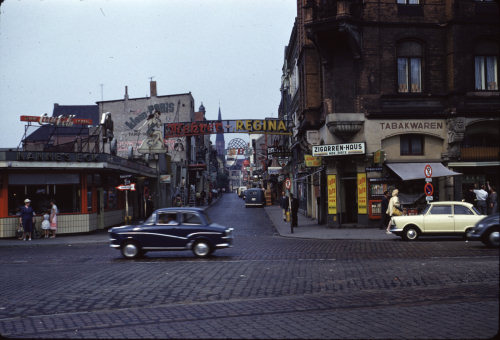
Reperbahn in the 1950’s – PhotoCredit: reeperbahn.uk.org
The Reeperbahn is the most famous street in Hamburg. To the tourist it offers bars, restaurants, shops, theaters and clubs, along with sex museums, erotic theaters and strip clubs. The district is the second most popular attraction of Hamburg after the harbor. In the 1960’s the Beatles wooed the German audiences in Hamburg and started their career in various music clubs along the street “Große Freiheit” (literally “Great Freedom”). At the corner of the Reeperbahn and Davidstraße is the most famous police station in Germany. The Davidstraße provides highly visible police protection and makes the area one of the safest ones in Hamburg. The name “Reeperbahn” comes from the old German word “reep” meaning heavy rope. In the 18th century heavy hempen ropes were produced here for sailing ships in the Hamburg harbor. The Reeperbahn does not come to life before the evening hours. So it was entirely safe and proper for us sixteen-year olds to visit this illustrious and somewhat notorious street during daytime hours. Under a heavy cloud cover the area appeared rather drab in the afternoon drizzle. With only a few tourists walking up and down the sidewalk, the street almost looked deserted. So it was not surprising that the employees of the various entertainment centers that were actually open at this time tried all the harder to get customers to come in to take in whatever titillating things there were to see. One of the attendants of such a steamy establishment boldly approached us and surreptitiously suggested that if we were eighteen years old we would be allowed in for free. Rainer and I just shook our heads as a sign of our refusal. We were neither eighteen nor had the desire to get a glimpse of whatever was lurking behind the garish-looking entrance. Besides we found out later that free meant one had to order a beer for twenty marks. No, we were driven by a totally different desire, the desire to spend our surplus money that we had saved up during the past two weeks. I had fifty marks in my pocket, and to my greatest delight I discovered a shop that specialized in radios and other small electronic gadgets. Before the summer holidays I had just ‘improved’ my latest receiver to the point of irreversible damage. Thus I was happy to see a radio within my anticipated price range in the display window. It was love on first sight. Even though guided by the bait-and-switch tactic the merchant did not succeed in convincing me to buy another ‘better’ model. I remained adamant. It was either the one in the display window or no purchase at all. Rainer did not find anything suitable to buy. So we strolled back to the bus station, passing by all those attractions for the pleasure-seeking night owls. With this excursion our vacation trip had come to a remarkable conclusion. Rainer had extra money in his pockets and I another radio in my possession.