Karl’s Report: Our Flight March 1945
Foreword
How was it possible that parents and children were going to flee from different places? Father Ernst Klopp had been ordered from our original residence in the Pomeranian county of Belgard into the Land of the Warthe to hand over expropriated Polish estates to Baltic Germans, who had been resettled primarily from Latvia. We were boarding with a family in Belgard to attend a secondary school. From there began on March 3rd, 1945 the flight into a westerly direction.
To what degree do memories committed to paper reflect the truth? This document limits itself to the presentation of direct impressions and experiences and sparsely delves into explanations. Therefore it avoids them unless absolutely necessary.
Due to the regrettable loss of a diary that I had kept since my early childhood days, most likely lost in a hay barn on the trek to the West, it is impossible for the sequence of events to be authentic.
Also subsequent inserts of military and historical value, or attempts of this nature were unproductive. The Wehrmacht reports, which one can read in the archives, and the historical works by authors based on the former – as far as they could be controlled by personal, absolutely authentic facts – lagged behind the events and even jumped ahead of them.
Images – March 1945
Memories of the Flight
On March 3rd at 6 o’clock in the evening ‘Tank Alert’ rang out in Belgard. Why did the defense and party headquarters choose the evening to evacuate the civilian population? The family Meißner-Kulmann, two women, five little girls and the Klopp brothers moved under the howling sounds of sirens and the wild perpetual ringing of our church to the designated area, where transportation facilities were supposed to be ready, which was not the case. Without any further discussions the group marched in the direction to the exit road leading to Kolberg in order to reach the coast. Halfway there we stopped in the middle of the night for shelter in the village of Leikow. Some luggage was in the handcart, on which also the children were sitting. Soon we realized that the family did not want to go farther. I was sent back the following evening to Belgard on a bicycle that I had been pushing to get a briefcase with documents belonging to one of their grown-up boys out of the house at the Schidlitz. In us grew the decision to separate from the family, who attempted to stop us by saying, “Fine Hitler boys you are!” I should mention that the march of the trek led us past familiar native places of our early childhood, which slid by in the dark night like shapeless outlines. We recognized how close the front line was by the fire in the village of Lülfitz, which was located north of the Kolberg road, which led in a westerly direction to the coast. In that direction stood also a train recognizable by the stream of sparks: Certainly the railroad line had already been cut.
I always liked to tell that early on my birthday I still got a cake – whether Frau Meißner had baked it in the simple quarters in Leikow or in her own oven in Belgard, I did not find out. March 6th was the day of separation from my room and board mother, who later had walked back to her house in Belgard with her daughters and grandchildren.
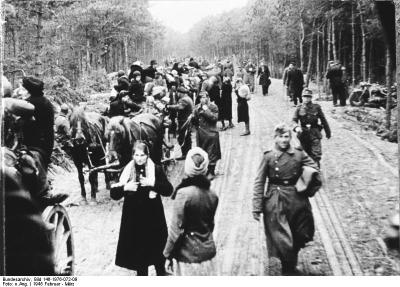
The Long Trek West
Halfway on the road to Kolberg we saw my classmate Ulrich Schulz (Uschu), with whom I had committed many a prank. He was wearing a bandage around his head. We exchanged a few words, but I have forgotten, what he had said about his injury. In the late afternoon of my birthday we arrived in Kolberg. We had entered the city without any problems. Earlier it had been declared a bastion and since then was considered (also according to army reports) surrounded. We hurried to the harbor, which we also knew very well and the seashore, because we had often traveled with the family or alone to this summer resort at the sea. There also existed relatives and a friendly family. The pictures of the German Baltic seaport of 1945 are well known through TV programs. We too saw the line-ups at the ships. We did not take long to think. We decided to march along the coastline. The great bridge at the Persante river was still intact and so we tried to get to the southern part (Maikuhle) of the city, where the friendly Pascheke family lived, who however had already fled. The city of Kolberg was already being fired at by artillery. The Soviets began the encirclement and assault of this also historically important place.
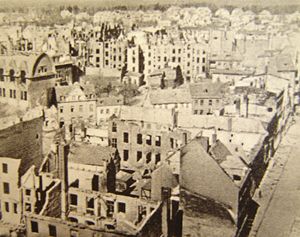
Kolberg March 1945
Once in a while we had a chance to travel a short distance on military vehicles. Since we had only our schoolbags filled with provisions on us, we were able to quickly climb on board. How nervous some people became, shall be demonstrated by the following example. A woman accused us of having stolen her suitcase filled with valuables. At a beach section we examined a boat that had been pulled up onto the shore as to its sea worthiness, but were quickly distracted by other things. Rides and marches changed according to the situation and opportunity. Finally we were forced to continue on land and a short time later even in an easterly direction. Thus, it happened that we saw a location twice: once on the march back and then again in the planned direction to the Oder estuary. The explanation for this is that the front lines were moving back and forth, often there were even wandering army pockets.
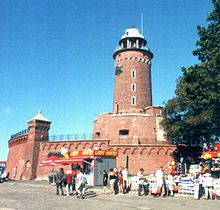
Lighthouse Kolberg Today – Photo Credit: Wikipedia.org
On such march in darkness and blowing snow we saw at the roadside an abandoned hearse. Since we were very tired, we simply lay down on the seats to catch a few winks. Whether it was instinct or battle noise, we left the protective shelter and went into the next village and asked the Pomeranian farmer to stay overnight. He did not want to let us into the barn saying, “You will set it on fire!” He offered us the pigsty and so we spent the remainder of the night right next to the box that housed a well-fed sow. We gave her our empty sardine cans, which she was licking and chewing all the time. When we came by the farm the next day on our way west to the Oder estuary, it was engulfed in flames. Now the farmer had lost everything! An hour later we saw the hearse. It had been totally torn to pieces by gunshot.
Only once did we get to know the Soviet air force. A ‘Rata’, an awkward looking, slow airplane, was shooting at the trek on the road leading to the West. Near us a woman lost her infant, whom she carried on her arm. We quickly looked for cover to evade further attacks. Once we had a chance to hitch a ride on a hauling truck, which pulled a huge artillery gun. At close range we could observe how the battery moved into position at dusk. We stayed nearby in order not miss a possible ride later on. Then it became clear what was going to happen: a tank attack in the immediate vicinity. I still remember the howling of the tank engines and the noise of the chains. In the flashes of the gun barrels I could watch the loading gunner, how he slid the big, heavy shell into the barrel, stopped his ears, waited for the recoil, then picked up the next shell, about three or five times. To the right in the background I saw exploding tanks, i.e. the gun towers all-aflame flew up and to the side. The remaining tanks turned and withdrew into the night. Later on I found out that night aiming devices were in existence. I also have been contemplating, as to why I can still visualize so vividly this scene. It was the unshakable calm of the gunner and steadiness of his movements: industrial work at the machine, prepared by ‘Refa’. We were not fast enough; the battery with its three or four artillery guns had disappeared during the night.
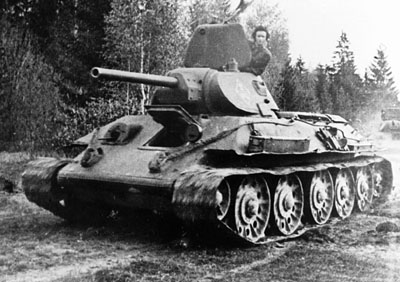
Russian T-34 Tank
In one of the next days and nights we stayed in a more westerly located village. I observed a group of our soldiers, who were giving to someone a lecture. One asked, “Where do you have your gun, Frenchman?” One needs to know that very many western Europeans under German occupation volunteered to be enlisted in their own units to fight against Bolshevism. The fear of being overrun from the East since the revolution in Russia was great. Almost all countries east of Germany developed into authoritarian and dictatorial regimes, Germany of course also and even more so. Also western peoples had similar ideas. Thus, French people entered the German army. The scenario makes me ask: Was it German arrogance or realistic assessment of the French fighting spirit?
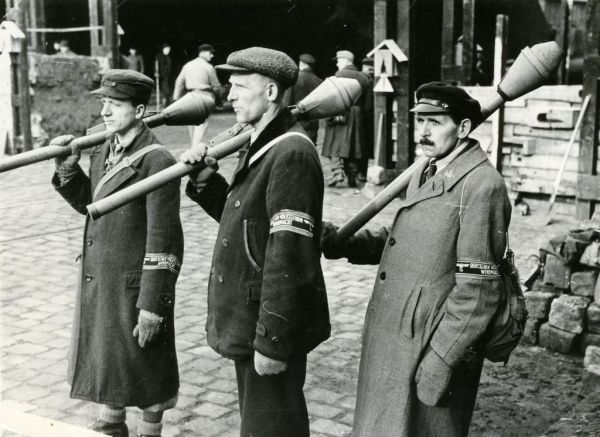
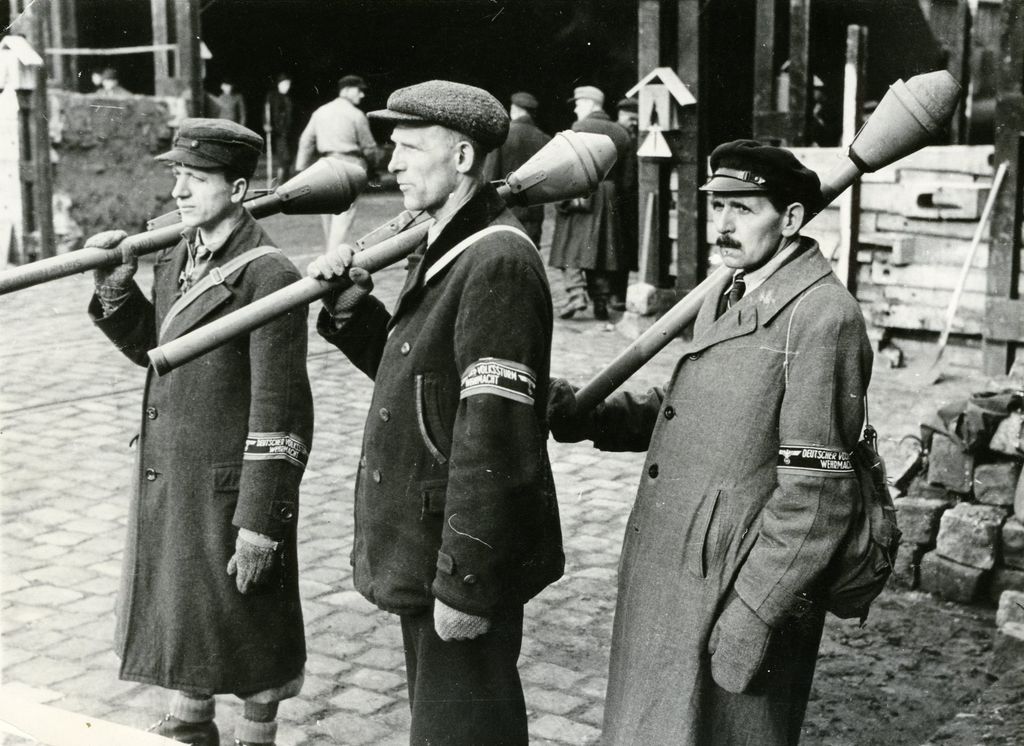
Old People Recruited to Fight – Photo Credit: Wikipedia.org
A short time later at the same spot we listened, as a battle at close range developed with the Soviet infantry. When tracer bullets were shot over our heads, we threw ourselves behind a manure pile, and we could see now close to our left and right the trails of light flashing by. The Russians were shouting “Hurrä”; in the counter offensive it was responded to with Hurra. A German soldier lost his nerves. Minutes long he was dancing with his gun in his arm from one leg onto the other. Much later, sitting in relative safety in the train, I retold my observation to another refugee. Thereupon a sergeant severely reprimanded me; one does talk about these things in such detail. The aforementioned attack therefore was repulsed. My brother and I were looking for better cover in a trench. An officer brandishing his pistol startled us and asked us to identify ourselves. He was a so-called hero-nabber (Heldenklau), whose job was to get after cowards and deserters or simply to bring the scattered bunch of his soldiers together again.
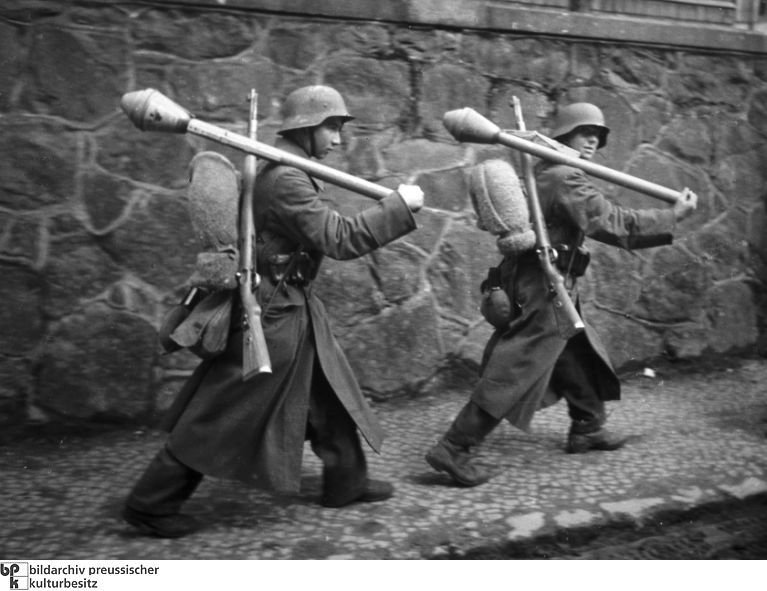
… but also Children
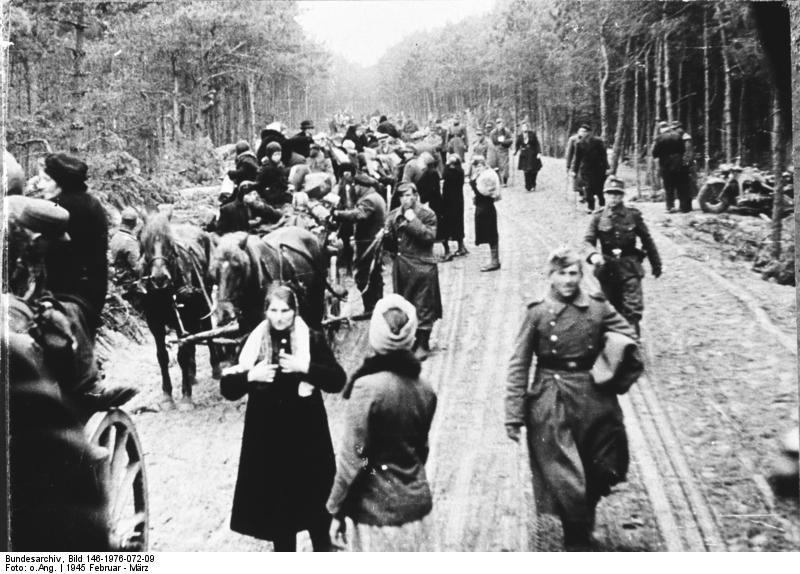
The military operations were pushing us again to the coast. Coming out of the dunes we saw an endless tapeworm of people moving west – military personnel as well as civilians, whom we joined, Soon we saw on the left the ruins of a church in the dunes. The village of Hoff lay ahead, a distance of 15 km to the eastern branch of the Oder river, the Dievenow. My grandmother had a picture of these ruins hanging in the hallway, which I had always looked at with great respect. I had spent the first two grades on my schooling in Stolpmünde. Now I saw the remainder of the church that had been destroyed by storm tides in previous centuries under such circumstances before my eyes.
We soon found out that the Russians were pushing hard directly to the coastline. Shots were coming out of the dunes aimed at the passers-by. German soldiers went into position and repulsed the attack, which would possibly have cut us off. Here is one impressive detail: A soldier was getting ready on the dune in the direction of the pine forest. An overly daring Russian fighter was hit and fell down and remained hanging in the lower branches. He wanted to get an overview of the scenario from the treetop.
I do not know why someone would throw bicycles into the sea. Anyway we got two of them out of the water, loaded our light luggage and moved ahead this way a lot faster. Near the water’s edge the sand was firm; only over the tidal inlets we had to lift our vehicles. The bikes were available to us for many more kilometers, until we caught in Neubrandenburg a train to Erfurt.
From the place, where we found the bikes, we soon reached the village of Dievenow located on either side of the arm of the Oder River, from which it got its name. At the east bank we had a major delay, because there was no bridge, but a ferry instead, which connected the ends of the old highway of the Reich I65 and which was no longer operational. The army had set up a pontoon service, which, when we arrived, was exclusively available for the troops. They consoled us civilians with the evening hours. We looked at the village – beautiful villas located near the beach like so many resorts at the coast. We went into abandoned houses in search for food. The provisions we had with us had been exhausted. Where we had stayed overnight we had begged for food or often filled our stomachs at the military field kitchens. It was awkward that we had neither a tin bowl nor a spoon with us. Once we ate out of a steel helmet, the inner lining of which we had removed. In the houses of Dievenow we found very little, at most canned fruit.
In this beautiful place I should have received my paramilitary training. They were sending the male Hitler-Youth to so-called training camps, from which they were directly transferred to the troops. During our journey I always had the draft notice readily available in my pocket, but had no intention to look around and locate the camp to report for military duty.
Finally they let us two bicyclists onto a pontoon, some of which were ferrying constantly back and forth.. Now one could already hear heavy artillery fire close by. Shells hitting the water indicated that the Soviets intentionally were going to disrupt the withdrawal movements.
Much relieved we pedaled onward in a westerly direction, needed no longer to divert our march into forests and fields, but rode on decent roads. There were also organized centers of provisions through field kitchens. Also the military operations were less noticeable in the rural areas. The city of Wollin, a day’s march from Swinemünde, was only captured on May 4th, 1945. We reached Swinemünde, the next city from Dievenow, already on March 12th, a date of horror in my memory.
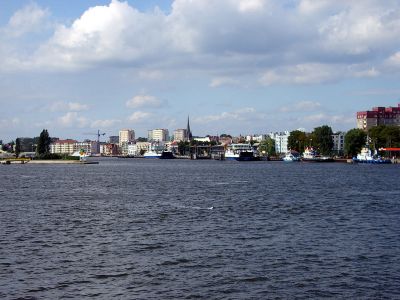
Modern Swinemünde – Photo Credit: Wikipedia
We soon arrived at the small beach resort town of Misdroy, twelve km before Swinemünde on the main road to Stettin. We had more often heard the thunder of big guns from the direction of the Baltic Sea. The German navy, which not only carried the masses of refugees primarily from the East Prussia to safety, but was also actively engaged with its long range guns in support of the battle on land, and was shooting no-go areas against the enemy to safeguard endangered front lines. What we heard on March 12th, let the ground at a wide range shake and doors bang open and shut. The Americans and British had fooled the antiaircraft authorities by not flying in a straight line to the town of Swinemünde, but then for one hour intensively bombarded the relatively small town area. The bombing raid resulted in 23,000 dead. They rest on the German side on the Golm, a cemetery of an area of one square km. Swinemünde is Polish today.
When we arrived at the town on the evening after the attack, where we had wanted to stay overnight, visibility was almost zero, the stench horrific, most certainly the smell of corpses. How we got over the relatively wide arm of the River Oder, by the name of Swine, I cannot recall. On a account of the smoke I was unable to see.
In the middle of the night we reached Ahlbeck and found some rest in a vacation guesthouse, where a compassionate woman with a little son took us in. For the first time in ten days we slept in a real bed.
Only now we began to discuss to which destination we should proceed. There were relatives, whose addresses we had in our heads as a result of a very active correspondence, in Freiburg and Erfurt. The latter was closer. Therefore, we decided to pedal on in a southeastern direction. Since we had neither maps nor compass, we did not choose the direct way, kept on pedaling six more days all the way to Neubrandenburg, where we became sick and tired of biking. We needed a rest, because the most recent journey went over the Pomeranian ridges, i.e. through hills and valleys and into the bones.
We used a savings account booklet filled with entries from our saved pocket money to buy train tickets to Erfurt and pay for the shipping of the bikes. The savings account organization had made life easier for the refugees with the set-up of a generous transaction policy.
It was a strange feeling to sit in a train, where to be sure there was incredible crowdedness, to be able to watch the landscape, to read the names of the cities of Mecklenburg-West Pomerania, of Brandenburg, and then of Saxony-Anhalt, places whose names until now had been unknown to me or about which I had a different perception.
Once in a while the train stopped in a hollow to await a bomber formation. Often enough low flying aircraft attacked trains or blocked the route in order to target troop transports. A friendly place-name sign ‘Wolmirstedt’ indicated to us that we were passing through the birthplace of our father Ernst Klopp. Slowly we were approaching Thuringia, where Uncle Günther and Aunt Lucie lived. It was an unknown place to us. A long trip in our childhood, especially not during the war, was out of the question. Then came the giant railroad station that destroyed all small town Pomeranian perceptions, then the walk to the probable town section, the search in the long street with the name Nonnenrain and the confusion about the house number, 70 instead of 17. Aunt Lucie was speechless. Of course, she could not answer our first question about the whereabouts of our parents. That we looked like dirty pigs must have affected her rather badly as it would have anybody else. At mealtime there was information on the conditions in the city, above all on the almost daily aerial attacks and on the air raid shelters. Besides the American front was approaching from the west.
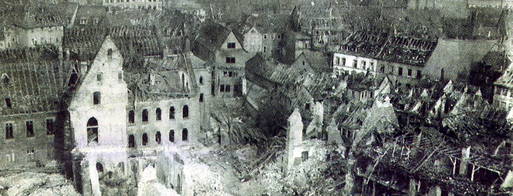
Erfurt after a Bombing Raid – Photo Credit: TLZ.de
At first we did not heed the warnings of the aerial attacks, until the powerful explosion of a bomb taught us otherwise. Uncle Günther, who was at the time hospitalized due to health issues going back to WW1, was sent home, and we met again, himself looking quite worried. With the arrival in Erfurt the flight had come to an end, and the thread to our homeland and to the parents was totally cut off. What came next was completely different.
End of Karl’s report
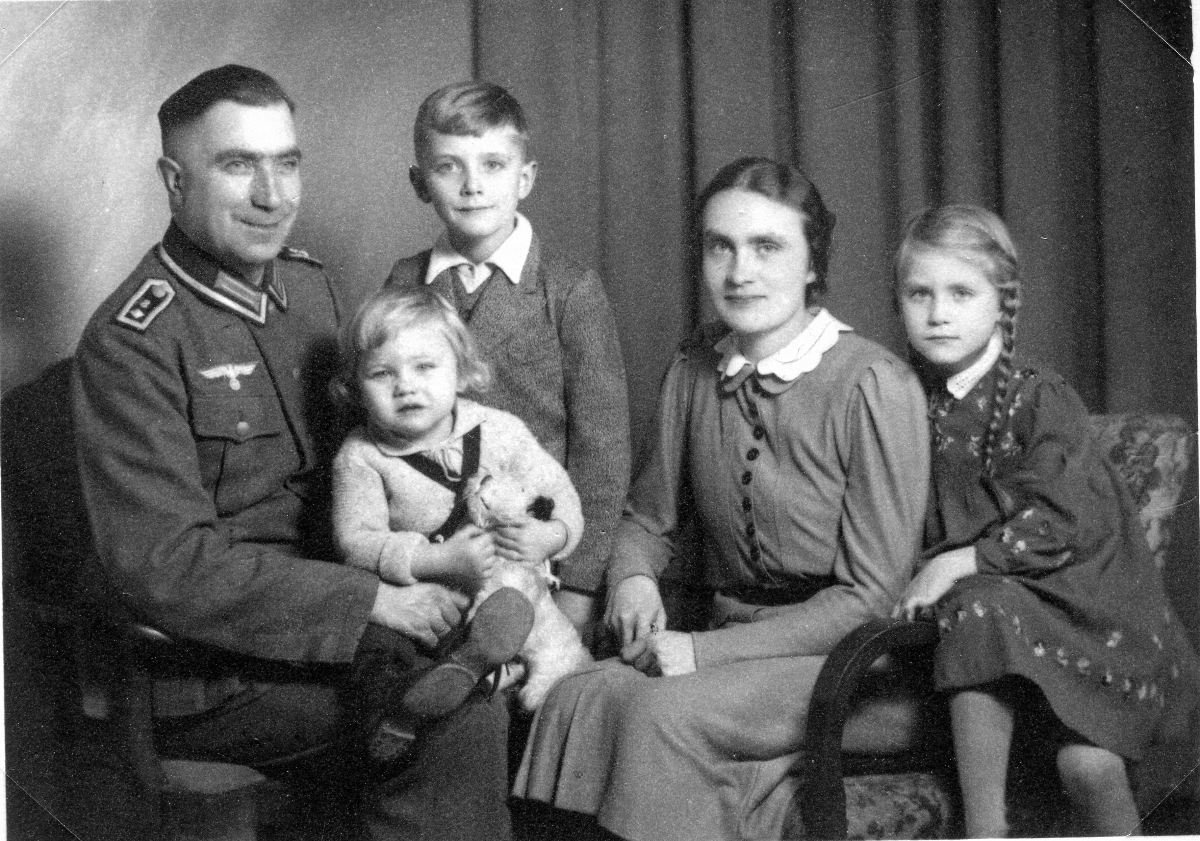
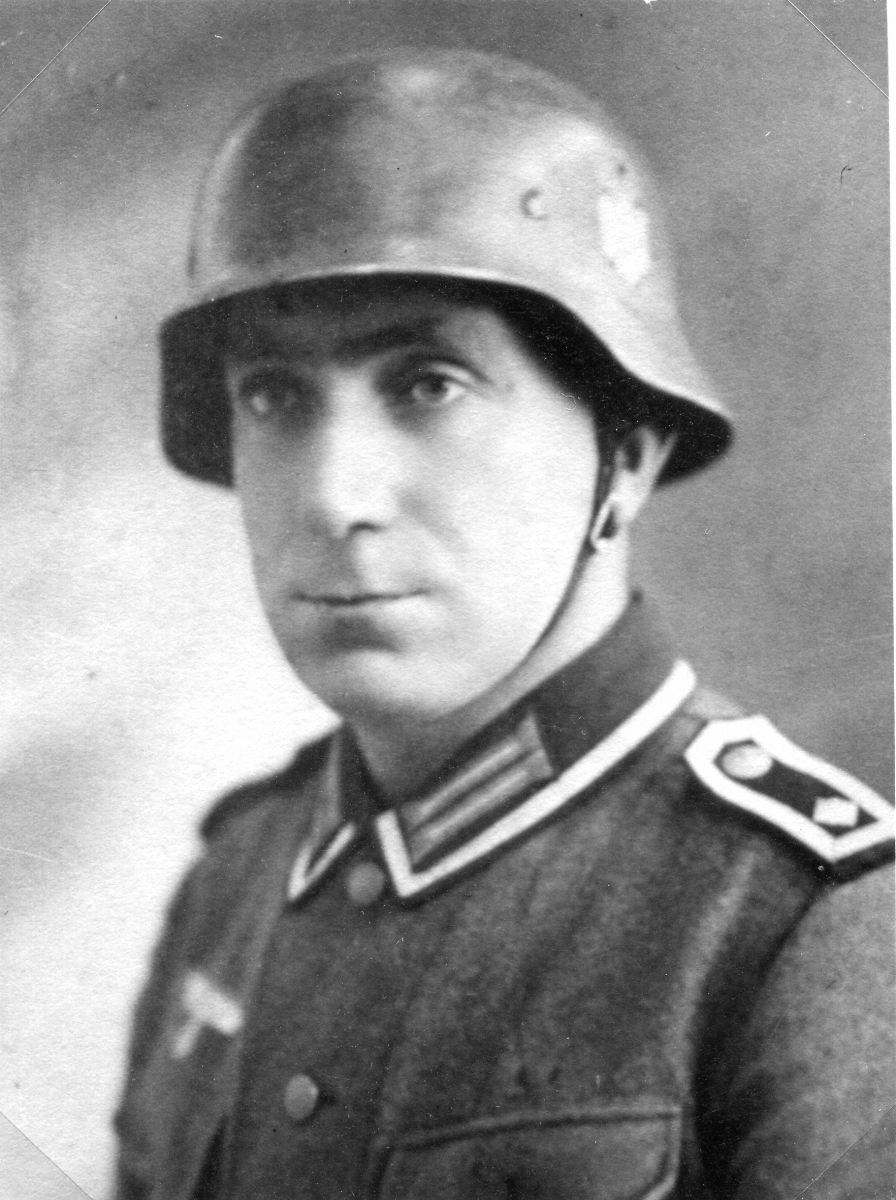


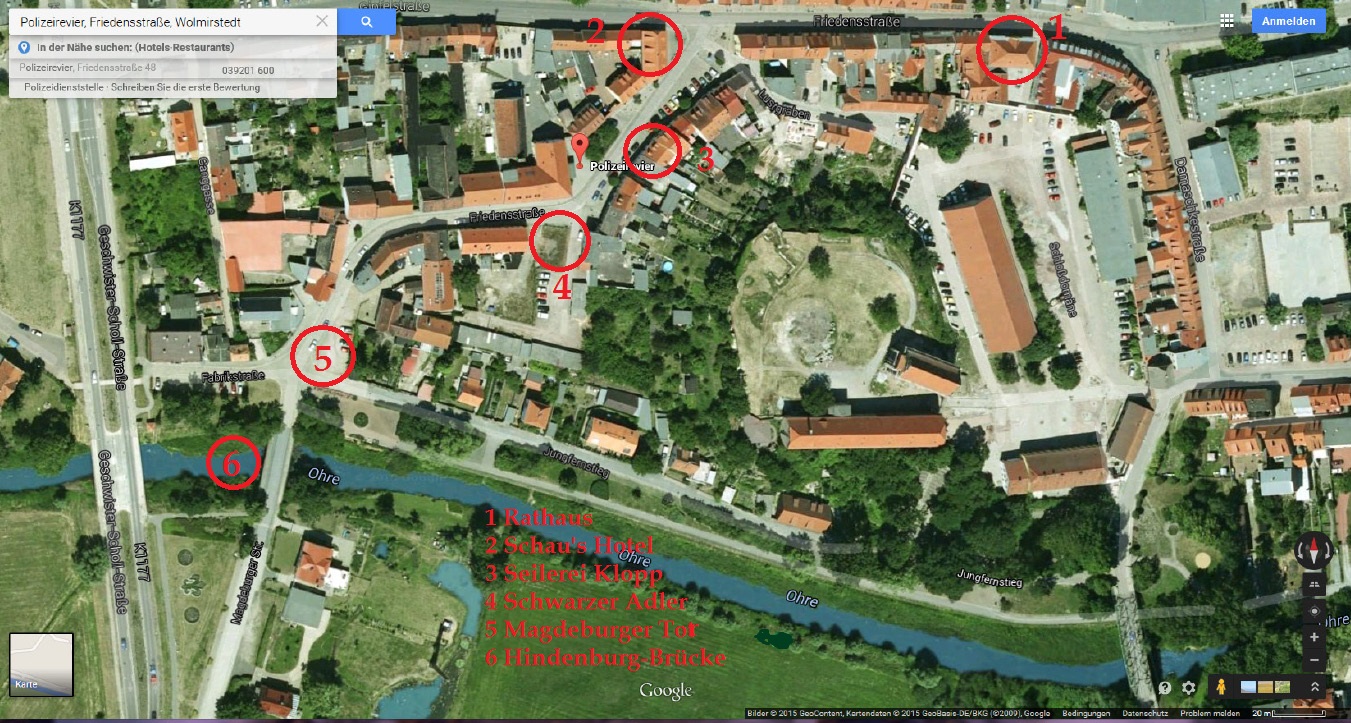




 The Peter and Gertrud Klopp Family