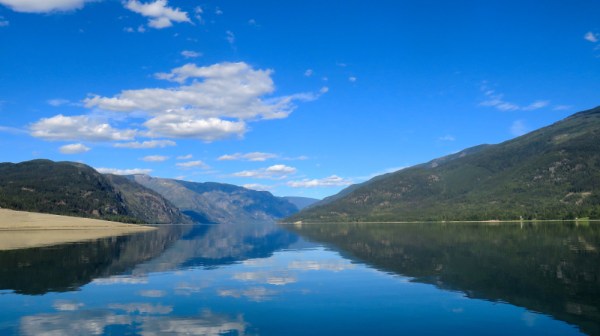
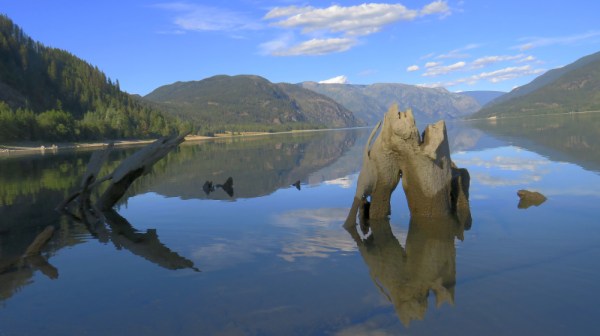
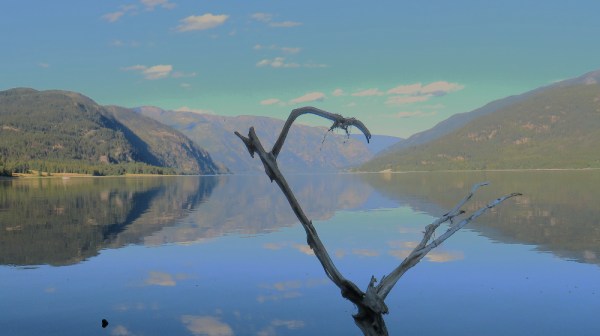
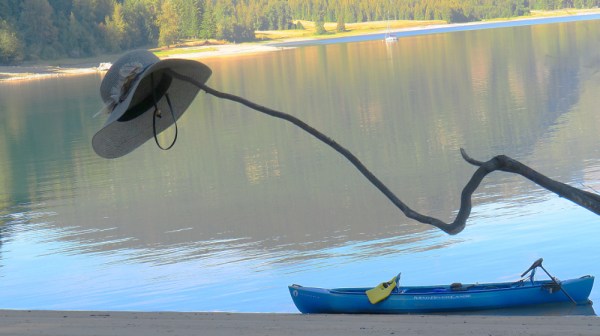
The readers who have been following me for some time will know from my posts that the Arrow Lakes are actually the mighty Columbia River that was dammed into a giant reservoir in the late 1960s. To make room for the project, many orchards and farms were destroyed. Entire forests were cut down. People lost their homes and had to move to higher grounds. Many left the area and never returned. As a result of this upheaval, tree stumps were submerged and only surface when the lake level is down in the dry summer months. I consider these leftovers as an opportunity to capture their stark beauty. Yesterday we took the canoe for a short trip north of the Needles Ferry landing where I found these beauties on the beach. My wife’s hat added that little bit of extra that the photographer in me is always in search of. Enjoy.
Frau Panknin’s Success and Biene’s New Friend Angelika
Biene wrote this post.
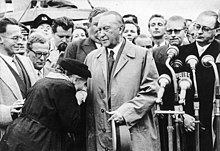
Often my mother was at the point of exhaustion and desperation to give up. The bureaucracy was so overwhelming that all her efforts seemed futile. But my mother’s tenacity and indefatigable spirit finally paid off after seven years. She went to the highest government department to plead for justice as a last desperate effort. Miraculously, she was received by a representative of the German Chancellor, Konrad Adenauer, who had a sympathetic ear and got the “ball” rolling in no time. My father was finally entitled to a sizeable pension and a big back pay for the lost years. My mother had won the struggle for financial security at the expense of her health and vitality. The years of worries and deprivations had taken their toll. But my brother and I were too young and self-absorbed to notice. For us, she remained a pillar of strength and comfort. Her love for us was inexhaustible.
Adenauer with the mother of a German POW brought home in 1955 together with thousands of other POWs from the Soviet Union due to Adenauer’s visit to Moscow– Photo Credit: Bundesarchiv
After this memory fragment of my mother, let’s return to my life. Shortly after our second year of high school had started, “Mecki,” our homeroom teacher, introduced a new student. He assigned her to sit beside me since I had lost my desk partner the previous year. She had failed the grade. I glanced furtively at my new companion, who looked straight ahead at Mecki. Angelika had a cute snub-nose and big blue eyes with long dark eyelashes. Her short hair curled softly around her round red cheeks. She had a nicely curved mouth and dimples. When she eventually dared to smile at me, she looked beautiful.
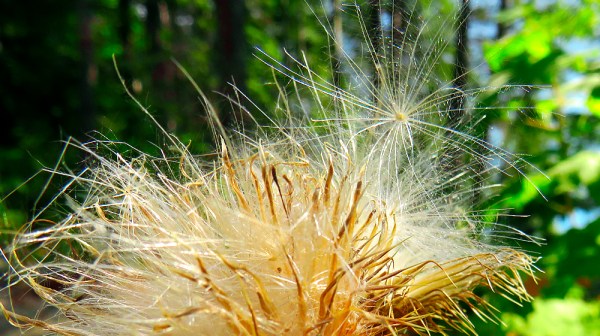
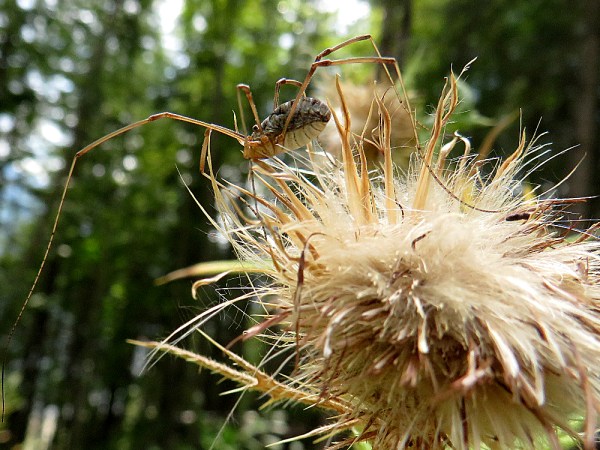
While camping on the Needle’s side of the Lower Arrow Lake, I observed the transformation of a thistle from a purple flower into a seed head. Most people do not find the final stages of any flower very attractive. Perhaps the image of decay and death troubles them, as they are overlooking the new beginning of life in the presence of myriads of seeds. While a dandelion seed resembles a tiny parachute, the thistle seed looks more like a feathery ball that can travel large distances before it lands on the ground. The wind strongly blew when I took the picture. But the single seed on the upper right was well anchored by a spider’s web string. Enjoy.
The first year of high school was a big adjustment for us. We had to get used to a variety of teachers and teaching styles. Learning a new language was fun but also very difficult. We had to memorize many English words, their difficult pronunciations and their idiosyncratic spellings. To this day, the infamous “th” is still a challenge for me sometimes. Spelling rules are relatively consistent in German, but exceptions to the rule are common in English. Memorization of words and phrases seemed to be the best solution.
In this humorous video, a German coast guard employee is having serious trouble with the ‘th’.
Although school ended at 1:15 p.m., we had little free time because of heavy homework for each subject. In the afternoon, my brother and I would sit at our only table in the small room of the “House of Rocky Docky” and study. His homework was utterly different from mine. We hardly talked to each other, immersed in a different world. My father worked in the Krupp dental laboratory and would not return until supper. My mother had her battles to fight. She was constantly on the go trying to fight for my father’s right to receive a government pension from the police force he had worked for until Germany was divided.
Most people in Germany did not have phone service when I grew up. It was difficult for my mother to talk to government officials and other essential contact persons involved in her struggle to get justice for my father. It was a difficult and stressful undertaking for my mother and very exhausting. She had to travel by bus or train to government offices in other cities to get an appointment. She had to write letters and fill out lengthy forms, which often landed in the wrong departments or were filed away unread. There was an overload of administrative work for the government officials to accommodate all the refugee claims from the east.
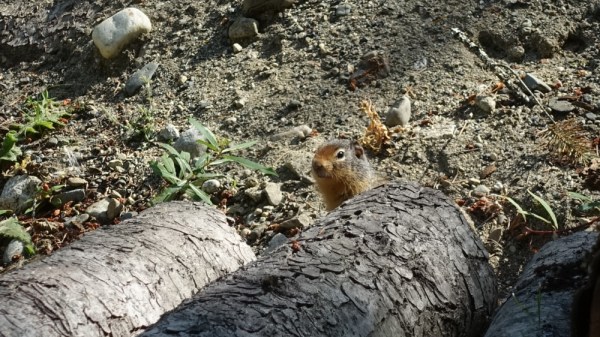
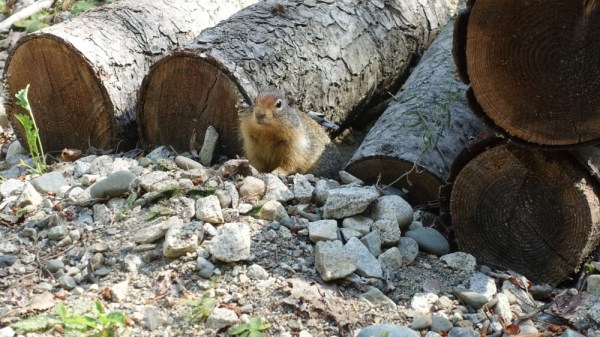
My wife and I have been camping for about a week at Arrow Lake, where we found relief from the unbearable heat at home. Forest fires are burning again. But we are fortunate this year. None of the BC forest fires are very close to us and do not endanger our little community. While relaxing in the cool breeze, I notice a gopher (prairie dog) cautiously approaching me. As it peered over a log and looked at me for a long time, I quickly got my camera out. Instead of running away it came closer and closer. Obviously, it recognized me as the friendly human from the previous year. After a few minutes, it was posing for a portrait less than a metre away. Enjoy.
We read works of world literature, first in German and then in English and French, and in the last three years, a few excerpts in Latin. We would discuss, debate and talk about the great themes which moved and influenced man’s quest for the meaning and purpose of life. I loved our philosophical discussions and would always actively participate. Although our teachers were authoritarian in many respects, they encouraged free thinking. We were expected and allowed to have our ideas and opinions as long as we could back them up with solid arguments to prove their validity. We were fortunate to have “Mecki” as our classroom teacher. He eloquently expressed deep thoughts and guided us through difficult discussions. He was a great model.
Our school emphasized language arts, while science-related subjects were neglected. Our physics teacher did not expect much of us. He would spend most of his lessons telling us interesting and entertaining anecdotes about his life and war experiences. Maybe he did not want to waste his efforts teaching science to girls who would never pursue a career in that field. This was still the pervasive opinion at that time. Although I was not scientifically inclined, I once delivered an amazing technical drawing of a Wankel motor. That was my only success in science, and I earned the respect of my teacher. I have to admit remorsefully that my brother had helped me with it.
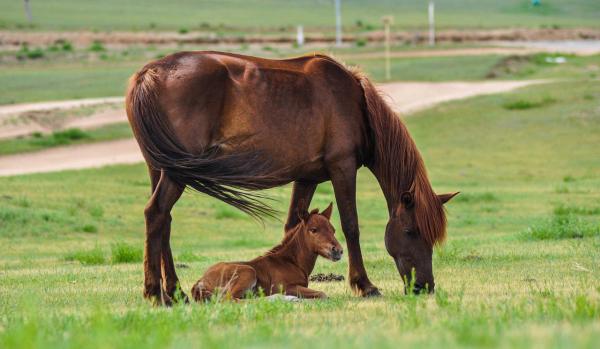
Biology was another neglected subject. Our squeamish elderly teacher was supposed to provide sex education. She would show us a film of a pregnant mare who miraculously suddenly had a newborn foal beside her. The actual birthing scenes were left out. We were left in the dark. Another substitute teacher took over the topic by telling us a Greek legend of a pot that eventually finds its matching lid. It sounded all Greek to us, and we were quite bewildered. Finally, we searched for answers in real life, not at school.




 The Peter and Gertrud Klopp Family