Baroness Anna von Waldenfels (née Klopp) – Part XIX

New Beginning for Anna and Ludwig von Waldenfels

From Gauting as their starting point, Anna and Ludwig von Waldenfels, both already at retirement age, began once again to build up a foundation for their livelihood. At the end of 1947, they leased one half of the former Wehrmacht training camp Pentenried, which had become the possession of the State of Bavaria. They purchased the living and material inventory for the property. The couple kept about 15 to 20 cows, 2 or 3 teams of horses, 2 German shepherds; they had access and use of a tractor and employed three coachmen, also Walter Schirrmeister, their former estate manager of Panwitz, as well as a certain Ulrich Kennemann, and between February 1948 and February 1949 their nephew Karl Klopp (1929 – 2019) [Peter’s brother]. At the beginning of 1950, the couple von Waldenfels gave up the lease again and went into retirement. Ludwig was 75, and Anna was 65 years old. Today there remains very little of the Pentenried estate, a few outbuildings, and a hall with pigs’ troughs dating back to the army years.

Anna and Ludwig acquired subsequently the house at Hauptstraße 1 in Söcking near Starnberg and there they spent their golden years. On 17 March 1954, Ludwig von Waldenfels died at the age of 79. His wife had him buried in his Bavarian officer’s uniform. In September 1990, the author of the Klopp Chronicles, which I am translating into English, Eberhard Klopp, visited the neglected gravesite and found Ludwig’s wooden cross, which while still showing name and vital dates of the deceased von Waldenfels had due to weathering greatly deteriorated over the past four decades. Ludwig’s unserviced gravesite No. 84/85 is located at the forest cemetery of Söcking. One searches in vain for the mention of Anna von Waldenfels (née Klopp), who has also been buried here in 1967.

Natural Splendour of the Arrow Lake

Wednesday’s Photos

The Blue Heron – The Graceful Visitor of the Arrow Lakes

The blue heron like the majestic eagle and the swift osprey has made a come-back after driven almost to extinction in the Arrow Lakes region. Until the use of DDT and pesticides had been outlawed, their population had been dwindling to the point of no return. Today’s post is dedicated to this graceful fish hunter along our shores typically found stalking through reeds and flooded grasses. Its voice is not pretty, but its gait and posture impress with their elegance and gracefulness. The blue heron is generally a wary and skittish bird that flies away at the slightest hint of danger. This time it allowed me to take pictures from a mere 10 m (about 30 ft). The short video clip shows the blue heron in flight. Enjoy.

A-IMG_6977A-IMG_6978A-IMG_6979A-IMG_6988

Baroness Anna von Waldenfels (née Klopp) – Part XVIII

Escape from the Horrors of War

On the morning of 29 January 1945 Ludwig von Waldenfels was totally against leaving Panwitz. Being a former WW1 officer of the Bavarian army, he planned to hide in the forests of Panwitz and armed with a pistol intended to sacrifice his life if necessary. His wife Anna knew how to curtail such dramatic, but senseless undertaking and with gentle force manoeuvred him into the waiting car.

The population of East Brandenburg (to which Panwitz belonged) experienced all the brutalities of the Russian hordes. The people percentage-wise paid the highest blood tribute rendered in 1945 at their expulsion from the German eastern provinces. In Rogsen alone, a village of 761 inhabitants 10 km south of Panwitz, a dozen men were shot and on the night of 29 January 1945 forty brutally raped women and girls committed suicide. Already in the afternoon of the same day, Soviet artillery shot from Heidemühl and Kupfermühle at a distance of 5km into Meseritz.

For Ludwig and Anna, in view of the military situation, there was only one escape route. It led over icy and snowed-in country lanes via Lagowitz and Brätz to the main connecting road to Schwiebus. With little luggage and the few things on their body, the couple reached after one week of travel Gauting near Munich. There they found first reception at their brother/brother-in-law Ernst von Waldenfels (1877 – 1955). He was a bank chief inspector and lived at 10 Hindenburg Street. He was in charge of money matters before the chaotic times set in. Here they experienced the arrival of the Americans and thus survived the war’s end.

Within just a few hours a life’s work and dream had sunk into oblivion. Only the nostalgic feelings of 18 years of Panwitz and Lagowitz remained, which nobody of the former residence would ever see again. Alive remains the memory of the shadowy gravesite of grandmother Emma Klopp (née Bauer) in the park of the Panwitz estate. Her final resting place was supposed to have become the family gravesite of the Klopp and von Waldenfels clans. The fury of war and the greatest mass expulsion in history had swept all this away.

Natural Splendour of the Arrow Lake

Wednesday’s Photos

Canoe Trip on Whatshan Lake

Thousands of Frames Make a two-minute Video

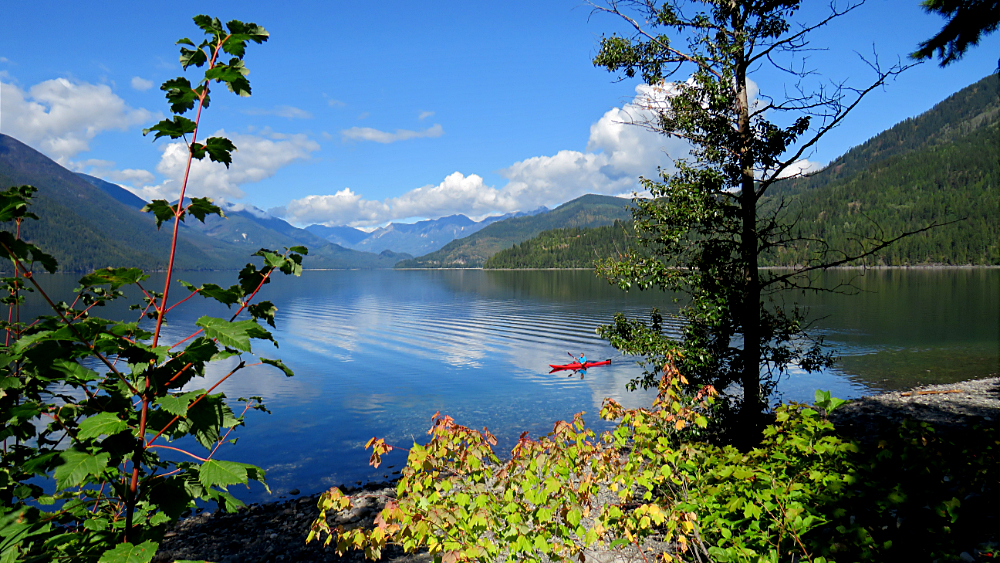
On Monday my wife and I took the ferry across the Lower Arrow Lake and travelled with our canoe to the nearby Whatshan Lake, a mere 4 km distance from Fauquier. Surrounded by forested hills, the 30 km long lake is actually comprised of two lakes connected by a narrow and winding channel. The boat launch not far from the public beach was virtually deserted so late in the summer season. Biene and I knew that we would have the lake almost entirely to ourselves. Bent on relaxation with a chance to capture the wild scenery on our cameras, we let the electric motor do the ‘paddling’ for us. Here is the video of our exploratory canoe trip. Enjoy.

Baroness Anna von Waldenfels (née Klopp) – Part XVII

Narrow Escape and Loss of Property

In the early part of 1945 Georg’s wife, Ilse  von Waldenfels escaped just in time from the rapidly advancing  Red Army. After briefly visiting acquaintances at Lake Scharmützel near Berlin she reached Berghorst in the Münster region in Northwest Germany, where her mother Helene née Wattendorf (1881 – 1973) resided. Georg after joining her as reported earlier became shortly afterwards a British POW and was interned in Recklinghausen until 1947. His entire property had been confiscated on account of his SS membership. There are some vague indications about Georg having been summoned as a witness against Genraloberst of the SS, Sepp Dietrich, in court proceedings at the Nuremberg war crime tribunal or at the Malmedy  Court, in which his former boss received a life sentence for being responsible for the shooting of POW’s during the Ardennes Offensive. The author Eberhard Klopp of these family chronicles did not further explore the connections of these claims. At any rate, Ilse von Waldenfels was able to send family care parcels to her interned husband in Recklinghausen.

By the end of January 1945, the Red Army was approaching the town of Tirschtiegel, which the Wehrmacht (regular German army) and SS units were defending on 30 January. Soviet units were breaking through the so-called ‘Obra Position’ and advanced on 28 January south and north of Tirschtiegel in a pincer attack all the way to the road connecting Meseritz and Bentschen. After the conquest of Bauchwitz only 5km north of Panwitz the Soviets not only blocked to the defenders the retreat from Tirschtiegel, but also to the rural inhabitants the escape route to the railway station in Meseritz.

Anna von Waldenfels describes the loss of her beloved Panwitz. “We were totally unaware the Russians with their tanks were ready to strike at any moment being only 5 km away from us. A general of the SS came by and told us that he would take us to Berlin if we would make up our mind immediately. He warned, ‘Tomorrow you all will be hanging from a tree’. Indeed that’s what happened to all our neighbours who stayed behind. For us to escape was truly a miracle”. On the very next morning (29 January 1945) the Russians had occupied the entire county. All men were shot and all women were raped by the Asian hordes.

To be continued next Friday …

Natural Splendour of the Arrow Lake

Wednesday’s Photos

A Moment in a Chipmunk’s Life

While camping at Taite Creek we had a daily visit from a chipmunk. The chipmunks (Streifenhörnchen in German) are undeniably the cutest squirrels in the forest. Intelligent enough to know that we human beings at the campsite generally pose no danger to them, they are, however, constantly on the alert for any threatening move that might signal the need for a quick escape. I was lucky to snap a sequence of photos showing our chipmunk friend eating a morsel of food he found in the fire pit. Enjoy.

A-IMG_6964A-IMG_6965A-IMG_6966A-IMG_6968A-IMG_6970