Chapter 16 of the P. and G. Story Part II

Yoga and Electronic Tinkering

I will insert in some posts a fact sheet to show what made the news headlines during the same time period in Canada.
St. Willibrodi Cathedral in Wesel -Photo Credit: wikipedia.org

St. Willibrodi Cathedral in Wesel – Photo Credit: wikipedia.org

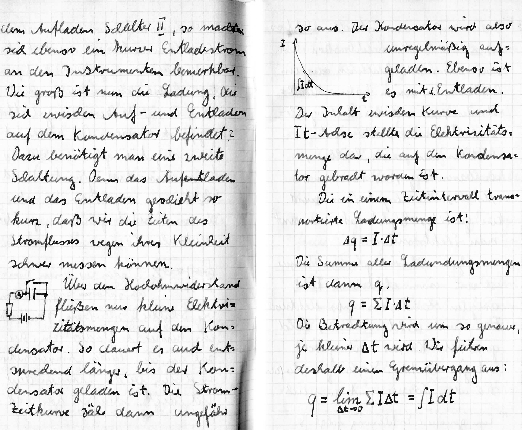
In school I managed to stay within the shrinking number of senior high school students and even improved my grades, especially in physics, where I impressed my science teacher and fellow students with my electronics projects. I brought them for enrichment into the old-fashioned physics lab that was equipped with outdated apparatus. I once demonstrated the ability of capacitors to store electrical energy. Out of old radio parts I had assembled a rectifier that supplied the high voltage energy to charge several electrolytic capacitors wired in parallel. After the device had been unplugged for several minutes, I connected a light bulb to the terminals. To everyone’s amazement the bulb lit up brightly. More than once through similar experimental contributions my teacher entered an A+ in his grade book. These voltage charges were not without danger, especially if I had forgotten to discharge the capacitors or worse, if I had left the power on. Many a times I suffered a severe zap from 300 V DC, when I wasn’t careful enough working with live circuitry. At one incident I was stunned for several minutes by the current that had run through my body from one hand into the other.

My passion for this hobby was well-known to my classmates and the word got around very quickly  that I had built a transmitter for wireless Morse code transmissions. When tinkering with a small electrical motor IMG_8993run by a battery I discovered that the stream of sparks on the commutator in turn produced a continuous noise across the entire AM band on the radio. With a long antenna connected via a Morse key to the running motor the electromagnetic signal spread over a distance of several hundred meters. Soon orders were coming in from my excited classmates for the Klopp transmitter, which I was selling at a tidy profit one unit at a time. Of course, it must have been very annoying for the people in the immediate neighborhood having to listen to the dah-di-dah’s instead of the news or music from their favorite radio stations. Even though my nickname Ede accompanied me for the remainder of the high school years and even past graduation as long as I stayed in contact with my closest friends, they also dubbed me the electro-boy. I took the name as a compliment. My friends did not use it to ridicule me, but rather in admiration for the expertise in a field that was supposed to become my professional career.
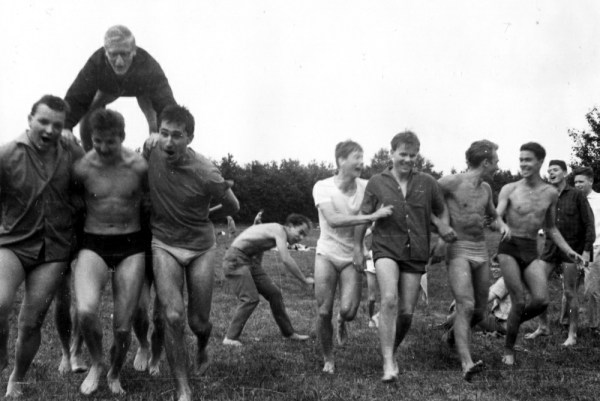
Sportday at the Wesel Highschool - Peter Third from the Left

Sports day at the Wesel Highschool – Peter Third from the Left

In Physical Education, where I trailed near the bottom of the class, it was an entirely different story. Because of my extreme growth rate during my teenage years I never felt quite at home in my own body. The old Latin saying ‘mens sana in corpore sano’ had no meaning for me. The call for a sound mind in a healthy body applied only to the fortunate ones whose body and mind grew up together in perfect synchrony. As for me I suffered under the lack of physical skills in the gym and outdoors on track and field days. I was actually afraid of having anything to do with the balance beam, the horizontal bar, parallel bars, the pommel horse, the rings and the vault and often refused to participate in all but the most basic exercises.

37

Mother and Aunt Marie(Tante Mieze) on a Walk in Wesel

One day I had bought a book on yoga. The exercises were described in a simple and concise language. They were illustrated by a number of photos that appealed to me. I could practice them in the privacy of my little room at home. Thus, I had a chance to have control in a slow and deliberate manner over my body. Little by little I acquired a skill level that made me proud and allowed me to compensate for my shortcomings in P.E. Soon I was doing a head stand away from the wall, assumed the lotus position for as long as I wanted, even wrapped my knee over the neck and did many other exercises, which with their emphasis on extreme flexibility and coordination of all body parts were bordering on acrobatics rather than on the meditative nature of yoga. When I presented some of the more spectacular exercises to my class during P.E., I had to learn to live with yet another nickname. Even the gym teacher was so impressed with the display of my new-found skills. They were so much different from the prescribed curriculum for the upper grades that he and my peers called me the yoga-man.

To be continued…
Chapter 16 of the P. and G. Klopp Story – Part I


Summer Employment, School, and Ballroom Dancing


“Let us read, and let us dance; these two amusements will never do any harm to the world.”

Voltaire


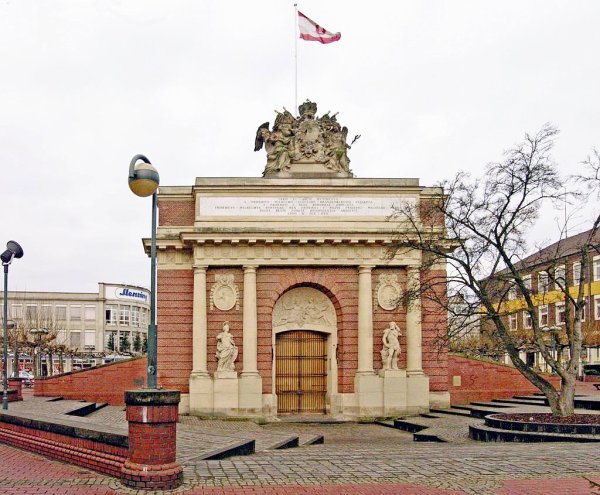
Berlin Gate of Wesel - Photo Credit: wikipedia.org

Berlin Gate of Wesel – Photo Credit: wikipedia.org

On a side street not too far from the post office and the Berlin Gate – not to be confused with the Brandenburg Gate of Germany’s capital – was a small electronics store. The owner was also a contractor who did most of the electrical wiring jobs for the apartment buildings, which were popping up like mushrooms in the early sixties. I was well known to the staff as I had often dropped in to ask for nonworking radios, which I would then cannibalize for parts. One day I felt especially courageous and asked if they had a job for me. To my great surprise the boss immediately hired me to work as an electrician’s helper on the various construction sites in Wesel. For the next week or so I had to punch holes into the concrete walls using hammer and chisel. For the first time in my life I began to see the connection between hard work and earning money. Being quite unaccustomed to this type of work at first, I often hit my hands and fingers leaving bluish and bloody reminders of my clumsiness at the end of the day. I worked under pressure, because the rectangular holes had to be ready for the certified electrician to wire the junction boxes. One day the foreman asked me to run over to the shop and ask the boss for construction holes, as they would be needed immediately. Very proud of having received such an important assignment, I ran as fast as I could to make the request for something that sounded quite mysterious to me. When the boss had received the message, he asked his employees with a twinkle in his eyes if they had seen any of those construction holes lying around.

          “I believe that some of those holes are on the top shelf over the counter”, the lady of the sales department answered. The boss reached for them and placed them into my outstretched hands. In total disbelief I stared into my empty palms. Then I realized that I had been fooled, when he said, “Here are half a dozen of these holes. Now rush back to the construction sites and make sure you don’t lose any.” With this remark the entire staff could no longer restrain themselves and burst out into good-natured laughter indicating their prank had worked  on the novice employee. For my part I was quite a bit annoyed that I had become the laughing stock, but took some consolation in the fact that every newcomer in this business had to undergo the same humiliating initiation.

Peter's Notebook on Electronics Theory

Peter’s Notebook on Electronics Theory

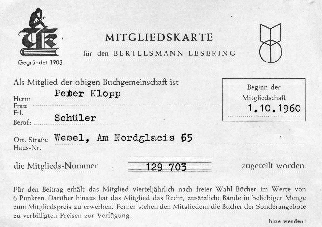
At the end of one of my shifts a young aggressive salesman, who had been standing outside the store, cornered me on my way home and bombarded me with an endless stream of words extolling the advantages of becoming a member of the Bertelsmann Book Club. It represented one of the largest publishing houses in Germany, the young man asserted. Eager to get home and totally unaware of the financial consequences, I signed on the dotted line of the contract. As long as we lived in Wesel Aunt Mieze (Marie Kegler) paid the quarterly membership fee. She assumed correctly that if I was going to do a lot more reading as a result of this commitment, it would help improve my language skills not only in the remaining school years, but would hopefully create an appreciation of good literature.

Membership Card for the Bertelsmann Book Club

Membership Card – Bertelsmann Book Club

In the meantime my boss had been informed by the safety board that it was illegal to have an electrician’s helper at my age working on a construction site. Apparently it had to do with laws governing safety and liability issues. However, he kept me in his employ at the store, even though there was absolutely nothing for me to do. For most of the day I hung around in the store, where pop music from the latest stereo equipment attracted a lot of potential customers, mostly women deeply touched by the sentimental love songs in vogue in those days. Occasionally I ran an errant for the people working in the repair and service department. During those days I discovered that working life is boring if one does not have anything meaningful to do.

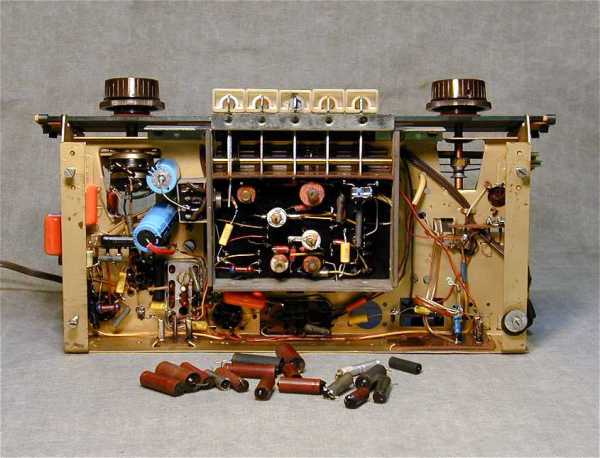
Old Radio with Valuable Parts for Peter's Hobby - Photo Credit: antiqueradio.org

Old Radio with Valuable Parts for Peter’s Hobby – Photo Credit: antiqueradio.org

One day I saw a short piece of solder on the floor. No cow was attached to it like in Rainer’s birthday speech. I put it in my pocket thinking it might come in handy when working on my electronic projects at home. A few minutes later one of the technicians, who had watched me pick it up, reported the incident to the boss. It is quite possible that my employer was truly outraged over my pilfering or perhaps it provided the perfect pretext to let me go from a place where I had outlived my usefulness. Whatever it was that made him fire me, something good came out of it. It created a moral sensitivity in me with regard to theft. No matter how small, petty, insignificant an item seems to be, whether it is piece of solder or a pen belonging to an office, in the realm of absolutes there are no gray areas. Theft is theft.

Chapter XV of the P. and G. Klopp Story – Part II

My Twentieth Birthday Celebration

558606-960x720-grillagetorte

In contrast to the war games my birthday parties with Hans, Klaus and Rainer took place in a rather amicable atmosphere. Mother, who liked my friends very much, was very supportive and ensured that we boys would have fun in celebrating my special day. She even contributed a bottle of fine Mosel wine. Since each guest also brought a bottle, Mother hid them and mad sure that only one bottle at a time would be on the living room table. She did this to alleviate my aunt’s concern over our overindulgence in alcoholic beverages. Before the actual party began, Mother and Aunt Mieze joined us for coffee and cake. All eyes were fixed on the main object of attraction, a visual feast, which made our mouth water in delightful anticipation. Mother had known my preference for the same cake during the past four years and had done it again for my 20th birthday. In the middle of the table she had placed the beloved Grillagetorte, which she had ordered from the local bakery and pastry shop. As soon as you mention this cake outside the Lower Rhineland, you encounter blank faces, because nobody seems to have heard of it. But for decades the Grillagetorte had been the center of many traditional coffee parties and the focus of family get-together and festive days. The cake is the product of high-level pastry making, a pastry composition made from half-frozen cream and meringue. This was heavenly cake for us. It had a fresh and crisp taste, crunchy and rich with its layers of cream and pastry, in short it was fit for the celebration of the first twenty years of my life. How much we enjoyed the feast can only be measured by what little was left over on our plates, which looked as if we had licked them clean. Mother and Aunt Mieze now withdrew to the kitchen so that the all-boys party could begin. We opened the first bottle of wine, filled our glasses to the rim and said cheers.

11a

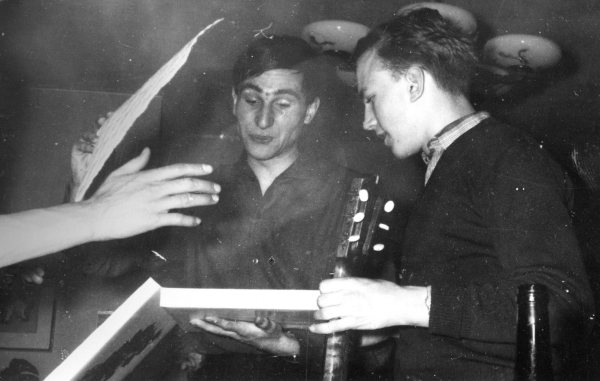
It’s Time to Hand out the Sweets – Hans Holding his Guitar on the Right

It was the tacit understanding that each guest would have to make a presentation worthy of the occasion. Rainer took on the role of a nonagenarian and delivered a comical review of his long life in a slapstick mix of prose and poetry, which, because I remember it so well, I will attempt to translate into English.

9a

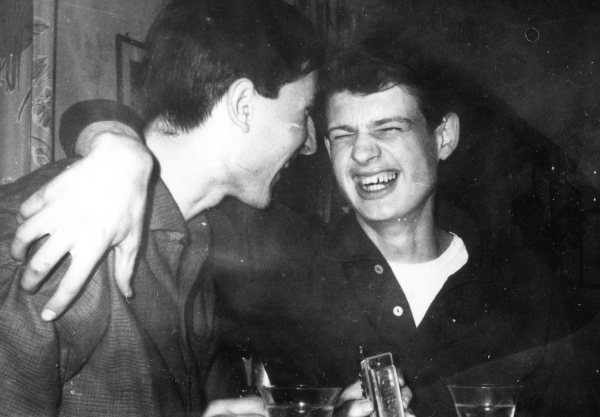
Rainer and the Birthday Child Having a Fun Time with Song and Drink

“Today I am celebrating my 90th birthday. I don’t feel that old yet, but I always say, what is gone, is gone. When I was born, there was nobody at home. On the table lay a note that said, ‘The milk is in the oven’. My mother’s maiden name was Federal Railway, for that name was written on our towels. We did not have a clock. When the chamber pot was full it was six o’clock in the morning. But when my father had gone boozing, the pot was running three hours fast. When I was six years old, I went to a special needs school. What my special needs were, I still don’t know to this day. The teacher was quite dumb and asked a lot of questions. One day he asked one student, ‘What do you know about the ancient Romans?’ The student answered correctly, ‘They are all dead.’ Then it was my turn, ‘What do you know about the ancient Wends (a Germanic tribe that sounds like walls in German)?’ I answered, ‘The plaster keeps falling off from them.’ He must have liked my answer, for he pressed his hand into my face. After I had completed my education, I started to work in a photo shop. There I could not develop, because my boss was constantly fixing me. One day a woman came into the shop and asked me to enlarge her family. I told her to kindly go to the man who had started it all. Each time I opened the cash register I got a cramp in my fingers. My boss did not like it and I was voluntarily forced to leave. Then I went on a long journey with my older brother. All the things he found, other people hadn’t even lost yet. One day we found a rope with a cow attached to it. The judge would not believe that we just wanted the rope and he gave us three years of free board and room. During that time I discovered my poetic talents and wrote a number of fine poems, one of which I would like to share with you now.

‘Ein Stinktier saß auf einer Bank und stank.

Es hatte keine Eile, es stank aus langer Weile.

Und als die Sonne war versunken,

da hat das Stinktier immer noch gestunken.’


Roughly translated into English, it reads like this:

‘A skunk sat on a bench and stank.

Away it wouldn’t scurry.

It wasn’t in a big hurry.

And when the sun had finally sunk

The skunk on the bench still had stunk.

The translation provides a little bit the flavor of the story, which was very well received by the entire gang and cheered with another glass of wine from a new bottle of slightly inferior quality. Hans for his contribution played three pieces of classical guitar music composed by Sor, Carulli, and Albinoni. This was truly a feast for our ears, even for Rainer not accustomed to this musical genre. Hans, an absolute genius in so many fields of endeavor and autodidact in the fine art of playing the guitar, performed later in his university years on his simple six-string so expertly that a wealthy aficionado gave him as a gift the best classical guitar money could buy. What amazed then and still amazes me today is how a single instrument can sound as if there were three: one for the melody, another for the accompaniment, and a third for the rhythm provided by the tapping of the free remaining fingers on the hollow body of the guitar.

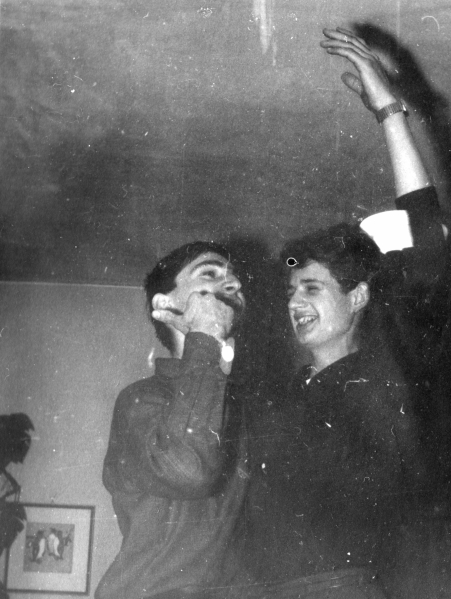
Rainer and Peter Singing a Duette

Rainer and Peter Singing a Duette of our Opera

Mother brought another bottle with a happy smile as if she was reminiscing about the good, old days in Gutfelde, where liquor also flowed in abundance to serve as a social lubricant. Then Klaus, apparently ill prepared, suggested that we all produced a totally improvised opera with the lofty theme of an emperor going to the bathroom. By this time we had imbibed so much wine that we most enthusiastically accepted the challenge to do a mini-opera without an orchestra guiding us from scene to scene except for Hans’ intermittent strumming on the guitar. We sang solos, duets, every possible combination of roles and characters describing graphically in a down-to-earth language the emperor’s pains and troubles on the toilet seat. As it was also loaded with words that would never surface in a properly written school essay, I will spare the reader any further details of our otherwise artfully created opera.

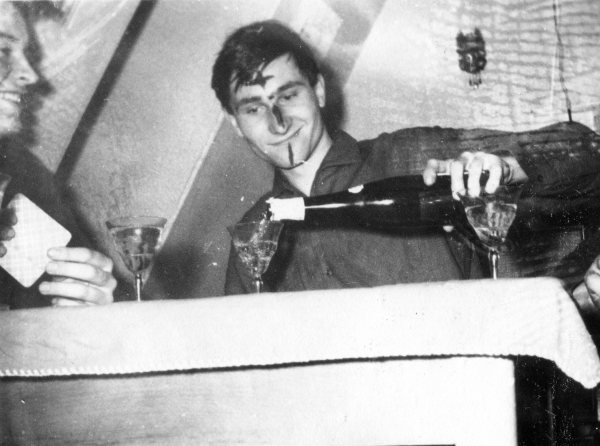
Peter Pouring another Glass of Wine

Peter Pouring a Glass of Wine to Celebrate another Black Poker Mark

After we had emptied the third bottle and our cheerfulness had turned into a cacophony of uninhibited song, fragments of classical music, and pop music from the radio, we transferred our party to my room at the opposite end of the apartment as not to disturb the elderly tenants below. With wine being consumed more in gulps than in sips, the level of our inebriation had reached its climax. We played a round of strip poker, in which for each lost game the player had to surrender one piece of clothing on his upper body and be marked with a black cross from a chunk of charcoal. Finally it was time for my friends to go home. I guided them down the two flights of the creaky wooden staircase making sure that nobody would fall over their wobbly legs and also would not make a racket that would incur the wrath of the landlady. She had once asked me rather innocently how I liked the new apartment. Not expecting any guile, I naively replied, “Oh, I love the new place very much.” Then in a threatening tone she retorted, “Then make sure that you will keep it!”

Chapter XV of the P. and G. Klopp Story – Part 1

Chess, War Games and Birthday Parties

“When you see a good move, look for a better one”
Emanuel Lasker

Since Father had taught me to play chess, the royal game, as he called it, I took every opportunity to challenge my friends and classmates to hone my thinking skills. What I liked about it was that its outcome did not depend on luck. As a matter of fact, the game was for me like a metaphor for life containing all the ingredients necessary for success, such as planning ahead, anticipating good and bad situations, making decisions, keeping a solid grip on your emotions, distinguishing between a real mistake and a bait or trap, being gracious and humble in victory and defeat. The chess literature offers a plethora of anecdotes making fun of the foibles of human nature among chess players, especially among those suffering from an excessive amount of vainglory and self-importance. One character can be added to this list in the following true story.

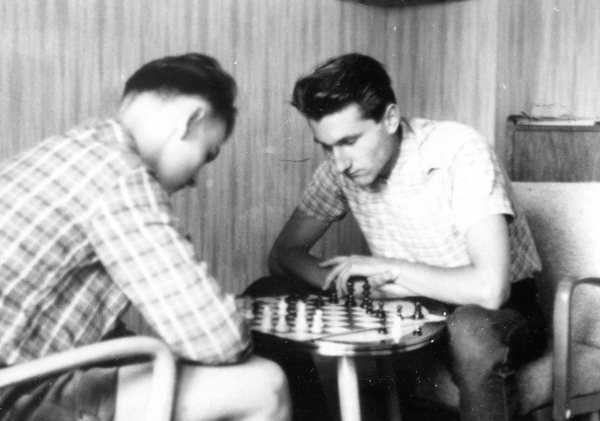
Peter with Spiked Haircut Playing Chess with a Friend

Peter with Spiked Haircut Playing Chess with a Friend

Whether ancient languages, mathematics, physics were the subjects, or playing classical guitar or practically anything else Hans took on, he excelled and was superior to anyone around him during the nine years I happened to know him. Being so good in everything, he could afford to be humble. But when I had beaten him in chess three times in a row, his reaction was definitely not a modest, humble acknowledgement of defeat. He exploded, “I cannot understand how somebody as dumb as you can beat me in chess!” I was so content with my victory over the genius of the Wesel High School that I was not even insulted. Actually I took his disparaging words as a compliment.

Typical Commercial WW2 Board Game - Photo Credit: warplanner.com

Typical Commercial WWII Board Game – Photo Credit: warplanner.com

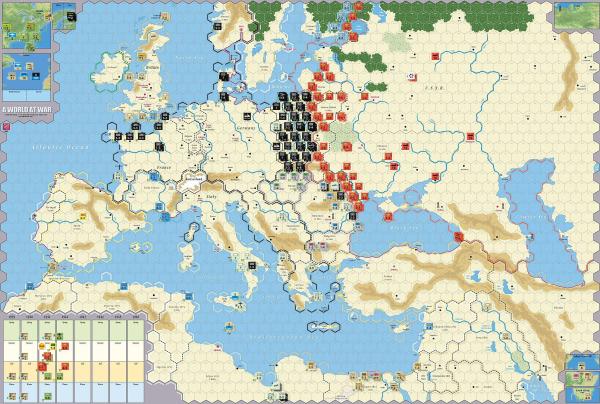
The chessboard is like a miniature battlefield except that the opposing armies are at the beginning identical in position, numbers, and strength. But with trillions of possible moves for the average game of thirty moves and counter-moves, the scales begin to tip in favor of the player who has the superior strategy and avoids making mistakes. Somehow it was this combative game that inspired me to create my own war game for four players. From chess I learned that a good game should not depend on luck, on the roll of dice, or cards pulled randomly from a stack. In the final version that would take three to four hours to play, transport vessels and battle ships, tanks, trucks and soldiers had their own movement and attack properties, very much like pawns, bishops, knights, rooks, queen and king in the chess game. On a large piece of  cardboard I had drawn a giant grid of 600 squares, on which I placed the four countries with their respective capitals around the inner sea in a perfectly symmetrical fashion. The successful occupation of a capital by any enemy piece would be equivalent to checkmate with one particular twist: all the lands, islands, the wealth of resources, war material and money would become immediate property of the player who captured the capital. Reflecting realistically the pattern of conquest throughout the history of mankind, the game had to include precious resources not available at the beginning within the borders of the four countries. Gold, iron, and other vital ores were located on the islands at the center of the ocean. To access any of the islands, the player would have to send his transport ships and occupy them. So war was inevitable. Each player depended on the resources to manufacture weapons or to turn them into money whose value fluctuated with the growth or decline of the island possessions. Add to this the player’s ability to form alliances, to make treaties, or arrange secret deals under the table, and we had an exciting game that was in its simplicity of rules and in complexity of scenarios years ahead of the commercial war games, such as ‘Rommel in the Desert’, ‘Eastern Front’, ‘The Battle of the Bulge’, and many others.

Year End School Party with Classmates

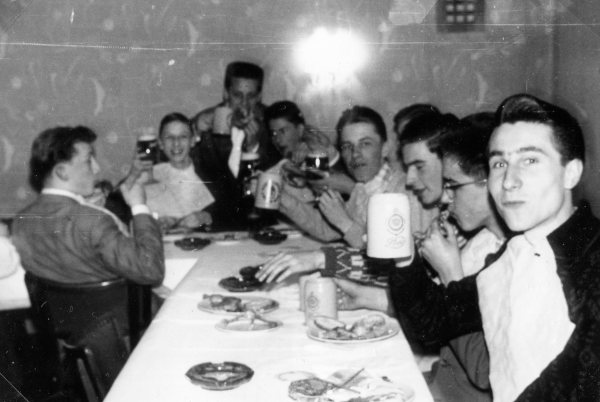
Year End School Party: Peter with raised Stein on the Right

As for me, the inventor of the game, I had the distinct advantage of knowing how to deploy the army and navy units most effectively. So it was no surprise that for most games I emerged victorious either as an ally with a willing partner or daringly going forth all alone. One day I arrived a little late for our weekly war game at Rainer’s place. I immediately sensed that my three friends had come to some sort of agreement to form an alliance against me that was supposed to hold at least until I was defeated and eliminated from the game. I saw my suspicion confirmed, when the two players whose countries were adjacent to mine almost immediately prepared an attack with their ground troops at the two borders, while the third player was directing his naval fleet towards my favorite island amounting to a declaration of war. It was plain to see that Hans, Rainer and Klaus had prearranged this maneuver, because the ships were loaded to their maximum carrying capacity with tanks and trucks, while the borders remained virtually unprotected. Never before had I been in such a precarious scenario, in which I had been outnumbered three to one in a war against all three playing partners. Once the enemy forces would have occupied the islands and cheap production of more war material would have begun, the odds would even be worse. I had to act swiftly and decisively. I suspected that Hans had devised this Machiavellian scheme, since in the past he had always been at the losing end of the stick. Although he amassed his troops at my border, he merely engaged in minor skirmishes. He was obviously hoping that the major battles would be fought by his allies who near the end would be so worn-out that all he would have to do was to let his units undiminished in strength and number march into the poorly defended capitals and taste effortlessly the sweet glory of victory. To his dismay I concentrated most of my forces at his border and forced him into battle. While his allies were making good progress facing only token resistance at land and at sea, Hans suffered heavy losses against an experienced general and began to grumble against his allies. When I cheerfully encouraged Rainer to capture my undefended capital, he was convinced that he had been double-crossed. Although their unexpected success was due to my strategy, he called them traitors and hurled undeserved and unmentionable expletives at their faces. No longer able to control his temper he swept the playing pieces off the game board. Thus, I managed to escape the humiliation of certain defeat at the hands of my three friends and enjoyed the honor of the details of this particular game being discussed by my friends for a long time afterwards.

Happy Times: Class on a Hiking Field Trip

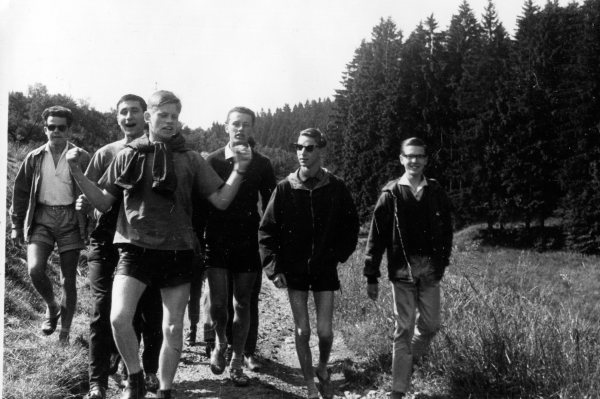
Rare Happy School Moments: Class on a Hiking Field Trip

Chapter XIV of the P. and G. Klopp Story – Part 6

Brandenburg Gate - Photo Credit: rosch.homepage.eu

Brandenburg Gate with Wall in front – Photo Credit: rosch.homepage.eu

Paralyzed by Fear

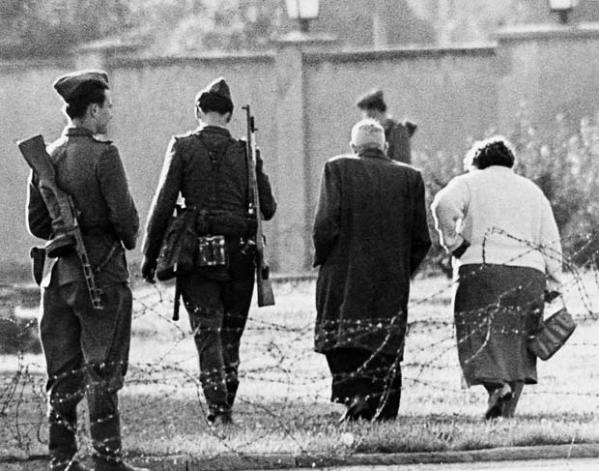
On my way back to the youth hostel I sat apprehensively in the city train that used to run unimpededly across the border, but now would stop at a new terminal a short distance from the nearest checkpoint. I had hoped to immerse myself into the anonymity of a large commuter crowd. But there were only a few passengers and at each stop more and more people stepped off the train, until I was almost by myself. I looked at my watch. In less than half an hour I would be at the border checkpoint. I was just beginning to relax a little, when a young man stepped into my compartment. He sat down on the bench opposite mine, and recognizing me by my clothes as a Westerner immediately addressed me and compelled me to listen to his story. In a torrent of words he seemed to have broken the dam of pain, anger and frustration deep within his troubled mind. He apparently was totally oblivious to the fact that a spy might be listening in and denounce him to the authorities. The more boldly he spoke, the more fearfully I listened. Enthralled by his tale and unable to move from my seat, I felt like the wedding guest in Coleridge’s poem ‘The Rime of the Ancient Mariner’.

“He holds him with his glittering eye –

The wedding guest stood still,

And listened like a three-years’ child.

The mariner hath his will.”

“Last year,” the young began his story, “I was just finishing my apprenticeship program. Many friends and family members had already fled to the West. There were rumors that the inner city border would be closed soon. Every week many people, first by the hundreds, then by the thousands, escaped to start a new life in freedom. Then my girlfriend also left with her entire family just one week before they built this horrible wall.” The young man was now sobbing and screaming.

British Soldier on Guard - Photo Credit: www.telegraph.co.uk

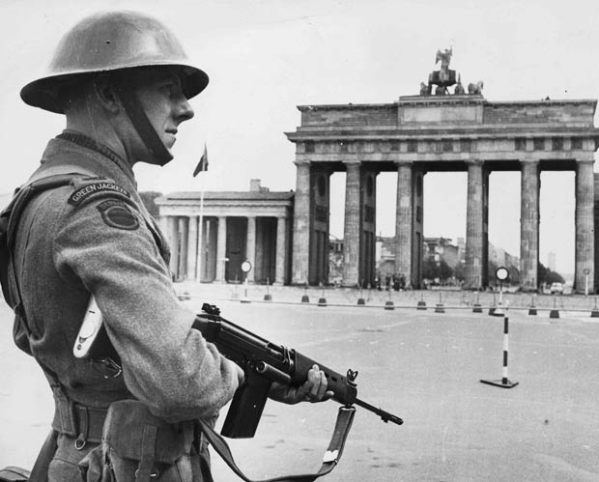
British Soldier on Guard during a Crisis – Photo Credit: telegraph.co.uk

“To get a good start with a completed journeyman ticket, I promised her that I would follow her as soon as I had passed my exam. How stupid I was in trying to be responsible. Over a better job I lost my love. I will never see her again. Like all the others her family is on the black list. She would be arrested and thrown into prison, if she tried to see me.” He was venting his anger and frustration so loudly that everyone left on the train could hear, but pretended not to.

This Couple Failed to Escape - Photo Credit: telegraph.co.uk

This Couple Failed to Escape – Photo Credit: telegraph.co.uk

“We live in one giant prison here! No, we live like animals in a zoo. Westerners may come and gawk. I feel like a monkey behind bars, when I look from my apartment window over the wall into West Berlin, where people are free to move about as they please. My girlfriend is out there somewhere. She cannot even write a letter for fear to land me in prison as someone befriending a traitor of socialism. Oh, how I loathe that ugly word!”

Checkpoint Charlie Border Crossing; Photo Credit: gonback.com

Checkpoint Charlie Border Crossing; Photo Credit: gonback.com

Suddenly the apprentice grew very quiet. He had unburdened himself by boldly telling his story. I knew that there was nothing I could do for him. How to give hope, when there is no hope, or how to offer a comforting word, when you cannot find it within yourself? A comment no matter how carefully chosen would have added insult to injury. It was good that I remained silent and listened to what he had to say. But to find the right words to show compassion to my fellow human beings had never been my forte and remains a problem to this very day. Without saying another word, the young man got off the train on the second last station. Five more minutes and I would be at the terminal.

I sat there on my bench all alone. Indeed the entire train car was empty now. The emptiness began to oppress me. I felt ashamed of having been so afraid. The apprentice from East Berlin was not. I began to realize that there was another kind of freedom that came from within independent of where one happens to live. But the realization of the converse hit me even harder. One could live in the best society – if there ever was one – with all the rights and privileges enshrined in its constitution and still be a slave to fear.

Gathering Strength Through Inner Calm

Within the next thirty minutes I had to deal with fear all over again. The guard on duty at the border checkpoint carefully examined my passport and was just about ready to check off my name from the list, when he asked for my camera, which I had left behind at my relatives. Under normal circumstances this would not have been a big deal. I could have given the camera as a gift to my aunt, lost it on the train, or gotten rid of it in myriads of other ways. But this was not considered normal. The guard asked me to follow him into the drab border building, where he made me enter a small office room, and then quickly left closing the door behind him. Sitting on a chair opposite a giant empty desk I felt trapped. I had the feeling, as if I was being watched for my reaction through hidden cameras. But to my surprise, a great calm pervaded my inner being. I had done nothing wrong, I had simply visited my relatives with official permission, had left a camera behind, which was not a crime, but a trivial oversight. After a five-minute wait a security officer neither friendly nor unfriendly entered the room and said without making any reference to the missing camera that he was going to ask me a few questions. Even though he made me feel that the whole process was a mere formality, it appeared to me like a full-fledged interrogation. There was nothing to hide. To all his questions about myself, my family, relatives in East and West Germany I gave prompt answers without showing any signs of nervousness. After being convinced that I was not a spy, he finally turned his attention to the camera. If it had not been recorded on the inventory list, there would not have been any problems. But since it was, I would have to go back, pick up the camera at my aunt’s place and show it to him, before his shift would end be at midnight. I said that this would be quite impossible for me to do considering that the youth hostel closes its gate at 11 o’clock, that I would be locked out, and that the teacher would report me as a missing person. To make a long story short, the officer showed some human understanding for my case behind the mask of his stern face and let me go under the condition that I would have to return during his shift on the very next day. If I did not comply and did not show him the camera, my relatives would be in serious trouble. Whether there was a bit of humanity shining through or whether it was even the fear for having broken some rules, I could not say. Perhaps it was a mixture of both.

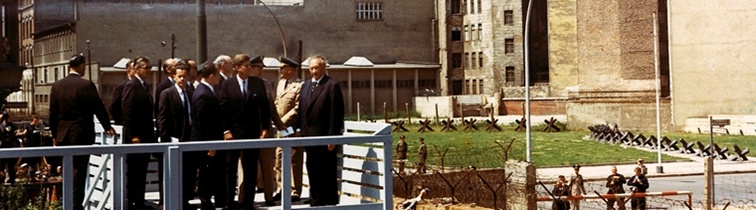
President Kennedy at the Berlin Wall - Photo Credit: jfklibrary.org

President Kennedy at the Berlin Wall (June 1963)- Photo Credit: jfklibrary.org

Chapter XIV of the P. and G. Klopp Story – Part 5

School Visit of the Berlin Wall (1961)

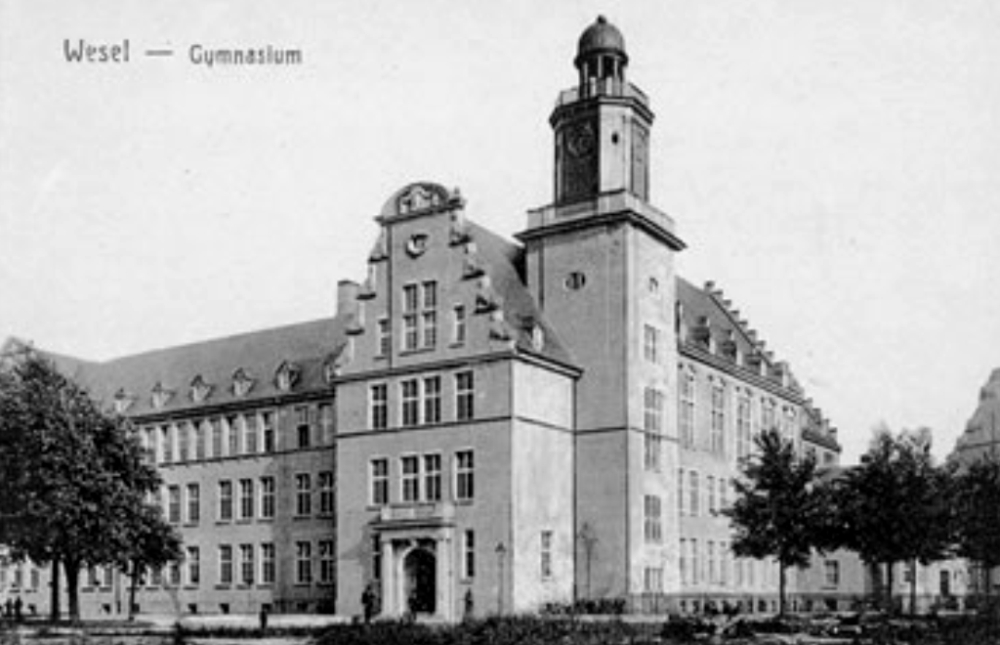
Our High School in Wesel built in 1912 - Now Court House Building

Our Former High School in Wesel built in 1912 – Now Court House Building

It is not surprising that the Wesel High School amongst many other schools in North Rhine-Westphalia organized, one year before our graduation, a field trip to the capital of Germany to provide the students with first-hand experience of the wall that was going to separate Germans from Germans for almost 30 years. The day after our class had participated in a guided tour of a small section of the wall, the teacher in charge of our group granted me permission to go see my relatives in East Berlin. Mr. Zorn with the Latin nickname Ira was personally responsible for our safety. I often wondered how he could have allowed me to cross the border on my own with all the horror stories circulating in the daily newspapers about harassments, arrests, even disappearances of people from West Germany. At the checkpoint I had to list all my personal belongings. I had nothing to declare except my cheap DM 20.00 camera.

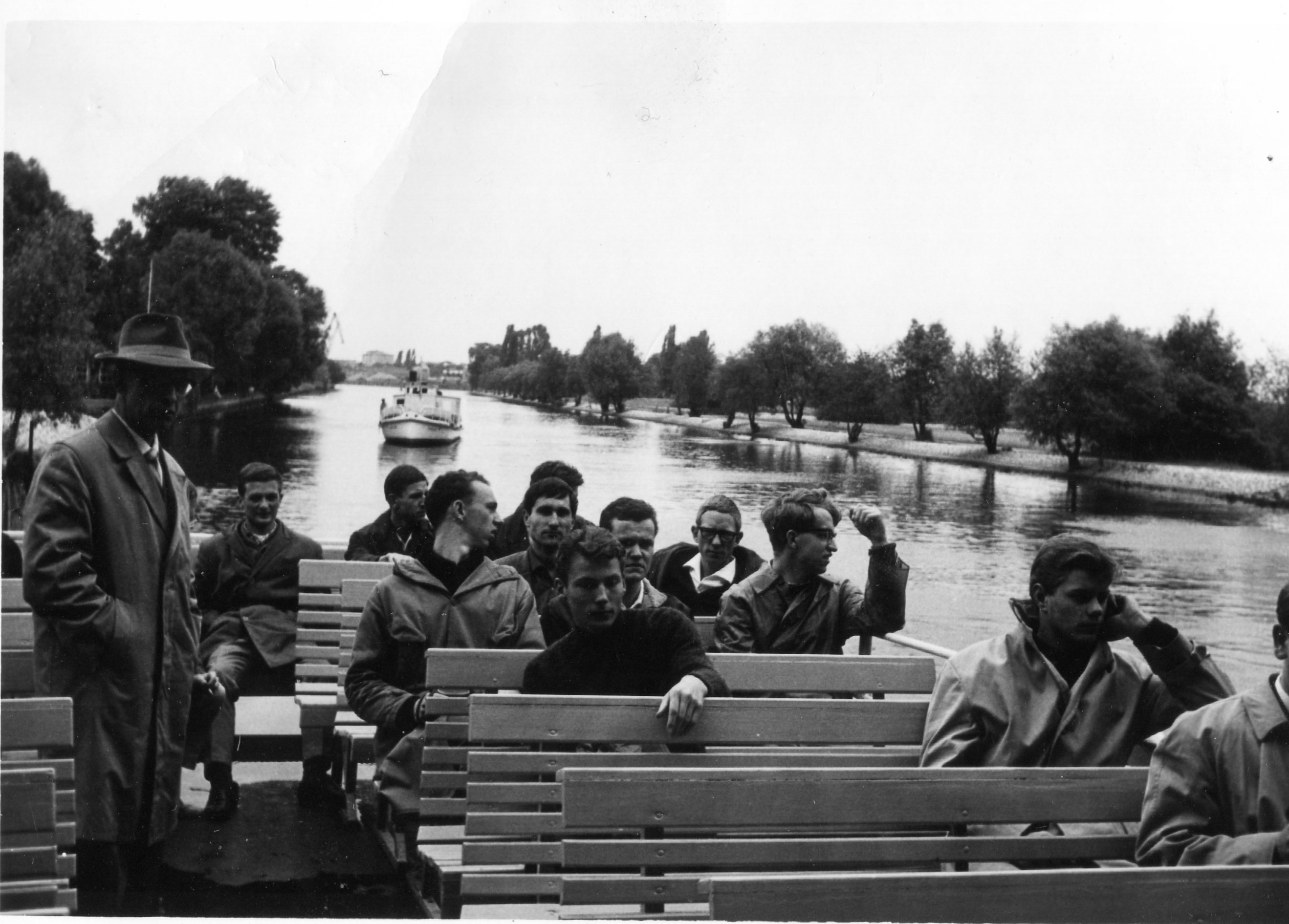
Boat Ride in Berlin

Boat Ride in Berlin – Peter on the Second Last Bench on the Far Left

Again I enjoyed a most pleasant visit with Aunt Alma and her family. I cannot recall having announced my coming, but I must have sent them a card, because the whole family had assembled in the living room, when I arrived at their door. Uncle Artur with his biting sarcasm softened only by a disarming sense of humor was again, as on my previous visit, at his best poking fun at the political system in general, but especially at the wall very much to the chagrin of his party-loyal sons-in-law. He asked whether I knew why there were so many round holes in the wall. When I shook my head, he answered the question for me, “To let off the cabbage steam.” Now this riddle makes only sense in English if one knows that cabbage steam (Kohldampf) was a euphemism for ravenous hunger.

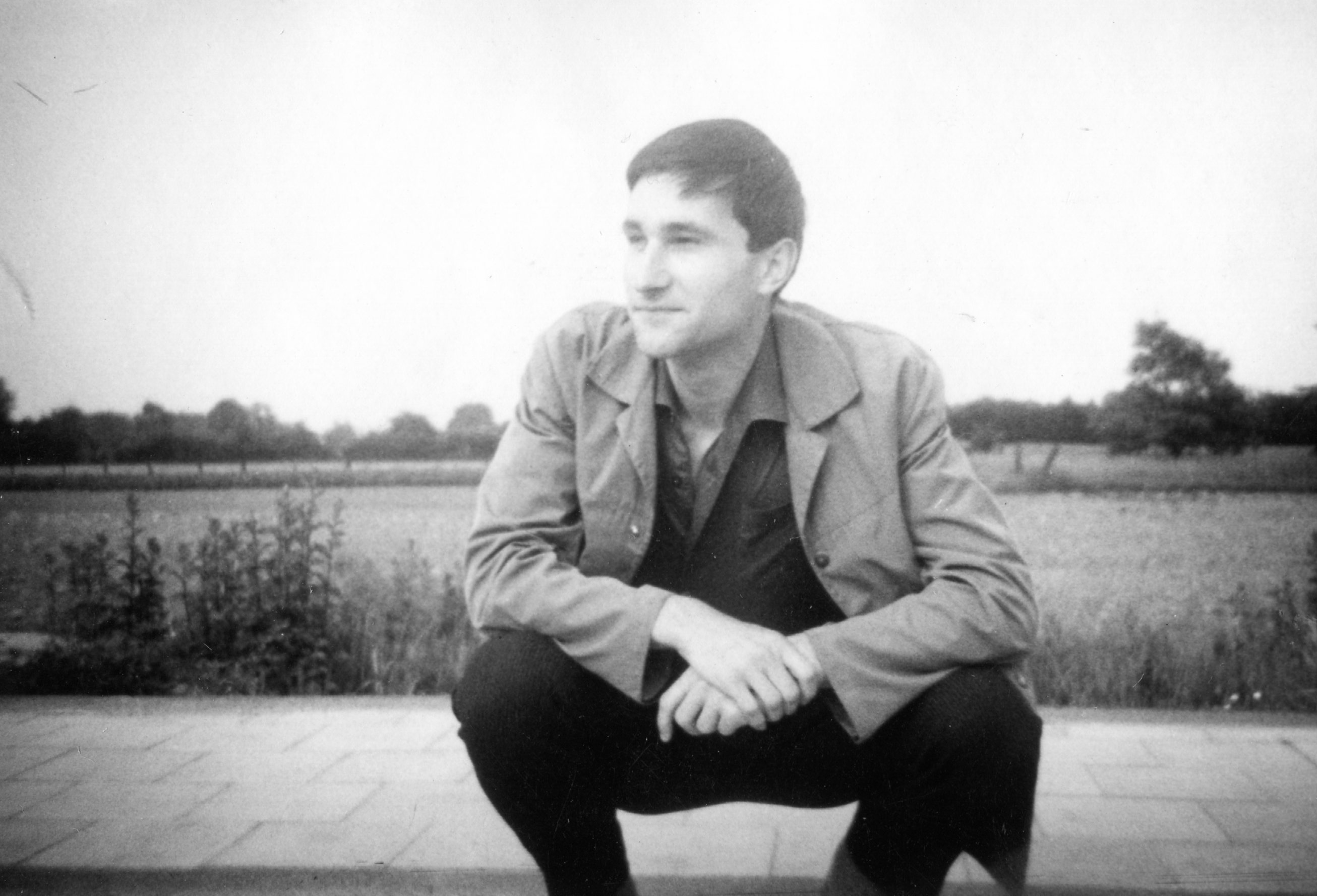
Peter Klopp at Age 19

Peter Klopp at Age 19

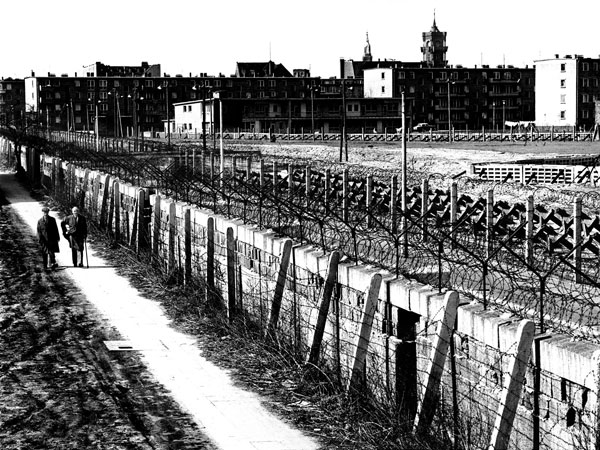
Now the sons-in-law had their turn to inform me from their perspective the raison d’être for the wall. It was built, so they insisted, to protect the citizens of the GDR from the attacks of the Western imperialists. Surely I must have seen the tank traps and the barbed wire in front of the wall facing west. They would serve as the first line of defense. If they were intended to keep people from leaving their socialist country, they would have been set up behind the wall. I remained unimpressed. Their fervor for the system showed me that they had pulled blindfolds over their eyes. They believed what they wanted to believe on the principle that you do not slap the hand that feeds you. With Uncle Artur`s help the family finally steered away from the political hogwash and focused on their guest.

Berlin Wall - Photo Credit: hstrclgrl.blogspot.ca

Berlin Wall – Photo Credit: hstrclgrl.blogspot.ca

When I told them about my trips to Spain and Yugoslavia I indirectly conveyed to them the kind of freedom I enjoyed on the other side of the Wall. Also I enthusiastically talked about my career plans, namely to study high frequency technology. Uncle Artur, a leading scientist in a related field, a son-in-law already involved with electronics in the NVA (National People’s Army), Anje, the second youngest daughter also planning to become an electronics engineer, we all warmed up to this refreshingly apolitical topic with Aunt Alma cheerfully chiming in, “Wouldn’t it be nice, if Peter and Anje could study together in the exciting world of electronics!” With this comment Aunt Alma more concerned about good family relations than about politics made a profound statement about the tragedy of a divided Germany.