Our Son Richard and Granddaughters Azure and Emeline

Day 3

Today Richard was very tired. Last night after he had settled down Azure and Emeline and got them to sleep, he sat down at his laptop to do some important work for his college in Montreal. This morning he went down to the lake to provide some strenuous exercise for his kids. As it turned, when they came back, he was very tired and his daughters were not. He had hoped that the little ones would have a long afternoon nap to give him a chance to recover.

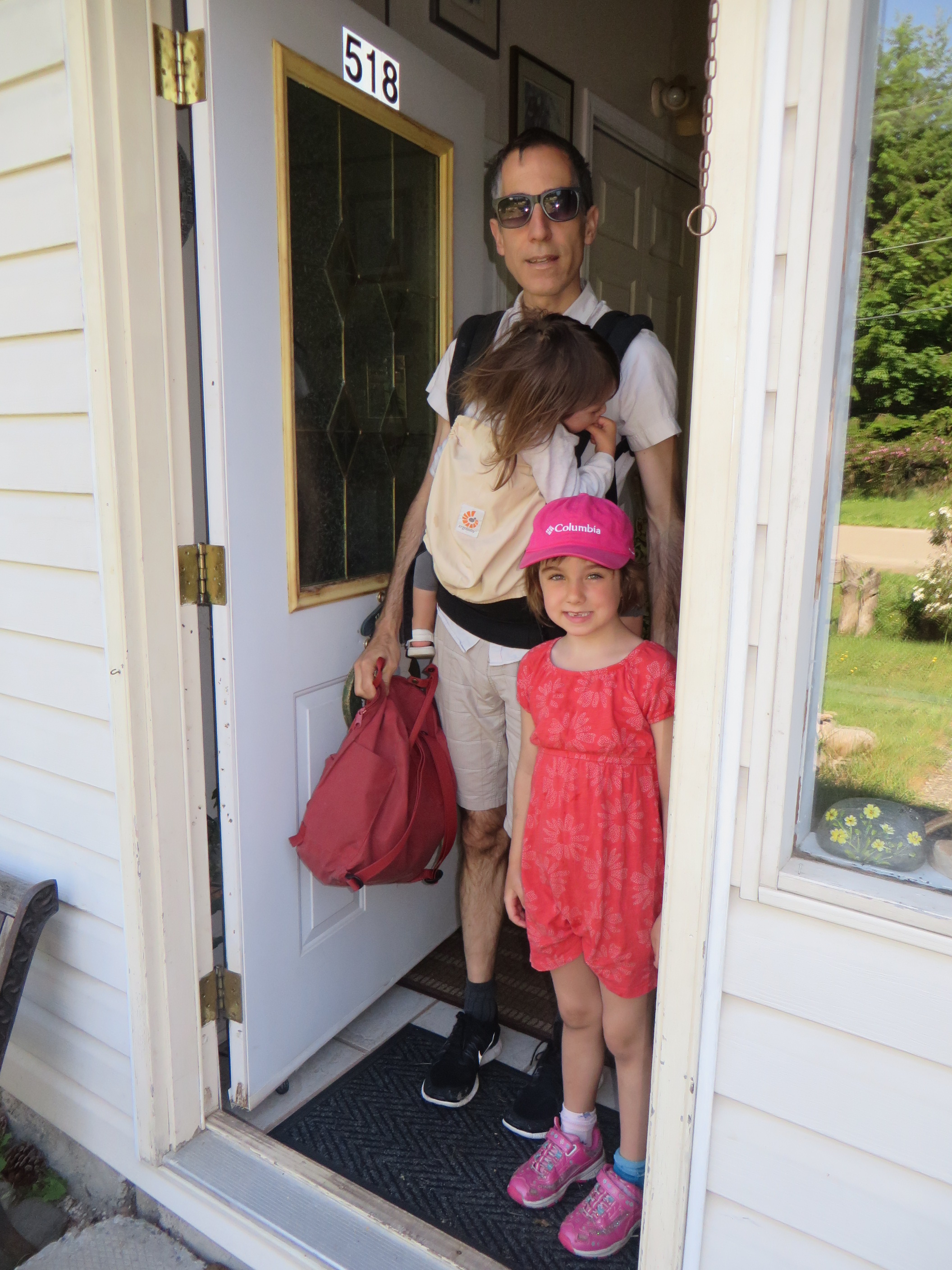
Richard, Azure and Emeline ready to go to the Fauquier Boar Dock

Richard, Azure and Emeline ready to go to the Fauquier Boat Dock

While I was napping in the front room, I heard some noises coming from the living room, which were getting louder by the minute. I concluded that Papa had fallen asleep and the girls had slipped out and were beginning to make their presence known by playing the toy piano. So I decided to interrupt my precious nap time and supervise the little ones, while Richard was sleeping. I turned out to be quite a bit of fun watching them dance and pose for me for quite a few nice pictures. Besides I learned quite a few new French words that Azure taught me while we were playing.

Whatever else of importance is going to happen today, I will publish it in tomorrow’s post.

Our son Richard and Granddaughters Azure and Emeline

Day 1

The day started out with a bacon and eggs breakfast that my granddaughters had specifically requested that I would prepare for them. Biene had to go off to work at eight, while we continued eating our breakfast in stages. Then I had an excellent learning session with Azure, who became my student and teacher in French. While Richard took Azure and Emeline to the lake, I cleaned up. Biene had prepared a large pot of vegetable soup, which I heated up for lunch. When Biene returned from work at three o’clock, I had a big pot of coffee ready, while Biene served her home-made chocolate ice cream. Emeline enjoyed hers very much, as it is clearly written all over her face on some of the pictures below.

Chapter XI of the P. and G. Klopp Story – Part III

Tinkering with Radios – Early Learning in Electronics

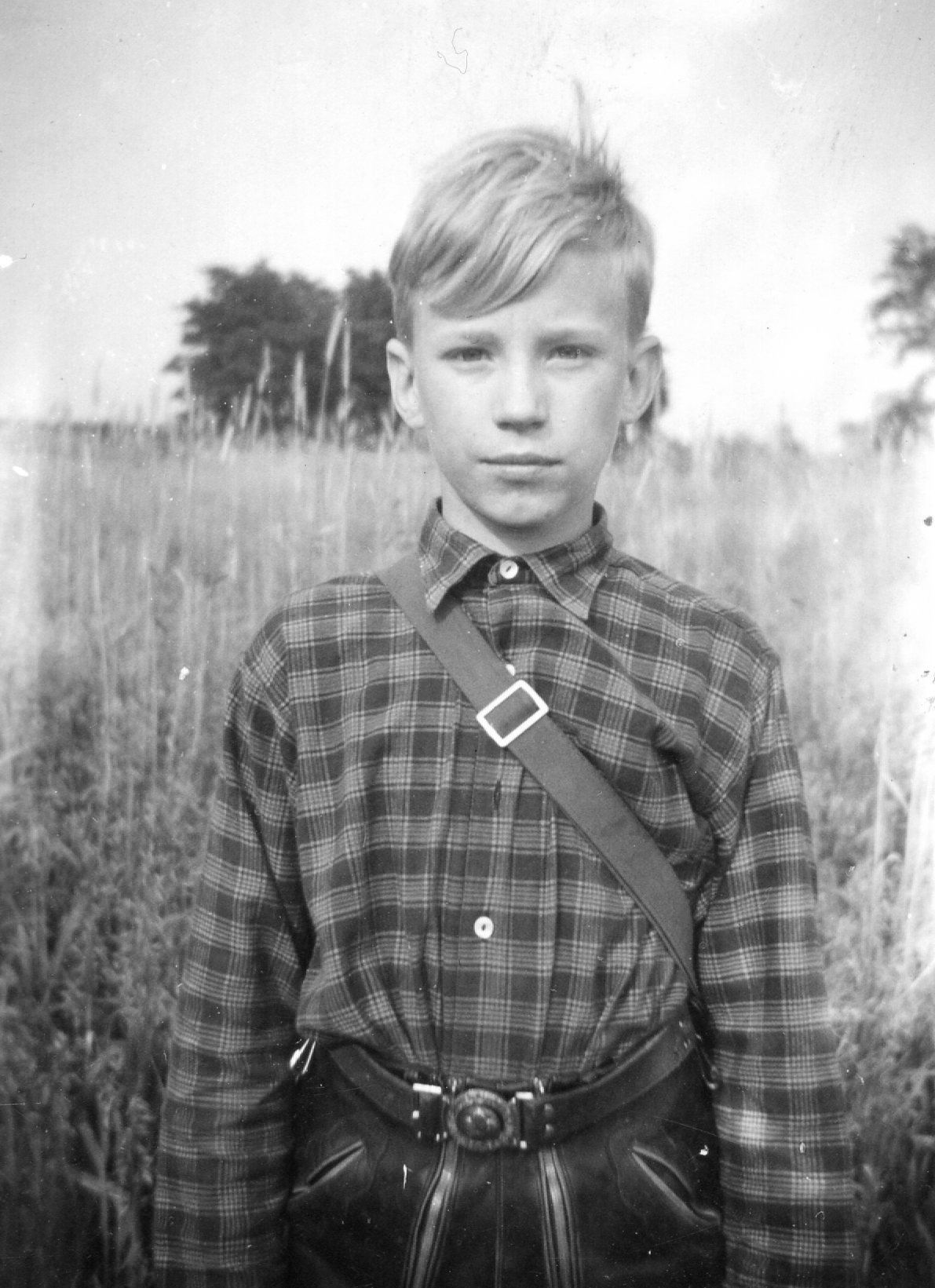
One of the ‘little piglets’ from our schoolyard games was Hans. He belonged to the so-called Ancient Language branch of the high school program with ancient Greek and Hebrew in addition to Latin as part of the prescribed curriculum. He was one of my closest friends. He excelled in every subject and later on graduated with the highest average mark the school had not seen for many years. In contrast to the rest of us he did not have to work in order to achieve such fame and glory. Barely an hour after school while I was still laboring over a math problem or hastily finishing a Latin translation, Hans stood two stories below on the sidewalk and whistled our secret code tune by which we recognized each others’ presence. He held an electronic kit under his arm and waited to be let into the apartment building. By this arrangement he did not have to ring the bell and disturb Mother in her sacred afternoon nap.

Hans

Hans

We spread out all the electronic parts needed for the next experiment on the kitchen table, studied and discussed the instructions in the voluminous manual, and then went ahead with the experiment of the day. After several weeks we have come to the last and most demanding project in the kit, the building of our first radio. Unlike today’s kits with their ready-made plug-in parts, ours was primitive. We had to wind our own coils on cardboard spools, which we procured from the empty rolls of toilet paper. We scraped the lacquer off the copper wire to make the ends conductive. But most challenging of all was the endless tinkering with the crystal that served as a diode that even then would have been available in electronic hobby shops in the big cities for as little as a dime. To make a long story short, we never got the radio to work no matter how hard we tried. But what we gained instead was far more valuable, a meaningful friendship and companionship that lasted until we lost track of each other when I immigrated to Canada. As for me, I had just added another fascinating hobby that engendered a passion for the world of electronics, a field that on a number of occasions promoted personal and professional growth and almost became a life-long career and had certainly – no maybe in this case – an all important impact on the direction that the trail of my personal life would take me.

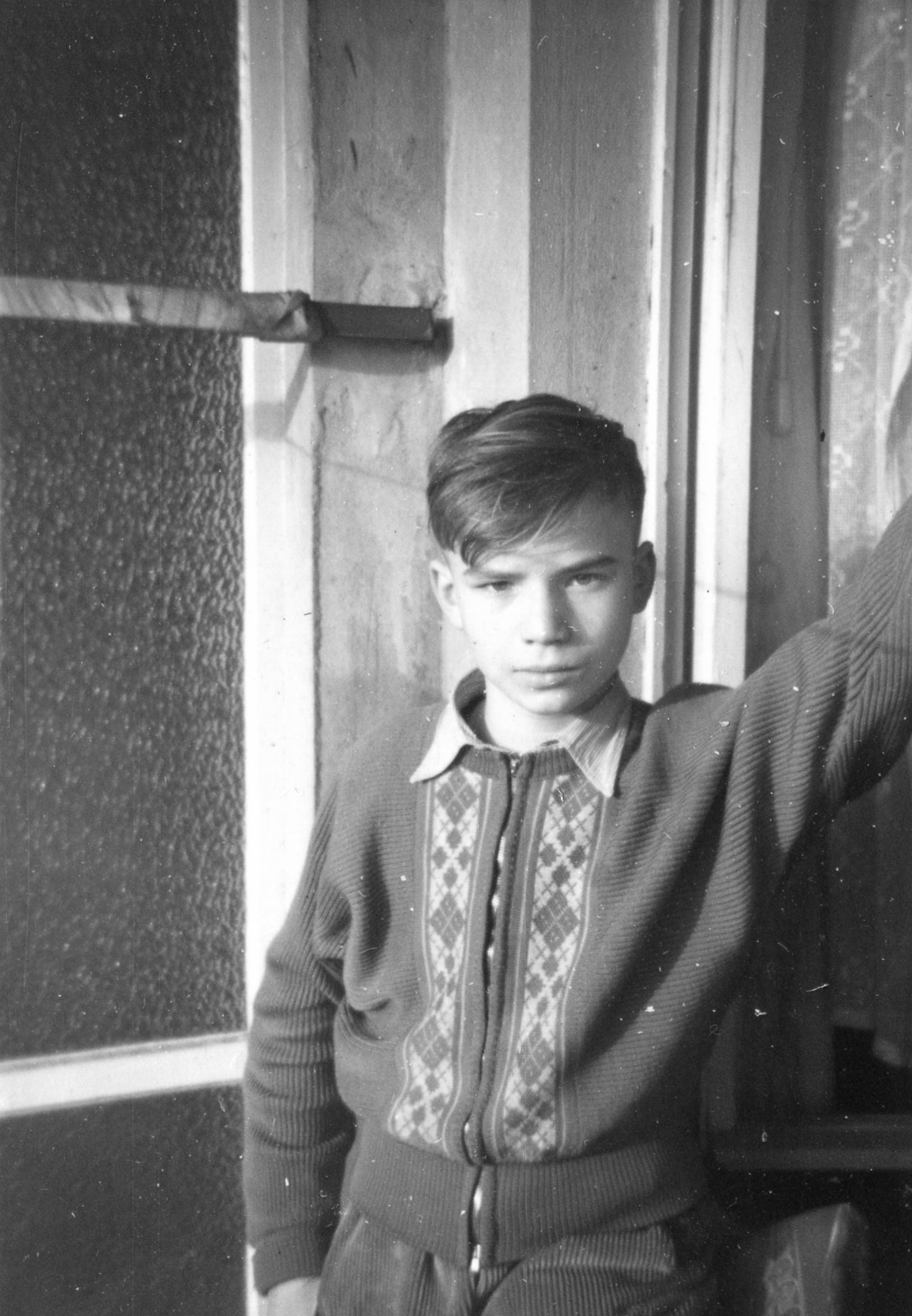
Hartmut on our Balcony

Hartmut on our Balcony

Quite early into my adolescent years Mother and Aunt Mieze decided to pay me a monthly allowance the equivalent of about ten dollars in today’s buying power. The purpose of this generous plan was to teach me to handle money in a responsible manner. Indeed I quickly learned to save money only for more valuable items rather than to spend them on candies and ice cream. Typically my first purchases were books on electronic circuits and theory. Then I spent a few marks on discarded unrepairable radios, which the local radio and TV stores wanted to get rid of. It did not take me very long to have in my possession one of the fancier American models, which even had a so-called magic eye indicating the strength of the tuned-in radio station. Aunt Mieze, always prim and proper with rules and regulations, promptly registered the radio, which with a little bit of tinkering was working very well. She paid the monthly fee at the Post Office, at the time in charge of licensing the use of radio and television reception. Unfortunately, only a few weeks later, she had to cancel the subscription, because of the ‘improvements’ I had made to the radio. After another debacle resulting from obsessive tinkering, Aunt Mieze had enough and bought a very fine Grundig radio with FM, which was placed safely out of my reach in her room. One day a promotional LP from a record company arrived in the mail. Of course, now I had to have a record player. I pestered the three electronic store owners in town, until one of them let me have an old broken-down record player without amplifier and loudspeaker. I played the record and listened to the faint, but quite audible sound of the Hallelujah Chorus from Händel’s Messiah. To make the music louder I took an empty open cocoa can, attached a record needle near the bottom and the entire contraption to the take-up arm of the record player. The sound of the classical music was now considerably louder, but also tinny and unpleasant to listen to. So this prompted me to build my own amplifier complete with volume control from the leftover parts of all my ‘improvement’ projects. My friend Hartmut was impressed, except that he did not like the Hallelujah Chorus, with which I greeted him each time he dropped in to borrow some money to go to the movies.

Chapter IX of the P. and G. Klopp Story – Part II

Progress at School with Father’s Help

Our school and its yard was surrounded by a brick wall about two meters high and looked more like a prison than a place of learning. The huge iron gate would open fifteen minutes before school started. At eight o’clock sharp the janitor locked the gate and any late student would have to ring the bell at the main entrance, over which was chiseled in stone ‘NON SCHOLAE SED VITAE’ (NOT FOR SCHOOL BUT FOR LIFE). The janitor would then take the delinquent scholar to the vice-principal’s office, where he had to explain the reason for his tardiness. After a severe dressing down and reprimand, he would receive a slip of paper signed and stamped which allowed him to enter his classroom.

15flip

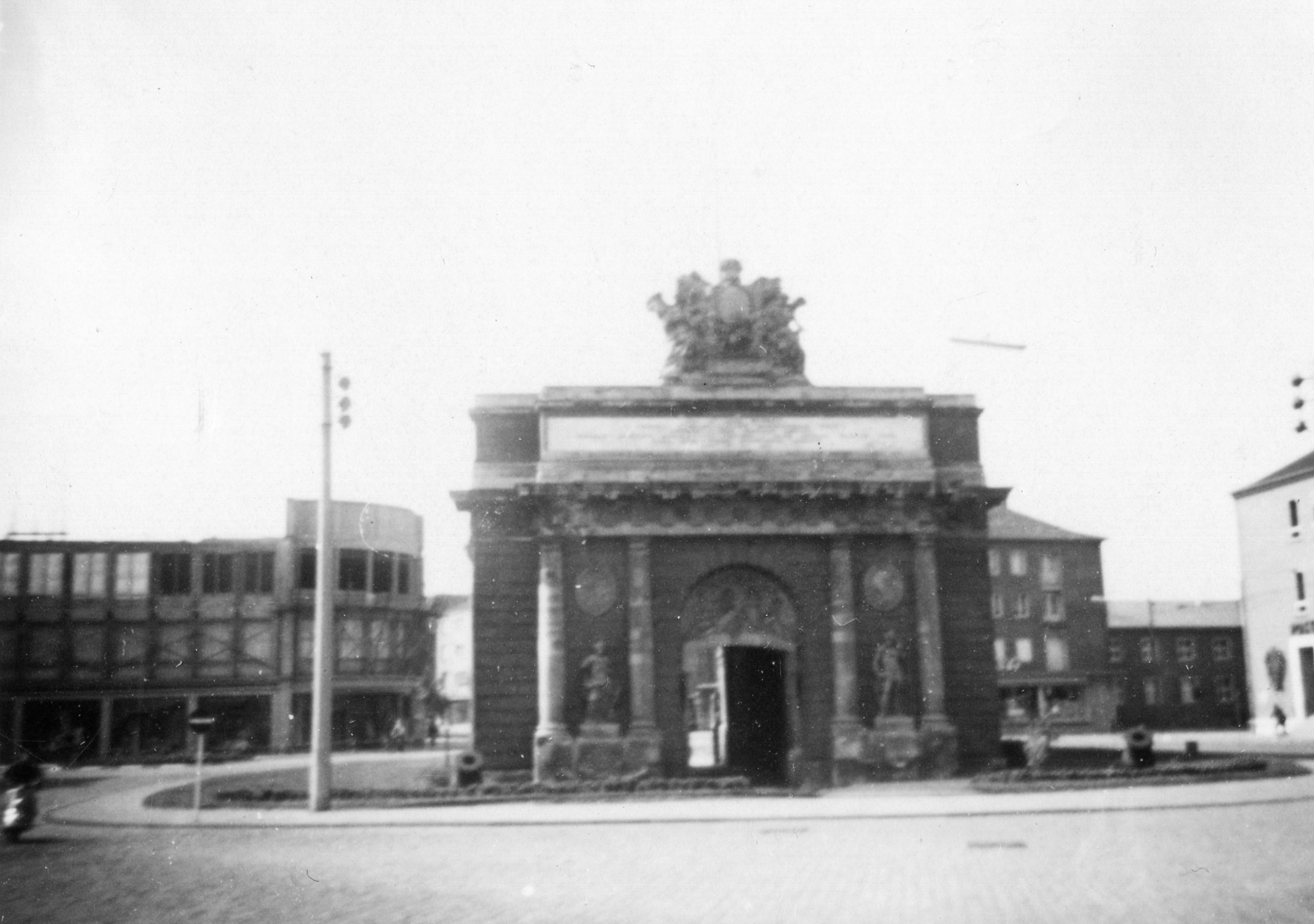
Berlin Gate at Wesel 1956

My second year at the Wesel High School turned out for me to be a very happy one. Having been placed back to the first high school grade the year before helped me overcome my deficiencies in Latin and made me feel superior in all other subjects, especially in Math. I quickly made friends with three other students. Being one year older and quite a bit taller, I took on the delightful role during recess and lunch breaks of the big, bad wolf and chased my friends, the three little piglets, all over the schoolyard. In the German comic books published under the worldwide license by the Walt Disney Company the wolf’s name was Ede. From this time on my nickname had been Ede for all those who belonged to the inner circle of my friends.

Berlin Gate at Wesel 2012 - Phot Credit: wikipedia.org

Berlin Gate at Wesel 2012 – Photo Credit: wikipedia.org

Great was my joy, when Father arrived. After two years of living only with Mother and Aunt Mieze this was a welcome change for me. What I didn’t know at the time was that my parents were drifting apart due to circumstances beyond their control. Mother having no employable skills had allowed herself to be bound completely to Aunt Mieze’s generous arrangement by taking over housekeeping duties in exchange for room and board, all expenses for herself and me. Father suffering from periodic back pains and other health issues could no longer find meaningful employment. His former administrative talents in agriculture were not in demand, especially not in the city of Wesel. Mother expected him to take up any employment. Even sweeping the streets or working for the sanitation department would have been all right in her eyes, she once confided to me. So as time went on, Father was facing a dilemma, either to continue to depend on Aunt Mieze’s charitable hospitality or to seek work completely out of line with his agricultural expertise.

But while he stayed with us, half a year or more, he did his best to create a sense of togetherness between himself and me, a kind of late bonding between father and son. He took great interest in my studies at the high school. He had heard of my difficulties in Latin and devised a motivational scheme to help me with grammar and vocabulary, which he himself had never learned. He also noticed that if I did get into trouble at school or at home it was primarily due to the fact that I, often wrapped up in my dream world, lost track of time. His plan, which I immediately embraced with great enthusiasm, was that I should earn my very first watch by studying Latin with him. For every exercise from my text-book, for every successfully completed vocabulary drill, for each translation into Latin he awarded me one point and recorded it meticulously with date and type of work into a little writing booklet. Once I had obtained the grand total of 500 points, he would give me the promised brand-new watch. When he left, I was not only the proud owner of a watch, but also more importantly my marks in Latin had soared to the second highest level one could get on the report cards. Moreover, I had accumulated so much knowledge that I was coasting along for four more high school years before slipping back to the more common satisfactory standing. It was also during Father’s short stay that he taught me how to play chess. His legacy was not only that I had developed a lasting passion for the ancient language of the Romans and the royal game of chess, but also that I harbor only the fondest memories of and feelings for my father. Little did I know that I was not going to see him again for six long years.

Gerhard Kegler, the German general, who dared to disobey Himmler – Part II

The Woldenberg Division and Himmler’s Order to Defend Landsberg

Excerpt Taken from the book ‘The Siege of Küstrin: Gateway to Berlin 1945’ by Tony Le Tissier, Publishers: Pen and Sword Books

The ineptness of Heinrich Himmler’s appointment as commander of Army Group ‘Weichsel’ is clearly demonstrated in his handling of the so-called ‘Woldenberg’ Division, a random assembly of troops taken from convalescent and training units stationed on the north bank of the Warthe, with which he expected to block the Soviet advance. Major-General Gerhard Kegler later wrote of this:

On the 30th January 1945 I received orders from Himmler to take command of the ‘Woldenberg’ Division without being given any orientation on the subject, nor the division’s task.

I had to find the division. I found the division’s command post east of Friedeberg. It had no signals unit and there were no communications with a superior headquarters. I took over command at about midday as I found this recently established ‘division’ in the course of disintegration as it retreated to Landsberg. While I was busy in Landsberg on the morning of the 31st January with the organization and deployment of the available units, I discovered that the ‘division’ had no anti-tank weapons, no ammunition or food supply arrangements and no signals unit. Neither was there a divisional medical officer. The artillery consisted of two horse-drawn batteries. The ‘division’ was not a ‘strong battle group’ nor were the troops battle­-worthy.

The population of 45,000 inhabitants were still in the town and no preparations had been made for evacuation.

I received Himmler’s orders from the commander-in-chief of the 9th Army to defend Landsberg as a fortress over the tele­phone. Russian tanks were already north of the Warthe-Netze sector. I had the Warthe Bridge demolished. After some consci­entious consideration, I decided to disobey this order [to defend Landsberg], which I considered senseless and whose compliance would serve no purpose other than great loss in human life.

Generalmajor Gerhard Kegler

Generalmajor Gerhard Kegler

Landsberg was abandoned by the ‘Woldenberg’ Division that same night. Major-General Kegler had set the withdrawal for February 1st, as the Soviet spearheads had already reached Küstrin some 40 kilometres to his rear, but his demoralized soldiers would not wait and abandoned their positions in the dark. The headquarters staff were only able to stop these demoralized units with difficulty some 3 kilometres west of the town.

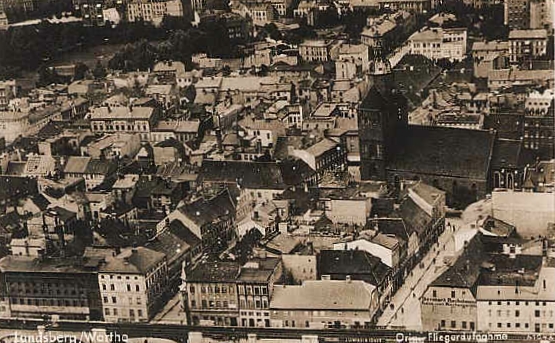
'Fortress' Landsberg, Warthe - Photo Credit:  prussianpoland.com

‘Fortress’ Landsberg, Warthe – Photo Credit: prussianpoland.com

Kegler reported by telephone to the 9th Army commander, General Busse, who had meanwhile established his headquarters in the Oderbruch village of Golzow. Busse demanded that Landsberg be retaken and defended, threatening Kegler with court-martial in accordance with Himmler’s orders. Nevertheless, Kegler stuck to his decision to withdraw to Küstrin by stages over the following nights. Even this, in view of the state of his troops and his open flank, was risky, and depended to a large extent upon their not being attacked as they withdrew along the northern edge of the Warthebruch on Reichsstrasse 1.

To be continued …

Chapter X of the P. and G. Klopp Story – Part III

Creative Use of Margarine Cards and Early Insights into Marital Spats

When Mother had a day off, we were able to do things together. What I liked the most was to go with her on hikes through the wooded hill country surrounding the town. At the end of a two- or three-hour leisurely walk along the highways that were not plagued too much by traffic, we always found a cozy roadside inn, where we dropped in for some refreshment and relaxation. Mother would order a cup of coffee for herself and for me a glass of mineral water or some homemade apple juice. On one occasion the innkeeper, who was running a small farm on the side, was too busy to stay with us being the only guests. So Mother and I spent the afternoon alone in the guest room and watched a movie on the small b/w TV screen. This was the very first time that I watched TV. I was thrilled getting acquainted with the new media that was just beginning to conquer the German entertainment market. The film most likely boring by today’s standards caught my immediate interest with its simple but captivating story about an immigrant from Europe who was on death row in an US state prison. He asked for and was granted permission to write letters to his aging mother in the Old Country. Within two weeks he wrote more than a hundred post-dated letters describing his imaginary tale about his proud achievements leading him from rags to riches in the New World. After his execution a prison guard with a heart sent off a letter every few months to his mother. A sad, but compelling story I remember vividly to this day.
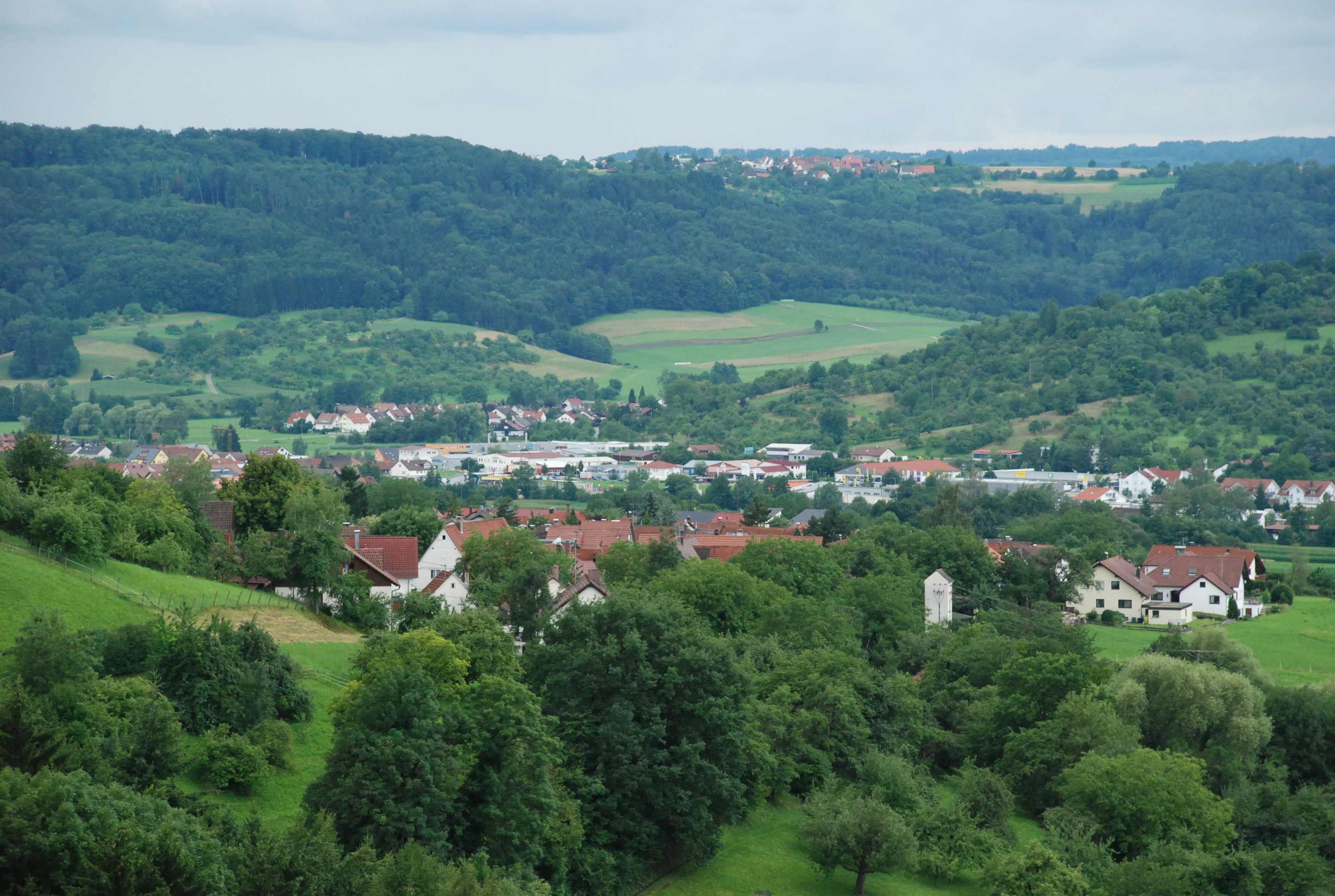
Rudersberg - Photo Credit: weather-forecast.com

Rudersberg – Photo Credit: weather-forecast.com

On the few rainy days, when we could not go on our beloved hikes, we stayed in Mother’s room and played her particular variation to the German card game ‘Six-and-Sixty’ with a double-deck of cards, which allowed us to unite in ‘marriage’ lots of queens and kings. Each marriage resulted in twenty more points than the marriage before. On these occasions Mother inspired by a glass of local wine or a satisfying victory in the card game would talk about her life in Pomerania, both sad and humorous stories. At times she would back to her childhood years in Grünewald. Proudly she told me that what she enjoyed the most. She liked horsing around and roughhousing with her brothers, which, although not becoming for a girl, was very much respected by her older brothers. Curiously she did not talk much about Father, nor did I ask any questions about him. I lived in the present; the future and the past did not yet have any meaning for me.

Back in Brünen, where the excellent food from the Wefelnberg country kitchen did miracles to the still slightly undernourished pre-teenage body of mine. In no time I gained enough weight so that I suddenly appeared quite chubby, perhaps even a little stout. There are no photos of the time, but I remember distinctly that I easily won wrestling matches with boys of my age by simply pinning them to the ground on account of my sheer weight.
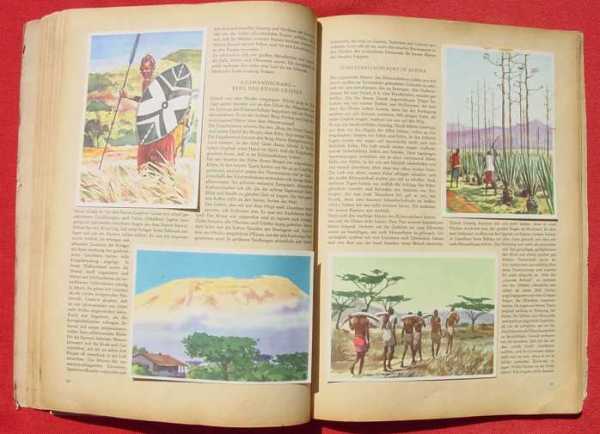
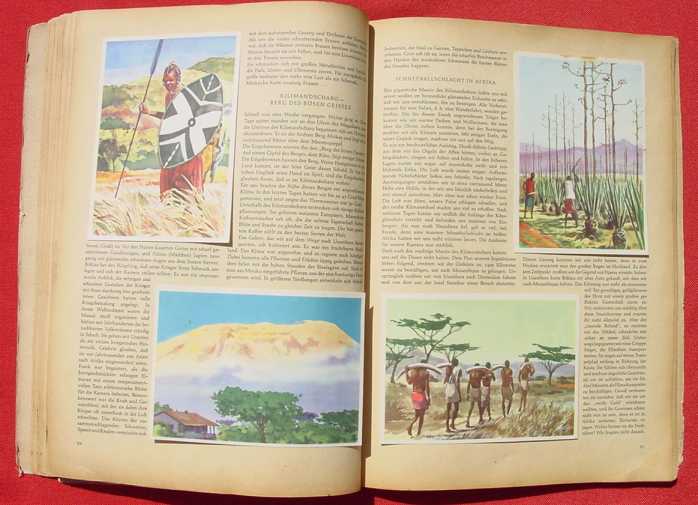
Sanella Album of Africa - Photo Credit: delcampe.net

Sanella Album of Africa – Photo Credit: delcampe.net

Butter was still expensive in the mid-fifties. Many households therefore were using margarine made of vegetable oil as an alternative to butter. One of the major margarine manufacturers added picture cards in the size of a standard 4 by 6 in. photo to their packaging and encouraged customers through their advertising to collect them and eventually paste them into booklets available from the company for a small fee. These booklets contained text and additional drawings, maps and illustrations for the cards and when completed represented a veritable treasure trove in the geography of Germany and other countries. I eagerly collected these cards. Frau Welfelnberg made sure that I would get them, when she opened another margarine package. Since there were many doubles, I traded them like stamps with many like-minded friends in the neighborhood. Since I had no money to order the corresponding booklets, I sorted them by themes of my own creation and glued them together to make a roll of forty to fifty pictures. Out of a sturdy cardboard box I fashioned a miniature stage. I cut out a rectangle roughly the size of one picture, inserted a round wooden peg on the right side of the box to serve as a pick-up spool for the roll of colorful images that would slip through the rectangular viewing area one picture at a time.

Now it was time to invite all my friends together with their younger brothers and sisters for the show that would take place in the natural theater of the backyard. The children sat on the lawn, while I presented the pictures very close to them on a small table taken out of the house for the performance. I invented the accompanying story and presented it extemporaneously in the form of a travelogue. The slide presentation became an instant success. The spectators not yet spoiled by children’s TV shows wanted to see more episodes. To help me they gathered as many picture cards they could scrounge up at home. What a creative way on the part of the Sanella margarine company to get people to buy their product!

One evening, while I lay on my bed that was wedged between the walls of my tiny bedroom, I overheard a conversation between the young miller and his wife, whose names I have completely forgotten. I witnessed a most peculiar spat between husband and wife behind the wall that separated their bedroom from mine.

Wife: How do like my new dress?

Husband: It looks beautiful on you.

Wife: Don’t you think it is VERY beautiful?

Husband: It is beautiful, indeed.

Wife: Now, now, you must admit that it is VERY beautiful.

Husband: There is nothing to admit here. It is my honest opinion that the dress is beautiful.

Wife: But you must see that my dress, the dress I bought with my own money, is VERY beautiful.

Husband: Whether you or I paid for it has nothing to do with its beauty. That’s illogical, my dear!

Wife: Leave me alone with your logic. Don’t you want me to look VERY beautiful?

Husband: Indeed, indeed! I want to …

Wife: So then, why don’t you say that the dress looks VERY beautiful on me?

Husband: Because there is a difference between beautiful and very beautiful.

Wife: So what you’re saying is that I look less than very beautiful. Why don’t you come right out and say I look VERY ugly in my new dress.

The conversation went on for a long time and became more and more animated and vociferous, but suddenly and rather abruptly ended with the wife sobbing quite miserably and with the husband deciding that it would be wiser to add no more fuel to the heated argument. It was time for the couple to make peace. A few minutes later the not so quiet springs of the marital mattress announced that love had overcome their verbal sparring. I had often pondered about the meaning of this curious episode.