Gustav Robert Hermann Klopp – Friedrich and Emma’s Eleventh Child – Part 3

Fighter Pilot and Hereditary Estate Farmer

The little village Kupfermühle including the mill estate and the forestry workers’ house Heidemühle is located on the southeast road from Meseritz at the Panwitz Creek, which flows out of the Lake Bauchwitz. Both mills, Copper and Heidemühle, existed long before 1500 and played an important role in the Meseritzian cloth-making industry as fulling mills.

The administration building into which Hermann and his wife had moved is located at the mill or copper pond, which was partially filled in the 1920s. The author (Eberhard Klopp) found almost unchanged the remnants of the canal’s lock and the still good-looking half-timbered house. About in the middle of 1923, Hermann Klopp began his job as an administrator. The old-time residents and new settlers having been displaced from the expropriated and now Polish regions began with the help of the government labour services to turn the swampy area into arable land. The initiatives of this kind were based on the agro-political programmes of various government agencies of the Weimar Republic within the framework “Eastern Assistance Action” (“Osthilfeaktion”). According to the census of 16 June 1925, there were 147 German only inhabitants. The official total area comprised of 910 ha. Johann Schaare functioned as the community foreman.

In Kupfermühle as well as at the Meseritz hospital Obrawalde (today Polish: Obrzyce) the daughter Jutta (1924 – 1958) and Bärbel (1925) were born. Then followed the sons Joachim (1926) and Hans-Hermann (1929 – 1939).

Around 1926 Hermann prepared the move of his brother-in-law Ludwig von Waldenfels and his sister Anna to Panwitz located about 10 km from Kupfermühle. The leasable estate Panwitz from the property of the castle baroness Lagowitz was available, as Hermann might have found out. With his advice and mediation, he may have decidedly contributed to the improvement of income and living conditions of the von Waldenfels family. In addition, more assistance from the German Settlers Agency could be depended upon in a similar fashion as he had made use of in West Prussia. The take-over of Estate Panwitz by Ludwig von Waldenfels took place in 1927.

To be continued …
Gustav Robert Hermann Klopp – Friedrich and Emma’s Eleventh Child – Part 2

Fighter Pilot and Hereditary Estate Farmer

To the inner circle of the flying aces which Hermann had to leave behind belonged among others Lieutenant Ernst Udet (1896 -1941), who had also joined the Richthofen fighter unit, and the artillery reconnaissance pilot and later writer Carl Zuckmayer (1896 – 1977).

Hermann received the Iron Cross for his brave aerial assignments, He did not take part in the last battle of his unit on 5 November 1918, nor the humiliating order to demobilize on 8 November 1918. Two days later Commodore Hermann Göring reluctantly announced the disbandment of the airforce.

In 1919 Hermann, halfway restored, took on an agricultural administrative post near Lobsenz, County of Wirsitz (today Polish: Luchowo near Lobznica). The area suitable for agricultural use amounted to about 2398 ha. Hermann’s workplace was reportedly on the adjacent Prussian state property. In 1920, the County of Wirsitz, as dictated by the Versailles Separation Treaty, became part of Poland. The now German-Polish state boundary was running barely four km west of Loblenz. The property was transferred over to the Polish authorities.

In August or September of the same year, Hermann, now forced into a new line of work turned to his 22-year-old sister Meta (1898 – 1984). She lived at the time on the Julia Steuer property “Neu Rosow, Post Colbitzow, County of Stettin.” The pond with no more than six little houses lies only about 300 m east of the new border with Poland since 1945. Sister Julia Steuer offered to the awesome former flying ace a preliminary rescue anchor. In 1922/23 he met with his brother Ferdinand, who found himself in a similar predicament, in the brick and mortar factory of Diensdorf at the Scharmützel Lake. Here both were able to find temporary employment and income.

In 1923 Hermann Klopp married Marianne (née Michael), who grew up in Lauten, County of Guhrau, Silisia). In Kupfermühle near Meseritz (border town Posen – West Prussia, today Polish: Kuznik near Miedzyrzecz) he had taken an administrative position advertised  by the German Settlers’ Society (deutsche Sieldlungsgesellschaft).

To be continued …

Gustav Robert Hermann Klopp – Friedrich and Emma’s Eleventh Child – Part 1

Fighter Pilot and Hereditary Estate Farmer

Friedrich and Emma’s eleventh child, Hermann was the first one to be born in the recently acquired house on 30 August 1892. In 1903 the eleven-year-old boy moved with his mother Emma and his six younger siblings to the farmstead at the village of Elsenau near Schönsee (now Polish: Kowalewo Pomorski) in West Prussia. Hermann completed an agricultural apprenticeship in that area and found before 1916 an administrative post of the Prussian state property Wtelno near Gogolinke, county of Bromberg (now Polish: Witelno near Gogolinek, about 20 km northwest of Bydgoszcz). The agricultural area of the domain was 385 ha.

In 1916 Hermann became a soldier and participated in World War I. He enlisted at the newly established air force unit just as his brother Ferdinand, who had served from 1915 on at the airstrip Großenhain. In August 1917, according to an army postcard, he became a fighter pilot trained at the “Flieger-Ersatz-Abteilung I”.

From March 21 to November 10, 1918, the day of the unit’s closure, Hermann Klopp belonged as a lieutenant and fighter pilot to the Airforce Unit I, which was headed by Manfred von Richthofen (1892 – 1918). Hermann was on active duty when his leader was fatally shot down on 21 April 1918 between Bray and Corbie (France).

Since the end of March 1918 the headquarters of the famous unit JG I was moved forward to the airport Léchelle as part of the German March offensive. After Richthofen’s death, First Lieutenant Reinhard became Herman’s new leader. On 6 July 1918 Captain Hermann Göring (1893 – 1946) was installed as the last commanding officer of the Imperial Airforce.

Under Göring’s leadership, the distinguished and audacious unit suffered heavy losses in the summer and fall of 1918. During the course of these air battles, during which Lieutenant Hermann Klopp flew the fighter plane Fokker D VII, his flying machine was shot down in the vicinity of Léchelle/Cappy. Seriously wounded he was transported to the nearest field hospital. It was found that he received a non-operable lung shot, from which he suffered for the rest of his life.

To be continued …

Friedrich Wilhelm Otto Klopp (1886 – 1937)

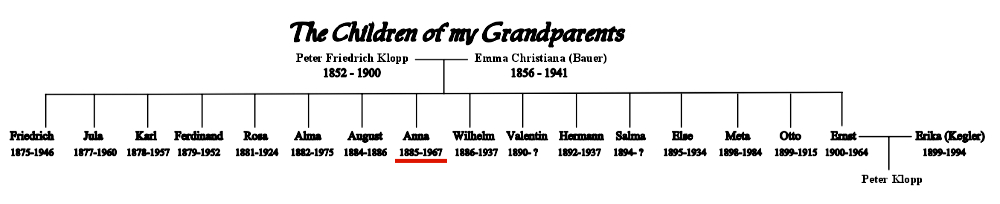
Chart I Peter and Emma Klopp Tree simple

The stories of the first eight children of my paternal grandparents have been told in earlier posts last year. Here are the links to the first half of Friedrich and Emma Klopp’s sons and daughters: Friedrich, Juliane, Karl, Ferdinand, Rosa, Alma, August, and Anna.

Friedrich Wilhelm Otto Klopp (1886 – 1937)

The Innkeeper of the “Brown Elk”

As the ninth child Wilhelm was born on 8 December 1886 in Jersleben. Due to the sparse memory retention of the descendants, Eberhard Klopp, the author of the Klopp Family Chronicles, had not been able to dig up any information on Wilhelm all the way up to 1919, when after the lost WW1 the latter returned from the eastern German provinces (given to Poland by the provisions of the Treaty of Versailles) to Elbeu. At the Magdeburg Street of Elbeu, Wilhelm bought a house, presumably with agricultural land attached to it. With his brother Ferdinand he seemed to have come to some sort of financial arrangement involving a considerable sum of money paid out by the state to compensate for lost property in the eastern provinces.

From Wilhelm’s first marriage with Maria Söchting come two sons: Wilhelm and Gerhard. Their mother died in 1912. In 1912 Wilhelm married his second wife Louise (née Grünwald). From this marriage originate four children: Viktoria (1914), Fritz (1916), Heinz (1919) and Günther (1924). It is safe to assume that 28-year old Wilhelm became a soldier in 1914. When he returned from the war with his brothers, he procured for his brother Ferdinand Klopp (1879 – 1952) the lease of the Elbeu Inn “Brown Elk”. Over financial disagreements in August 1922, the two had in the barroom a fight, during which Ferdinand shot his brother. Wilhelm was wounded at his left shoulder. Louise, who was standing behind him, was grazed by the bullet. Mother-in-law Emma Klopp must have heard about this incidence either at her daughter Rosa Diesing’s (1881 -1924) place at Schöneberg or experienced it first hand right on location in Elbeu. At any rate, it had been passed down through the grapevine that Emma had used the highly defamatory term “Satan’s wife” in describing her daughter-in-law. Mother Emma condemned Wilhelm’s excessive alcohol consumption, which she blamed on his wife’s bad influence. Louise died in 1924, presumably on account of the injury she suffered from the grazing bullet. Wilhelm was reconciled with his brother Ferdinand – at least on the surface, took over the “Brown Elk”, and remained innkeeper for the rest of his days.

Around 1925 he married for the third time: Ruth (née Grünwald), the sister of his second wife. Six underage children needed to be cared for. From this marriage descended two more sons: Hans-Georg and Hans-Joachim, both were born in Elbeu. On 7 August 1937, Wilhelm passed away at the age of only 51 years. At the end of his short life, he had apparently become his own best customer of the local watering hole.

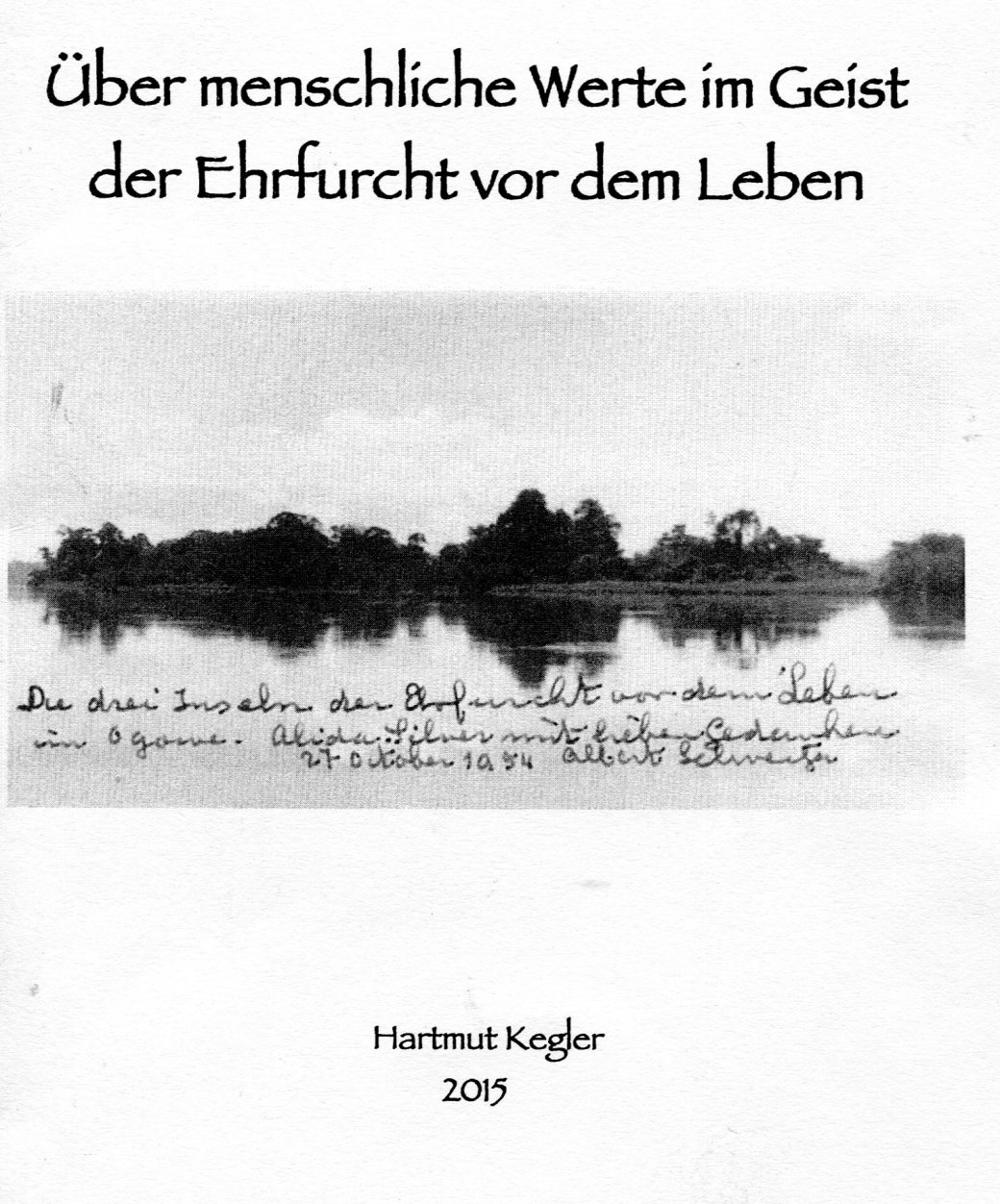
Über menschliche Werte im Geiste der Ehrfurcht vor dem Leben – 18. Teil

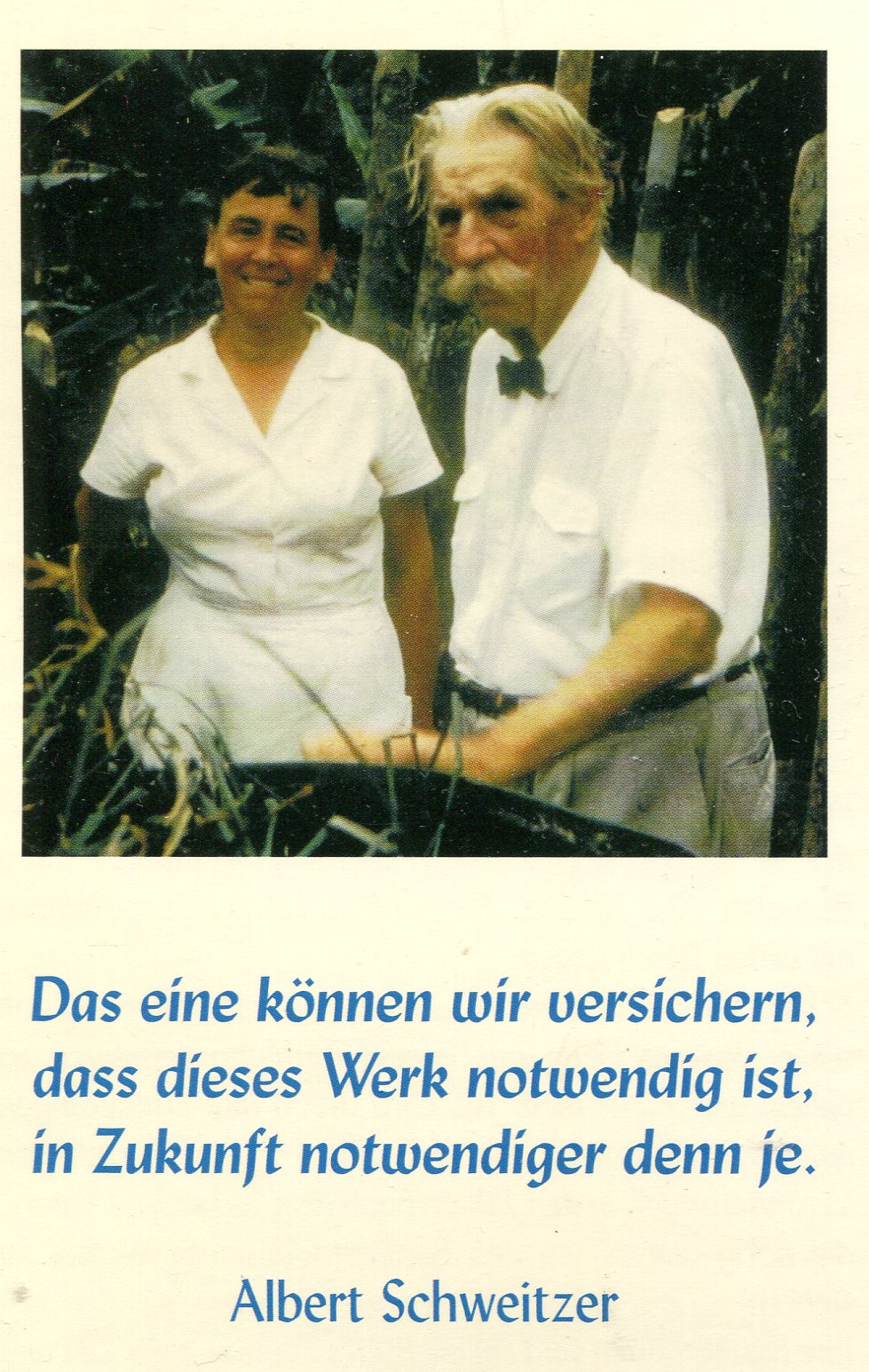
To my English speaking blogging friends: Today’s post is the last instalment of the Schweitzer inspired series on human values. I thank you all for your patience and for the effort of some to translate these rather difficult posts. Next Friday I will return to the Klopp Family Story.

A012


Vertrauen

Auch das Wort Vertrauen ist kaum noch gebräuchlich. Die Herrschaft der Ökonomie im Denken und Handeln der Menschen führt dazu, dass alles, was man nicht berechnen und Voraussagen kann, wertlos ist. Denn „Vertrauen ist etwas Geistiges”, sagte Albert Schweitzer. „Es kann nur in geistigem Geschehen entstehen … Ich bekenne, dass ich Vertrauen in die Menschen setze. Mein langes Leben hat mich gelehrt, dass wir alle denkende Wesen sind und dass es nur darauf ankommt, dass dieses Denken erwacht und bis in die Tiefe unseres Seins geht.”

Aber auch für alle Unternehmen ist Vertrauen „das große Betriebskapital, ohne welches kein nützliches Werk auskommen kann. Es schafft auf allen Gebieten die Bedingungen gedeihlichen Geschehens.” Ohne das Vertrauen in die Worte Jesu: „Du aber folge mir nach!”, ohne das Vertrauen in alle seine treuen Mitarbeiterinnen und Mitarbeiter und ohne das Vertrauen in das „Symbol seines Werkes”, das Spital in Lambarene, hätte er all die Mühsal, alle die Rückschläge, alle die Verleumdungen und alle diese Widerstände nicht überwinden können. Aber auch seine Mitarbeiter und Patienten ‘lebten davon, dass jemand an sie glaubt’ und ihnen vertraut. ‘Was ein Mensch an Gütigkeit in die Welt hinaus gibt, das arbeitet an den Herzen der Menschen und an ihrem Denken.’

Was zwischen einzelnen Menschen gilt,  hat ebenso in den Beziehungen zwischen den Völkern und Staaten Bedeutung. Auch hierzu hat sich Schweitzer mit dem Hinweis geäußert: „Gemeinsame Ideale allein bieten die Möglichkeit, dass der Einzelne wie auch die Völker sich gegenseitig verstehen, sich gegenseitig achten und Vertrauen zueinander haben.” Die geistige Kraft des Vertrauens ist das beste Mittel zur Wahrung des Friedens. Den guten Staatsmann erkennt man auch daran, dass er internationales Vertrauen schafft.

Über menschliche Werte im Geiste der Ehrfurcht vor dem Leben – 12. Teil

A017

Muße

Von Elsa Triolet stammt der Hinweis: „Ein Mensch, der über keinerlei Muße verfügt, ist weniger als ein Lasttier. Er ist einfach eine Maschine, um den Reichtum anderer zu produzieren, er ist körperlich zerbrochen, geistig verkümmert.” Er wird ebenso „zur Maschine”, wenn es um den eigenen Reichtum, wenn es um das „Haben” geht, das Erich Fromm der Existenzweise des „Seins” gegenüberstellt. Auf die Frage, was denn Muße sei, antwortet George Bernhard Shaw: „Echte Muße ist Freiheit, zu tun, was uns beliebt, nicht, gar nichts zu tun.” Doch scheint Muße noch mehr zu sein, als „gar nichts zu tun”. Gabriele Herbst (in Möllering und Behlau) weist zunächst darauf hin, dass das Wort „Muße” von der griechischen Vokabel ,schole’ abgeleitet wurde, was Zeit für sich, sich zu bilden, kreative Stille, philosophische Reflexion mit dem Wunsch bedeutet, etwas für den Frieden im Land zu tun. Sie schreibt weiter: „Muße war also nur bedingt freie Zeit, passive Zeit, ziellose Zeit, Zeit des Nichts-Tuns. Sie war eine Zeit gesteigerter Freiheit, in der der Mensch in Ruhe nachdenken konnte, den Versuch unternahm, wirklich er oder sie selbst zu sein oder zu werden.” Doch in unserer Zeit, in der die Existenzweise des „Habens” vor der des „Seins” rangiert, sucht der Mensch Zerstreuung ohne große geistige Anforderungen und pflegt alles andere als Muße und innere Einkehr. In seinem Buch „Der Sabbat. Seine Bedeutung für den heutigen Menschen” verweist der jüdische Theologe Abraham Joshua Heschel darauf, dass am Sabbat Gott nicht die Arbeit, sondern die Zeit heiligte. Es sei eine Zeit des Einklanges von Körper, Geist und Phantasie, ein Tag für das Leben. Der siebente Tag sei Friede zwischen Mensch und Mensch, Mensch und Natur, Friede im Menschen. Sabbat sei zudem ein Tag, an dem der Umgang mit Geld als Entweihung gilt, an dem der Mensch seine Unabhängigkeit von dem bestätigt, was der oberste Götze der Welt ist. Muße ist also nicht „aller Laster Anfang”, sondern der Beginn einer inneren Erneuerung.

Es ist also für das Wohl des Menschen unerlässlich, wenn die christlichen Kirchen warnen: „Ohne Sonntag ist jeder Tag Werktag!” Warum soll oder „muss” man an diesem Tag einkaufen, verreisen, „schaffen”?! Müssen wir nicht wieder denkende Menschen werden? In seinem Buch „Aus meinem Leben und Denken” schreibt Albert Schweitzer: „Wird der Mensch denkend über das Geheimnisvolle seines Lebens und der Beziehungen, die zwischen ihm und dem die Welt erfüllenden Leben bestehen, so kann er nicht anders, als daraufhin seinem eigenen Leben und allem Leben, das in seinem Bereich tritt, Ehrfurcht vor dem Leben entgegen zubringen und diese in ethischer Welt- und Lebensbejahung zu bestätigen.”

Entschließen wir uns also wieder zu mehr Muße! Wenigstens am „Sabbat”!