Walter Panknin (1898 -1977) and His Family Ch7 Part 3

Papa Panknin’s Life in Review

Born and raised in Kalthof, West Prussia, steeped in the traditional work ethics of his time, Walter Panknin perceived his employment as a police officer as a contract between the state and the individual. The state offers the individual a permanent position with an income commensurate with his rank and the prospect of a pension providing security and a comfortable living for retirement. In return, the individual faithfully and honourably delivers a service to his country.
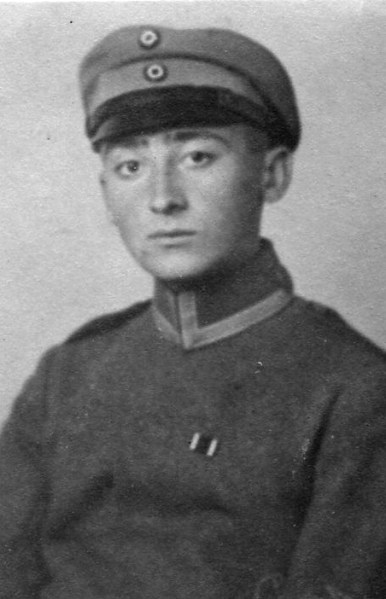
Walter Panknin 1918

In 1915, barely seventeen years old, Papa volunteered and served as a soldier in the Great War. When the German army was reduced to 100,000 men in 1919, he embarked on a career in the police force in North Rhine-Westphalia. His leadership qualities were soon recognized, and he moved quickly up the ranks, becoming a leader of a police detachment in a small town near Dortmund during the turbulent time of the Weimar Republic. One day, while riding his bike to work, he took a spill and fell to the ground. Unfortunately, as he landed on the cobblestone street, his service pistol went off and sent a bullet through his abdomen. At the hospital, the surgeon discovered that the shot had destroyed his left kidney. So Papa had to spend the rest of his life with only one kidney.
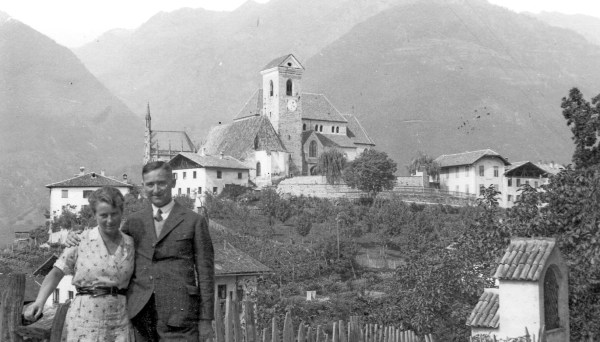
Walter and Elisabeth Pankin on their Honeymoon in Italy

The night before the Nazis seized power in 1933, rowdy Brownshirts (SA stormtroopers) terrorized the townspeople with their unruly behaviour in the streets. Walter Panknin, responsible for law and order, sent out the police force and had the troublemakers arrested. The very next day, a call came from the Nazi headquarters, demanding his immediate resignation. His career as a police officer would have ended if some influential friends had not put in a good word for him. That was his first brush with the new dictatorial regime.
Walter Panknin (1898 – 1977) and His Family Ch7 Part 2

Struggle for Justice

Biene described in vivid detail her mother’s exhausting trips by public transportation and on foot to the government offices in the bigger cities. With unwavering determination, she bypassed the lower-ranked officials. She gained access to the ministers of justice and social services, an incredible feat that only people familiar with the German bureaucracy can understand. In those days, there was no phone service for the general public, no emails, and no Internet search engines that we in the twenty-first century take for granted. With her tenacity and unshakeable resolve, she managed to open doors, scout for invaluable information and find assistance in the fight to recognize their refugee status and Papa Panknin’s pension claim.

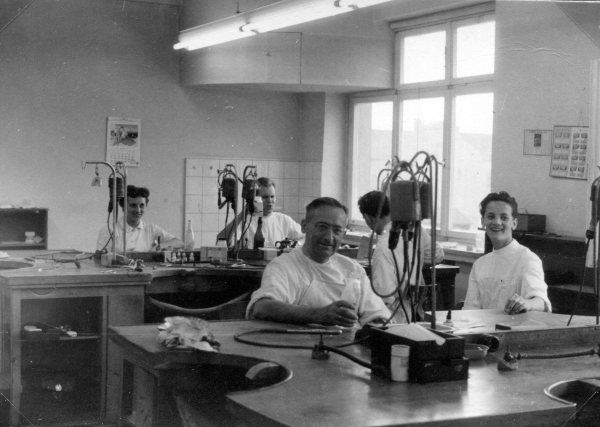
Walter Panknin at the Dental Lab 1957


To fully understand their situation, we need to go back to 1957. The Panknin family, like so many refugees from the Soviet-controlled eastern part of Germany (GDR – German Democratic Republic), lived in extreme poverty. My father-in-law, former captain of the police force and later commander of an army unit in former Yugoslavia, provided with his meagre income the cost of food and shelter for the family of four. He worked as a dental technician in a lab in a nearby city. What his wife had accomplished by blazing a trail and opening doors to influential politicians, Walter Panknin complemented her efforts by resorting to his powerful writing skills. Reading his elaborate correspondence with the movers and shakers of the government ministries of the West German province of Rhineland-Westphalia, I gained great insight into their struggle for justice. What really impressed me was how the couple worked together as a team. I also learned that despite the glitz and glamour of the economic boom (Wirtschaftswunder), there was something rotten in Germany.

Walter Panknin (1898 – 1977) and His Family Ch7 Part 1

Switching Authors Again

Biene wrote the preceding chapters based on a wealth of experiences from 1945 to the early 1960s. The story begins with her father’s return from the Bad Kreuznach POW camp to his family and home in Gotha. It ends with a vivid description of life as a refugee family in the so-called ‘Golden West.’ In loving memory, she sees her mother as a pillar of strength. She did not hesitate to jeopardize her health and well-being in the fight for justice for her husband and children. Biene depicts Papa Panknin’s stern appearance without the usual negativity often found in a father-daughter relationship. She briefly mentions her squabbles with her twin brother Walter. For example, the abusive ‘burrowing’ of her dolls and toys and often wrecking them bothered her. In retrospect, she preferred to dwell on the joys and emotional support she received from her friends while entering her teenage years.

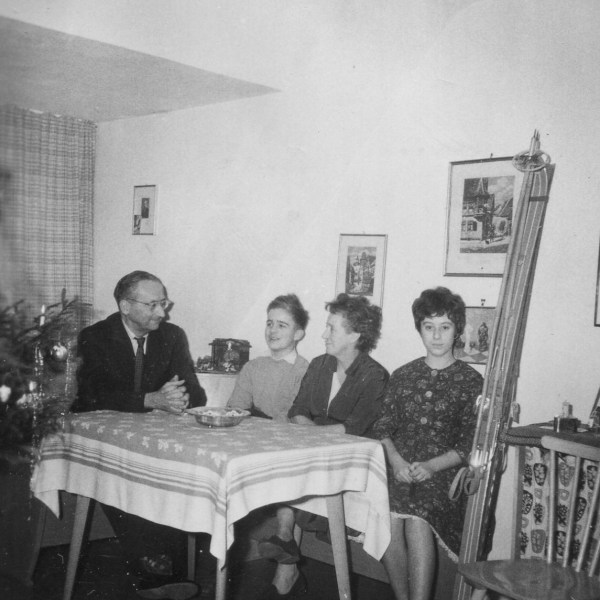
Modest Beginning in the ‘Golden West’ – Christmas 1958

The task at hand of writing about the rest of the story will be a challenging one for me. In contrast to Biene, I did not have personal experiences with my parents-in-law. Indeed, I only had the pleasure of meeting them three years after our wedding in Canada. However, what enables me to throw detailed light on Papa and Mutti’s life is their love and passion for expressing themselves through their immense correspondence with friends and relatives. They meticulously sorted and preserved their work in well-organized, dated folders and binders.

Papa Panknin suffered from nervous tics in his facial muscles and hands dating back to WW1 shell shocks. Therefore, he used an old typewriter for his letters to government officials, friends, and relatives. Typing had the advantage of producing carbon copies for his records, for which I am very grateful, making my job as a family chronicler much easier. My writing will be drier for the most part and less colourful than Gertrud’s autobiographical notes. However, I hope that many excerpts from his correspondence, especially those dealing with family events, will be noticed even in translation. So without further ado, let the extraordinary story of the Walter Panknin family continue.

Walter Panknin (1898 – 1977) and His Family Ch6 Part 29

Foreshadowing the Turbulent Adolescence Years

Biene wrote this post.

Gisela’s grandparents always received us warmly when Gudrun and I came for a visit, and they treated us with delicious homemade refreshments. They took a genuine interest in our lives and liked to tell us stories of their exciting past,
Unlike Gisela, Gudrun was very outgoing and radiated warmth. She always had a sweet smile on her round face. Blond, blue-eyed and well-developed, she liked to take life easy and have fun. While I still wore hand-me-down clothes from my second cousins, Gudrun had the most beautiful skirts, blouses and dresses, which her mom sewed for her.
Like Gisela’s mom, her mother was a war widow and a seamstress. She also had a tailoring business at her home. Gudrun’s grandma lived with them. But her grandfather was dead. Gudrun’s Oma did the household chores while her mom sewed on a big long table in the corner of the spacious kitchen close to the window.
Gudrun’s well-dressed mom looked glamorous with her fashionably styled blonde hair, heavy makeup and bright red, enormously long fingernails. They were curved like claws. I secretly wondered how she could handle delicate materials with them. She would take frequent smoke breaks showing off her long fingers by gracefully holding the cigarette. She half closed her eyes leisurely and slowly exhaled the smoke through her rounded red lips. Smoking looked so pleasurable and alluring to us girls.
Periodically. a male friend of the family who was a truck driver for a brewery would visit Gudrun’s mom. At those times, much laughter and joking occurred, and thick clouds of smoke were coming from the sewing corner, distracting us from studying for school. I think her mom’s friend was a father substitute for Gudrun.
Gudrun had a record player, a luxury our family could not yet afford. She owned records of the top hits, most of them gifts from her mother’s friend. We would listen with excitement to the catching songs and rhythms of Little Richard, Elvis Presley. Connie Francis and Brenda Lee. We would even dance around as soon as Gudrun’s mom and Oma ran errands. When our top idol Elvis sang, “Love me Tender,” we were mesmerized and started dreaming of first love.

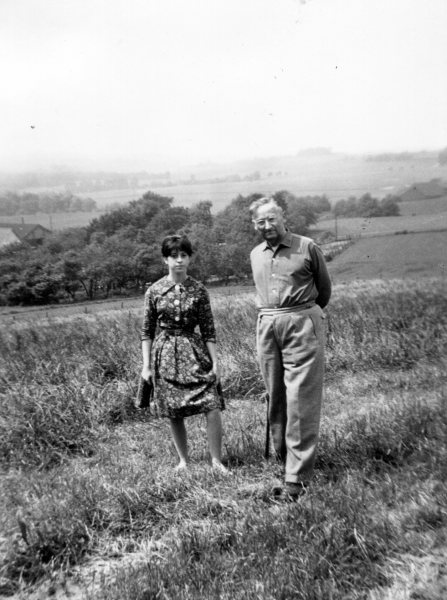
Biene Hiking with her Father Walter Panknin

With this final post of chapter 6, Biene concludes her contribution to the Walter Panknin story. I will carry on with this family history in Chapter 7.

Walter Panknin (1898 – 1977) and His Family Ch6 Part 28

New Friends on the Road to Adolescence

Biene wrote this Post

After our return from summer camp in Berg Neustadt, our parents told us the exciting news that the construction of the apartment building was nearing completion. If all went according to schedule, we would celebrate Christmas in our new home.
Angelika had moved to Wolfsburg during the summer. My friend and I had been an inseparable pair, mainly keeping to ourselves. Angelika did not like to “share” me with other girls and had jealously guarded our friendship. I felt lost without her. I was apprehensive about going back to school, fearing being without friends. Once in a while, Angelika and I were invited to for a special occasion to Gisela’s house. Gisela was the girl from Eisenach, the famous town close to Gotha, where the Wartburg castle is located.
But as so often in my life, my fears were unfounded. Gisela and her friend Gudrun felt sorry for me and asked if I wanted to walk with them during recess. They also invited me to do homework at their homes. They always took turns. Knowing my situation, they did not mind that I could not ask them back because of the Old House. I promised them they could always come to my place once we moved. They were okay with this prospect.
Gisela lived with her grandparents, her mom and her older sister in a new apartment not far from our prospective home. Gisela’s pretty mom, a petite, dark-haired woman, was a war widow. Gisela had never known her dad, a pilot, who was killed shortly before her birth.

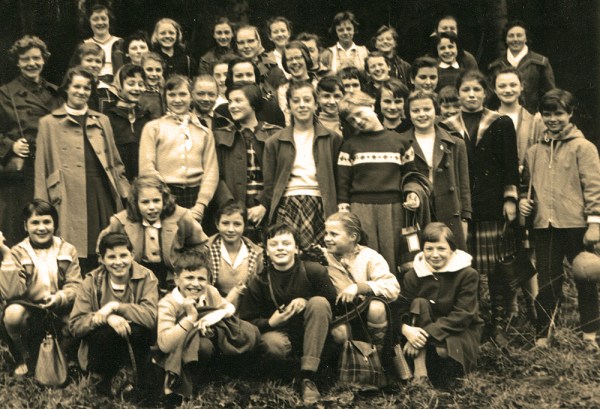
School Photo with Biene at the Centre


After the war and their flight from east Germany, Gisela’s mom worked as a seamstress while her parents took care of the household chores. Gisela, a tall, long-legged girl with big brown eyes, always wore the most stylish and beautiful dresses which her talented mom designed and sewed for her. Gisela was a bit more serious and reserved than most classmates and appeared to be older.

Walter Panknin (1898 -1977) and His Family Ch6 Part 27

Papa’s Shocking Letter from Home

Biene wrote this post.

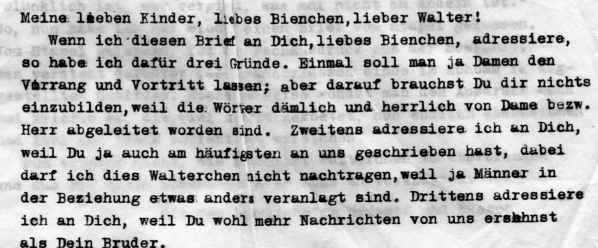
One day, we were all supposed to write a postcard home. I wrote a desperate plea to my parents to come and get me as soon as possible. A few days later, I received a letter from my father.  I eagerly opened this welcome message from home with joyful anticipation. But what my father wrote to me seemed to top off all the bullying I had endured. Instead of comforting words, my father wrote what he may have thought to be a witty  “dissertation.” He explained the linguistic origin of the German words ‘dämlich’ and ‘herrlich,’  roughly translated as ‘dumb’ and ‘masterful.’   Unfortunately, the allusions and fine points of his linguistic examinations are lost in translation.  There are no equivalents in the English language. He told me that the word “dumb” derives from the word “dame.”  On the other hand, “masterful” or “manly” originates from master or man,  and ‘Herrlich’  also has the connotation of wonderful or glorious.

Extract of Papa’s Letter in German (1956)

I could not finish reading my father’s letter because tears of shame and disappointment blinded my vision.  But miraculously, my pain was short-lived.  A supervisor approached me and told me I had a visitor waiting for me in the main office.  When we entered, there was my beloved mother!  It seemed like a miracle. She had made the long and costly trip by bus and train to see me against my father’s advice. I was overjoyed.  We spent the beautiful afternoon together walking in the forest and talking.  I unburdened my heart, and she listened with empathy.   When evening approached, she gave me the choice of going back home with her or staying for the remainder of the vacation.

One thing my father’s letter had accomplished. It stirred up my pride and courage. I was going to show him that I was not that ‘dumb’  weak ‘dame’  intimidated by the ‘wonderful masters.’ I would not give him the satisfaction of proving his point. I decided to stay.I enjoyed the remainder of my time at the youth camp. I learned to ignore verbal assaults and not take them personally. I avoided playing unsupervised games with rough boys and sought out the company of friendly girls.  I also noticed that the supervisors intervened more readily when they saw inappropriate behaviours. Maybe due to my mother’s visit, they were more vigilant.

Summer camp, in many respects, was a great learning experience for me and made me stronger. Thanks to my mother’s love, I felt happy and relieved that I did not quit or give in to fears and feelings of insecurity.  In retrospect, I also appreciate my father’s words.  Although it was not so obvious,  he acted out of concern for me.  He knew that by taunting me, I would rise to the challenge.   In his words, I learned to  ‘master’ my fears.