Chapter 18 of the P. and G. Klopp Story – Part IV

Happy End to a most Enjoyable Visit

Then a close family member dropped in for a brief visit. When she heard that I had been going out dancing with Roswitha, she mockingly and contemptuously commented on her in Father’s presence, “Ho! Ho! Peasant duffer! (Bauerntrampel in German)” By now I had become quite accustomed to the unpredictable outpourings of her sharp tongue. Her caustic and biting remarks at Mother’s place in Wesel had been edged forever into my memory. However, Father was livid. Having respected all his life the hard honest work of the farmers from whom we receive our daily bread, he was deeply insulted by that derogatory remark. He gave her a severe dressing-down for displaying unjustified disdain for such an honorable class of people. Never since my early childhood days, when he had read me the riot act for stealing eggs from Mother’s henhouse, had I seen Father so angry. If I did not know the meaning of holy wrath, I knew it now.

My brother Karl and his wife Ingrid with an aunt in front of Erna's house

Erna Klopp with her neighbor’s baby in her loving arms

Erna’s house was at least half a century old and the electrical wiring was outdated and no longer in compliance with the latest electrical code. It required that all circuits be properly grounded. It made me feel good that I was not just there to enjoy a relaxing summer visit but also had the opportunity to make myself useful. Father had bought the three-prong wire, and I installed it and connected it to the junction boxes, outlets and switches. When I showed reluctance to take the twenty marks Father wanted to give me as pay for my work, he lectured me somewhat like this, “Listen, Peter, if someone offers you money, not dishonest money mind you, but money earned for work you did, do not hesitate to accept it. For you not only cheat yourself out of the reward that is rightfully yours, but you also insult the generosity of the giver.” To such a powerful argument I had nothing to reply and took the twenty marks.
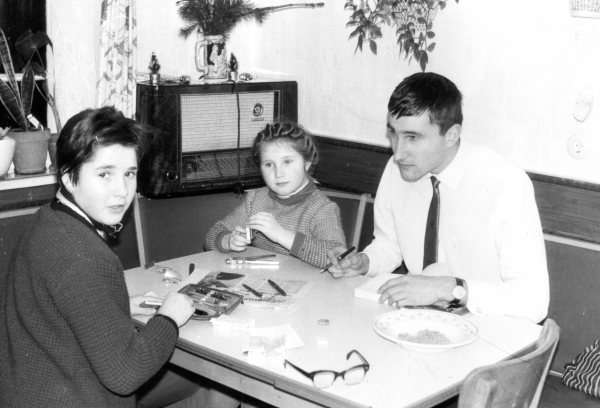
Together with Helga and Anita in Michelbach

Together with Helga and Anita in Michelbach

At times when Father’s back pains were hurting too much, he stayed in bed for most of the day. Adolf and I were sitting at his bedside to keep him company. Then Father and I would often talk about the great empires of the past and the lessons one might learn from the causes of their decline. I really warmed up to this topic as I had recently taken a keen interest in the history of the Roman Empire. We came to the conclusion that if one allows foreign religious and ethnic elements to penetrate the cultural core of the nation, it will sooner or later lose its identity, its values and strength and will eventually have to face first decline and then total collapse. Germany according to Father has not learned her lessons and was headed in the same direction. He pointed to the record player on the night table remarking, “The record is turning, the needle appears to be progressing even though it is running in circles, but in the end it will be starting all over again symbolizing the eternal recurrent of the same in world history.” Adolf feeling a little left out in this highfalutin talk said he would buy himself a couple of history books to study up on the things he had missed in school.

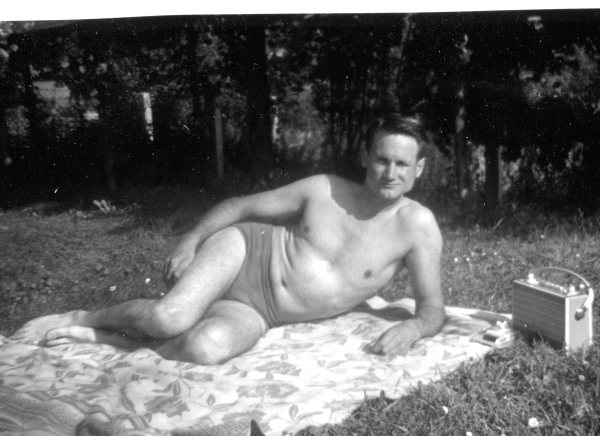
Reading and Relaxing - Summer of 1962

Reading and Relaxing – Summer of 1962

Before the end of my vacation in Michelbach I gave Erna my moped. The engine of her better looking moped had completely broken down. Adolf, the skilful mechanic and jack-of-all-trades, took the good engine out of mine and installed it into Erna’s moped. As reward for my generosity Adolf drove me in his Volkswagen beetle back home to Wesel, where he was going to spend a few days to visit with Mother and Aunt Mieze.
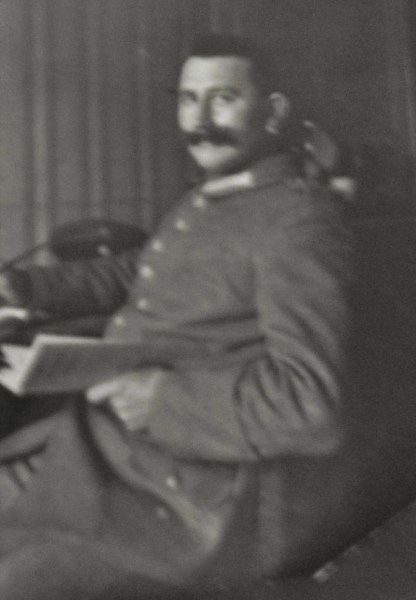
Friedrich Wilhelm Ferdinand Klopp (1879-1952) – Part IV

Charged with Attempted Murder

Klopp Family Tree

Chart I – II

On a sultry summer evening pub owner Ferdinand Klopp, short-tempered and irascible at the best of times, was quaffing copious amounts of schnaps with his younger brother Wilhelm. As the drinking session was dragging on into the wee hours, the two had an argument over the financial status of the pub ‘Brown Elk’, which they owned and managed together. Wilhelm’s wife, whom mother-in-law Emma later described contemptuously as Satan’s wench, added oil to the fraternal dispute by heaping insults upon her brother-in-law Ferdinand.

WWI Pilot Ferdinand Klopp

WWI Pilot Ferdinand Klopp – Picture taken 1915

With no weapon at hand in such an explosive situation one would expect the dispute to deteriorate into a brawl. However, Ferdinand did have an illegal weapon, an army pistol hidden away somewhere. In his fury he aimed at his brother and pulled the trigger. The shot penetrated Wilhelm’s shoulder and injured his wife, who was standing behind him.

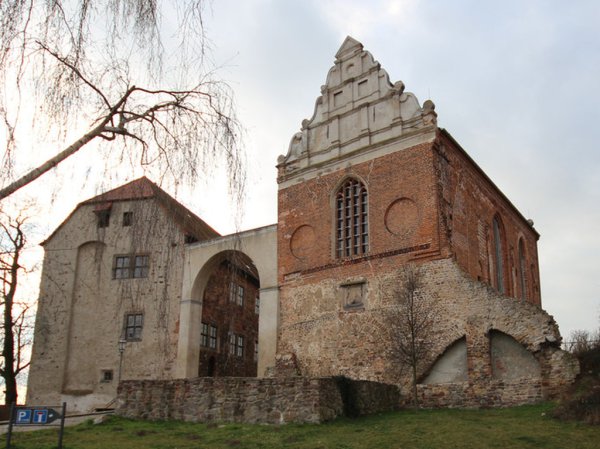
Castle at Wolmirstedt - Photo Credit: holidaycheck.de

Castle at Wolmirstedt – Photo Credit: holidaycheck.de

After his arrest Ferdinand, while waiting for the court proceedings to start, spent several weeks as prisoner in the castle at Wolmirstedt. His sentence turned out to be rather mild. The judge dismissed the attempted murder charge. It was clear to him that the accused committed the crime under extremely volatile and emotional circumstances. After being released from prison, Ferdinand handed over the pub to his brother, departed almost like a fugitive and left his home turf around Wolmirstedt in a big hurry.

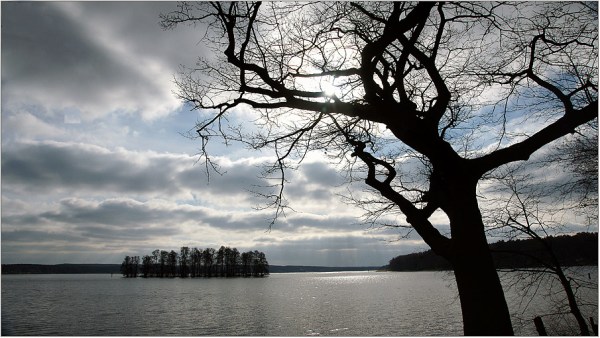
Lake Scharmützel ß Photo Credit: Alfred Held

Lake Scharmützel – Photo Credit: Alfred Held

Ferdinand found refuge at his sister Jula‘s brick and mortar factory, whom I had already mentioned in a previous post. There he found employment and received a modest income. It appears that here in Diensdorf at the beautiful Lake Scharmützel Jula rescued her brothers Ferdinand and the still unmarried younger brother Hermann (1892-1957) from the devious comfort of drinking and carousing that people in trouble often seek as a form of escapism.

Chapter 18 of the P. and G. Klopp Story – Part III

Is it Love?

Within the scope of the family history I would go too far if I included Erna’s side of the family except the ones that I came into contact with. There was the Langlitz family, Walter, Frieda (Friedchen) and their two daughters Helga and Anita. Walter had become a successful contractor who ran a prosperous business with his impressive array of trucks,

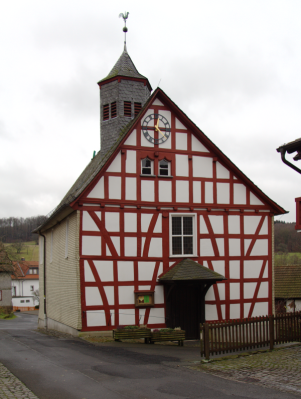
Church of Michelbach now part of Schotten - Photo Credit: wikipedia.org

Church of Michelbach now part of Schotten – Photo Credit: wikipedia.org

caterpillars, backhoes and other heavy machinery that he had acquired to assist in the government sponsored land reform program. In contrast to the northern provinces of Germany, where the eldest son inherits the farm, inheritance laws in the south required equal division of the fields among all the children of the deceased farmer. Thus, over time emerged a chaotic patchwork of tiny fields often less than one ha in size, which made farming more and more inefficient and unproductive. So Walter profited from the reallocation of land by owning the right equipment at the right time. The two daughters, Helga and Anita, age 12 and age 10, whose exact degree of relationship to Erna I do not recall, often showed up to play board games, such as chess and checkers with the newcomer in Father’s home.

52

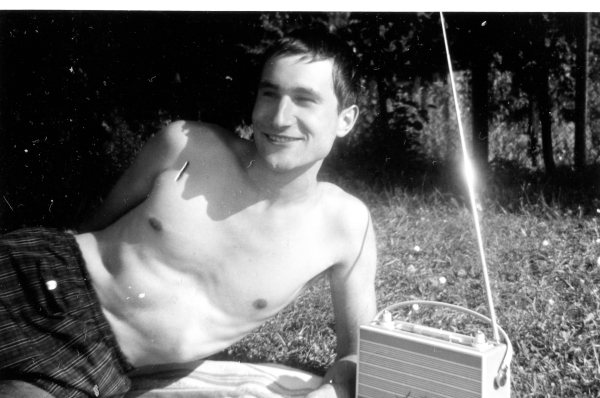
Peter Basking in the Sun – Summer 1962

Erna was also anxious to have me meet her 16 year-old niece Roswitha, who lived a few houses down the street with her widowed mother. Even though I did not recognize it at the beginning, it was clearly a matchmaking effort supported by Father. In collusion with her sister-in-law, Erna invited her niece over for coffee and cake to make sure we would see each other as often as possible. Roswitha in terms of the standards I had set for what a girl should look like fell well within the range of acceptability. However, inner qualities, such as interests in activities that one could do together, readiness to share and exchange thoughts and feelings, to support them and if necessary even to oppose them, such qualities, which began to gain more and more in importance for me, were severely lacking. In a way my encounter with her helped me set the bar a few notches higher, which further limited the number of choices for my future mate. I vaguely felt for the first time that only love could help jump the hurdle. But what is love? I could not tell, because I had not experienced it yet. So what Erna had hoped for, did not happen. We were friends, who did things together for a while. We walked down the steep hill down to the town and district swimming pool in Schotten and on Saturday evenings we went dancing in the nearby villages. The music was not exactly rock ‘n’ roll, but we could dance to it, whenever a fast beat would permit. The performance of the band improved with each refill of the giant beer mugs during the frequent breaks. Thanks to the loud music there was no opportunity to talk, and there would not have been much to talk about. On our long walk home in the moonlight I explained to her how the stars would move like the sun following the rotation of the earth. For everything I said during my scientific dissertation she approvingly giggled. Only once did she protest to express her utter disbelief, when I insisted that the moon shining so brightly now onto the forests and meadows would also show its pale face during daytime.

My brother Adolf relaxing at the Schotten Swimming Pool

My brother Adolf relaxing at the Schotten Swimming Pool

With my first visit to see Father after such along gap inconceivable in the light of today’s custody laws that require visiting rights at regular intervals, I accomplished much more than just reconnecting with him. The ice had been broken. Other family members now were eager to come in a spirit of reconciliation that was shared even by Mother albeit somewhat reluctantly. Near the end of my holidays my brother Adolf dropped in for a visit. He had returned from Canada to Germany on a temporary basis to learn a trade in an apprenticeship program at the Honeywell Company at Hanau. There he eventually acquired a journeyman ticket as a trained machinist that would – so he was hoping – land him a good paying job upon his return to Canada. Adolf endowed with a witty sense of humor and an extroverted personality was the life of the party no matter where he went. In formal or informal gatherings, in suit or in jeans, with academics or with factory workers, he was the born entertainer who made people cheer up when they were depressed, got things rolling when they appeared to be stuck. Everybody liked him. He had many friends and few enemies. There was just one problem with this gregarious likable brother of mine. He seemed to be shy, yes even afraid of unmarried women, who might take too much of a liking to him, pursue him with the full force of passion and lock him up in the golden cage called marriage. When we received an invitation to a social evening by Roswitha’s mother, Adolf felt safe, because his youngest brother was with him. On the surface it looked like we were the suitors, Roswitha being courted by two promising young men. In reality in a strange reversal of the customary roles it was the other way around. As we gathered in the living room, Frau K. served us wine, crackers and cheese, spent a few perfunctory minutes in conversation with us and discretely withdrew with a few cheerful words meaning that we now were on our own. I found the situation very odd and to some extent embarrassing, because I had expected her to stay. It was Adolf who saved the day or more accurately the evening with his social skills that helped to get the ball rolling. He asked Roswitha about school, hobbies, her likes and dislikes, the weather, and all the other trivia that he was so apt in using as a social lubricant. To her replies often accompanied by the aforementioned giggles he added humorous comments that made us laugh and feel at ease. Eventually even I emerged out of my taciturn shell and presented to everyone’s amusement a few jokes and riddles. Around eleven o’clock Adolf ironically remarked that it was time for us ‘boys’ to go home. We politely said good night and cheerfully departed to have another drink of a more potent kind at our Father’s place.

Friedrich Wilhelm Ferdinand Klopp (1879-1952) – Part V

Ferdinand’s Wheeling and Dealing

Klopp Family Tree

Chart I – II

On the basis of daughter Victoria Luise’s birth in 1910 at Kriewen (today Polish Krzwin  about 15 km southeast of Koscian) one can safely assume that after two years Ferdinand managed to lease another dairy or mill. Never resting he finally succeeded in squeezing his eldest brother and family out of the house in Wolmirstedt. However, he did not use the property for himself, but rented it out, until he eventually sold it to the neighboring print shop Adolf Grenzau between 1912 and 1914. In 1914 the Ferdinand Klopp family dwelled in Elsterwerda, Brandenburg, where his fifth daughter Else Meta was born. It was rumored that Ferdinand bought agricultural property in that region.

Elsterwerda, Brandenburg - Photo Credit: wikipedia.org

Elsterwerda, Brandenburg – Photo Credit: wikipedia.org

At the beginning of WWI in 1914 Ferdinand was drafted into the army. With the rank  of a sergeant he earned the Iron Cross. On a photograph of October 10, 1915 he is described as a pilot of the Third Company, Aviation Department 6 in Großenhain. Whether he was actually promoted to the rank of an officer could not be determined by the author of the Klopp family chronicles, Eberhard Klopp.

Großenhain - Photo Credit: wikipedia.org

Großenhain – Photo Credit: wikipedia.org

At the end of WWI Ferdinand was in possession of considerable amounts of money due to any of the following circumstances. Mother Emma was known for her financial generosity, the army may have provided funds as part of the decommissioning process, Ferdinand may have received compensation for his lost properties in West Prussia, which now had become part of Poland, last but not least the sale of his Wolmirstedt house may have added a significant amount to his bank account. A decisive factor in his systematic and hard-nosed isolation of his eldest brother Friedrich can be traced back to his insane penchant for revenge by the impulsive and irascible Ferdinand.

'Coffee' Mill at Elbeu - Photo Credit: wikipedia.org

‘Coffee’ Mill at Elbeu – Photo Credit: wikipedia.org

In Elbeu, where he – so it is said – acquired ‘estates’ in 1919, the sixth and last daughter, Rosel, was born on November 16, 1919. As a matter of fact, Ferdinand and his younger brother Wilhelm (1886-1937) got together on a joint business venture. Wilhelm, who likewise returned for his lost properties in the eastern provinces to Wolmirstedt and had bought a new house in Elbeu, arranged for the purchase of the inn ‘Brauner Hirsch’ (Brown Elk). The author of the Klopp Chronicles, which I am translating at least to a large part in this blog, stated that on his visit of the region in 1990 he viewed a derelict guesthouse run by the GDR trade organization (HO) on the road to Magdeburg. In 1932 the pub had become the scene of a ‘brotherly’ altercation, which resulted in a murder charge and will be the topic of next Thursday’s post.

Chapter 18 of the P. and G. Klopp Story – Part II

Joy at my Father’s Home

Right from the beginning of my visit Erna and I got along very well. Her cheerful and lively disposition did not allow me to lose myself in gloomy moods, as I was occasionally prone to do, especially during prolonged periods of idleness and aimlessness. I could even see, even though I was reluctant to admit it, that Erna was the right person for Father. She was the sunshine that had brought lightness and contentment to his sunset years. From her radiated a contagious joyous spirit that created the in-peace-with-the-world atmosphere so conducive to Father’s healing process from a torturous past, from which he only now began to recover. I definitely do not remember him as a man broken in body and spirit, as my distant cousin Eberhard Klopp described him in his book of the Klopp Family History.

Schotten - Photo Credit: vogelsbergtourist.de

Town of Schotten – Photo Credit: vogelsbergtourist.de

Erna also had a moped of the same make and the same 49 cc class as mine, on which she would travel down the steep hill into the town of Schotten to buy the few things she needed for the small household in Michelbach. When there is company, one always seems to find the time to show off the beauty surrounding one’s home turf. Without visitors one tends to delay and leave such outings for another day. Erna was no exception. Now she was eager to travel with me to the nearby-forested hills, up the scenic Nature Park around Mount Vogelsberg, down winding country roads into the lush verdant valleys neatly tucked in between minor mountain ranges. There was no better form of transportation than our two mopeds. With a lunch pack clamped to the rear luggage rack we were ready to dart off into the wonderful Hessian landscape. Father a little overweight for these light machines gladly stayed behind looking after a few chores still to be done on this mini-farm with just a few goats to feed and milk,. Just as we were revving up the engines, Father came to the road to congenially shout over the noise, “Have a good trip!” At the end of my vacations thanks to our weekly excursions into the hill country, I had acquired a solid geographical knowledge of the region. As I was internally preparing myself to leave the Rhineland for good after my graduation, I had already created a new base to drop in as son and stepson, a place I could truly call home.

Landscape of Vogelsberg Hill Country - Photo Credit: vogelsbergtourist.de

Landscape of Vogelsberg Hill Country – Photo Credit: vogelsbergtourist.de

In the long summer evenings after supper we three would sit in the living room leisurely sipping homemade apple cider. We would talk until it was time to go to bed. More accurately speaking it was Erna, who did most of the talking. She truly had the gift of the gab. With the unerring memory for minutest details spiced up with colorful expressions and peppered with the melodious dialect of her village she was the born storyteller. I will never forget how she described the chaotic scene of the German Reichstag of the roaring twenties. She and her friends were sitting in the same living room forty years earlier and acted out the ugly political debates they had heard over the radio. And they did this with such exuberance, with so much mock yelling and screaming that the poor cats terrified by the brouhaha created by the inflammatory speeches sought refuge under the sofa and added to the parliamentary cacophony with much hissing and growling.

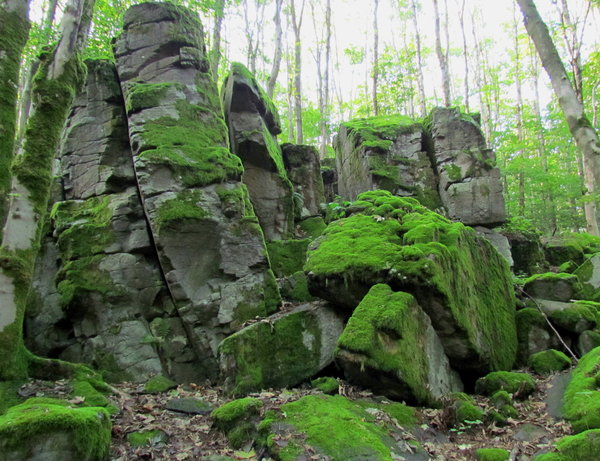
Incredible Rock Formations near the Top - Photo Credit: myheimat.de

Amazing Rock Formations near the Top – Photo Credit: myheimat.de

Friedrich Wilhelm Ferdinand Klopp (1879-1952) – Part IV

Raising his Family in West Prussia

Klopp Family Tree

Chart I – II

In 1905 Ferdinand married in the St. Mary’s Church of Thorn (today Polish Torun) his mother’s Polish maid. Her name was Rosalie Gronga (1877-1953). She was from Sampohl near Groß Konarcyzn, West Prussia. Her father owned a small farm and was at the same time at the service of the forestry department of Prussia. Ferdinand and Rosalie worked together a parcel of land similar in size and kind as mother Emma’s land in the vicinity.

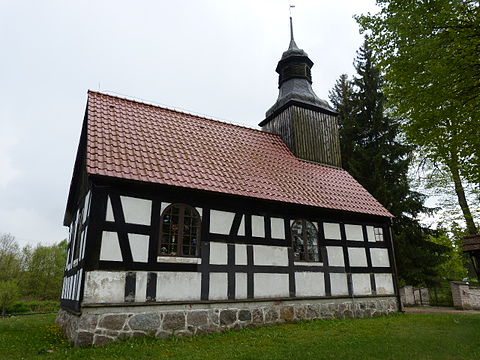
Church in Elsenau (Olszanowo)

Church in Elsenau (Olszanowo) – Photo Credit: wikipedia.org

Their daughters Margarethe and Charlotte were born there in 1906 and 1907 respectively. Then the family moved to Gostyn in the area south of Posen (today Polish Posnan), where they took over a dairy. Since Ferdinand had some expertise in the dairy business, he seized on an opportunity to get rid of the less profitable settler’s parcel at Elsenau.

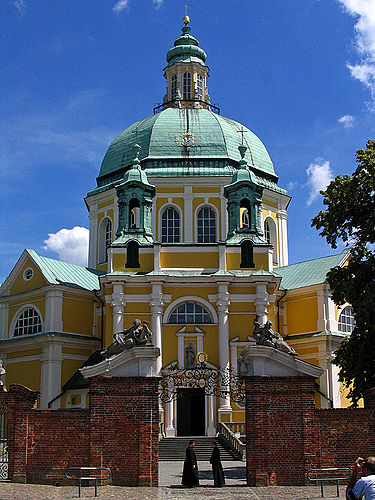
Church of Gostyn near Posnan

Church of Gostyn near Posnan – Photo Credit: wikipedia.org

The establishment of hundreds of estate dairies is directly connected to the years, when the byproducts of the sugar refineries and distilleries were intensively reprocessed for feed in the burgeoning cattle industry. In addition to this innovation the use of artificial fertilizers and the production of bone meal for fertilizing the meadows resulted in increased milk production among the successful cattle ranchers. Daughter Gertrud was born here in 1908. At the same time brother-in-law August and sister Rosa lived in Gostyn. This is a definite indication that at least in part, family connections were the cause for the resettlement.

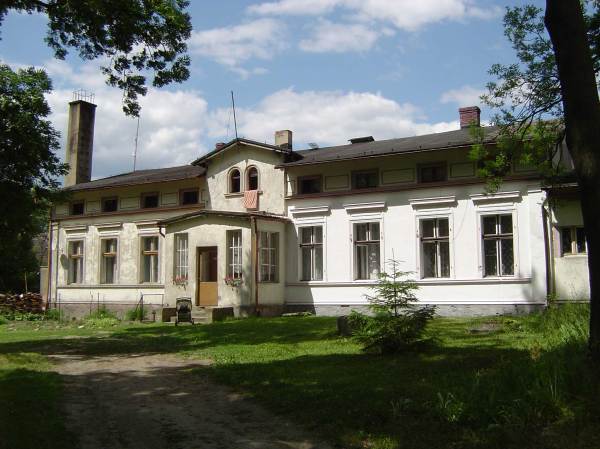
Typical Estate Manor around the Turn of the Century

Typical Estate Manor around the Turn of the Century – Photo Credit: wikipedia