Chapter 18 of the P. and G. Klopp Story – Part I

On my Moped to Father in Michelbach


It doesn’t matter who my father was; it matters who I remember he was.

Anne Sexton


50

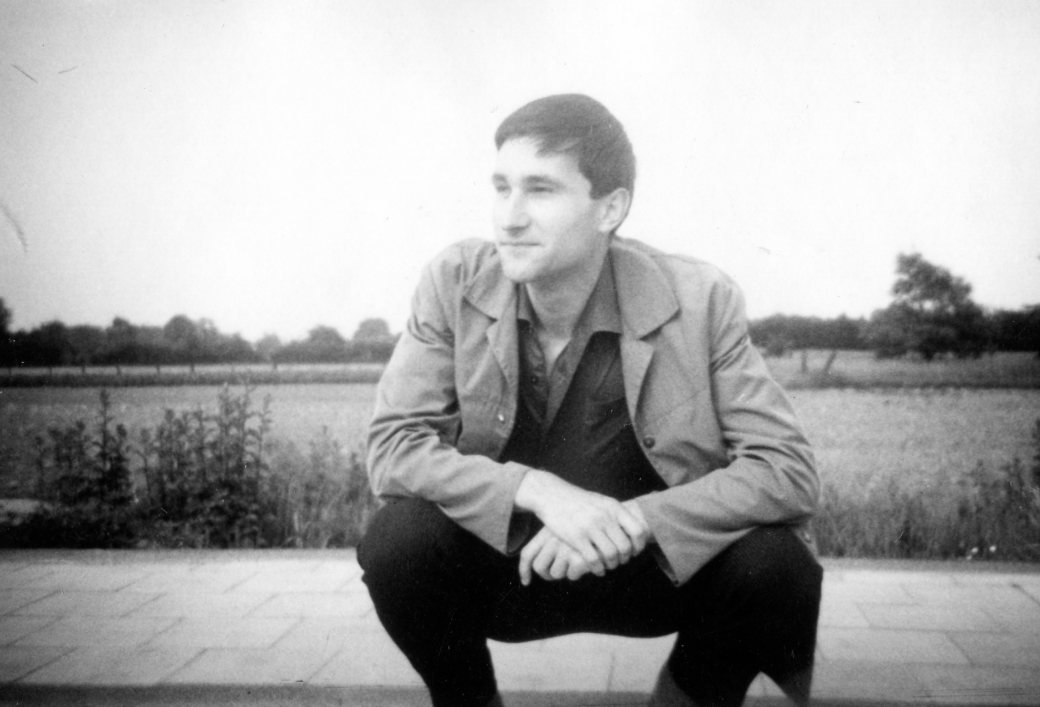
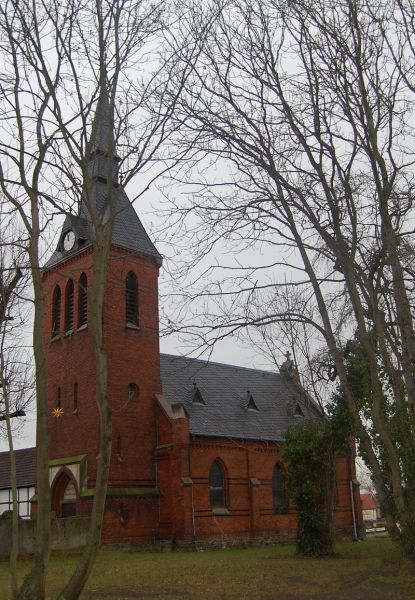
My Father in front of Erna’s House in Michelbach near Schotten

It had been more than five years, since I had seen Father. He had left one day looking for work at friends and relatives. Considering his poor health and age, he was faced with the dilemma of having to return to Wesel, where he would be dependent on Aunt Mieze’s financial support or else be content with the odd casual work, which barely supported his livelihood. Furthermore considering his intensive pride as a former successful agricultural administrator and the pain he must have suffered from the dismal failure of his farming venture in Southern Germany, I can understand his anguish and feelings of having become utterly worthless in his own eyes and in the eyes of his family. Pride and failure have never been good bedfellows in a man’s heart, and Father was no exception. As for me, I missed his presence a lot, but I was too timid to ask as to when he would come back and did not know what was going on behind the scenes. Much later I found out that with Uncle Günther’s support Mother had initiated divorce proceedings. On the basis of the law that required common residence and conjugal relations Mother was able to get a divorce in exchange for waiving any rights to financial support from Father. So to make this sad and depressing story short, Father after the divorce joined and not long afterwards married Erna Krämer, an old acquaintance from the Warthegau days, who lived in her rustic and cozy home in the village of Michelbach at the foot of Mount Vogelsberg north of Frankfurt.

Schotten_Uebersicht_Kirche

Picturesque Schotten – Photo Credit: wikipedia.org

The last summer holidays before graduation were only a few weeks away. It was also to be the last year Mother and Aunt Mieze would reside in Wesel. Uncle Günther and Aunt Lucie had invited them to live with them in Watzenborn-Steinberg (now Pohlheim), where all four would share the rent of a brand-new house that had been built by a teacher as a retirement home in the distant future. Naturally there was a lot of joyful excitement among the three Kegler siblings having been raised together at the parsonage in Grünewald and now having the chance of living once more under one roof. There was just one problem. How would I fit into the grand plan of bringing the family members together? A transfer to a high school in another province with different graduation requirements was out of the question. The solution was an obvious one. I had to stay behind and continue my studies later on in the fall, while they would move to the land of the Hessians. The decision to finish my secondary education in Wesel proved to become one of the great milestones and turning points of my life.

34

Twenty-year Old Peter

But for now at the beginning of the six-week break from school I had other things on my mind. I had to think of visiting Father. One of my old scout buddies sold me his moped for DM 50.00, a true bargain at the equivalent of ten monthly allowances. It had a peppy engine and in spite of being quite old was in excellent shape. The best part was that I did not need a driver’s license. Having always envied Klaus for his scooter, I now had my very own motorized transportation with which I could travel to Michelbach to see Father and his new wife Erna.

60

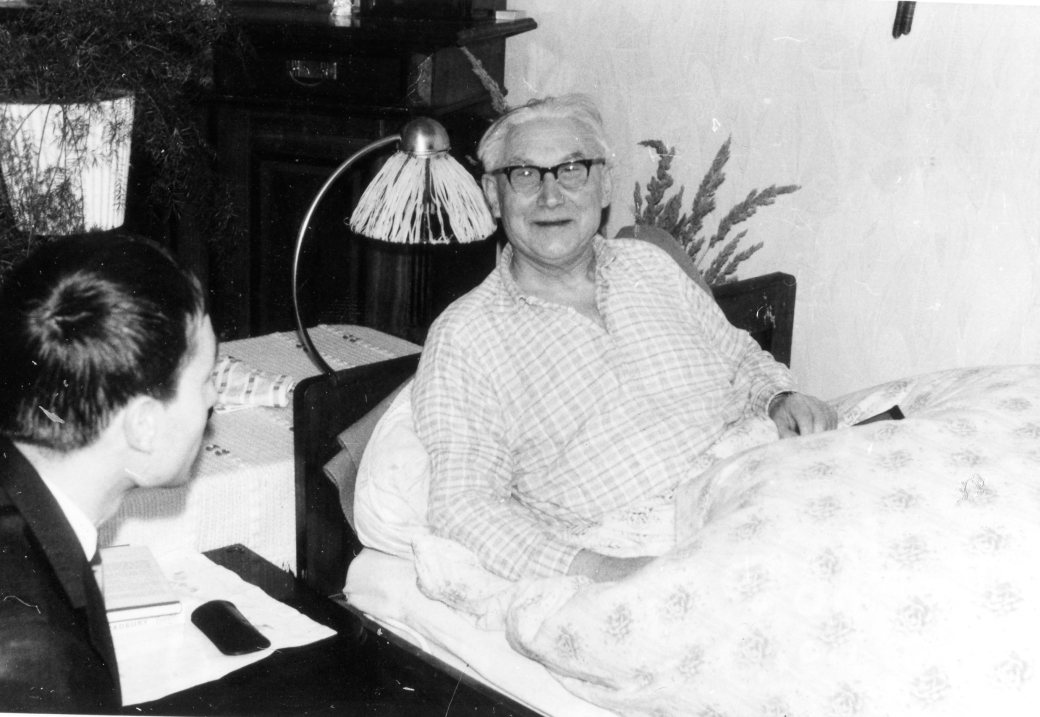
Philosophical Discussions with my Father

At a maximum speed of 50 km/h it took me all day to reach the scenic hill country around Mount Vogelsberg. Father and Erna gave me a warm welcome alleviating immediately all fear that Father might have turned into a stranger. I had departed from Wesel with these somber feelings, which had been building up due in part to our long separation, but also due to Mother’s bitter and regretful remarks that she had sometimes made about the divorce. So it was a great relief to be greeted so cordially and be welcomed as son and friend into their cozy old farmhouse. Here then I was going to spend the next six weeks, would become reacquainted with a rural environment slightly reminiscent of Rohrdorf, would get to know Father more closely through our philosophical and historical discussions, would begin to like his wife, would be introduced to her friends and relatives in the village, would taste her hearty meals albeit a little too rich in fat, in short I was here to relax and feel completely at home in an atmosphere of genuine friendliness and camaraderie.

Friedrich Wilhelm Ferdinand Klopp (1879-1952) – Part III

On a Special Mission to the United States of America

Klopp Family Tree  (Chart I – II)

Chicago fbcoverstreet com

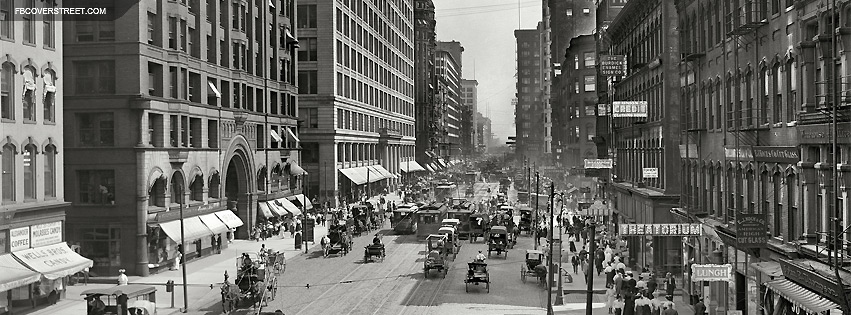
Chicago around the turn of the century – Photo credit: fbcoverstreet.com

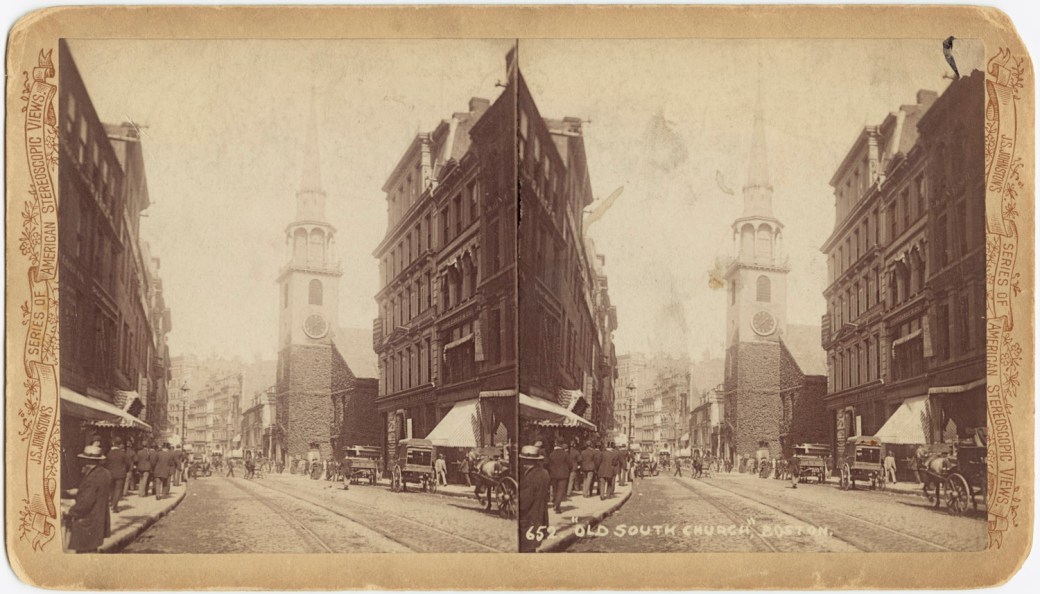
It cannot be stated with certainty whether Ferdinand’s father kicked his son out of the house or whether Mother Emma sent him on a special mission to the USA. In 1900 Ferdinand arrived there and spent almost five years in Boston, Philadelphia and Chicago. Ferdinand’s job was to research the market for the usefulness of American varieties of flour and to arrange for their purchase and export to Wolmirstedt, Germany. The mission appears to coincide with the planned acquisition of the water mill at Zielitz. Widow Emma was perhaps calculating improved marketing chances for her business.

Old_South_Church,_Boston_(Boston_Public_Library)

Boston around 1900 – Photo Credit: wikipedia.com

But Ferdinand was developing his own life plans. he became engaged to an American woman, which indicated that he may have had plans to stay in the US. But the engagement did not work out, primarily because his mother from the Old Country was pleading for his assistance. For the first time in his life ‘outcast’ Ferdinand was needed on the home front.

Philadelphia joesherlock com

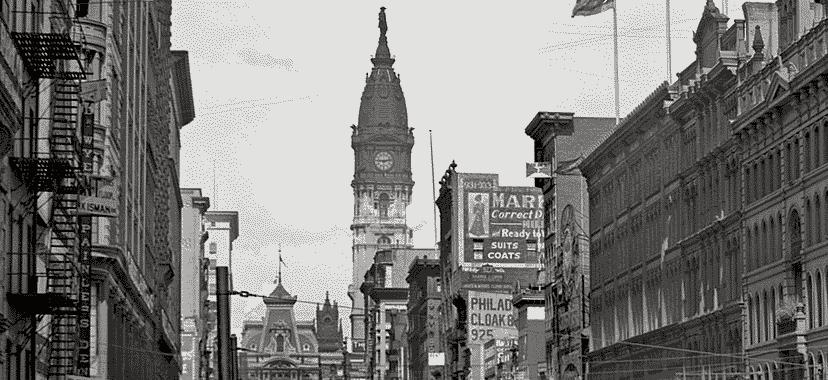
Philadelphia around 1905 – Photo Credit: wikipedia.org

He now saw himself in the role of a “savior in times of need”, returned from the US and acted accordingly at the Wolmirstedt house in June, 1905. The relations with his eldest brother Friedrich worsened and soon reached the boiling point resulting in a state of constant enmity between the two brothers and their families. Incapable of carrying on with the rope making business in this poisoned atmosphere, Ferdinand reluctantly or rather craftily passed on the factory to his brother. He did this without being clear about the ownership question with regard to the inheritance of the property. He most likely left that critical question deliberately open in collusion with Emma. When Ferdinand followed his mother to Elsenau, West Prussia (now Poland), in 1905, the property and inheritance question was left precariously hanging in the air.

Chapter 17 of the P. and G. Klopp Story Part II

A Most Curious Camping Trip

How I Met Biene

Pentecost was a long weekend and the beginning of a one-week break from school, the last one before the summer holidays. Hans had dropped out of our planned camping trip, because he had to baby-sit his younger stepbrothers and sisters. So Helmut and I got together to discuss our destination and the supplies we needed for the two and a half days. The reasons for the choice of our campsite will forever remain one of the great mysteries of my life. The nearby forests on either side of the River Rhine were within easy reach of a two- or three-hour bike ride. Our favorite camping sites were on federal land, rarely controlled for trespassing by forestry officials, miles away from the noisy highways, perfect places to be in tune with Mother Nature. The choice for this particular location was the opposite of everything I had learned to cherish during the years as a scout. As Helmut and I unfolded the map for the area of North Rhine Westphalia, we glanced over the tent icons, which marked the locations of campsites, and spotted one that bordered directly on a lake. On closer inspection we found out that it was Lake Baldeney between the city of Essen to the north and the city of Velbert to the south.
Lake Baldeney - Photo Credit: dirkosada.de

Lake Baldeney – Photo Credit: dirkosada.de

          Apart from the dead side branches of the River Rhine, there was no real lake in the vicinity of Wesel. It appears to me that the things one does not have exert a certain attraction that one often finds hard to resist. So despite nagging doubts that in the light of the hard facts we had made a poor choice about our camping destination, our decision to go there was irrevocable. Who would have thought it possible that I would have considered taking a train to go camping? Was it not totally insane to trade a peaceful refuge in the forest for the hustle and bustle of a noisy commercial campground? The Rhine was filthy and burdened with chemical pollutants that came from the Ruhr industrial area, to which we were planning to go. With the economic recovery of West Germany came the demand for energy. Mining for the high-quality anthracite coal was in high gear bringing work and prosperity to the region, albeit at a price. On windless days the coal dust polluted the air. Dirt and grime covered walls, lawns, and even the wash that women hung up to dry. Yes, it is hard to believe that Helmut and I actually went, where – as people who knew the area around Essen warned us – the sun would seldom completely break through the gray cover of a leaden sky.
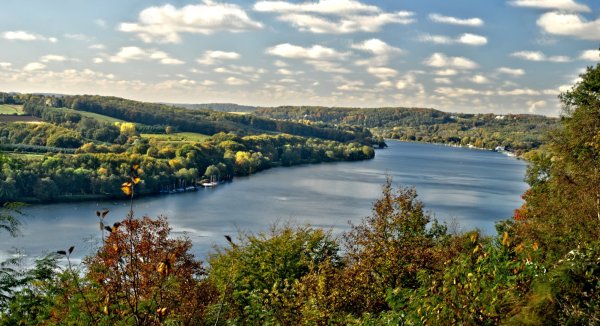
Lake Baldeney near Essen - Photo Credit: mapio.net

Lake Baldeney near Essen – Photo Credit: mapio.net

          So it came to pass that on the late afternoon of June 9th, 1962, two young men carrying heavy backpacks and holding a two-man tent between the two of them arrived at the Baldeney Lake campground. Helmut and I were pleasantly surprised to view scenery quite different from what we had anticipated to find. The sky had cleared from the cleansing action of an early morning rain. There was not even a layer of industrial haze left to obscure the blue sky. The sun shone brightly, the trees were in full leaf, the lawn impressed us with its light-green spring verdure, best of all the brilliantly shining lake reflecting the blue sky created an ambiance we had not expected in a park south of the city of Essen. Since it was still early in the season and only a few hardy people had ventured out to camp, we had no trouble finding a suitable site near the lake shore to set up our tent. We enjoyed an early supper, which I had prepared from a can of chunky soup and had heated it up over my gasoline fueled camp stove. We spent the evening listening to pop music from my transistor radio and taking in the lush-green trees and bushes that the locals call the green lung of the Ruhr region. The only reminder that the black gold was mined north of here deep down from the rich coal deposits came when we looked at the dark soles of our feet black from our bare-foot walk through the park.

          Next morning after a frugal breakfast with cereal and milk we pulled out our air mattresses into the brilliant morning sun. We relaxed reading, listening to music from Radio Luxembourg and watched people saunter by on the way to the beach. Two men, one in his early sixties, the other a little bit younger than I, caught our attention as they brought two of those so-called folding boats down to the lake shore. They can be easily transported on buses, trains, and even in the trunk of a car, because when folded together they easily fit into a large duffle bag.
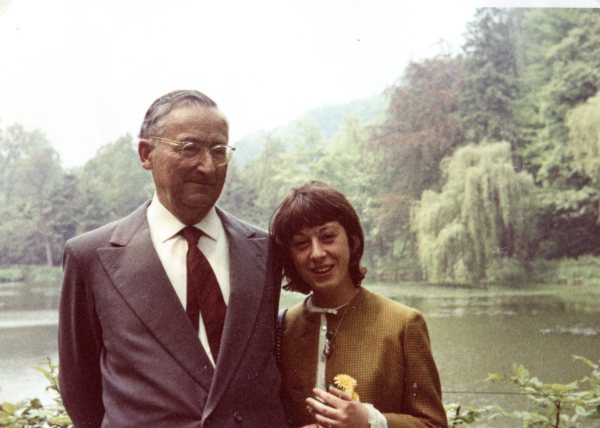
Biene and her Dad

Biene and her Dad

          For lunch I opened a can of sardines, an excellent staple for people like us traveling on a shoestring budget. Helmut having relied on me in charge of the provisions grumbled about the meal that consisted only of slices of dry bread and fish. In the meantime the boaters had returned to their tent with the folding boats. As we found out later, they were Herr Panknin and his son Walter. It seemed strange to us that they had nothing to eat and just sat there as if they were waiting for something. That something was obviously food. For now at a distance we noticed two persons approaching the camping area. As they came nearer, they turned out to be a woman and a young girl carrying baskets filled with delicious food perfect for a picnic in the sun. Enviously we looked on, as Frau Panknin and daughter Gertrud with a rather curious nickname Biene (Bee in English) unpacked the mouthwatering content of the baskets. We could see that this was culinary heaven on earth, Schlaraffenland, as a German fairy tale by Grimm so aptly describes the land, where people eat the finest delicacies in gluttonous quantities without having to work for them.
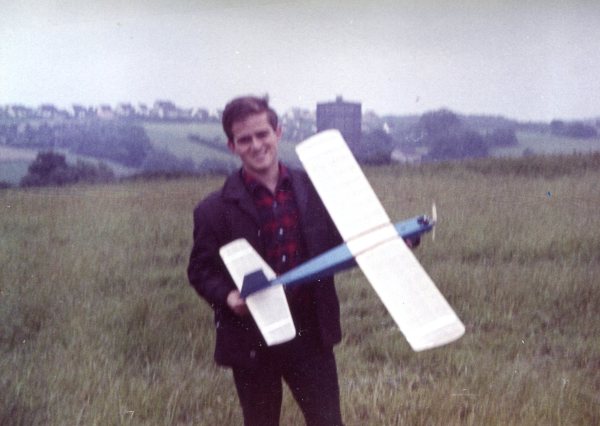
Twin Brother Walter with one of his Model Airplanes

Twin Brother Walter with one of his Model Airplanes

          What attracted me to this family, however, was not so much the food, which in comparison to our lunch was so alluring, but rather that pretty seventeen-year old girl whose first impressions on me provided a good match with the image of idealized beauty that had been growing in my mind for the past two years. Biene, from the moment I cast my eyes on her, radiated a charm whose magic did not depend on bracelets, earrings, and similar outward adornments, not on make-up or perfume, which I rightly or wrongly loathed as poorly disguised cover-ups, but rather on the very lack of all those artificial means. In short, I gazed in admiration at the girl of my dreams.
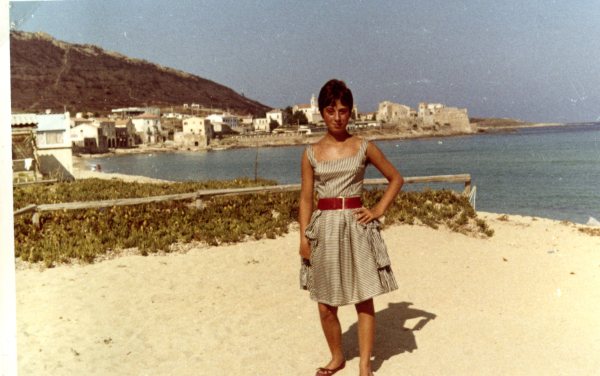
Biene at the Mediterranean Sea

Biene at the Mediterranean Sea

          Helmut and I were watching Biene and her twin brother play badminton in the open field. There was no net. The game was not very competitive. Its objective was to set new records by counting the number of times the birdie would fly back and forth before hitting the grass. Suddenly the idea occurred to me that we all could organize a mini-tournament with two pairs competing with each other for the highest score. After we had introduced ourselves, I explained the idea of a badminton tournament to be played with two pairs. Seeing that this would add a little bit of excitement, Walter and Biene readily accepted the proposal. As I had secretly wished, Biene wanted to form a team with me. I no longer recall how many rounds we played, but Biene and I always succeeded in getting the greatest number of hits. We were both very competitive, but the success in the game depended on complete cooperation. We felt good about our victories over our rivals and even more so, because we had won them together.

          It was only a matter of time, until the topic of the folding boats would surface in our conversation. Walter suggested going for a ride on the lake. Herr and Frau Panknin voiced no objections, indeed they were happy to see their twins go boating and at the same time having a little bit of peace and quiet. Somehow Helmut had managed to partner with Biene, which at first made me feel quite annoyed. But he argued convincingly that it was now his turn, since I had spent so much time playing badminton with her. As I was paddling with Walter, I soon got over my disappointment. Full of enthusiasm for his hobbies, Walter talked about his model airplanes and ships that he had been building. That was quite a pastime for Walter and took a lot of time, skills and dedication to bring a building project of this kind to perfection. I thought that just as Walter needed to have a plan and all the parts ready before he could even begin, so did I going through the same process in building a working radio. The moment Walter mentioned that he was thinking of using radio controlled devices to direct his model in the air or on water, I got quite excited and told him about my electronics projects, especially about the tube driven transmitter that provided musical entertainment to my friends in the apartment block in Wesel. Having found an area of common interest, we paddled less and less vigorously and talked all the more enthusiastically not realizing how fast time had been slipping by. When we pulled the boat ashore, we had already exchanged addresses and promised each other to mail each other schematics of electronic circuitry. Of course, what Walter did not know was that I had established a link to Biene, a connection that went beyond mere electronics. Like in an electric current, which the battery is pumping through a circuit providing energy and action to its individual parts, so warm feelings were flowing through my heart in the belief that Biene may have taken a liking to me during our badminton contest with Walter and Helmut.

Friedrich Wilhelm Ferdinand Klopp (1879-1952) – Part II

Turmoil in the Parental Home at Wolmirstedt

Klopp Family Tree

Chart I – II

Around the turn of the century the rope maker’s apprentice Ferdinand Klopp turned 21 years of age. The family structure in the overcrowded house in Wolmirstedt threatened to fall apart. The business of rope making was just beginning to secure an income to feed the family. It was also quite foreseeable that the continuously expanding family would soon reach the breaking point.

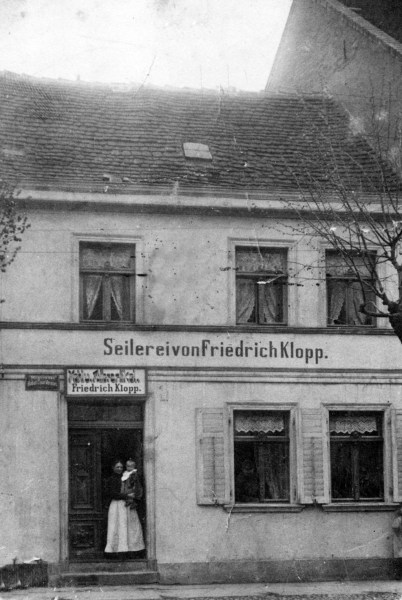
4 Seilerei Klopp

Although the siblings Jula and Karl, the nineteen-year old Rosa, the eighteen-year old Alma, possibly also the fifteen-old Anna had most likely been placed elsewhere, the parents Emma and Peter Friedrich Klopp still had to care for the remaining five sons and three daughters. In addition, they had to cope with the newly-weds Friedrich, their eldest son, and Marie-Luise Klopp, who was expecting her first child. This all happened at the same time, as my grandmother Emma was expecting her 16th child, my father Ernst Klopp.

375px-Wolmirstedt_Kirche_Josef

St. Joseph Church in Wolmirstedt – Photo Credit: wikipedia.org

In this tense and often emotionally charged atmosphere lack of control and anger were heaped onto the ‘Late Bloomer’ Ferdinand. His father P.F. Klopp turned violent and beat him up on several occasions. The dummy, as Ferdinand was often branded never forgave this kind of humiliation. Father Klopp in the meantime was seeking comfort through beer and schnaps in ‘Fatjes Hotel’ or in the ‘Anchor’. One night in May 1900 his alcoholic excesses cost him his life, when on his way home he fell off his horse.

Chapter 17 of the P. and G. Klopp Story Part I

Some Reflections on the So-called Coincidences of Life

“Coincidence is God’s way of remaining anonymous.”
Albert Einstein

Camping with Hans and Helmut
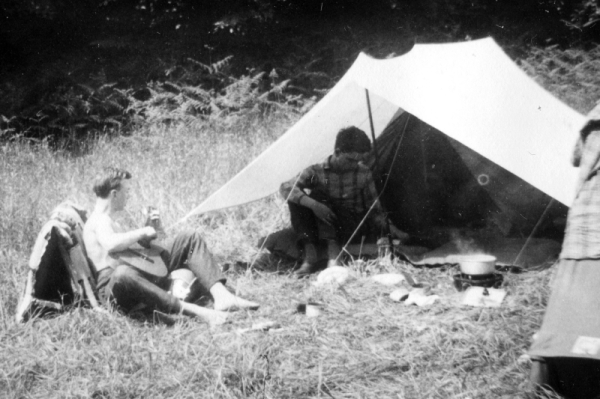
Hans Playing the Guitar and Helmut Sitting in frontofmy Tent

Hans playing the Guitar and Helmut sitting in front of my Tent

          Spring came early in 1962. I no longer played an active role in the scout movement. But my desire to get out of the city and enjoy nature in the company of friends was as strong as ever. Among my friends, who had survived the nine-year culling process at the high school, only Hans and Helmut were left. All the others were either eliminated by the academic hurdles or departed on their own looking for other ways of moving up the educational ladder. Ever since I did Helmut that great favor at the ballroom final, he was seeking my friendship and clung to me like a burr on a woolen sweater. He wanted to be included in our overnight camp-outs. When I objected on the grounds that there was not enough room in my tent, he replied that he would sleep in his own tent. So it happened one sunny weekend that three young men went out camping together, with Helmut – so it appeared – being the odd man out. Hans and I in spite of our differences shared a bond that had lasted for more than five years. Our friendship was based on experiences in the boy scout movement, on our common interest in experimental electronics, all the way back to early days on the school yard, when I was Ede Wolf and Hans one of three piglets that I was supposed to catch. Helmut was a newcomer and in a sense also an intruder, gentle, polite, simply wanting to be part of our camaraderie. Perhaps on his part it was a struggle against loneliness that intellectuals feel more intensely, but we perceived him as an intruder just the same.

13

Peter strumming a few tunes on Hans’ guitar

          It was evening, when we arrived on our heavily packed bikes at a clearing. We quickly erected our tents helping each other to get ready for the night. After we had wolfed down our sandwiches, which our mothers had so lovingly prepared, we hurried into the woods, gathered dead branches and proudly started a campfire with only one match. In no time, flames leaped up and around the kettle, which we had suspended over the fire on a wooden tripod. Helmut, in my eyes still an intellectual nerd, impressed me how well he had learned the basics of camping in such a short time, and most of all how hard he tried to be helpful. The tea water in the kettle had almost come to a boil. Hans and I ceremoniously took turns adding tea bags, plenty of red wine, pepper and other assorted spices into the steaming brew. We lifted the kettle off the tripod to prevent the alcohol from evaporating. To fortify the punch some more, I pulled from my coat pocket a small bottle of rum and poured its brown content under the approving applause of my friends into the aromatic brew. By now it was getting dark. The stars began to shine in ever increasing numbers on the canopy of a moonless sky. The fire merrily crackled and its fiery tongues shot up high casting dancing shadows of us onto the mossy ground. It was time to fill our cups to the rim, to cheer to each other’s health and happiness, and drink. Hans grabbed his six-string and entertained us for a while with Spanish guitar music, which he played superbly off the cuff. In the meantime, the cups needed a refill. The warmth of this miraculous elixir penetrated deep into our bodies and spirits. During a pause I suggested to Hans to do something together, while the drink was good and the fire burning, “Let’s raise our voices and sing our favorite scouting songs.” Helmut being a good sport supported my suggestion, even though he did not know the lyrics of most of these specialized traveling songs. He would whistle along, whenever he recognized the tune, he said. Soon a chorus in a strange blend of young male voices, guitar chords, and whistling rose above the campfire strengthened in volume and enthusiasm by the concoction from the kettle. The birds waking up in the forest may have wondered why we were making such a cheerful noise. The more the night advanced, the more boisterously we belted out the songs, which glorified the violence and cruelty of the German and Swedish pike men in the Thirty-Year War in lines like, ‘We also came to Rome, there we threw the pope from his throne.’ ‘The little nobleman’s daughter we cast her into hell.’ And ‘Hang the chaplain on the window cross’. The booze, the raucous singing, the flickering flames, the starry night, all contributed to conjure up images in our young hearts of a time wild and free, in which we participated for this one short moment and in which Helmut had become a member of our friendship circle. Long after midnight we poured the remaining dregs from the kettle over the embers and happy and sleepy crawled into our sleeping bags.

Friedrich Wilhelm Ferdinand Klopp (1879-1952) – Part I

A Somewhat Rocky Start

for Ferdinand Klopp

Klopp Family Tree

Chart I – II
Magdeburg - Photo Ctedit: wikipedia.org

Magdeburg – Photo Ctedit: wikipedia.org

On November 22, 1879 the fourth child was born in the house on Hemmsack Street in Osterweddingen near Magdeburg. Anyway, these houses – some still existing today- are traditionally ascribed to the dwellings of mill leasers and workers since the 19th century. Already in 1881 Ferdinand moved with his parents back to Jerslebe3n, spent three years there  at the Düppler Mill and in 1885 entered the Elementary School of Wolmirstedt, the birth place of my father Ernst. In the nearby town of Jersleben, Ferdinand’s father P.W.F. Klopp had found work as miller master.

Church at Jersleben - Photo Credit: wikipedia.org

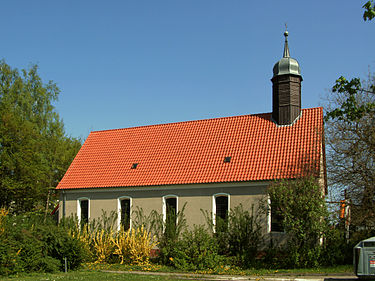
Church at Jersleben – Photo Credit: wikipedia.org

In 1893 Ferdinand was sent to Hannoversch-Münden to attend a dairy apprenticeship program. When he returned to his father’s great disappointment after only one year of training, his father forced him to work with his eldest brother Friedrich as a rope maker’s apprentice in the Wolmirstedt house. He had probably shown little interest in his work in Hannoversch-Münden and further increased the image of a good-for-nothing worker under the whip of his elder brother and rope making master Friedrich. The disrespectfully treated Ferdinand was from then on called rather degradingly clown (“Klon”).

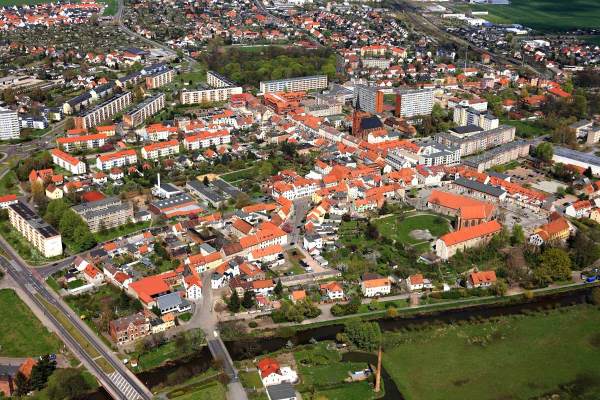
Arial Photo of Wolmirstedt - Photo Credit: wolmirstedt.de

Arial Photo of Wolmirstedt – Photo Credit: wolmirstedt.de