Walter Panknin (1898 – 1977) and His Family Ch6 Part 10

The New School

Biene wrote this post.

The school looked new and bright. Our teacher was a young, tall man with a severe expression. He didn’t smile at us once. About thirty students quietly stared at us when we entered the classroom. I recognized a girl and a boy I had seen last night at the Old House. When our teacher introduced us as refugee children from Thuringia, a tall girl with big brown eyes smiled at me. Gisela was her name, and she eventually became one of my best friends. She still lives close to Velbert, Germany. We have only seen each other twice after moving to Canada, but we have been corresponding for almost 50 years. I soon discovered that she was born in the “East” and from Eisenach, close to Gotha in Thuringia. Eisenach is renown for its imposing Wartburg castle.
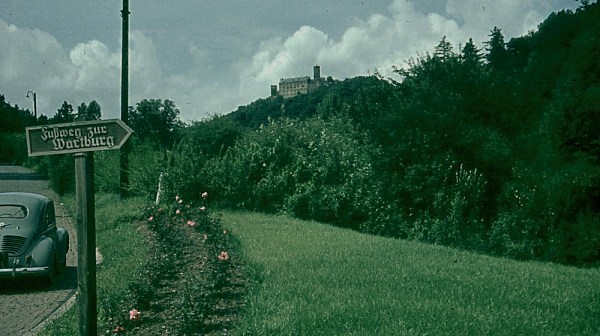
Historical Photo of the Castle Wartburg (late 1960s)

When school was dismissed, a girl from one grade higher than us approached me and introduced herself as Margit. I had briefly seen her through the window at the Old House this morning. Margit smiled at me warmly and invited me to walk back with her. She became my closest friend when we lived at the Old House. Margit was mature beyond her age. She was a motherly type and a born leader. We liked her cheerful and outgoing personality. Fights amongst us kids never lasted long because she was a peacemaker, and we trusted in her judgement. 

About 15-20 kids about our age lived in the Old House, and we spent most of our time playing in the big yard around the old building. The Old House used to be a beer garden restaurant with a bowling alley in its younger days. The hedged-in yard with old trees had been the garden area of the venue where people would eat and drink on warm and sunny days.
Walter Panknin (1898 – 1977) and His Family Ch6 Part 9

Finally Regular School Again

Biene wrote this post.

When I woke up from a deep sleep the following day, I could see through the big window that a clean blanket of snow had covered the drabness of the yard outside the Old House of Rocky Docky.  My father had heard the famous song on the radio and aptly applied it to our new abode.  It would always cheer us up to listen to our “theme song,”  We would sing it with gusto to make the old house rock.

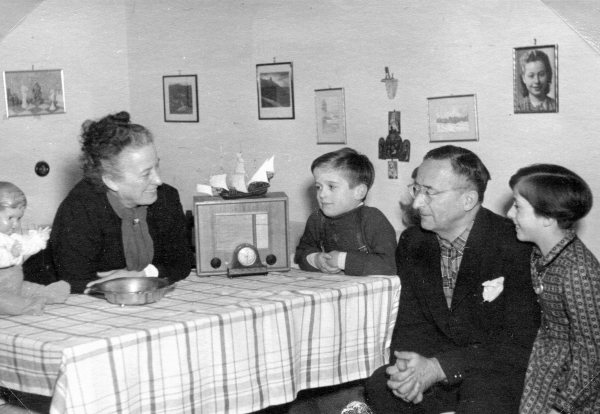
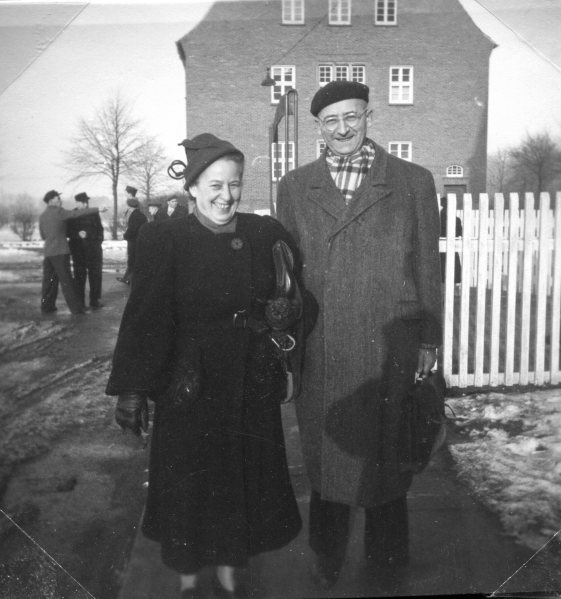
Walter and Elisabeth Panknin smile at the prospect of having their own apartment soon.

The bright morning sun made the snow crystals sparkle and dance; Despite the first signs of spring earlier, winter was not over yet. My parents were already dressed to go out. My mother told us that the manager of the refugee shelter had allocated them some funds to buy household items, utensils and other necessary equipment for everyday living. Our mother told us that before she would go shopping, she would enroll us in the nearby school called Elementary School at the Tree.   Since we had missed classes for more than a month in the transition camp in Massen,  we were looking forward to regular school life again.

Walter Panknin (1898 – 1977) and His Family Ch6 Part 8

Mama Panknin in Agony

Biene wrote this Post

At the end of it, there was a door leading to a small room with a large recessed window in the bare rock wall.  It looked like a prison cell, except there were no bars on the window.  There were two sets of bunk beds, a table with four chairs, a small table with a two-burner hotplate and a small dresser.  “This is your temporary place until your apartment is completed,” the manager told us.  And in response to my parent’s questioning glance, he added, “This may take up to two years.  We just don’t know where to house all you people,” he grumbled, leaving us to attend to the other families.

We all stood dumbfounded until my mother’s loud sobs broke the silence for a moment.  She collapsed on one of the beds and cried and cried.  I had never seen my mother cry like that before, which shocked me deeply.  My father looked helpless.  Eventually, he started stroking my mother’s back.  My brother and I climbed onto our top beds, completely bewildered.

Mama Panknin Making Tea on the Hot Plate

Eventually, my mother’s crying stopped.  She rallied and took us to the outhouse.  She found a clean wash basin to scrub the grime off our face and hands’ long dusty truck ride.   She magically produced some bread, butter, cheese and jam. She also made some weak tea on the hot plate.   We were so starved; it tasted heavenly. Then she hugged us warmly and said,  “With God’s help, we’ll make it through.”

Walter Panknin (1898-1977) and His Family Ch6 Part7

This Old House

Biene wrote this post.

The driver jumped out of the cab, opened the truck ramp, and started unloading the luggage and helping us jump out.   Dazed and bewildered, numb from the cold and very hungry, we all stood speechless for a moment.  “Take your belongings and follow me,” the driver told us.

When the Panknin family had moved into this dingy, rundown place in 1954, the single ‘THIS OLE HOUSE” had just been released in the US and became very popular in Germany with the version in German. The song provided some joy despite the depressing living quarters.

He led us around the extremely long building to a courtyard with a row of several outhouses.  “You can go there in a minute,” he told us, “but let me show you your quarters first. This old building used to be a pub and a bowling alley,” he continued,  “now it has been converted into an emergency shelter for people like you.  I’ll introduce you to the manager of this establishment.” He laughed and pointed to a man who had just stepped out of the entrance to receive us.

THIS OLE HOUSE IN GERMANPapa Panknin liked this song as it gave a fitting description of the refugee camp they now had to live in until they had found an apartment.

We were the first ones to be led to our room.  We had to go through a long hall with several big sinks, laundry tubs and a wash line with a few rags drying.  There were brooms, mops, pails, garbage cans and other equipment stored along the walls.  The evening light coming in through oversized windows could hardly soften the drabness of this dingy hall.

Walter Panknin (1898 – 1977) and His Family Ch6 Part 4

Imagination Run Wild

Biene wrote this Post

Although I missed my best friend in Gotha, I made many new friends. After school, we would play on the large meadows surrounding the buildings. Contrary to our parents, the restricted living area in that small room was not an issue. We had lots of space and freedom to roam on the meadows and green spaces surrounding the barracks.
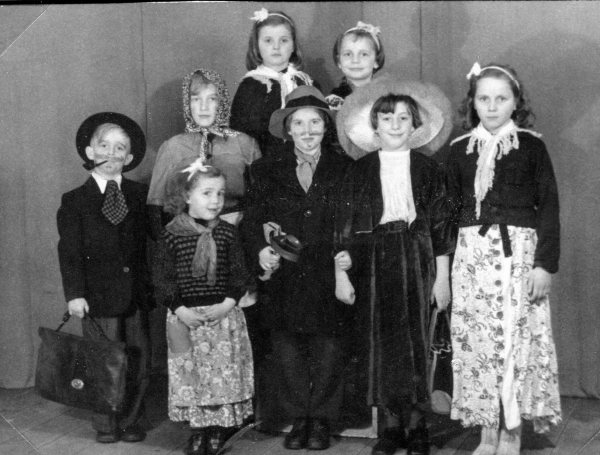
One day we ventured as a group out of the camp confines to a nearby treed area to play hide-and-seek. It was almost getting dark when one of the kids shouted, “Let’s go back. A dangerous man is trying to catch us!” We raced back to the camp gate with pounding hearts and breathlessly told the attending guard that a dangerous man had pursued us. Although I found out later that none of us had seen this man, we were sure we were telling the truth. In our minds, he existed. I guess this is a small example of mass hysteria. We never ventured into that forest area again.

Putting on a play (Biene with the big hat)


Later I will tell you about our move to the Old House of Rocky Docky in the Rhineland region of Germany. But now, I want to talk a bit more about our experiences in the refugee camp in Aurich, East Frisia. Most children live in the present. I have always liked to live in the present moment to this day. However, writing my blog now forces me to relive the past.

Walter Panknin (1898 – 1977) and His Family Ch6 Part 3

The Picky Eater

Biene wrote this post.

Although we did not like to eat in the crowded and noisy dining hall, my brother and I adjusted quickly to our new life in the camp. I, in particular, was a very picky eater and often felt nauseous just from the food odours permeating the building. My father had experienced extreme hunger as a POW. Therefore, he had no sympathy for me and would get very upset and angry when I refused to eat certain foods or left something on my plate. Eventually, my mother would feed us separately at different times so my dad could enjoy his meals without stress.

The Panknin Family 1954

After a long break in Dortmund, my brother and I could go to school again right at our camp. Makeshift classrooms were set up in one large lecture and meeting hall. We sat at round tables, which was a nice break from individual desks. I always loved school and even enjoyed homework. Since one teacher instructed us in a multigrade setting, we often had to work independently. Math problems were my favourites because we could read or draw when they were completed. I would always draw beautiful princesses in elegant dresses.

I remember the day I received my first report card. My brother and our friends walked across the big courtyard back to the living quarters. All of a sudden, we were stopped by a stranger. “Well,” he asked, “who of you children received the best report card today?”  Immediately some of our friends pointed at my brother, some at me and some at another boy. “Let me see your report cards,” the man demanded. Timidly we handed them to him. After studying them for a while, he handed them back except mine. “You have the best,” he said, “congratulations, you deserve a reward.”  He reached into his wallet and gave me some money, about $5.00. I was so stunned that I could barely say thank you. I had never had so much money before. My dad was so proud to hear the story that he matched the stranger’s reward.