Baroness Anna von Waldenfels (née Klopp) – Part IV

The Panwitz Estate

In 1927 Anna and Ludwig von Waldenfels acquired the estate Panwitz (today Polish Panowice). It was located 15 km southeast of Meseritz, East Brandenburg (today Polish Miedzyrzcecz). Originally it was a knight’s estate of about 300 ha, half of it was land under cultivation and pasture, the other half was forest. The building had been in the sober and down-to-earth style constructed following the trend dominant around the time of World War I.  The two-storey manor with its pseudo-classical columnated entrance and its three-storey high addition of a tower is located in a park in the centre of the village. At the south and east it was partly surrounded by a wall.

In the mid 1920’s the German government has set up a special office at Meseritz to deal with the resettlement of those farmers, who had been dispossessed and expelled from their land  in West Prussia and the Posen territory. To provide them support for their livelihood new settlements were established, in which Panwitz was included. By granting credits for the exchange of real estates to the former land owners the German government was able to push through the acquisition of large tracts of land to help the dispossessed farmers from the former eastern provinces. Through this fortunate turn of events, Ludwig von Waldenfels took possession of the new estate in Panwitz. Ludwig and Anna appeared to have profited the most under the new settlement provisions of the agro-political government programme. In the written records it was mentioned that in 1930 the village of Panwitz under the mayor W. Ihnow was still in the re-settlement phase. By 1939 the village had 32 households of 147 German inhabitants.

Ludwig von Waldenfels and his ‘Baroness’ Anna, as she was from now on very pleased to be called, were by 1930 well established here. Many relatives began to drop in for a visit. Among them were captain and company commander Gerhard Kegler (my uncle), who was stationed at Züllichau in 1934 and brother-in-law Ernst Klopp (my father). Anna’s sister Meta spent in some years entire months at the Panwitz estate. ‘Castle Panwitz’ had turned out to be a beloved family centre for the entire family. For the development of this feeling the arrival of Anna’s mother Emma (my grand-mother) had greatly contributed. She spent the remaining 14 years of her life at Panwitz. Here in the living- and diningroom at the warm fireplace she devoted herself to her dreams. Of unbroken and enterprising spirit even until her very old age, she used to encourage her visiting children and grandchildren with statement like this, “Come and let us make plans”. In the tower chambers of the manor she had her own private apartment.

In 1996, Eberhard Klopp (a cousin of mine), the author of the Klopp family chronicles, noticed that the wooden floors and staircase to Emma’s tower had become totally rotten and had collapsed.
Baroness Anna von Waldenfels (née Klopp) – Part III

The Long Arduous Road to the Panwitz Estate

While World War I was still raging and devastating Europe, Anna’s husband Ludwig von Waldenfels was reactivated into the military service on July 27th 1918 and served as supervising officer at a penal camp at Oberhaus near Dachau until demilitarization in May 1919. Now already 43 years old with a modest pension Ludwig had to worry about his family’s future. After his high school graduation in Munich he had taken a three-semester training course at the forestry college at Aschaffenburg between 1894 and 1896. Therefore, he had some basic agricultural knowledge. On the northern edge of Passau the couple acquired the estate Kastenreuth. On the hilly terrain the work in the fields was not very cost effective and the harvests appeared to have been quite meagre.  Already by 1922 Anna and Ludwig sold the property to the physician and researcher Professor Dr. Wilhelm Kattwinkel.

In the same year they acquired the estate Neuhof (today Polish Garbek) in the county of Schlochau. It was located right at the border of the newly formed ‘Corridor’ between the remaining part of German West Prussia and the new state of Poland. According to my cousin Eberhard Klopp’s research my Uncle Hermann (1892-1937) had passed on the 200ha property to his brother-in-law Ludwig. As a result of the Versailles Treaty the Polish border was moved within a few metres of the estate boundary. It ran about 300 metres east of the village street alongside a pond still existing today. In a 100 m direct line of sight was the Polish hamlet Zychce (German Sichts). In 1921 the West Prussian rural bank founded ten settlers’ places in Neuhof. Baron von Waldenfels and his wife Anna acquired the remaining parcel with the even today well-preserved estate building on the left side of the village street.

In the village of Neuhof of some 200 inhabitants Ludwig von Waldenfels worked the 810ha farming property and served at the same time as mayor until 1927. “The inhabitants originated mostly from the stolen parts of West Prussia and partly from Münsterland (Münsterland is a mostly flat, agricultural region in North Rhine-Westphalia, Germany).  Only 14 people were speaking Polish.” When the family von Waldenfels left Neuhof in 1927, their property was also parcelled into seven more settlements.

It is definitely unimaginable that the couple von Waldenfels accustomed to the big city life style of Metz and Berlin would feel at home in the solitude of a remote little border village. In the year of their departure in 1927 brother Ernst Klopp (1900 – 1964 my father) found employment and stay during the summer harvest. Mostly likely he participated in the preparations for the move out of the second agricultural venture. In the remote bush, heather, and meadow landscape with a few deciduous woods the family von Waldenfels managed to last barely five years.

Now brother-in-law Herman Klopp jumped into action as helper in a new government initiative. Having been the administrator of the copper mill near Meseritz, East Brandenburg (today Polish Miedzyrzcezc) he was familiar with all locally pertinent facts. He made a concrete proposal to the couple von Waldenfels, which turned out to be a stroke of luck.

Baroness Anna von Waldenfels, neé Klopp – Part II

Conversion to Catholicism

Anna’s mother-in-law living at Etzenhausen near Dachau insisted that she and her baby converted to the Catholic faith. This intent according to the Wolmirstedt-Zielitz family clan represented the ultimate of impertinence towards the family, which from earliest times has presumably adhered to the Lutheran confession.

As long as Ludwig Max von Waldenfels has been for 16 long years serving in the same Metzger regiment (1905 battalion assisting officer, 1909 promoted to senior lieutenant, 1913 captain and company commander), religious questions played a minor role in Ludwig’s life. However, the choice of his wife was an entirely different matter. Anna did not befit his social status.

Anna and Ludwig must have been trying for years to navigate around the cliff of Ludwig’s mother’s adamant position. Now because of mother-in-law’s pressure and of related inheritance and financial questions, the situation demanded a sacrifice, from which there seemed to be no escape. The future husband had earlier introduced Anna to his mother as a ‘society woman’. The wedding took place on October 19, 1916. At the same time little Fritz Georg most likely was baptized into the Catholic faith. Obviously money and inheritance matters accelerated the decisive step.

Twelve years had passed until the Klopp offspring Fritz Georg received the prestigiously sounding name von Waldenfels now even with the blessing of his grandmother and the Catholic church. Now the Klopp family of Wolmirstedt and Zielitz could no longer despise Anna for her loose life style they had accused her before, but her conversion to catholicism definitely made her a renegade in their envious eyes. It made no difference whether her change of religion was based on Jewish or Catholic causes. Despicable was everything that deviated from the Wolmirsted-Zielitz norm, even at the risk of having confused in their stupidity apples with pears.

The Story of my Aunt Anna Baroness von Waldenfels

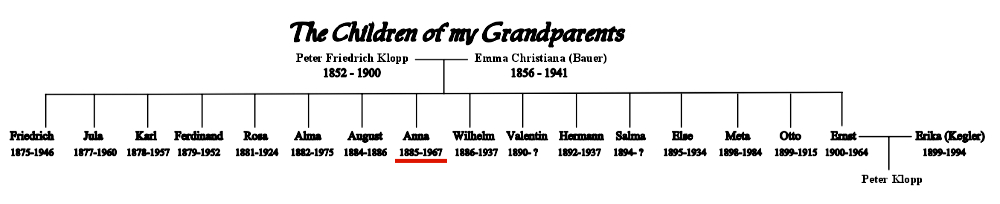
Chart I Peter and Emma Klopp Tree simple

A couple of years ago, as some of my early followers may recall, I published the life stories of the first seven children of my grandparents. My father was the sixteenth and last child of this extremely large family, an unusual occurrence even in the world of the 19th century. My posts are based on a book published by my cousin Eberhart Klopp.

Now that Book I of the Peter and Gertrud Klopp has been published in its entirety, I can turn my attention again to the remaining children, my aunts, uncles and my father Ernst Klopp. The life story of my aunt Anna is particularly fascinating, as she was the one endowed with a large portion of beauty and intelligence with that extra portion of luck, which enabled her to catapult herself from the lower-middle class segment of society into the glorious realm of nobility.

The Long Road to Castle Panwitz – Part I

Baroness Anna Auguste Luise von Waldenfels (née Klopp)

Anna was born, as stated by the author Eberhart Klopp, as the product of a passing state of euphoria in marital relations after the parents Friedrich and Emma Klopp received their share of the inheritance from Emma’s grandfather Johann Christian Bauer (1792-1883). Anna, the eighth child, was born on September 29, 1885 in Jersleben, was baptized by Pastor Heyne. After the completion of the elementary school program in Wolmirstedt she enrolled around 1900 in a trade school in Berlin, a early form of business college for women with room and board facilities for non-resident students.

As a 15/16 year old student she somewhat experienced from afar the narrow-minded domestic squabbles between her father and her brothers Friedrich (1875-1946) and Ferdinand (1879-1952) as well as her mother Emma being discriminated against back home at Wolmirstedt. She spent in 1902 or1903 some time as au-pair girl in an Irish household, where she acquired her English language skills.

In 1903 she applied for a secretarial position at the administration at the garrison in Metz, Loraine. After she was hired, she became acquainted there with Lieutenant Ludwig Max Baron von Waldenfels (1875-1954). Ludwig entered the officer’s training program  at the First Field Artillery Regiment in Munich in 1897 and after being promoted to the rank of Second Lieutenant he became a member of the 4th Bavarian Infantry Regiment in Metz.

When the liaison between the protestant miller’s daughter and the titled Lieutenant von Waldenfels became known, it created mixed feelings with the future mother-in-law Maria von Waldenfels (née von Mühldorfer), whose husband was not involved, since he had already passed away in 1898.

The birth of Anna’s son Fritz Georg was not exactly a joyful event for the catholic von Waldenfels family. Anna gave birth to her only child neither in proximity of her mother-in-law nor in the nebulous circle of the officers’ wives of Metz. In preparation for her ‘heavy hour’ she decided to give birth in the impoverished pioneer’s cabin at her mother Emma in the West Prussian village of Schönsee-Weihe near Thorn. In the church of Schönsee (today Polish Kowalowo Pomorskie) Firtz Georg was baptized into the protestant faith. The offspring of the much later performed official marriage ceremony offered a great opportunity to the Klopp-Weihe family clan for deriding comments, not omitting even adventurous speculations about Anna’s Jewish background. The actual truth for the rumours trickling down to Wolmirstedt and Zielitz may be found in the reaction of the Bavarian mother-in-law Maria von Waldenfels.

To be continued next week …


Halleluja by Leonard Cohen

An Amazing New Year’s Greeting

For New Year our friend in Germany sent us a couple of videos of his family celebrating Christmas, enjoying an impressive fireworks display on New year’s Eve and of his wife Edda playing the Halleluja by Leonard Cohen. Edda is the granddaughter of my Uncle Bruno. If you look at the Kegler family tree, you will find her on Chart IIc. Never have my wife Biene and I received a more touching and more precious New Year’s greeting than this video. A big thank you goes out to Dieter, Edda’s husband, who made this beautiful recording! It is my hope that you like it as much as we do.

Kindred Time Travel Narrative by Justin Shaw

Please note: Justin’s great-great-grandparents are my grandparents Carl and Elisabeth Kegler. Inspired by an account of my uncle’s (Günther Kegler) near death experience on the battle field in WW1, he wrote this highly creative piece and gave me his kind permission to publish it as a guest post in the Klopp Family Blog.

Kindred Time Travel Narrative

A deafening explosion burst nearby, sending a fountain of soil all around me. I fell to the floor, knocking the air out of my lungs. As I rolled over and gasped for air, another shell exploded near the trenches not too far away from me. Paralysed for a second, my mind started whirring through the countless questions that arose from my situation: Where am I? How did I get here? Am I going to die?

Yet, I had nowhere near enough time to think as a round of bullets caused me to dive into a trench. Spitting out dirt, I looked up through the smoky air to see a face looking down at me.

“Who are you?”

A young man in his early 20s wearing a military uniform peered down at me. I coughed, preparing to answer him, when I realised that I had just understood what seemed to be perfect German.

“What- what year is it?” I managed to sputter out, the words finding themselves without me having to attempt to translate.

“1917- what’s going on?” the German man shouted, confused. I would have answered him, but my mind was going through a thousand thoughts at once. I felt myself falling to the floor, but before I hit the ground, I was gone.

Gasping for air, I shot up to find myself half-asleep at my kitchen table, head buried in an old family tree. I picked myself up cautiously, half-expecting to find myself back on the Western front. I blinked once or twice, taking a moment to assess my situation. My experience felt surreal, but too lifelike to be a dream. Rubbing my eyes, I was still feeling remnants of the smoke and dirt that filled the air of the battlefield. World War I… Germany… Slowly things began to click into place. I turned towards the record of my family’s history and began to flip through the pages of information feverishly, looking for a clue as to where I had just been. Pouring through the text, I skimmed for any clue related to what I had just witnessed. Finally, something caught my eye.

It was a distant relative, Gunther Kegler. He had been born in Germany in 1894, and had joined the army at the beginning of WWI. In 1916, he became the commander of a machine gun company and traveled around Europe, fighting in many different battles for the Imperial German Army. Next to the description I found an aged picture. The man was much older than the boy I had seen in the trenches, but his face was familiar.

As I gently touched the photograph, I began to slip away again. I found myself back on the battlefield. Quickly, I threw myself to the ground expecting hails of bullets, but this time, none came. The battle must be over, I thought as I pulled myself up relieved. I began to look around the large expanse of land that had been home to the violence and human misery I had briefly witnessed before.

Trying to find my only link to this place, I scanned the scene for Gunther. As I looked around the battlefield, my eyes found large large craters from shells, and extensive networks of trenches carved like scars into the ground. My gaze came to rest on a large military truck. It was filled with corpses, a gruesome image. But my expression froze with surprise when I saw Gunther lying in the hearse. I rushed over. This didn’t make sense, Gunther didn’t die in this battle! What was going on?

“Gunther!” I shouted loudly. I ran over to the edge of the truck. He was lying still, and it looked like he had been very badly injured.

“Gunther!” I called again desperately. Had history changed itself? Was it my fault?

Gunther coughed gently. He was still alive! I pulled him out of the truck and glanced around worriedly. Nobody seemed to be around. Straining myself, I lifted him onto my back, barely able to stand under his weight. I began to slowly lumber over to the camp in the distance.

After struggling forward slowly for what felt like hours, I made it to the tents. Looking around frantically, I saw wounded soldiers slowly shuffling into a hospital tent. Pulling Gunther towards them quickly, I called out for help.

Weary eyes turned to face me, but I was already gone.


Works consulted: “The Kegler Tree.” The Peter and Gertrud Klopp Family Project, klopp-family.com/our-family/the-kegler-tree/. Accessed 5 Apr. 2017.