Our Son’s Guest Post on Norway

A Bridge of Stone in Norway

by Robert Klopp

As my father turns 75 this week, I felt compelled to finally fulfill a promise to make a contribution to his Blog with a personal narrative, touching on some of his favorite themes: history, heritage, and family.

Fjord

Several months ago I received an invitation to visit Norway to attend a conference. I usually would not attend such things, but I had some vacation to use up and going would give me an opportunity to meet up with a school friend that I hadn’t seen in almost exactly 20 years. So I registered and when the time came, I headed north.

Travelling in Norway can be strange sensation if you have grown up or travelled in British Columbia, as there are times you would swear you have just been teleported there.   (There are of course many areas that are uniquely Norwegian.)   Having visited the city of Stavanger, I was now driving east to Oslo where I had to be at the end of the week. The weather was what it should be near the beginning of spring, grey and rainy bordering on snow, so I was considering leaving the country roads I was on and getting on the main highway to drive through to Oslo, to spend an extra day there.

Norway1

For some reason, shortly before getting to the highway, I decided to stop at a geographic tourist information point. The map contained many geologic points of interest of the area. I gave it a quick look and was about to go when something caught my eye: a place named “Terland klopp” and it wasn’t far from where I was.

Norway2

So off I drove, curious to what I might find. As I headed inland, the landscape quickly changed. I crossed the main highway and the road became smaller and traffic almost disappeared. Thinking I had missed the location of which was likely to be only a small historic site; I was already looking for an opportunity to turn around. Fortunately this was not possible due to the road improvement work that was in progress.

Just then, over the river to my right, a stone pedestrian bridge appeared. Impressed at this beautiful simple structure in the middle of nowhere, I stopped in the only space available and got out. A sign, in three languages, provided some information. Terland klopp was built about 200 years ago – the longest bridge of its kind in Norway.   There was no information on who built it – but I figured it could have been named after the builder, or perhaps one of the main users.

Bridge

After having photographed it from as many vantage points as possible, I explored a bit more. Heading further up this valley, the dark granite walls on either side continued to rise and became steeper.   I soon reached a pair of lakes.   These mirrored the extreme calmness I felt around me. I stopped to take it in as everything, the lakes, mountains and fog blended into each other, part of each other.

Regular readers of this blog will know that my father lives in a fairly sparsely populated area of British Columbia. And while this particular region of Norway is more like the coastal areas of British Columbia, I couldn’t help but think that perhaps there would be something here that would explain the deep attachment of my parents to the place which they eventually made their home.

Egersund, which is the nearest major town to the bridge, is an ancient port on one of Norway’s best natural harbors. It was named after an Oak forest that used to exist there.   Historically people have lived here since several hundred years BC.   As a historical reference marker typical of Europe, the first church is mentioned in 1292. The ancient Norwegians (aka the Vikings) had travelled extensively and had been known to cross and settle in Northern Europe – perhaps there was some ancient link?

Ship

I finally got on the highway to Oslo.   Later in the week, I hit the internet trying to find further potential links to this region, either through language, person, or history. It took some time. With some careful research over the next days the mystery was solved.

As it turns out, the key was located right next to the bridge.

Map

Across the 42 “Sidalsveien” road I was travelling on is a smaller one called “Terlandsveien” that leads up a hill to some farms.   In Norwegien, “-veien” is fairly common suffix that translates to –you guessed it- , road. So if “Terland” is the name of the road, it was also the name of the bridge. But Bridge in modern Norwegian is “Bro” and “Bru” in ancient Norwegian, so what exactly did the klopp mean?   Again the solution lay nearby, a small group of houses named “Kloppa”.   This translates to small bridge. Further searching also led me to “Kloppen”, which means footbridge in Norwegian.   So, with slight bitter-sweetness, I had found the explanation.

Epilogue: As I was shutting down my computer, I found a reference for a small community incorporated into Tønsberg, not far from Olso. Tønsberg is generally regarded as the oldest town in Norway. In the late medieval period it served as one of three Hanseatic trading posts in Norway, with ties to Northern Germany. Tønsberg is a part of Vestfold, which is mostly dominated by lowland and is among the best agricultural areas of Norway. And that community is called Klopp. And there is not bridge anywhere in the vicinity….

Creating and Managing Menu Items for your Family History Blog

A Very Basic Tutorial – Part III

Top User Menu

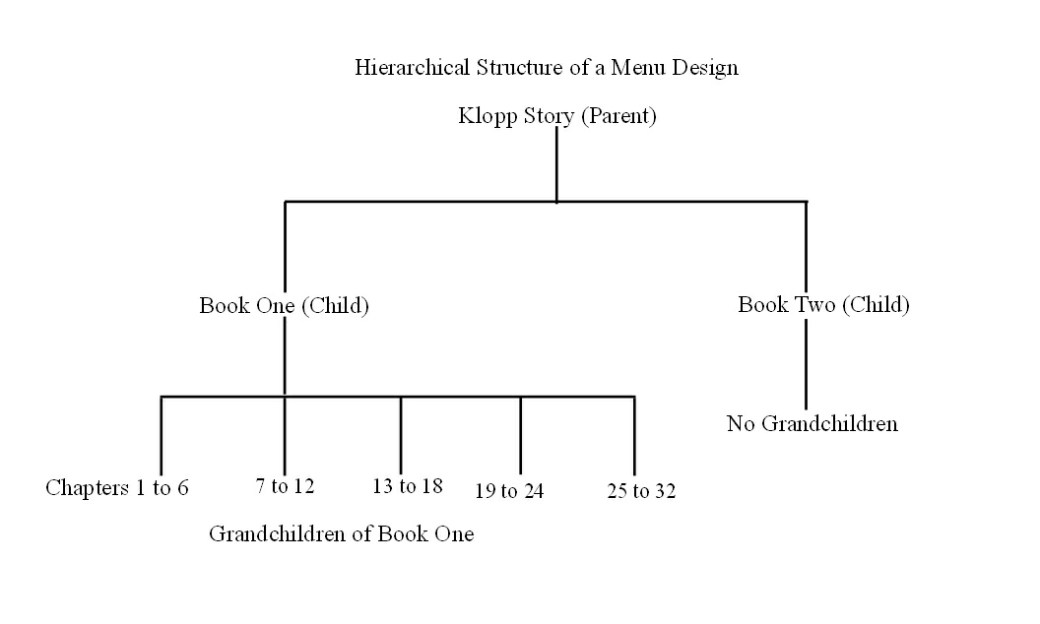
With this post I will conclude the tutorial sessions on creating and managing menu items. Click Part I and/or Part II, if you did not yet read them. I will use the ‘Klopp Story’ tab above as an example of the hierarchical nature of a more complex menu structure.

Hierarchical Structure of a Menu Design

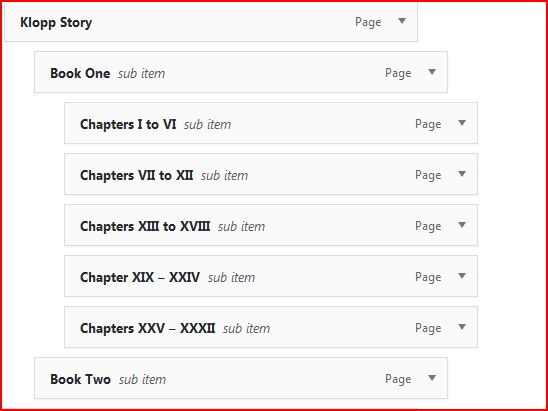
As you can see from the tree diagram above, the ‘Klopp Story’ page (Parent) has two children (sub items) ‘Book One’ and ‘Book Two’. The latter is still empty waiting for the Grandchildren to be written. Book One has five sub items, which are the grandchildren of the ‘Klopp Story’. As the diagram indicates, I had to create seven pages all together. To avoid confusion, it is important to note that each page you create must have its own unique name.

Partial Menu Structure

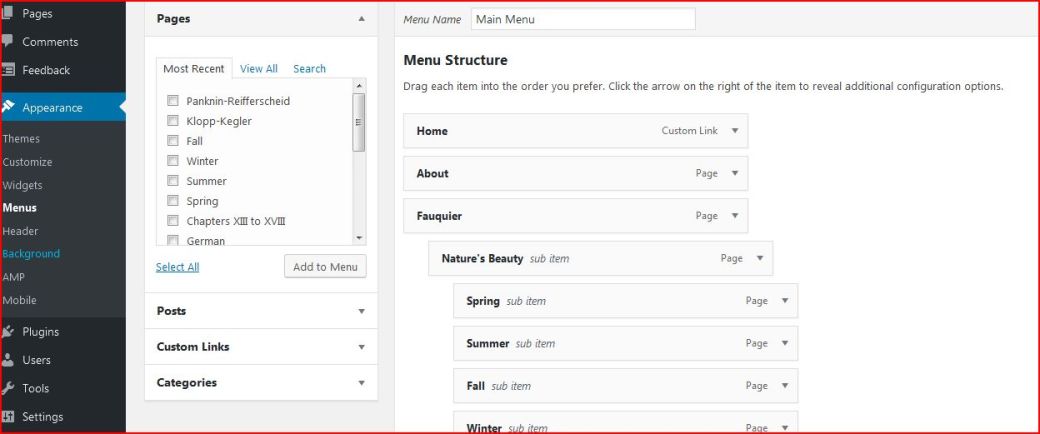
In the ‘Menus’ section that you control as the administrator you find that your sub items may scattered all over the place in a fairly unorganized fashion. Click and drag the sub item ‘Book One’ under the ‘Klopp Story’ and move it a bit to the right to make it a Child (sub item). Then click and drag the Chapter sub items and move them a little more than before to the right as shown on the diagram above. Treat the ‘Book Two’ sub item the same way as the ‘Book One’ item. Make sure to save the changed main menu, when you are done. Please note you can experiment without fear of messing up your blog site, since you can always the Menus section later and delete all the undesirable pages. Happy Blogging!

Creating and Managing Menu Items for your Family History Blog

A Very Basic Tutorial – Part II

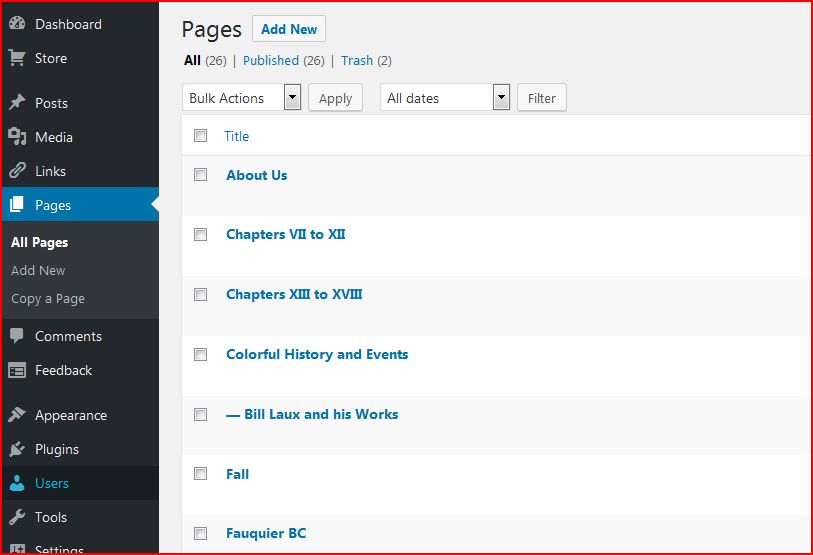
Once you created a new page on your family blog (see Part I), it is actually quite simple to fill it with content from your posts. Let’s assume you just posted the first chapter about your grandparents. To copy the post onto your new page, e.g. ‘My Grandparents’, you follow the standard editing commands. Click anywhere on your post and select its entire content by pressing Ctrl + A and then copy it by pressing Ctrl + C. Then to the left of your post click on Pages and then on All Pages at the drop down menu. Then click on the list item that contains your page. Once you see the page on the computer screen, click at the top of the page and press Ctrl + V to paste the entire post content. Make sure to save the page before leaving it.

Now when you post chapter 2 or the next part of chapter 1, go through the same process, but make sure to paste the new content at the bottom of the previous post. That way you will allow your readers to read your family history in perfect chronological order.

In Part III I will introduce you to multiple pages and explain how to structure them to accommodate the various branches of a family tree. Until then happy blogging!

Creating and Managing Menu Items for your Family History Blog

A Very Basic Tutorial – Part I

The klopp-family.com blog is now in its third year. While I absolutely claim no expertise in setting up and managing a blogging website using WordPress, I do believe that I have learned a few things during the past 24 months that are worth sharing. Let me state right from the outset that the tips on organizing a family history blog are for the novice to help him/her avoid the common pitfalls in a genealogy oriented blog. This article is also targeting all those who are struggling with keeping a semblance of order  in their blog with multiple strands of topics. So if you are just publishing one genre, such as poetry, short stories, book reviews, photographs etc., then this post is not for you.

The first thing to notice is that your home page presents your posts in reverse chronological order. What you published most recently, will appear on top of the stack. So the readers who join you much later will be annoyed that the great chronicle of your grandparents or your latest crime thriller are presented backwards.

new-page

The remedy is to create at least one page for every major topic you plan to cover on your blog. For a starter let’s keep it simple. On a subsequent post I will explain how to create multiple pages and even sub-pages. Let us assume you want to embark on writing  your autobiography. For this you need to create a new page. You do this by clicking on Pages, then on Add New,  and enter the title, e.g. ‘“My Autobiography” and Publish the page. Unfortunately, when you want to preview it on your website, it does not show up yet on the menu bar. Go back to the dashboard, click on Appearance and then on Menus. There check off the box for the page you just created and press save. Now this page should show up as a menu item on your website.

Menus.JPG

On my next post I will demonstrate how to fill this page in the correct chronological order with the posts you created on your home page. Till then Happy Blogging!

Gerhard Kegler – Military and Civilian Hero (Guest Post in German)

Gerhard Kegler – ein militärischer und ziviler Held

Biographische Skizze
Beitrag von Dietrich Kegler


Die militärische Laufbahn meines Vaters ist hinreichend bekannt und verschiedentlich nachzulesen, nicht zuletzt im Internet, wo die Generale der Wehrmacht ausführlich vorgestellt werden. Bekannt wurde Generalmajor Kegler in Deutschland vor allem durch die Ereignisse am Ende des Krieges, als er in hoffnungsloser Situation die Stadt Landsberg (ehemals in der Neumark gelegen, heute polnisch) auf Befehl Himmlers verteidigen sollte, der sich die Befehlskompetenz der 9. Armee anmaßte, die eigentlich dem Kommandeur der Armee, General Busse, zustand. Wie man weiß, weigerte sich mein Vater, diesen unsinnigen Befehl auszuführen, wurde sofort zum Kriegsgericht nach Torgau bestellt und dort in einem Schnellverfahren zum Tod durch Erschießen verurteilt.

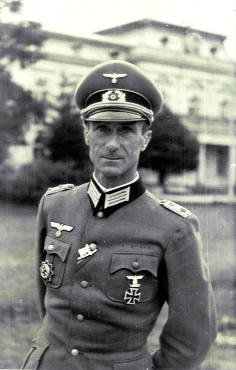
Generalleutnant Gerhard Kegler - Gutfelde 1944

Oberst Gerhard Kegler – Gutfelde 1944

Nur dem Untersuchungsrichter Freiherr von Dörnberg ist es zu verdanken, dass mein Vater überlebte. Er wurde zum Schützen degradiert und als einfacher Soldat wieder an die Ostfront geschickt, die sich bereits an der Oder befand. Dort, unweit von Frankfurt/Oder, wurde er verwundet und in einem langen und sehr beschwerlichen, immer wieder aus der Luft beschossenen Bahntransport nach Eutin in Schleswig-Holstein gebracht. Da hatte sich die ursprünglich kleine Wunde (ein Granatsplitter in der linken Schulter) derartig verschlechtert, dass der linke Arm abgenommen werden musste. Mein Vater blieb noch eine kurze Zeit der Rekonvaleszenz in Eutin und wurde dann aus englischer Gefangenschaft noch 1945 nach Gießen entlassen, wo unsere Familie im Jahre 1947 wieder zusammenfand.

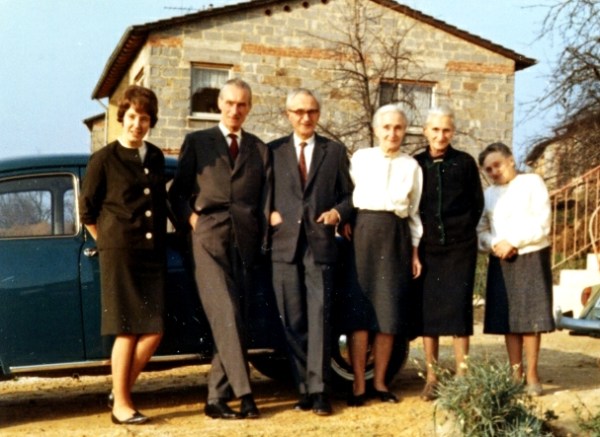
Gerhard Kegler between his Daughter Helga and Brother Günther 1964

Gerhard Kegler zwischen Tochter Helga und Bruder Günther Kegler; rechts folgen die beiden Schwestern von Gerhard, Erika Klopp und Maria Kegler, und Günter Keglers Frau Luci (1964)

Da die Bundesrepublik sich noch lange auf das von Himmler befohlene Urteil des Kriegsgerichts (Degradierung vom Generalmajor zum Schützen) berief und meinem Vater die ihm zustehende Pension verweigerte, bedurfte es erst einer großen Pressekampagne, um die Behörde zu bewegen, das Urteil aufzuheben, was schließlich durch den Bundespräsidenten geschah. Dann konnte mein Vater seine Pension erhalten.

Die große Pressekampagne zeitigte noch eine andere positive Folge. Freunde und Bekannte, die in den Wirren des Kriegsendes, durch Flucht, Ausbombung usw. überallhin verschlagen worden waren, wurden aufmerksam und nahmen Kontakt zu unseren Eltern auf. Ich erinnere mich an viele Besuche ehemaliger Freunde, Kameraden oder Untergebener meines Vaters. Und immer hörten wir großes Lob und große Anerkennung, wenn diese Menschen von den Ereignissen erzählten, die sie zusammen mit meinem Vater erlebt hatten.

Die tapfere und verantwortungsvolle Handlungsweise meines Vaters bei Landsberg ist nicht das einzige Ereignis dieser Art. Immer wieder wagte er, Vorgesetzte zu kritisieren, wenn sie unsinnige Befehle gaben. Dafür wurde er mitunter durch Versetzungen bestraft.

Umsichtiges Handeln in schwierigen Situationen berichtet auch schon die Regimentsgeschichte des Westpreußischen Infanterieregiments 149, dem mein Vater im Ersten Weltkrieg angehörte. Eine dieser Aktionen war die nächtliche Aushebung eines französischen Doppelpostens bei Reims in der Champagne, die dem Regiment wertvolle Informationen lieferte und, wie ausdrücklich betont wird, größere Verluste ersparte. Mein Vater hat uns auf einer Frankreichreise in den sechziger Jahren die Stelle gezeigt, wo er mit ein paar freiwilligen Leuten die Franzosen nachts überraschte, gefangen nahm und hinter die deutschen Linien brachte, wo man sie verhören konnte.

Soweit der militärische Teil im Leben meines Vaters. Aber das Leben ging ja nach dem überstandenen Krieg in Gießen weiter und gewährte meinen Eltern nach der ersten harten und entbehrungsreichen Zeit auch noch schöne Jahre.

Unsere Mutter hatte ebenfalls seit Kriegsbeginn Schweres durchgemacht. Aus München, wo das Leben durch die Luftangriffe immer unsicherer wurde, zog sie mit uns Kindern in den Warthegau. Von dort musste sie sich mit Jutta und mir wie Millionen anderer Menschen auf die wochenlange winterliche Flucht begeben. Wir fuhren zunächst in einem Planwagen mit polnischem Kutscher durch das winterliche Westpreußen, bis der Pole irgendwo in Pommern umkehrte. Ein Offizier nahm uns mit seinem Fahrzeugkonvoi bis nach Berlin mit, von dort ging es in überfüllten Zügen nach Dresden zu meiner Großmutter. Helga und Nati waren vorher schon nach Augustusburg (bei Chemnitz) gebracht worden. Bevor wir aber dort sein konnten, erlebten wir die drei verheerenden Bombenangriffe, an die ich mich lebhaft erinnere.

Im Sommer 1947 verließen wir die sowjetische Besatzungszone und gingen bei Philippstal an der Werra schwarz über die grüne Grenze, wobei uns die ortskundige Tante Lucie half. Unsere Familie fand nun in Gießen wieder zusammen. Wir wohnten zunächst in zwei Zimmern der Bergschenke, einem Hotel und Restaurant, das ursprünglich zum Kruppschen Bergbaubetrieb gehörte. Vater hatte in der Bergschenke eine vorläufige Bleibe gefunden und die Aufgabe eines Hausmeisters und Betreuers der dort wohnenden Studenten übernommen. Diese Studenten waren zumeist bereits Kriegsteilnehmer gewesen und studierten an der Universität Gießen Tiermedizin. Als Familie Stolcke, Onkel Werner, Tante Anni und ihre drei Kinder, nach Argentinien auswanderte, konnten wir aus der Bergschenke in die relativ komfortable „Baracke“ auf dem Bergschenkengelände umziehen, die sie bewohnt hatten.

Die Lebenssituation war in dieser Zeit zwischen Kriegsende und Währungsreform (1948) bekanntlich äußerst prekär. Als Vater uns in jenem Sommer 1947 in Gießen erwartete, sammelte er in einer ehemaligen Munitionskiste eine Menge von Lebensmitteln, die er sich vom Mund abgespart hatte, um seiner Familie einen guten Empfang zu bereiten. Das ist eine Tatsache, die ich selbst nicht bezeugen kann, Helga mir aber erzählte.

Besser wurde die Situation erst, als Vater die Stelle eines Stadtjugendpflegers der Stadt Gießen übernehmen konnte. In dieser Zeit, Anfang der fünfziger Jahre, erfolgte auch seine Rehabilitierung, wodurch sich unsere Lebenssituation entscheidend verbesserte.

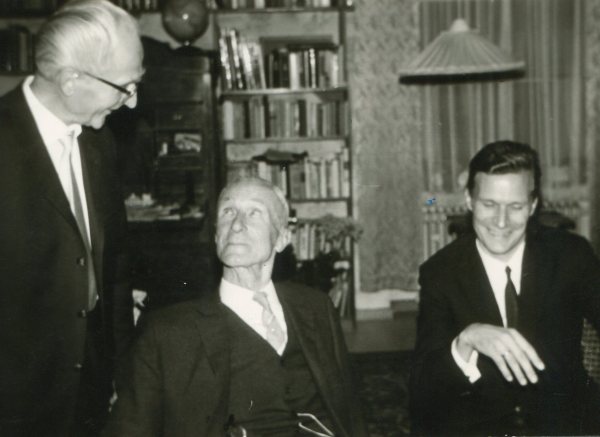
164_69

Gerhard Kegler zwischen Bruder Günther und Sohn Dietrich (1969)

Das Leben mit der Einarmigkeit verlangt sehr viel Geduld und Geschicklichkeit. Durch Geduld zeichnete sich unser Vater gewiss nicht aus, aber er war sehr geschickt bei allen Verrichtungen, wozu ein Mensch normalerweise beide Arme braucht. Und der Stolz über die relative Unabhängigkeit und Selbständigkeit, die Vater sich trotz der Einarmigkeit erworben hatte, kam zum Beispiel in einem Reim zum Ausdruck, den Helga und Nati zum 50. Geburtstag unseres Vaters in einem Gratulationsgedicht formulierten. Sie legten ihrem Vater folgende Worte in den Mund, die er sicherlich in „Prosa“ geäußert hatte: „Was ich mit einer Hand kann richten, macht Ihr mit zweien stets zunichten.“ Vater brauchte nur zu wenigen Handlungen im Alltag Hilfe, so etwa zum Schnüren der Schuhe. Aber Rasieren, Schlips binden, Schreibarbeiten usw. erledigte er ohne Hilfe, auch Autofahren in Fahrzeugen, die dafür nicht besonders präpariert waren. In den Wagen mit Schaltgetriebe, die er zuerst fuhr, musste er zum Schalten das Steuer loslassen. Er fuhr sicher, aber ich erinnere mich, dass mir als Mitfahrer immer etwas mulmig wurde, wenn er schaltete.

In der einsam am Waldrand gelegenen Baracke hatte der General natürlich auch an mögliche Einbrecher gedacht. Die Fenster waren sehr niedrig und stellten kein Hindernis für kriminelle Besucher dar. Vater hatte einen kurzen dicken Knüppel an seinem Bett und sagte mir, als wir uns einmal über die “militärische Lage“ der Baracke unterhielten, dass er hart zuschlagen würde, wenn ein Bursche es wagen sollte, einzusteigen.

Und als Held zeigte sich unser Vater später wieder einmal, als die Eltern in Leihgestern (Am Hasenpfad) wohnten. In einer Sommernacht schlief er allein in seinem Zimmer im ersten Stock. Die Balkontür stand offen, es war eine warme Nacht. Vater wird durch ein Geräusch geweckt und sieht von seinem Lager aus, wie sich ein Einbrecher, der über den Balkon in das Zimmer gekommen war, am Kleiderständer an der Jackentasche des schlafenden Generals zu schaffen macht und sie untersucht. Vater erkennt sie Situation sofort und brüllt ihn noch im Bett liegend an, worauf der Dieb sofort das Weite sucht. Die Reaktion unseres Vaters ist erstaunlich und bewundernswert, denn aus dem Schlaf direkt zum Angriff überzugehen, erfordert Mut, und in schlaftrunkenem Zustand ist man normalerweise moralisch nicht gerade stark.

Die Krankheit, die ihn dann im Jahre 1986 auf das Krankenbett warf, hat er tapfer ertragen. In dieser Zeit war auch unsere Mutter kränklich und pflegebedürftig. Unsere Eltern waren nun auf Hilfe angewiesen, die ihnen vor allem Helga treu und fürsorglich zukommen ließ. Mittlerweile lebten sie in einem kleinen Haus am Alten Friedhof in Gießen.

Der ältere Bruder meines Vaters, Onkel Günter, mein Patenonkel, war schon im Januar desselben Jahres verstorben, und Vater hat ihn noch bis zum Juli 1986 überlebt. Vaters langjähriger Freund, Horst Schubring, ebenfalls Hinterpommer, den er in den ersten schweren Gießener Jahren zufällig kennengelernt hatte – damals Gemeindepfarrer in Wieseck, dann Propst von Oberhessen – begleitete unseren Vater auf dem letzten Gang. Sein Grab, das einige Jahre später auch unsere Mutter und in jüngster Zeit unsere Schwester Renate aufnahm, liegt auf dem Neuen Friedhof in Gießen.

Ein tapferer Mann, dessen Leben im Pfarrhaus von Hinterpommern begonnen hatte, der in den Kadettencorps von Plön und Berlin seine Erziehung zum Offizier erhalten und zwei Kriege und große Belastungen durchlitten hatte und der nach allen Katastrophen noch viele friedliche und gute Jahre erleben durfte, war an sein Ende gekommen.


Dormagen (Gohr) im September 2016

  Dietrich Kegler


Chapter 22 of the Peter and Gertrud Klopp Story – Part VIII

Exploring the Moselle Valley with my Brother Adolf

x294

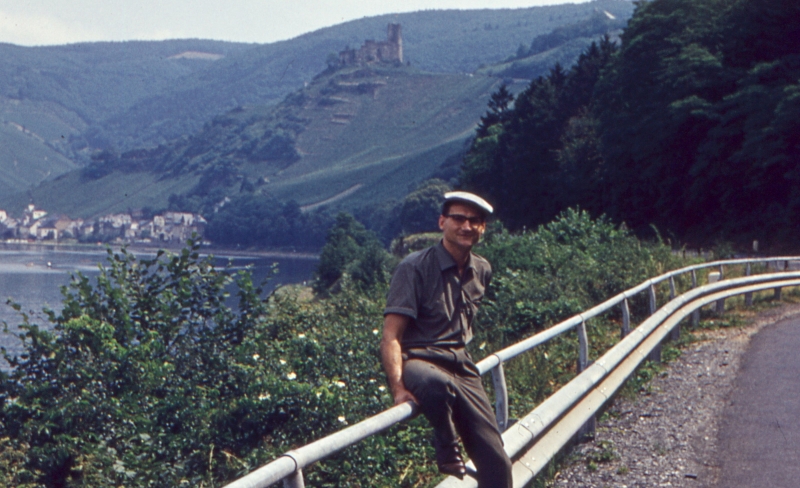
Moselle River – Summer 1964

My brother Adolf was in the final year of his apprenticeship program at the Honeywell Company in Hanau. This city north of Frankfurt was not far from Koblenz. When the weather was fine, Adolf would make it a weekend practice to pick me up at the gates of the Falckenstein barracks. From there we went on trips in his venerable old VW beetle to explore together the beautiful Lahn and Moselle valleys. The summer of 1964 brought an exceptionally long period of sunshine quite unusual for this western part of Germany, when cloudy skies and rain often drove sun-seeking German tourists south to the Mediterranean beaches of Italy and Spain. On one of these fabulous weekends Adolf suggested a wine sampling tour all the way up the River Moselle to Trier, the ancient location of the imperial summer residence of the Roman emperors.

x303

Peter Relaxing in the Famous Wine Region of Germany

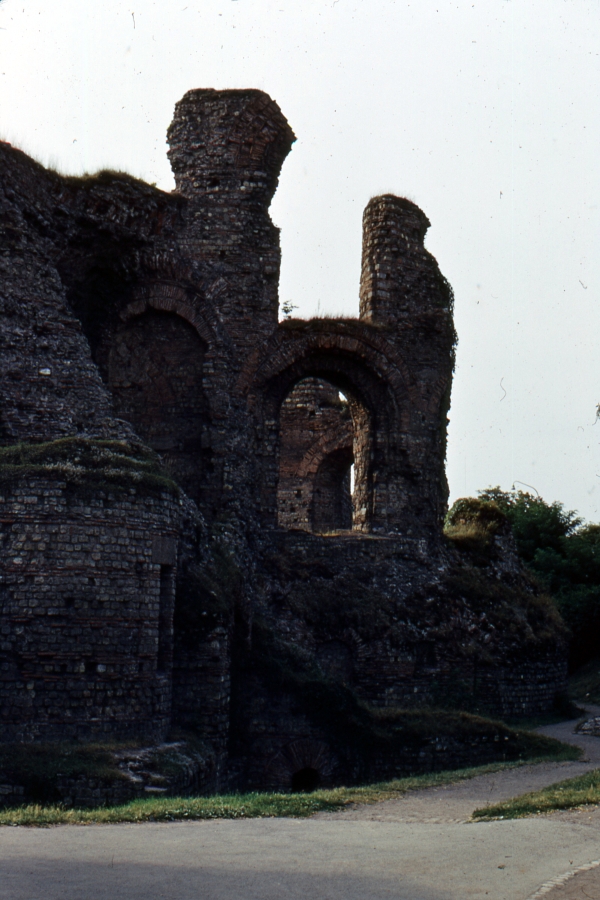
Having finally moved by two rendezvous with Biene at Lake Baldeney beyond a mere fantasy world to a more solid relationship, I felt carefree and cheerful. I readily agreed to Adolf’s proposal, and off we rolled into a westerly direction. Small towns and quaint villages, medieval castles on hill tops, the meandering river, the hills covered with the light green carpets of vineyards offered a magnificent view. At the town centers often located near the local fountain, vintners with samples from last year’s vintage were catering to the traveling tourists in the hope of selling their fine bottled wine. The labels on the bottles were just as alluring as they were their precious content. Some had grotesque, unusual, even titillating names, such as Zeller’s Black Cat, Bare Bottom, Dear Woman’s Milk, just to name a few. Adolf and I took full advantage of the incredibly inexpensive samples of the finest wines in the country. In high spirits we drove on to the next ‘watering hole’, sampled another exquisite wine, and kept on going from town to town, from sampling station to sampling station, like bees flitting from flower to flower savoring the delicious nectar. We happy-go-lucky brothers were singing, joking and drinking all the way to Trier, where Adolf feeling generous invited me to have dinner in a cozy restaurant not far from the historic Porta Nigra and the famous ruins of the Roman thermal baths.

x301

The Imperial Baths of Trier

It felt good to enter the cool premises of an inn after such a long ride through the sweltering summer heat. After a hearty meal we lingered over a cool refreshing beer while waiting for the heat in the valley to come down to a more tolerable level. Air conditioning in a VW was virtually nonexistent in those days.

x298

My Brother Adolf at the Thermal Baths at Trier

There I sat, a bit sleepy and drowsy from the wine and beer, listening half-heartedly to Adolf’s tirades against the American imperialists, the war in Vietnam, the killing of innocent women and children perpetrated by the American ice cream soldiers as he contemptuously called the GI’s, the exploitation of the working people, the advantages of socialism for the common people and the evils of capitalism. When Adolf was talking politics, a passionate fervor seized his entire being; his words poured out as if he had experienced all these real and imagined injustices himself. When the verbose eruption of truths, half- truths and lies had finally subsided with no notable effect on me, the apolitical person that I was at the time, Adolf returned to his congenial and humorous self again, ordered another beer for us from the pretty and courteous waitress and described her benevolently as a ‘nice kid’. Now it was time to introduce me to the kind of vocabulary that would definitely not be very useful for my later academic career. The stock of swearwords coming from the oil patch environment was quite impressive.

x304

Peter on a Sightseeing Tour with his brother Adolf

When he changed topics and began to talk with extravagant enthusiasm about Canada, I was all ears, even though he described a totally different country from the one I had learned from books. Adolf’s opening line for almost anything that had to do with Canada was, “Peter, with us in Canada things are like this.”

x293

Adolf taking a Roadside Break at the River Moselle

Before coming to Germany for a three-year stay, he had worked in the oil fields at Swan Hills in northern Alberta, where work was hard and money was plentiful. He loved to tell me stories of the rough-and-tumble of camp life. At payday many workers would rush to Edmonton, the capital city of Alberta, to spend their hard earned money on booze, women, and cars. Adolf having a good grip over his finances was not entirely immune to the lure of owning a shiny new car. In a sudden wave of nostalgia for the good old days at camp he described how he had once walked into a car dealer’s showroom and pointed at the latest model of an eight cylinder muscle car that he wanted to purchase on the spot. When the delighted salesman asked him how he intended to pay for it, Adolf’s moment of glory had come, which he now revived by telling the story to his kid brother.

“Why,” Adolf answered, “in cash, of course!” And with these words he pulled out a bundle of hundred dollar bills and counted out the full amount of the purchase price on the counter of the astonished salesman. Adolf never failed to make critical remarks about the painfully slow German bureaucracy that he had to put up with, when he bought his VW beetle in Germany.

“Peter, with us in Canada things are like this,” he used his opening pet phrase again. “With all the paper work done and the registration and insurance papers signed I drove that beauty of a car out of the dealer’s parking lot within less than an hour.” Having learned how things were done in Canada, I remarked that it was time to return to my barracks. The evening sun flooded the eastern mountains in a sea of gold. When Adolf and I arrived in Koblenz, the sun began to set and only the pinnacles of the volcanic Eifel Mountains were still reflecting the last rays of the day.